Amazon Bedrock Managed Knowledge Base Goes GA — Agentic Retriever Ends DIY RAG Pipelines
By Vatsal Shah · June 18, 2026 · Cloud · Source: AWS What's New
AI SUMMARY
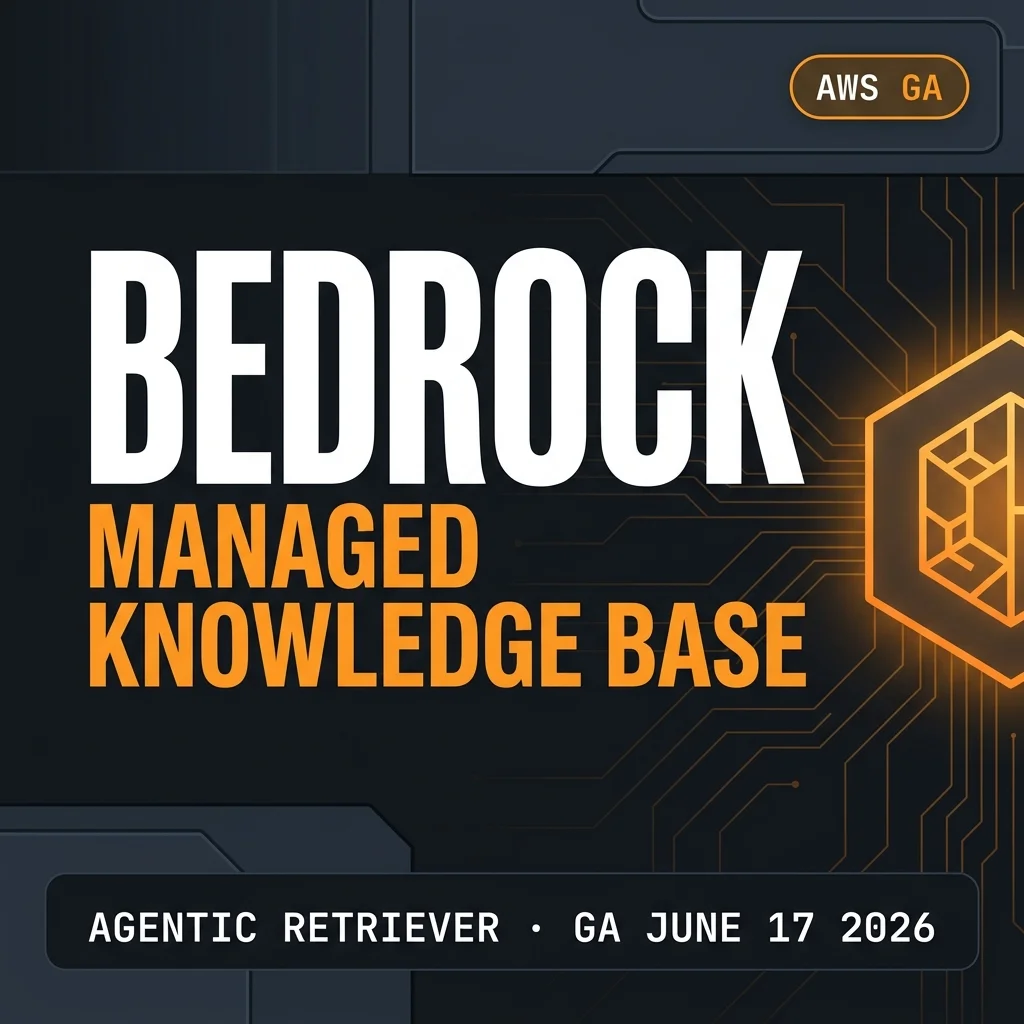
- Amazon Bedrock Managed Knowledge Base reached General Availability on June 17, 2026 across US East, US West, EU, APAC, and GovCloud regions.
- The Agentic Retriever — a new multiturn, multihop retrieval engine — is the central addition: it decomposes complex queries into sub-questions and issues sequential retrieval hops to build context-rich, synthesized answers.
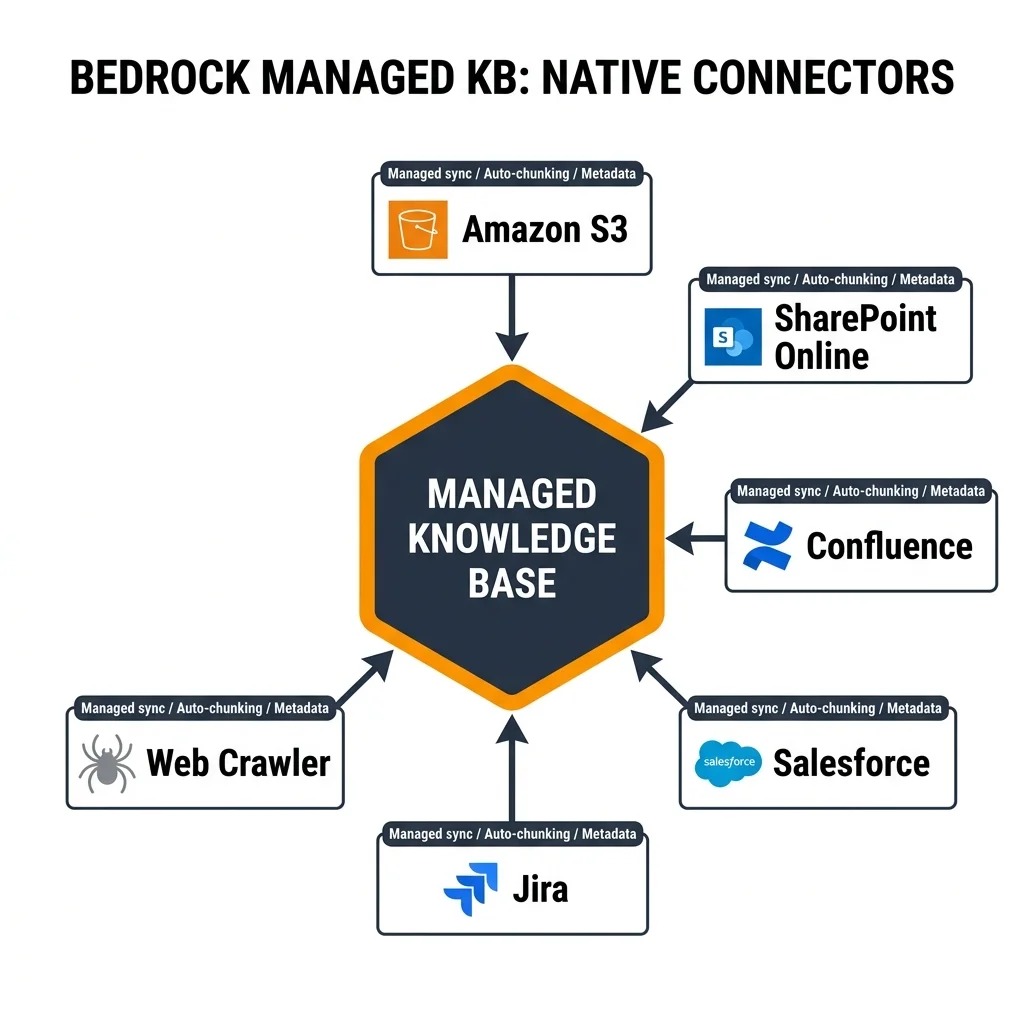
- Six native connectors (Amazon S3, SharePoint Online, Confluence, Salesforce, Jira, Web Crawler) handle automated ingestion, chunking, embedding, and sync — eliminating the DIY ETL layer that most enterprise RAG teams build and maintain manually.
- Managed vector storage removes the need to provision, scale, or back up a separate vector database for knowledge base workloads.
- Announced during AWS Summit New York 2026, this GA is AWS's clearest signal yet that enterprise RAG is a cloud primitive — not a framework problem.
What Happened
Amazon Web Services made Bedrock Managed Knowledge Base and its Agentic Retriever generally available on June 17, 2026, announced as a headline release during AWS Summit New York 2026.
The core offering: a fully managed Retrieval-Augmented Generation (RAG) system built directly into the Amazon Bedrock platform. Teams no longer need to stand up and operate their own vector databases, write custom document ingestion pipelines, or maintain chunking and embedding logic — Bedrock handles all of it.
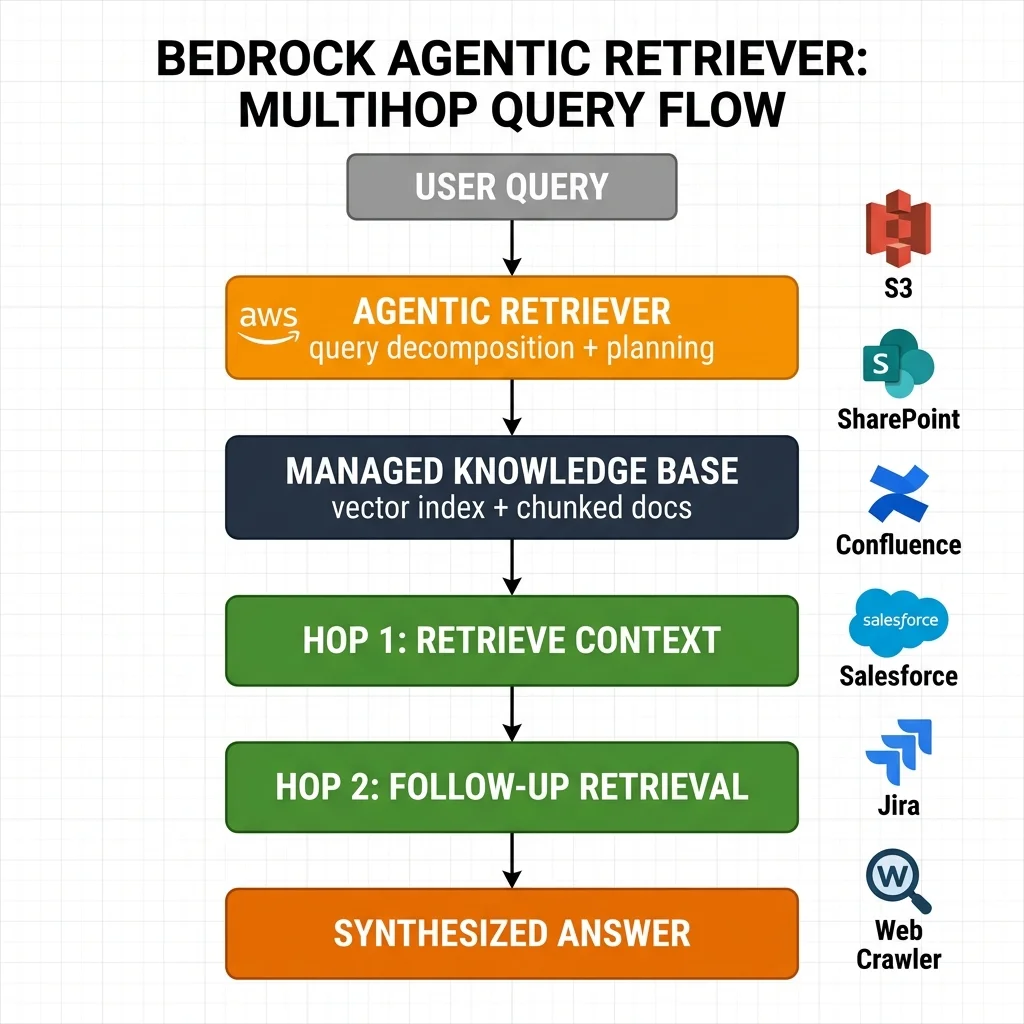
The centerpiece feature is the Agentic Retriever: a multi-step, multihop retrieval engine that goes beyond classic single-pass vector search. When a user asks a complex question — "What were the key decisions in the Q1 2026 product review meeting, and how do they align with the roadmap from last year's strategy document?" — the Agentic Retriever:
- Decomposes the query into sub-questions
- Issues sequential retrieval hops against the knowledge base
- Uses each hop's results to inform the next query
- Synthesizes a final answer from the accumulated context
This is categorically different from a one-shot similarity_search() call against a Pinecone or pgvector index.
What's included at GA:
- Six native connectors: Amazon S3, SharePoint Online (Microsoft 365), Confluence, Salesforce, Jira, and a managed Web Crawler. Each connector handles scheduling, incremental sync, metadata extraction, chunking, and embedding — without custom ETL code.
- Managed vector storage: AWS handles provisioning, scaling, backup, and the embedding model lifecycle. No separate vector database to operate.
- Bedrock AgentCore integration: The knowledge base connects natively to Bedrock AgentCore, the agent runtime layer announced at re:Invent 2025. Agents built on AgentCore can issue Agentic Retriever calls as first-class tool invocations.
- Multiturn memory: The retrieval context is maintained across conversation turns, enabling follow-up questions without re-ingesting the full context window.
- Regional availability: US East (N. Virginia), US West (Oregon), EU (Ireland, Frankfurt), APAC (Tokyo, Sydney), and AWS GovCloud (US-East).
Why It Matters
The DIY RAG Tax Is Real
Every enterprise RAG team I've worked with in 2025–2026 has the same origin story: they spent 4–10 weeks building and hardening a custom pipeline — LangChain document loaders, a chunking strategy, an embedding service, a vector database cluster (Pinecone, Weaviate, or pgvector on RDS), and a retrieval layer with hybrid search. Then they spent another 4–6 weeks debugging it in production — stale embeddings after document updates, connector failures, chunk size tuning, and embedding model version drift.
That infrastructure is now a managed service. For teams already on AWS, this is the clearest path to eliminating the operational burden of enterprise RAG.
Multihop Is the Missing Piece for Enterprise Queries
The single biggest limitation of classic RAG in enterprise deployments isn't embedding quality — it's that real enterprise questions require multi-document synthesis that a single retrieval call can't satisfy. A question about a customer's contract terms, their account history, and the relevant product documentation requires at minimum three separate retrieval passes, each informed by the previous result.
The Agentic Retriever addresses this directly. Its multihop architecture mirrors what teams were previously building manually with LangChain's MultiQueryRetriever or custom agent loops — but as a managed, latency-optimized primitive.
The AgentCore Integration Signal
The tight coupling between Bedrock Managed Knowledge Base and AgentCore tells you where AWS is going with its agent platform: knowledge retrieval as a native tool in the agent execution loop, not a side-service to call via custom HTTP. This reduces the architecture complexity of Bedrock-native agents significantly — one API surface instead of three (LLM + vector DB + retrieval orchestration).
What Teams Lose by Self-Managing
Teams on non-AWS stacks (Azure OpenAI + AI Search, Google Vertex AI Search, or self-managed pgvector + LangChain) retain full control over chunking strategy, embedding model selection, and retrieval tuning. Bedrock Managed KB makes those trade-offs for you. For most enterprise use cases where the priority is operational simplicity, that's a good trade. For teams with highly specialized retrieval requirements (domain-specific embedding models, bespoke chunking, custom hybrid search weights), the managed approach may hit ceilings that require escalation to the underlying primitives anyway.
The connector coverage also has a notable gap at GA: Google Drive, ServiceNow, and Zendesk are not in the six native connectors. Teams whose primary knowledge source is one of these three will need a custom S3-based pipeline as an intermediate layer.
What to Watch Next
- AgentCore action groups GA: AWS is expected to GA AgentCore action groups (the tool-calling layer for Bedrock agents) within Q3 2026. The combination of Managed KB for retrieval + action groups for tool execution forms a complete Bedrock-native agent stack. Watch the AWS re:Invent 2026 preview cycle.
- Connector expansion: The six GA connectors will grow. Google Drive and ServiceNow are the two highest-demand additions based on the pre-GA preview feedback. Expect announcements in the July–September 2026 update cycle.
- Embedding model flexibility: GA ships with Amazon Titan Embeddings V3 and Cohere Embed v4 as the managed embedding options. Fine-tuned or domain-specific embedding models (via Bedrock Custom Models) are on the roadmap for Q4 2026.
- Pricing at scale: Managed KB pricing combines per-document ingestion, per-query retrieval, and managed vector storage fees. At high document volumes (>10M chunks), the cost structure vs self-managed pgvector or OpenSearch Serverless needs a detailed TCO analysis before committing.
Source
AWS What's New — Amazon Bedrock Managed Knowledge Base GA (Jun 17, 2026)
Additional coverage: AWS News Blog · AWS Summit NY 2026 Recap
Related on shahvatsal.com:
- GraphRAG in Production: Beyond Simple Vector Search
- Model Context Protocol v1.0: The Agentic AI Foundation
- pgvector at Scale: Lessons from Production RAG Pipelines