Microsoft Cuts OpenAI and Anthropic Spend, Shifting Copilot Workloads to In-House MAI Models
By Vatsal Shah · July 7, 2026 · AI Models · Source: Microsoft Investor Relations
AI SUMMARY
- Microsoft has initiated a cost-cutting campaign to reduce its reliance and API spend on external AI providers, specifically OpenAI and Anthropic.
- Under the direction of Microsoft AI CEO Mustafa Suleyman, the company is quietly routing tens of thousands of daily Copilot prompts in Excel and Outlook to its proprietary MAI (Microsoft AI) models.
- The shift utilizes the newly unveiled MAI model family, which includes MAI-Thinking-1 (reasoning) and MAI-Code-1-Flash (coding / Copilot integrations).
- This strategy, known as MAI verticalization, matches specific workloads to cheaper, domain-specialized in-house models rather than utilizing expensive, general-purpose frontier models.
- The pivot follows a renegotiation that granted Microsoft greater freedom to build and deploy competitive model architectures.
What Happened
Microsoft has begun aggressively reducing its API spend with external partners OpenAI and Anthropic. The software giant is shifting standard productivity queries away from frontier models toward its own internally developed MAI (Microsoft AI) model family.
Under Microsoft AI CEO Mustafa Suleyman, the company has started routing tens of thousands of weekly Copilot prompts in Excel and Outlook to its proprietary MAI models. While OpenAI's GPT-4 and GPT-5 class models still handle complex reasoning prompts, Microsoft is matching basic summaries, data formatting, and draft generations to its in-house options.
The migration is powered by the MAI model family, a suite of seven specialized models announced in early summer. These include MAI-Thinking-1 (reasoning), MAI-Code-1-Flash (coding), and custom media models. By running these models on Azure’s optimized hardware, Microsoft is closing the gap between performance and infrastructure cost.
The MAI Routing Architecture
Microsoft's strategy relies on a dynamic routing layer. Instead of sending every request to the most expensive frontier model, the platform routes prompts based on task complexity.
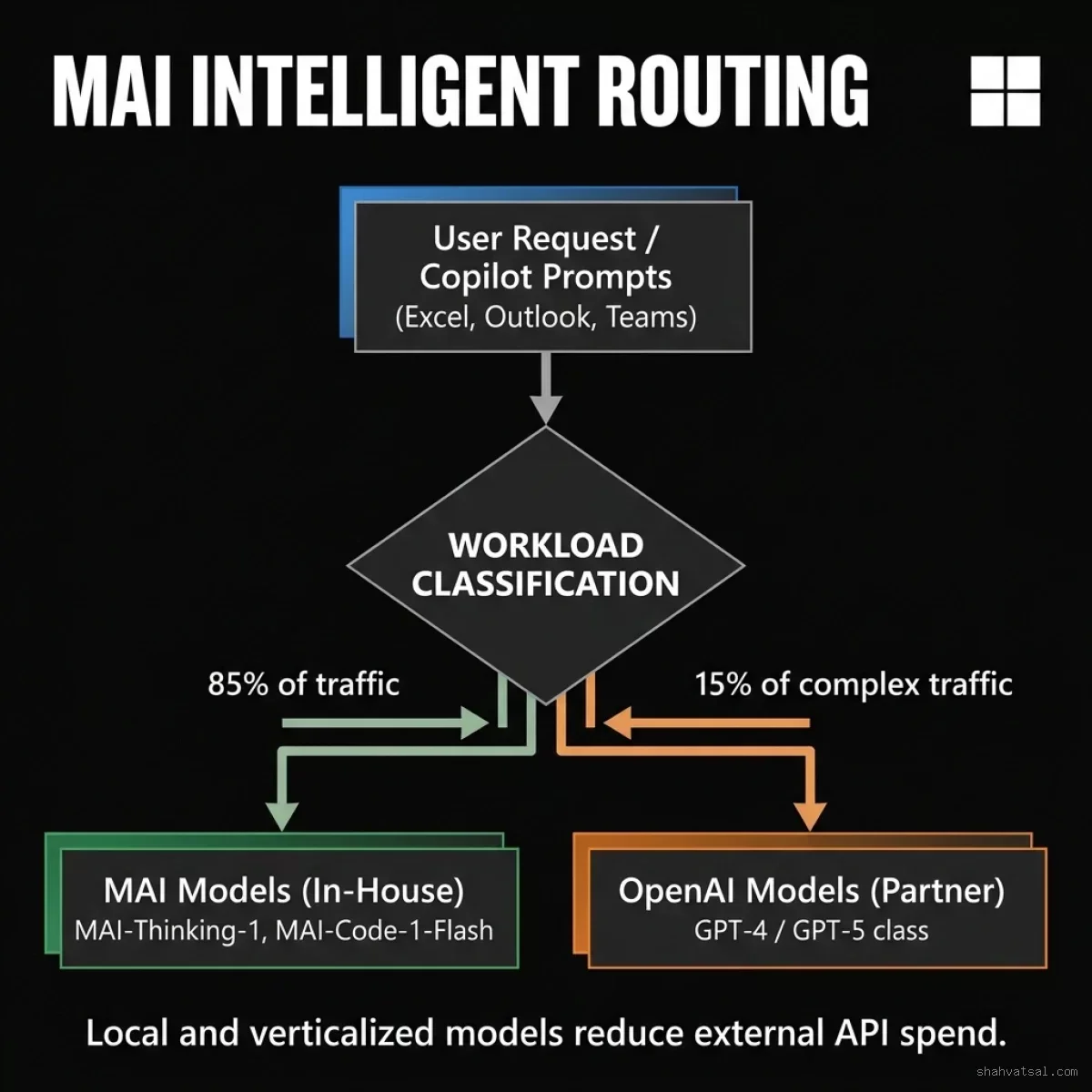
This routing architecture helps Microsoft manage:
- Cost Scaling: Routine operations (e.g. "format this table as currency" or "draft a brief reply") are handled by smaller models at a fraction of the cost.
- Latency Control: Smaller, verticalized models like MAI-Code-1-Flash return responses with lower time-to-first-token.
- Independence: Building custom, domain-specific models allows Microsoft to negotiate and control its product development path without being blocked by partner schedules.
Why It Matters
Infrastructure Cost Pressures
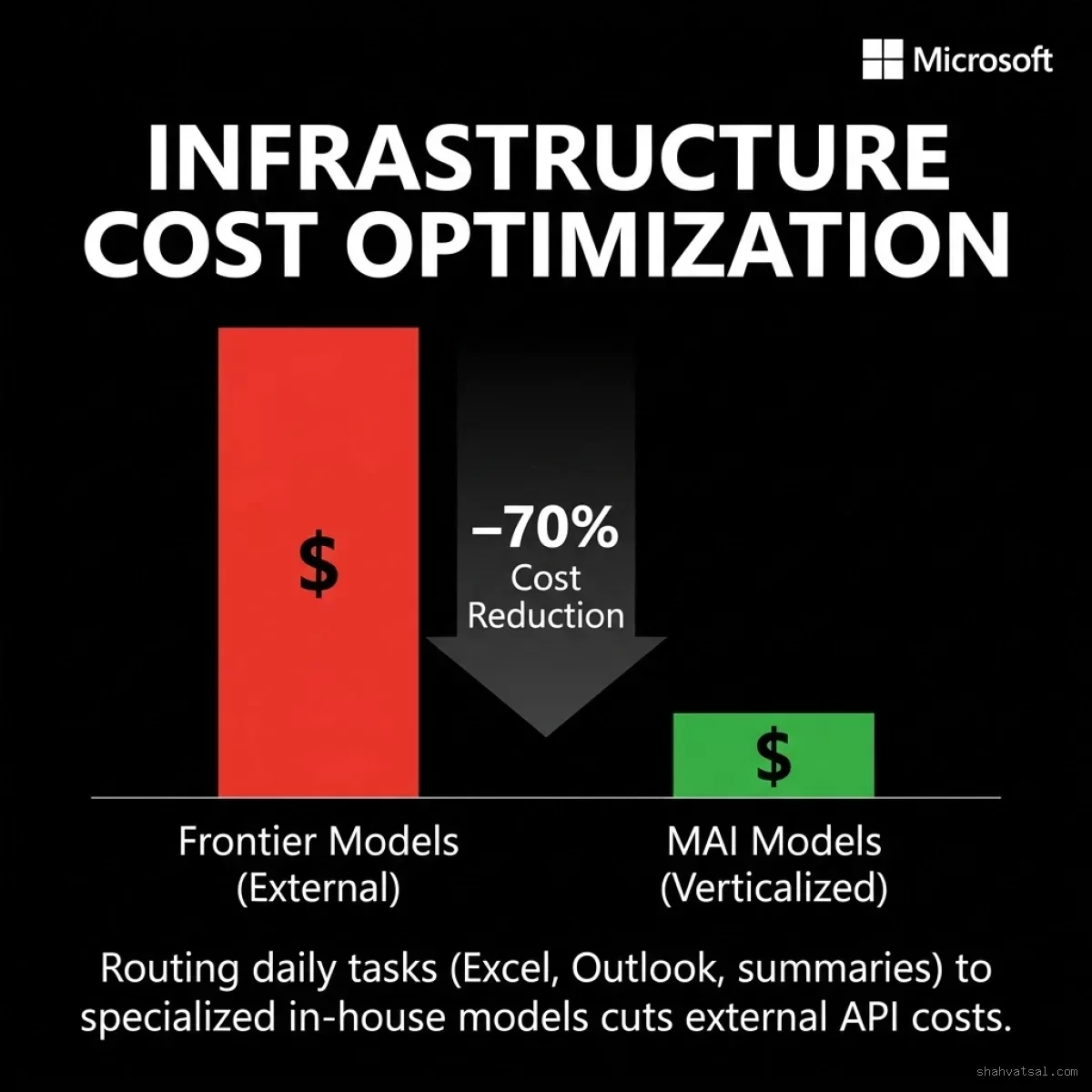
AI inference costs remain a challenge for enterprise software vendors. Providing un-routed access to frontier models under flat-rate subscription pricing (like Copilot's $30/month fee) leads to margin pressure. Shifting workloads to smaller in-house models optimizes that balance.
We have detailed similar enterprise strategies in our playbook on LLM Inference Cost Optimization Framework.
Evolving Partnerships
This transition highlights a shift in Microsoft's partnership with OpenAI. While Microsoft remains OpenAI's primary cloud provider and investor, it is also actively building a competing product portfolio. Shifting traffic to MAI models allows Microsoft to build its own technical capabilities, aligning with strategies explored in the Post-Managerial Era of Autonomous Agents.
What to Watch Next
- Deactivation of External API Endpoints: Watch for whether Microsoft begins disabling OpenAI fallbacks for standard tier M365 Copilot subscribers.
- GitHub Copilot Integration: Expect MAI-Code-1-Flash to take on a larger share of autocomplete and chat workloads within VS Code and Visual Studio.
- Azure Custom Silicon: Shifting software workloads to MAI models aligns with the rollout of Cobalt CPU and Maia GPU clusters in Azure datacenters.
Source
Microsoft Investor Relations — Strategic Updates (July 2026)
Related on shahvatsal.com:
- LLM Inference Cost Optimization Framework
- The Post-Managerial Era — Leading Autonomous Agents
- OpenAI ChatGPT Work + GPT-5.6 GA
- Multi-Agent Orchestration in 2026 — Architecture Patterns