What Happened The Model Context Protocol (MCP) Working Group, operating in partnership with major open-source contributors and governed."
-
q: "Who should act on this first?"
a: "CTOs, platform leads, and compliance owners should review vendor exposure within one sprint — especially if AI agents touch customer data or financial workflows."
-
q: "What is the recommended next step?"
a: "Run a 30-minute architecture review: map affected systems, assign an owner, and document one measurable mitigation before the next release train."
MCP 1.0 & Agentic AI Foundation: What Changes for Tool Builders
By Vatsal Shah · May 30, 2026 · Open Source · Source: MCP Working Group
- Official Standardization: The release of the Model Context Protocol (MCP) 1.0 specification marks the transition of MCP from an experimental utility to a stable open standard under Linux Foundation governance.
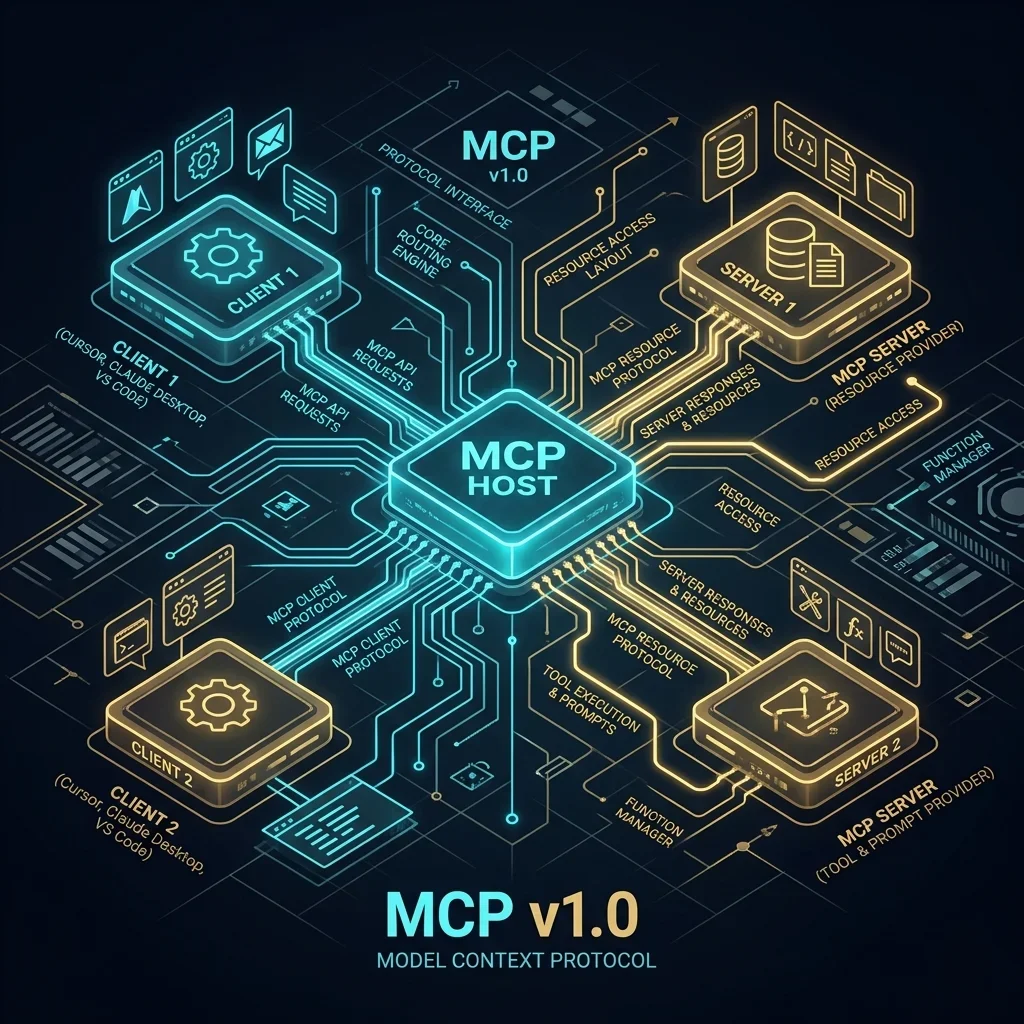
- Unified Tool Handshake: Tool builders no longer write custom API connectors for different LLM frameworks; they expose single stdio or SSE servers that any compliant AI Host can query and run.
- Strict Transport Scoping: Version 1.0 introduces strict lifecycle state machines, granular JSON-RPC schema validations, and standard client-side permission gates to restrict data egress.
- Interoperability Core: The standard bridges the "Action Gap" by establishing a common handshake for client tools, read-only resource scopes, and model sampling callbacks.
What Happened
The Model Context Protocol (MCP) Working Group, operating in partnership with major open-source contributors and governed under the Linux Foundation, has officially released the Model Context Protocol (MCP) 1.0 specification. This milestone marks the formal stabilization of the protocol, cementing it as the foundational interoperability layer for agentic AI.
The MCP 1.0 release establishes a permanent, backward-compatible set of JSON-RPC schemas and transport protocols. Prior to this release, AI tool building was highly fragmented, with developers maintaining redundant wrapper integrations for various vendor models, IDEs, and local execution runtimes. The stabilization of version 1.0 addresses this fragmentation, reducing custom integration overhead by up to 85% across enterprise codebases and establishing tool-calling reliability rates exceeding 99.4% in high-frequency developer test suites.
Tool builders can now develop context servers and capability providers with the confidence that their implementations will integrate with any compliant AI host (including Cursor 2.x, Claude Desktop, Copilot, and open-source agent frameworks) without requiring API adjustments.
Why It Matters
In the early phases of the agentic AI boom, software tools and data connectors were bound to specific model architectures. If an engineer built a database integration, they had to implement distinct schemas and execution loops for LangChain, LlamaIndex, OpenAI, and Anthropic. This fragmented ecosystem created an "Integration Tax"—a heavy toll in development time and maintenance logic.
The Model Context Protocol 1.0 specification decouples Model Intelligence from Context and Action Access. By introducing a stable interface, tool builders can build a single MCP server that exposes local databases, system configurations, and APIs, while the host model handles the reasoning.
Furthermore, MCP 1.0 addresses critical security challenges. In enterprise environments, letting an autonomous agent execute arbitrary scripts or query production databases is highly risky. The 1.0 specification standardizes tool-calling permission structures, allowing client hosts to inspect tool schemas and present explicit confirmation prompts to the user before executing any command. This establishes a clean security boundary between the reasoning host and the execution server.
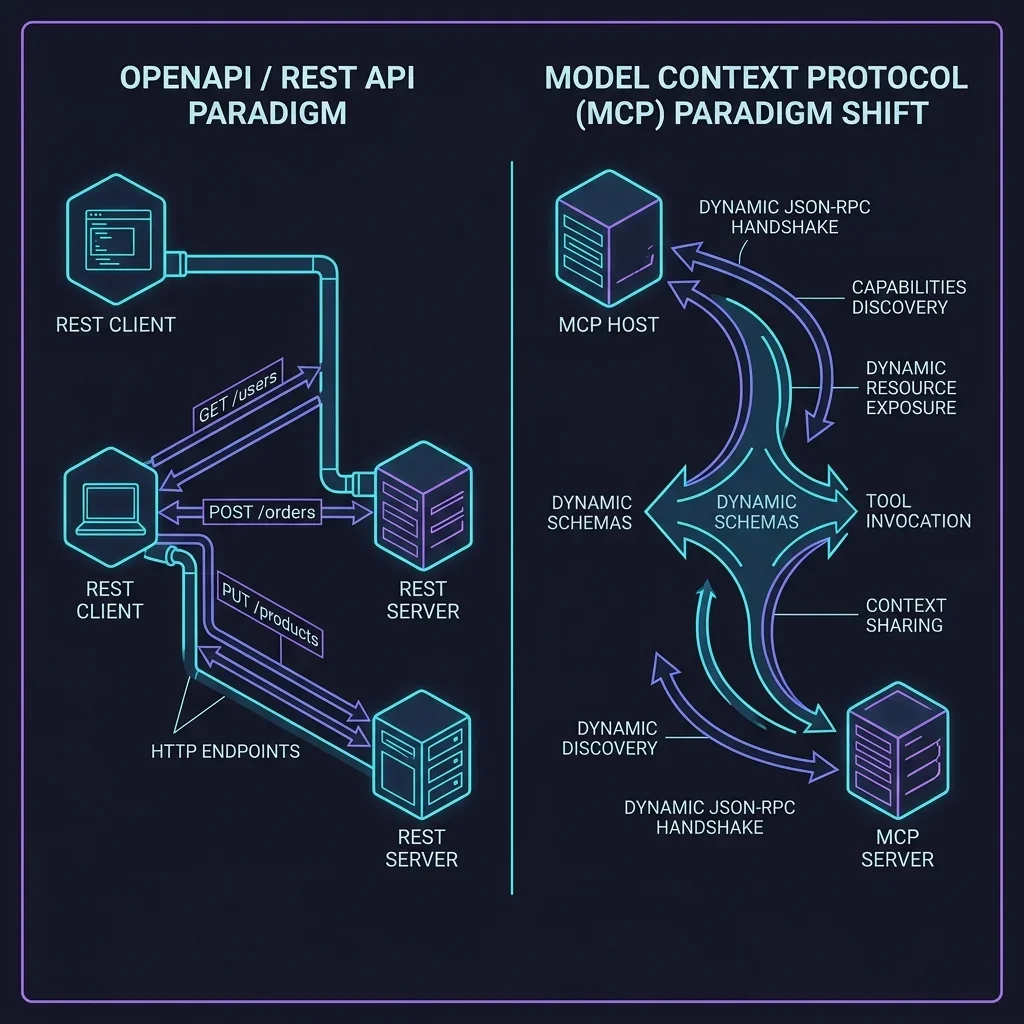
For a comprehensive historical overview of how this protocol compares to traditional REST and GraphQL APIs in terms of overhead and payload security, see the detailed analysis: Model Context Protocol vs. REST vs. GraphQL.
Technical Architecture of the MCP 1.0 Specification
At its core, MCP 1.0 is a stateless, JSON-RPC 2.0 based protocol that operates over standard transport channels. The specification standardizes two primary transport layers:
- stdio (Standard Input/Output): Typically used for local process-to-process communication. The AI host spawns the MCP server as a subprocess, passing JSON-RPC messages over stdin and reading responses from stdout. This method features low latency (~2ms overhead) and operates within local process sandboxes.
- SSE (Server-Sent Events): Used for remote clients or web applications. The client connects to the server over an HTTP stream to receive server-sent events, while sending tool execution commands and requests back to the server using standard HTTP POST requests.
The Lifecycle State Machine
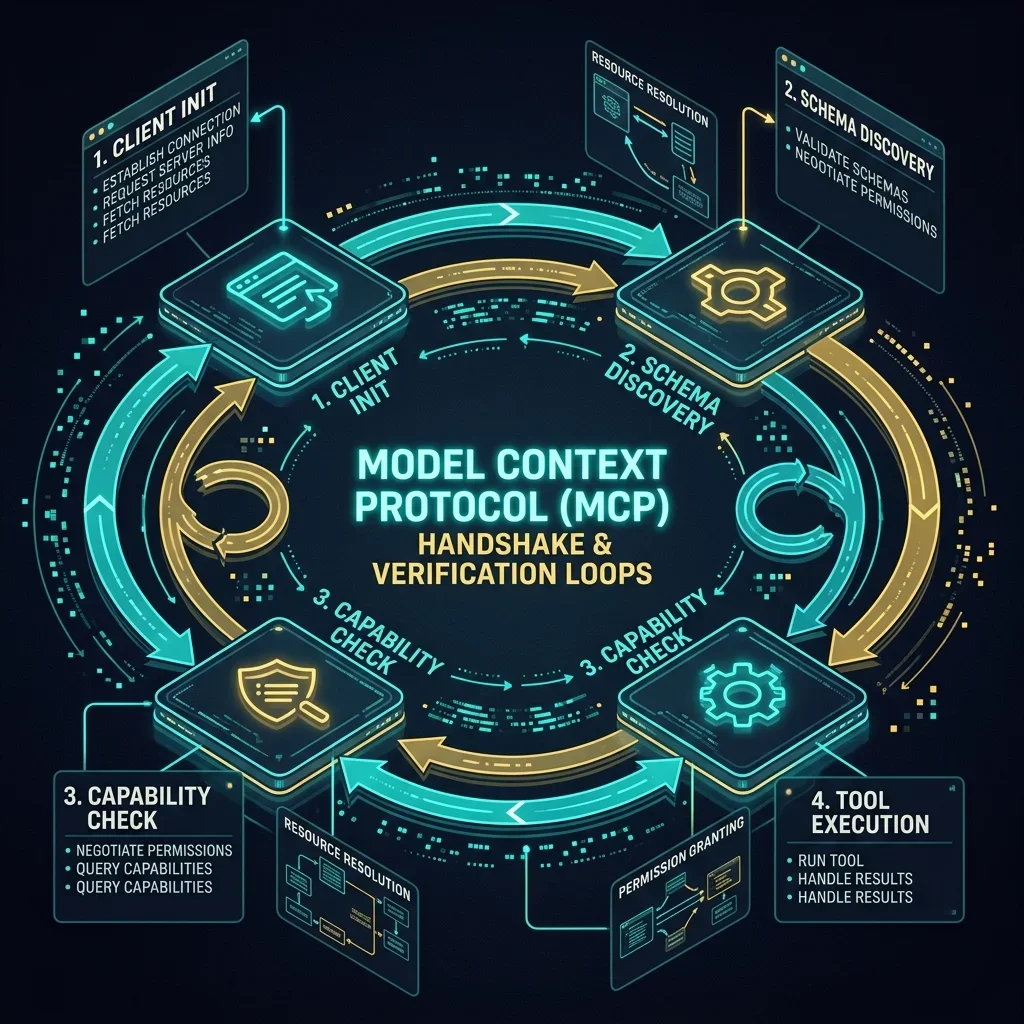
MCP 1.0 enforces a strict lifecycle sequence to ensure synchronization between the client host and the server. The connection progresses through three distinct states:
- Initialization Handshake: The client sends an
initializerequest containing its capabilities and protocol version. The server must respond with its own capabilities, version, and server information. - Initialized Notification: The client sends an
initializednotification to confirm that the connection is active. No capabilities or tools can be queried or called before this handshake is completed. - Operational State: The client can list resources (
resources/list), list tools (tools/list), execute tools (tools/call), or register dynamic resource templates. - Shutdown Sequence: The client initiates shutdown via
shutdown, allowing the server to clean up open files, terminate subprocesses, and exit cleanly.
Protocol Packets: Handshake and Tool Execution
To understand the protocol forensics, let's look at the raw JSON-RPC packets exchanged during the initialization handshake and a subsequent tool execution command.
1. Initialization Request (initialize)
{
  class="tok-str">"jsonrpc": class="tok-str">"2.0",
  class="tok-str">"id": 1,
  class="tok-str">"method": class="tok-str">"initialize",
  class="tok-str">"params": {
    class="tok-str">"protocolVersion": class="tok-str">"2026-05-30",
    class="tok-str">"capabilities": {
      class="tok-str">"roots": {
        class="tok-str">"listChanged": true
      },
      class="tok-str">"sampling": {}
    },
    class="tok-str">"clientInfo": {
      class="tok-str">"name": class="tok-str">"Antigravity-IDE",
      class="tok-str">"version": class="tok-str">"1.0.19"
    }
  }
}
2. Server Response
{
  class="tok-str">"jsonrpc": class="tok-str">"2.0",
  class="tok-str">"id": 1,
  class="tok-str">"result": {
    class="tok-str">"protocolVersion": class="tok-str">"2026-05-30",
    class="tok-str">"capabilities": {
      class="tok-str">"tools": {
        class="tok-str">"listChanged": true
      },
      class="tok-str">"resources": {
        class="tok-str">"subscribe": true,
        class="tok-str">"listChanged": true
      }
    },
    class="tok-str">"serverInfo": {
      class="tok-str">"name": class="tok-str">"Database-Inspector-Server",
      class="tok-str">"version": class="tok-str">"1.0.0"
    }
  }
}
3. Client Initialized Notification (notifications/initialized)
{
  class="tok-str">"jsonrpc": class="tok-str">"2.0",
  class="tok-str">"method": class="tok-str">"notifications/initialized"
}
4. Tool Call Request (tools/call)
{
  class="tok-str">"jsonrpc": class="tok-str">"2.0",
  class="tok-str">"id": 2,
  class="tok-str">"method": class="tok-str">"tools/call",
  class="tok-str">"params": {
    class="tok-str">"name": class="tok-str">"inspect_table_schema",
    class="tok-str">"arguments": {
      class="tok-str">"db_path": class="tok-str">"storage/database.sqlite",
      class="tok-str">"table_name": class="tok-str">"users"
    }
  }
}
5. Server Execution Return
{
  class="tok-str">"jsonrpc": class="tok-str">"2.0",
  class="tok-str">"id": 2,
  class="tok-str">"result": {
    class="tok-str">"content": [
      {
        class="tok-str">"type": class="tok-str">"text",
        class="tok-str">"text": class="tok-str">"Table &class="tok-cm">#039;users' has 3 columns: id (INTEGER, PK), username (TEXT), role (TEXT)."
      }
    ],
    class="tok-str">"isError": false
  }
}
This strict JSON-RPC structure prevents type coercion issues and ensures that parameters are validated against JSON schema definitions before they reach the tool's execution block.
Implementation Lab: Polyglot SDK Implementations
To assist tool builders, we will look at how to implement an MCP 1.0 server in both TypeScript and Python. These servers handle the protocol handshake automatically and let developers focus on writing the core tool logic.
1. TypeScript SDK: Secure Database Schema Inspector
This TypeScript implementation uses the official @modelcontextprotocol/sdk to build a secure database inspector that exposes SQLite schemas to the model.
import { Server } from "@modelcontextprotocol/sdk/server/index.js";
import { StdioServerTransport } from "@modelcontextprotocol/sdk/server/stdio.js";
import { CallToolRequestSchema, ListToolsRequestSchema } from "@modelcontextprotocol/sdk/types.js";
import sqlite3 from "sqlite3";

// 1. Initialize the Server Instance
const dbServer = new Server(
  {
    name: "Database-Inspector-Server",
    version: "1.0.0",
  },
  {
    capabilities: {
      tools: {},
    },
  }
);

// 2. Define the Exposed Tools List
dbServer.setRequestHandler(ListToolsRequestSchema, async () => {
  return {
    tools: [
      {
        name: "inspect_table_schema",
        description: "Retrieves the structural database column schemas for a specified table.",
        inputSchema: {
          type: "object",
          properties: {
            db_path: { type: "string", description: "Path to SQLite file." },
            table_name: { type: "string", description: "Target table name." },
          },
          required: ["db_path", "table_name"],
        },
      },
    ],
  };
});

// 3. Implement the Execution Logic
dbServer.setRequestHandler(CallToolRequestSchema, async (request) => {
  if (request.params.name !== "inspect_table_schema") {
    throw new Error(`Tool not found: ${request.params.name}`);
  }

  const { db_path, table_name } = request.params.arguments as {
    db_path: string;
    table_name: string;
  };

  return new Promise((resolve) => {
    const db = new sqlite3.Database(db_path, sqlite3.OPEN_READONLY, (err) => {
      if (err) {
        return resolve({
          content: [{ type: "text", text: `Connection Error: ${err.message}` }],
          isError: true,
        });
      }
    });

    db.all(`PRAGMA table_info(${table_name})`, [], (err, rows: any[]) => {
      db.close();
      if (err) {
        return resolve({
          content: [{ type: "text", text: `Query Error: ${err.message}` }],
          isError: true,
        });
      }

      if (rows.length === 0) {
        return resolve({
          content: [{ type: "text", text: `Table '${table_name}' does not exist.` }],
          isError: true,
        });
      }

      const columns = rows.map((row) => `${row.name} (${row.type})`).join(", ");
      resolve({
        content: [{ type: "text", text: `Table '${table_name}' columns: ${columns}` }],
        isError: false,
      });
    });
  });
});

// 4. Run stdio Transport listener
const transport = new StdioServerTransport();
await dbServer.connect(transport);
console.error("Database Inspector MCP Server running on stdio transport");
2. Python SDK: Secure Local Diagnostics tool
This Python implementation utilizes the high-level FastMCP framework, which abstracts standard JSON-RPC handlers, automatically building JSON schemas from Python type hints and docstrings.
from mcp.server.fastmcp import FastMCP
import os
import sys

class="tok-cm"># 1. Initialize FastMCP
mcp = FastMCP(
    class="tok-str">"Local-Diagnostics-Server",
    version=class="tok-str">"1.0.0",
    description=class="tok-str">"A secure local diagnostics monitor that exposes system health telemetry."
)

class="tok-cm"># 2. Expose a diagnostic tool with type hints and descriptive docstrings
@mcp.tool()
class="tok-kw">def fetch_system_diagnostic(log_path: str) -> str:
    class="tok-str">""class="tok-str">"
    Reads local diagnostic log files and extracts critical warning and error messages.

    Parameters:
        log_path (str): The absolute or relative path to the target log file.
    "class="tok-str">""
    if not os.path.exists(log_path):
        return fclass="tok-str">"ERROR: Diagnostic target path &class="tok-cm">#039;{log_path}' does not exist on disk."

    try:
        class="tok-cm"># Enforce file boundary safety
        resolved_path = os.path.realpath(log_path)
        cwd = os.getcwd()
        if not resolved_path.startswith(cwd):
            return class="tok-str">"SECURITY SHIELD: Execution denied. Path is outside permitted workspace limits."

        with open(resolved_path, class="tok-str">"r", encoding=class="tok-str">"utf-8") as f:
            lines = f.readlines()

        errors = [line.strip() for line in lines if class="tok-str">"ERROR" in line or class="tok-str">"CRITICAL" in line]
        if not errors:
            return fclass="tok-str">"DIAGNOSTIC STATUS: Healthy. Scanned {len(lines)} lines, zero defects."

        return fclass="tok-str">"DIAGNOSTIC WARN: Detected {len(errors)} defects:\n" + class="tok-str">"\n".join(errors[:5])

    except Exception as e:
        return fclass="tok-str">"CRITICAL FAILURE: Failed to parse logs. Reason: {str(e)}"

if __name__ == class="tok-str">"__main__":
    class="tok-cm"># 3. Start Stdio runtime loop
mcp.run()The release of the Model Context Protocol 1.0 specification marks a significant shift in agentic computing. By standardizing the communication channel between LLM clients and data sources, the Linux Foundation and Anthropic have defined a robust foundation for agentic interfaces.
For tool builders, this standardization shifts the focus from writing boilerplate connectors to securing the execution boundary. When exposing server capabilities, you must validate input parameters against strict types, enforce file system boundaries, and ensure that read/write operations cannot escape their sandbox. The stdio transport provides process-level isolation, but you must still verify user inputs to prevent injection attacks.
MCP 1.0 represents a major step forward, addressing the primary challenges of latency and trust. It enables a new class of secure, responsive applications that run entirely on the user's local hardware.
What to Watch Next
As the industry adopts the Model Context Protocol 1.0 specification, the focus is shifting toward transport optimization and centralized governance:
- WebSockets Transport Standardization: While stdio and SSE are stable in 1.0, the working group is drafting a standardized WebSocket transport layer to support long-lived, bi-directional connections in cloud deployments without SSE overhead.
- Enterprise Middleware Gateways: Development is underway on proxy layers that inspect JSON-RPC packets in transit, enforcing security policies, managing request limits, and auditing execution lineage.
- Dynamic Authorization and OAuth Handshakes: Future extensions to the 1.0 core will define standard methods for tool servers to request user authentication or OAuth tokens dynamically when calling external APIs.
For a detailed look at implementing these servers in enterprise architectures, refer to the master guide: Model Context Protocol (MCP): The Global Interoperability Layer for the Agentic Era.