NVIDIA Unveils 35 AI Supercomputers Across Europe and Vera Rubin Platform at ISC 2026
By Vatsal Shah | June 22, 2026 | 6 min read | Source: NVIDIA Press
- Sovereign Infrastructure Buildout: The deployment of 35 distinct HPC clusters establishes a decentralized sovereign compute network across Europe, mitigating dependency on centralized US-based hyperscalers.
- Vera Rubin Scientific Integration: The Vera Rubin platform bridges the historical divide between exact FP64 mathematical precision and non-deterministic agentic model reasoning.
- Blackwell and Hopper Dominance: Blackwell architectural nodes form the core backbone of Europe’s new EuroHPC AI Factory initiative.
Lead Paragraph
HAMBURG, Germany — Capitalizing on Europe’s aggressive push for computational sovereignty, NVIDIA has announced a massive high-performance computing (HPC) expansion at the ISC High Performance 2026 conference. The silicon giant unveiled the development of 35 new AI supercomputers distributed across 23 European nations, projecting a combined processing capacity exceeding 800 AI exaflops. Powered by the NVIDIA Blackwell and Hopper architectures, this buildout is designed to serve over three million scientific researchers. Alongside this hardware expansion, NVIDIA officially launched the Vera Rubin scientific supercomputing platform, bringing dedicated double-precision FP64 hardware pipelines and local agentic AI orchestration together to accelerate complex physics, climate, and molecular simulations.
What Happened
The announcement at ISC 2026 marks a major milestone in global infrastructure investments. Key developments within the European initiative include:
- The EuroHPC AI Factory Initiative: The Barcelona Supercomputing Center will host one of the first multi-thousand-node Blackwell clusters, dedicated to open-source European foundation model training.
- High-Density Sovereign Nodes: Specialized clusters are being constructed in scientific centers, including Germany’s HLRS HammerHAI, Sweden’s NAISS Mimer, and BavariaAI’s Blue Swan.
- Vera Rubin Launch: The Vera Rubin platform has graduated from developer preview to general availability, introducing unified memory capabilities designed for massive data-parallel simulations.
                           NVIDIA EUROPE HPC NETWORKING
+--------------------------------------------------------------------------+
|  Vera Rubin Scientific Supercomputing Core                               |
|         │                                                                |
|         ├─► [ Barcelona Supercomputing Center ] ─► EuroHPC AI Factory     |
|         ├─► [ BavariaAI Blue Swan ] ─────────────► Industrial Materials   |
|         └─► [ NAISS Mimer Sweden ] ──────────────► Climate Simulations   |
|         │                                                                |
|         ▼ (Federated Sovereign AI Data Interconnects)                    |
|  Decentralized HPC Infrastructure: 800+ AI Exaflops, 35 Systems          |
+--------------------------------------------------------------------------+
Why It Matters
For engineering leaders and infrastructure architects, the scale of this buildout represents a paradigm shift in how computing capacity is distributed. By decentralizing massive computing blocks across European borders, governments and research institutions are establishing a resilient, sovereign hardware foundation. Rather than routing sensitive industrial R&D data through public cloud pipelines, researchers can execute workloads locally within national security boundaries.
This infrastructure matches the architectural requirements detailed in Vatsal Shah’s guide on Sovereign Architecture 2026. The shift toward local, high-performance clusters reduces long-term operational costs and prevents vendor lockout, allowing organizations to maintain full governance over their models and data.
The Europe AI Factory Buildout
The installation of 35 supercomputers represents a major expansion of the EuroHPC initiative. Instead of building a single centralized mega-cluster, the deployment distributes high-performance nodes across 23 different countries to optimize regional access.
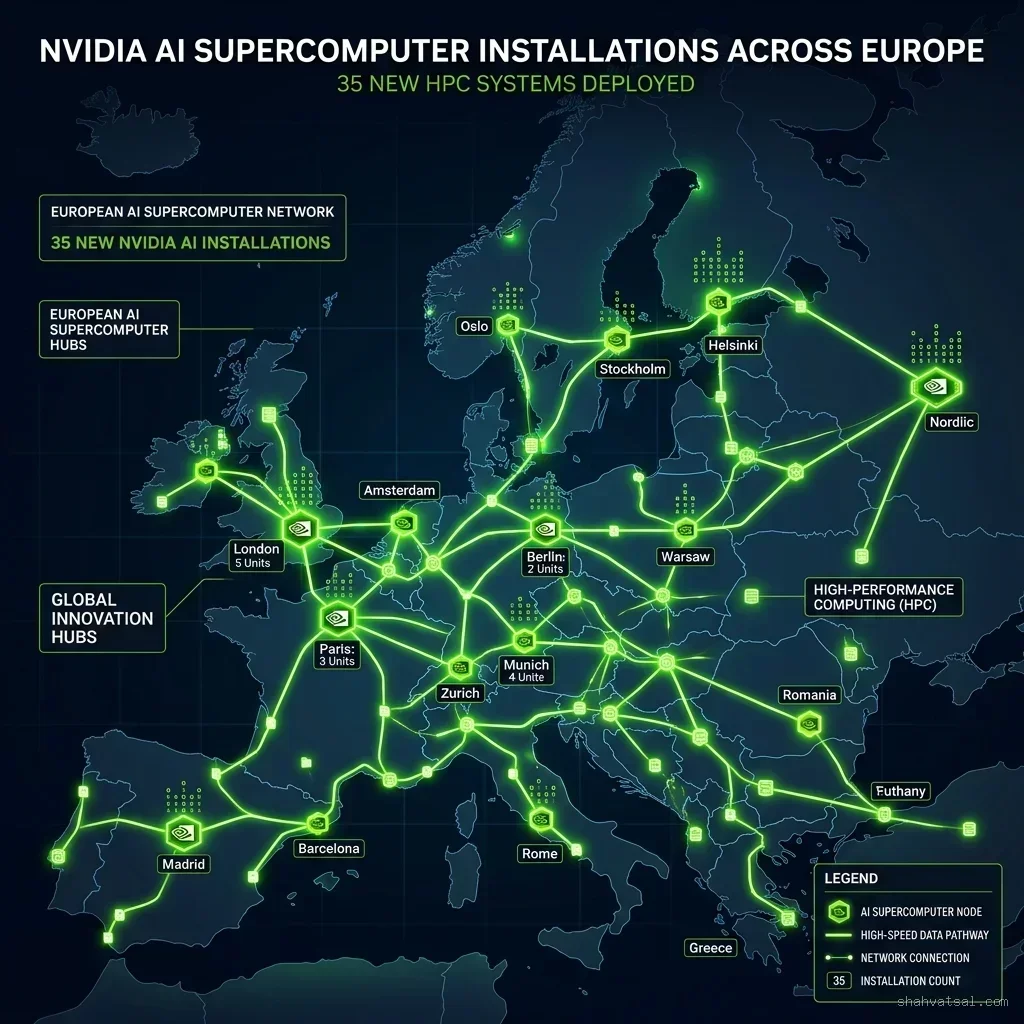
Each regional site is tailored to specific scientific workloads. For instance, BavariaAI’s Blue Swan focuses on materials science and structural mechanics, while NAISS Mimer in Sweden specializes in long-range climate forecasting. By utilizing the NVIDIA Blackwell platform, these systems can run mixed-precision workloads efficiently, enabling researchers to switch from low-precision model training to high-precision numerical simulations on the same node architecture.
H2: Inside the Vera Rubin Architecture
The Vera Rubin platform introduces a hybrid architecture designed to run both traditional physics simulations and modern generative AI models.
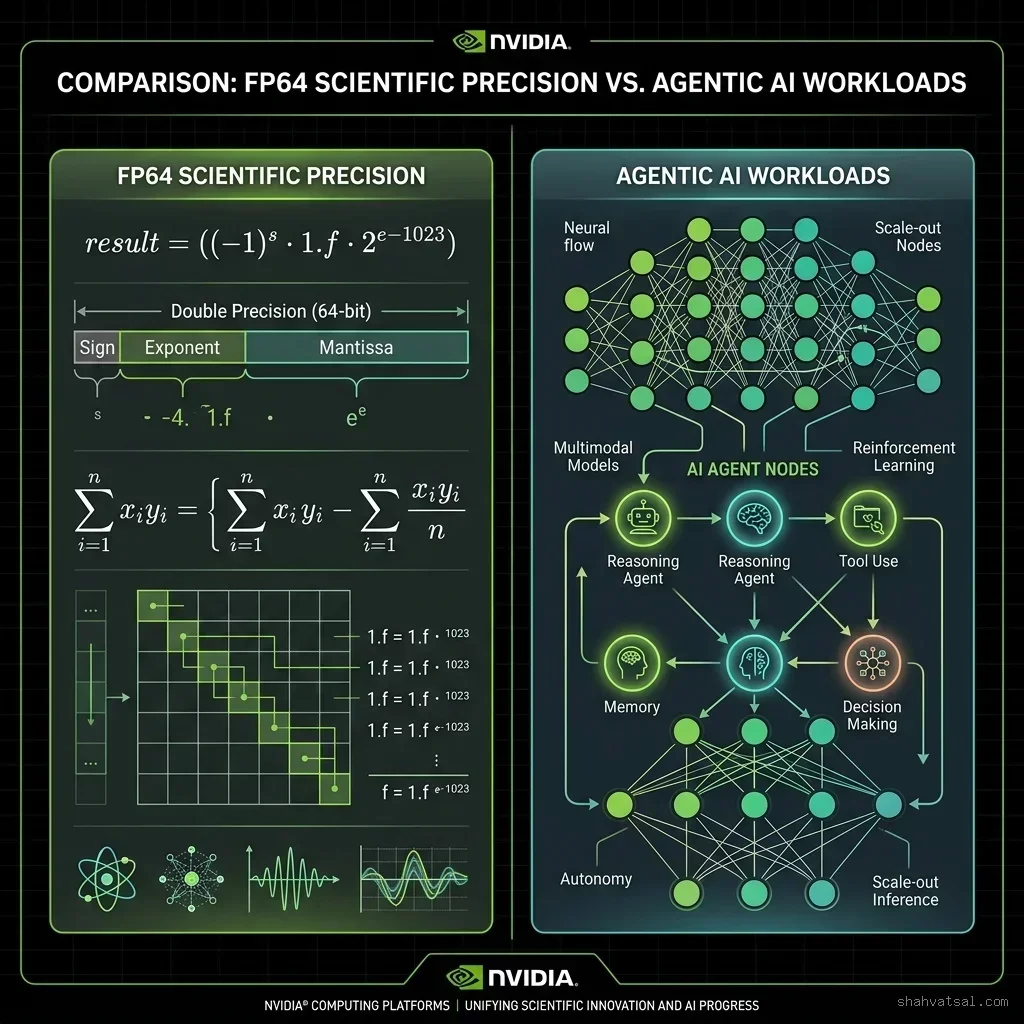
Historically, scientific supercomputing relied entirely on double-precision FP64 math to prevent rounding errors in complex calculations. However, modern AI models run faster on low-precision formats like FP8 or INT8. The Vera Rubin platform bridges this gap by dedicating hardware areas to FP64 operations while using Blackwell’s transformer engines to process low-precision AI queries. An integrated runtime orchestrates these workloads, allowing agentic models to analyze intermediate simulation results in real time and automatically adjust parameters without stopping the run.
Strategic Implications: Edge vs Cloud
The deployment of localized supercomputing factories also reshapes the balance between edge computing and centralized cloud architectures. In deep-dive analysis on Edge Computing vs Cloud Computing 2026, localizing high-capacity nodes near data generation points is crucial for latency-sensitive applications.
By placing AI factories directly inside national research facilities, European institutions eliminate the network latency and bandwidth costs associated with moving petabytes of raw data to distant public cloud datacenters. Furthermore, localizing these workloads ensures compliance with strict European data sovereignty laws, such as the EU AI Act, which mandates auditability and strict data boundaries for high-risk models.
To learn more about the initial technical announcement of this silicon line, review the coverage on NVIDIA Computex 2026 Vera Rubin Inference.
What to Watch Next
- Inter-Cluster Fiber Backbones: Look for announcements regarding high-speed optical connections linking these 35 supercomputers to form a unified virtual computer.
- Vera Rubin SDK Updates: Watch for updates to NVIDIA’s scientific software toolkits, enabling developers to build custom simulation agents.
- Blackwell Ultra Deployments: Monitor the rollout of Blackwell Ultra hardware to see if later installations receive mid-cycle compute updates.
Read the official announcements and technical sheets on NVIDIA Press → NVIDIA Pressroom
Key Takeaways
- Historic Expansion: NVIDIA is deploying 35 new AI supercomputers across 23 European nations under the EuroHPC program.
- Vera Rubin GA: The Vera Rubin platform is now generally available, combining FP64 precision with agentic AI routing.
- Massive Exaflop Scale: The new infrastructure adds over 800 AI exaflops of processing capacity for European research.
- Blackwell Hardware Backbone: The Barcelona Supercomputing Center and other major hubs will use Blackwell nodes.
- Data Sovereignty Focus: Localized clusters help European institutions comply with data privacy regulations.