The Post-Managerial Era: Leading 100+ Autonomous Agents Instead of People
By Vatsal Shah · June 4, 2026 · Leadership / Management
- Structural Re-alignment: The role of the technology leader is shifting from managing human hours to orchestrating distributed, stateful AI agent meshes.
- Management Category Error: Applying traditional human-centric management heuristics to algorithmic workloads or treating code execution loops as emotional actors is the primary failure mode of modern teams.
- The 1:100 Leverage Ratio: High-performance organizations in 2026 utilize a core team of elite "Sovereign Engineers" who direct, audit, and audit-gate hundreds of highly specialized autonomous software agents.
- Model Context Protocol (MCP): Standardizing context exchange through MCP gateways ensures deterministic data flow and robust agent orchestration across heterogeneous cloud systems.
Table of Contents
- Introduction
- What is the Post-Managerial Era?
- The Management Category Error
- The 1:100 Ratio: Algorithmic Team Scaling
- Performance Reviews for Code: Auditing Agentic Logic
- Human-Agent Collaboration Matrix
- Agentic Governance and Architectural Guardrails
- Procedural Logic: Orchestrating the Agentic Gateway
- Pitfalls & Modern Anti-Patterns
- Futuristic Horizon: 2027–2030 Roadmap
- Key Takeaways
- FAQ
- About the Author
Introduction
The organizational chart of the modern enterprise is undergoing a fundamental phase transition. In previous technology cycles, scaling output was a direct function of head count. If a division needed to ship more code, launch more campaigns, or resolve more support tickets, the manager's primary response was to recruit, onboard, and coordinate more human beings. This structural dependency created massive operational overhead, meeting fatigue, and coordination friction.
In 2026, this linear relationship between head count and organizational velocity has collapsed. Today, high-performance technology leaders do not spend their days unblocking human schedules, managing emotional cycles, or coordinating synchronous status updates. Instead, they operate as Agentic Orchestrators, directing a decentralized, self-healing mesh of hundreds of autonomous software agents. The transition from "managing people" to "orchestrating agents" requires a complete rewrite of engineering management heuristics. This guide breaks down the core architectures, governance guardrails, and tactical systems required to lead a highly leveraged agentic workforce.

What is the Post-Managerial Era?
The Post-Managerial Era is defined as the structural state where organizational execution is predominantly handled by specialized, autonomous software agents, shifting the human role from tactical coordination to strategic intent definition and boundary enforcement.
In this new paradigm, the focus shifts from process management (tracking when and how work is done) to intent management (defining target outcomes, cost parameters, and quality gates). A single human leader no longer acts as a router for tasks; instead, they oversee a system of self-correcting agent loops that operate continuously across the enterprise stack.
Core Pillars of the Post-Managerial Shift
- Continuous Execution Loops: Unlike human teams constrained by 8-hour workdays and synchronous communication windows, agent meshes run 24/7/365, resolving code bugs, processing log streams, and updating deployment configurations continuously.
- Context Standardization: Information is no longer siloed in employee memory or disorganized Slack channels. It is standardized programmatically via the Model Context Protocol (MCP), allowing agents to instantly pull context from databases, source repositories, and cloud logs.
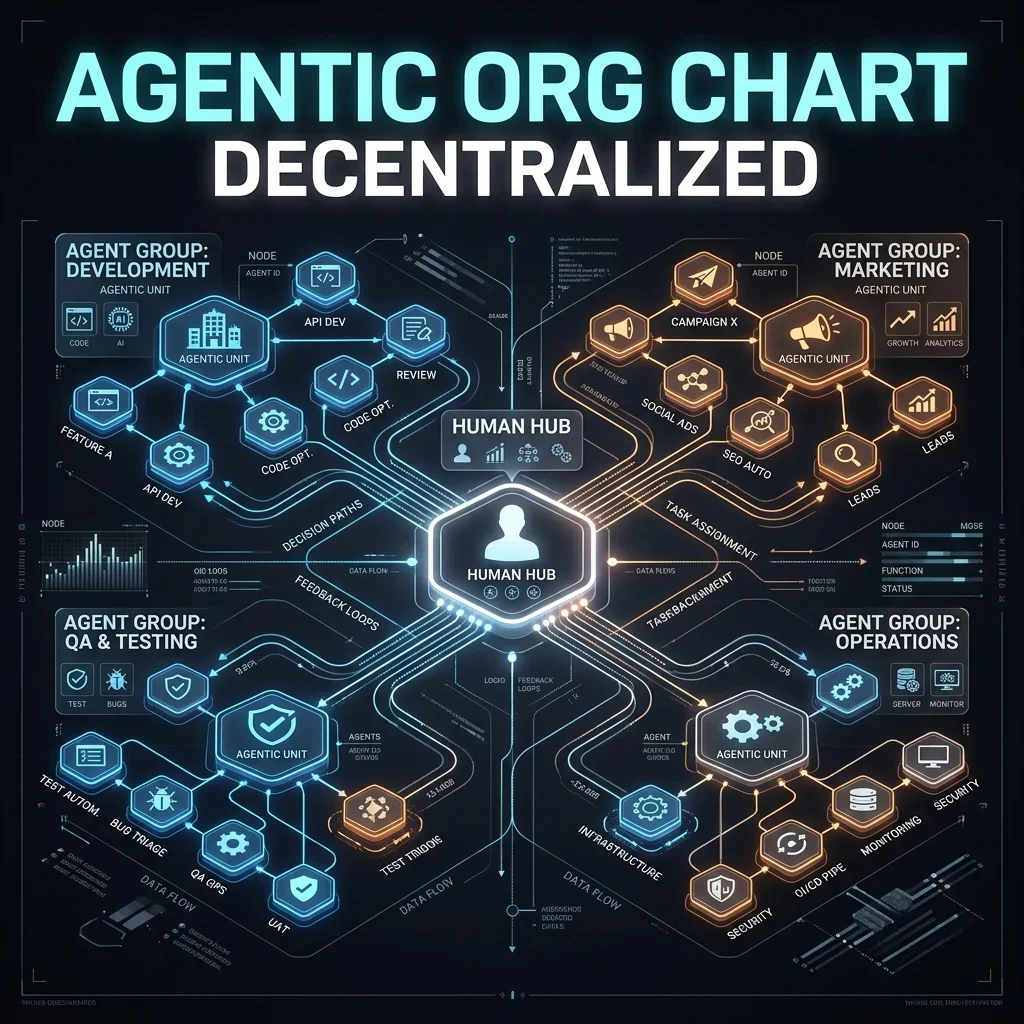
- Decentralized Execution Mesh: Teams are structured not as reporting pyramids, but as dynamic DAGs (Directed Acyclic Graphs) where specialized agents coordinate with one another, sharing tasks and verifying outputs before presenting final outcomes to human coordinators.
The Management Category Error
The primary source of failure when companies attempt to integrate AI agents is the Management Category Error. This error occurs in two ways:
- Treating deterministic, programmatic execution loops as if they require human management (such as scheduling synchronous check-ins for agents).
- Treating human workers as if they are machines (by tracking raw keystrokes or expecting algorithmic predictability).
Practitioner Insight:
In my experience directing scaled AI integrations, teams that treat AI tools as "virtual human employees" fail within the first month. They waste hours setting up mock meetings, writing conversational guidelines for bots, and attempting to resolve "conflicts" between models. AI agents do not have feelings, burn out, or need motivational speeches. They require crisp API boundaries, well-defined token budgets, and strict schemas. Focus 100% of your energy on engineering the interfaces and 0% on humanizing the agent's internal reasoning loops.
When managing autonomous software agents, you must transition from tracking activity to validating state transitions. A human manager monitors whether an employee is sitting at their desk; a sovereign agent leader monitors whether the agent's logic graph successfully transition from PLANNING to VERIFIED without violating API budget bounds.
The 1:100 Ratio: Algorithmic Team Scaling
In a traditional organizational model, a manager's span of control is limited by cognitive limits (Dunbar's number, communication overhead). The sweet spot for a direct reporting structure has historically been 6 to 8 people. Beyond this, the manager becomes a bottleneck, spending all their time in 1-on-1s and status updates.
In the Post-Managerial Era, the leverage ratio shifts to 1:100+. A single engineer, acting as an orchestrator, can direct a cluster of 100+ specialized agents. This is possible because communication between agents is asynchronous, programmatic, and executed at machine speed.
How One Human Coordinates 100+ Agents
To achieve this level of leverage, the organizational structure must be modularized into functional clusters:
- Strategic Orchestrators: Human directors who define high-level goals, authorize resource spending, and resolve edge cases.
- Router Agents: Central models that decompose the human's strategic intent into discrete tasks and assign them to specific sub-agents.
- Specialist Agents: Deeply specialized models restricted to narrow domains (e.g., database schema migration, unit test generation, UI CSS optimization, API security auditing).
- Verifier Agents: Independent models whose sole job is to audit and attempt to break the output of the specialist agents before code is pushed to production.
Performance Reviews for Code: Auditing Agentic Logic
How do you evaluate the performance of an employee who does not have an annual review, doesn't ask for a raise, and processes millions of tokens a minute? You shift from subjective evaluations to algorithmic auditing.
Managing AI agents vs people means replacing performance reviews with Execution Audits. Instead of assessing team culture or execution speed, leaders monitor metrics like token efficiency, graph traversal success, rollback rates, and context window pollution.
Core Metrics of the Agentic Workforce
| Metric | Definition | High Performance Target | Warning Threshold |
|---|---|---|---|
| Task Completion Rate (TCR) | Percentage of initiated agent runs that reach RESOLVED state without human intervention. | > 92% | < 75% |
| Token Efficiency Index (TEI) | The ratio of successful task outcomes to total tokens consumed. | > 1.8x (optimized context) | < 0.6x (infinite looping) |
| Rollback / Defect Rate | The percentage of agent-generated code commits that trigger automated test rollbacks. | < 2% | > 8% |
| Context Window Pollution | The accumulation of redundant, unstructured data within the agent's operational memory. | < 15% (strict MCP filtering) | > 40% (bloated prompts) |
| Action Latency | Time taken from human strategic intent input to the generation of a deployable system. | < 45 seconds | > 5 minutes |
Human-Agent Collaboration Matrix
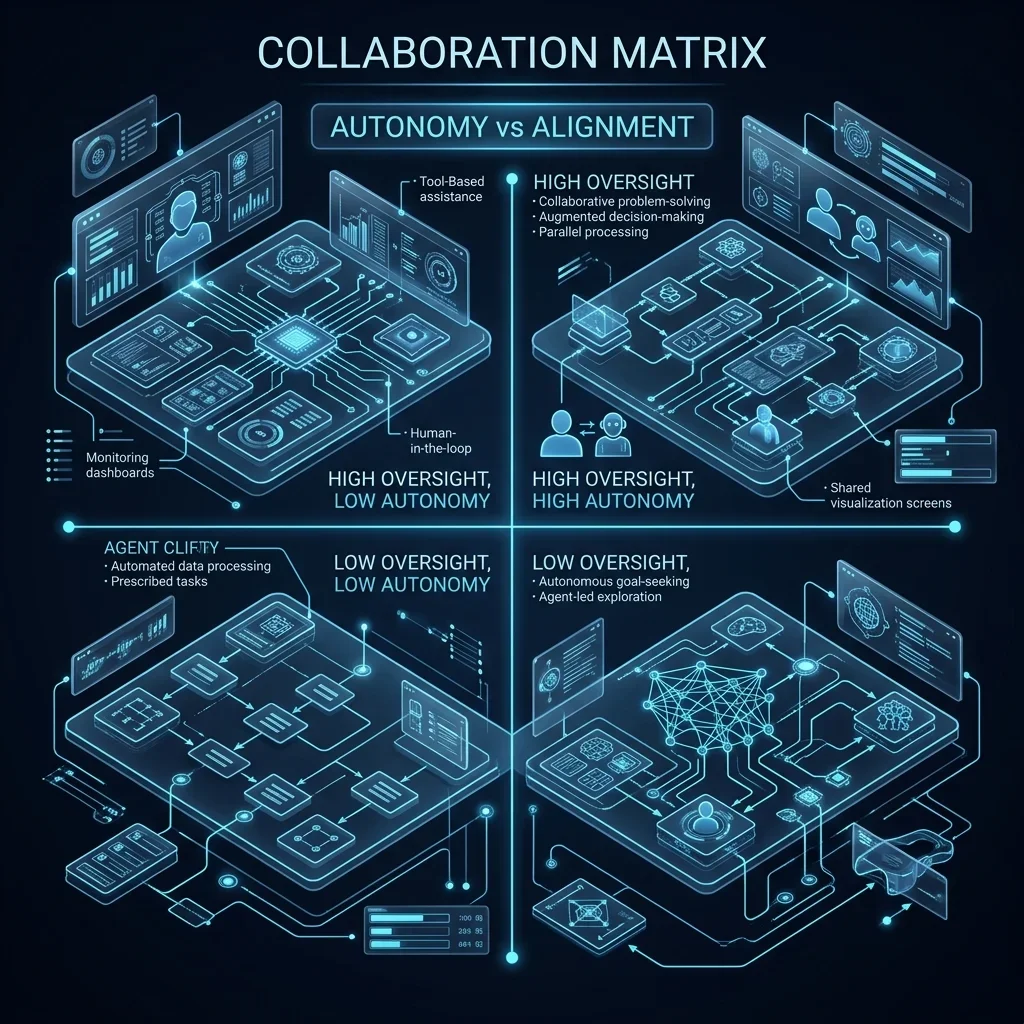
To prevent agents from running wild in production, leaders map out human-agent interaction bounds. The framework utilizes a 2x2 matrix that balances agent autonomy with human alignment.
- Quadrant 1: High Autonomy, Low Human Alignment (Banned): Agents executing system-level actions without budget controls or audit logs. This results in runaway API bills and database corruption.
- Quadrant 2: Low Autonomy, Low Human Alignment (Legacy): Standard script automation. Slow, fragile, and unable to adapt to schema changes.
- Quadrant 3: Low Autonomy, High Human Alignment (Co-pilot): Human-in-the-loop pairing. The agent suggests code; the human manually reviews and merges every line. Highly secure but limits leverage.
- Quadrant 4: High Autonomy, High Human Alignment (Sovereign Mesh): The agent cluster operates autonomously within strict governance guardrails. Humans act as system gatekeepers, auditing only when warning thresholds are breached.
Agentic Governance and Architectural Guardrails
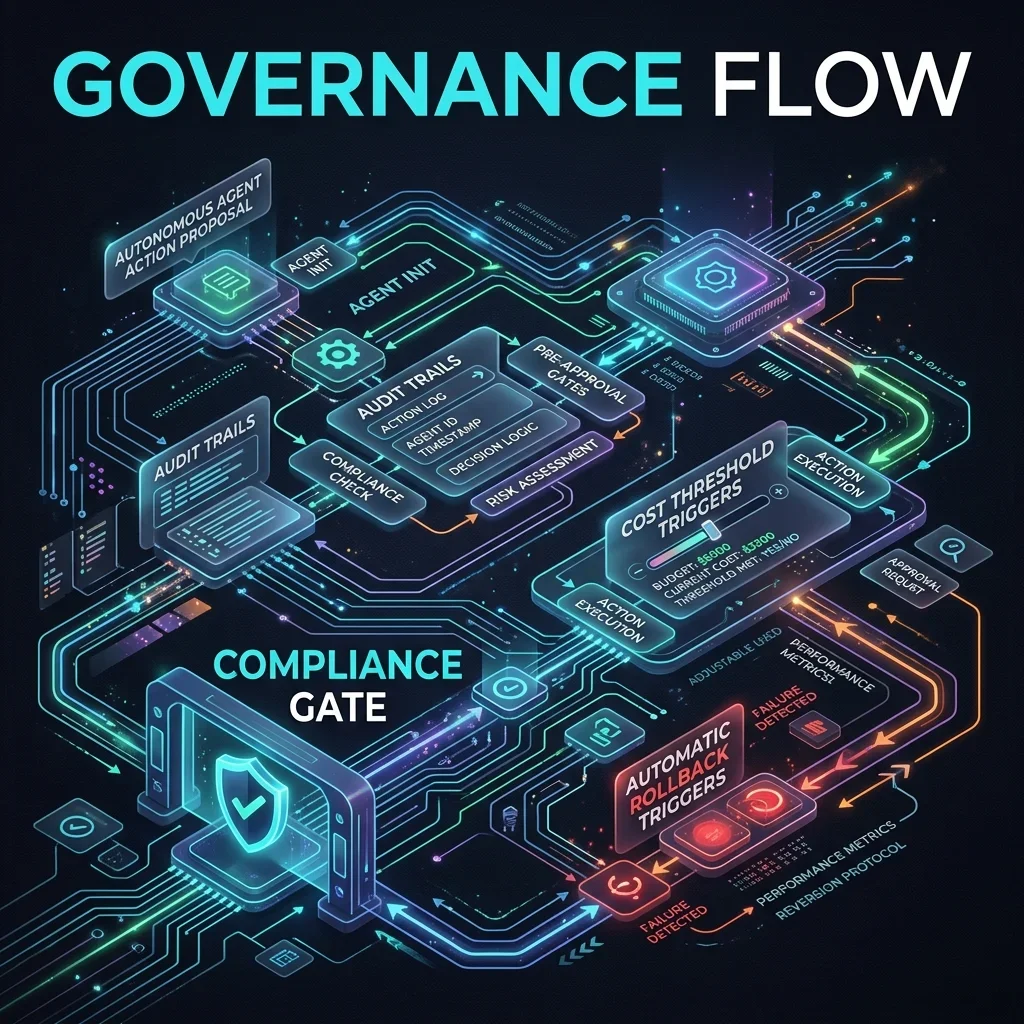
Leading an agentic workforce requires implementing programmatic guardrails that act as digital HR and compliance departments. You cannot rely on agents "following the rules" stated in a system prompt. LLMs are probabilistic; they hallucinate, drift, and occasionally execute loop paths that bypass simple instructions.
Your governance must be enforced at the infrastructure layer, not the prompt layer.
Core Elements of Agentic Governance
- Token Budgets & Rate Limit Pools: Every agent session must be initialized with a hard token spending cap. If a model enters an infinite execution loop, the API gate terminates the thread once the budget is depleted.
- Deterministic Context Isolation: Avoid dumping your entire codebase or database schema into an agent's context window. Use Model Context Protocol (MCP) gateways to only expose the absolute minimum files and resources required for the target task.
- Automated Rollback Triggers: If an agent pushes code that degrades performance, causes database latency to spike, or fails a security lint scan, the deployment pipeline must automatically revert the changes to the last known stable state.
Procedural Logic: Orchestrating the Agentic Gateway
In an agentic organization, the leader defines the orchestrator routing engine. Below is a production-ready Python class illustrating how to configure an autonomous routing and verification loop that enforces token limits and verification gates before code is deployed.
import os
import sys
from typing import Dict, Any

class AgentOrchestrator:
    class="tok-kw">def __init__(self, token_limit: int, verification_model: str):
        self.token_limit = token_limit
        self.verification_model = verification_model
        self.token_spent = 0
        self.state = class="tok-str">"IDLE"

    class="tok-kw">def execute_agent_loop(self, task_payload: Dict[str, Any]) -> Dict[str, Any]:
        class="tok-str">""class="tok-str">"
        Executes an autonomous agent reasoning cycle with strict token-budget
        enforcement and deterministic verification gates.
        "class="tok-str">""
        print(fclass="tok-str">"[Orchestrator] Initializing task run. Token Limit: {self.token_limit}")
        self.state = class="tok-str">"PLANNING"

        class="tok-cm"># Simulating execution steps and tracking token consumption
        self.token_spent += 12000
        if self.token_spent > self.token_limit:
            self.state = class="tok-str">"BUDGET_EXCEEDED"
            return self.terminate_execution(class="tok-str">"Token limit exceeded during planning phase.")

        self.state = class="tok-str">"EXECUTING"
        class="tok-cm"># Specialist agent writes code changes
        self.token_spent += 25000

        class="tok-cm"># Verification gate: Independent model checks specialist output
        self.state = class="tok-str">"VERIFYING"
        is_verified = self.run_verification_gate(task_payload)

        if not is_verified:
            self.state = class="tok-str">"FAILED_VERIFICATION"
            return self.terminate_execution(class="tok-str">"Agent output failed compliance and security verification.")

        self.state = class="tok-str">"COMPLETED"
        print(class="tok-str">"[Orchestrator] Task successfully verified and prepared for deployment.")
        return {
            class="tok-str">"status": class="tok-str">"SUCCESS",
            class="tok-str">"state": self.state,
            class="tok-str">"tokens_consumed": self.token_spent,
            class="tok-str">"payload_verified": True
        }

    class="tok-kw">def run_verification_gate(self, payload: Dict[str, Any]) -> bool:
        class="tok-str">""class="tok-str">"
        Independent verification logic simulating audit validation.
        "class="tok-str">""
        class="tok-cm"># Checks for security flags, syntax errors, or prompt injection attempts
        if class="tok-str">"eval_bypass" in payload.get(class="tok-str">"code_diff", class="tok-str">""):
            return False
        return True

    class="tok-kw">def terminate_execution(self, reason: str) -> Dict[str, Any]:
        print(fclass="tok-str">"[CRITICAL TERMINATION] {reason}")
        return {
            class="tok-str">"status": class="tok-str">"TERMINATED",
            class="tok-str">"state": self.state,
            class="tok-str">"tokens_consumed": self.token_spent,
            class="tok-str">"error": reason
        }

class="tok-cm"># Instantiate and run orchestrator with a 50,000 token limit
if __name__ == class="tok-str">"__main__":
    orchestrator = AgentOrchestrator(token_limit=50000, verification_model=class="tok-str">"grok-4-verifier")
    sample_diff = {
        class="tok-str">"task_id": class="tok-str">"T11_HOTFIX",
        class="tok-str">"code_diff": class="tok-str">"class="tok-kw">def execute_logic():\n    class="tok-cm"># System task execution code\n    pass"
    }
    result = orchestrator.execute_agent_loop(sample_diff)
    print(fclass="tok-str">"Final Run Status: {result[&class="tok-cm">#039;status']} | State: {result['state']}")
Pitfalls and Modern Anti-Patterns
Orchestrating 100+ agents is not without risks. Technology leaders must watch out for the following critical failure modes:
- The Hallucination Cascade: This occurs when the output of one hallucinating agent is consumed as ground truth by another. Within minutes, the entire agent mesh is reasoning based on false data, corrupting databases or generating broken configurations.
- Token Budget Hemorrhaging: If an agent lacks clear exit conditions, it may loop indefinitely when faced with an unexpected error message. A single unchecked thread can exhaust thousands of dollars in API credits over a single weekend.
- Context Pollution: Sending raw logs, system traces, and entire files to the model's context window dilutes attention. The model misses critical parameters and begins outputting generic, low-fidelity responses. Always use MCP services to prune context before ingestion.
Futuristic Horizon: 2027–2030 Roadmap
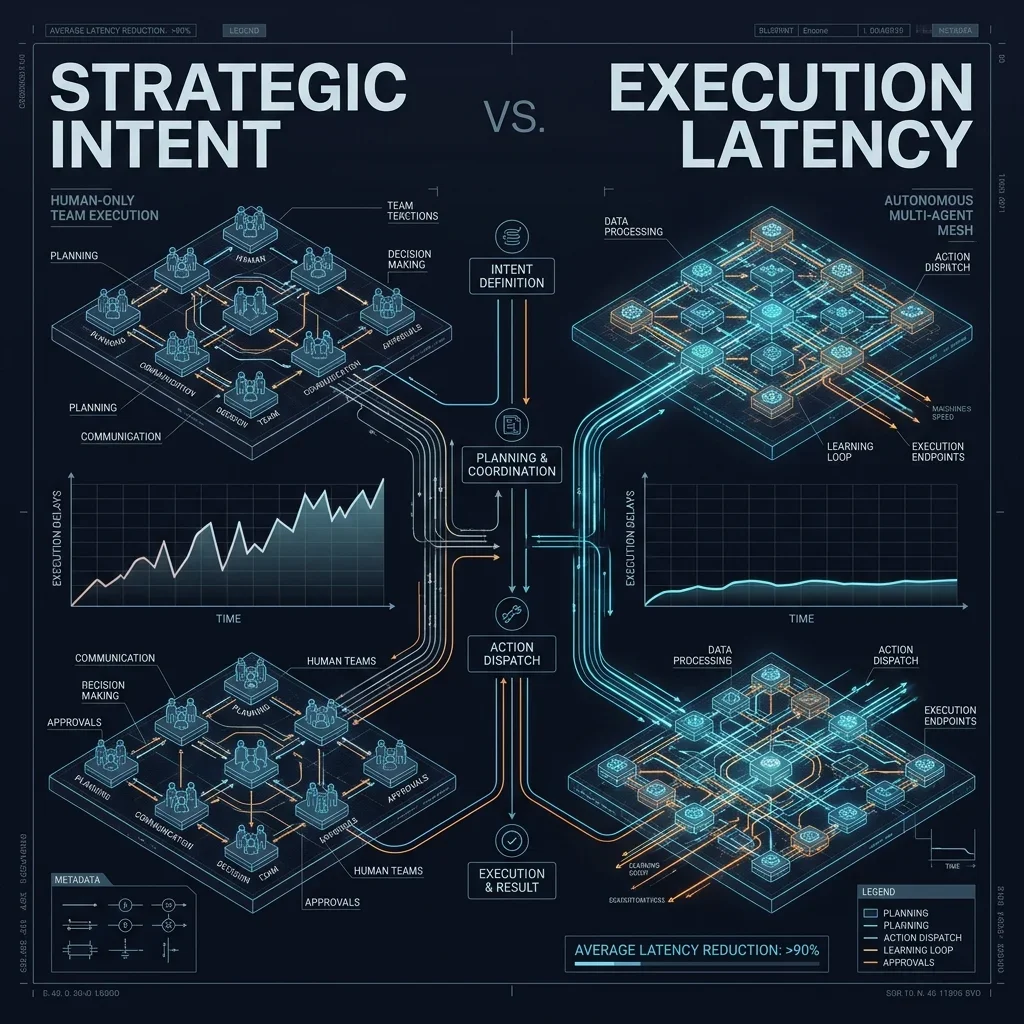
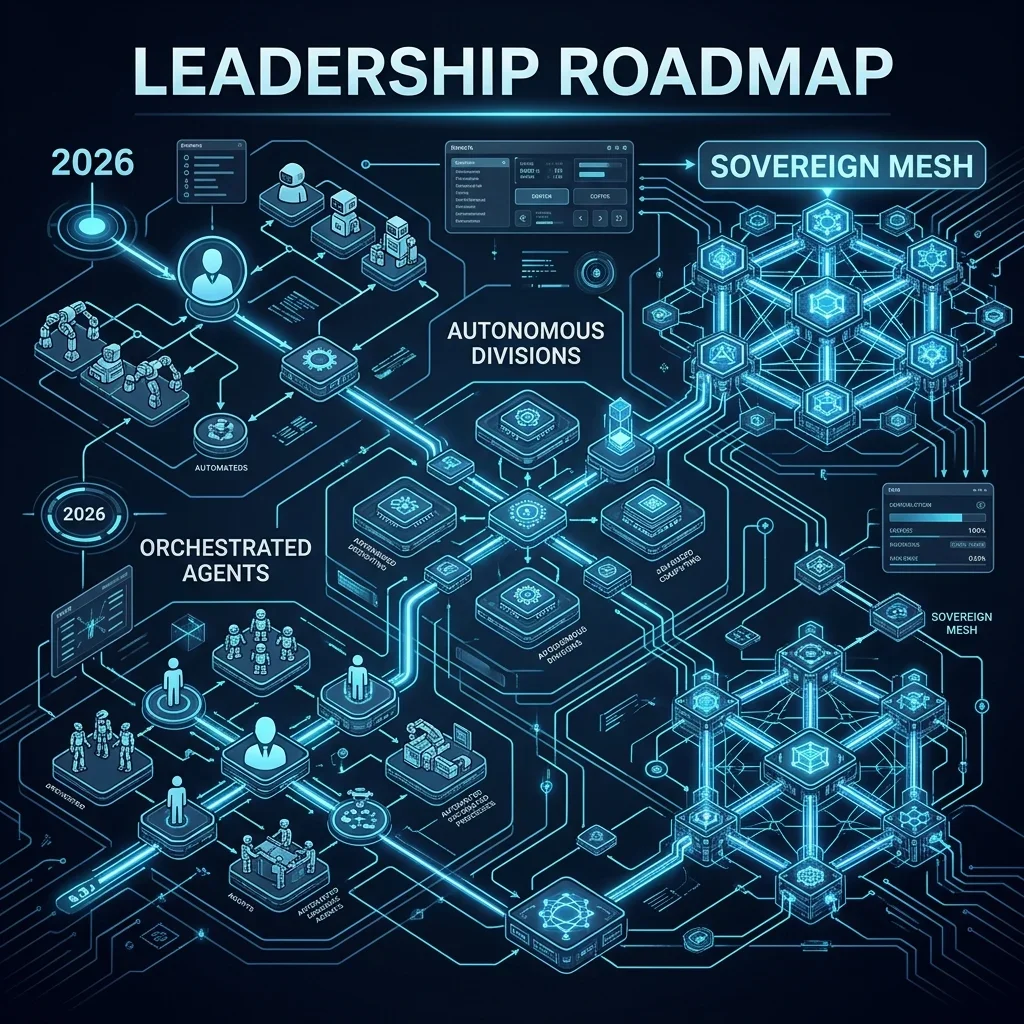
The evolution of organizational design will accelerate as agent capabilities move from basic tool calling to sovereign system execution. The roadmap below outlines the transition phases from human-led teams to autonomous meshes:
Phase 1 (2026): The Orchestrated Agent Team
Human engineers define daily goals and monitor outputs. Agents operate as co-pilots or execute micro-tasks (writing tests, formatting files, running audits) within isolated development trees.
Phase 2 (2028): Autonomous Corporate Divisions
Whole functional areas (such as billing cycles, server provisioning, customer support triage, and content generation) are run completely by agent networks. Humans only intervene for budget approvals or custom escalations.
Phase 3 (2030): The Sovereign Corporate Mesh
Organizations scale to billions of dollars in valuation with fewer than 10 human employees. The business operates as a self-optimizing network of agents that dynamically spin up new microservices, adjust pricing models, and acquire external APIs based on real-time market data.
Key Takeaways
- Shift Focus: Move from managing employee schedules to configuring system parameters, token boundaries, and API schemas.
- Infrastructure-Level Guardrails: Implement rate limits and transaction audits at the API and pipeline levels rather than relying on prompts.
- Embrace Asynchronous Work: Structure your systems so agents can run continuously, presenting final outcomes for verification only when they pass automated tests.
- Audit metrics closely: Monitor Token Efficiency, Defect Rates, and Context Window Pollution to keep your systems running optimally.
- Leverage MCP: Standardize data sharing via the Model Context Protocol to prevent information fragmentation.
FAQ
How do I handle performance evaluation for an AI agent?
You evaluate agents using programmatic audits. Key indicators include the Task Completion Rate (TCR) and the Token Efficiency Index (TEI). If an agent's defect rate rises or its token efficiency drops, it's time to refine its system prompts, update its context retrieval pipeline, or swap out the underlying model.
Will agents replace human product managers and engineering leaders?
No. The shift changes their focus. Leaders will spend less time routing tasks or holding status meetings. Instead, they will focus on defining system objectives, setting safety guardrails, and guiding product vision.
How do we prevent token budget runaway?
Enforce hard caps on token use per session at the gateway level. If an agent loops repeatedly without resolving an error, the orchestrator should terminate the run, log the state, and alert a human supervisor.
What is the Model Context Protocol (MCP) and why does it matter?
MCP is a standardized protocol that lets AI models safely interact with local data sources and development tools. It removes the need for custom, fragile API integrations by providing a clean, secure channel for models to fetch context.
What role do human developers play in a 1:100 agentic team?
Human developers act as system architects and code verifiers. They focus on complex system integrations, define key system inputs, and review agent-generated outputs before they go live.
About the Author
Vatsal Shah is a Senior AI Solutions Architect and Tech Director who helps companies implement scalable AI systems, modern API architectures, and agile project workflows. With over a decade of experience leading software teams, Vatsal designs practical solutions that help businesses scale their operations through modern technology.
Conclusion + CTA
Managing 100+ autonomous software agents is a major change in how we think about tech leadership. By focusing on systemic guardrails, clean interfaces, and standardized protocols like MCP, companies can scale their operations in ways that were once impossible.
Ready to build your autonomous team? Connect with Vatsal Shah to design your agentic architecture and deploy resilient AI systems.