2026's \"Proof-of-Impact\" Reckoning: Why Enterprise AI Pilots Are Getting Killed
By Vatsal Shah · 2026-05-27 · AI / Technology
AI SUMMARY
- The 2026 Reckoning: Enterprise boards and CFOs are shutting down AI pilots and Proof of Concept (POC) experiments that fail to deliver clear financial impact.
- Data-Backed Fatigue: Industry reports from Deloitte and Capgemini show that while over 75% of enterprises launched AI pilots, fewer than 20% moved them to production.
- The Impact Ladder: Framework to transition AI initiatives from basic experiments (Level 1) to production workflows (Level 2) and measurable P&L outcomes (Level 3).
- Consulting Strategy: Organizations must implement 90-day proof-of-impact sprints, build clear KPI trees, and rationalize their AI project portfolios to focus on value.
What Happened
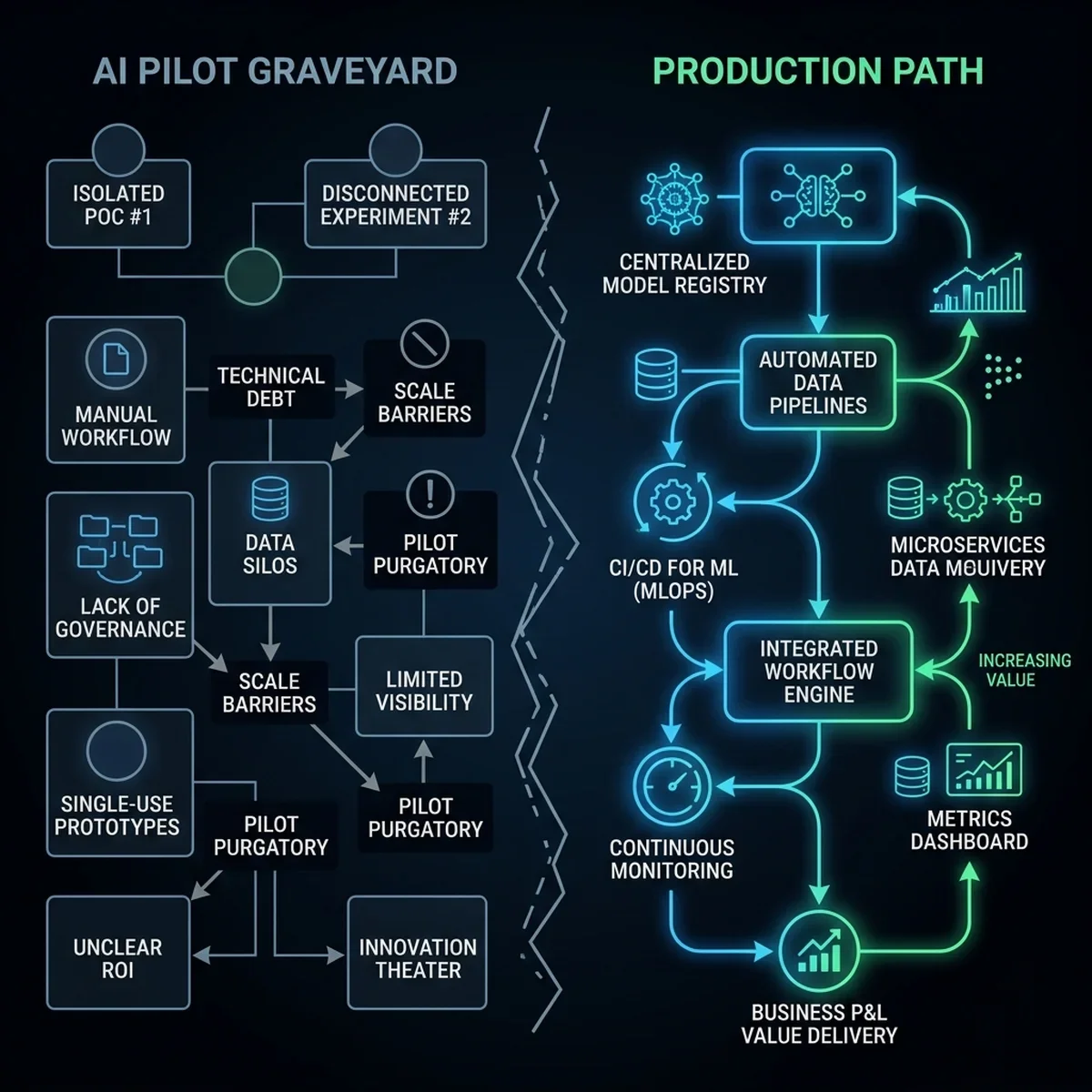
The era of easy funding for enterprise AI experiments has officially ended. In 2026, corporate boards and CFOs are conducting major resets of their transformation programs, shutting down hundreds of AI pilots and Proof of Concepts (POCs) that cannot show clear returns on investment (ROI).
According to the Deloitte State of AI in the Enterprise 2026 report and Capgemini's Top Tech Trends 2026 study, companies are experiencing severe AI pilot fatigue. While over 75% of surveyed organizations launched AI pilots over the past two years, fewer than 18% have successfully transitioned those models into full-scale production runtimes.
As boards demand proof of impact rather than "innovation theater," projects that focus on superficial chatbots or simple search tools are getting defunded in favor of initiatives that directly improve the bottom line.

To survive this reckoning, CIOs and Chief Transformation Officers are resetting their portfolios. Instead of launching dozens of small, disconnected use cases, they are concentrating resources on a few integrated workflows that directly affect business margins.
Why It Matters
This shift highlights a fundamental misunderstanding of how AI delivers value. In the initial rush to adopt generative AI, companies focused on surface-level productivity, like summarizing emails or generating text. While these tools save individual employees a few minutes a day, they rarely translate into measurable cost reductions or new revenue.
The core challenge is moving from a simple POC to a production system. Running a pilot in a controlled sandbox with clean data is relatively easy.
However, scaling that system to handle real-world customer data, manage APIs, and maintain performance under load is much harder. Many projects fail because they run into technical challenges, such as database integration bottlenecks or model memory issues.
For an analysis of why agents fail in production, read our guide on AI agents production memory and state failures.
   [ INNOVATION PILOT ]                 [ PRODUCTION PIPELINE ]
             │                                     │
     ┌───────┴───────┐                     ┌───────┴───────┐
     ▼               ▼                     ▼               ▼
   Simple         Sandbox               API-First      Integrated
  Chatbots      Experiments             Workflows      Data Layers
     │               │                     │               │
     └───────┬───────┘                     └───────┬───────┘
             ▼                                     ▼
   Innovation Theater ($)                  P&L ROI Delivery ($$$)
To guide organizations through this transition, we use the Impact Ladder framework, which structures AI initiatives into three levels of maturity:
- Level 1: Pilot & POC (Innovation Theater): Focuses on quick experiments, basic chatbot prompts, and sandbox environments. Delivers local productivity gains but has zero impact on P&L margins.
- Level 2: Production Enablement (Workflow Integration): AI is integrated into daily business processes. The system connects to corporate databases and APIs, automating routine administrative tasks and reducing manual processing times.
- Level 3: P&L Value Delivery (Measurable Impact): AI systems actively optimize resources, reduce carrying costs, or drive new revenue streams. Results are visible on the company's financial balance sheet.
Enterprise AI Project Matrix
To help leadership teams evaluate their AI portfolios, the table below compares typical Level 1 pilot behaviors against Level 3 production implementations.
| Operational Dimension | Level 1: Innovation Pilot (POC) | Level 3: High-Impact Production AI |
|---|---|---|
| Core Metric of Success | Qualitative user feedback, system engagement, and user adoption rates | Hard financial outcomes (e.g., headcount efficiency, cost reduction, or revenue growth) |
| Data Integration | Manual file uploads (PDFs, CSVs) inside isolated sandboxes | Real-time API integrations with core ERP, CRM, and transactional databases |
| User Interface | Standard chat interfaces or playground environments | Integrated task screens, background automation, and event-driven triggers |
| Operational Latency | Seconds or minutes (relying on manual prompts and reviews) | Sub-second execution or automated background processing |
| Governance & Compliance | Informal data privacy reviews and basic policies | Strict compliance mapping, read-only audit logs, and IAM permissions |
To climb the Impact Ladder, organizations must implement structured measurement frameworks. Rather than counting how many AI features are deployed, they need to measure how those features impact operational efficiency. For a step-by-step methodology on designing these dashboards, review our playbook on digital transformation ROI and measurement frameworks.
What to Watch Next
As the proof-of-impact reckoning continues, three trends are likely to shape the enterprise AI market:
- Portfolio Consolidation: Companies will cut their AI portfolios by up to 60%, focusing their budget on 3 to 5 core workflow automation platforms.
- FinOps for GenAI: Growing adoption of tools to monitor and optimize API token costs, cloud compute usage, and model licenses.
- Outcome-Based Consulting: A shift in consulting services from advisory work to outcome-based contracts, where payments are tied to achieved efficiency goals.
Source
Read the official research reports and trend analyses:
For assistance with portfolio assessments, building KPI trees, or structuring 90-day sprints to transition your pilots to production, reach out to our team at /contact.