ChatGPT Workspace Agents Hit Enterprise: Governance, Security, and Metered Pricing
By Vatsal Shah · 2026-05-27 · AI / Technology
AI SUMMARY
- OpenAI Workspace Agents: OpenAI announced the public preview of ChatGPT Workspace Agents, shifting from simple, personal GPTs to shared, collaborative team agents running in the cloud.
- Administrative Control Plane: Features include centralized connector allowlists, organizational suspend switches, and a dedicated Agent Compliance API for security monitoring.
- Metered Pricing Model: Shifting from flat seat licenses to consumption-based billing model, charging per agent execution token and connector API call.
- Security Implications: Enterprise rollouts require proactive policy checks, RBAC controls, and prompt injection defense layers to prevent corporate data leakage.
What Happened
OpenAI has launched the public preview of ChatGPT Workspace Agents, representing a major transition from personal productivity tools to collaborative, enterprise-grade agent runtimes. This release upgrades simple, custom GPTs into cloud-hosted agents that run continuously, execute multi-step workflows, and are shared across organizational teams with central administrative controls.
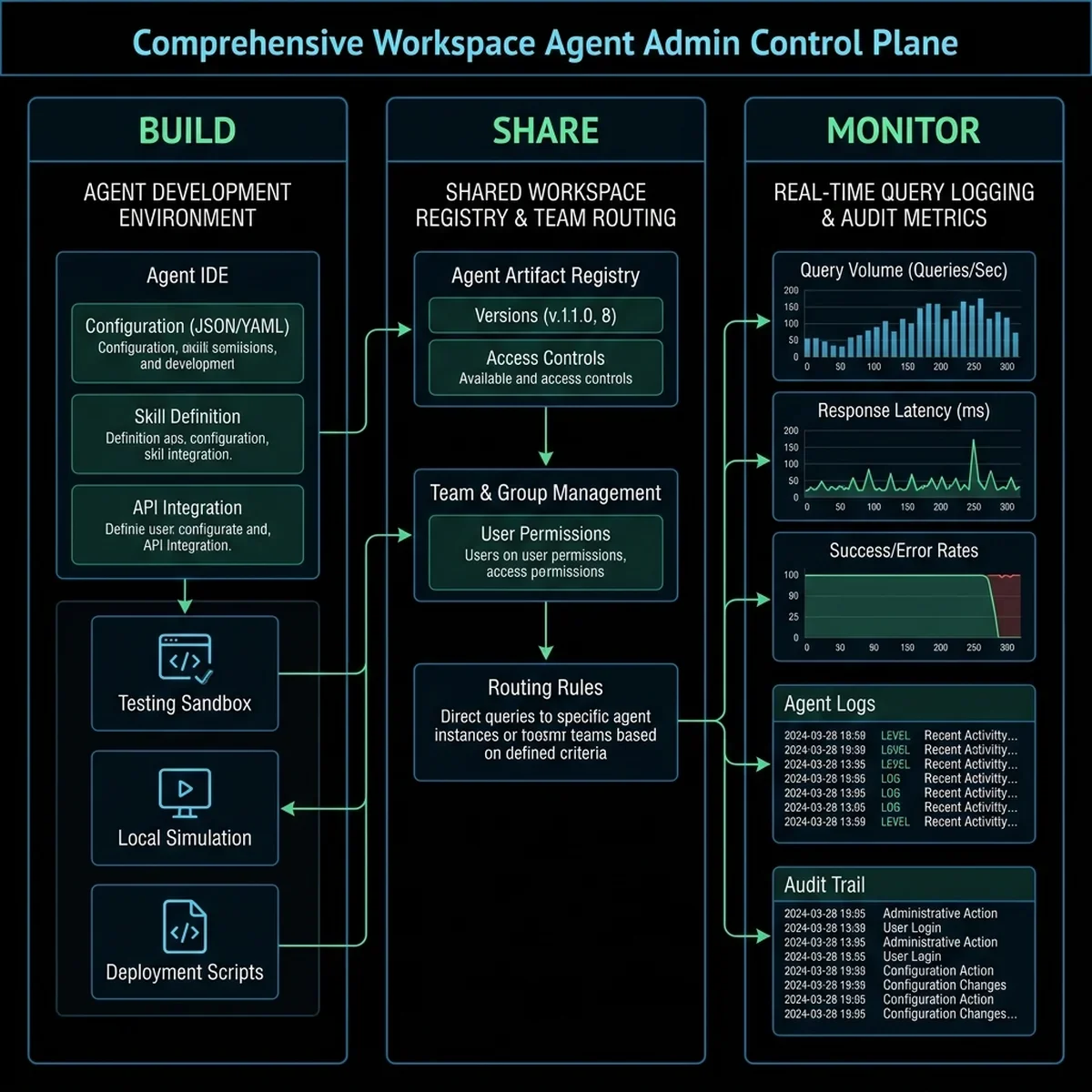
The defining feature of this release is the Admin Control Plane. IT administrators can manage and govern all agents deployed within their corporate workspace. Key administrative features include the Agent Compliance API, which provides complete visibility into agent chats, outputs, and database actions.
Administrators can set allowlists for external connectors, audit file transfers, and instantly suspend any agent violating data governance rules.
Simultaneously, OpenAI announced a shift in its licensing strategy. The workspace agent runtime will use a metered, consumption-based pricing model.
Instead of flat-rate seats, enterprises will be billed based on execution tokens, connector call volumes, and persistent memory storage. This shift allows companies to scale usage dynamically but requires more careful cost tracking.
Why It Matters
This release represents a significant shift for IT and operations leaders. While personal custom GPTs helped individual productivity, they created a challenge for IT departments. Employees built custom tools without data policies, leading to Shadow AI 2.0—where corporate data is sent to external, ungoverned AI models.
Workspace Agents address this governance gap by providing administrators with complete control over integrations, actions, and data boundaries. To manage security risk, IT security teams must deploy these tools under structured guidelines:
- Connector Allowlists: Disallowing wild-card API access. Administrators must approve individual SaaS integrations (such as Jira, Salesforce, or internal endpoints) to protect data pipelines.
- Compliance API Auditing: Connecting the compliance stream directly to corporate Security Information and Event Management (SIEM) systems to detect data leaks.
- Prompt Injection Safeguards: Deploying validation layers to inspect incoming client data, protecting agents from execution manipulation.
       [ USER CONTEXT ]                     [ ADMIN CONTROL PLANE ]
              │                                        │
      ┌───────┴───────┐                        ┌───────┴───────┐
      ▼               ▼                        ▼               ▼
   Workspace      Connector               Compliance      Kill-Switch
     Agent        Allowlist                  API            Control
      │               │                        │               │
      └───────┬───────┘                        └───────┬───────┘
              ▼                                        ▼
    Agent Execution ($)                      Audit Trail Logging ($$)
Architectural Paradigm Comparison
To help security teams and enterprise architects evaluate this update, the table below compares OpenAI's Workspace Agents framework with simple Custom GPTs.
| Dimension | Legacy Custom GPTs | Workspace Agents (2026 Preview) |
|---|---|---|
| Execution Lifecycle | Session-bound; execution terminates when the user closes the chat interface | Persistent execution; long-running workflows continue running in the background |
| Sharing & Discovery | Ad-hoc sharing via link, leading to siloed databases | Centralized team registries with Role-Based Access Control (RBAC) settings |
| Administrative Auditing | No real-time log ingestion or system activity monitoring | Dedicated Agent Compliance API streaming system logs to SIEM targets |
| Connector Security | User-authorized OAuth profiles with minimal admin configuration | Centralized allowlists, credential vaults, and IP restriction filters |
| Pricing Structure | Included in flat $30/user/month ChatGPT Enterprise license | Metered consumption model based on tokens and active VM runtime minutes |
The risk of prompt injections is a critical concern for security teams. In agents connected to shared systems, a malicious user or an external file could inject instructions to bypass safety checks, accessing sensitive database tables or sending files to external sites.
To address this, enterprises must deploy dedicated validation engines that sit between the agent runtime and external integrations, analyzing payloads for anomalies. For a deeper look at protecting corporate data, see our guide on agentic threat modeling and RAG security.
Beyond immediate security risks, organizations must plan for the organizational changes driven by agent deployments. As shared agents assume responsibilities in data routing and administrative support, the structure of business operations changes.
Teams must move from individual tools to collaborative workforce topologies, aligning manual work with automated agents. Discover how companies are managing this change in our playbook on synthetic staffing and hybrid workforce topologies.
What to Watch Next
As companies deploy ChatGPT Workspace Agents, three developments will be key to watch:
- Governance Policy Packages: The growth of pre-configured governance templates, allowing security teams to quickly set up compliant, RBAC-protected workspaces.
- SIEM Connectors for AI Logs: The emergence of standard tools to connect the Agent Compliance API directly into enterprise security platforms like Splunk or Microsoft Sentinel.
- AI FinOps Tools: The rise of cost-control software to track, allocate, and optimize metered token usage across different departments and active agents.
Source
Read the official OpenAI announcement:
OpenAI Product Blog - Introducing ChatGPT Workspace Agents for Enterprise
For custom policy architectures, integration support, and security audits before organization-wide enablement, reach out to our team at /contact.