Google Pushes Gemini Enterprise, Spark, and Managed Agents API Into Production Stacks
By Vatsal Shah · 2026-05-25 · AI / Technology
AI SUMMARY
- I/O 2026 Announcements: Google launched a suite of agentic capabilities powered by the Antigravity agent harness and Gemini 3.5 Flash at Google I/O 2026.
- Managed Agents API: A public preview API allowing developers to deploy autonomous agents in Google-managed, ephemeral Linux sandboxes.
- Gemini Spark: An always-on, 24/7 background agent running on dedicated VMs that persists across user sessions to handle multi-step workflows.
- Paradigm Contrast: Google's developer-first sandbox model directly challenges Microsoft's SaaS-focused, Purview-gated Agent 365 licensing.
What Happened
At the Google I/O 2026 conference, Google launched a major expansion of its enterprise AI suite. Centered on the new Antigravity agent harness, Gemini 3.5 Flash, and the Gemini Enterprise Agent Platform, Google is transitioning from simple chatbot interfaces to production-ready agent execution runtimes. The announcements establish a comprehensive "Agent-as-a-Service" model directly integrated into the Google Cloud Platform (GCP) stack.
The core developer release is the Managed Agents API, now available in public preview. This API enables developers to deploy autonomous agents in secure, ephemeral, Google-hosted Linux environments with a single API call. These isolated sandboxes allow agents to execute custom code, manage files, and browse the web without requiring developers to configure underlying infrastructure or write complex execution frameworks.
Simultaneously, Google introduced Gemini Spark, an always-on personal AI agent designed to run in the background on dedicated Google Cloud virtual machines. Unlike standard sessions that close when a user logs off, Spark persists to execute multi-step, long-horizon tasks. Using Google Cloud's connector framework, Spark coordinates tasks across Google Workspace apps and third-party systems, including Microsoft OneDrive, ServiceNow, and corporate document repositories.
Why It Matters
Google's release highlights a split in how major vendors approach enterprise AI. While Microsoft is focusing on SaaS-level bundles by integrating Agent 365 with Active Directory and Purview, Google is taking a developer-first, infrastructure-oriented path. This infrastructure focus makes GCP a compelling runtime for custom, complex agent workflows.
In practice, I have seen IT architects struggle with the security overhead of custom agent deployments. Running an agent that can write python scripts or call external APIs requires isolation to prevent system compromise. By running these tasks inside Google-managed, ephemeral Linux sandboxes, the Managed Agents API provides an elegant security boundary. The agent can compile code and execute tools, but any malicious loop or prompt injection remains contained within the single-use sandbox, protecting the core enterprise network.
       [ DEVELOPER ENTRY ]                     [ SECURITY BOUNDARY ]
                │                                         │
        ┌───────┴───────┐                         ┌───────┴───────┐
        ▼               ▼                         ▼               ▼
  Managed Agents   Antigravity               GCP Ephemeral     DLP / VPC
       API           Harness                 Linux Sandbox     Gateways
        │               │                         │               │
        └───────┬───────┘                         └───────┬───────┘
                ▼                                         ▼
      GCP Agent Runtime ($)                    Isolated Sandboxing ($$)
Architectural Paradigm Comparison
To help multi-cloud architects and transformation leads compare these paradigms, the table below contrasts Microsoft's Agent 365 against the Google Gemini Agent Platform.
| Dimension | Microsoft Agent 365 Paradigm | Google Gemini Agent Platform Paradigm |
|---|---|---|
| Architectural Focus | SaaS-first registry and Active Directory-gated control plane | Developer-first, infrastructure-as-a-service agent execution |
| Execution Runtime | Tenant-bound cloud processes integrated with Microsoft 365 | Google-hosted, ephemeral Linux sandboxes (via Managed Agents API) |
| Always-On Capability | Event-triggered workflow nodes running in Copilot Studio | Gemini Spark running continuously on dedicated background VMs |
| Governance & Security | Entra machine identities, Purview data sensitivity tags | VPC security perimeters, IAM roles, DLP gateways |
| Primary Integrations | Outlook, Teams, SharePoint, Power Platform | Gmail, Docs, Google Cloud VPC, third-party APIs via MCP |
The challenge for IT decision-makers is cost modeling. Microsoft's Agent 365 standalone license is a flat $15/user/month, whereas Google's Managed Agents API runs on a metered, consumption-based pricing model tied to VM execution minutes and token usage. For high-volume, lightweight routing tasks, Microsoft's flat fee is more predictable. However, for compute-heavy reasoning loops that require isolated code execution, Google's infrastructure is far more capable.
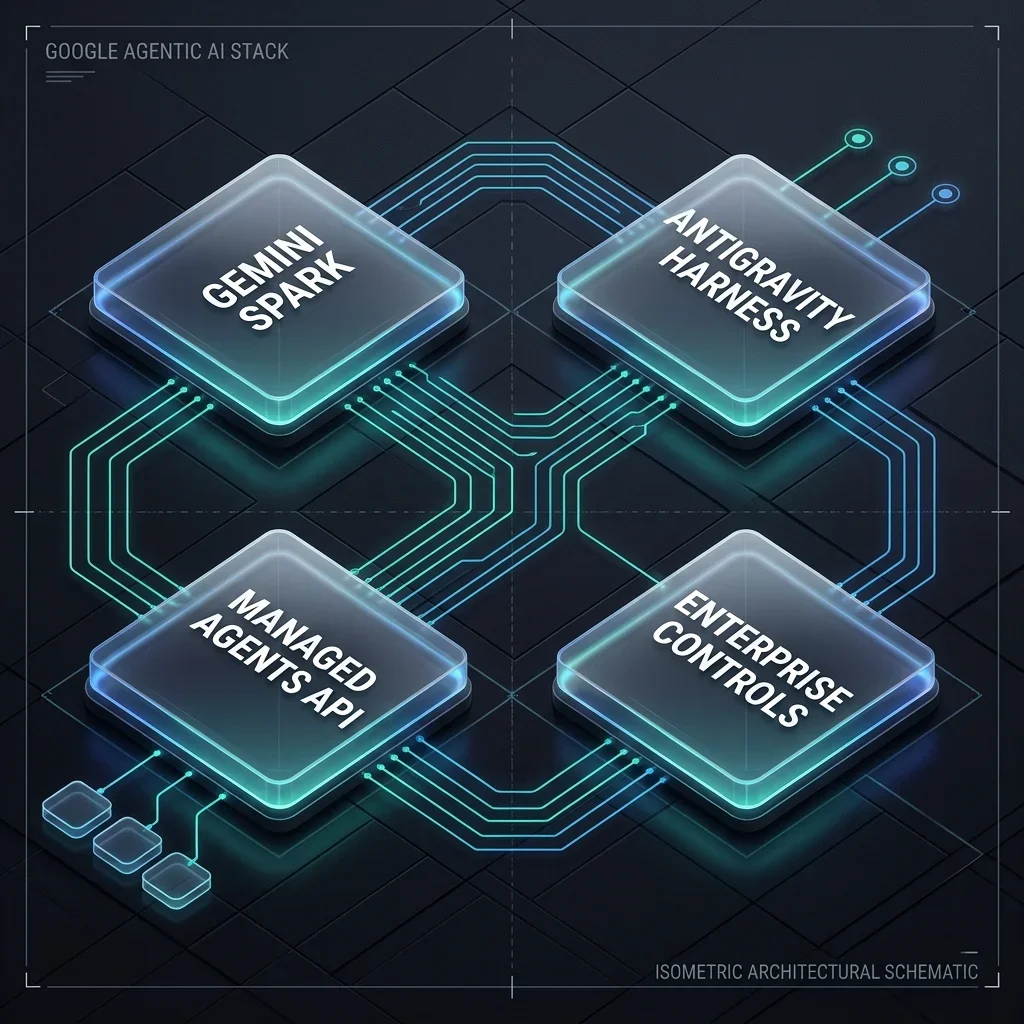
Ultimately, Google's stack appeals to organisations building custom internal platforms. By utilizing the Antigravity harness alongside standard Model Context Protocol (MCP) integrations, developers can build a multi-vendor gateway. This allows them to route queries to different model providers while maintaining unified VPC controls and audit logs, avoiding vendor lock-in.
What to Watch Next
As enterprises begin adopting Google's agentic tools, three trends are likely to emerge:
- Multi-Cloud Agent Gateways: Large enterprises will build custom middleware to route tasks between Microsoft Agent 365 (for Office workflows) and Google Managed Agents (for custom cloud applications).
- Standardization of Sandbox Runtimes: Security teams will demand standard compliance profiles for ephemeral execution sandboxes, driving Google to offer specialized HIPAA- and SOC2-compliant Managed Agent environments.
- Background VM Cost Optimization: As background agents like Gemini Spark run 24/7, companies will face unexpected cloud compute bills. Cost-control tools for active agents will become a necessary part of the FinOps discipline.
Source
Read the official Google Cloud announcement and documentation:
Google Cloud Blog - Introducing Gemini Enterprise Agentic Stack