What Happened In the run-up to Apple’s annual Worldwide Developers Conference (WWDC 2026), reports from supply chain analysts."
-
q: "Who should act on this first?"
a: "CTOs, platform leads, and compliance owners should review vendor exposure within one sprint — especially if AI agents touch customer data or financial workflows."
-
q: "What is the recommended next step?"
a: "Run a 30-minute architecture review: map affected systems, assign an owner, and document one measurable mitigation before the next release train."
Report: Apple WWDC 2026 Preview — On-Device Foundation Models and App Intents for Agents
By Vatsal Shah · May 31, 2026 · Mobile · Source: Bloomberg
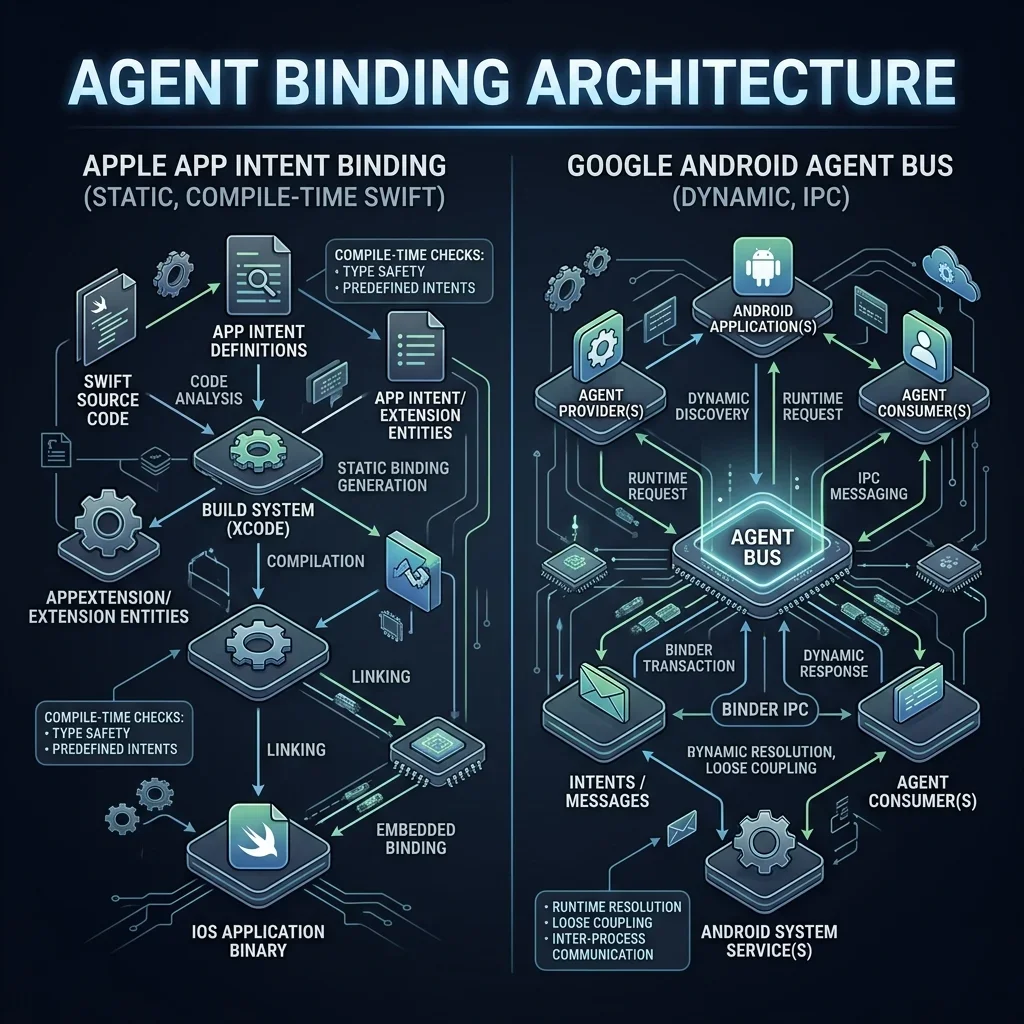
- Compile-Time Binding: Leaks suggest Apple is doubling down on Swift-based App Intents, forcing agents to bind to strongly-typed compile-time contracts rather than dynamic runtime IPC.
- On-Device Core: A new suite of 8B and 15B parameter foundation models is expected to run locally on M5 and A19 Pro NPUs, utilizing a proprietary 2-bit quantization technique.
- PCC Verification: Private Cloud Compute (PCC) is rumored to receive zero-knowledge cryptographic attestation, allowing local agents to offload heavy logical tasks without compromising user keys.
- Android Contrast: In contrast to Google's Android Agent Bus which uses a dynamic publish-subscribe system server, Apple's architecture is static, strict, and privacy-hardened.
What Happened
In the run-up to Apple’s annual Worldwide Developers Conference (WWDC 2026), reports from supply chain analysts and developer leaks indicate a significant architectural shift in iOS 20 and macOS 17. The center of this update is a new local orchestration framework designed to run autonomous agents directly on consumer hardware.
At the core of Apple's upcoming AI announcement is a rumored upgrade to the Swift App Intents framework. Unlike generic chatbot integrations, this framework will allow the OS-level Siri agent to invoke strongly-typed application capabilities locally. The system is backed by a new family of on-device foundation models, reportedly ranging from 8 billion to 15 billion parameters, optimized to execute at the Silicon NPU level with 2-bit quantization.
Additionally, Apple is expected to expand its Private Cloud Compute (PCC) infrastructure. For complex reasoning steps that exceed the thermal limits of an iPhone or iPad, the local agent will dynamically route sub-tasks to PCC nodes. The transactions will be protected by end-to-end cryptographic attestations, ensuring that user data remains invisible even to Apple's infrastructure servers.
Why It Matters
Apple's move represents a major philosophical divide in the battle for on-device AI dominance. Mobile developers building agentic workflows have watched the platform giants closely. Google recently announced its dynamic IPC Binder-driven approach, the Android Agent Bus, at Google I/O. Google’s design allows dynamic publish-subscribe routing of model payloads across application boundaries at runtime.
Apple’s rumored layout stands in stark contrast. Instead of a dynamic, runtime-resolved message bus, Apple relies on Swift compile-time declarations. Developers define their application's capabilities using static Swift structures. Siri's local semantic engine reads these schemas at compilation, indexing the application's capability set directly within the secure sandbox enclave of the OS.
This static, strongly-typed approach has two major advantages:
- Deterministic Security: The operating system can verify exactly what tools an application exposes at compile time, eliminating the risk of runtime injection attacks or unauthorized capability escalation.
- Memory Efficiency: Because the schema is compiled, the model does not need to parse large runtime payloads. It maps intent parameters directly to Swift binary symbols, bypassing serialization overhead.
However, the trade-off is developer friction. Mobile developers will have to strictly format their app architectures using App Intents. Apps that fail to expose their features through these structured compile-time frameworks will remain entirely invisible to Siri’s local reasoning loop.
To see how these local-first architectures stack up against cloud agent designs, see our in-depth analysis: Google I/O 2026: Gemini 2.5 Ultra and the Local Android Agent Bus Unleashed.
Deep Dive: Apple App Intents vs. Google Android Agent Bus
The following table contrasts Apple's rumored static compile-time architecture with Google's recently announced dynamic IPC Agent Bus:
| Architectural Vector | Apple Siri + App Intents (Rumored) | Google Android Agent Bus (AAB) |
|---|---|---|
| Orchestration Paradigm | Static Compile-Time Binding | Dynamic Runtime Publish-Subscribe |
| Communication Method | Direct parameter mapping in Secure Enclave | Low-latency OS-level IPC Binder driver |
| Developer Schema Declaration | Swift App Intents structs and Macros | AIDL (Android Interface Definition Language) |
| Tool Calling Latency | <10 milliseconds (direct execution) | <15 milliseconds (via shared memory handles) |
| Cloud Fallback Architecture | Private Cloud Compute (PCC) enclaves | Google Cloud Vertex AI (standard TLS) |
| Model Quantization | Proprietary 2-bit MX (Microscaling) format | Int8 / Int4 NPU-optimized weights |
Code Lab: Preparing for Swift-Based Agentic Intents
To participate in Apple's upcoming local agentic loop, developers must migrate traditional user-triggered actions into strongly-typed App Intents.
Below is a Swift code example demonstrating how to declare a static, schema-validated App Intent. This intent allows an on-device reasoning model to search private databases and parameterize queries automatically at compile time:
import AppIntents
import Foundation

@available(iOS 18.0, macOS 15.0, *)
struct QuerySecureVaultIntent: AppIntent {
    static var title: LocalizedStringResource = class="tok-str">"Query Secure Vault Data"
    static var description = IntentDescription(class="tok-str">"Exposes a local database queries for NPU-driven autonomous reasoning.")

    class="tok-cm">// Define strongly-typed parameters for the model to populate
    @Parameter(title: class="tok-str">"Database Domain", description: class="tok-str">"The internal domain schema to target.")
    var targetDomain: String

    @Parameter(title: class="tok-str">"SQL Query Substring", description: class="tok-str">"Fuzzy matching string for record retrieval.")
    var querySnippet: String

    @Parameter(title: class="tok-str">"Maximum Records", default: 10, description: class="tok-str">"Limit response count to avoid VRAM overflow.")
    var maxRecords: Int

    class="tok-cm">// Static parameter validation before model execution
    static var parameterSummary: some ParameterSummary {
        Summary(class="tok-str">"Search \(\.$targetDomain) for \(\.$querySnippet) up to \(\.$maxRecords) items")
    }

    class="tok-cm">// Execution block resolved directly on-device
    func perform() async throws -> some IntentResult & ReturnsValue<[String]> {
        let databaseManager = LocalSecureDB.shared

        class="tok-cm">// Guard parameter bounds to protect local hardware
        guard maxRecords <= 50 class="tok-kw">else {
            throw IntentError.maxRecordsExceeded
        }

        do {
            let results = try await databaseManager.fetchRecords(
                domain: targetDomain,
                query: querySnippet,
                limit: maxRecords
            )
            class="tok-kw">return .result(value: results)
        } catch {
            class="tok-kw">return .result(value: [class="tok-str">"Error: Query execution failed."])
        }
    }
}

class="tok-cm">// Dummy helper class demonstrating local sandboxed access
class LocalSecureDB {
    static let shared = LocalSecureDB()
    func fetchRecords(domain: String, query: String, limit: Int) async throws -> [String] {
        class="tok-cm">// Enforce localized sandboxing checks here
        class="tok-kw">return [class="tok-str">"EncryptedRecord_01", class="tok-str">"EncryptedRecord_02"]
    }
}

enum IntentError: Swift.Error, CustomStringConvertible {
    case maxRecordsExceeded
    var description: String {
        class="tok-kw">return class="tok-str">"Requested record limit exceeds sandboxed safety parameters."
    }
}For mobile engineering teams, the take-away is clear: start refactoring your app architectures immediately. The days of treating mobile apps as simple UI renderers for cloud-based endpoints are drawing to a close.
If Apple’s WWDC leaks are accurate, static schema-binding will require you to declare all parameters and data models in Swift using clean, compile-time contracts. This forces a clean separation of concerns: your app’s UI should interface with a modular engine that can be driven just as easily by Siri's App Intent resolver as by a human finger.
The teams that prepare their Swift App Intents now will dominate app-store discovery in the fall of 2026, as Siri’s local agents will prioritize apps they can communicate with dynamically.
What to Watch Next
As WWDC 2026 approaches, developers should monitor several key milestones:
- Xcode 18 Beta Drops: Watch for Swift compile-time analyzer upgrades designed to validate App Intent schemas for runtime execution.
- PCC Cryptographic Attestation Whitepapers: Look for Apple's security papers describing how the local OS certifies that a Private Cloud Compute node has not cached customer keys.
- NPU Benchmarks: Test how the rumored 2-bit Microscaled (MX) models handle context drift compared to traditional 4-bit edge runtimes.
To prepare your platform architecture for local-first enclaves, see our playbook on mobile security and infrastructure: Sovereign Architecture: Building Private AI Enclaves.
Source
Read the official developer frameworks documentation → Apple App Intents Specification