Amazon S3 Introduces Object Annotations: Attaching 1 GB Rich Metadata for AI Agents
By Vatsal Shah | June 18, 2026 | 8 min read | Source: AWS Official News Blog
- 1 GB Structured Metadata: Developers can now attach up to 1 GB of JSON, XML, or binary metadata payload per object, bypassing the traditional 2 KB S3 user-defined metadata limit.
- Index-less RAG Pipelines: Directly retrieve object annotations inside a single S3 GET request, avoiding separate database queries to Redis, pgvector, or Elasticsearch.
- Native Security Integration: Annotations are encrypted at rest using KMS keys and inherit the bucket's IAM access controls, simplifying security mapping.
- Developer API GA: Fully integrated into the AWS SDKs, allowing programmatically updating and retrieving metadata annotations with minimal latency.
Lead Paragraph
NEW YORK CITY, New York — During the opening keynote at the AWS Summit New York in June 2026, Amazon Web Services announced the General Availability of Amazon S3 object annotations. This capability enables developers to append up to 1 GB of rich, structured metadata payloads to any object stored in Amazon Simple Storage Service (S3). Designed to address the scaling limits of traditional 2 KB header-based user metadata, S3 Object Annotations allow direct indexing, querying, and retrieval of object context. The architectural shift provides a low-latency, index-less caching model for Retrieval-Augmented Generation (RAG) applications, drastically reducing the dependency on external databases for metadata mapping.
What Happened
The release of S3 Object Annotations solves a long-standing constraint of object storage systems. Previously, associating descriptive parameters, classification tags, or semantic graphs with an object meant either storing small strings inside S3’s 2 KB user-defined metadata limit or maintaining an external reference database (such as DynamoDB, PostgreSQL, or Redis). The external route introduces network round-trips, database connection overhead, and data synchronization challenges.
With S3 Object Annotations, AWS introduces:
- Massive Metadata Payload Limits: From a restrictive 2 KB to a maximum of 1 GB per annotation attachment.
- Direct S3 Query Execution: Developers can filter and fetch specific keys inside an annotation payload using S3 Select-style SQL syntax, returning only the needed attributes without downloading the whole object or annotation.
- Zero-Sync AI Caching: AI orchestration systems can bind document embeddings, chunk maps, or GraphRAG entities directly onto the original PDF or image files.
Technical Deep Dive: Annotation Attachment Structure
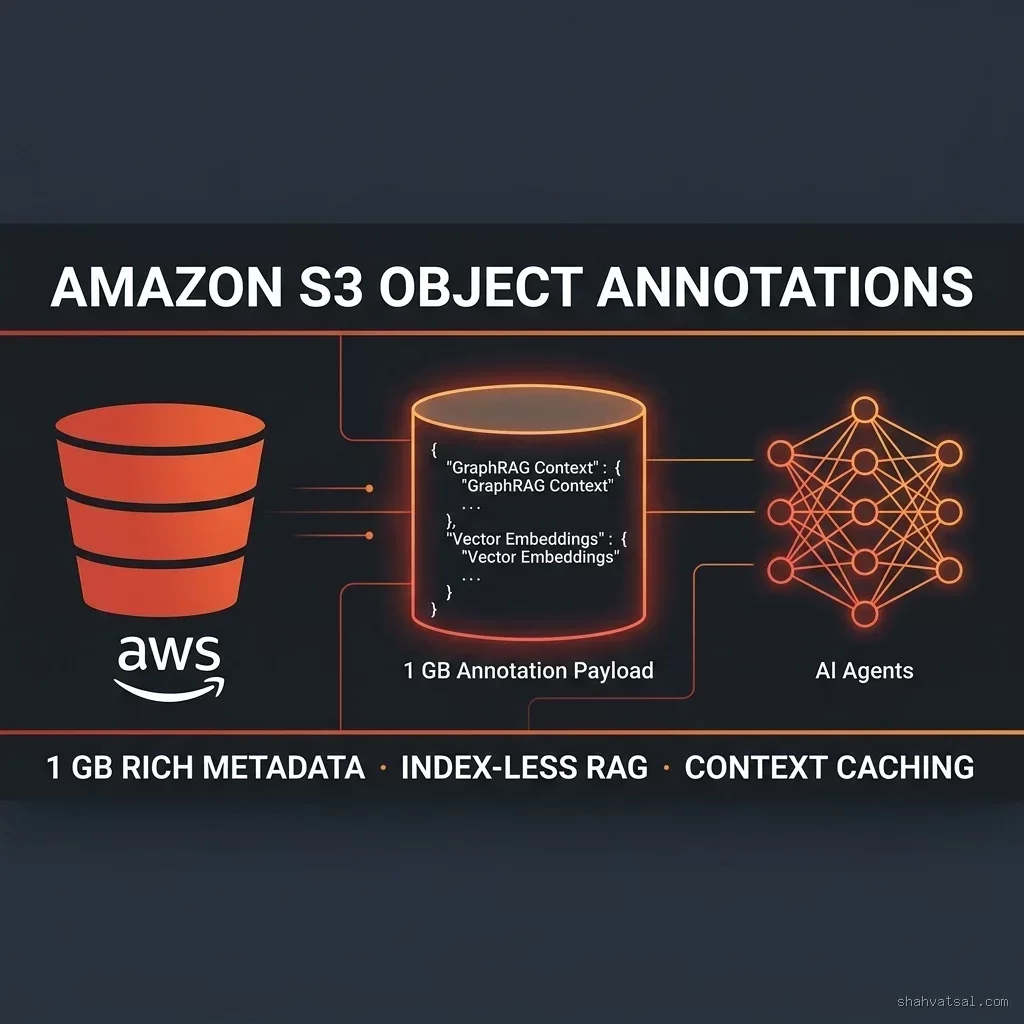
S3 Object Annotations exist alongside the target object as a managed, high-performance metadata layer. The physical separation allows developers to update, overwrite, or retrieve the annotations without modifying or re-uploading the primary object itself.
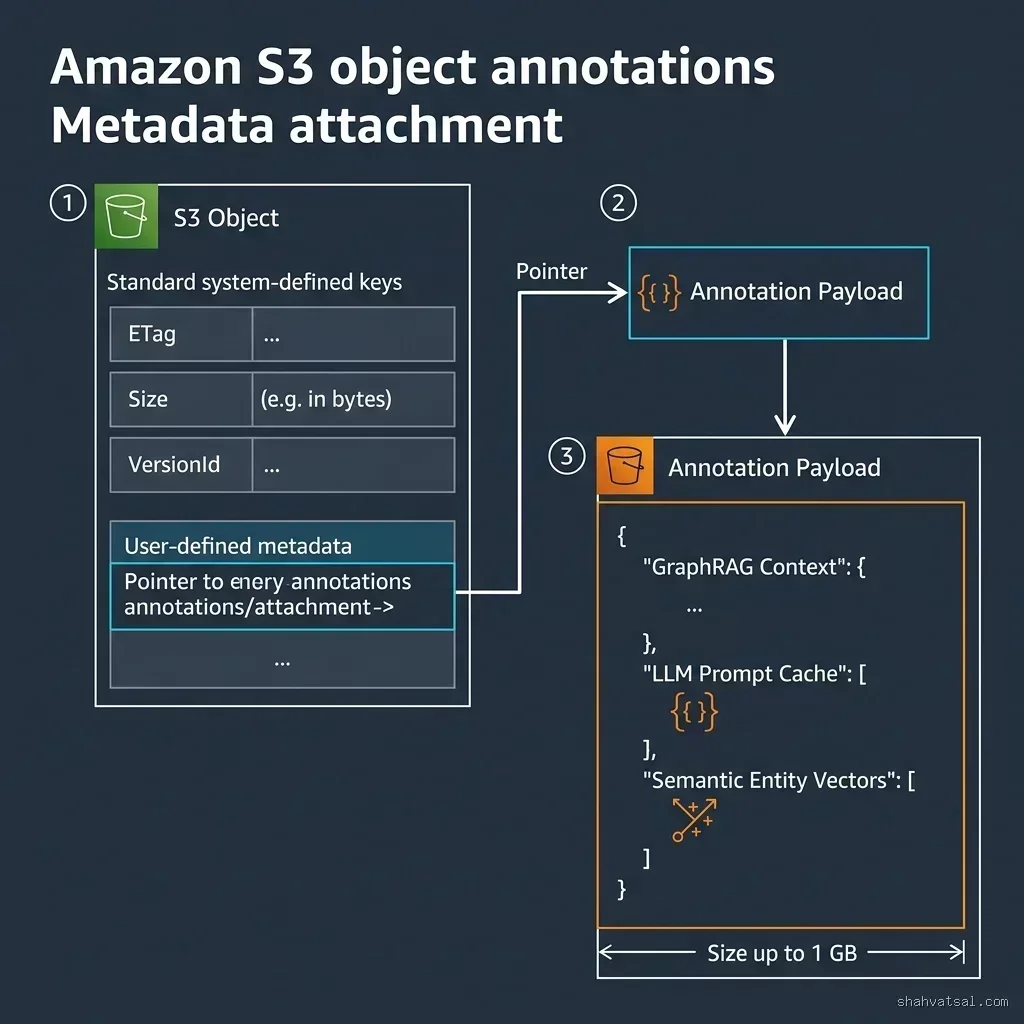
As shown in Figure 1, the S3 object record contains standard headers and a native pointer mapping to the annotation payload. The annotation itself can hold complex, nested structures like:
- Semantic Vectors: Embeddings representing the content of the object.
- Context Graphs: Relationships between this document and other entities.
- LLM Prompt Cache: Summaries and system prompts pre-calculated for the object.
To attach or retrieve an annotation, developers use the new PutObjectAnnotation and GetObjectAnnotation API endpoints:
import boto3
import json

class="tok-cm"># Initialize the AWS S3 client (AWS SDK 2026 update required)
s3_client = boto3.client(&class="tok-cm">#039;s3class="tok-str">', region_name='us-east-1class="tok-str">')

bucket_name = &class="tok-cm">#039;ai-agent-knowledge-vault'
object_key = &class="tok-cm">#039;legal_contract_2026_q2.pdfclass="tok-str">'

class="tok-cm"># Build a rich, structured metadata payload representing document chunks
annotation_payload = {
    "document_summary": "Q2 Legal Agreement regarding cloud infrastructure leasing.",
    "semantic_tags": ["contract", "lease", "us-east-1", "q2-2026"],
    "graphrag_nodes": [
        {"entity": "Vatsal Technosoft", "type": "Vendor"},
        {"entity": "AWS Direct Connect", "type": "Infrastructure"}
    ],
    "chunk_references": [
        {"chunk_id": 0, "offset": 1024, "token_count": 256, "hash": "sha256-..."},
        {"chunk_id": 1, "offset": 4096, "token_count": 180, "hash": "sha256-..."}
    ]
}

class="tok-cm"># Attach the 1 GB-eligible metadata annotation to the S3 object
try:
    response = s3_client.put_object_annotation(
        Bucket=bucket_name,
        Key=object_key,
        Annotation={
            &class="tok-cm">#039;ContentType': class="tok-str">'application/json',
            &class="tok-cm">#039;Body': json.dumps(annotation_payload)
        }
    )
    print(class="tok-str">"S3 Object Annotation attached successfully!")
except Exception as e:
    print(fclass="tok-str">"Error attaching annotation: {str(e)}")
Architectural Impact: Index-less RAG Metadata Caching
For engineers deploying AI agents, the typical retrieval pattern involves checking an index database (like Pinecone, Qdrant, or PostgreSQL) to resolve metadata properties associated with a file, followed by a GET request to S3 to read the actual document.
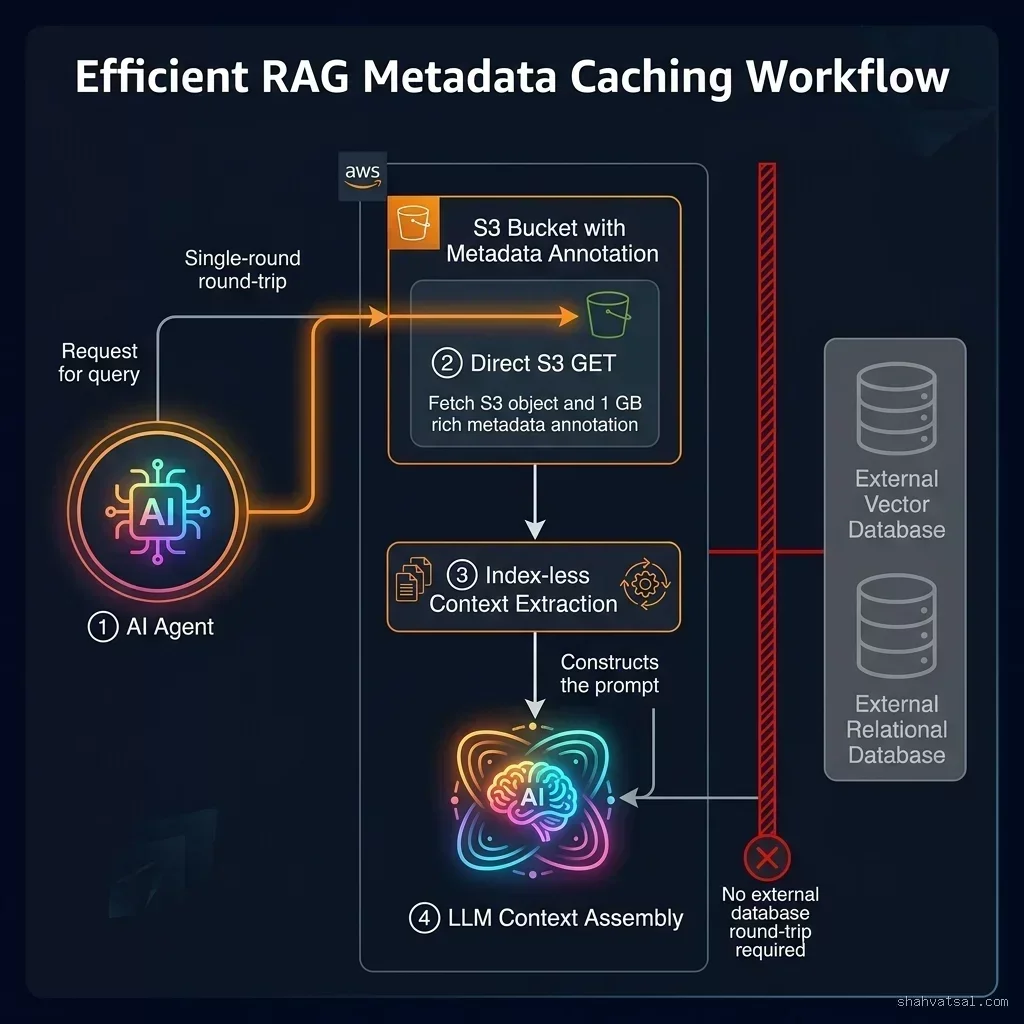
With S3 Object Annotations, the vector index and document metadata are unified on the object store level:
- Single GET Round-trip: The AI agent issues a standard GET request to S3, fetching both the raw document and its associated 1 GB rich metadata annotation in one network transaction.
- No External Database Lookup: The system bypasses external relational or vector database checks. If the agent needs to identify the relationship graph of a document, it queries the annotation directly from the S3 file.
- Automatic Eviction and Syncing: Since the metadata is bound directly to the S3 file, deleting or archiving the S3 object (e.g., via S3 Lifecycle policies) automatically cleans up its associated metadata annotation, resolving cache drift.
This approach is highly compatible with advanced graph-based indexing strategies. For teams scaling GraphRAG implementations, storing dense relationship matrices directly inside the corresponding PDF’s annotation payload simplifies scaling. For a detailed guide on managing relationship graphs in high-throughput applications, see our analysis of GraphRAG in Production.
Additionally, for applications that still utilize relational databases for structured searches, storing vector mappings within S3 annotations helps optimize index size and query load. Learn more in our technical review of pgvector Scaling in 2026.
Performance and Pricing
According to the AWS announcement:
- Latency:
GetObjectAnnotationrequests exhibit latencies similar to standard S3 metadata GET operations (typically sub-10ms inside the same region). - Storage Cost: Stored annotation payload data is billed at standard S3 storage tier rates (e.g., $0.023 per GB/month in
us-east-1for S3 Standard). - API Cost: Billed at the same rate as standard S3 PUT/GET requests (e.g., $0.005 per 1,000 PUT requests, $0.0004 per 1,000 GET requests).
What to Watch Next
- S3 Select Integration: Watch for updates enabling complex JSON path queries directly inside S3 bucket policies, allowing fine-grained IAM restrictions on specific annotation nodes.
- Open-Source SDK Support: Track the integration of S3 Object Annotations into popular AI frameworks like LangChain, LlamaIndex, and Semantic Kernel.
- Competitor Parity: Monitor whether Microsoft Azure Blob Storage and Google Cloud Storage (GCS) introduce equivalent high-capacity metadata features to match S3's new limits.
Read the official blog post on AWS News → AWS Official News Blog
Key Takeaways
- Metadata Limit Extended: Amazon S3 Object Annotations allow up to 1 GB of structured metadata per object.
- Index-less RAG: Eliminate secondary database queries by retrieving rich JSON/XML metadata directly from S3.
- Direct Key Querying: Use S3 API queries to filter and fetch keys inside the annotation without downloading the entire document.
- IAM & KMS Integrated: Annotations inherit standard S3 bucket policies, KMS encryption, and IAM security controls.
- Simplified Cleanup: Object deletion automatically purges associated annotations, resolving data sync drift.