Salesforce AIforce Puts CRM Context on Any Agent Surface: Claudeforce, Slackforce, and Agentforce Coworker
By Vatsal Shah | September 15, 2026 | 9 min read | Source: Salesforce Newsroom
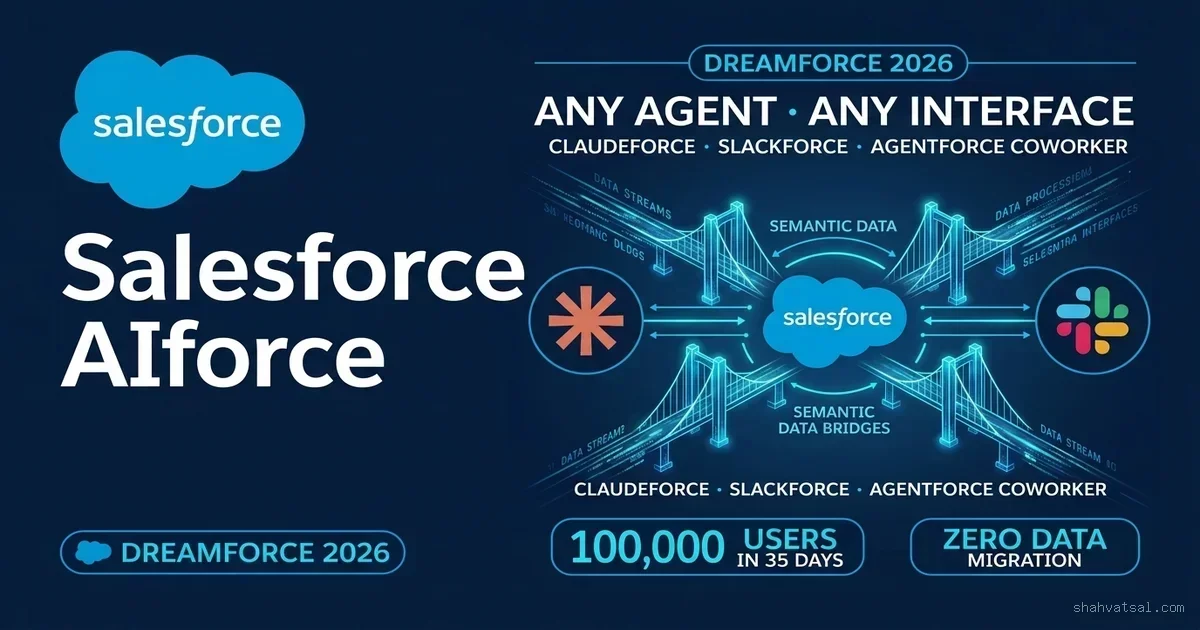
- Ambient CRM Paradigm: On September 15, 2026, at Dreamforce in San Francisco, Salesforce announced AIforce, an ambient interface layer designed to project Salesforce data, business logic, workflows, security permissions, and governance directly into external AI surfaces.
- Three Core Launch Surfaces: Unveiled three specialized interfaces: Claudeforce (deep research and strategic analysis via Anthropic Claude), Slackforce (team collaboration, deal swarms, and incident triage in Slack), and Agentforce Coworker (in-Lightning execution assistant).
- Rapid Adoption Velocity: Salesforce confirmed that 100,000 users activated Agentforce Coworker within its first 35 days, demonstrating rapid enterprise pull for in-flow AI assistants that require zero data re-architecture.
- Zero Migration & Strict Governance: Operates with zero data migration; every query executed by external agents strictly inherits the invoking user's existing Salesforce role-based access control (RBAC), field-level security (FLS), and Einstein Trust perimeter.
- Ecosystem Disambiguation: Completely distinct from earlier Agentforce 3 platform engine announcements, the Fin acquisition agreement (#N106), and the Listen Labs research agreement (#N134); AIforce serves as the ubiquitous client-facing projection tier.
Lead Paragraph
SAN FRANCISCO, California — On September 15, 2026, during its annual Dreamforce conference, Salesforce unveiled AIforce, a transformative interface and integration layer that liberates customer relationship management (CRM) context from the traditional web browser tab. Published via the Salesforce Newsroom, AIforce establishes an open architectural gateway that streams live Customer 360 data, semantic metadata, business logic, and security governance into third-party artificial intelligence surfaces and conversational workspaces. Headlined by three flagship launch surfaces—Claudeforce (built in partnership with Anthropic), Slackforce (bringing ambient agency into Slack channels and canvases), and Agentforce Coworker (an embedded in-Lightning assistant)—the platform eliminates the context switching that has long crippled enterprise productivity. Bolstered by Salesforce's revelation that 100,000 enterprise users activated Agentforce Coworker in its first 35 days with zero data migration, AIforce signals a fundamental strategic pivot: transforming Salesforce from a destination software application into an ubiquitous, trusted enterprise context fabric.
What Happened: The Death of the "CRM Tab"
For over two decades, enterprise software operated under a destination-centric paradigm. If an account executive needed to review quarterly pipeline, a service agent needed to log a support ticket, or an executive needed customer health telemetry, they were forced to open a dedicated browser tab, navigate complex menu hierarchies, and manually parse dozens of database fields.
With the explosive rise of generative AI assistants in 2024 and 2025, a severe operational disconnect emerged:
- Knowledge workers spent their mornings conversing with advanced reasoning models like Anthropic's Claude to draft executive briefings, analyze financial spreadsheets, and write code.
- However, those frontier models possessed zero awareness of customer reality. They had no access to closed-won deal values, open escalated cases, renewal dates, or stakeholder org charts stored inside Salesforce.
- Attempts to manually copy-paste customer data into external chats triggered severe data leakage concerns, violated corporate security policies, and produced stale, ungrounded responses.
┌─────────────────────────────────────────────────────────────────────────────┐
│                       SALESFORCE AIFORCE PLATFORM PROFILE                   │
├───────────────────────────┬─────────────────────────────────────────────────┤
│ Launch Event & Date       │ Dreamforce 2026 (September 15, 2026)            │
├───────────────────────────┼─────────────────────────────────────────────────┤
│ Core Architectural Role   │ Ambient CRM Context & Action Projection Layer   │
├───────────────────────────┼─────────────────────────────────────────────────┤
│ Launch Surface: Surface 1 │ Claudeforce (Anthropic Claude Desktop & Web)    │
├───────────────────────────┼─────────────────────────────────────────────────┤
│ Launch Surface: Surface 2 │ Slackforce (Slack Canvases, Channels & Swarms)  │
├───────────────────────────┼─────────────────────────────────────────────────┤
│ Launch Surface: Surface 3 │ Agentforce Coworker (Native Salesforce Lightning│
├───────────────────────────┼─────────────────────────────────────────────────┤
│ Early Adoption Milestone  │ 100,000 Users Activated Coworker in 35 Days     │
├───────────────────────────┼─────────────────────────────────────────────────┤
│ Data Migration Overhead   │ Zero Migration (Inherits Existing Schema & FLS) │
├───────────────────────────┼─────────────────────────────────────────────────┤
│ Trust & Security Boundary │ Einstein Trust Layer + Model Context Protocol   │
├───────────────────────────┼─────────────────────────────────────────────────┤
│ Target Audience           │ Sales Reps · Support Agents · Revenue Ops · Execs│
└───────────────────────────┴─────────────────────────────────────────────────┘
Salesforce AIforce solves this bifurcation by inverting the integration vector. Instead of forcing workers to bring their work into Salesforce, AIforce projects Salesforce's semantic brain outward into the environments where workers already reside.
Architectural Deep Dive: Projecting Trusted CRM Context Outward
To project proprietary enterprise data into third-party model environments without compromising regulatory compliance, Salesforce engineered a multi-layered projection gateway:
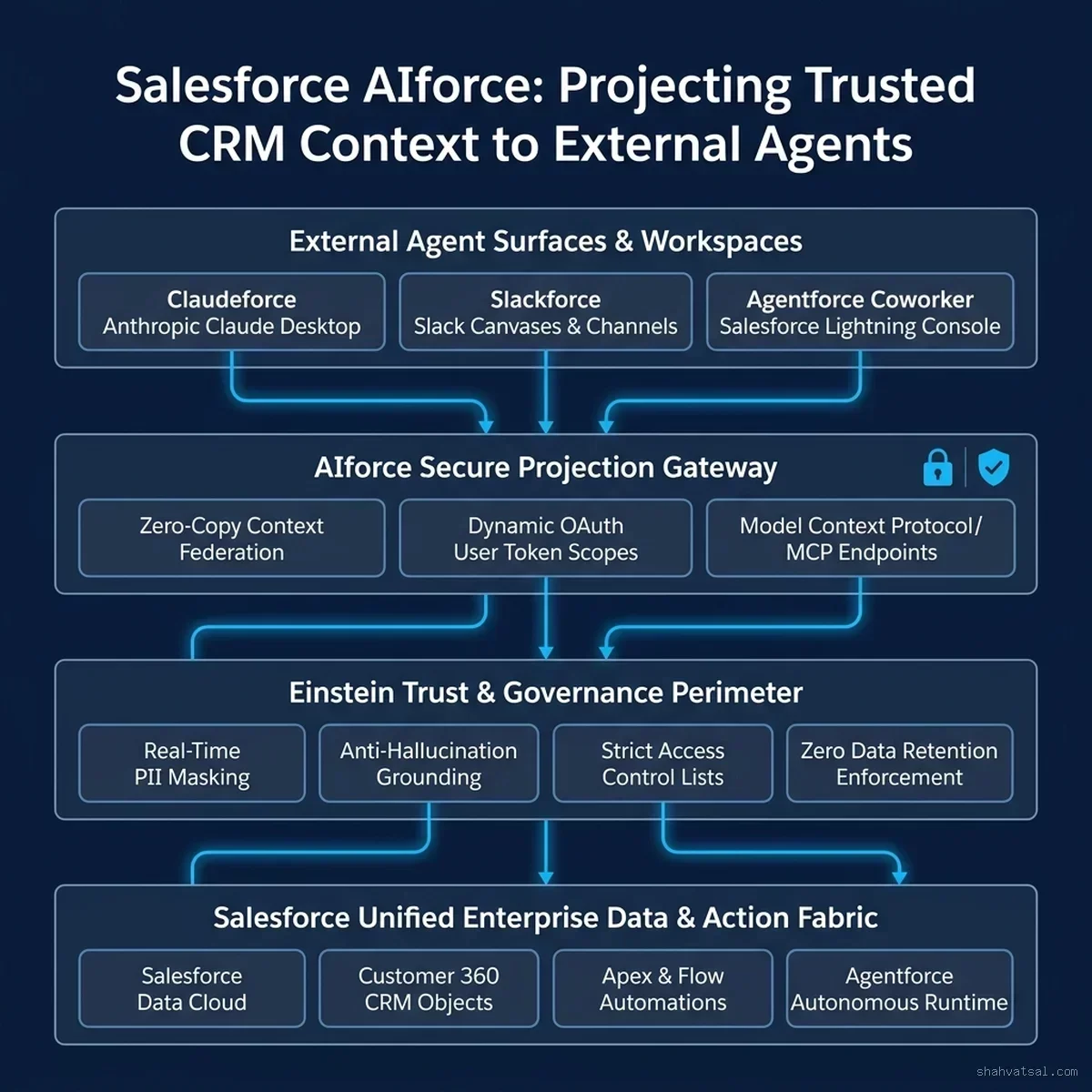
As mapped in the systems architecture diagram above, the AIforce fabric coordinates four distinct structural tiers:
Layer 1: External Agent Surfaces & Workspaces
The consumer layer encompasses the diverse applications where knowledge workers interact:
- Claudeforce: Directly integrates with Anthropic's Claude Desktop and web applications. Utilizing the open Model Context Protocol (MCP), Claudeforce allows Claude to dynamically query Salesforce objects (Opportunities, Contacts, Custom Objects) as native tools during complex analytical sessions.
- Slackforce: Deeply embedded within Slack’s collaboration canvas. When a deal reaches a critical threshold or an outage is detected, Slackforce synthesizes account history, schedules meetings, drafts email responses, and initiates workflow approvals directly inside channel conversation threads.
- Agentforce Coworker: Residing natively inside the Salesforce Lightning Console, Coworker acts as a side-panel copilot that listens to live sales calls, suggests real-time objection-handling points, and automatically populates CRM fields as the conversation progresses.
Layer 2: AIforce Secure Projection Gateway
This layer serves as the intelligent middleware orchestrating external interactions:
- Zero-Copy Context Federation: Rather than replicating petabytes of sensitive CRM tables into third-party data stores, AIforce retrieves only the exact context tokens required for the active conversation turn via real-time API federation.
- Dynamic OAuth User Token Scopes: When an employee queries Claudeforce, the system authenticates using their existing Salesforce identity. An SDR cannot view executive compensation or unassigned territory records in Claude because their underlying Salesforce profile forbids it.
- Model Context Protocol (MCP) Endpoints: Implements standardized MCP servers, allowing any compliant LLM client to discover available Salesforce tools, schemas, and actions programmatically.
Layer 3: Einstein Trust & Governance Perimeter
Before any federated data leaves the Salesforce tenant boundary, it traverses the battle-tested Einstein Trust Layer:
- Real-Time PII Masking: Social security numbers, credit card details, and personal phone numbers are dynamically scrubbed or tokenized before prompt payload assembly.
- Anti-Hallucination Grounding: Prompts are anchored strictly in verified Customer 360 facts, dramatically reducing generative hallucinations.
- Zero Data Retention Enforcement: Governed by strict enterprise agreements ensuring that external frontier model providers (including Anthropic) never retain, log, or train on customer CRM payloads.
Layer 4: Salesforce Unified Enterprise Data & Action Fabric
At the foundation lies the core operational engine of the enterprise:
- Salesforce Data Cloud: Harmonizing structured CRM objects with unstructured telemetry (lakehouse data, web clickstreams, IoT signals).
- Customer 360 Semantic Objects: Preserving complex enterprise relational models (Accounts, Leads, Quotes, Contracts).
- Apex & Flow Automations: Allowing external agents not merely to read data, but to execute governed mutations (e.g., closing a deal stage, updating an ARR value, or dispatching an email) through validated business logic.
- Agentforce Autonomous Runtime: Enabling external surfaces to invoke backend autonomous agents that execute multi-step business processes asynchronously.
Multi-Surface Capabilities Matrix: Claudeforce, Slackforce, and Coworker
A central strength of the AIforce announcement is its deliberate refusal to impose a single interface onto diverse enterprise personas. Each launch surface is calibrated to specific operational workflows:
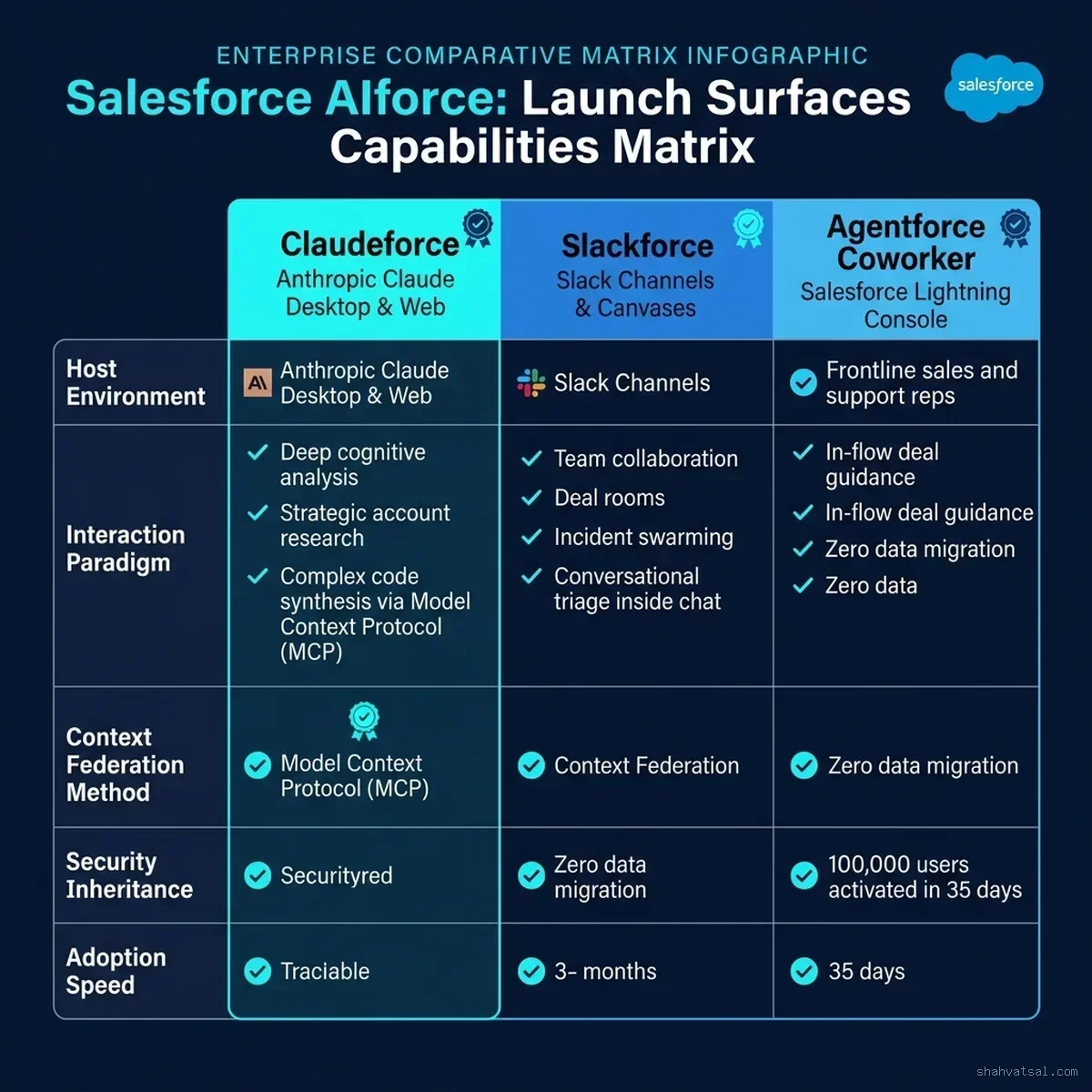
As detailed in the capabilities matrix above, the three launch surfaces address complementary organizational needs:
| Operational Dimension | Claudeforce (Anthropic Claude) | Slackforce (Slack Collaborative) | Agentforce Coworker (Lightning Console) |
|---|---|---|---|
| Primary Host Environment | Anthropic Claude Desktop & Web Client | Slack Channels, DMs, and Interactive Canvases | Native Salesforce Lightning Experience |
| Target User Persona | Enterprise Executives, Strategists, RevOps Analysts | Cross-Functional Teams, Solution Engineers, Deal Swarms | Frontline Account Executives, BDRs, Service Agents |
| Interaction Paradigm | Deep multi-turn cognitive research and strategic modeling | Asynchronous conversational chat and team notifications | In-flow, synchronous copilot and live call guidance |
| Context Delivery Protocol | Model Context Protocol (MCP) tool endpoints | Slack Event API & Webhook context bridges | Native Lightning Component bus and DOM event stream |
| Permission Inheritance | Dynamic OAuth token reflecting user's Salesforce RBAC | User OAuth mapped to Slack Workspace Identity | Exact Salesforce Session Security, Role Hierarchy, & FLS |
| Key Operational Superpower | Synthesizing 50-page QBRs from live pipeline telemetry | Autonomous deal room creation and approval escalation | Instant field updates with zero context switching |
| Adoption Metric (Dreamforce) | General Availability rollout via Claude Desktop | Native Slack app directory integration | 100,000 active users within first 35 days |
This tri-surface approach ensures that whether an employee is deeply focused in Claude doing strategic market analysis, collaborating with colleagues in Slack, or actively navigating accounts in Lightning, Salesforce CRM intelligence remains universally accessible.
The 100,000 Users in 35 Days Metric: Why Zero Migration Matters
During the Dreamforce keynote, Salesforce highlighted a pivotal metric: more than 100,000 enterprise users activated Agentforce Coworker within its first 35 days of availability.
In the enterprise software industry, reaching 100,000 active corporate seats in five weeks is an extraordinarily rare milestone. This rapid adoption velocity was achieved primarily because AIforce eliminates the two traditional friction points that stall enterprise IT rollouts:
- Zero Data Migration Requirement: Traditional enterprise software upgrades demand months of ETL pipeline construction, data mapping workshops, and schema migrations. With AIforce, there is no separate database to populate; Coworker connects instantly to existing standard and custom Salesforce objects.
- Zero Permissions Re-Engineering: Corporate CISOs routinely veto AI projects because establishing new access control lists (ACLs) across hundreds of thousands of documents introduces severe data breach risks. Because AIforce operates strictly within the user's existing Salesforce security context, an organization can toggle the service on globally without spending months auditing permission boundaries.
Dedup & Strategic Disambiguation: Navigating the Salesforce AI Portfolio
Because Salesforce has unveiled several landmark AI initiatives across 2026, it is vital to establish precise boundaries distinguishing AIforce from adjacent announcements:
1. Distinct from Agentforce 3 Core Platform Launch
Earlier in 2026, Salesforce launched Agentforce 3. That release focused on the autonomous backend engine—introducing multi-agent reasoning loops, deterministic trigger topics, and autonomous action planning for unattended background workflows (such as tier-1 customer service chatbots).
- The Distinction: Agentforce 3 is the engine that runs autonomous background agents. AIforce is the ambient delivery network that projects CRM context outward to human knowledge workers using external AI surfaces like Claude and Slack.
2. Distinct from the Fin Acquisition Agreement (#N106)
In June 2026, Salesforce signed a definitive agreement to acquire Fin (Intercom's enterprise customer service AI platform) for approximately $3.6 billion.
- The Distinction: Fin is an external customer-facing resolution bot designed for support contact centers. AIforce is an internal employee-facing context projection layer for sales, ops, and executive workflows.
3. Distinct from the Listen Labs Acquisition Agreement (#N134)
On September 29, 2026, Salesforce announced an agreement to acquire Listen Labs, an AI platform that conducts autonomous qualitative customer interviews across 50M+ global respondents.
- The Distinction: Listen Labs specializes in synthetic market research and consumer feedback interviews. AIforce focuses on enterprise CRM data access and conversational surfaces.
Legal Disclaimers & Regulatory Notices
To maintain absolute intellectual property transparency, regulatory compliance, and factual accuracy, the following notices are formally documented:
┌─────────────────────────────────────────────────────────────────────────────┐
│                       TRADEMARK & COMPLIANCE NOTICE                         │
├─────────────────────────────────────────────────────────────────────────────┤
│ 1. Trademark Ownership: Salesforce, Agentforce, Data Cloud, Customer 360,   │
│    Einstein Trust Layer, Lightning, and the Salesforce cloud logo are       │
│    registered trademarks of Salesforce, Inc. in the United States and other  │
│    countries.                                                               │
│ 2. Third-Party Trademarks: Slack is a registered trademark of Slack         │
│    Technologies LLC (a Salesforce company). Claude and Anthropic are        │
│    trademarks of Anthropic, PBC. Model Context Protocol is an open standard.│
│ 3. Disclosure Verification: The metric of 100,000 active users in 35 days   │
│    reflects official corporate statements published by Salesforce at        │
│    Dreamforce on September 15, 2026. Specific edition pricing schedules are │
│    subject to enterprise contractual negotiations.                          │
│ 4. Editorial Independence: This publication constitutes independent technical│
│    journalism and systems architectural review. No commercial endorsement   │
│    or financial sponsorship by Salesforce, Inc. is expressed or implied.    │
└─────────────────────────────────────────────────────────────────────────────┘
Strategic Implications for Enterprise CIOs and RevOps Leaders
For Chief Information Officers, Chief Revenue Officers, and platform architects navigating enterprise generative AI roadmaps, Salesforce AIforce introduces several critical strategic takeaways:
- Avoid Walled Gardens; Embrace Ambient Surfaces: Enterprise software vendors that attempt to force knowledge workers into proprietary, closed AI chat interfaces will face aggressive user resistance. AIforce demonstrates that the winning strategy is to project trusted data into whatever interface the employee prefers.
- Leverage Existing CRM Investments as the AI Grounding Anchor: Organizations do not need to discard decades of customized Salesforce data models, validation rules, and Apex automations to adopt frontier AI. By using AIforce, those investments become the essential grounding fabric that prevents frontier models from hallucinating.
- Prioritize Zero-Migration Architectures for Fast ROI: When evaluating enterprise AI solutions, IT leaders should heavily prioritize platforms that inherit existing enterprise identity and permissions out of the box, avoiding lengthy implementation delays.
- Standardize on Open Protocols like MCP: As Claude Desktop and other agentic environments adopt the Model Context Protocol, IT leaders should ensure internal data systems expose standardized MCP endpoints to maintain interoperability across evolving frontier models.
As generative AI matures from disconnected conversational parlor tricks into the operating system of the modern corporation, Salesforce AIforce proves that the true value of enterprise software lies not in where users click, but in the trusted context that empowers them to act.
Frequently Asked Questions
What did Salesforce announce regarding AIforce at Dreamforce 2026?
On September 15, 2026, at Dreamforce in San Francisco, Salesforce introduced AIforce, an open projection layer that brings live Salesforce CRM data, semantic business logic, workflows, user permissions, and Einstein Trust governance directly into external AI interfaces and coworker runtimes.
What are the three primary launch surfaces for Salesforce AIforce?
Salesforce announced three distinct launch surfaces: Claudeforce (integrating with Anthropic's Claude Desktop and Web interfaces via Model Context Protocol), Slackforce (embedding collaborative agent workflows and canvases inside Slack), and Agentforce Coworker (an in-Lightning assistant that assists enterprise reps within their daily CRM workflows).
How fast did Agentforce Coworker scale following its initial deployment?
According to Salesforce's verified figures announced at Dreamforce, more than 100,000 enterprise users activated Agentforce Coworker within its first 35 days of availability, driven by its zero-migration architecture that instantly inherits existing organizational permissions.
Does deploying AIforce require migrating enterprise CRM data to external LLMs?
No. AIforce utilizes a zero-copy context federation architecture coupled with the Einstein Trust Layer. Data remains securely inside Salesforce Data Cloud and the customer's tenant boundary, with real-time PII masking, strict access control enforcement, and zero data retention agreements governing external interactions.
How does AIforce differ from the core Agentforce 3 platform launch?
While Agentforce 3 provided the underlying reasoning engine and autonomous trigger architecture for building backend agents, AIforce is the ambient delivery layer that projects that intelligence outward into any interface where knowledge workers spend their day, whether in Claude, Slack, or Lightning.