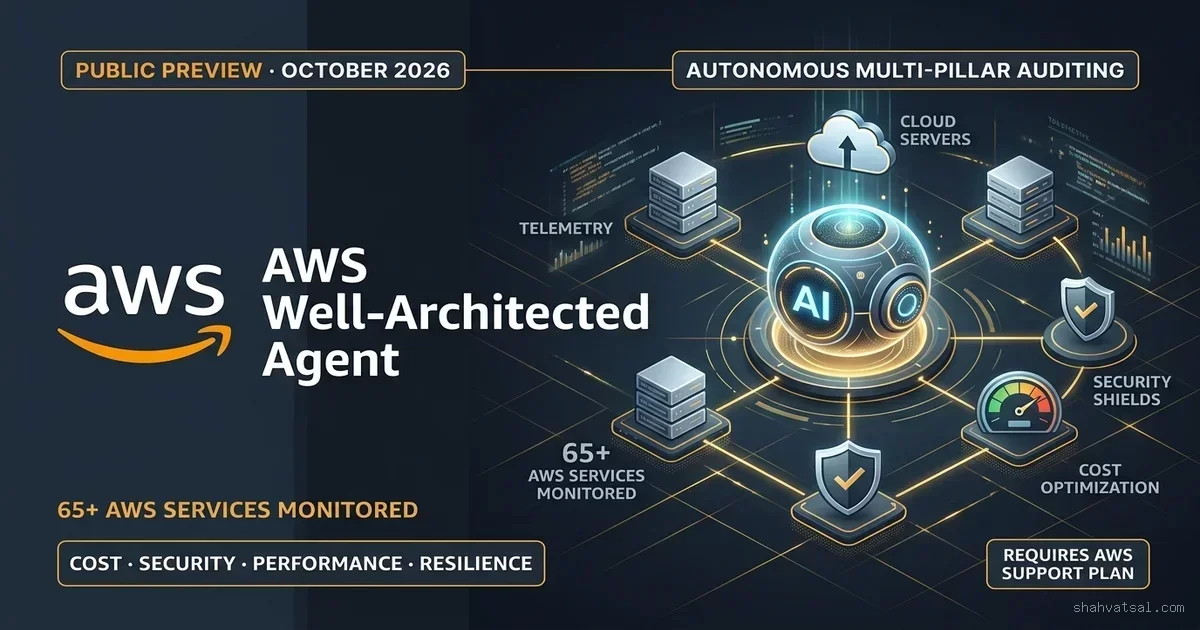
AWS Well-Architected Agent Enters Public Preview: Autonomous Environment Reviews and Multi-Pillar Cloud Optimization
By Vatsal Shah | October 1, 2026 | 9 min read | Source: AWS News Blog
- Public Preview Launch: On October 1, 2026, Amazon Web Services (AWS) launched the public preview of AWS Well-Architected Agent, an autonomous cloud optimization service that continuously analyzes cloud account environments against the AWS Well-Architected Framework.
- Deep 65+ Service Coverage: Operates agentlessly across 65+ core AWS services—including Amazon EC2, Amazon S3, Amazon RDS, AWS Lambda, Amazon EKS, and Amazon CloudFront—ingesting configuration drift and telemetry via AWS Config and CloudTrail.
- Multi-Pillar Tradeoff Analysis: Evaluates four foundational pillars—Cost Optimization, Security Posture, Performance Efficiency, and Operational Resilience (encompassing Reliability and Sustainability)—synthesizing prioritized findings and balancing tradeoffs.
- Automated IaC Remediation: Moves beyond static survey checklists by generating executable CloudFormation and Terraform implementation packages, accompanied by step-by-step rollout runbooks and rollback safeguards.
- Access Prerequisites & Regions: Hosted in US East (N. Virginia), US East (Ohio), and US West (Oregon) with support for workloads across all commercial regions. Access requires an active AWS Support plan (Business or Enterprise Support tier).
- Ecosystem Distinction: Distinct from the OpenAI-powered Bedrock Managed Agents runtime (#N114) and general conversational coding assistants like Amazon Q Developer; this is a dedicated, first-party infrastructure auditor and FinOps/SecOps remediation engine.
Lead Paragraph
SEATTLE, Washington — On October 1, 2026, Amazon Web Services announced the public preview of AWS Well-Architected Agent, introducing an autonomous, AI-driven intelligence layer designed to continuously audit, optimize, and remediate enterprise cloud environments. Published via the official AWS News Blog, the service transforms the historical Well-Architected review—traditionally an infrequent, manual questionnaire conducted every six to twelve months by solutions architects—into a continuous, agentic control loop. By scanning configurations, telemetry, and network topologies across more than 65 AWS services, the agent autonomously identifies high-risk architectural anti-patterns across Cost Optimization, Security, Performance Efficiency, and Operational Resilience. Crucially, the preview is gated behind an active AWS Support plan (Business or Enterprise Support) and operates under a governed human-in-the-loop paradigm, generating validated CloudFormation and Terraform implementation packages rather than performing unverified autonomous mutations on production workloads.
What Happened: The Shift from Manual Checklists to Autonomous Auditing
Since its formal introduction in 2015, the AWS Well-Architected Framework has stood as the gold standard for enterprise cloud engineering. However, the operational reality of executing Well-Architected reviews has long been characterized by significant organizational friction:
- Infrequent Assessment Cadence: Because manual reviews demand days of engineering interviews, documentation retrieval, and architectural diagram inspection, enterprises typically conduct reviews once a year—often right before an audit or after a catastrophic outage.
- Configuration Drift Blind Spots: In modern cloud-native environments characterized by continuous integration and ephemeral microservices, infrastructure drifts daily. A workload certified as "Well-Architected" in January frequently develops critical security holes, orphaned compute resources, and unindexed database queries by March.
- The Implementation Gap: Solutions architects historically produced lengthy PDF reports detailing dozens of "High Risk Issues" (HRIs) and "Medium Risk Issues" (MRIs). Engineering squads, overwhelmed by feature sprint commitments, rarely had the bandwidth to author the custom Infrastructure as Code (IaC) scripts necessary to resolve them.
┌─────────────────────────────────────────────────────────────────────────────┐
│                 AWS WELL-ARCHITECTED AGENT PREVIEW PROFILE                  │
├───────────────────────────┬─────────────────────────────────────────────────┤
│ Announcement Date         │ October 1, 2026                                 │
├───────────────────────────┼─────────────────────────────────────────────────┤
│ Release Status            │ Public Preview (Explicit Preview Label)         │
├───────────────────────────┼─────────────────────────────────────────────────┤
│ Core Technology           │ Autonomous Cloud Optimization Agent             │
├───────────────────────────┼─────────────────────────────────────────────────┤
│ Service Inspection Breadth│ 65+ AWS Services (EC2, S3, RDS, Lambda, EKS...) │
├───────────────────────────┼─────────────────────────────────────────────────┤
│ Core Evaluated Pillars    │ Cost · Security · Performance · Resilience      │
├───────────────────────────┼─────────────────────────────────────────────────┤
│ Primary Deliverable       │ Verified CloudFormation / Terraform IaC Packages│
├───────────────────────────┼─────────────────────────────────────────────────┤
│ Commercial Access Gate    │ Requires Eligible AWS Support Plan (Business/Ent│
├───────────────────────────┼─────────────────────────────────────────────────┤
│ Agent Host Regions        │ us-east-1 (N. Virginia), us-east-2, us-west-2   │
├───────────────────────────┼─────────────────────────────────────────────────┤
│ Workload Scope            │ Any Global Commercial AWS Region                │
├───────────────────────────┼─────────────────────────────────────────────────┤
│ Governance Model          │ Governed Human-in-the-Loop Review Gate          │
└───────────────────────────┴─────────────────────────────────────────────────┘
The AWS Well-Architected Agent bridges this implementation gap. Rather than asking engineers thirty subjective questions in a spreadsheet, the agent directly reads configuration state via AWS Config, analyzes operational traffic patterns via Amazon CloudWatch, and correlates identity boundaries via AWS CloudTrail and AWS IAM Access Analyzer.
Architectural Deep Dive: Multi-Pillar Cloud Intelligence
To understand how the agent unifies disparate telemetry into coherent architectural guidance, consider the multi-tier systems architecture that powers the service:
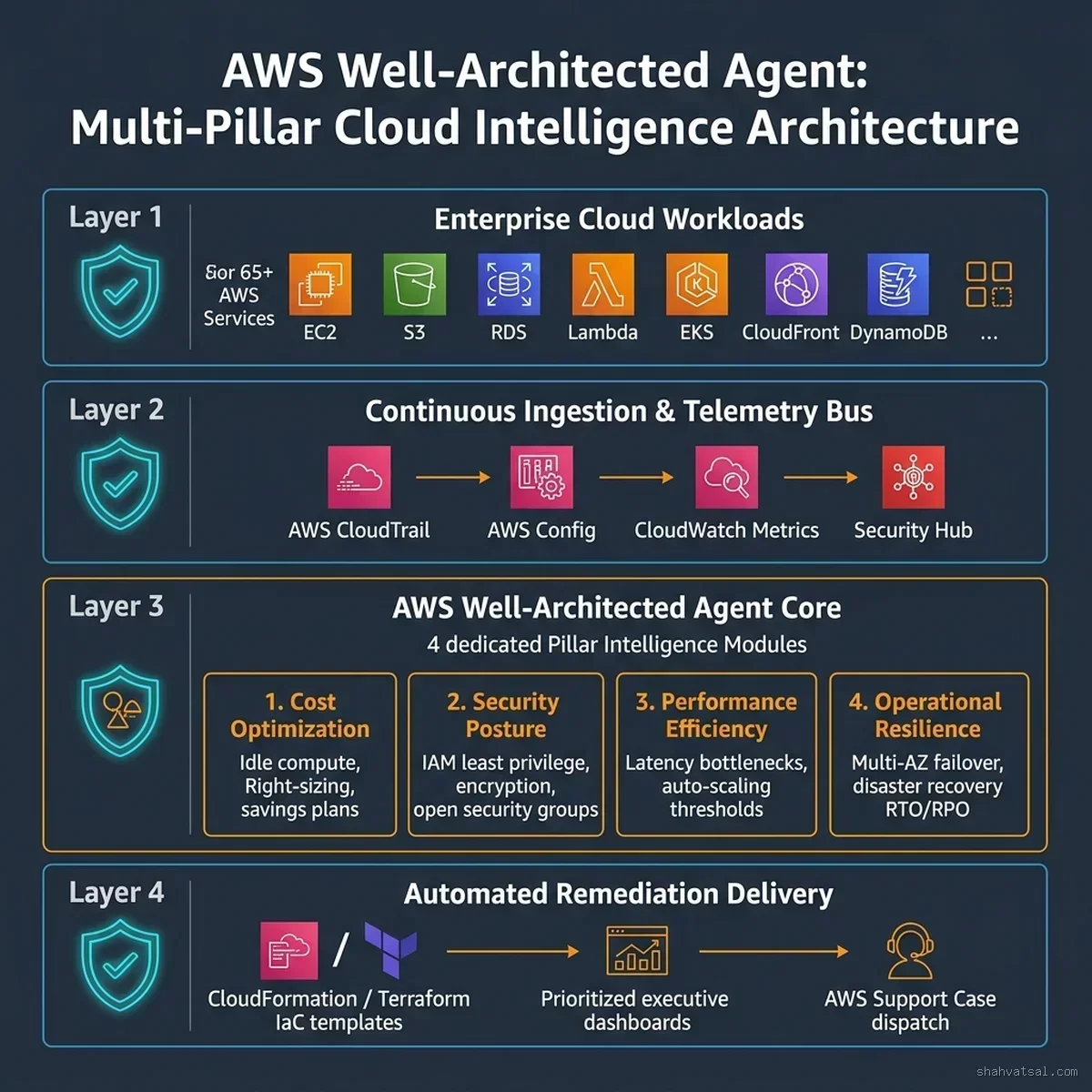
As illustrated in the system architecture diagram above, the service operates across four coordinated layers:
Layer 1: Enterprise Cloud Workloads
The agent monitors the customer's live cloud footprint across more than 65 AWS services. This includes foundational compute (Amazon EC2, AWS Lambda, AWS Fargate), container orchestration (Amazon EKS, Amazon ECS), managed data stores (Amazon Aurora, Amazon DynamoDB, Amazon S3), networking fabrics (Amazon CloudFront, AWS Transit Gateway), and identity perimeters (AWS IAM).
Layer 2: Continuous Ingestion & Telemetry Bus
Unlike legacy auditing tools that flood production APIs with invasive polling scripts, the Well-Architected Agent leverages an asynchronous, event-driven telemetry pipeline:
- AWS CloudTrail: Captures management events, identity assumptions, and administrative API mutations in real time.
- AWS Config: Records configuration history, resource relationships, and compliance drift.
- Amazon CloudWatch: Streams utilization metrics (CPU, memory, IOPS, network ingress/egress, serverless invocation throttles).
- AWS Security Hub: Aggregates findings from GuardDuty, Inspector, and IAM Access Analyzer to eliminate duplicate alert noise.
Layer 3: AWS Well-Architected Agent Core
At the heart of the service sits the reasoning engine, hosted within dedicated AWS secure enclaves across Northern Virginia, Ohio, and Oregon. The engine distributes audit tasks across four specialized pillar modules:
- Cost Optimization Module: Identifies over-provisioned instance families, idle elastic load balancers, unattached EBS volumes, untransitioned S3 tiers, and suboptimal Savings Plans coverage.
- Security Posture Module: Detects wildcard IAM policies, exposed public S3 buckets, unencrypted database snapshots, unrotated KMS keys, and security groups permitting overly permissive ingress (
0.0.0.0/0). - Performance Efficiency Module: Analyzes database query latency, cache hit ratios in ElastiCache and CloudFront, Lambda cold-start overhead, and suboptimal auto-scaling thresholds.
- Operational Resilience Module: Evaluates multi-Availability Zone (Multi-AZ) configurations, cross-region replication health, automated backup retention windows, and RTO/RPO tolerance against sudden zonal impairments.
Layer 4: Automated Remediation Delivery
Rather than stopping at observation, the agent packages solutions into production-ready artifacts:
- Executable IaC Packages: Compiles syntactically verified AWS CloudFormation and HashiCorp Terraform templates that implement the remediation.
- Prioritized Executive Dashboards: Quantifies monthly dollar savings, risk reduction deltas, and resilience scores for VP and C-level stakeholders.
- AWS Support Integration: Automatically links complex remediation plans with dedicated AWS Enterprise Support Technical Account Managers (TAMs) for collaborative advisory.
The Autonomous Remediation Loop: Closed-Loop Continuous Governance
The fundamental breakthrough of the AWS Well-Architected Agent lies in its continuous, five-stage operational lifecycle. Optimization is treated not as a one-time project, but as an automated feedback loop:
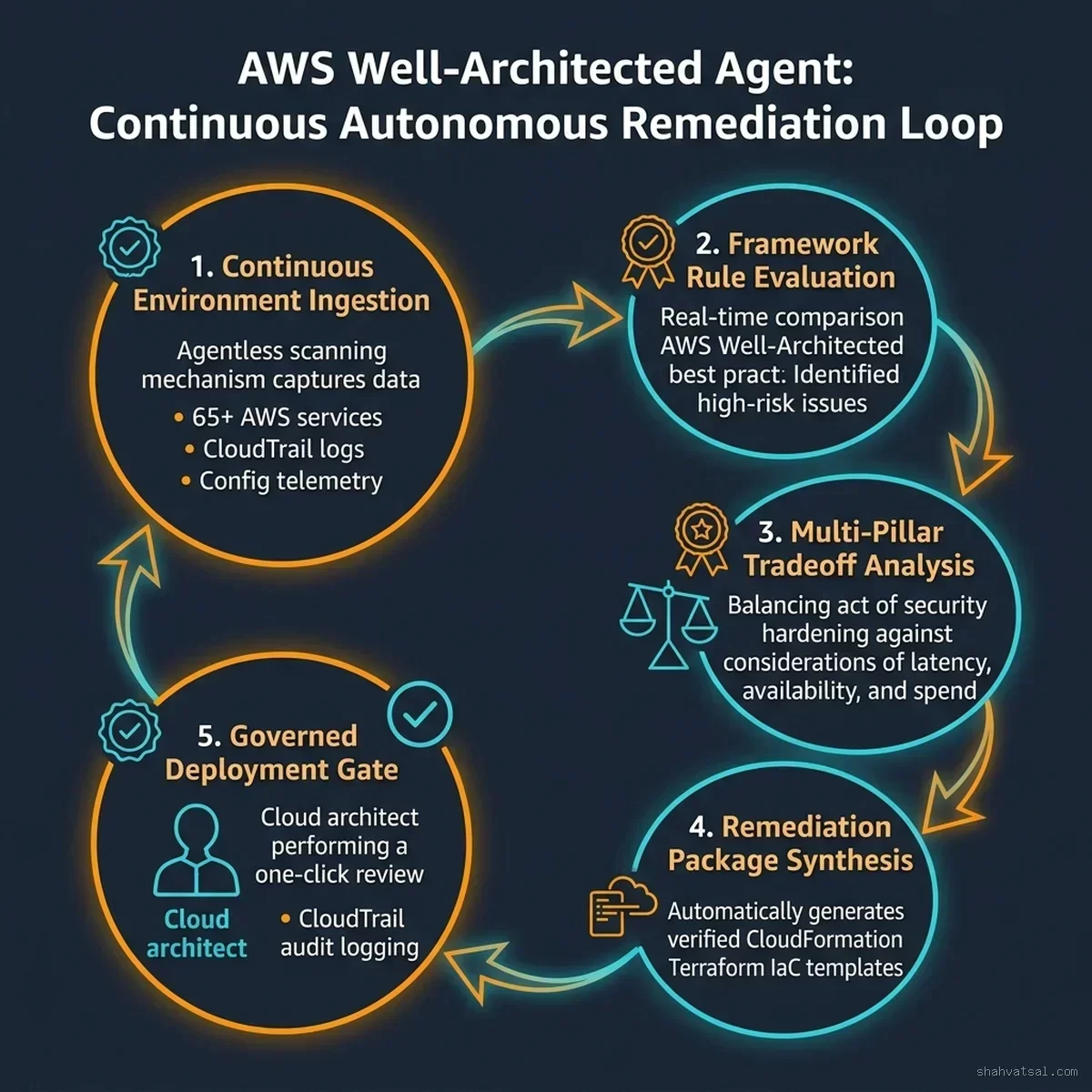
As mapped in the closed-loop process flow above, the agent executes five synchronized phases:
Phase 1: Continuous Environment Ingestion
The agent maintains an agentless footprint. It reads environmental state across all commercial regions, mapping resource interdependencies (e.g., how an API Gateway routes through an Application Load Balancer to a private EKS cluster backed by an Aurora replica).
Phase 2: Framework Rule Evaluation
Live configuration state is continuously compared against thousands of codified Well-Architected best practices, AWS Security Epics, and FinOps benchmarks. Potential violations are flagged as High Risk Issues (HRIs) or Medium Risk Issues (MRIs) based on blast-radius severity.
Phase 3: Multi-Pillar Tradeoff Analysis
Architectural optimization is rarely straightforward; fixing one pillar frequently impacts another. For example, adding multi-region active-active database replication dramatically improves Resilience, but significantly increases Cost and network Latency.
The Well-Architected Agent’s cognitive model explicitly calculates these trade-offs, providing architects with comparative matrices:
- Option A: Maximum resilience with a +22% cost increment.
- Option B: Zonal auto-recovery with a 0% cost increment but an estimated 4-minute RTO.
Phase 4: Remediation Package Synthesis
Once an optimization vector is selected, the agent writes the complete code required to resolve the issue. If an Amazon S3 bucket lacks lifecycle transition rules, the agent outputs both a Terraform block and a CloudFormation changeset, complete with automated rollback scripts in the event of unexpected application errors.
Phase 5: Governed Deployment Gate
To maintain strict enterprise safety, the agent does not unilaterally apply infrastructure mutations in the preview release. The generated remediation package is submitted to the cloud platform engineering team for a one-click review. Every inspection, proposal, and deployment event is permanently recorded in AWS CloudTrail for immutable compliance auditing.
Comparative Assessment: Manual Reviews vs Commercial Tools vs AWS WA Agent
To understand where AWS Well-Architected Agent sits within the enterprise cloud toolset, it is valuable to compare it against existing industry approaches:
| Operational Dimension | Traditional Manual Well-Architected Review | Commercial Third-Party CSPM / FinOps SaaS | AWS Well-Architected Agent (Preview) |
|---|---|---|---|
| Assessment Frequency | Annual or semi-annual manual workshops | Continuous scanning on fixed schedule | Continuous, real-time autonomous event stream |
| Engineering Time Investment | 40–80 engineering hours per workload review | 5–10 hours/week managing alert queues | Near-zero discovery time; minutes for review |
| Service Inspection Breadth | High-level sampling of 10–15 major services | Broad API scanning, often lacks deep service nuances | Native, authoritative telemetry across 65+ AWS services |
| Cross-Pillar Balancing | Subjective discussion among engineers | Siloed (Security tools don't model FinOps costs) | Algorithmic multi-pillar tradeoff balancing |
| Output Deliverable | Static PDF / PowerPoint report | Alert dashboard, Jira ticket webhooks | Ready-to-deploy CloudFormation / Terraform IaC packages |
| Pricing Model | Included in AWS consulting / partner fees | Expensive per-resource monthly SaaS license | Included with eligible AWS Support plans in preview |
| Safety Governance | Advisory only, no code generated | Automated remediation often disabled due to fear | Governed human-in-the-loop review gate with rollback code |
This operational comparison explains why cloud platform leaders are eager to test the preview. Commercial Cloud Security Posture Management (CSPM) and FinOps tools have notoriously overwhelmed platform teams with tens of thousands of disconnected alerts. By consolidating findings under the cohesive philosophy of the Well-Architected Framework and pairing them with executable code, AWS dramatically lowers the barrier to actual remediation.
Ecosystem Disambiguation & Dedup Analysis
Given the intense pace of cloud announcements in early autumn 2026, it is vital to establish strict boundaries distinguishing AWS Well-Architected Agent from adjacent AWS initiatives:
1. Distinct from Amazon Bedrock Managed Agents Powered by OpenAI (#N114)
Announced in late September 2026, Amazon Bedrock Managed Agents powered by OpenAI is an application runtime service. It enables developers to deploy custom AI agents powered by OpenAI models within Bedrock, leveraging AWS IAM per-agent roles and Model Context Protocol (MCP) tool execution.
- The Difference: Bedrock Managed Agents is a developer platform to build customer-facing AI agents. AWS Well-Architected Agent is a first-party operational intelligence agent designed specifically to manage and optimize AWS infrastructure accounts.
2. Distinct from AWS Forward Deployed Engineer Program (#N105)
The AWS Forward Deployed Engineer (FDE) initiative is a high-touch professional services program where human AWS principal engineers embed directly with enterprise customers on multi-million dollar transformation engagements. The Well-Architected Agent is a self-service, software-based autonomous platform.
3. Distinct from Amazon Q Developer Chat
While developers can ask Amazon Q conversational questions inside the AWS Management Console or IDE, Amazon Q operates as an interactive developer assistant. AWS Well-Architected Agent operates autonomously in the background, conducting continuous account-wide audits without requiring interactive user prompting.
Legal Disclaimers & Regulatory Notices
To ensure full compliance, copyright adherence, and clear intellectual property representation, the following notices are formally established:
┌─────────────────────────────────────────────────────────────────────────────┐
│                       TRADEMARK & REGULATORY NOTICE                         │
├─────────────────────────────────────────────────────────────────────────────┤
│ 1. Trademark Attribution: Amazon Web Services, AWS, the AWS logo,           │
│    Amazon EC2, Amazon S3, Amazon RDS, AWS Lambda, Amazon EKS, CloudFront,    │
│    CloudTrail, CloudWatch, AWS Config, and AWS Well-Architected are         │
│    registered trademarks or trademarks of Amazon.com, Inc. or its           │
│    affiliates in the United States and other jurisdictions.                 │
│ 2. Third-Party Trademarks: HashiCorp Terraform is a trademark of HashiCorp, │
│    Inc. All other corporate marks belong to their respective owners.        │
│ 3. Preview Release Status: AWS Well-Architected Agent is in Public Preview   │
│    as of October 1, 2026. Features, regional availability, service coverage,│
│    and support plan requirements are subject to modification prior to       │
│    General Availability (GA).                                               │
│ 4. Editorial Independence: This publication constitutes independent technical│
│    cloud architecture analysis. No commercial sponsorship or endorsement    │
│    by Amazon Web Services, Inc. is expressed or implied.                    │
└─────────────────────────────────────────────────────────────────────────────┘
Strategic Recommendations for Cloud Platform Leaders
For Chief Technology Officers, VP of Cloud Infrastructure, and Principal Cloud Architects evaluating the AWS Well-Architected Agent preview, the following adoption guidelines are recommended:
- Verify AWS Support Plan Eligibility: Ensure the target organization maintains an active AWS Business Support or Enterprise Support agreement, as basic and developer support tiers are excluded from the initial public preview.
- Onboard Non-Production Sandbox Accounts First: While the agent uses an agentless read-only telemetry model, pilot the service initially on development, staging, and sandbox AWS Organizations organizational units (OUs) to evaluate the quality and accuracy of the generated CloudFormation and Terraform remediation scripts.
- Establish a Dedicated Platform Review Board: Implement a weekly 30-minute review cadence where senior cloud architects evaluate the agent’s generated remediation packages, reviewing cross-pillar tradeoffs before triggering pipeline deployments.
- Integrate with Existing GitOps Pipelines: Rather than applying generated IaC templates directly through the console, route the agent’s output into existing Git pull request workflows (e.g., GitHub Actions, GitLab CI/CD, or AWS CodePipeline), ensuring standard peer-review, policy-as-code (OPA/Conftest), and canary deployment practices remain active.
As enterprise cloud environments expand in scale and complexity, the launch of AWS Well-Architected Agent marks a decisive milestone: the evolution of cloud architecture from static, episodic documentation into a living, continuous, and autonomous engineering discipline.
Frequently Asked Questions
What did AWS announce regarding AWS Well-Architected Agent?
On October 1, 2026, AWS announced the public preview of AWS Well-Architected Agent, an AI-powered autonomous intelligence service that continuously scans cloud workloads across 65+ AWS services, maps configurations against the AWS Well-Architected Framework, and generates validated Infrastructure as Code (IaC) remediation packages.
What pillars of the AWS Well-Architected Framework does the agent review?
The agent primarily evaluates workloads across Cost Optimization, Security Posture, Performance Efficiency, and Operational Resilience (incorporating Reliability and Sustainability), balancing cross-pillar tradeoffs before recommending architectural changes.
What are the prerequisite requirements to access the AWS Well-Architected Agent preview?
Access to the preview requires an active, eligible AWS Support plan (such as AWS Business Support or AWS Enterprise Support). The agent itself is hosted out of US East (N. Virginia), US East (Ohio), and US West (Oregon), with the ability to audit workloads deployed in any commercial AWS Region.
How does AWS Well-Architected Agent differ from Amazon Bedrock Managed Agents powered by OpenAI?
Amazon Bedrock Managed Agents powered by OpenAI (previewed in late September 2026 under #N114) provides an application development runtime allowing developers to host custom OpenAI agents on AWS. In contrast, AWS Well-Architected Agent is a specialized, first-party AWS infrastructure optimization agent that audits and remediates customer AWS cloud accounts directly against AWS architectural best practices.
Does the agent execute architectural changes automatically without human approval?
No. AWS Well-Architected Agent operates under a governed, human-in-the-loop deployment model. It discovers anti-patterns, models tradeoffs, and synthesizes ready-to-deploy CloudFormation or Terraform remediation templates. Cloud architects review and approve changes before any production modification is executed.