Dynatrace Closes $915M Arize Acquisition: Unifying Davis AI with Open-Source Phoenix and Enterprise Agent Observability
By Vatsal Shah | October 1, 2026 | 11 min read | Source: Dynatrace Press Room & SEC Filings
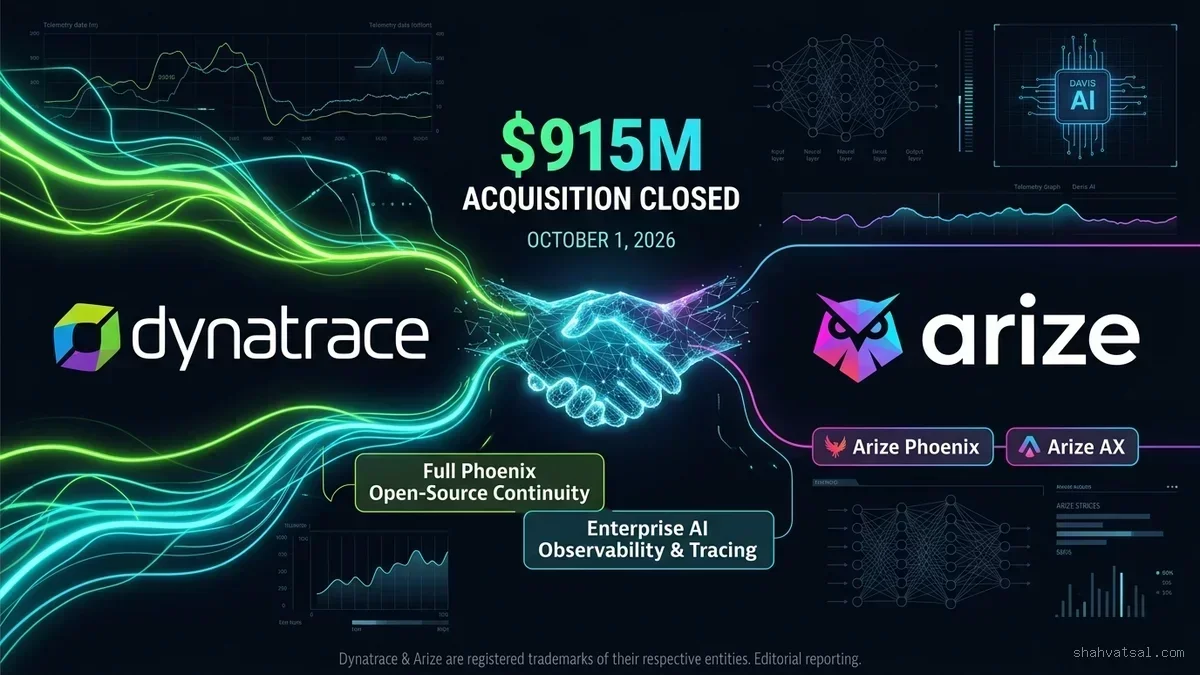
- Formal Transaction Close: On October 1, 2026, Dynatrace (NYSE: DT) completed its acquisition of AI observability leader Arize AI, Inc., finalizing the definitive agreement originally announced on August 13, 2026.
- $915 Million Aggregate Valuation: The total consideration stands at approximately $915 million, comprising roughly $815 million in cash funded through cash-on-hand and existing revolving credit lines, alongside $100 million in unvested equity retention awards for core technical leadership.
- Arize Phoenix Open-Source Commitment: Dynatrace confirmed that Arize Phoenix—the industry-standard open-source evaluation and tracing engine—will remain strictly open source under its Apache 2.0 license, maintaining autonomous development roadmaps and vendor neutrality.
- Bridging Davis AI & Grail to Agent Telemetry: The acquisition unifies Arize’s pre-production evaluations and LLM guardrails with Dynatrace’s Davis hypermodal causal AI and Grail massively parallel data lakehouse, closing the gap between infrastructure metrics and cognitive agent workflows.
- The Dev-to-Prod Observability Loop: Delivers an integrated lifecycle: developers evaluate prompts and agents locally via Phoenix, gate deployments inside CI/CD pipelines, monitor production multi-agent systems via OneAgent, and capture semantic drift back into evaluation datasets.
- Clear Market Separation: Distinct from AI compliance policy tooling (such as Collibra’s purchase of trail ML) and packaged CRM agent bots (such as Salesforce’s acquisition of Fin AI); this represents the largest pure-play AI telemetry and diagnostics transaction of 2026.
Lead Paragraph
WALTHAM, Massachusetts — On October 1, 2026, global observability and security automation leader Dynatrace officially announced the completion of its $915 million acquisition of Arize AI, Inc. The closing finalizes the definitive merger agreement struck on August 13, 2026, marking the observability sector’s most significant strategic consolidation in the generative AI era. Funded through approximately $815 million in cash alongside $100 million in performance-vesting equity awards, the transaction unites Dynatrace’s enterprise-grade infrastructure monitoring, Davis AI causal intelligence engine, and Grail data lakehouse with Arize’s market-leading Arize AX enterprise platform and widely adopted open-source Arize Phoenix tracing library. Crucially, Dynatrace reaffirmed that Phoenix will remain independent and open source, while the combined technical architecture establishes the industry's first true "dev-to-prod" telemetry loop—enabling software engineering teams to evaluate autonomous agents in local development, validate benchmarks across automated CI/CD gates, and diagnose complex distributed multi-agent failures in live enterprise production.
What Happened: Completing the $915M Enterprise AI Observability Deal
The transaction closed following standard regulatory clearances and shareholder approvals across late August and September 2026. While the initial agreement was publicized in mid-August, the October 1 close formalizes the operational combination, organizational alignment, and immediate integration milestones between Dynatrace’s engineering teams in Waltham and Linz, Austria, and Arize AI’s hubs in San Francisco and Berkeley.
| Transaction Attribute | Verified Contractual Specification |
|---|---|
| Acquiring Entity | Dynatrace LLC / Dynatrace, Inc. (NYSE: DT) |
| Target Entity | Arize AI, Inc. (San Francisco, CA) |
| Announcement Date (Agreement) | August 13, 2026 |
| Closing Date (Completion) | October 1, 2026 |
| Total Transaction Consideration | ~$915 Million USD Aggregate Value |
| Cash Consideration | ~$815 Million USD (Cash on hand & revolving credit facilities) |
| Equity Consideration / Retention | ~$100 Million USD (Unvested equity awards for key technical founders & staff) |
| Core Software Assets Acquired | Arize Enterprise Platform (Arize AX), Arize Phoenix (Open Source), Prompt Evaluation Harnesses |
| Open-Source Licensing Disposition | Arize Phoenix remains 100% Open Source under Apache 2.0 License |
| Core Integration Targets | Dynatrace Davis AI, Grail Data Lakehouse, OneAgent Telemetry, Smartscape Topology |
The acquisition directly addresses a severe structural disconnect that emerged as Fortune 500 enterprises scaled autonomous AI agents from experimental proofs-of-concept into mission-critical production workflows.
Historically, corporate IT operations relied on traditional Application Performance Monitoring (APM) to track CPU spikes, memory leaks, and HTTP response latencies. However, an autonomous agent can exhibit a pristine 200 OK HTTP status code with 120ms latency while simultaneously hallucinating false revenue numbers, failing a vector database semantic retrieval, or falling into an infinite loop of redundant tool calls. Arize AI established itself as the pioneering authority in diagnosing these cognitive and semantic failures. By bringing Arize under the Dynatrace umbrella, enterprise customers gain a unified pane of glass capable of tracing an infrastructure failure from a physical NVIDIA GPU cluster up through an agent's multi-step chain-of-thought reasoning graph.
The Dev-to-Prod AI Evaluation & Observability Loop
The centerpiece of the combined Dynatrace and Arize product roadmap is the elimination of the "eval-runtime wall." Prior to this merger, software engineers performed prompt experimentation and benchmark evaluation in isolated Python notebooks using open-source tools, while Site Reliability Engineers (SREs) and platform architects monitored production infrastructure in separate enterprise APM consoles.
The newly formalized Dynatrace + Arize Dev-to-Prod AI Evaluation & Observability Loop establishes a closed-circuit feedback loop across four continuous lifecycle phases:
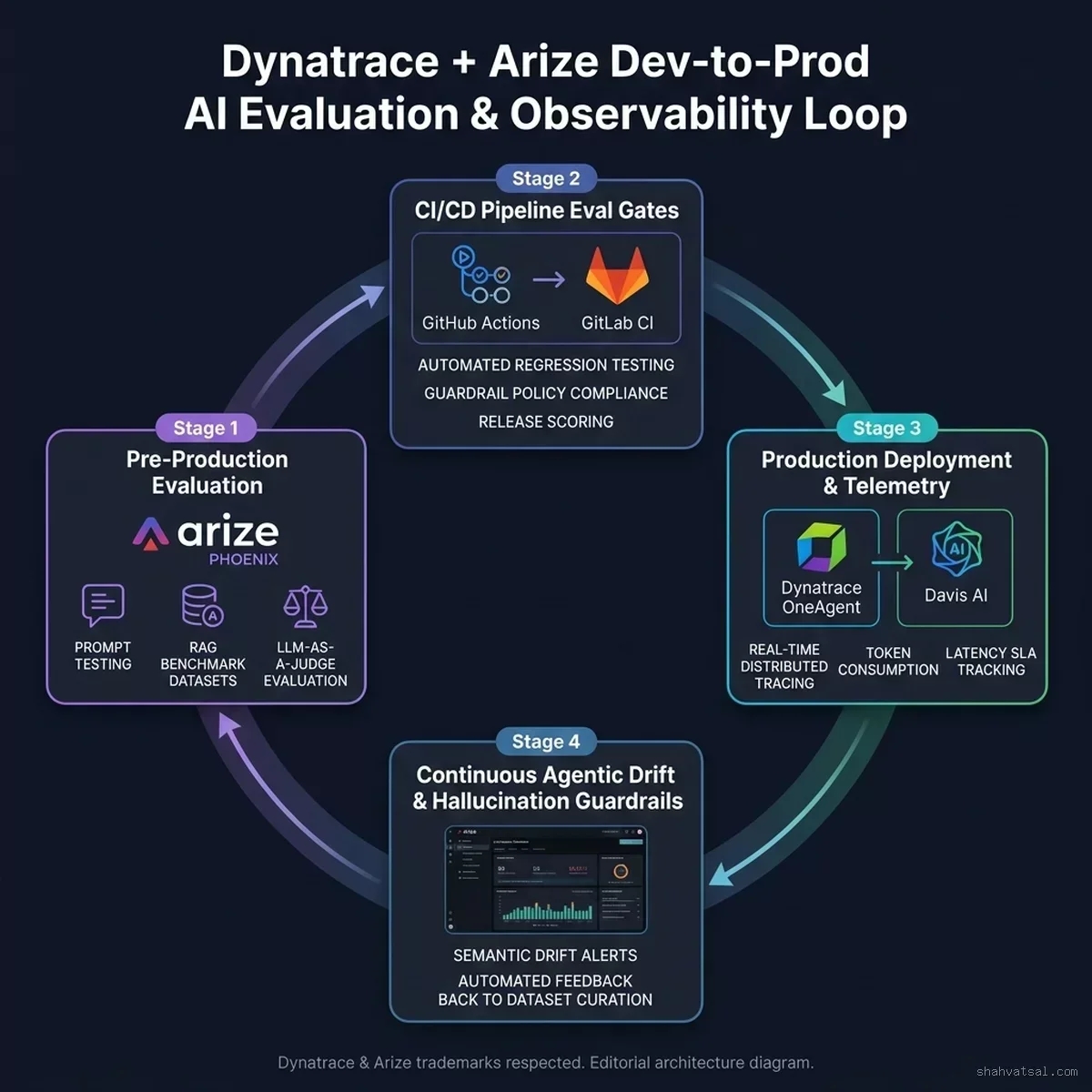
Stage 1: Pre-Production Evaluation (Arize Phoenix)
Development teams authoring generative AI applications and multi-agent workflows begin inside local development environments:
- Zero-Friction Tracing: Developers import
arize-phoenixvia PyPI or npm. The library automatically instruments major agent frameworks—including LangChain, LlamaIndex, AutoGen, CrewAI, and the Model Context Protocol (MCP)—via OpenTelemetry standard semantic conventions. - RAG & Agent Benchmark Datasets: Test datasets containing curated golden question-and-answer pairs, ground-truth documents, and expected agent tool invocation sequences are executed against prospective model checkpoints.
- LLM-as-a-Judge Scoring: Automated evaluators compute quantitative scores for hallucination rates, answer relevance, context recall, toxicity, and tool-call accuracy before a single line of code is pushed to version control.
Stage 2: CI/CD Pipeline Eval Gates
As code is committed to Git repositories, automated CI/CD workflows (such as GitHub Actions, GitLab CI, or Jenkins) trigger strict quality gates:
- Regression Testing: Candidate prompts, modified system instructions, or upgraded foundation model endpoints are evaluated against regression suites.
- Deterministic Thresholds: Release pipelines enforce deterministic thresholds (e.g., minimum 96.5% context relevancy and zero critical security policy violations). If an updated system prompt induces reasoning regression or safety drift, the pipeline fails automatically, preventing deployment.
- Policy Compliance Attestation: Evaluation scores are cryptographically logged to establish audit trails for organizational governance.
Stage 3: Production Deployment & Telemetry (Dynatrace OneAgent & Davis AI)
When agent services pass pipeline gates and deploy into production Kubernetes clusters or serverless cloud environments, Dynatrace's operational engine assumes real-time telemetry capture:
- OneAgent Auto-Discovery: Dynatrace OneAgent automatically detects containerized Python, Node.js, and Go agent runtimes, injecting distributed tracing headers across the entire microservice mesh without manual code modification.
- Davis AI Root-Cause Diagnostics: Dynatrace's Davis hypermodal AI monitors infrastructure health, Kubernetes pod lifecycles, and database latencies, correlating upstream infrastructure anomalies directly with agent response degradations.
- Token Economics & Latency Tracking: Real-time dashboards meter prompt and completion token consumption, inference cost per user session, and multi-turn conversational latency SLAs across hybrid clouds.
Stage 4: Continuous Agentic Drift & Hallucination Guardrails (Arize AX)
In live production, user interactions inevitably diverge from synthetic pre-production test datasets:
- Semantic Drift Detection: Arize AX continuously calculates embedding drift across user queries, detecting when production query distributions drift into domains where the model exhibits high uncertainty.
- Online Guardrail Scoring: A configurable fraction of live production inference traces is routed through asynchronous LLM-as-a-judge evaluation pipelines to flag toxic outputs, ungrounded answers, or unauthorized tool executions.
- Automated Feedback Loop: Failing production traces and low-confidence sessions are automatically tagged, masked for data privacy, and fed back into Stage 1 as new ground-truth benchmark datasets, continuously fortifying future evaluation cycles.
Architectural Deep Dive: The Unified Observability Stack
To appreciate how Dynatrace and Arize function mechanically, consider the four-layer architectural topology powering the unified platform:
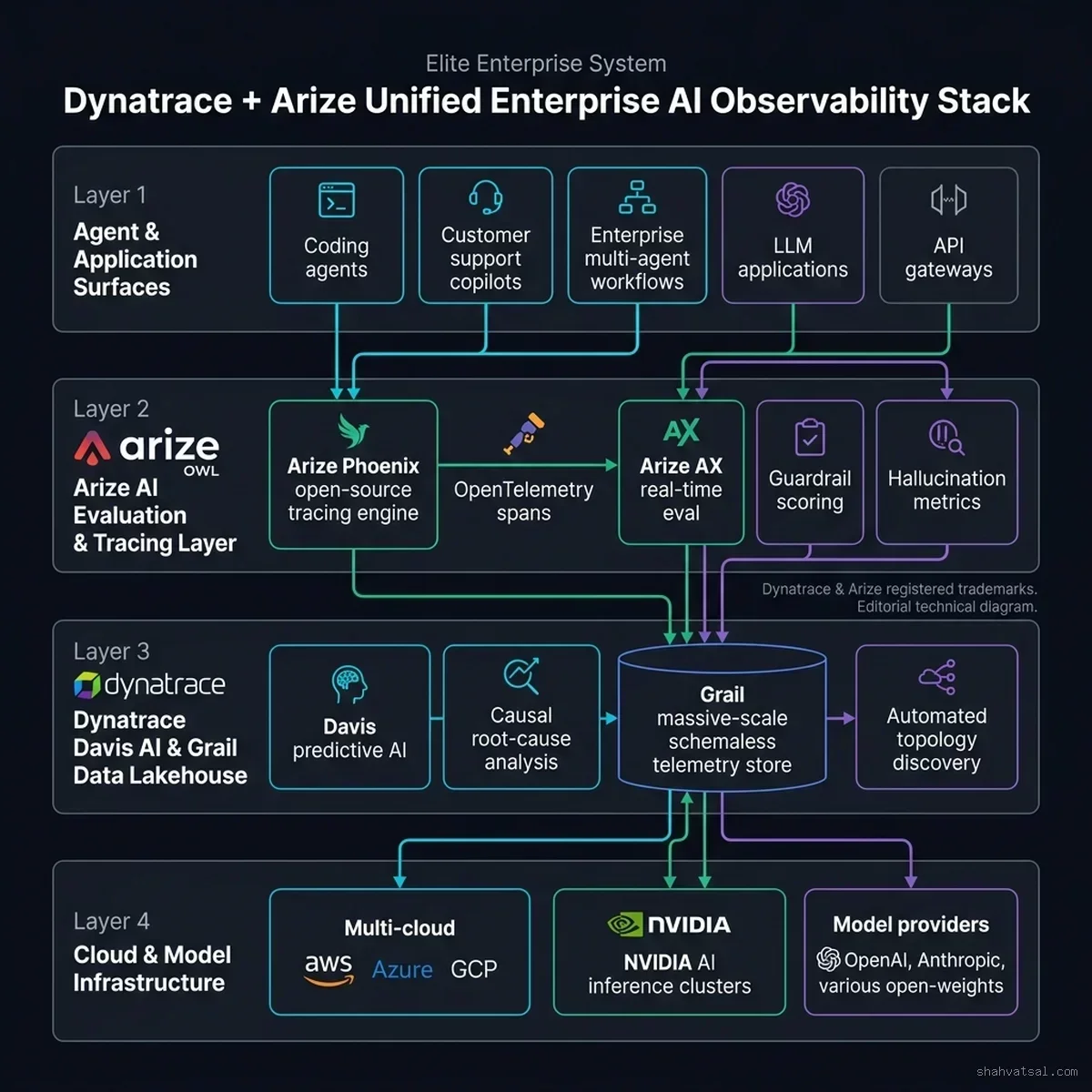
Layer 1: Agent & Application Surfaces
At the user and application perimeter sit diverse enterprise workloads:
- Autonomous Coding Agents: Tools executing iterative code refactoring, test generation, and automated pull requests (e.g., Cursor, Claude Code, GitHub Copilot).
- Customer Support Copilots: High-consequence customer-facing conversational agents interacting with CRM backends and ERP systems.
- Enterprise Multi-Agent Orchestrations: Complex supervisor-worker frameworks delegating business logic across specialized sub-agents via standardized protocols.
- API Gateways & RAG Pipelines: Semantic routers, vector search endpoints, and retrieval-augmented generation pipelines interfacing with internal corporate knowledge stores.
Layer 2: Arize AI Evaluation & Tracing Layer
This layer captures semantic, cognitive, and linguistic telemetry:
- Arize Phoenix Open-Source Tracing Engine: Collects standardized OpenTelemetry (OTel) traces containing prompt inputs, model responses, temperature settings, and tool inputs.
- OTel Semantic Spans: Translates multi-turn reasoning steps into standard spans (
gen_ai.system,gen_ai.request.model,gen_ai.prompt,gen_ai.usage.completion_tokens). - Arize AX Real-Time Evaluation Engine: Performs real-time classification, computing context precision, semantic similarity, and guardrail enforcement scores across streaming spans.
- Hallucination & Drift Vector Spaces: Maps high-dimensional text embeddings into lower-dimensional projections (UMAP/t-SNE) to isolate semantic clustering and data anomalies visually.
class="tok-cm"># Canonical Example: Instrumenting an Enterprise Agent with Phoenix OpenTelemetry
from opentelemetry import trace
from arize.otel import register_arize_otlp_exporter
from phoenix.otel import register_phoenix_tracer_provider

class="tok-cm"># Step 1: Initialize open-source Phoenix local tracer
tracer_provider = register_phoenix_tracer_provider(
    project_name=class="tok-str">"enterprise-billing-agent",
    endpoint=class="tok-str">"http:class="tok-cm">//localhost:6006/v1/traces"
)

class="tok-cm"># Step 2: Configure production dual-egress to Dynatrace Grail Lakehouse
register_arize_otlp_exporter(
    tracer_provider=tracer_provider,
    arize_space_id=class="tok-str">"prod-finance-workspace",
    arize_api_key=class="tok-str">"arize_sec_prod_live_2026",
    dynatrace_otlp_endpoint=class="tok-str">"https:class="tok-cm">//{dt_environment_id}.live.dynatrace.com/api/v2/otlp/v1/traces"
)

tracer = trace.get_tracer(class="tok-str">"agent.orchestrator")

class="tok-kw">def execute_governed_agent_step(user_prompt: str, context_documents: list):
    with tracer.start_as_current_span(class="tok-str">"agent_reasoning_cycle") as span:
        span.set_attribute(class="tok-str">"gen_ai.system", class="tok-str">"anthropic")
        span.set_attribute(class="tok-str">"gen_ai.request.model", class="tok-str">"claude-sonnet-5-5")
        span.set_attribute(class="tok-str">"agent.retrieval_docs_count", len(context_documents))

        class="tok-cm"># Invoke agent execution logic...
        response, latency_ms, eval_score = run_agent_inference(user_prompt, context_documents)

        class="tok-cm"># Attach semantic evaluation attributes ingested by Davis AI & Arize AX
        span.set_attribute(class="tok-str">"arize.eval.faithfulness", eval_score[class="tok-str">"faithfulness"])
        span.set_attribute(class="tok-str">"arize.eval.context_relevancy", eval_score[class="tok-str">"context_relevancy"])
        span.set_attribute(class="tok-str">"dynatrace.sla.compliant", eval_score[class="tok-str">"faithfulness"] > 0.95)
        return response
Layer 3: Dynatrace Davis AI & Grail Data Lakehouse
The core analytical brain and storage lakehouse of the enterprise:
- Dynatrace Grail Data Lakehouse: A schemaless, parallel processing data store optimized for massive ingest volumes. Grail natively indexes unstructured logs, structured OpenTelemetry traces, time-series metrics, and high-dimensional vector embeddings without requiring brittle upfront database schema migrations.
- Davis Predictive & Causal AI: Unlike probabilistic LLMs that guess correlations, Davis utilizes deterministic causal topology graphs. It traces an observed decline in agent response relevancy backwards through the dependency chain—discovering, for instance, that an unannounced PostgreSQL index rebuilding job increased vector database query latency, which caused the agent's context retriever to time out and fall back to outdated cached documents.
- Smartscape Topology Discovery: Maps every agent entity to its hosting container, cloud compute instance, and underlying network connection automatically.
Layer 4: Cloud & Model Infrastructure
The physical and virtual foundations underpinning execution:
- Hyperscaler Cloud Environments: AWS, Microsoft Azure, and Google Cloud infrastructure hosting distributed container clusters and microservices.
- NVIDIA AI Inference Clusters: DGX supercomputing nodes, H100/B200 GPU instances, and liquid-cooled inference racks running private open-weight models (e.g., Llama 4, DeepSeek, GLM).
- External Foundation Model APIs: Commercial frontier model endpoints including OpenAI, Anthropic, Google, and specialized domain models.
The Strategic Importance of Keeping Arize Phoenix Open Source
A major point of inquiry following the August announcement was whether Dynatrace would restrict or monetize Arize Phoenix. In proprietary enterprise software acquisitions, parent companies have occasionally relicensed open-source projects under restrictive source-available or commercial licenses, alienating open-source contributors and developer ecosystems.
Dynatrace’s leadership took decisive steps on October 1 to quash these concerns:
- Unconditional Apache 2.0 Licensing: Phoenix remains licensed under the Apache 2.0 open-source license. The repository on GitHub (
Arize-ai/phoenix) remains open to all community contributions, independent bug fixes, and external integrations. - Dedicated Open-Source Engineering Budget: Dynatrace committed multi-year engineering and developer-relations funding specifically earmarked for the Phoenix core maintainer team.
- Vendor Neutrality: Phoenix will continue to maintain first-class export compatibility with rival observability platforms, local visualizers, and standard OpenTelemetry collectors. Dynatrace recognizes that winning developer mindshare requires unencumbered adoption in the earliest phases of code authorship.
- Complementary Product Funnel: The commercial synergy relies on a natural scale transition: developers utilize open-source Phoenix locally on individual workstations; when their multi-agent systems scale to thousands of concurrent enterprise users requiring multi-tenant RBAC, SOC 2 compliance, petabyte-scale Grail storage, and Davis AI causal analysis, organizations seamlessly upgrade to Dynatrace and Arize AX.
Market Landscape & Ecosystem Deduplication Analysis
The autumn of 2026 has witnessed unprecedented merger and acquisition activity across the cloud, AI, and developer tools sectors. To ensure contextual accuracy, this transaction is formally differentiated from concurrent market developments:
| Recent Industry Move | Acquiring / Sponsoring Entity | Acquired / Released Entity | Core Focus Area | Distinction from Dynatrace × Arize |
|---|---|---|---|---|
| Dynatrace × Arize (#N117) | Dynatrace LLC | Arize AI, Inc. ($915M) | Full-Stack AI Observability & Tracing | Primary Subject: Unifies infrastructure APM with LLM-as-a-judge evaluations and open-source Phoenix. |
| Collibra × trail ML (#N116) | Collibra | trail ML (Munich) | AI Governance & Regulatory Compliance | Focuses on policy enforcement, risk assessments, and EU AI Act compliance, not operational telemetry or tracing. |
| Salesforce × Fin AI (#N106) | Salesforce | Fin AI / Intercom ($3.6B) | Autonomous Customer Service Agents | Focuses on pre-packaged CRM resolution bots for Agentforce, rather than monitoring general third-party LLMs. |
| SAP × Dremio (#N107) | SAP | Dremio | Data Lake Query Federation | Targets analytical SQL querying over Apache Iceberg data lakes, possessing zero native LLM evaluation capabilities. |
| AWS Bedrock Managed Agents (#N114) | Amazon Web Services | OpenAI Agent Hosting | Cloud Managed Agent Runtime | An infrastructure hosting runtime inside AWS Bedrock, not an independent multi-cloud telemetry and diagnostics platform. |
| NVIDIA × Hugging Face (#N139) | NVIDIA Corporation | Hugging Face ($12.93B) | Open Model Hub & Compute Infrastructure | An ecosystem play unifying hardware acceleration with model weight distribution, operating above the telemetry layer. |
Technical Comparison: Traditional APM vs. Combined Dynatrace + Arize AI Platform
To understand why this $915 million transaction changes the economics of enterprise observability, review the functional capabilities across traditional APM and the unified Dynatrace + Arize platform:
| Observability Capability | Legacy APM Platform (Pre-2025 Standard) | Standalone LLM Eval Library | Unified Dynatrace + Arize Platform (2026) |
|---|---|---|---|
| Infrastructure Telemetry | Full metrics (CPU, RAM, Disk, Network) | None | Full metrics across Kubernetes, cloud pods, and GPUs |
| Distributed Tracing | Standard OpenTelemetry HTTP/gRPC spans | None | OpenTelemetry spans enriched with cognitive agent steps |
| LLM Semantic Inputs/Outputs | Truncated strings or unparsed JSON payloads | Captured in local memory | Fully indexed, redacted for PII, stored in Grail |
| Evaluation Metrics | Basic regex status code validation | Offline batch calculation in notebooks | Real-time LLM-as-a-judge scoring in CI/CD and production |
| Hallucination Detection | Completely incapable | Post-hoc manual dataset analysis | Automated semantic drift alerts with confidence scoring |
| Causal Root Cause Analysis | Statistical correlation across server events | None | Deterministic Davis AI causal graph connecting spans to hardware |
| Multi-Agent Chain of Thought | Uncoordinated single HTTP requests | Local visualizer for individual workflows | Enterprise-wide topology discovery of multi-agent interactions |
| Cost & Token Governance | Cloud billing dashboards (monthly delayed) | Client-side token counters | Real-time token consumption metering linked to business KPIs |
| Data Lakehouse Scalability | Rigid SQL schemas requiring indexing rebuilds | Local SQLite or ephemeral files | Schemaless, massively parallel processing via Grail |
Legal Notices, Trademark Attribution & Regulatory Disclaimers
To maintain full corporate transparency, legal accuracy, and journalistic integrity, the following notices are formally documented:
[!NOTE]
Corporate & Intellectual Property Disclaimers
1. Trademark Attributions: Dynatrace, Davis, OneAgent, Smartscape, and Grail are registered trademarks or service marks of Dynatrace LLC and its subsidiaries. Arize, Arize AI, Arize Phoenix, and Arize AX are trademarks or registered trademarks of Arize AI, Inc.
2. Third-Party Marks: Anthropic, Claude, OpenAI, GPT, Google, Gemini, AWS, Microsoft Azure, NVIDIA, GitHub, GitLab, Docker, Kubernetes, and OpenTelemetry are the property of their respective trademark owners.
3. Open-Source Licensing: References to Arize Phoenix refer to software distributed under the Apache License, Version 2.0. Open-source licenses grant specific rights to use and modify source code; commercial terms referenced herein relate exclusively to proprietary software assets (such as Arize AX) and Dynatrace enterprise SaaS platforms.
4. Financial Verification: Transaction valuations ($915 million aggregate consideration; ~$815 million cash; ~$100 million equity awards) reflect official disclosures filed in Dynatrace press releases and SEC filings dated August 13, 2026 and October 1, 2026.
5. Editorial Independence: This analysis constitutes independent technical reporting. No financial compensation, sponsorship, or corporate endorsement was provided by Dynatrace LLC or Arize AI, Inc. in connection with this publication.
Strategic Guidance for Enterprise Architects & Engineering Leaders
For Chief Technology Officers, VP of Platform Engineering, and Principal Enterprise Architects navigating the deployment of generative AI and autonomous agent systems, the closing of the Dynatrace-Arize acquisition yields several immediate takeaways:
- Standardize on OpenTelemetry Semantic Conventions Today: Whether your teams currently use Dynatrace, Datadog, Grafana, or custom logging collectors, mandate that all internal AI applications emit traces utilizing standard OpenTelemetry generative AI semantic attributes (
gen_ai.*). Because Arize Phoenix and Dynatrace both adhere strictly to OTel, adopting standard telemetry formats ensures your engineering organization avoids proprietary vendor lock-in. - Establish Pre-Production Evaluation Gates in CI/CD: Do not treat AI evaluation as a manual post-deployment audit. Implement automated eval scoring within GitHub Actions or GitLab CI pipelines using Phoenix harnesses. Treat prompt modifications, RAG embedding changes, and system instruction updates with the same rigor as compiled code: if regression test pass rates fall below 95%, fail the build automatically.
- Bridge SREs and Data Science Teams: Dissolve the organizational silo separating machine learning engineers from infrastructure operations teams. With Dynatrace Davis AI now capable of digesting Arize semantic spans, platform teams can give both data scientists and SREs a shared operational dashboard—correlating infrastructure latencies with LLM reasoning fidelity in real time.
- Monitor Semantic Drift Proactively: Implement continuous vector drift monitoring across production agent workflows. When customer query distributions diverge from synthetic testing datasets, configure automated alerts to capture those failing sessions into curated test suites for subsequent fine-tuning or prompt refinement.
As autonomous agentic workflows become the primary engine of modern enterprise software, observability can no longer remain confined to infrastructure ping tests and server health. By unifying Davis causal intelligence with Arize’s semantic evaluation mastery, Dynatrace has established the foundational control plane for the autonomous AI enterprise.
Frequently Asked Questions
What did Dynatrace announce regarding the Arize AI acquisition on October 1, 2026?
On October 1, 2026, Dynatrace announced the formal closing and completion of its acquisition of Arize AI, Inc. The transaction, initially entered under a definitive agreement on August 13, 2026, carried an aggregate transaction value of approximately $915 million, comprising $815 million in cash funded from balance sheet reserves and revolving credit, alongside approximately $100 million in equity retention incentives.
What happens to Arize Phoenix open-source observability following the acquisition?
Dynatrace committed to maintaining full continuity for Arize Phoenix under its existing permissive Apache 2.0 open-source license. The open-source project will continue its independent development cadence, accepting community contributions and functioning as a vendor-neutral OpenTelemetry-compatible tracing and evaluation library for Python and TypeScript developers.
How does Arize AX integrate with Dynatrace's core Davis AI and Grail architecture?
Arize AX provides pre-production evaluations, prompt engineering experimentation, and real-time LLM-as-a-judge guardrail scoring. These agentic spans and evaluation metrics are being ingested into Dynatrace Grail—its massively parallel, schemaless data lakehouse—allowing Dynatrace Davis AI to execute causal root-cause analysis across infrastructure, network layers, and LLM reasoning steps simultaneously.
Why is the dev-to-prod evaluation loop critical for enterprise AI workloads?
Traditional application performance monitoring (APM) tools tracked server CPU, memory, and API latency, but remained blind to model hallucinations, prompt drift, retrieval quality, and tool failure chains. The unified Dynatrace and Arize stack establishes a continuous loop where pre-production benchmark evaluations in Phoenix validate code during CI/CD gates, while production drift alerts in Arize AX dynamically seed regression testing suites.
How is this transaction differentiated from other AI governance and automation acquisitions in late 2026?
This transaction is strictly distinct from Collibra's acquisition of trail ML (which focuses on regulatory compliance, risk controls, and EU AI Act auditing), Salesforce's acquisition of Fin AI (a conversational customer support agent for Agentforce), and SAP's acquisition of Dremio (relational query federation for data warehouses). Dynatrace's acquisition of Arize is focused purely on full-stack AI system observability, telemetry, and real-time model evaluation.