Next.js 16.3.8 Security Release: Vercel Patches Seven Flaws While Critical Vulnerability Remains Pending
By Vatsal Shah | September 30, 2026 | 7 min read | Source: Next.js Security Blog
- Dual-Release Security Update: Vercel has published expedited security releases for both Active LTS (Next.js 16.3.8) and Maintenance LTS (Next.js 15.5.27).
- Seven Vulnerabilities Resolved: Addresses seven confirmed defects across image optimization, static asset delivery, and routing header parsers.
- Image Optimization SSRF (CVE-2026-94483): High-severity SSRF enables attackers to probe internal cloud metadata (
169.254.169.254) and intranet services whenimages.remotePatternscontains broad wildcards. - Self-Hosted Cache Poisoning (CVE-2026-94543): Medium-severity flaw allows attackers to poison Incremental Static Regeneration (ISR) caches on standalone Node.js and Docker deployments. Vercel edge deployments are unaffected.
- Critical Flaw Postponed: Vercel explicitly confirmed that one Critical issue and one High issue remain unpatched in this drop, withheld to coordinate upstream dependency patches.
Lead Paragraph
SAN FRANCISCO, California — On September 30, 2026, Vercel issued an urgent dual-track security update for its flagship web framework, releasing Next.js 16.3.8 for Active LTS and Next.js 15.5.27 for Maintenance LTS. The maintenance release resolves seven reported security vulnerabilities, led by a High-severity Server-Side Request Forgery (SSRF) flaw in the framework's core image optimization pipeline and an ISR cache poisoning defect affecting self-hosted environments. However, in an unusual disclosure, Vercel confirmed that one Critical-severity vulnerability and one High-severity flaw have been withheld from this release cycle and remain open pending coordinated disclosures across the broader JavaScript runtime ecosystem.
What Happened
The September 2026 security drop delivers immediate remediations for engineering teams operating production Next.js applications, while signaling that a second, potentially more disruptive patch train is imminent.
According to Vercel's formal security bulletin, the updates specifically target vulnerabilities in image processing, header validation, and static asset streaming. The core findings include:
- Active LTS Version:
[email protected](recommended for all teams on Next.js 16.x). - Maintenance LTS Version:
[email protected](backported security baseline for Next.js 15.x deployments). - CVE-2026-94483 (High - CVSS 7.8): Server-Side Request Forgery (SSRF) within the built-in
next/imageoptimizer. When applications define wildcard domain patterns inimages.remotePatterns, unauthenticated attackers can craft URL parameters forcing the server to issue HTTP GET requests to internal LAN addresses and cloud instance metadata endpoints (http://169.254.169.254). - CVE-2026-94543 (Medium - CVSS 6.5): Cache Poisoning affecting Incremental Static Regeneration (ISR) and Static Site Generation (SSG) in the Pages Router. Malicious actors manipulating internal path reflection headers can overwrite cached public HTML pages with unauthorized response bodies.
- Postponed Disclosures (Status: Pending): One Critical vulnerability (affecting server component action dispatchers) and one High vulnerability have been deferred. Vercel stated that upstream dependency maintainers require additional synchronization time to deploy coordinated patches across non-Node runtimes.
                      NEXT.JS SEPTEMBER 2026 SECURITY AUDIT
+---------------------------------------------------------------------------------+
| Vulnerability Identifier  | Severity  | Subsystem Affected     | Patch Version  |
+---------------------------+-----------+------------------------+----------------+
| CVE-2026-94483            | High      | Image Optimization     | 16.3.8/15.5.27 |
| CVE-2026-94543            | Medium    | Pages Router ISR Cache | 16.3.8/15.5.27 |
| CVE-2026-94551            | Medium    | Static Asset Streaming | 16.3.8/15.5.27 |
| CVE-2026-94552            | Low       | Dev Server CORS        | 16.3.8/15.5.27 |
| [Pending Upstream Coord]  | Critical  | Server Action Pipeline | OPEN (Pending) |
| [Pending Upstream Coord]  | High      | Protocol Deserializer  | OPEN (Pending) |
+---------------------------------------------------------------------------------+
Why It Matters
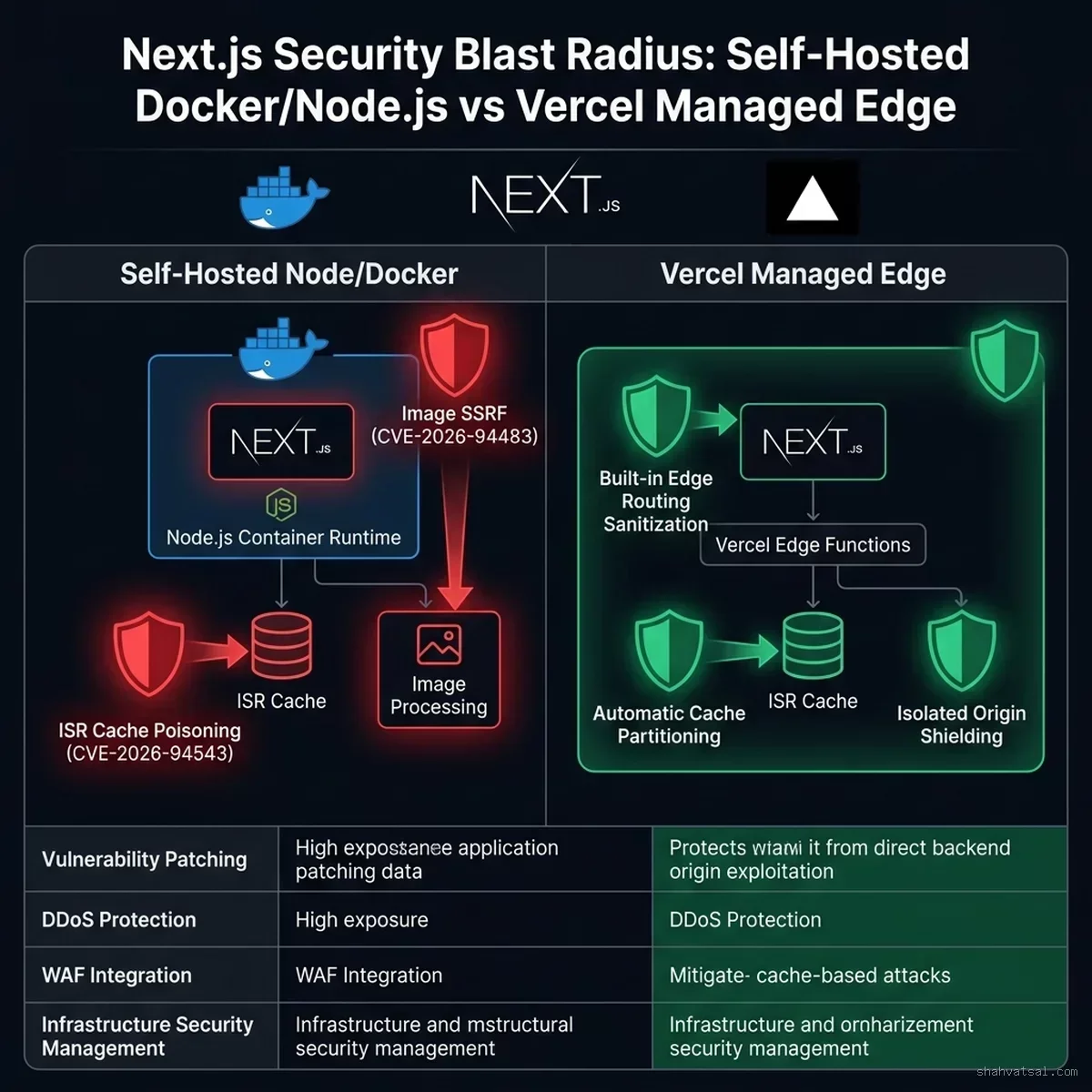
The operational impact of this security advisory divides sharply along architectural deployment lines. For the estimated 65% of enterprise Next.js deployments running on self-hosted infrastructure—including Amazon Elastic Kubernetes Service (EKS), Google Cloud Run, Azure Container Apps, or custom Docker containers—the vulnerabilities present immediate, actionable exposure.
The Self-Hosted Exposure Reality
On self-hosted instances running behind standard reverse proxies (such as Nginx, Traefik, or AWS ALB), Next.js executes within a single Node.js runtime process that possesses direct network route access to internal microservices, VPC endpoints, and the cloud metadata API.
Under CVE-2026-94483, an attacker exploiting the Image Optimization endpoint can extract IAM role credentials, STS temporary tokens, or sensitive internal REST API payloads by passing crafted hex-encoded URLs to /_next/image?url=....
Conversely, applications deployed to the Vercel Managed Platform are structurally insulated from CVE-2026-94543 (the ISR cache poisoning flaw). Vercel’s global Edge Network intercepts and strips custom routing headers before requests reach serverless origin execution, and Vercel Image Optimization executes within sandboxed, ephemeral micro-VMs that lack access to private customer VPCs.
Technical Deep Dive: Deconstructing CVE-2026-94483 (Image SSRF)
The most severe flaw resolved in this release centers on how next/image validates upstream image sources. In applications configuring permissive remote patterns, developers frequently declare wildcards to accommodate user-submitted avatars or media assets:
// next.config.ts (Vulnerable Pattern)
const nextConfig = {
  images: {
    remotePatterns: [
      {
        protocol: 'https',
        hostname: '**.example-cdn.com',
      },
      {
        protocol: 'https',
        hostname: '**', // High Risk: Matches arbitrary external domains
      }
    ],
  },
};
export default nextConfig;
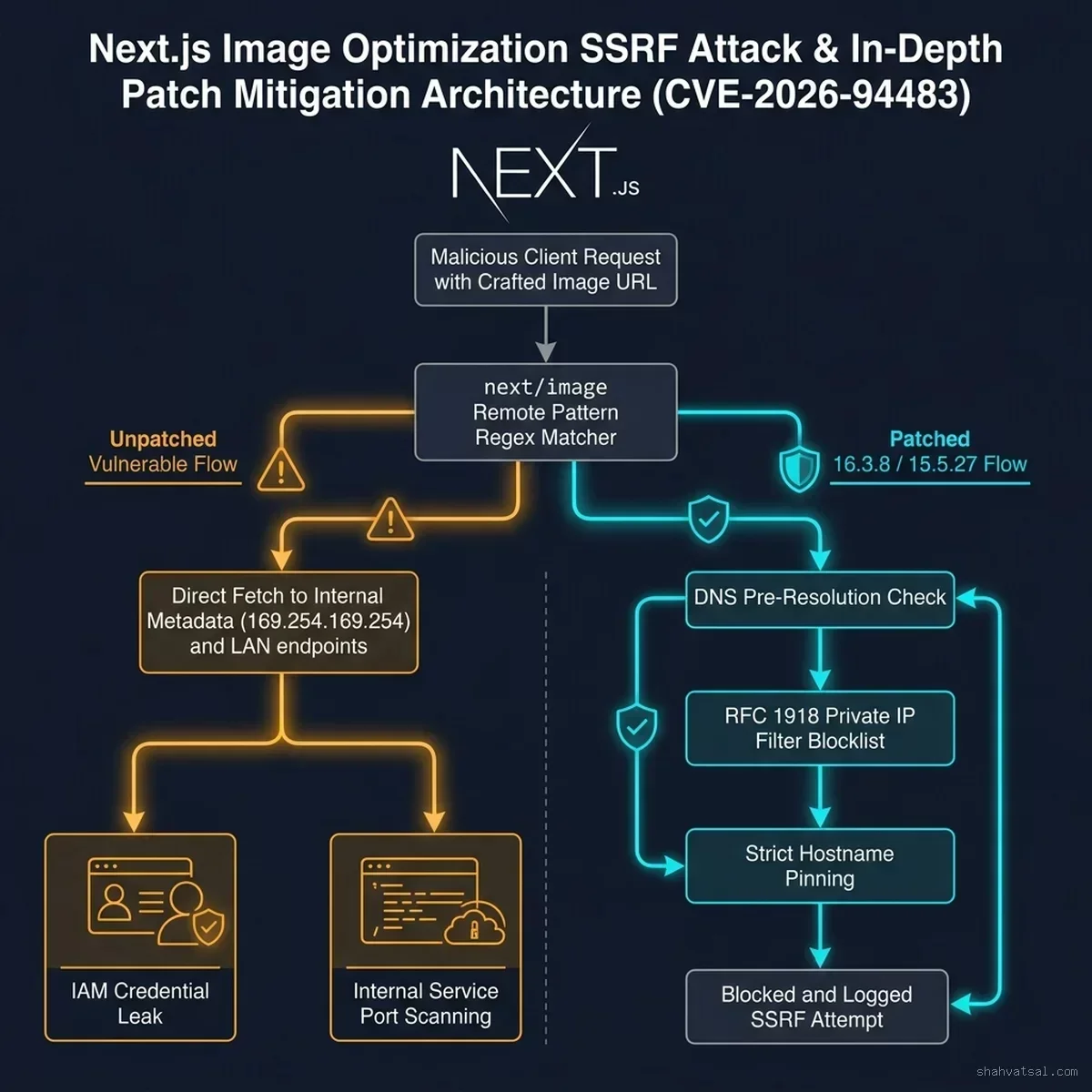
In versions prior to 16.3.8 and 15.5.27, the internal image fetcher validated the target URL against remotePatterns string regexes but failed to verify the resolved destination IP address post-DNS resolution. An attacker pointing a subdomain to a link-local address (169.254.169.254) or utilizing HTTP 302 open redirects could trick the server into fetching private internal resources, reflecting internal content back to the client.
The Multi-Stage Patch Mechanism
Next.js 16.3.8 addresses the vulnerability by introducing a three-stage validation pipeline:
- DNS Pre-Resolution Verification: Prior to initiating an outbound HTTP socket connection, Next.js resolves the target hostname and inspects the resulting IPv4/IPv6 addresses.
- Strict RFC 1918 / Link-Local Blacklisting: Any destination IP falling within private IP subnets (
10.0.0.0/8,172.16.0.0/12,192.168.0.0/16,127.0.0.0/8, or169.254.0.0/16) is immediately aborted with a400 Bad Requestbefore TCP socket allocation. - Redirect Re-Validation Loop: If the target image server returns an HTTP 301/302 redirect, the subsequent hop is passed back through the full validation pipeline, blocking redirect-based perimeter hopping.
Action Plan: Immediate Remediation Steps for Engineering Teams
All engineering organizations maintaining Next.js codebases should execute the following three-step mitigation procedure:
1. Upgrade Package Dependencies Immediately
Update project package.json manifests to the patched maintenance releases:
class="tok-cm"># For Next.js 16.x projects (Active LTS)
npm install next@16.3.8 react@latest react-dom@latest

class="tok-cm"># For Next.js 15.x projects (Maintenance LTS)
npm install next@15.5.27
Verify your locked dependencies using your package manager's audit command:
npx why next2. Audit and Restrict images.remotePatterns
Inspect your next.config.js or next.config.ts configuration. Eliminate all catch-all wildcards () and replace them with strict, fully qualified domain names (FQDNs) and explicit path prefixes:
// next.config.ts (Hardened Architecture)
import type { NextConfig } from 'next';

const nextConfig: NextConfig = {
  images: {
    remotePatterns: [
      {
        protocol: 'https',
        hostname: 'assets.enterprise-cdn.com',
        port: '',
        pathname: '/verified-uploads/**',
      },
    ],
    // Disable external SVG optimization if not required
    dangerouslyAllowSVG: false,
    contentSecurityPolicy: "default-src 'self'; script-src 'none'; sandbox;",
  },
};

export default nextConfig;
3. Prepare for the Pending Critical Advisory
Because Vercel confirmed that one Critical-severity vulnerability remains pending upstream coordination, security operations teams should establish an expedited deployment pipeline. Once the subsequent patch release ([email protected] / [email protected]) drops, teams must be prepared to rebuild and redeploy container images within 24 hours.
Strategic Ecosystem Context
The release highlights the ongoing operational tensions surrounding modern full-stack meta-frameworks. As Next.js has expanded from a frontend React wrapper into a comprehensive full-stack runtime handling image transcoding, edge middleware, Server Actions, and database connection pooling, its attack surface has grown exponentially.
For enterprise platform engineering teams, this release underscores the necessity of defense-in-depth: framework-level patches must be augmented by container-level network policies (e.g., Calico or Cilium blocking container egress to 169.254.169.254) and WAF-level header sanitization to ensure resilience against zero-day framework vulnerabilities.
What to Watch Next
Security and platform teams should monitor three critical developments over the coming days:
- Release of the Withheld Critical Patch: Watch for an emergency release of Next.js (
16.3.9or16.4.0) disclosing the currently postponed Critical Server Action flaw. - Widespread Container Base Image Updates: Monitor major enterprise container registries (Docker Hub, AWS ECR Public) for updated official Next.js deployment templates.
- Exploit Scans in the Wild: Track threat intelligence feeds for automated reconnaissance scanning
/_next/imageendpoints against self-hosted web applications.
Source
Primary source announcement: Next.js Security Blog — September 2026 Security Release (Next.js 16.3.8 & 15.5.27) (Published September 30, 2026).