Oracle Introduces Fusion Claw: Governed Agentic Runtime and 25 New Enterprise Applications
By Vatsal Shah | September 29, 2026 | 8 min read | Source: PR Newswire / Oracle
- Governed Agentic Execution Runtime: Oracle announced Fusion Claw, a purpose-built runtime embedded directly into Oracle Fusion Cloud Applications that orchestrates multi-agent enterprise workflows under strict governance boundaries.
- Unifying Reasoning with Deterministic Compute: Fusion Claw bridges the gap between probabilistic generative AI reasoning and exact, deterministic enterprise calculations, ensuring general ledger integrity, tax precision, and auditability.
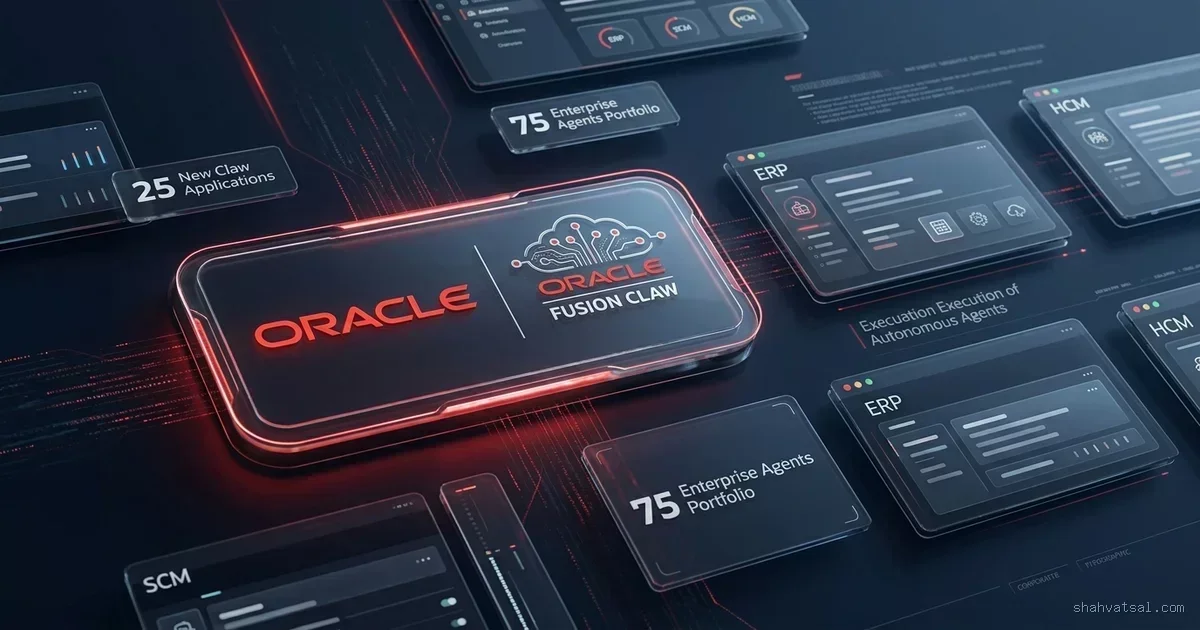
- 25 New Applications, Portfolio Reaches 75: The announcement introduces 25 new Claw-powered applications, expanding Oracle's production footprint to 75 total agentic applications coordinating end-to-end enterprise operations.
- Targeted Specialist Work: Specifically engineered for high-cognition enterprise workflows including research, computation, simulation, modeling, and continuous re-planning.
- Cross-Pillar Enterprise Coverage: Deployed natively across Oracle Fusion Cloud ERP (Finance), SCM (Supply Chain), HCM (Human Resources), and CX (Customer Experience).
- Strict Data and Regulatory Boundaries: Operates entirely within the enterprise tenant boundary on Oracle Cloud Infrastructure (OCI), inheriting existing role-based access control (RBAC), data residency controls, and SOX compliance boundaries without exporting context to third-party endpoints.
Lead Paragraph
AUSTIN, Texas — On September 29, 2026, Oracle announced Fusion Claw, a governed agentic execution runtime engineered to execute autonomous specialist work natively within Oracle Fusion Cloud Applications. Expanding its enterprise agentic footprint, Oracle introduced 25 new Claw-powered applications, bringing its cumulative portfolio to 75 agentic applications capable of coordinating complex, multi-stage business processes across finance, supply chain, human resources, and customer experience. Rather than treating artificial intelligence as a disconnected conversational wrapper or conversational sidecar, Fusion Claw integrates large language model reasoning directly with deterministic enterprise computation, giving autonomous agents the ability to perform deep research, dynamic simulation, mathematical verification, and continuous operational re-planning without compromising transactional consistency or compliance controls.
What Happened
Enterprise software architectures are undergoing a fundamental transformation. Over the past two years, initial enterprise generative AI implementations were predominantly constrained to unstructured tasks: drafting marketing copy, summarizing customer service transcripts, or synthesizing internal knowledge base documentation. However, core enterprise resource planning (ERP) and supply chain management (SCM) environments demand mathematical precision, strict adherence to statutory accounting standards, and immutable auditability—attributes fundamentally at odds with the probabilistic, nondeterministic nature of raw neural models.
To overcome this divide, Oracle’s September 29, 2026 announcement positions Fusion Claw as the execution substrate for the autonomous enterprise. Built directly into Oracle Cloud Infrastructure (OCI) and operating inside Oracle Fusion Cloud Applications, Claw acts as an operating system for domain-specific agentic swarms.
The launch centers on three key milestones:
- The Fusion Claw Runtime Engine: An isolated, tenant-isolated execution environment where autonomous software agents plan, test, and execute complex workflows against enterprise data dictionaries and transactional APIs.
- 25 New Claw-Powered Agentic Applications: Purpose-built agent solutions targeting specialized, labor-intensive workflows such as automated period-end reconciliation exceptions, multi-tier supply chain disruption re-routing, dynamic headcount planning, and complex revenue contract accounting.
- Portfolio Expansion to 75 Total Agentic Applications: Scaling Oracle's previously deployed collection of conversational and predictive automations into a synchronized ecosystem of coordinated agents sharing unified data semantics and security parameters.
Importantly, Oracle emphasized that Fusion Claw is not a forward-looking laboratory experiment or developer SDK requiring ground-up application assembly; it is an integrated capability native to the Fusion Cloud suite, activating governed autonomy within existing corporate deployments.
The Architectural Thesis: Unifying Reasoning and Deterministic Compute
The cornerstone of the Fusion Claw runtime is its hybrid computational paradigm: the formal coupling of probabilistic AI reasoning with deterministic enterprise computation.
In traditional generative AI integrations, models often fail when asked to perform multi-step arithmetic, apply complex enterprise discounting matrices, or verify double-entry journal balance constraints. A 99% accuracy rate may be acceptable for content drafting, but in a Fortune 500 general ledger, a 1% hallucination rate creates material accounting weaknesses, statutory non-compliance, and severe audit failures.
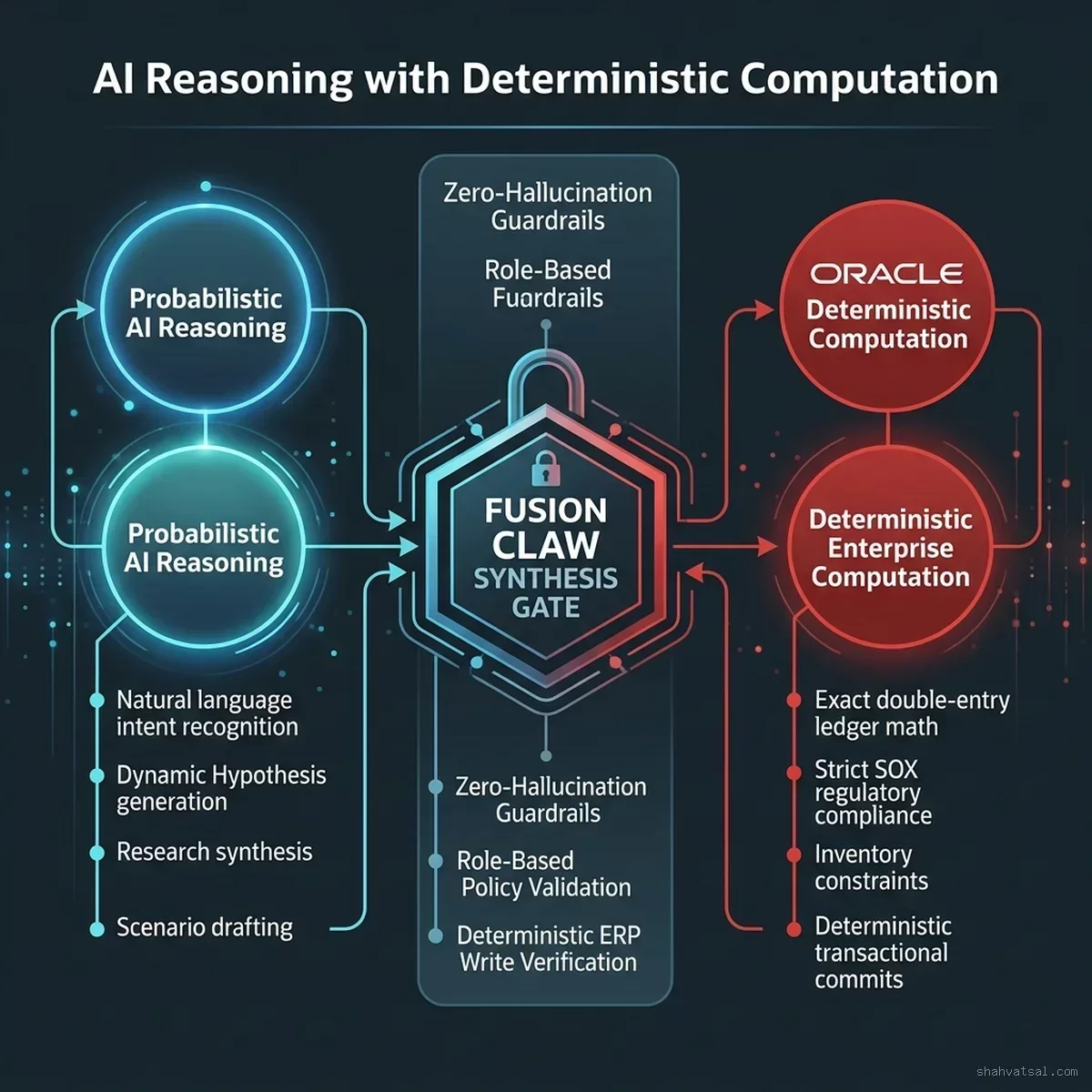
Fusion Claw resolves this tension by decomposing autonomous tasks into distinct cognitive and transactional phases:
- The Probabilistic AI Reasoning Layer: Leverages advanced foundation models to interpret high-level human directives, parse unstructured contracts and supplier correspondence, synthesize disparate qualitative signals, draft tactical hypotheses, and formulate candidate action sequences.
- The Deterministic Computation Engine: Leverages Oracle's battle-tested transactional code, rules engines, and database constraint matrices to execute hard mathematical operations, evaluate statutory tax logic, enforce regulatory compliance frameworks (such as SOX, GAAP, and IFRS 15), and test physical inventory allocation limits.
- The Fusion Claw Synthesis Gate: Serves as the immutable validation checkpoint. Before any agent can commit a write transaction, generate an accounts payable voucher, or alter a shipping manifests route, the proposed action must pass deterministic computational checks. If an agent's reasoning suggests an inventory reallocation that violates warehouse safety stock thresholds or vendor master contracts, the deterministic engine intercepts and halts the execution, sending the agent back into a re-planning loop or elevating the decision to a human supervisor.
By insulating the enterprise database from direct, unchecked model outputs, Oracle guarantees that business processes retain the reliability of deterministic software while capturing the flexibility and contextual comprehension of modern AI.
Anatomy of Fusion Claw: The Governed Agentic Runtime
Operating within the zero-trust architecture of Oracle Cloud Infrastructure, Fusion Claw provides the foundational runtime services necessary for enterprise agents to operate reliably at scale.
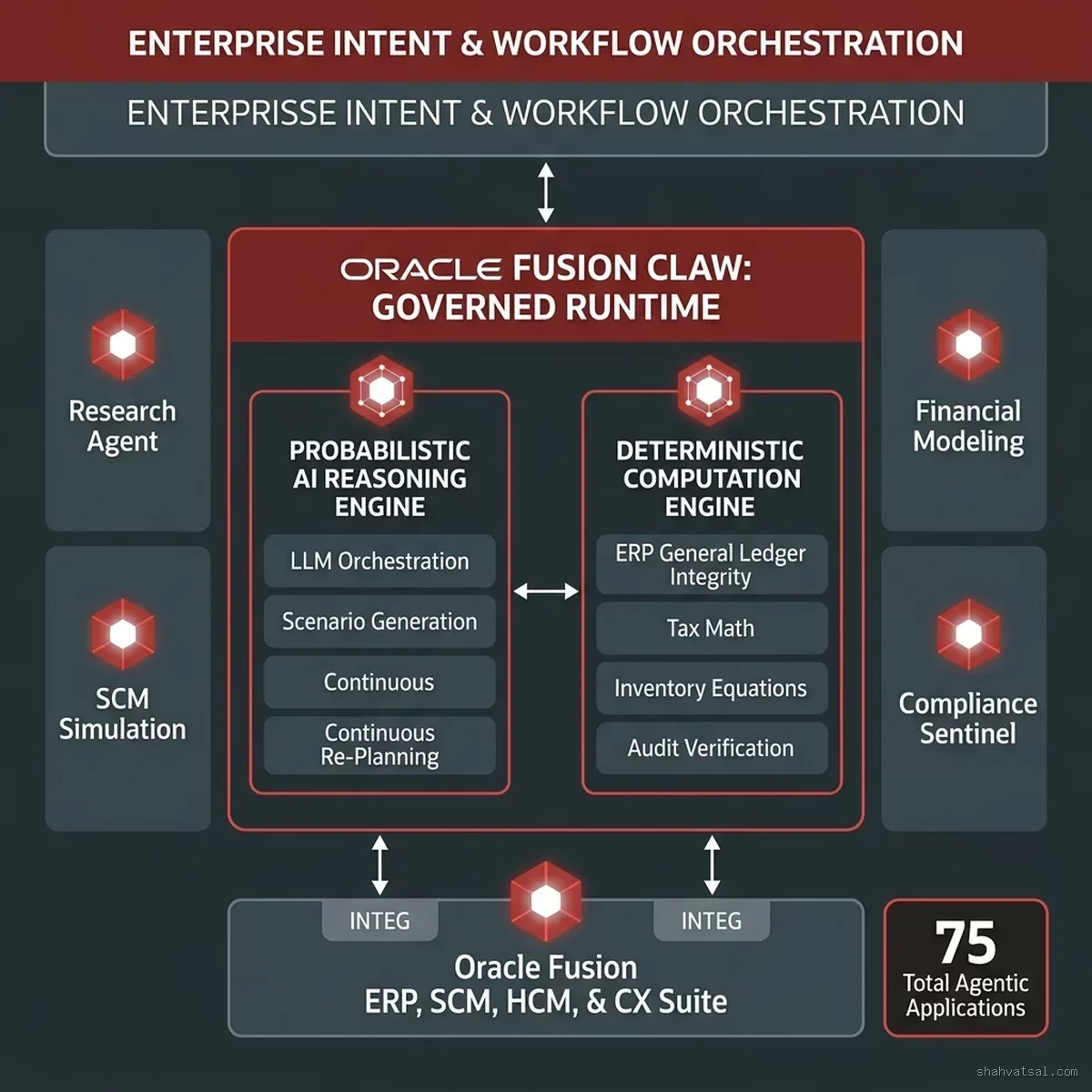
The architecture is composed of five interconnected layers:
1. Enterprise Semantic Bus & Data Dictionary
Agents running within Fusion Claw do not interact with raw database schemas or arbitrary endpoints. Instead, they operate through Oracle's unified enterprise semantic layer. Every object—whether an invoice, purchase order, employee record, or bill of materials—carries embedded business logic, relationships, validation constraints, and temporal validity definitions. This shared ontology ensures that an agent working in SCM understands the precise financial ramifications in ERP without requiring brittle translation scripts.
2. Tenant-Isolated Execution Sandboxes
Every Claw execution runs inside dedicated, ephemeral sandboxes provisioned within the customer's OCI tenancy. Model invocations, intermediate calculations, and simulation scratchpads remain strictly isolated from external environments. Crucially, customer data processed by Fusion Claw is never utilized to train third-party foundation models, preserving proprietary corporate intellectual property and data sovereignty.
3. Role-Based Security & Delegated Authority
A critical vulnerability in ungoverned autonomous agents is privilege escalation—where an agent bypasses departmental permissions by chaining legitimate tools. Fusion Claw eliminates this vulnerability by enforcing contextual delegated authorization. An agent operates exclusively with the explicit security clearance, approval limits, and data segmentation privileges granted to its executing role. An agent managing accounts payable for European operations cannot access North American payroll records, regardless of prompt formulations or internal plan trajectories.
4. Immutable Execution Telemetry & Audit Logs
Every cognitive decision, intermediate hypothesis, deterministic validation check, and API invocation executed by a Claw agent is recorded in an immutable, cryptographically verifiable audit trail. Compliance officers, internal auditors, and systems administrators can inspect step-by-step decision trees to verify precisely why an agent recommended a particular supplier reroute or flagged a specific ledger variance.
The Five Pillars of Specialist Enterprise Work
The September 29 release explicitly defines the scope of work undertaken by Fusion Claw. Rather than general-purpose chat assistance, Claw agents specialize in five core operational disciplines:
┌─────────────────────────────────────────────────────────────────────────────┐
│                       ORACLE FUSION CLAW WORK MODES                         │
├─────────────────────┬───────────────────────────────────────────────────────┤
│ Specialist Mode     │ Enterprise Operational Mandate                        │
├─────────────────────┼───────────────────────────────────────────────────────┤
│ 1. Research         │ Ingesting, parsing, and synthesizing multi-source     │
│                     │ contracts, regulatory filings, supplier notices, and  │
│                     │ market pricing indices into structured context.       │
├─────────────────────┼───────────────────────────────────────────────────────┤
│ 2. Computation      │ Executing complex, multi-tiered numerical operations, │
│                     │ statutory currency translations, tax allocations, and │
│                     │ multi-entity consolidation calculations.              │
├─────────────────────┼───────────────────────────────────────────────────────┤
│ 3. Simulation       │ Running parallel Monte Carlo and synthetic stress-    │
│                     │ tests across supply chains, working capital flows,    │
│                     │ and staffing models prior to operational commitment.  │
├─────────────────────┼───────────────────────────────────────────────────────┤
│ 4. Modeling         │ Building predictive demand projections, pricing       │
│                     │ elasticity curves, and asset lifecycle forecasts based│
│                     │ on historical transactional records.                  │
├─────────────────────┼───────────────────────────────────────────────────────┤
│ 5. Continuous       │ Actively monitoring real-time telemetry (orders,      │
│    Re-Planning      │ shipments, inventory levels, delays) and dynamic      │
│                     │ replanning without awaiting manual batch schedules.   │
└─────────────────────┴───────────────────────────────────────────────────────┘
By institutionalizing these five execution paradigms, Fusion Claw automates analytical and operational tasks that previously consumed thousands of manual engineering and accounting hours each quarter.
25 New Applications Across the Fusion Cloud Suite
The 25 newly introduced Claw-powered applications span Oracle’s primary enterprise pillars, demonstrating how the governed runtime operates across diverse functional domains:
1. Enterprise Resource Planning (ERP) & Financials
- Autonomous Subledger Reconciliation Agent: Continuously matches bank statement feeds, credit card settlement transactions, and internal clearing accounts, resolving routine discrepancies and packaging complex outliers with pre-gathered audit evidence.
- Contract-to-Revenue Compliance Agent: Analyzes multi-element sales contracts, extracts variable consideration clauses, and deterministically computes performance obligation schedules under IFRS 15 / ASC 606 standards.
- Dynamic Cash Liquidity Allocator: Models near-term cash requirements across multi-currency international accounts, continuously re-balancing treasury balances to minimize borrowing costs while ensuring working capital availability.
2. Supply Chain Management (SCM) & Logistics
- Disruption Mitigation & Routing Agent: Ingests maritime shipping telemetry, port congestion feeds, and geopolitical risk alerts to detect supply disruptions days before delivery schedules fail. It simulates alternative rail, truck, and air freight routes, calculates landed cost differentials, and drafts purchase order modifications.
- Inventory Buffer Optimization Agent: Evaluates fluctuating supplier lead times and warehouse throughput rates to dynamically recalibrate safety stock parameters across regional distribution centers.
- Supplier Risk & Sustainability Monitor: Aggregates vendor compliance certifications, financial health filings, and environmental ESG disclosures, identifying supply chain vulnerabilities before procurement commitments are finalized.
3. Human Capital Management (HCM)
- Workforce Scenario & Succession Simulator: Simulates the organizational impact of planned retirements, departmental restructuring, and global expansion initiatives, cross-referencing internal talent skill inventories against projected role vacancies.
- Continuous Skills Calibration Agent: Evaluates completed projects, technical certifications, and peer performance signals to dynamically update employee competency profiles across global teams.
4. Customer Experience (CX) & Field Service
- Complex B2B Solution Configure-Price-Quote (CPQ) Agent: Ingests technical customer specifications, models hardware and software dependency constraints, and calculates optimal margin pricing within pre-approved deal desks boundaries.
- Predictive Asset Maintenance Dispatcher: Synthesizes IoT telemetry from fielded industrial machinery to schedule preventative technician visits and pre-order replacement parts prior to catastrophic machine failure.
Together with the existing 50 applications, the combined 75-application portfolio forms a comprehensive, synchronized network of autonomous software capabilities running on top of corporate systems of record.
Governance, Security, and Determinism
The primary hurdle preventing large enterprises from embracing agentic autonomy has never been a lack of raw AI reasoning power; it has been the fundamental risk of uncontained errors. When an agent misinterprets a prompt or hallucinates a policy exception in a customer-facing chatbot, the damage is reputational. When an agent hallucinates inside an ERP ledger, it can trigger SEC investigations, tax penalties, and supply chain gridlock.
Oracle’s strategy with Fusion Claw directly confronts this enterprise anxiety through four deterministic governance mechanisms:
- Deterministic Write-Locks: No generative model can directly write to or update an Oracle database table. Every proposed modification must be converted into a structured transactional payload and submitted through Oracle’s standard Application Programming Interfaces (APIs), which enforce schema validation, referential integrity, and business logic constraints.
- Deterministic Dual-Validation Gates: For critical financial operations exceeding predefined materiality thresholds (e.g., vendor invoice payments above $50,000 or structural changes to chart-of-accounts hierarchies), Fusion Claw mandates dual-signature validation: one from the autonomous agent's mathematical proof, and one from a verified human controller.
- SOX and Internal Control Alignment: Claw operations map directly to standard COSO internal control frameworks. Every automated action is assigned a specific control identifier, ensuring external auditors can test and certify the effectiveness of automated controls during annual compliance reviews.
- Data Isolation and Model Independence: Fusion Claw is architected to remain model-agnostic. While it leverages state-of-the-art models running within OCI's dedicated AI infrastructure, the governance framework treats the underlying LLM as a replaceable cognitive processor. If an underlying model is upgraded or substituted, the surrounding security envelope, semantic dictionary, and deterministic compute rules remain unchanged.
Competitive & Market Context
The launch of Oracle Fusion Claw intensifies the battle among enterprise software incumbents to capture the mission-critical agentic computing market.
Deduplication and Domain Positioning
To understand Oracle's positioning, it is essential to distinguish this operational launch from other recent enterprise milestones:
- Vs. Oracle–Tencent Chip Lease Report (#N118): That report centered purely on infrastructure hardware leasing and hyperscaler compute capacity negotiations. In contrast, #N135 represents Oracle’s application-layer software execution environment.
- Vs. SAP North Star Architecture (#N100): SAP’s North Star platform focuses on modular business data fabrics and federated S/4HANA agent orchestration. Oracle Fusion Claw represents a tightly integrated execution runtime that couples OCI database compute with out-of-the-box Fusion applications.
- Vs. Salesforce AIforce / Agentforce: While Salesforce focuses heavily on front-office engagement, CRM context delegation, and conversational customer-facing agents, Oracle’s focus with Claw is centered directly on the back-office engine: core general ledgers, global supply chains, statutory tax regimes, and manufacturing production lines.
- Vs. ServiceNow Otto & Control Tower: ServiceNow addresses IT service management (ITSM) and employee operational workflows, whereas Fusion Claw operates deep within transactional enterprise resource planning.
┌─────────────────────────────────────────────────────────────────────────────┐
│                 ENTERPRISE AGENTIC PLATFORMS COMPARISON (2026)              │
├───────────────────┬──────────────────────┬──────────────────────────────────┤
│ Platform          │ Primary Domain Focus │ Core Computational Moat          │
├───────────────────┼──────────────────────┼──────────────────────────────────┤
│ Oracle Fusion     │ Core ERP, SCM, HCM,  │ Governed Runtime uniting AI      │
│ Claw (class="tok-cm">#N135)      │ Finance, CX          │ reasoning with deterministic     │
│                   │                      │ database computation (75 apps).  │
├───────────────────┼──────────────────────┼──────────────────────────────────┤
│ SAP North Star    │ ERP Core, Business   │ Federated business data fabric & │
│ (class="tok-cm">#N100)           │ Data Web, Logistics  │ Joule multi-tier orchestration.  │
├───────────────────┼──────────────────────┼──────────────────────────────────┤
│ Salesforce        │ CRM, Marketing,      │ Data Cloud semantic graph & live │
│ AIforce (class="tok-cm">#N136)   │ Customer Support     │ agent interface delegation.      │
├───────────────────┼──────────────────────┼──────────────────────────────────┤
│ ServiceNow Flow   │ IT Service Desk,     │ Workflow engine & automated      │
│ & Otto (class="tok-cm">#N137)    │ Enterprise Workflow  │ cross-platform IT task action.   │
└───────────────────┴──────────────────────┴──────────────────────────────────┘
Oracle’s unique competitive leverage lies in its complete vertical stack ownership. Because Oracle owns the physical OCI data centers, the Autonomous Database layer, and the business application suite, Fusion Claw avoids the latency, security vulnerabilities, and integration friction that plague heterogeneous multi-vendor architectures.
Enterprise Takeaways & Next Steps for CIOs
For chief information officers, finance chiefs, and enterprise systems architects, the launch of Oracle Fusion Claw signals that agentic systems have migrated from experimental pilot phases to core operational infrastructure.
Organizations evaluating or currently deploying Oracle Fusion Cloud should prioritize three strategic actions:
- Audit Established Business Process Semantics: Autonomous agents depend entirely on clean, well-defined corporate ontologies. Organizations should audit their master data management (MDM) practices, standard operating procedures, and chart-of-accounts definitions to ensure agents encounter unambiguous data dictionaries.
- Define Delegated Authority Matrices: Just as human employees have documented authorization limits for purchases, credit approvals, and payroll adjustments, enterprises must establish formal delegated authority frameworks for autonomous agents. CIOs should collaborate with internal audit and risk teams to define threshold limits where agents can execute autonomously versus where human sign-off remains mandatory.
- Pilot High-Friction Operational Bottlenecks: Rather than pursuing broad, speculative automation across entire business units, enterprises should target specific, high-friction analytical workflows where Claw's five specialist capabilities deliver immediate value—such as continuous subledger reconciliations, multi-tier freight disruption simulation, or contract revenue recognition.
With 25 new applications in production and an expanding portfolio of 75 agentic capabilities, Oracle Fusion Claw sets a rigorous benchmark for enterprise AI: autonomy governed by determinism, speed tempered by security, and innovation anchored in mathematical truth.
Frequently Asked Questions
What is Oracle Fusion Claw and what does it do?
Oracle Fusion Claw is a governed agentic execution runtime designed specifically for Oracle Fusion Cloud Applications. It unifies probabilistic generative AI reasoning with deterministic, high-integrity enterprise computation to execute specialist tasks across complex business processes.
How many new agentic applications were announced with Fusion Claw?
Oracle announced exactly 25 new Claw-powered applications, expanding its active portfolio to 75 total agentic applications spanning enterprise resource planning (ERP), supply chain management (SCM), human capital management (HCM), and customer experience (CX).
What categories of specialist enterprise work does Fusion Claw handle?
The release explicitly designates five core categories of specialist work: automated business research, rigorous numeric computation, multi-variable scenario simulation, predictive economic modeling, and continuous adaptive re-planning.
How does Fusion Claw ensure financial integrity and prevent generative hallucinations in core ERP systems?
Fusion Claw enforces a strict governance separation between probabilistic reasoning (hypothesis formation and context parsing) and deterministic computation (double-entry general ledger rules, statutory tax math, and transactional write-locks). Actions that commit changes to enterprise ledgers must pass through deterministic validation gates that cannot be bypassed by LLM approximations.
Does Fusion Claw share customer data with public AI models?
No. Fusion Claw runs entirely within customer-isolated environments on Oracle Cloud Infrastructure (OCI). Customer transactional data, internal correspondence, and financial figures remain strictly within the customer's tenancy and are never utilized to train shared third-party AI models.
How does Oracle Fusion Claw differ from conversational AI assistants like chatbots?
Conversational AI assistants typically operate as advisory interfaces that generate natural language responses to user prompts. Fusion Claw is an autonomous execution runtime that coordinates multi-step operational tasks, runs multi-variable simulations, evaluates deterministic math, and submits validated transactions directly to enterprise applications under human-configured governance boundaries.