Jira Governed Agent Loops Enter Private Early Access: Automated Backlog-to-PR Workflows with Human Review Gates
By Vatsal Shah | September 10, 2026 | 8 min read | Source: Atlassian Blog / Inside Atlassian
- Private Early Access Launch: Atlassian has officially introduced Jira Governed Agent Loops in Private Early Access, bringing autonomous issue-to-code execution directly inside Jira Cloud.
- Strictly Not GA: The agent loop execution runtime is restricted to an invite-only early cohort; Atlassian has not declared General Availability (GA).
- Backlog-to-PR Autonomous Flow: The engine scans backlogs for well-specified, unassigned user stories and bug fixes, dispatches work to the Jira Coding Agent, writes code and unit tests, and automatically opens a draft Pull Request linked to the Jira issue.
- Mandatory Human Review Gate: Autonomous execution terminates at a strict human approval gate. Agents cannot merge code autonomously; developers retain full authority to accept, modify, or reject generated pull requests.
- Integrated Standards & AI Review: The private early access package bundles Engineering Standards (architectural rule enforcement) and AI Code Review (automated code hygiene checks before human inspection).
- Product Tier Distinctions: Distinct from the separate Code Context open beta (semantic repo graph for paid Jira) and future enterprise features (Agent Context Controls and Usage Dashboards coming in future months).
Lead Paragraph
SAN FRANCISCO, California — On September 10, 2026, Atlassian unveiled Jira Governed Agent Loops in Private Early Access, marking a decisive transition for the world’s leading project management platform from passive issue tracking to active software creation. Published via the Inside Atlassian technical blog, the announcement details an autonomous workflow loop that scans sprint backlogs for unassigned, well-defined user stories and bug tickets, delegates the implementation to the Jira Coding Agent, and automatically opens ready-to-inspect pull requests across GitHub, GitLab, and Bitbucket. Emphasizing enterprise safety, Atlassian stressed that the loops operate strictly under a mandatory human review gate, ensuring software engineers maintain final authority over what merges into production repositories. By coupling autonomous code generation with embedded engineering standards and automated AI review, Atlassian seeks to eliminate routine development backlogs without sacrificing software reliability or compliance boundaries.
What Happened
For over two decades, Jira has served as the universal source of truth for software development planning. Engineering managers create tickets, assign story points, prioritize backlogs, and track release burn-down charts. However, once a ticket entered "To Do," the actual synthesis of code took place entirely outside Jira—inside disconnected IDEs, local terminal windows, and scattered Git repositories.
With the launch of Governed Agent Loops, Atlassian is closing the gap between agile planning and code delivery.
According to Atlassian’s September 10 technical post, the system automates the traditionally manual handover between task specification and initial code drafting:
┌─────────────────────────────────────────────────────────────────────────────┐
│                    ATLASSIAN AGENTIC PORTFOLIO TIMELINE (2026)              │
├───────────────────────────────┬─────────────────────────────────────────────┤
│ Capability                    │ Rollout Phase & Entitlement                 │
├───────────────────────────────┼─────────────────────────────────────────────┤
│ Governed Agent Loops          │ PRIVATE EARLY ACCESS (Select Customers)     │
│ (class="tok-cm">#N133 Execution Engine)      │ NOT GENERALLY AVAILABLE                     │
├───────────────────────────────┼─────────────────────────────────────────────┤
│ Engineering Standards &       │ PRIVATE EARLY ACCESS (Bundled with Loops)   │
│ AI Code Review                │ Automated rule & quality gating             │
├───────────────────────────────┼─────────────────────────────────────────────┤
│ Code Context Semantic Graph   │ SEPARATE OPEN BETA (All Paid Jira Plans)    │
│                               │ Multi-repository AST & context index        │
├───────────────────────────────┼─────────────────────────────────────────────┤
│ Agent Context Controls &      │ COMING MONTHS (Enterprise Paid Jira)        │
│ Usage Dashboard               │ Token budgets & granular repo permissions   │
├───────────────────────────────┼─────────────────────────────────────────────┤
│ Atlassian DX for Agentic Dev  │ THIS QUARTER (Atlassian DX Subscribers)     │
│                               │ Developer productivity telemetry & insights │
└───────────────────────────────┴─────────────────────────────────────────────┘
Crucially, Atlassian explicitly noted that Governed Agent Loops are in Private Early Access, not general availability. While paid Jira customers currently have access to the open beta of Code Context, full autonomous execution loops are restricted to an initial cohort of enterprise engineering teams to validate safeguard thresholds and developer experience metrics.
The Governed Loop Lifecycle: From Backlog to Pull Request
The fundamental innovation in Jira Governed Agent Loops is the seamless chaining of asynchronous autonomous agents with enterprise project management controls.
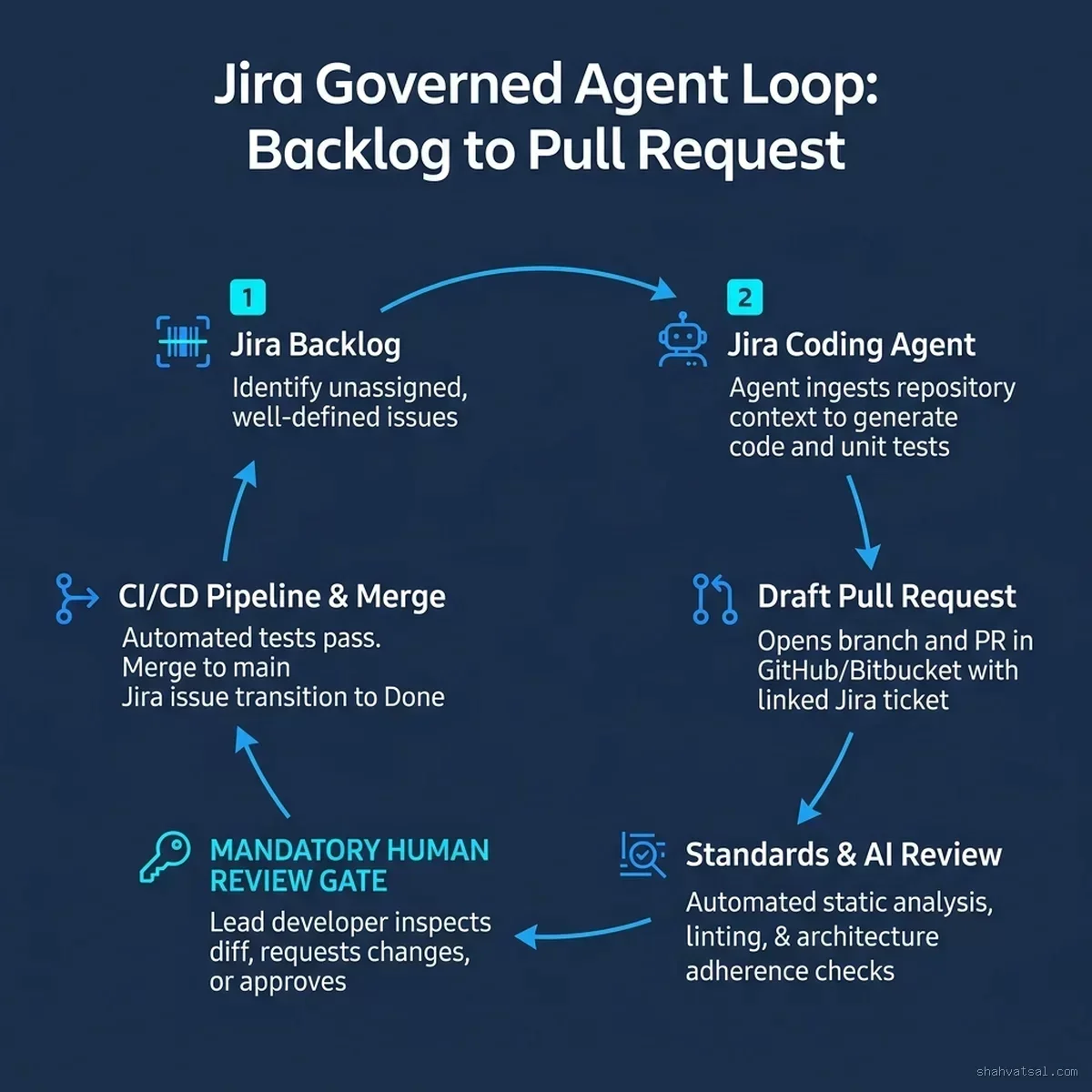
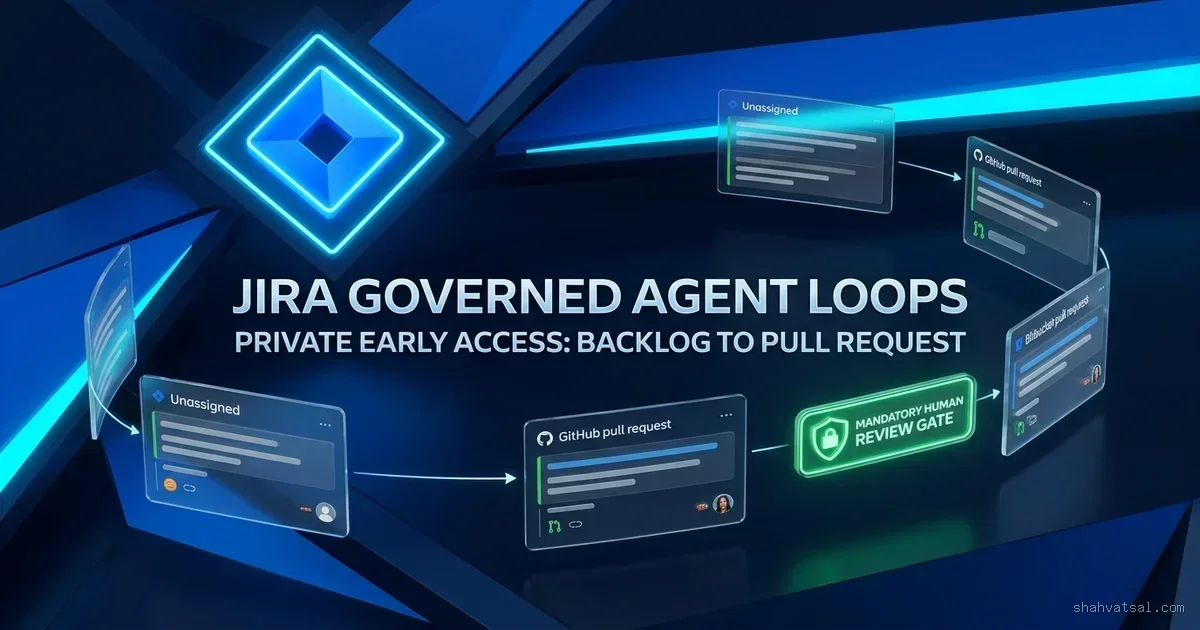
As illustrated in the lifecycle diagram above, the execution loop operates across six discrete, auditable stages:
1. Backlog Scanning & Eligibility Filtering
The loop engine monitors the team’s backlog during off-hours or sprint planning cycles. It actively filters for issues that meet strict "Readiness Criteria":
- The ticket status is
Unassignedand labeledReady for Development. - The ticket contains explicit acceptance criteria, clear requirements, and reproduction steps.
- The ticket is classified as a low-to-moderate complexity task, such as boilerplate microservice endpoints, unit test additions, localized bug fixes, or dependency refactors.
2. Context Ingestion & Jira Coding Agent Dispatch
Once an eligible issue is identified, the system assigns the issue to the virtual Jira Coding Agent. The agent queries Atlassian’s semantic index to retrieve relevant repository files, existing architectural patterns, type definitions, and coding conventions.
3. Asynchronous Code & Test Synthesis
Working within an ephemeral cloud sandbox, the Coding Agent creates an isolated Git feature branch, writes the necessary source code modifications, and drafts comprehensive unit test suites to validate acceptance criteria.
4. Automated Standards & AI Review Gating
Before any human is notified, the branch passes through Atlassian’s newly bundled Engineering Standards & AI Review engine:
- Architectural Rules: Verifies that new code adheres to organizational policies (e.g., zero circular imports, mandatory input validation, specific logging frameworks).
- Code Hygiene & Linting: Scans for anti-patterns, missing documentation, or test coverage deficits. If violations are detected, the agent autonomously enters an internal correction loop.
5. Mandatory Human Review Gate
Once standards are verified, the agent automatically opens a draft Pull Request in GitHub, GitLab, or Bitbucket, directly linking the PR to the originating Jira ticket. The issue status transitions to In Review, and an engineering lead is assigned. The agent cannot merge on its own. A human engineer must inspect the diff, review test execution logs, and provide cryptographic sign-off.
6. Pipeline Execution & Issue Closure
Upon human approval, standard continuous integration (CI) pipelines run automated regression tests and build artifacts. Once merged into the target branch, Jira automatically transitions the ticket status to Done, logging full provenance telemetry.
Architectural Separation: Mapping the Atlassian AI Ecosystem
A common point of confusion among technology leaders is differentiating Atlassian’s various 2026 AI and agentic announcements. To understand today's milestone, it is essential to trace how Governed Agent Loops fit into Atlassian's broader engineering stack.
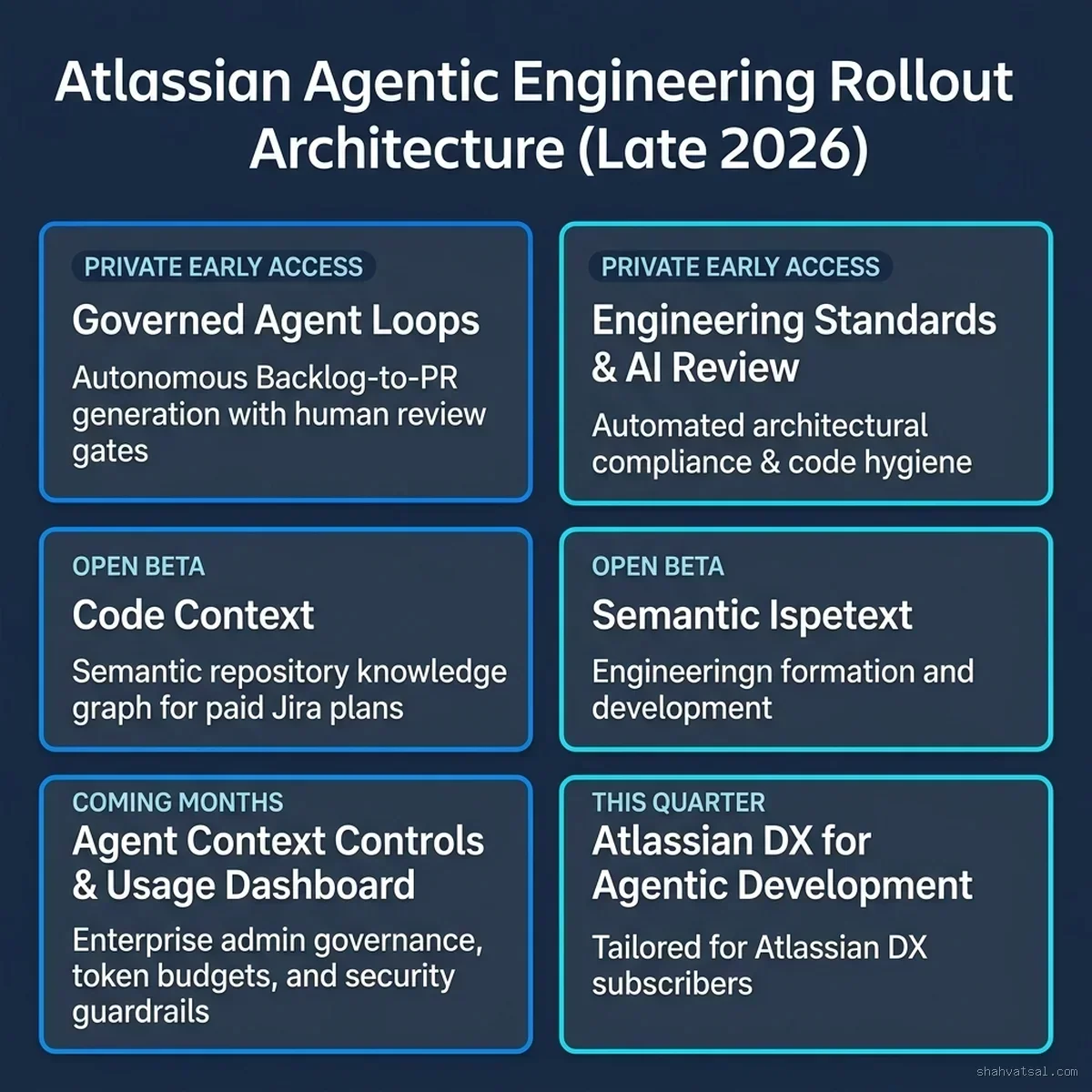
As detailed in the architecture matrix above, the platform separates capabilities across distinct functional layers:
Governed Agent Loops vs. Code Context Open Beta
Many industry observers conflate Governed Agent Loops with Atlassian’s Code Context feature. They are fundamentally separate:
- Code Context (Open Beta): A semantic repository indexing layer available in open beta across paid Jira Cloud tiers. It indexes source code repositories, maps Abstract Syntax Trees (ASTs), and builds semantic graphs so Atlassian Rovo can answer natural language questions about codebase architecture.
- Governed Agent Loops (Private Early Access): The active execution engine that takes action on tickets, writes commits, and opens pull requests. Code Context provides the knowledge, but the Governed Agent Loop provides the execution.
Context Controls & Usage Dashboards (Coming Months)
For enterprise CISOs and engineering VPs, unconstrained agent execution poses risk of intellectual property leakage and unexpected cloud API expenditures. To address this, Atlassian announced that Agent Context Controls (restricting which specific repositories agents can read or write) and the Agent Usage Dashboard (monitoring token burn rates, ticket success ratios, and cost per pull request) will roll out broadly to paid Jira plans "in the coming months."
Atlassian DX for Agentic Development (This Quarter)
Targeted specifically at subscribers to Atlassian’s Developer Experience (DX) suite, this analytics module will launch later this quarter to measure the net productivity impact of agent loops—quantifying whether automated pull requests accelerate delivery cycles or introduce downstream code review fatigue.
Deduplication and Coverage Boundaries
To maintain rigorous editorial boundaries, today’s milestone must be clearly demarcated from preceding Atlassian developments:
- Vs. Teamwork Graph CLI (#N94): The Teamwork Graph CLI focused on local developer machine integration and command-line querying of enterprise dependency graphs. Today’s news is a fully hosted, server-side execution loop running inside Jira Cloud.
- Vs. Atlassian Rovo Model Context Protocol (MCP) Server (#N95): Rovo MCP established open protocol connectors allowing external AI agents (such as Claude Code or Cursor) to read Atlassian data. Governed Agent Loops represent Atlassian’s internal native coding agent executing tasks within Jira.
- Vs. Jira Product Discovery Global Views: Product Discovery updates centered on roadmap portfolio visualization and ideation, entirely separate from developer coding execution.
The Human-in-the-Loop Imperative: Why Atlassian Kept the Gate
In an era where some speculative startups advocate for "zero-touch software development," Atlassian’s decision to mandate human review gates is a calculated engineering choice.
In production software systems, the cost of debugging a bad pull request that slipped into main is an order of magnitude higher than the cost of reviewing the pull request before merge. By confining the Jira Coding Agent to unassigned backlog tickets and requiring human authorization, Atlassian achieves three critical outcomes:
- Elimination of Pull Request Spam: Agents only write code for tickets explicitly validated and labeled by product owners, preventing autonomous swarms from flooding repositories with unsolicited changes.
- Defensible Auditability for SOC 2 and ISO 27001: Enterprise security frameworks require that every line of code deployed to production be traceable to an authenticated human identity. The Jira review gate ensures compliance requirements remain strictly satisfied.
- Engineering Team Trust: Rather than replacing software developers, the system positions the Coding Agent as an automated junior engineer that tackles tedious, well-defined tasks, freeing human developers to focus on high-impact architectural design.
Industry Takeaways for Engineering Leaders
For chief technology officers, engineering directors, and agile transformation leaders, Jira’s entry into governed agentic coding signals a major structural shift in software delivery:
- The Quality of the Backlog Dictates the Quality of the Code: Autonomous coding agents are only as effective as the issue descriptions they ingest. Teams with vague, single-sentence tickets ("fix the checkout bug") will see agents stall or hallucinate. Teams with structured acceptance criteria, API contracts, and reproduction steps will see routine tickets resolved overnight.
- Reviewing Code Becomes the Primary Developer Skill: As agents generate an increasing share of boilerplate pull requests, human engineers will spend less time typing raw syntax and significantly more time critically reviewing code diffs, evaluating edge cases, and verifying security boundaries.
- Prepare Governance Policies Before GA: Engineering organizations should begin defining internal policies regarding agentic contributions—establishing repository allowlists, setting unit test coverage thresholds, and training leads on evaluating agent-authored diffs.
With Governed Agent Loops entering Private Early Access, Atlassian has delivered a compelling blueprint for the future of agile software development: autonomous execution governed by engineering discipline, anchored in the system of record where software work begins.
Frequently Asked Questions
What are Jira Governed Agent Loops and how do they function?
Jira Governed Agent Loops are autonomous engineering workflows that continuously scan team backlogs for well-defined, unassigned tasks, hand them to the Jira Coding Agent to synthesize code and unit tests, and automatically open a linked Pull Request in GitHub, GitLab, or Bitbucket—all governed by mandatory human review gates.
Are Jira Governed Agent Loops generally available (GA) today?
No. Governed Agent Loops are currently in a restricted Private Early Access phase for select enterprise customers. Atlassian has explicitly not made this capability generally available (GA).
What additional features are bundled in the Private Early Access release?
Alongside Governed Agent Loops, Atlassian has shipped Engineering Standards enforcement and AI Code Review in the same Private Early Access bundle, validating architectural rules and code hygiene prior to human review.
How does Code Context relate to Governed Agent Loops?
Code Context is a separate open beta available to paid Jira customers that provides a semantic knowledge graph across connected repositories. It informs the coding agent's understanding but is a distinct product tier separate from the Private Early Access agent loop execution engine.
Can the Jira Coding Agent merge code into production autonomously?
No. The system enforces a mandatory human review gate. An engineering lead or developer must review the proposed pull request diff, inspect test coverage, and explicitly authorize the merge before the issue can transition to Done.