Cloudflare Quietly Enables 'Block AI Bots' by Default - How to Reclaim Your AI Search Visibility
By Vatsal Shah | July 2, 2026 | 7 min read | Source: Cloudflare Blog
- Default Exclusion Shock: By activating "Block AI Bots" automatically, Cloudflare has cut off millions of small-to-medium websites from next-generation AI discovery networks, impacting organic referral traffic.
- WAF Rules Overwrite robots.txt: Because the block happens at the edge layer, robots.txt exceptions are bypassed entirely, requiring manual configuration of Cloudflare Custom Rules.
- Generative Engine Optimization (GEO): Content visibility is shifting from traditional SEO to GEO. Blocking crawler bots prevents LLMs from indexing content, resulting in complete exclusion from AI-generated answers.
Lead Paragraph
SAN FRANCISCO, California — In a major shift for web traffic management, Cloudflare has rolled out a mid-2026 update enabling default edge-blocking of prominent artificial intelligence web scrapers across its free and paid plans. The update automatically targets popular user-agent identifiers, including OpenAI's GPTBot, Anthropic's ClaudeBot, Google's VertexBot, and Perplexity's crawling engines. While Cloudflare frames this move as a protection mechanism for digital publishers against unauthorized training data scraping, the default setting has caused an unintended consequence: thousands of web domains have vanished from generative search engines and AI answer panels without their owners realizing it. To maintain visibility in AI search, website administrators must now make manual adjustments to their Cloudflare security settings.
What Happened
The default edge-blocking update alters the request pipeline for all sites proxied through Cloudflare. Key developments include:
- The Edge Blocking Default: The "Block AI Bots" setting under Cloudflare Security > Bots is now set to "Block" by default, turning a security feature into an opt-out policy.
- Bypassing robots.txt: Traditional crawler directives in
robots.txtare ignored because Cloudflare's WAF drops the connections at the edge before the requests ever reach the host server. - Declining AI Referrals: Businesses that rely on traffic from AI-driven search engines (like ChatGPT Search and Perplexity) are seeing drop-offs in organic referral traffic due to index exclusion.
                           CLOUDFLARE REQUEST FILTERING
+--------------------------------------------------------------------------+
|  Incoming HTTP Request (User-Agent: GPTBot)                              |
|         │                                                                |
|         ▼ (Edge Network Filtering)                                       |
|  [ Cloudflare WAF Security Check ] ──► [ AI Bot Toggle: Enabled ]        |
|         │                                                                |
|         ├─► [ Match: True ] ──► Drop Request (403 Forbidden Response)    |
|         └─► [ Match: False ] ─► Pass to Origin Server                    |
+--------------------------------------------------------------------------+
Why It Matters
For modern digital businesses, search visibility is shifting from classic keyword queries to conversational, AI-driven answers. When users ask an AI assistant for product recommendations or technical solutions, the model queries its index of crawled pages to generate a response. If your website blocks these crawlers, your content cannot be indexed, and your brand will be excluded from the generated answers.
This change highlights the importance of keeping your site accessible to legit AI crawlers. By allowing verified scrapers through while blocking malicious ones, you ensure your content is visible to next-generation AI search engines. Maintaining this balance is key to a modern web strategy, similar to the principles discussed in Vatsal Shah’s article on Surviving Shadow AI.
The Request Filtering Path
Cloudflare's implementation works by checking the incoming request's IP and User-Agent signature at the edge. If the request matches a known AI bot list, the connection is closed immediately.
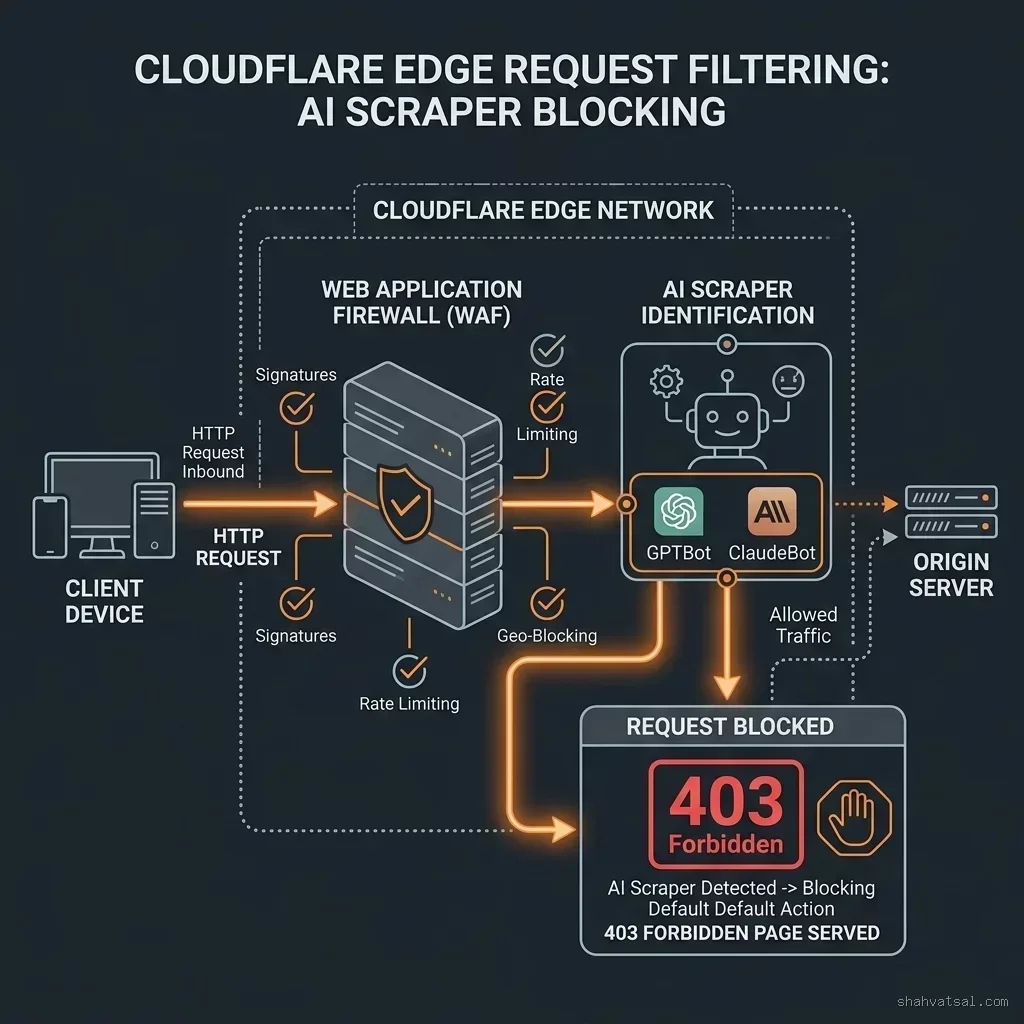
While this prevents scraper bots from draining server bandwidth, it also blocks search indexers. This blunt approach treats research crawlers the same as scrapers that copy content without permission. As a result, websites lose their presence in conversational search engines, making it harder for users to discover their services.
Restoring Visibility: The GEO Lifecycle
To restore visibility in AI search systems, administrators must adopt a structured Generative Engine Optimization (GEO) workflow. This strategy focuses on formatting content so AI models can easily crawl and summarize it.

The cycle starts by compiling structured, schema-rich content that AI scrapers can parse easily. Next, administrators must update their Cloudflare configuration to allow verified bots while keeping general security rules active. Once indexed, the content is processed by LLM reasoning layers and included in conversational answer panels, maintaining your referral traffic.
For more details on how next-generation protocols enable automated agent discovery, see the report on the MCP 1.0 Agentic AI Foundation.
What to Watch Next
- Verified Bot Classification Updates: Watch for updates to Cloudflare's bot classification systems, which may separate index crawlers from training data scrapers.
- Alternative Crawler Protocols: Monitor the adoption of index-sharing APIs like IndexNow, which allow sites to submit content directly without traditional scraping.
- WAF Exemption Templates: Check Cloudflare's library for pre-built rule templates designed to easily whitelist specific AI search crawlers.
Read the official updates on Cloudflare Blog → Cloudflare Blog
Key Takeaways
- Default Block Policy: Cloudflare's WAF now blocks major AI bots and scrapers by default across all service tiers.
- Index Exclusion Risk: Sites using the default settings are invisible to conversational AI search engines.
- Robots.txt Bypassed: The block occurs at the edge, making host-level crawler directives ineffective.
- GEO Strategy Critical: Reclaiming visibility requires manually whitelisting search crawlers while keeping general scraper protections active.
- Manual Fixes Available: Admins can use Cloudflare Custom Rules to whitelist specific user-agents like GPTBot and ClaudeBot.