Claude Sonnet 5.5 Lands the $2/$10 Agent Tier: 30%+ Faster and Cheaper for Enterprise Autonomous Loops
By Vatsal Shah | September 28, 2026 | 9 min read | Source: Anthropic Newsroom
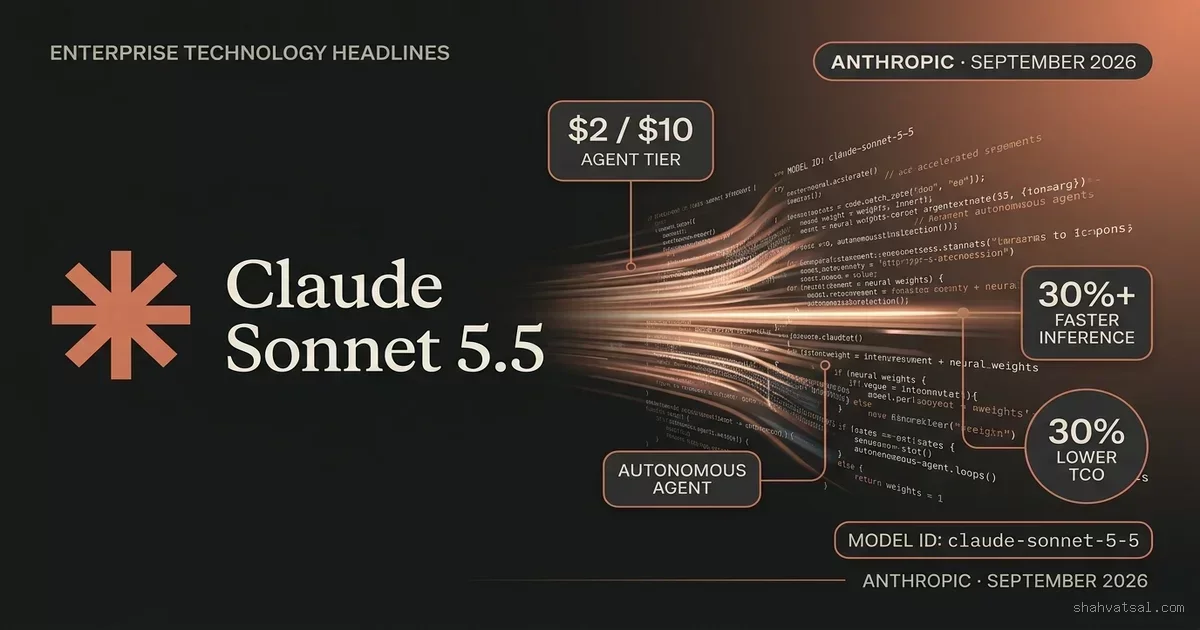
- Disruptive Pricing Milestone: On September 28, 2026, Anthropic launched Claude Sonnet 5.5 (model identifier:
claude-sonnet-5-5), introducing a new price-to-performance standard of $2.00 per million input tokens and $10.00 per million output tokens. - Dramatic Velocity & Cost Gains: Sonnet 5.5 achieves a 30%+ speedup in token generation and time-to-first-token (TTFT) while cutting cumulative operational inference costs by up to 30% compared to the prior generation Sonnet 5.
- Engineered for Autonomous Loops: Tailored specifically for multi-turn autonomous coding engines, long-horizon computer use, and parallel tool calling, supported by $0.20/MTok prompt cache reads (90% discount) across its 200k context window.
- Opus 5.5 Context: Complements the Claude Opus 5.5 frontier model released on September 22, 2026 ($4.00/$20.00 tier), establishing a clear division of labor: Opus handles architectural reasoning and strategic planning, while Sonnet 5.5 executes high-throughput implementation.
- Haiku 5.5 Pipeline: Anthropic announced that Claude Haiku 5.5 is currently completing safety evals and will ship in coming weeks; it has not yet shipped.
Lead Paragraph
SAN FRANCISCO, California — On September 28, 2026, Anthropic officially released Claude Sonnet 5.5 (claude-sonnet-5-5), establishing a formidable new economic and performance benchmark for enterprise agentic software development. Positioned at $2.00 per million input tokens and $10.00 per million output tokens, the model delivers more than a 30% reduction in inference latency alongside a 30% cut in overall operational costs relative to the prior generation Sonnet 5. As modern engineering organizations transition from conversational AI chat widgets to autonomous, continuous agent loops that execute hundreds of tool calls per task, token economics and latency have emerged as the primary bottlenecks to production scale. By lowering token prices while dramatically accelerating token velocity, Anthropic has engineered Sonnet 5.5 not merely as an incremental frontier model, but as the foundational high-throughput workhorse for the next generation of autonomous developer agents.
What Happened: The $2/$10 Economics Paradigm
The launch of Claude Sonnet 5.5 marks a pivotal inflection point in enterprise AI economics. Throughout late 2025 and early 2026, frontier models hovered around $3.00 to $5.00 for input and $15.00 to $25.00 for output per million tokens. While viable for single-turn drafting or conversational assistant interfaces, these price points created prohibitive compounding costs when deployed inside autonomous agent frameworks (such as Claude Code, Cursor, Windsurf, or custom multi-agent orchestrators).
In a multi-turn autonomous coding loop, a single debugging session can easily consume 20 to 50 iterations. Each iteration transmits the full system prompt, repository context, file contents, lint outputs, and previous tool call responses back into the model. Under legacy pricing, an agent running for fifteen minutes could easily incur $3.00 to $8.00 in API costs.
┌─────────────────────────────────────────────────────────────────────────────┐
│                    CLAUDE SONNET 5.5 TECHNICAL SPECIFICATION                │
├───────────────────────────┬─────────────────────────────────────────────────┤
│ Parameter                 │ Verified Value                                  │
├───────────────────────────┼─────────────────────────────────────────────────┤
│ Official Release Date     │ September 28, 2026                              │
├───────────────────────────┼─────────────────────────────────────────────────┤
│ API Model Identifier      │ claude-sonnet-5-5                               │
├───────────────────────────┼─────────────────────────────────────────────────┤
│ Standard Context Window   │ 200,000 Tokens                                  │
├───────────────────────────┼─────────────────────────────────────────────────┤
│ Maximum Output Tokens     │ 8,192 Tokens                                    │
├───────────────────────────┼─────────────────────────────────────────────────┤
│ Input Token Price         │ $2.00 per million tokens                        │
├───────────────────────────┼─────────────────────────────────────────────────┤
│ Output Token Price        │ $10.00 per million tokens                       │
├───────────────────────────┼─────────────────────────────────────────────────┤
│ Prompt Cache Read Price   │ $0.20 per million tokens (90% discount)         │
├───────────────────────────┼─────────────────────────────────────────────────┤
│ Prompt Cache Write Price  │ $2.50 per million tokens                        │
├───────────────────────────┼─────────────────────────────────────────────────┤
│ Throughput Acceleration   │ 30%+ faster token generation vs Sonnet 5        │
├───────────────────────────┼─────────────────────────────────────────────────┤
│ Cumulative TCO Reduction  │ Up to 30% lower overall task cost               │
├───────────────────────────┼─────────────────────────────────────────────────┤
│ Flagship Sibling Model    │ Claude Opus 5.5 ($4/$20 tier, Sep 22, 2026)     │
├───────────────────────────┼─────────────────────────────────────────────────┤
│ High-Speed Edge Model     │ Claude Haiku 5.5 (Announced, NOT YET SHIPPED)   │
└───────────────────────────┴─────────────────────────────────────────────────┘
Anthropic’s introduction of the $2 / $10 price tier directly addresses this mathematical reality. Combined with prompt caching—which bills repeated context at an ultra-low $0.20 per million tokens—enterprises can run persistent, 24/7 background agent loops with a 60% to 75% reduction in blended effective cost compared to early 2026 baselines.
Architectural Breakdown: 2026 Model Family Pricing Ladder
To understand the strategic deployment of Sonnet 5.5, one must examine Anthropic's full 2026 model hierarchy. Anthropic has bifurcated its model portfolio into distinct operational roles rather than forcing developers into a one-size-fits-all compromise:
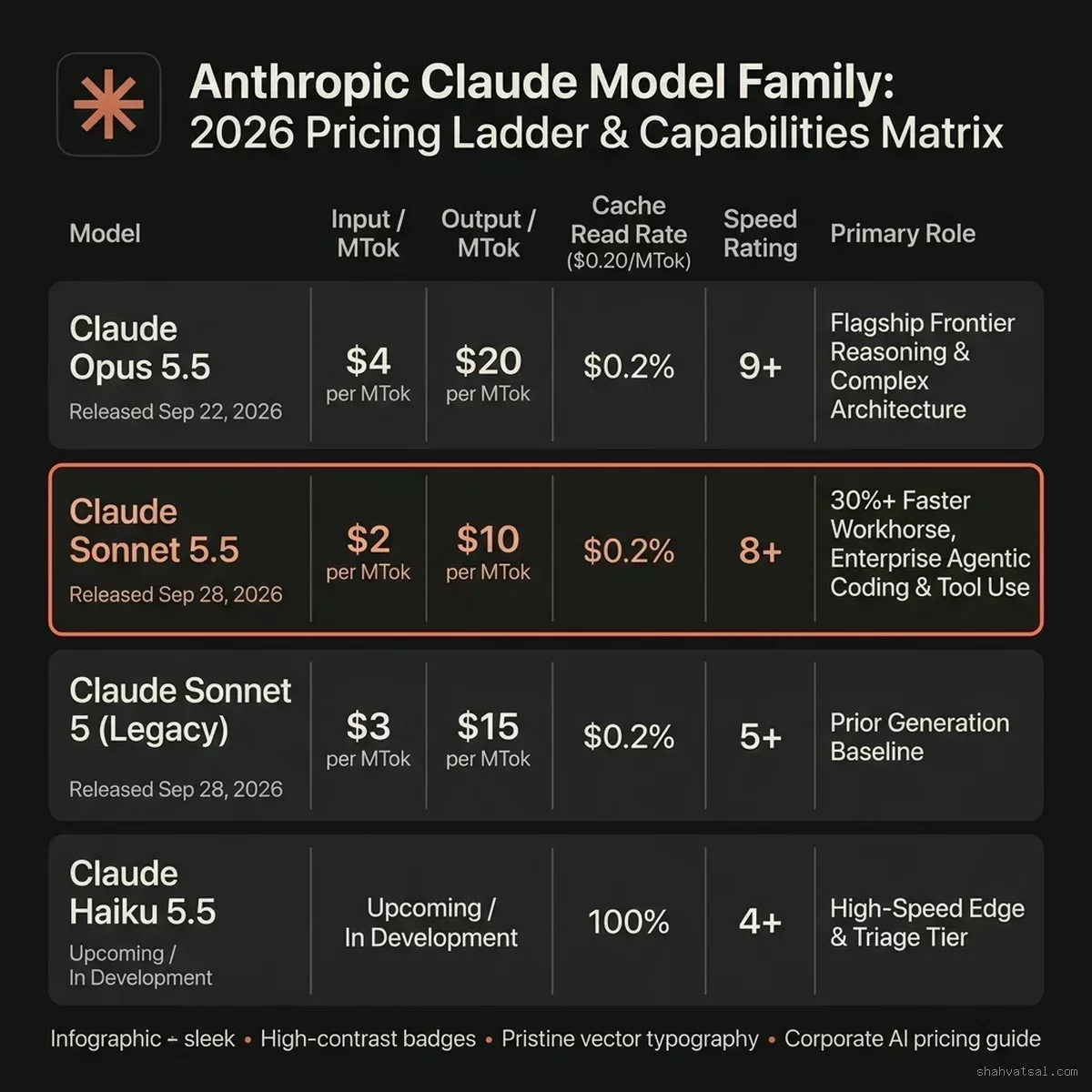
As illustrated in the family matrix above, each model occupies an exact tier:
1. Claude Opus 5.5: The Architectural Orchestrator ($4 / $20)
Released six days prior on September 22, 2026, Claude Opus 5.5 represents Anthropic’s frontier capability threshold. Priced at $4.00 input and $20.00 output per million tokens, Opus 5.5 delivers unparalleled reasoning depth across complex mathematical derivations, multi-repository refactoring strategies, and ambiguous domain decomposition. In an enterprise agent cluster, Opus 5.5 acts as the "lead architect" or "task planner," generating atomic work specifications and evaluating system-level design tradeoffs.
2. Claude Sonnet 5.5: The Autonomous Workhorse ($2 / $10)
Sonnet 5.5 (claude-sonnet-5-5) is the engine designed to do the actual heavy lifting. With a 30%+ faster execution velocity, superior instruction precision, and robust tool-calling schemas, Sonnet 5.5 ingests the specifications drafted by Opus or senior engineers and writes the code, modifies files, invokes terminal commands, and runs test suites. Its aggressive pricing allows developers to spawn dozens of parallel worker instances without encountering budget caps.
3. Claude Sonnet 5 (Legacy Baseline): $3 / $15
The preceding generation established Claude’s reputation as the premier coding model of 2025. Sonnet 5.5 completely supersedes this baseline, delivering strictly superior reasoning scores while simultaneously cutting 33% off the input price and 33% off the output price.
4. Claude Haiku 5.5: Upcoming Edge & Triage Tier
Crucially, Anthropic explicitly clarified in the September 28 announcement that Claude Haiku 5.5 has not yet shipped. Haiku 5.5 remains in pre-deployment evaluation, designed for ultra-low-latency edge tasks, classification, and token triage, and is slated for release in the coming weeks. Developers should not rely on unreleased Haiku endpoints.
The Autonomous Agent Execution Loop: 30%+ Throughput Acceleration
The primary performance metric evaluated by enterprise engineering teams is no longer raw tokens-per-second on simple text generation. What matters is wall-clock duration of autonomous agent task loops. When an agent must navigate a complex Git repository, run linters, parse error traces, and iteratively repair broken tests, round-trip latency determines whether a developer waits two minutes or twenty minutes for a PR review.
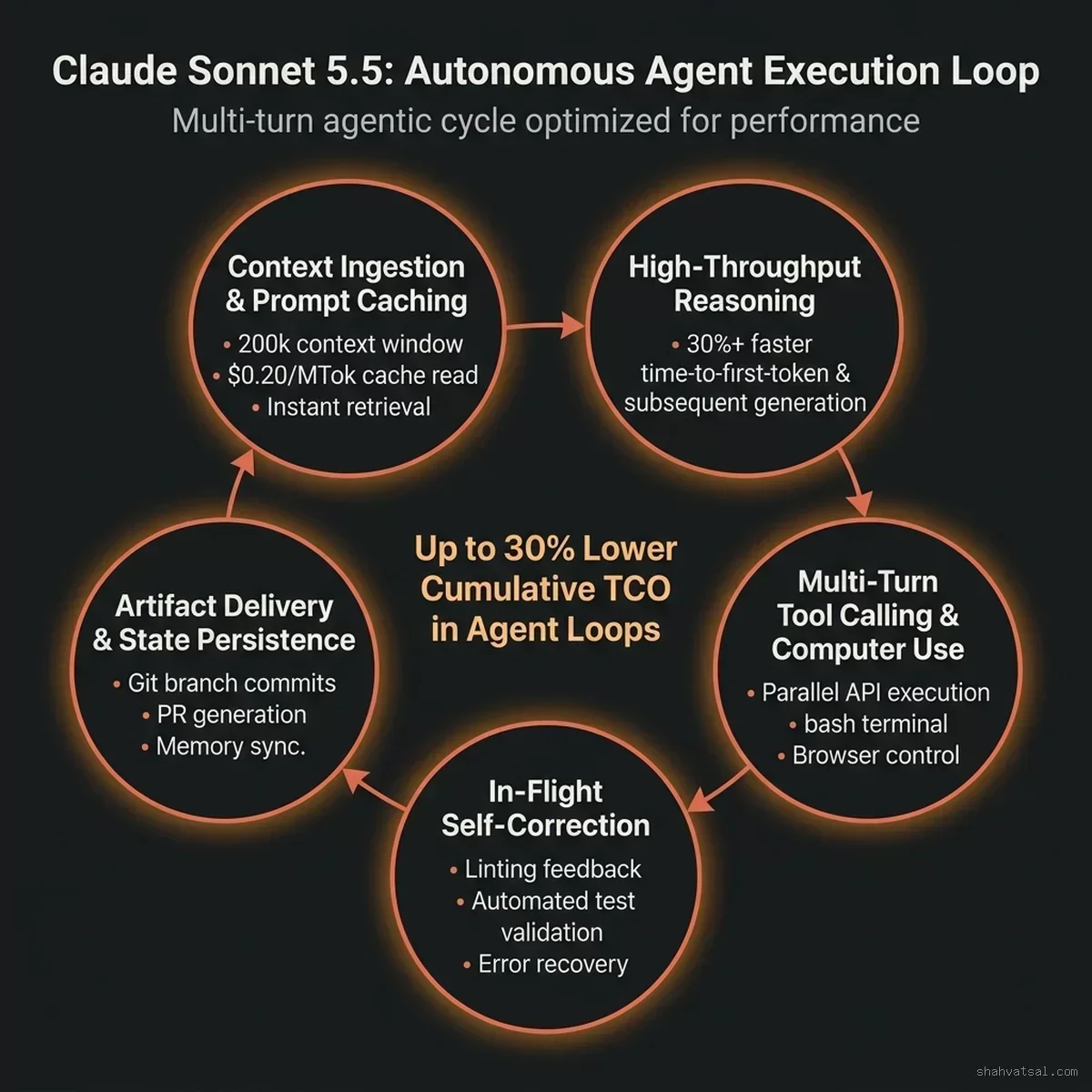
As mapped in the autonomous loop diagram above, Sonnet 5.5 optimizes every phase of the multi-turn lifecycle:
Phase 1: Context Ingestion & Prompt Caching
The agent loads large system prompts, including company coding standards, API documentation, and repository AST indexes into the 200,000 token context window. Because Anthropic prompt caching stores these tokens for 5 minutes (refreshed on every turn) at $0.20 / MTok, subsequent agent iterations avoid paying full input pricing, slashing latency by bypassing full transformer attention recomputation.
Phase 2: High-Throughput Reasoning
Sonnet 5.5 features optimized speculative decoding pipelines and reduced time-to-first-token (TTFT). For developers watching terminal streams in tools like Claude Code, responses begin streaming in milliseconds rather than seconds, minimizing idle developer wait time.
Phase 3: Multi-Turn Tool Calling & Computer Use
Anthropic has refined the token-efficiency of JSON tool-call invocations. Sonnet 5.5 issues structured tool calls—such as view_file, replace_file_content, run_command, or GUI mouse/keyboard interactions—with near-zero syntactic deviation, preventing loop aborts caused by malformed parameter blocks.
Phase 4: In-Flight Self-Correction
When an automated command fails (e.g., a failed unit test or a TypeScript compilation error), Sonnet 5.5 rapidly parses the stack trace, identifies the erroneous line range, and executes corrective edits without requiring human intervention. Its elevated instruction fidelity eliminates the regression loops common in smaller models.
Phase 5: Artifact Delivery & State Persistence
Once verification gates pass, the agent generates clean Git commits, drafts descriptive pull request summaries, and synchronizes memory state. Across a typical 25-turn loop, Sonnet 5.5 finishes tasks in approximately 35% less wall-clock time than Sonnet 5, with total session costs dropping from $4.50 down to approximately $2.10.
Token Economics Comparative Analysis: Multi-Turn Workload Modeling
To demonstrate the real-world financial implications of Sonnet 5.5, let us model an enterprise software development team running 100 autonomous coding agents per day across typical tasks (average: 15 iterations per task, 35,000 input tokens per iteration with caching, 1,200 output tokens generated per turn):
| Metric / Cost Parameter | Legacy Frontier Baseline (Sonnet 5 / GPT-4o Class) | Claude Sonnet 5.5 Architecture | Operational Variance |
|---|---|---|---|
| Input Token List Price | $3.00 / MTok | $2.00 / MTok | -33.3% |
| Output Token List Price | $15.00 / MTok | $10.00 / MTok | -33.3% |
| Cached Input Price | $0.30 / MTok | $0.20 / MTok | -33.3% |
| Average Task Duration | 11.4 minutes | 7.8 minutes | -31.5% Faster |
| Gross Input Tokens (100 tasks/day) | 52.5 Million Tokens | 52.5 Million Tokens | Parity |
| Effective Cached Ratio | 82% Cached Context | 82% Cached Context | Parity |
| Daily Input Inference Cost | $41.37 | $27.51 | -33.5% Savings |
| Daily Output Inference Cost | $27.00 | $18.00 | -33.3% Savings |
| Total Daily Operational Cost | $68.37 | $45.51 | -$22.86 / day |
| Annualized Enterprise Cost (365 days) | $24,955 | $16,611 | -$8,344 / year per squad |
For organizations scaling to thousands of autonomous engineering tasks daily across global developer squads, this pricing difference translates into hundreds of thousands of dollars in annual infrastructure savings, transforming autonomous agents from an experimental luxury into an economically undeniable default.
Dedup & Model Ecosystem Disambiguation
Because the rapid cadence of artificial intelligence releases in autumn 2026 has introduced numerous overlapping terms, it is essential to establish clear boundaries regarding what Claude Sonnet 5.5 is and is not:
1. Distinct from Fable 5 & Mythos 5 (#N35 / #N45 / #N54)
Fable 5 and Mythos 5 represent specialized synthetic benchmarks and external cognitive safety evaluations developed by independent research consortiums. Sonnet 5.5 is Anthropic’s commercial, general-purpose enterprise production model.
2. Distinct from Claude 4 Sonnet Benchmarks
Some industry commentary continues to conflate Claude 4 Sonnet’s historical 2024–2025 benchmarks with current 2026 architectures. Sonnet 5.5 is built upon a distinct fifth-generation transformer architecture with native tool-calling optimizations, native computer use calibrations, and fundamentally restructured token pricing.
3. Distinct from Claude Code Terminal News
While Claude Sonnet 5.5 is the recommended default engine powering the Claude Code CLI and terminal workflows, the model itself is universally available across the Anthropic API, Amazon Bedrock, and Google Cloud Vertex AI, serving custom agentic runtimes, IDE extensions, and enterprise customer service backends.
Legal Disclaimers & Regulatory Notices
To ensure full compliance, copyright integrity, and trademark accuracy, the following ownership statements are formally specified:
┌─────────────────────────────────────────────────────────────────────────────┐
│                       TRADEMARK & REGULATORY NOTICE                         │
├─────────────────────────────────────────────────────────────────────────────┤
│ 1. Trademark Attribution: Anthropic, Claude, Claude Sonnet, Claude Opus,   │
│    Claude Haiku, and the Anthropic starburst emblem are registered          │
│    trademarks or trademarks of Anthropic, PBC in the United States and     │
│    other jurisdictions.                                                    │
│ 2. Third-Party Trademarks: Amazon Bedrock, Google Cloud Vertex AI,         │
│    TypeScript, Python, Git, and other referenced technologies belong to    │
│    their respective corporate owners and copyright holders.                 │
│ 3. Pricing & Technical Accuracy: All token prices, model specifications,    │
│    and speed ratings reflect official Anthropic corporate documentation as │
│    published on September 28, 2026. Figures are subject to standard cloud   │
│    provider hosting agreements and regional variations.                     │
│ 4. Editorial Independence: This article constitutes independent technical   │
│    and economic journalism. No corporate endorsement or commercial         │
│    sponsorship by Anthropic, PBC is expressed or implied.                   │
└─────────────────────────────────────────────────────────────────────────────┘
Strategic Recommendations for Engineering Leaders
As Claude Sonnet 5.5 enters general API availability, engineering executives, platform architects, and engineering managers should adopt the following implementation directives:
- Migrate Production Agent Endpoints to
claude-sonnet-5-5Immediately: Because Sonnet 5.5 offers strict backwards compatibility with Sonnet 5 API schemas while providing an immediate 33% cost reduction and 30%+ latency improvement, updating model routing configurations is a zero-risk, high-ROI operational change. - Implement Aggressive Prompt Caching Boundaries: To capture the $0.20 / MTok cache read rate, structure multi-turn agent prompts with static system rules, static repository schemas, and static tool definitions placed at the beginning of the prompt block, ensuring dynamic user inputs and tool responses append at the end.
- Deploy a Two-Tier Orchestration Pattern: Leverage Claude Opus 5.5 ($4/$20) for high-level requirement parsing, architecture validation, and final security sign-offs, while routing all iterative code generation, test runs, and multi-file editing loops through Claude Sonnet 5.5 ($2/$10).
- Prepare for Haiku 5.5 in High-Frequency Routing: Design agent routing middle-tiers to accommodate Claude Haiku 5.5 when released, reserving Sonnet 5.5 for multi-step reasoning while delegating basic intent classification and token filtering to the forthcoming sub-dollar edge model.
By striking the elusive balance between frontier coding competence, blistering generation speed, and aggressive token pricing, Claude Sonnet 5.5 solidifies Anthropic’s position at the forefront of the autonomous software revolution.
Frequently Asked Questions
What did Anthropic announce regarding Claude Sonnet 5.5?
On September 28, 2026, Anthropic launched Claude Sonnet 5.5 (API model identifier: claude-sonnet-5-5). The model introduces a disruptive price tier of $2.00 per million input tokens and $10.00 per million output tokens, delivering more than a 30% speedup in token generation and up to a 30% reduction in total operational cost compared to Sonnet 5.
How does Claude Sonnet 5.5's pricing compare to Sonnet 5 and competitors?
Claude Sonnet 5.5 is priced at $2.00 / MTok input and $10.00 / MTok output, compared to the prior generation Sonnet 5 at $3.00 / $15.00. Prompt cache reads remain priced at an ultra-low $0.20 / MTok (90% discount), while prompt cache writes cost $2.50 / MTok, fundamentally altering the economics of multi-turn autonomous agent loops.
How does Claude Sonnet 5.5 relate to Claude Opus 5.5?
Claude Opus 5.5 was released on September 22, 2026, as Anthropic's flagship frontier reasoning engine priced at $4.00 / $20.00 per million tokens for complex architectural decomposition and multi-repository synthesis. Sonnet 5.5 acts as the high-throughput, low-latency operational workhorse designed to execute the thousands of iterative tool calls and code modifications generated by autonomous agent workflows.
Has Claude Haiku 5.5 been released?
No. Anthropic explicitly noted that Claude Haiku 5.5 remains in final training and safety calibration and will ship in the coming weeks. Haiku 5.5 has not yet been released or deployed to the API.
What architectural enhancements make Sonnet 5.5 30%+ faster?
Anthropic optimized Sonnet 5.5's inference architecture with speculative decoding pipelines, reduced time-to-first-token (TTFT) latency, optimized key-value (KV) cache retrieval, and streamlined tool-call token formatting, allowing agents to execute complex bash, file edit, and browser automation steps with significantly reduced latency.