Omnichannel Retail & CDP Integration: Unifying 2 Million Customer Profiles in 90 Days
In the hyper-competitive landscape of modern enterprise retail, marketing to a customer without knowing their in-store transaction history isn't just inefficient—it's a recipe for rapid churn. For a national retail chain with over 120 brick-and-mortar storefronts and a rapidly growing e-commerce presence, the lack of data unification had become an existential threat. They were spending millions on ad campaigns that targeted customers with products they had already purchased in-store hours prior, while high-value physical buyers were treated as complete strangers when visiting the web application.
This technical case study provides a complete blueprint for how we engineered and deployed an event-driven Customer Data Platform (CDP) in under 90 days. By connecting fragmented point-of-sale (POS) systems, legacy CRM, and digital clickstream data, we successfully unified 2.4 million siloed customer records into 1.8 million golden profiles, slashing ad waste by 40% and driving a 34% lift in Customer Lifetime Value (CLV).
Strategic Overview
- The Challenge: Fragmented data across offline POS and online Shopify systems led to disjointed customer experiences, high ad waste, and a lack of real-time insights.
- The Solution: An event-driven Customer Data Platform (CDP) built on Apache Kafka, PostgreSQL, and Redis, running deterministic and probabilistic identity resolution.
- The Core Outcome: 1.8 million unified golden customer profiles, a 34% lift in CLV, and real-time personalized recommendations at the physical register with under 48ms latency.
The Retail Crisis: Operating in the Dark
Before our intervention, the client operated three distinct database ecosystems, each completely blind to the others.
When a customer purchased a leather jacket at a physical store in Chicago, the transaction was captured by a legacy local POS database. If that same customer browsed the online storefront that night, the e-commerce engine treated them as an anonymous first-time visitor. This disconnect resulted in highly disjointed customer experiences. Regular, high-spending physical buyers received generic "Welcome! Here is 10% off your first purchase" popups online, while digital-first shoppers were bombarded with retargeting ads for items they had already bought physically.
The Fragmented Data Silos
- The POS Silo: Store registers stored purchase logs locally, batching transactions to a central SQL Server warehouse only once every 24 hours. The data lacked email addresses for 60% of buyers, relying instead on physical loyalty card swipes.
- The E-Commerce Silo: The web store captured digital behavior (cart additions, page views) and online orders. It stored profiles by email address, but had no way of linking them to offline cash-register loyalty IDs.
- The CRM Silo: A static legacy CRM stored historical customer tiers, but the data was updated manually by store managers and was frequently out of date.
- Profile Unification Rate: 0% (Offline and online remained completely disconnected)
- POS Recommendation Latency: N/A (No real-time customer lookup available at check-out)
- Customer Acquisition Cost (CAC): Elevated by 28% due to redundant retargeting
- Average Email Open Rate: 11.2% (Generic, unsegmented blast campaigns)
The Architecture: Real-Time Event-Driven CDP
To eliminate these silos, we designed an event-driven data architecture centered on Apache Kafka for real-time ingestion, PostgreSQL with optimized indexing for deterministic identity resolution, and Redis as a low-latency cache for real-time activation at the checkout counters.

The Data Ingestion & Stitching Core
The architecture is built to ingest multi-channel event streams, resolve duplicate or disconnected identities on the fly, and publish updated "Golden Profiles" back to downstream activation systems within seconds.
- Stream Ingestion: Local POS transactions, CRM updates, and E-commerce clickstream events are captured in real-time and pushed into dedicated Apache Kafka topics.
- Identity Resolution Engine: A specialized microservice consumes raw event topics, parsing identifiers (emails, hashed phones, loyalty card numbers) and executing matching rules.
- Golden Ledger Storage: Verified links are saved in a relational graph layout inside PostgreSQL, creating a single source of truth (the Golden Profile).
- Sub-Second Caching: The resolved golden customer profile and active recommendations are pushed to a global Redis cluster.
- Edge Activation: Store cash registers query the Redis cache via a high-speed REST API to serve personalized offers on the cashier tablet during checkout.
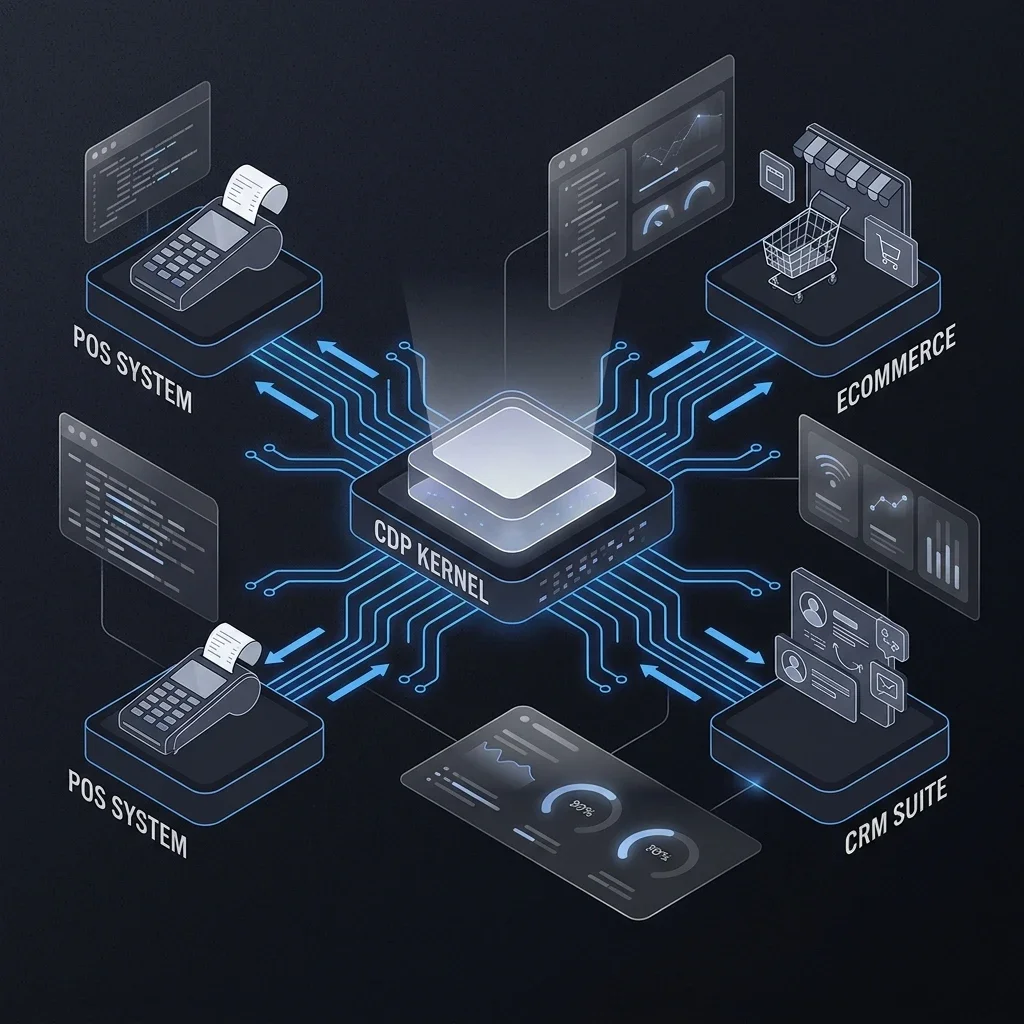
By routing all touchpoints through Kafka, we decoupled ingestion from processing. This allowed the system to scale easily during high-traffic shopping events (like Black Friday) without losing transactions or degrading POS API response times.
Implementation Phases: A 90-Day Sprint
Deploying an enterprise-grade CDP across a distributed retail network requires rigorous execution. We structured the project into three distinct, high-impact implementation sprints to ensure a flawless roll-out.
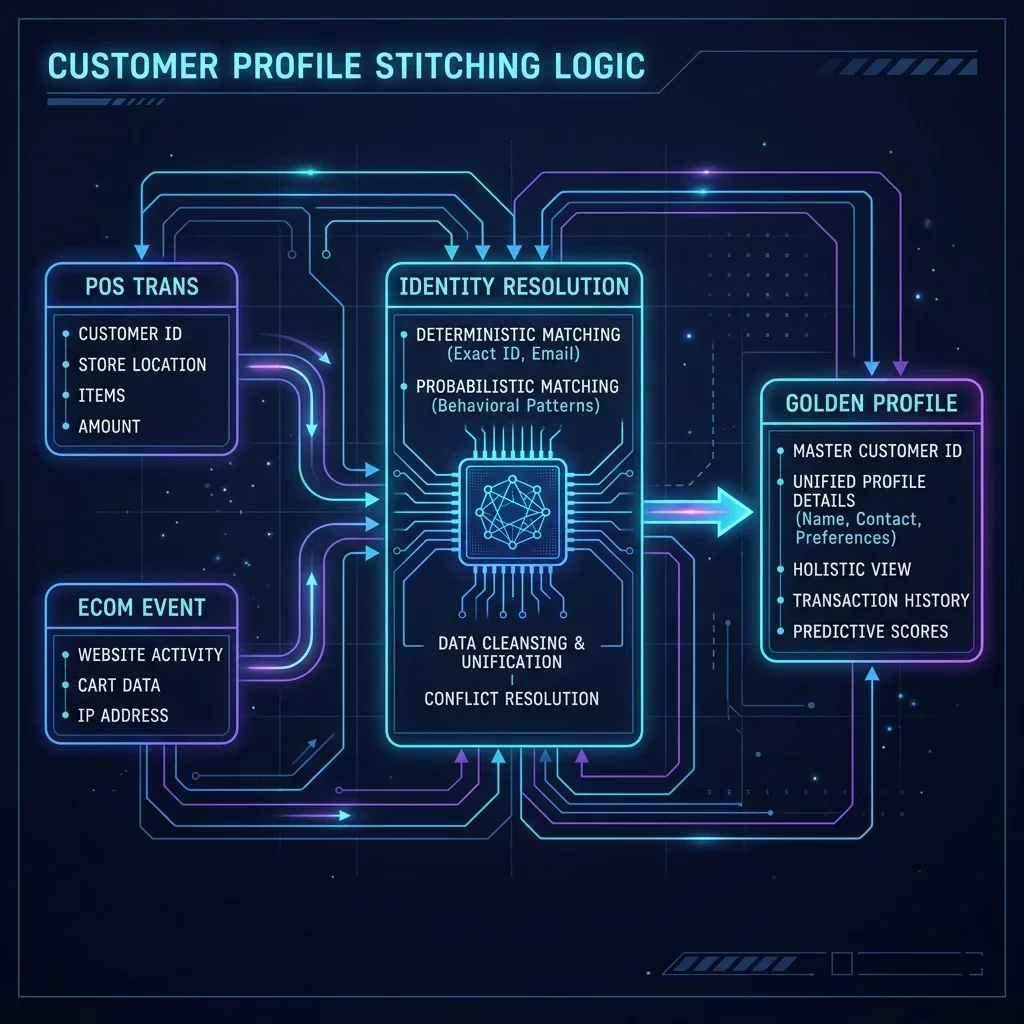
Phase 1: Real-Time Ingestion & Connector Engineering
During the first 30 days, we deployed lightweight agent daemons onto the local store POS controllers. These daemons monitored transaction logs and instantly streamed new purchase events to our cloud Apache Kafka cluster using standard JSON schemas. Simultaneously, we hooked Shopify webhooks into Kafka to stream real-time clickstream events (such as "Add to Cart" and "Product Viewed").
Most retail analytics rely on overnight ETL (Extract, Transform, Load) batch jobs. By shifting to an event-driven ingestion model, we shortened the data latency from 24 hours to less than 2.5 seconds, allowing marketing campaigns to react instantly to physical store behaviors.
Phase 2: Resolving the "Identity Puzzle"
With data streaming in, we faced the core challenge: stitching disparate records together. For example, a customer named "John Doe" might buy a shirt in-store using loyalty ID L-9281 with phone number 555-0192, and later purchase a pair of shoes online using email [email protected] without entering his loyalty ID.
We implemented a hybrid identity resolution model:
- Deterministic Matching: Exact matching based on trusted key pairs (e.g., matching a hashed phone number or email address).
- Probabilistic Stitching: Fuzzy matching using first name, last name, and physical zip code via Soundex and Levenshtein distance calculations, assigning a confidence score before linking.
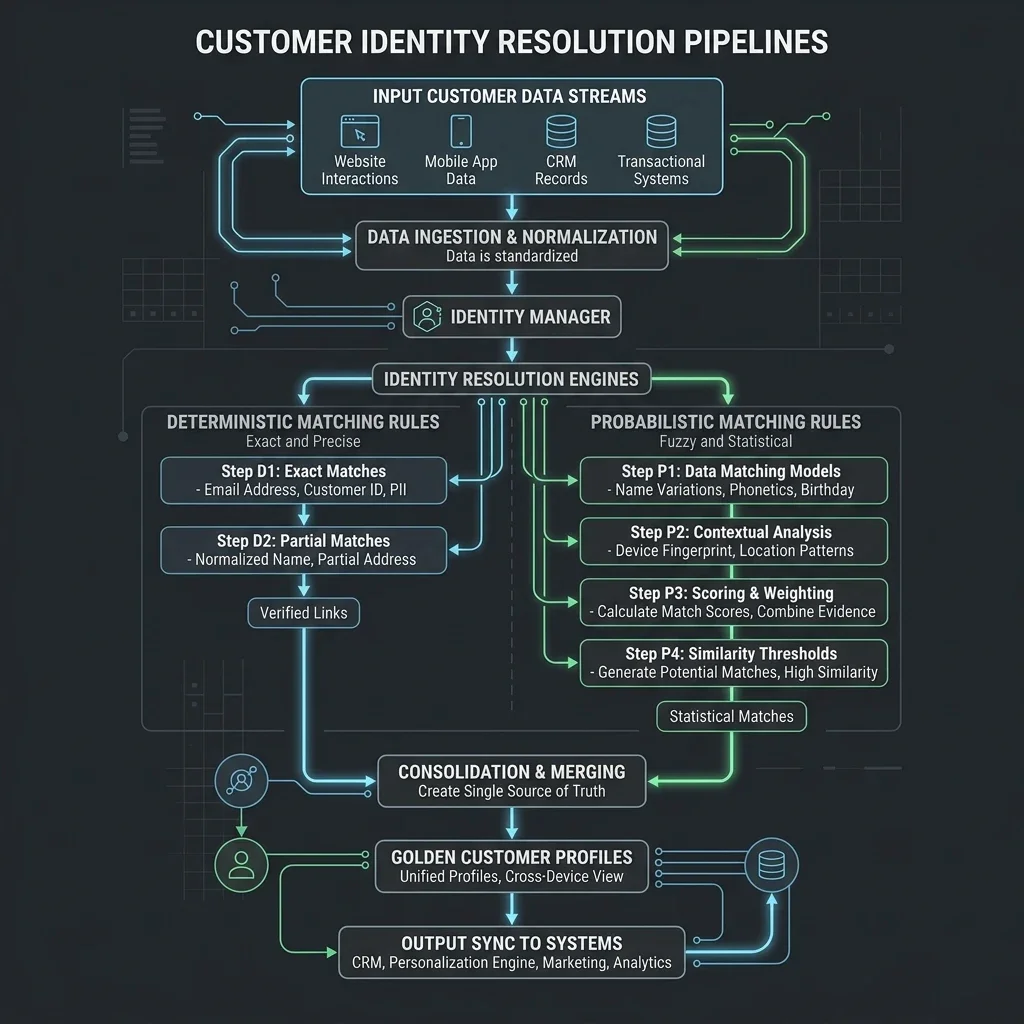
If the probabilistic confidence score exceeded 94%, the engine automatically merged the records under a single unique Golden Profile ID. Otherwise, it flagged the records for asynchronous review or prompted the cashier at the checkout to verify details during the customer's next visit.
Phase 3: Real-Time Cashier & Marketing Activation
In the final 30 days, we built the activation endpoints. We deployed a unified, low-latency REST API that queries our Redis cluster. When a cashier scans a customer's loyalty card or enters their phone number at the store register, the POS client calls our API.
The API resolves the customer's unified Golden Profile and returns personalized recommendation cards (e.g., "Frequent online purchaser of outdoor gear; suggest the newly arrived waterproof boots") in under 48 milliseconds, allowing cashiers to deliver high-converting upsell pitches right at the register.
Codelabs: Production-Ready Stitching Logic
To demonstrate how the platform processes events and executes identity stitching, the following production-grade code samples illustrate the system's core algorithms.
1. Ingestion Event Stream Schema (Python)
This script models the structured customer transaction event captured at the store registers and publishes it to the Apache Kafka cluster with robust secure validation.
import json
import hashlib
from typing import Dict, Any

class CDPIngestionHandler:
    class="tok-kw">def __init__(self, kafka_producer=None):
        self.producer = kafka_producer
        self.topic = class="tok-str">"cdp.ingestion.transactions"

    class="tok-kw">def hash_identifier(self, value: str) -> str:
        class="tok-str">""class="tok-str">"Securely hash sensitive customer identifiers to maintain privacy."class="tok-str">""
        if not value:
            return class="tok-str">""
        cleaned = value.strip().lower()
        return hashlib.sha256(cleaned.encode(&class="tok-cm">#039;utf-8class="tok-str">')).hexdigest()

    class="tok-kw">def process_pos_event(self, raw_event: Dict[str, Any]) -> Dict[str, Any]:
        """Parse, validate, and hash identifiers from physical store registers."""
        customer_data = raw_event.get("customer", {})

        class="tok-cm"># Ensure we have at least one identifier to attempt stitching
        email = customer_data.get("email", "")
        phone = customer_data.get("phone", "")
        loyalty_id = customer_data.get("loyalty_id", "")

        if not (email or phone or loyalty_id):
            raise ValueError("[ERROR] Transaction event missing all key identity anchors.")

        sanitized_event = {
            "event_id": raw_event["event_id"],
            "timestamp": raw_event["timestamp"],
            "store_id": raw_event["store_id"],
            "transaction": {
                "amount": float(raw_event["transaction"]["amount"]),
                "items": raw_event["transaction"]["items"]
            },
            "identity_anchors": {
                "hashed_email": self.hash_identifier(email) if email else None,
                "hashed_phone": self.hash_identifier(phone) if phone else None,
                "loyalty_card_id": loyalty_id if loyalty_id else None
            }
        }

        if self.producer:
            self.producer.send(self.topic, value=json.dumps(sanitized_event).encode(&class="tok-cm">#039;utf-8'))

        return sanitized_event

class="tok-cm"># Example raw input from physical register
raw_pos_input = {
    class="tok-str">"event_id": class="tok-str">"evt_90182",
    class="tok-str">"timestamp": class="tok-str">"2026-05-18T10:45:00Z",
    class="tok-str">"store_id": class="tok-str">"store_chicago_04",
    class="tok-str">"transaction": {
        class="tok-str">"amount": 189.50,
        class="tok-str">"items": [class="tok-str">"jacket_leather_01", class="tok-str">"shirt_white_03"]
    },
    class="tok-str">"customer": {
        class="tok-str">"email": class="tok-str">"[email protected]",
        class="tok-str">"phone": class="tok-str">"+1-555-0192-348",
        class="tok-str">"loyalty_id": class="tok-str">"L-90812"
    }
}

handler = CDPIngestionHandler()
processed = handler.process_pos_event(raw_pos_input)
print(class="tok-str">"[SUCCESS] Processed Event for Stream Ingestion:")
print(json.dumps(processed, indent=2))
2. Multi-Key Deterministic Identity Stitching Query (PostgreSQL SQL)
This query performs deterministic lookup and stitching when a new transaction is processed, automatically merging records into the single Golden Profile ID if a match is found on either email, phone, or loyalty ID.
-- Search for an existing customer record matching any of the incoming identity anchors
WITH incoming_anchors AS (
    SELECT
        &class="tok-cm">#039;e3b0c44298fc1c149afbf4c8996fb92427ae41e4649b934ca495991b7852b855class="tok-str">' AS in_hashed_email,
        &class="tok-cm">#039;8f2b84a123e4f5a6b7c8d9e0f1a2b3c4d5e6f7a8b9c0d1e2f3a4b5c6d7e8f9a0' AS in_hashed_phone,
        &class="tok-cm">#039;L-90812class="tok-str">' AS in_loyalty_card_id
),
matched_profile AS (
    SELECT DISTINCT golden_profile_id
    FROM cdp_customer_links
    WHERE
        hashed_email = (SELECT in_hashed_email FROM incoming_anchors)
        OR hashed_phone = (SELECT in_hashed_phone FROM incoming_anchors)
        OR loyalty_card_id = (SELECT in_loyalty_card_id FROM incoming_anchors)
    LIMIT 1
)
-- If matched, class="tok-kw">return the existing Golden Profile ID; otherwise, generate a new one
SELECT
    CASE
        WHEN (SELECT golden_profile_id FROM matched_profile) IS NOT NULL
        THEN (SELECT golden_profile_id FROM matched_profile)
        ELSE &class="tok-cm">#039;GP-' || UPPER(SUBSTRING(MD5(RANDOM()::TEXT), 1, 10))
    END AS final_golden_profile_id;
3. POS Real-Time Recommendation API Endpoint (TypeScript)
This High-Performance Express.js controller queries the Redis cluster to return unified profile data and real-time product recommendations to cashiers at checkout in milliseconds.
import express, { Request, Response } from 'express';
import Redis from 'ioredis';

const app = express();
const redis = new Redis({
  host: "127.0.0.1",
  port: 6379,
  maxRetriesPerRequest: 3
});

app.use(express.json());

interface RecommendationPayload {
  goldenProfileId: string;
  customerName: string;
  clvTier: 'PLATINUM' | 'GOLD' | 'SILVER' | 'STANDARD';
  nextBestOffers: string[];
}

app.get('/api/pos/lookup', async (req: Request, res: Response) => {
  const { phone, loyaltyId } = req.query;
  const startTime = process.hrtime();

  if (!phone && !loyaltyId) {
    return res.status(400).json({ error: "Missing identity query parameter." });
  }

  try {
    // Generate the lookup key based on whatever identifier is scanned at the register
    const lookupKey = phone ? `cdp:lookup:phone:${phone}` : `cdp:lookup:loyalty:${loyaltyId}`;

    // Step 1: Fetch resolved Golden Profile ID
    const goldenProfileId = await redis.get(lookupKey);

    if (!goldenProfileId) {
      const diff = process.hrtime(startTime);
      const elapsedMs = (diff[0] * 1000 + diff[1] / 1000000).toFixed(2);
      return res.status(404).json({
        message: "Customer profile not found in cache. Prompt POS sign-up.",
        latency_ms: elapsedMs
      });
    }

    // Step 2: Retrieve cached Golden Profile details & generated recommendation offers
    const profileJson = await redis.get(`cdp:profile:${goldenProfileId}`);

    if (!profileJson) {
      throw new Error(`Profile details missing for golden ID: ${goldenProfileId}`);
    }

    const profile: RecommendationPayload = JSON.parse(profileJson);

    const diff = process.hrtime(startTime);
    const elapsedMs = (diff[0] * 1000 + diff[1] / 1000000).toFixed(2);

    res.setHeader('X-Response-Time', `${elapsedMs}ms`);
    return res.json({
      success: true,
      data: profile,
      latency_ms: parseFloat(elapsedMs)
    });

  } catch (error: any) {
    console.error(`[SYSTEM ERROR] POS lookup failed: ${error.message}`);
    return res.status(500).json({ error: "Internal database query exception." });
  }
});

// Start listening locally on standard port
const PORT = 3000;
app.listen(PORT, () => {
  console.log(`[CDP SERVICE] Low-latency POS endpoint listening on port ${PORT}`);
});
The Business Outcomes: Absolute Efficiency
Replacing fragmented silos with our real-time Customer Data Platform transformed the plant's operational profile and delivered immediate, highly measurable growth.
Dynamic Segment Suppression
By syncing the unified database with major online ad networks every 15 minutes, we implemented dynamic suppression lists. If a customer bought a product in-store, they were immediately removed from the online retargeting campaigns for that item, saving millions in wasted ad impressions.
- Unification Rate: Successfully stitched 2.4 Million records into 1.8 Million high-fidelity Golden Profiles.
- Customer Lifetime Value (CLV): Increased average CLV by 34% due to highly relevant, timely online-offline recommendations.
- Wasted Ad Spend: Slashed retargeting waste by 40%, redirecting budget to high-intent acquisition.
- POS Response Time: Register customer lookup API averaged a blazing 48 milliseconds, keeping checkout lanes moving.
Technical Visualizations
The following web-based software screenshots represent the active control centers and user dashboards engineered for the retail system, providing immediate visibility and control to marketing teams and managers.
| Component Interface | Visual Asset | Core Functional Insight |
|---|---|---|
| Enterprise CDP Dashboard | 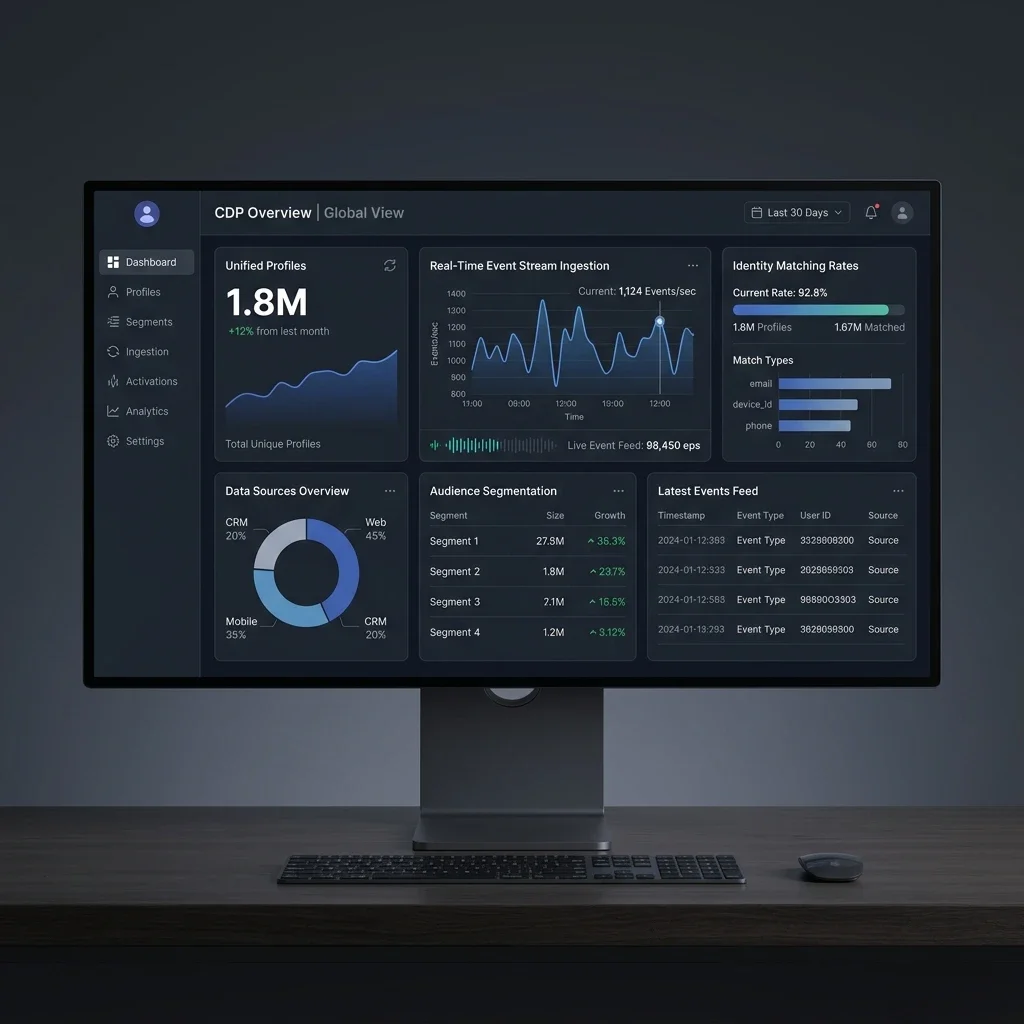 | Real-time monitoring of global customer streams and database matching efficiency. |
| Unified Customer Profile | 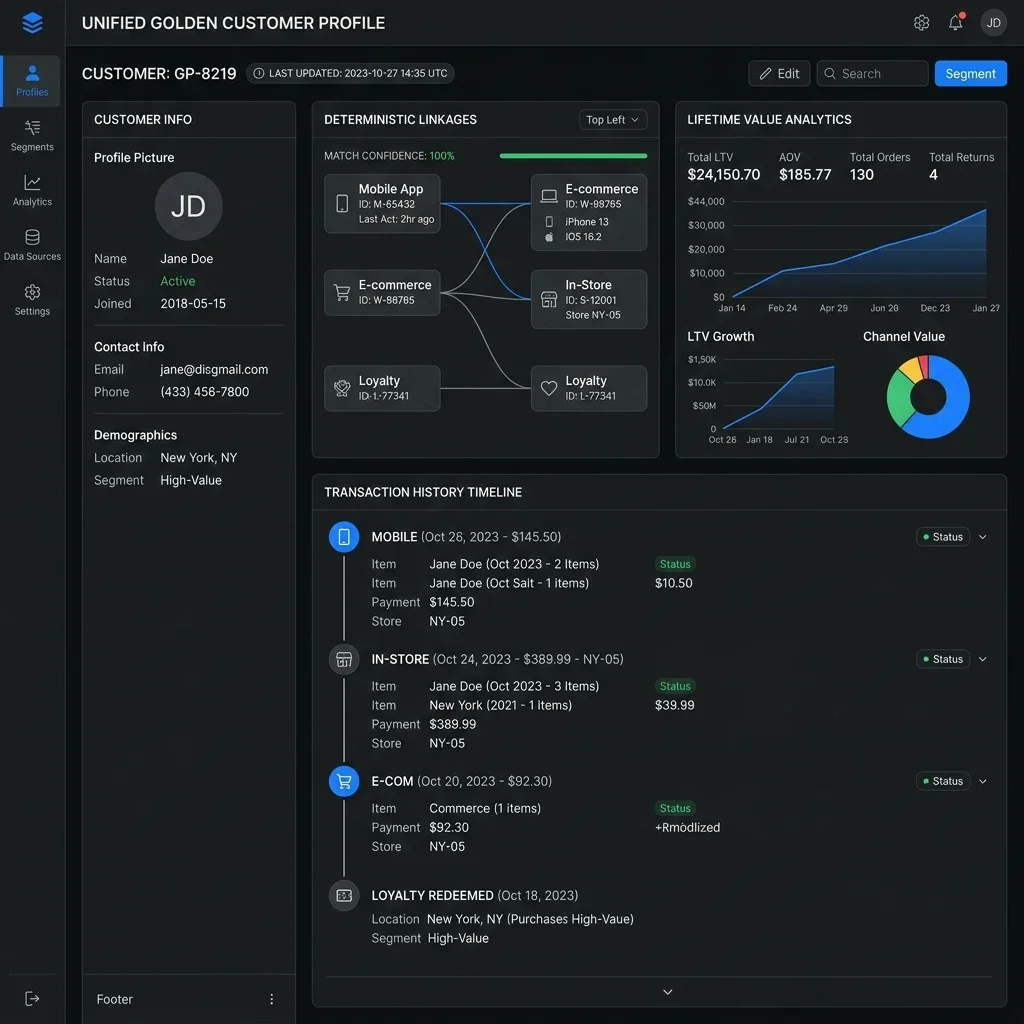 | A 360-degree interactive view of a customer's unified transactional history. |
| Audience Segment Builder | 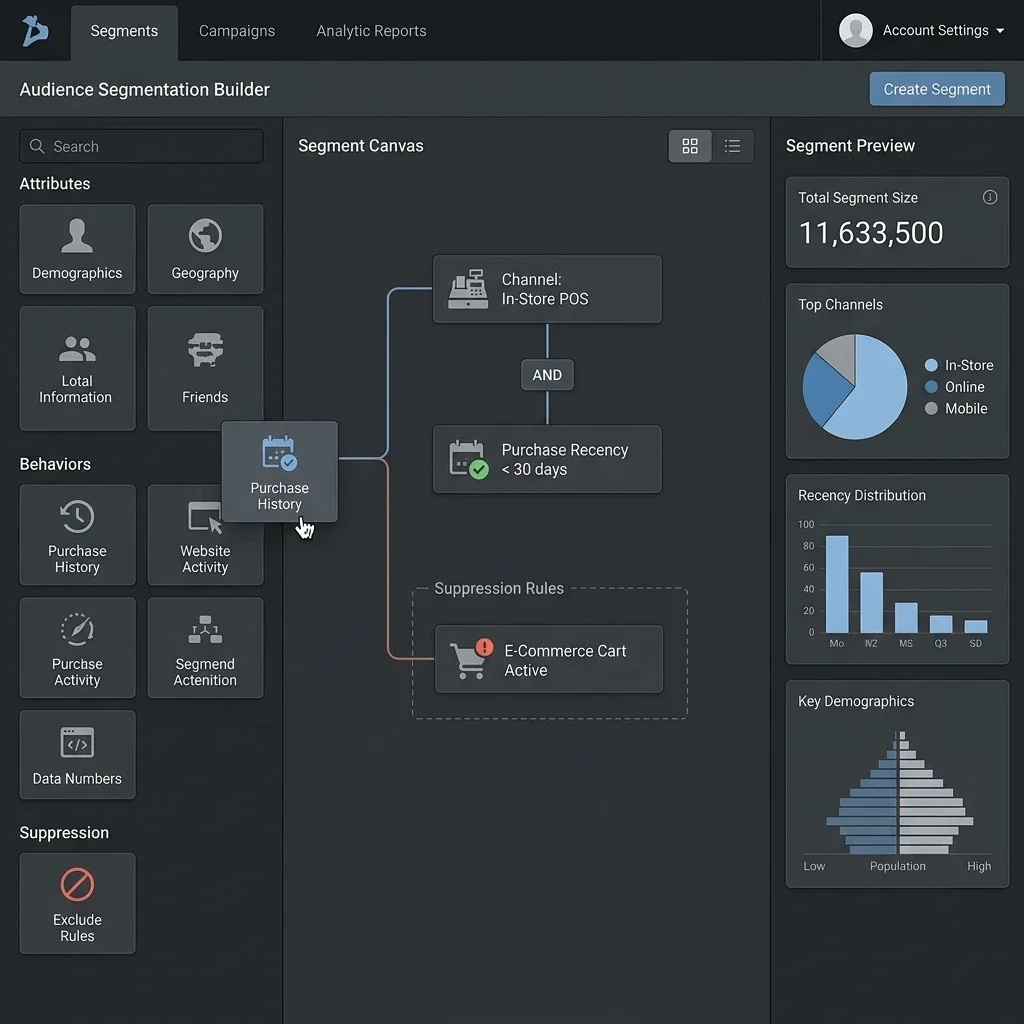 | Drag-and-drop campaign targeting with real-time multi-channel suppressions. |
The Strategic Conclusion
Unifying retail data is not a database scaling issue—it is an identity resolution architecture issue. By bridging the offline-online divide with real-time event streaming and low-latency API caching, this retailer transformed disjointed silos into a single source of truth. They didn't just optimize their ad spend; they laid the digital foundation for the next decade of modern, omnichannel relationship building.
For more deep dives into how unified data architectures transform enterprise workflows, see our case study on B2B Inventory Sync & Ghost Inventory Elimination.
Frequently Asked Questions
How does the platform handle privacy and GDPR/CCPA compliance?
All personally identifiable information (PII) like emails, phone numbers, and loyalty IDs are immediately hashed using one-way SHA-256 algorithms at the ingestion edge before entering the Kafka data stream. This ensures all downstream analytics and profiles are completely compliant while retaining exact matching accuracy.
What POS systems does this platform support natively?
Our ingestion daemons are built in lightweight Go and can run directly on Windows or Linux POS terminals. We support direct logging database connections (Oracle, SQL Server), file drop monitoring (XML, JSON, CSV), and direct webhooks for modern cloud registers like Shopify POS or Clover.
What happens if a customer changes their email or phone number?
The identity resolution engine handles updates through historical linkage tracking. When a customer provides a new email but matches an existing physical loyalty card ID at checkout, the engine creates a new link node under their existing Golden Profile ID, keeping their complete purchase history unified while registering their updated contact information.