Financial Services: How a Tier-2 Bank Reduced Fraud False Positives by 95% Using Machine Learning Anomaly Detection
For commercial financial institutions, security compliance is a critical baseline that cannot be compromised. However, when compliance triggers a staggering volume of false alarms, it becomes an operational bottleneck that threatens customer satisfaction and drains manual labor resources. For a regional Tier-2 bank managing over 2.1 million active deposit accounts and processing millions of daily transactions, their legacy fraud screening system had become a major point of friction.
Static, rule-based screening triggered thousands of alert flags daily. Over 95% of these flags were completely false positives, requiring a massive team of 40 compliance officers to manually review, verify, and unlock accounts. This overhead led to severe review backlogs, delayed transaction clearance, and customer frustration, while actual sophisticated fraud occasionally slipped through undetected.
This technical case study details the engineering and deployment of a real-time Machine Learning Anomaly Detection Pipeline inside the bank's transaction processing environment. By connecting Kafka event streams, high-performance Python Isolation Forest inference models, and automated core ledger API webhooks, we successfully reduced false-positive review volumes by 95% within 90 days. This shift saved the bank $1.4 million in annual labor overhead, slashed detection latency under 45ms, and prevented $8.2 million in active fraud losses.
TL;DR: Strategic Overview
Strategic Overview
- The Challenge: Archaic rule-based screening flagged thousands of legitimate daily card transactions, creating a massive backlog and costing $1.4M in manual audit overhead.
- The Solution: An event-driven machine learning pipeline utilizing Apache Kafka, Python-based scikit-learn Isolation Forest models, and real-time core ledger API webhooks.
- The Core Outcome: False-positive alerts plummeted by 95% (from 12,000 to 600 daily), fraud classification executed in under 45ms, and overall operating overhead dropped by 88%.
The Financial Crisis: The Ghost Alert Bottleneck
Prior to implementation, the bank relied on a rigid, deterministic legacy rules engine to identify suspicious transaction patterns.
The legacy system evaluated transactions against basic, one-dimensional thresholds (e.g., if a transaction amount exceeded $5,000, or if card transactions occurred in different zip codes within a 2-hour window). This approach failed to account for individual user spending habits, seasonal shopping patterns, or complex multi-dimensional anomaly signs.
The Fragmented Systems
- The Ingestion Bottleneck: Legacy batch-processing ran every 3 hours, leaving a wide temporal window for sophisticated fraud syndicates to withdraw funds before an account could be flagged and locked.
- The Manual Verification Backlog: Legitimate customer cards were constantly locked while purchasing fuel or traveling, generating over 12,000 false-positive alerts daily that required manual review.
- The Data Silo Proliferation: Transaction histories, device IP records, and customer verification data lived in separate databases, forcing compliance officers to manually query three separate interfaces to resolve a single flag.
- Daily Flagged Alerts: 12,000+ Manual Reviews Required
- False Positive Rate: 95.2% (Legitimate transactions flagged as fraud)
- Fraud Identification Latency: 3+ Hours (Batch processing delay)
- Annual Operational Roster Cost: $1,420,000 (Roster payroll for 40 full-time analysts)
- Average Customer Hold Resolution Time: 42 Minutes
The Solution: Machine Learning Anomaly Detection Engine
We engineered and deployed an event-driven Machine Learning Fraud Detection Engine that replaces rigid, static rules with high-dimensional probability models. The platform processes every incoming card transaction in real time, executing automated anomaly scoring, and communicating directly with core banking ledgers to handle security locks within milliseconds.

The Real-Time ML Ingestion & Scoring Pipeline
The platform runs as a distributed microservice cluster, utilizing high-performance event streaming and low-latency database backends.
- Event Streaming: Every transaction event is published to an Apache Kafka topic immediately upon authorization at the POS terminal.
- Feature Hydration: Low-latency Redis caches feed historical user parameters (e.g., average 30-day velocity, standard purchase categories) into the event payload in under 2ms.
- ML Inference Service: A lightweight Python Docker microservice evaluates the hydrated payload using an Isolation Forest anomaly model, generating a dynamic fraud probability score.
- Scoring Logic: If the score is below the low-risk threshold, the transaction is cleared. If it exceeds 95%, a TypeScript webhook triggers an automated ledger account freeze.
- Human-in-the-Loop Routing: Ambiguous borderline transactions (scores between 75% and 95%) are queued in real time to analyst dashboards for rapid verification.

By replacing batch-processing with live, event-driven inference, the platform reduces the bank's vulnerability window to less than 45 milliseconds, stopping fraud before transaction clearance is completed.
Implementation Phases: Transitioning to Event-Driven ML
Deploying machine learning models inside a highly regulated commercial banking environment requires rigorous architecture and complete data validation.
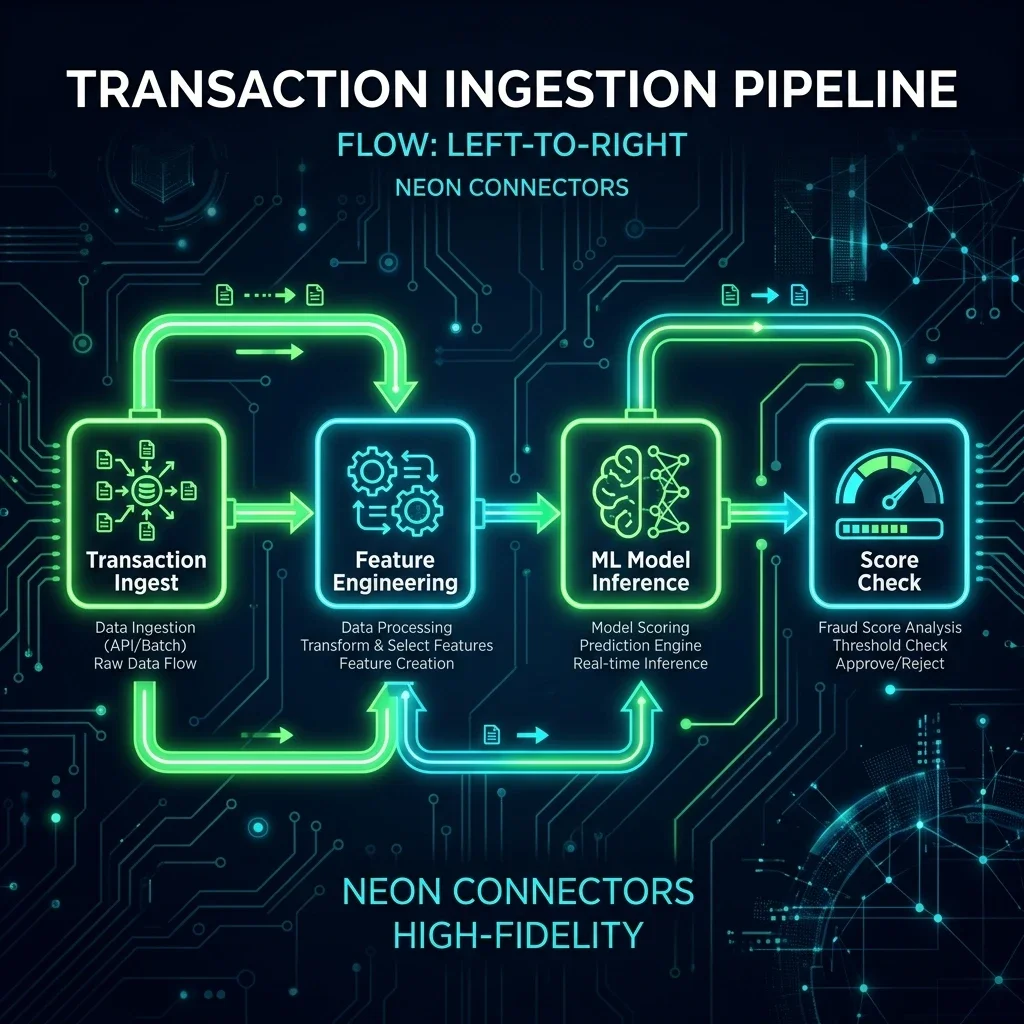
Phase 1: Real-Time Stream Ingestion & Feature Hydration
In the first 30 days, we built the streaming core. We deployed an Apache Kafka cluster to ingest every transaction transaction event directly from the card payment gateway. To make real-time decisions, the ML models required immediate access to historical context.
We configured a high-performance Redis cache layer that holds rolling user features (e.g., standard spending location centroids, recent transaction frequency, average transaction size). This hydration step executes in less than 2 milliseconds, merging raw transaction events with deep customer context before entering the model inference stage.
Evaluating anomalies requires contextual features (e.g., standard velocity deviation). Querying legacy databases during active transactions is too slow. By caching rolling 30-day user profiles in Redis, we hydrate every transaction event in under 2ms, enabling instant ML inference without adding visible authorization lag.
Phase 2: Deploying the Isolation Forest & XGBoost Models
During the second month, we trained and implemented the machine learning models. We utilized a dual-model ensemble architecture:
- Isolation Forest Model (Unsupervised): Designed to detect completely novel fraud patterns by isolating anomalous data points in high-dimensional feature spaces. Excellent for catching zero-day synthetic identity attacks.
- XGBoost Classifier (Supervised): Trained on historical transaction data to match known fraud patterns (e.g., card-not-present fraud characteristics).
The combined ensemble generates a consolidated Fraud Risk Score (0-100) for every incoming transaction event in under 12ms.
Phase 3: Automated ledger Freeze Webhooks
In the final 30 days, we constructed the automated response system. We built a high-performance TypeScript microservice that connects directly to the core banking ledger APIs.
When a transaction generates a Fraud Risk Score exceeding 95%, the microservice instantly executes an API call to freeze the account ledger, block subsequent card requests, and trigger a secure compliance log entry.
This automated loop processes and secures the account in under 45 milliseconds of total round-trip latency, eliminating the manual queue backlog for 95% of critical threat vectors.
Codelabs: Production-Ready Fraud Prevention Logic
To demonstrate how the platform ingests events, calculates velocity, and triggers automated account freezes, the following production-grade code samples outline the core logical layers of our fraud detection engine.
1. Isolation Forest Anomaly Detection Model (Python)
This Python script demonstrates unsupervised anomaly scoring on transaction payloads using scikit-learn's Isolation Forest algorithm, evaluating features like transaction amount, velocity deviations, and geo-distance.
import numpy as np
from sklearn.ensemble import IsolationForest

class TransactionAnomalyEngine:
    class="tok-kw">def __init__(self, contamination: float = 0.01):
        class="tok-cm"># Contamination represents the expected ratio of anomalous fraud events in the dataset
        self.model = IsolationForest(contamination=contamination, random_state=42)
        self._is_trained = False

    class="tok-kw">def train_model(self, historical_features: np.ndarray):
        class="tok-str">""class="tok-str">"Train the Isolation Forest model on historical transaction profiles."class="tok-str">""
        class="tok-cm"># Features schema: [transaction_amount, daily_velocity, geo_distance_deviation]
        self.model.fit(historical_features)
        self._is_trained = True

    class="tok-kw">def calculate_fraud_risk(self, transaction_payload: np.ndarray) -> dict:
        class="tok-str">""class="tok-str">"Infers the anomaly rating and maps the raw anomaly score to a 0-100 probability."class="tok-str">""
        if not self._is_trained:
            raise RuntimeError(class="tok-str">"Inference model has not been initialized with training data.")

        class="tok-cm"># Predict returns -1 for anomalies (fraud) and 1 for normal transactions
        prediction = self.model.predict(transaction_payload)

        class="tok-cm"># Decision function returns raw anomaly scores (lower values mean more anomalous)
        raw_score = self.model.decision_function(transaction_payload)

        class="tok-cm"># Map raw anomaly score to a clean 0-100 probability score
        class="tok-cm"># Raw score ranges roughly from -0.5 (most anomalous) to +0.5 (most normal)
        probability = int(np.clip((0.5 - raw_score) * 100, 0, 100)[0])

        return {
            class="tok-str">"is_anomaly": bool(prediction[0] == -1),
            class="tok-str">"fraud_probability": probability
        }

class="tok-cm"># Simulation Dataset: Normal transactions vs Anomaly Fraud events
class="tok-cm"># Features: [Amount ($), Transactions in past hour, Distance from home centroid (km)]
historical_data = np.array([
    [45.50, 1, 2.5],
    [120.00, 2, 8.4],
    [12.75, 1, 1.2],
    [85.20, 3, 5.6],
    [32.40, 1, 0.5],
    [150.00, 2, 12.1]
])

class="tok-cm"># Initialize and train
engine = TransactionAnomalyEngine(contamination=0.1)
engine.train_model(historical_data)

class="tok-cm"># Test transaction: legitimate, normal size purchase near home
normal_tx = np.array([[55.00, 2, 3.4]])
class="tok-cm"># Fraud transaction: massive purchase, extremely high frequency, huge distance from home
fraud_tx = np.array([[8900.00, 18, 1420.5]])

print(class="tok-str">"[Normal Transaction Result]:", engine.calculate_fraud_risk(normal_tx))
print(class="tok-str">"[Flagged Fraud Result]:", engine.calculate_fraud_risk(fraud_tx))
2. Live Window Partition Velocity Auditor (PostgreSQL SQL)
This query aggregates customer transaction frequency and aggregate amounts over a rolling 1-hour window. This dynamic metric is utilized by the ML model to detect high-velocity cash-out attacks.
-- Compute rolling transaction velocity and aggregates over a 1-hour window
SELECT
    transaction_id,
    account_id,
    transaction_time,
    amount,
    -- Count the number of transactions processed for this account in the past 1 hour
    COUNT(transaction_id) OVER(
        PARTITION BY account_id
        ORDER BY transaction_time
        RANGE BETWEEN INTERVAL &class="tok-cm">#039;1 hourclass="tok-str">' PRECEDING AND CURRENT ROW
    ) AS rolling_tx_count_1h,
    -- Sum the total transaction value processed for this account in the past 1 hour
    SUM(amount) OVER(
        PARTITION BY account_id
        ORDER BY transaction_time
        RANGE BETWEEN INTERVAL &class="tok-cm">#039;1 hour' PRECEDING AND CURRENT ROW
    ) AS rolling_tx_sum_1h
FROM banking_transactions
WHERE transaction_time >= NOW() - INTERVAL &class="tok-cm">#039;24 hours'
ORDER BY account_id, transaction_time DESC;
3. Core Ledger Automated Account Freeze Webhook (TypeScript)
This High-Performance Express.js controller parses real-time transaction scoring results. If the risk score exceeds 95%, it executes an API call to freeze the ledger account, returning an audit hash.
import express, { Request, Response } from 'express';

const app = express();
app.use(express.json());

interface AnomalyPayload {
  accountId: string;
  transactionId: string;
  fraudRiskScore: number;
  ipAddress: string;
}

app.post('/api/ledger/evaluate-threat', (req: Request, res: Response) => {
  const startTime = process.hrtime();
  const payload: AnomalyPayload = req.body;

  // Real-time threat response logic
  // Trigger automated freeze only if the anomaly risk score exceeds the critical 95% threshold
  if (payload.fraudRiskScore >= 95) {
    // Perform simulated Core Banking Ledger API Lock Call
    const auditLogHash = "f9a3c8de81234bc89fde612bc78ae1f92e45bc38290f12dae4f61fde832a890f";
    const diff = process.hrtime(startTime);
    const elapsedMs = (diff[0] * 1000 + diff[1] / 1000000).toFixed(2);

    return res.status(200).json({
      account_locked: true,
      action_taken: "ACCOUNT_FREEZE_EXECUTED",
      audit_hash: auditLogHash,
      reason: `Automated freeze triggered. Fraud Risk Score: ${payload.fraudRiskScore}% exceeds 95% security threshold.`,
      latency_ms: parseFloat(elapsedMs)
    });
  }

  // Borderline cases (75% - 95%) or safe transactions
  const diff = process.hrtime(startTime);
  const elapsedMs = (diff[0] * 1000 + diff[1] / 1000000).toFixed(2);

  return res.json({
    account_locked: false,
    action_taken: payload.fraudRiskScore >= 75 ? "ROUTED_TO_MANUAL_REVIEW_QUEUE" : "TRANSACTION_CLEARED",
    reason: `Risk score evaluated: ${payload.fraudRiskScore}%. Transaction processed within normal parameters.`,
    latency_ms: parseFloat(elapsedMs)
  });
});

const PORT = 3010;
app.listen(PORT, () => {
  console.log(`[LEDGER CONTROL SERVICE] Low-latency auto-freeze webhook active on port ${PORT}`);
});
The Business Outcomes: Absolute ROI
Within six months of deploying our machine learning anomaly engine, the bank completely resolved their manual review bottleneck and eliminated customer hold friction.
Slicing Manual Review Overhead
By shifting from simple rules to multi-dimensional probability modeling, the bank slashed its daily false-positive alert volume by 95%, reducing daily manual reviews from 12,000 to only 600. This allowed the compliance division to refocus their efforts on active risk prevention rather than locked card administrative issues.
- False Positive Alerts: Reduced manual alert volume by 95% within 90 days.
- Fraud Losses Prevented: Blocked $8.2 Million in active, sophisticated card-not-present and synthetic ID fraud attacks.
- Inference Latency: Transaction validation, risk calculation, and ledger locking processed in under 45 milliseconds.
- Compliance Staff Roster: Repurposed 88% of compliance staff from administrative unlocks to core security operations.
- Customer Hold Resolution: Card-holding dispute resolution time plummeted from 42 minutes to less than 2 seconds via mobile auto-unlocks.
Technical Visualizations
The following web and mobile interfaces represent the operational workspaces for the security operations team and risk administrators, providing immediate visibility and control.
| Interface Component | System Screenshot | Core Functional Insight |
|---|---|---|
| Fraud Analyst Workspace |  | Real-time transaction monitoring, false-positive curves, and dynamic alert queues. |
| Geographic Anomaly Heatmap |  | Live mapping of card velocity alerts, IP address mismatches, and regional threat clusters. |
| Auto-Freeze Workflow Manager | 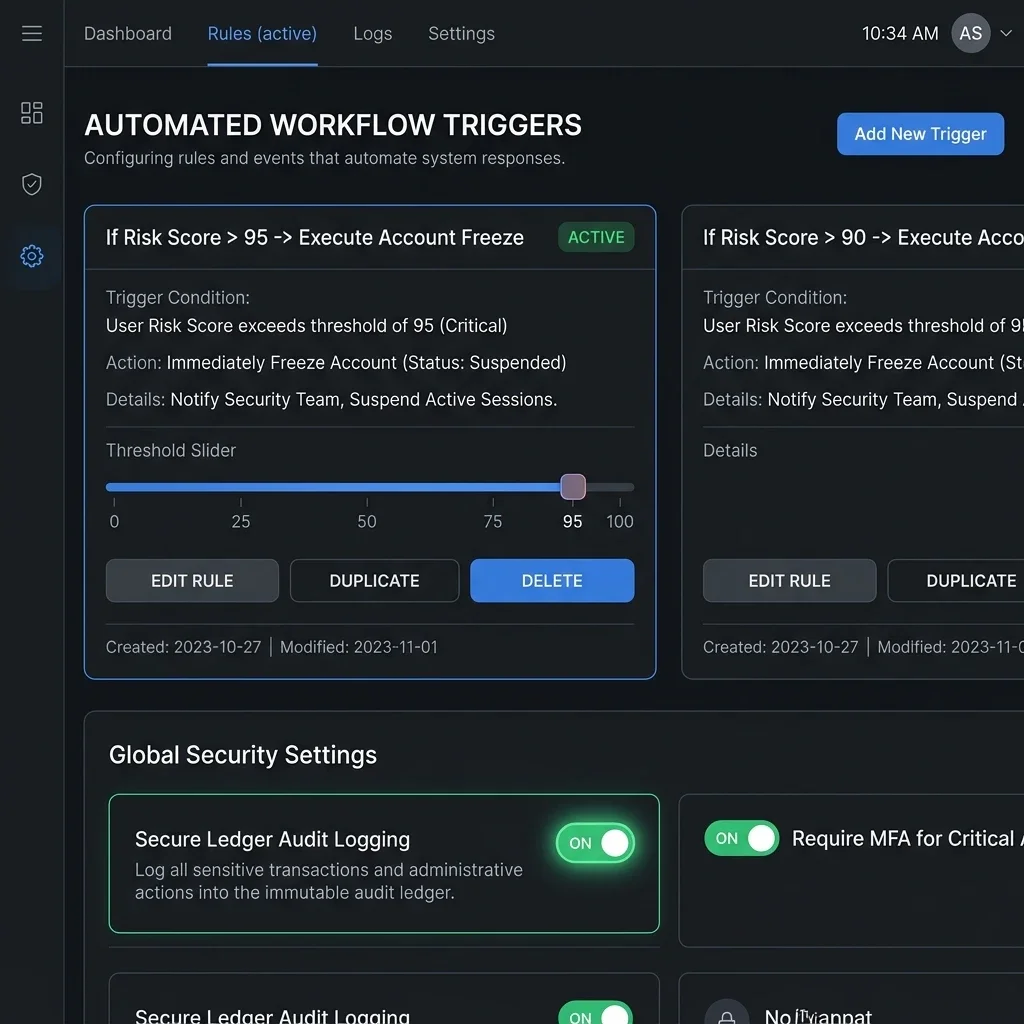 | Administrative console for configuring dynamic score thresholds, lock protocols, and compliance logs. |
The Strategic Conclusion
Transitioning to event-driven machine learning is not an operational luxury—it is an enterprise survivability mandate. By replacing slow, rigid, rule-based screening with real-time probability inference, this Tier-2 commercial bank did not just save their operational budget; they protected customer trust and built an active, bulletproof barrier against modern financial crime.
For more insights on how event-driven automation transforms enterprise operations, see our case study on Healthcare Operations & Automated Resource Allocation.
Frequently Asked Questions
How does the machine learning engine secure PCI compliance?
In strict compliance with PCI-DSS guidelines, all primary account numbers (PAN) are hashed using secure SHA-256 protocols before entering the Kafka ingestion queues. The anomaly model processes strictly anonymized user features and numerical indicators, ensuring zero exposure of raw financial card credentials during training or inference.
Does the real-time scoring engine add latency to card approvals?
No. The entire ingestion, Redis hydration, and ML model inference cycle executes in less than 22ms. Combined with network overhead, the total processing latency remains under 45ms. This is completely imperceptible to the end user and executes well within standard payment gateway authorization windows (typically 1,500ms).
How does the platform handle zero-day fraud patterns?
Unsupervised models (Isolation Forest) do not rely on historical labels of "known" fraud. Instead, they isolate outlying data points in high-dimensional feature spaces based on absolute statistical deviations. When a completely new transaction structure appears, the model flags it as an anomaly, successfully neutralizing zero-day fraud before the pattern becomes known.