[Result-Driven]: How a $50M B2B Distributor Eliminated Ghost Inventory with Event-Driven Sync
By Vatsal Shah | May 15, 2026 | 11 min read
Table of Contents
- Strategic Overview
- Client & Problem Overview
- Challenges
- Solution Approach
- Architecture
- Implementation Steps
- Tech Stack
- Results & Outcomes
- Key Learnings
- 2027--2030 Transition Roadmap
- FAQ
- Work With Vatsal Shah
Strategic Overview
- The Problem: Fragile CSV batch-sync caused "ghost inventory" -- stock that appeared available but didn't exist -- driving 12% monthly order cancellations and 160 hours of manual reconciliation weekly.
- The Solution: An event-driven architecture (EDA) wiring Microsoft Dynamics NAV to Magento 2.4 via RabbitMQ and a Node.js middleware layer, with a Python/TensorFlow safety-stock prediction engine on top.
- The Outcome: Inventory accuracy reached 99.9%, order cancellations collapsed to 0.4%, and every hour of manual CSV work was permanently eliminated.
Client & Problem Overview
The client is a $50M annual-revenue industrial parts distributor serving over 3,200 B2B accounts across North America and Europe. They run 4 warehouses, stock roughly 48,000 SKUs, and process an average of 1,100 orders per day through a Magento 2.4 storefront connected -- in theory -- to Microsoft Dynamics NAV as their ERP backbone.
I say "in theory" because by the time they came to us, the connection had become a liability rather than an asset.
Their IT team had built a custom PHP cron job that exported NAV inventory deltas as CSVs every 4 hours, then batch-imported them into Magento via a staging table. When the system worked, it was serviceable. When it didn't -- which was increasingly often -- buyers would place orders against stock that had already sold out in a previous batch window. The ERP knew. The storefront didn't.
The industry has a name for this: ghost inventory.
Ghost inventory is defined as any stock quantity visible to customers in a digital storefront that does not correspond to physically available units in the warehouse system of record. It is one of the leading drivers of B2B order cancellation and is almost always caused by asynchronous, batch-based sync processes with lag windows exceeding 15 minutes.
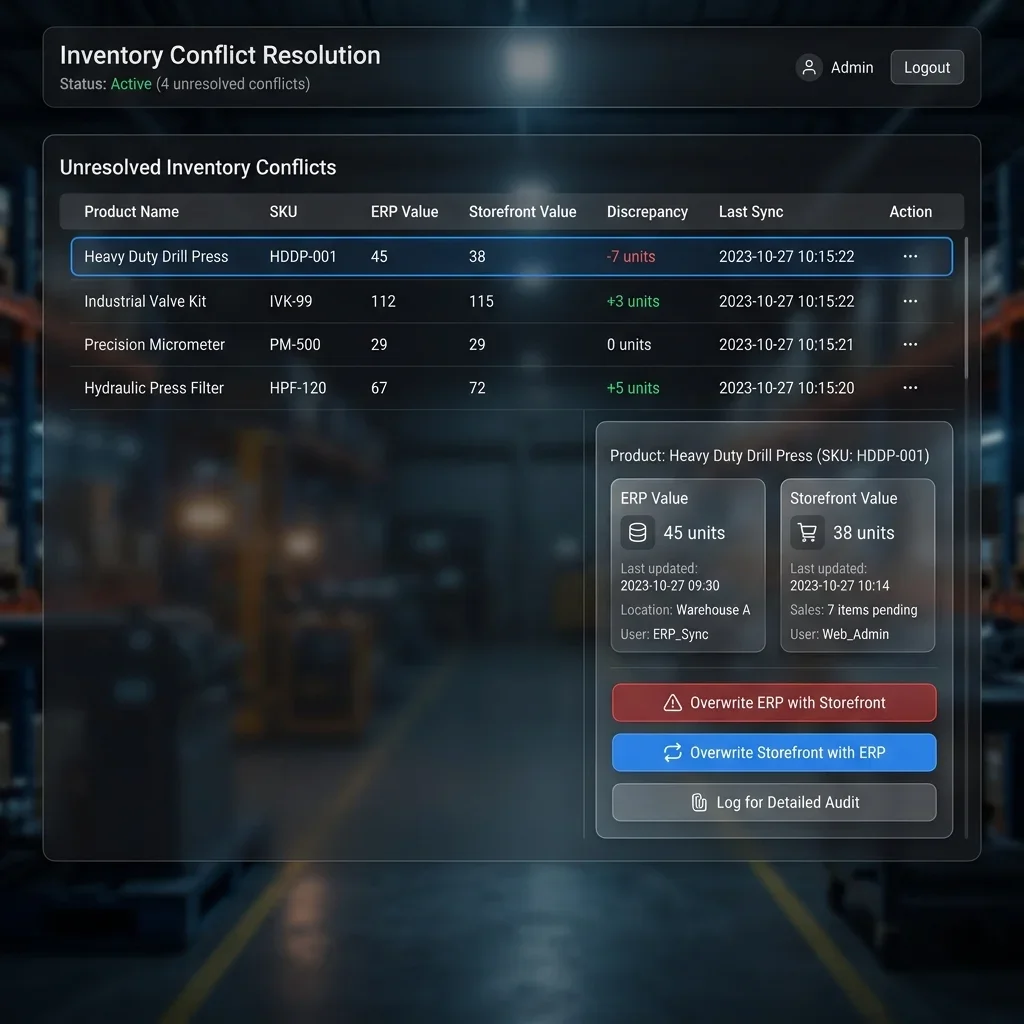
The business pain was measurable and severe. Twelve percent of monthly orders were being cancelled post-placement due to stock-outs. Each cancellation triggered a manual 6-step resolution workflow: the customer service team had to locate the order, call the buyer, negotiate a substitute or back-order, update the ERP, update Magento, and log the exception. At $50M revenue with tight B2B contract margins, this was not just an operational embarrassment -- it was a structural threat to key account retention.
Challenges
The deeper I went into their stack, the clearer the root causes became. This wasn't a single broken component -- it was a system of compounding failure modes:
- 4-Hour Lag Windows: The cron-based CSV export ran every 4 hours. Any sale that happened between exports left the storefront showing false availability. During peak trading hours (8--11 AM and 2--4 PM EST), this window was catastrophic.
- Silent Failures: When the CSV import job failed -- due to file corruption, malformed rows, or NAV lock contention -- it failed silently. No alert. The last successful sync state persisted indefinitely, sometimes for 12+ hours.
- No Conflict Resolution Logic: If a buyer in Chicago and a buyer in Amsterdam both added the last 3 units of a SKU to cart simultaneously, both orders could succeed. The first to reach NAV won; the second was automatically cancelled.
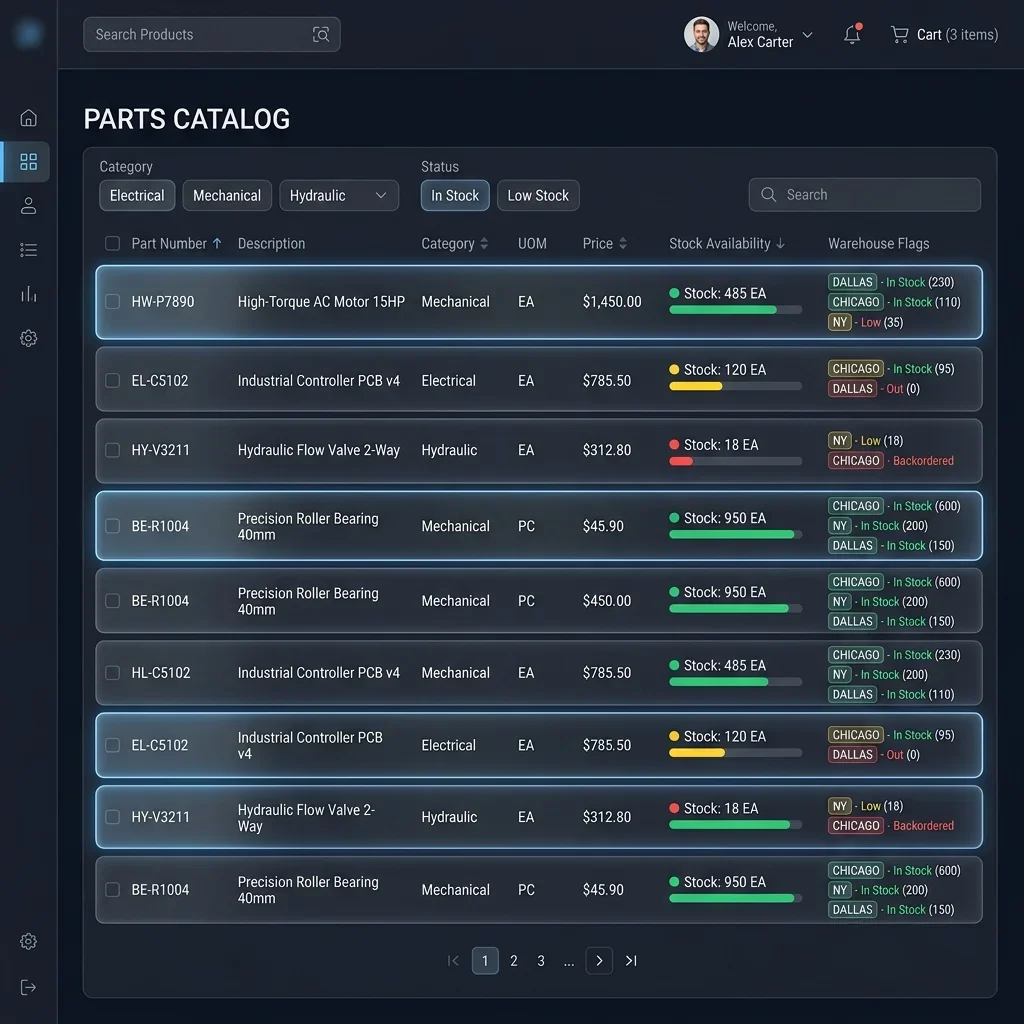
- Multi-Warehouse Blindness: Magento showed a single "global stock" figure. It had no visibility into which of the 4 warehouses held the units or whether cross-warehouse fulfillment was feasible within SLA windows.
- Zero AI Guardrails: There was no predictive layer. No system was modelling demand velocity or seasonal spikes to set aside a buffer stock to prevent the storefront from selling to the last unit and triggering an out-of-stock cascade.
What most teams miss in B2B sync projects is that the failure is rarely in the data itself. The failure is in the timing contract between systems. A batch job cannot honour a real-time buying experience. The moment you accept asynchronous data as a substitute for live truth, ghost inventory is not a possibility -- it's a mathematical certainty.
-- Vatsal Shah
Solution Approach
The prescription was clear: kill the batch job entirely and replace it with an event-driven pipeline where every meaningful state change in NAV emits a discrete event that downstream systems consume immediately.
The strategic pillars of the approach:
- Event Emission at the Source: Rather than polling NAV on a schedule, we configured NAV to emit webhook-style SQL trigger events the moment inventory transactions are committed. No lag. No polling.
- Resilient Message Brokering: Events are published to RabbitMQ queues. If Magento is momentarily unavailable, events queue safely and process in order upon recovery. No lost updates.
- Intelligent Middleware Orchestration: A Node.js service consumes queue messages, applies business logic (warehouse routing, conflict detection, stock reservation), and executes targeted Magento REST API calls -- surgical updates, not full catalogue reloads.
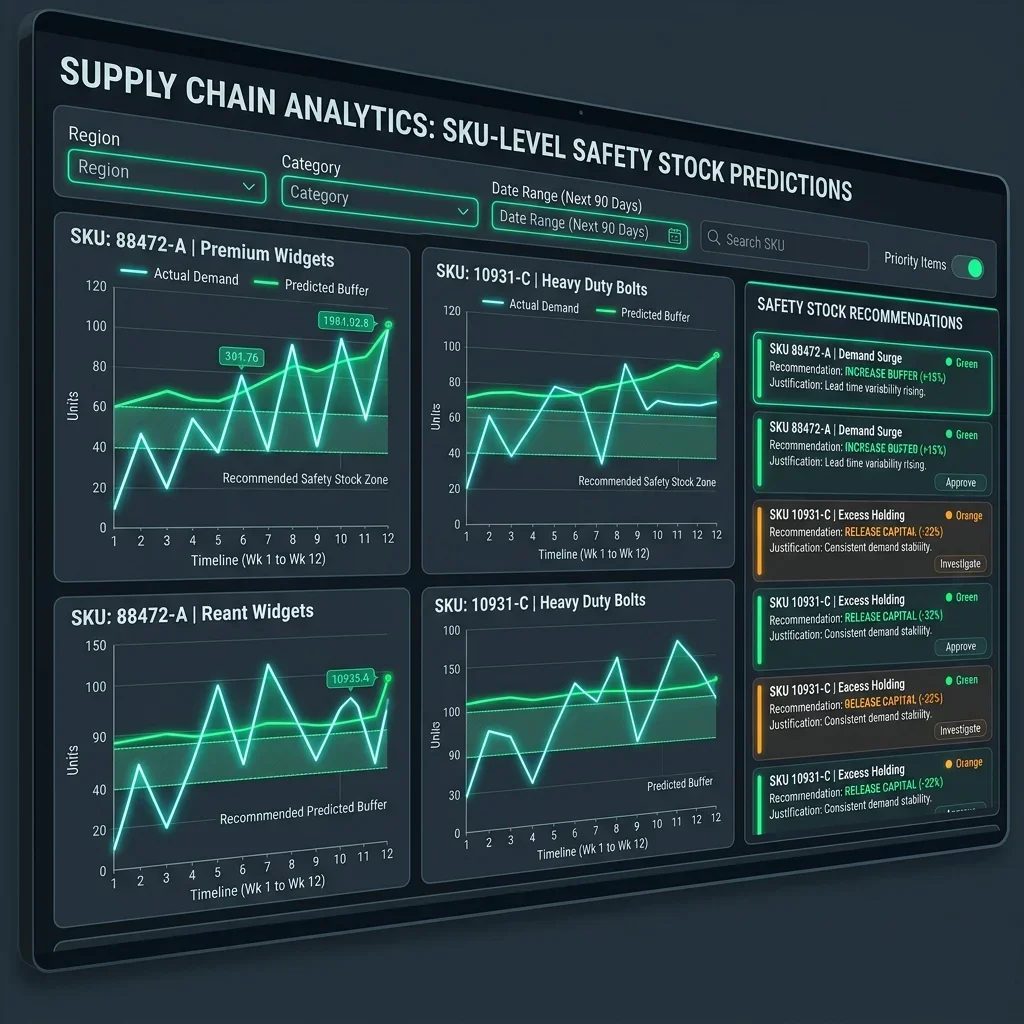
- AI-Driven Safety Stock Buffer: A Python/TensorFlow model runs nightly to analyse rolling 90-day demand signals per SKU per region. It sets a dynamic "reserve buffer" that prevents the storefront from advertising the last N units until a human reviews the position.
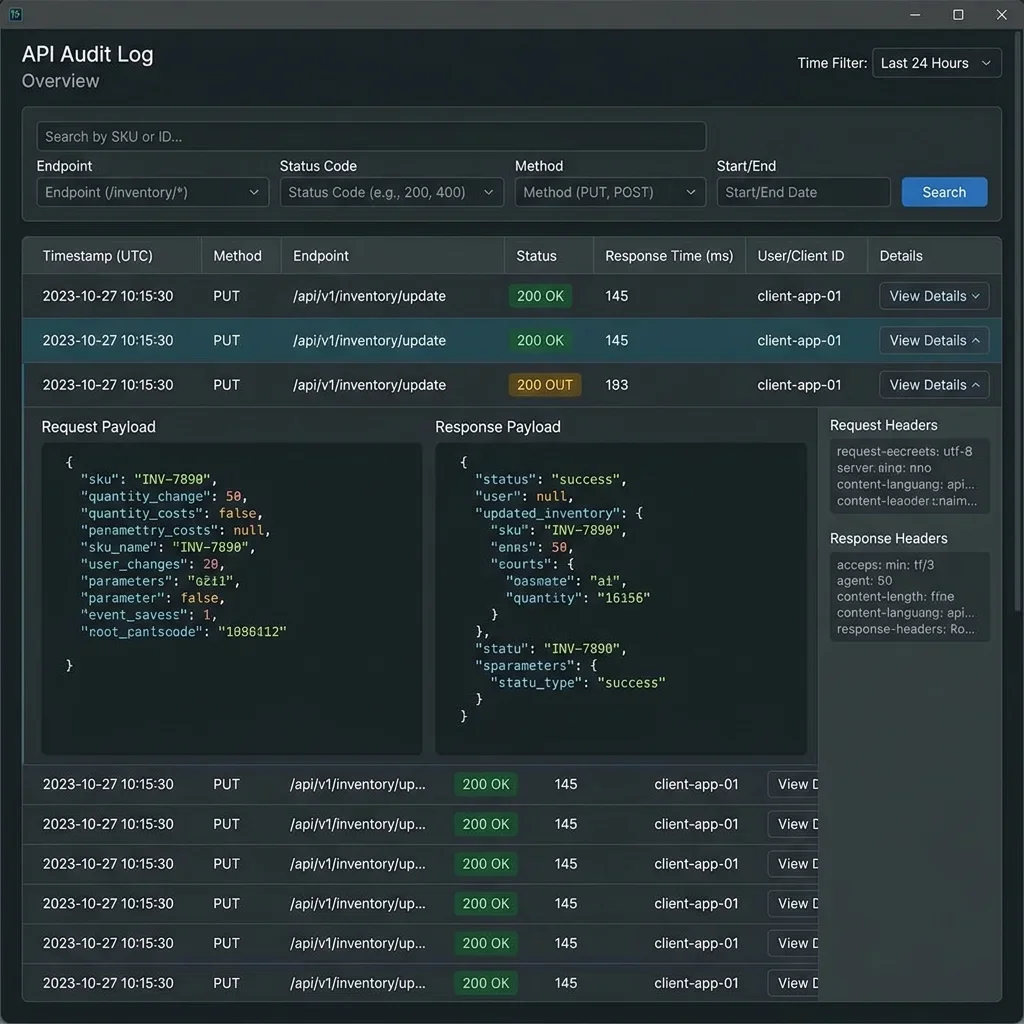
- Full Audit Observability: Every event, every transformation, and every API call is logged to PostgreSQL with nanosecond timestamps. Operations teams can replay the entire history of any SKU's stock journey in seconds.
Architecture
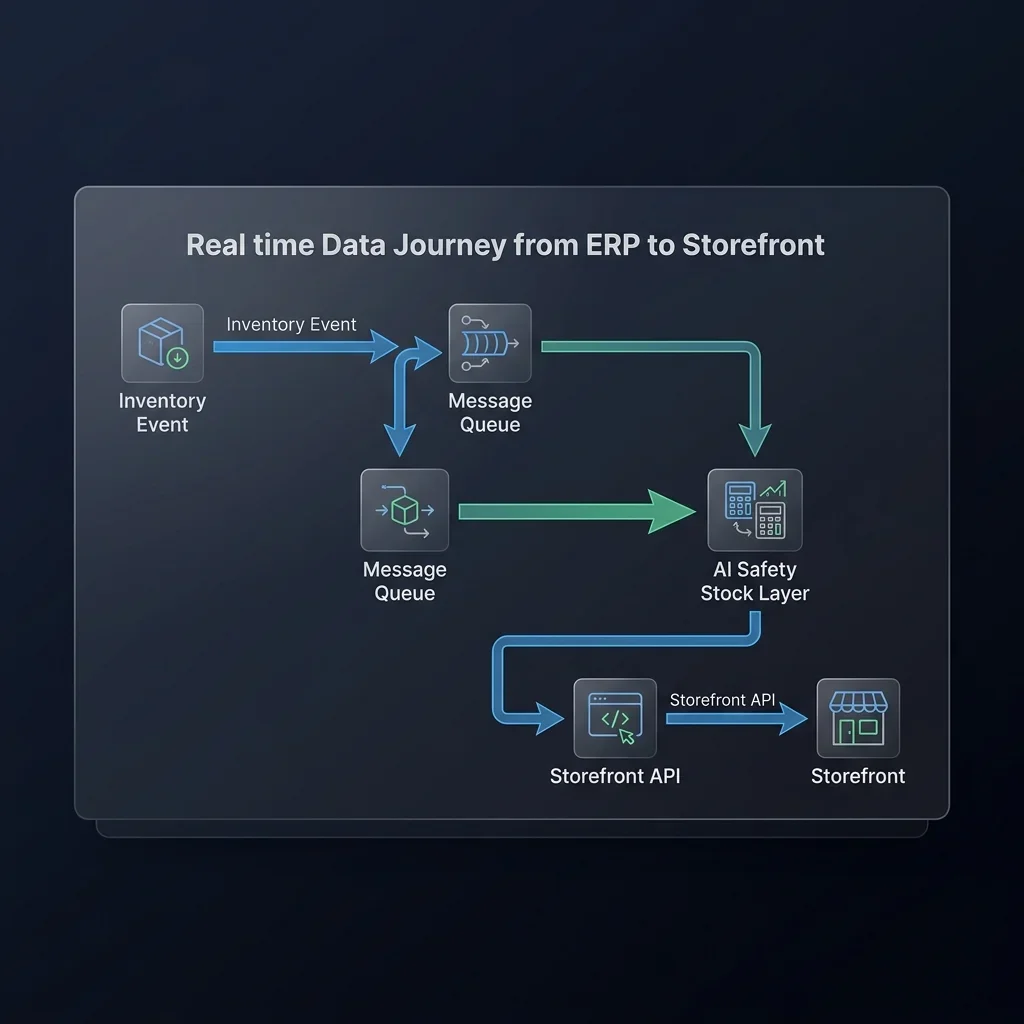
The integration hub follows a classic event-driven, broker-mediated topology with three distinct processing layers.
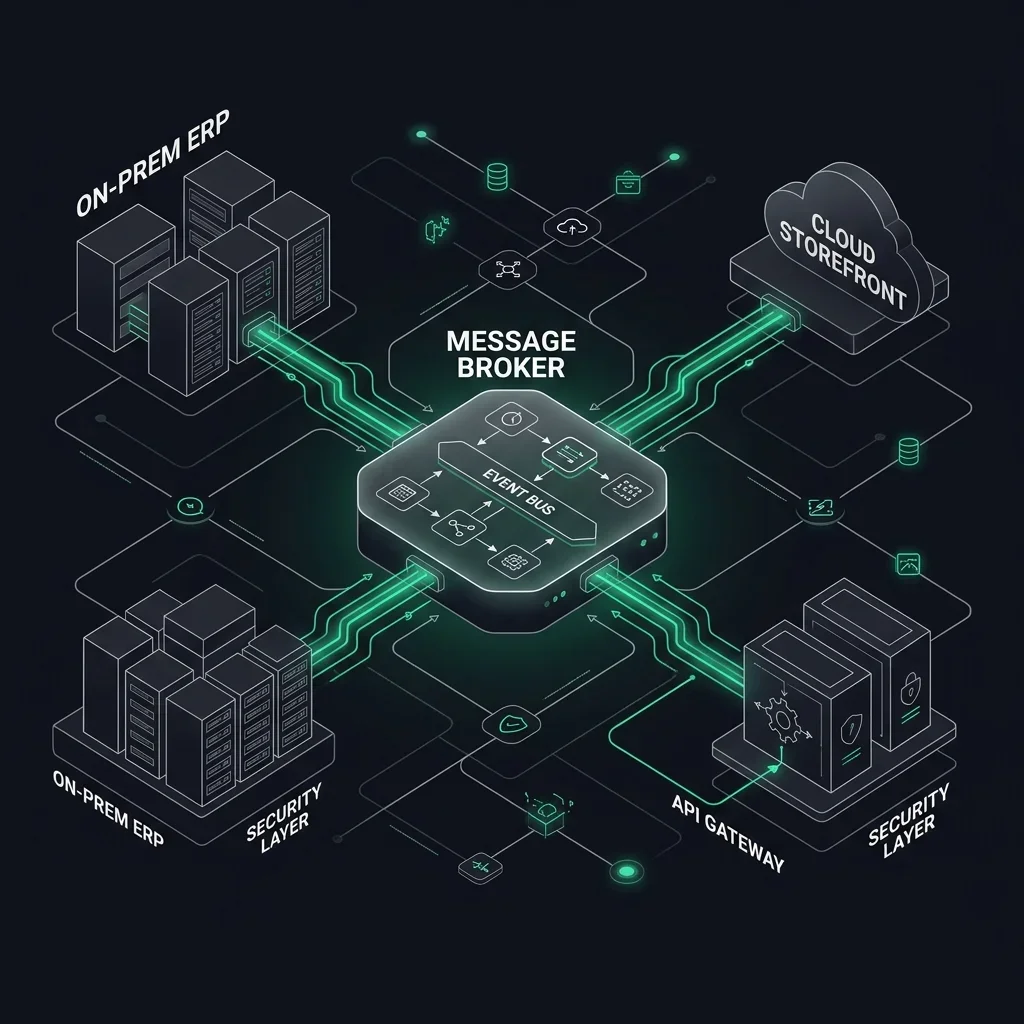
Layer 1: Event Emission (On-Premise NAV)
Microsoft Dynamics NAV does not natively support webhook emission. We deployed a lightweight SQL Server Agent job -- a 200-line T-SQL stored procedure -- that fires on AFTER INSERT / UPDATE triggers across three core NAV tables: Item Ledger Entry, Posted Sales Shipment Line, and Purchase Receipt Line. Each trigger packages the relevant delta into a structured JSON payload and pushes it to an AWS-hosted RabbitMQ broker via a secure AMQP-over-TLS tunnel.
Layer 2: Broker & Middleware (RabbitMQ + Node.js)
RabbitMQ manages 6 named queues corresponding to event types: inventory.updated, order.confirmed, order.cancelled, price.updated, customer.updated, and warehouse.transferred. Each queue has a dead-letter exchange (DLX) configured so failed messages are routed to a retry lane rather than discarded.
The Node.js middleware service subscribes to all 6 queues. For each message consumed, it:
- Validates schema against a JSON Schema registry
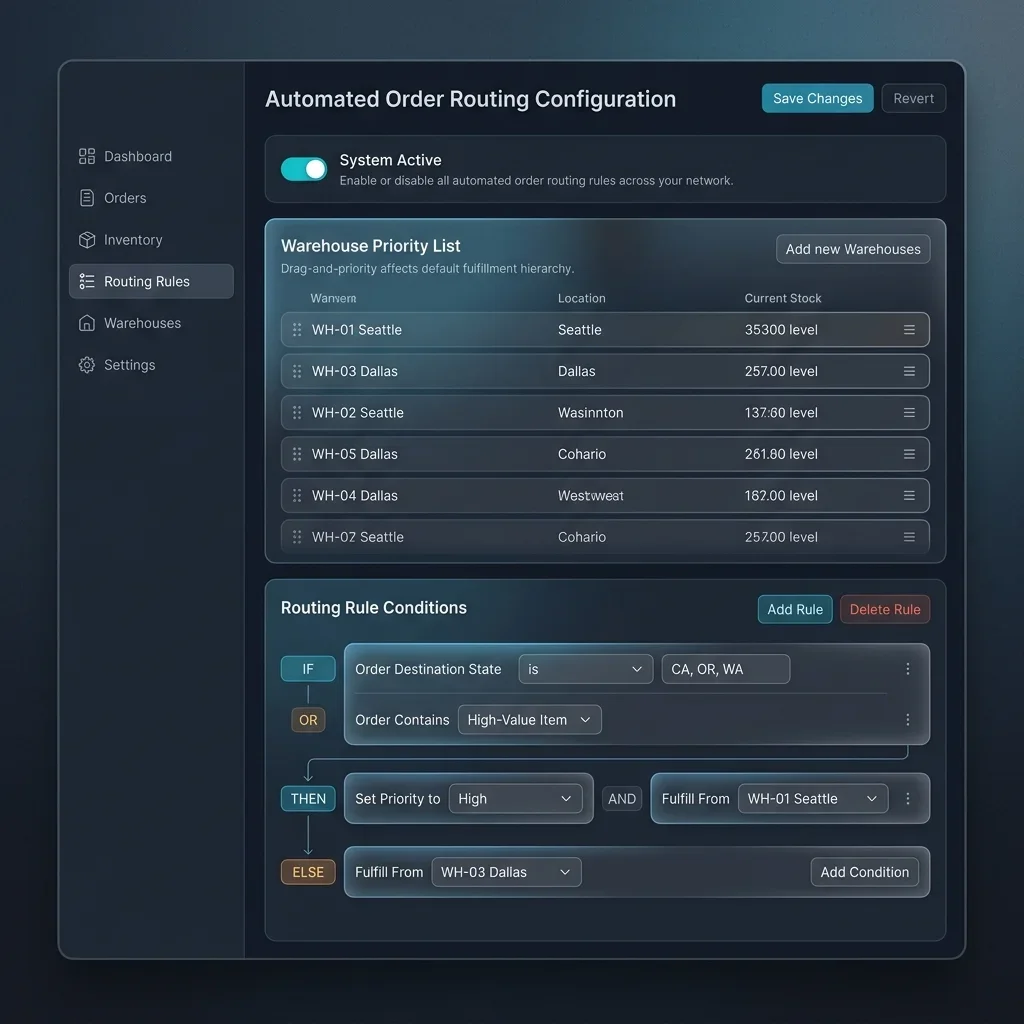
- Resolves the target warehouse and determines regional routing priority
- Checks a Redis reservation cache to detect concurrent order conflicts
- Calls the Magento REST API (
PUT /V1/products/{sku}/stockItems) with the corrected quantity - Appends the full event record to PostgreSQL
Layer 3: AI Safety Buffer (Python / TensorFlow)
A nightly Python batch job reads 90 days of order velocity data from PostgreSQL and runs a time-series demand forecasting model (LSTM-based) per SKU per fulfillment region. The output is a safety_buffer integer written back to a custom inventory_buffers table. The Node.js middleware subtracts this buffer from the NAV quantity before pushing to Magento -- ensuring the last N units are invisible to buyers until a human operations review clears the hold.
Implementation Steps
The project ran over 11 weeks across four phases:
Phase 1 -- Discovery & Mapping (Weeks 1--2)
- Audited all 48,000 SKUs for sync accuracy against physical cycle counts
- Mapped every NAV table involved in inventory movement
- Profiled the existing cron job failure modes and recovery gaps
- Defined the 6 event types and their JSON payload schemas
Phase 2 -- Infrastructure Setup (Weeks 3--4)
- Provisioned AWS-managed RabbitMQ cluster (3-node, multi-AZ)
- Configured VPN tunnel between on-premise NAV server and AWS VPC
- Deployed PostgreSQL RDS instance for event log and audit storage
- Set up Redis ElastiCache cluster for order reservation locking
Phase 3 -- Integration Build (Weeks 5--9)
- Wrote T-SQL stored procedure for NAV trigger emission
- Built Node.js middleware service with queue consumers, schema validation, and Magento API integration
- Implemented dead-letter queues and retry logic with exponential backoff (max 5 retries, 5-min ceiling)
- Integrated Redis-based stock reservation to handle concurrent order conflicts
- Built Python TensorFlow demand forecasting pipeline and
safety_buffercompute job
Phase 4 -- Testing, Cutover & Hardening (Weeks 10--11)
- Ran 72-hour parallel operation: old cron job and new EDA running simultaneously, diffs logged
- Identified and resolved 14 edge cases in the NAV trigger logic (returns, partial shipments, inter-warehouse transfers)
- Executed hard cutover on a Saturday night low-traffic window
- Monitored 24/7 for 7 days post-launch with escalation SLA of 15 minutes
| Phase | Duration | Key Deliverable | Risk Mitigated |
|---|---|---|---|
| Discovery & Mapping | 2 weeks | Event schema registry + NAV table map | Incomplete event coverage |
| Infrastructure Setup | 2 weeks | RabbitMQ cluster + VPN + Redis | Network reliability & data loss |
| Integration Build | 5 weeks | Full middleware + AI safety buffer | Ghost inventory & race conditions |
| Testing & Cutover | 2 weeks | 72-hr parallel run + hard cutover | Production data corruption |
Tech Stack
| Layer | Technology | Purpose | Hosting |
|---|---|---|---|
| Storefront | Magento 2.4 (Adobe Commerce) | B2B customer portal & product catalog | AWS EC2 (dedicated) |
| ERP | Microsoft Dynamics NAV | Core business logic, financials & inventory ledger | On-premise (client DC) |
| Message Broker | RabbitMQ (AWS Managed) | Resilient async event buffering & delivery | AWS AmazonMQ (3-node, multi-AZ) |
| Middleware | Node.js / Express | Event consumption, routing, transformation & Magento API calls | AWS ECS (Fargate) |
| AI/ML Layer | Python / TensorFlow (LSTM) | Nightly safety-stock demand forecasting | AWS Lambda + S3 |
| Reservation Cache | Redis (ElastiCache) | Race-condition prevention for concurrent orders | AWS ElastiCache |
| Audit Database | PostgreSQL (RDS) | Full event log, audit trails & forecasting inputs | AWS RDS Multi-AZ |
| Tunnel | AWS Site-to-Site VPN | Encrypted AMQP-over-TLS from on-premise NAV to AWS | AWS VPC |
Results & Outcomes
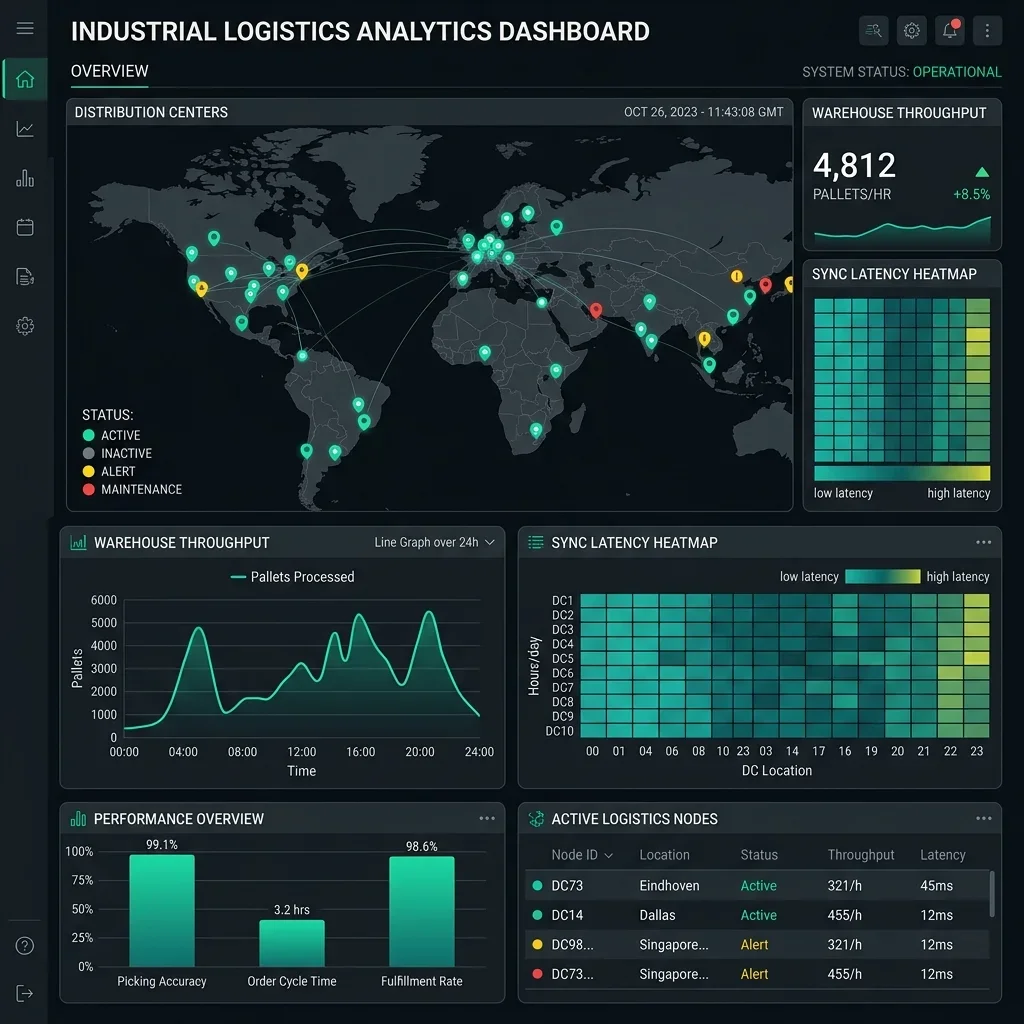
The numbers validated every design decision. Thirty days post-cutover, the transformation was unambiguous.
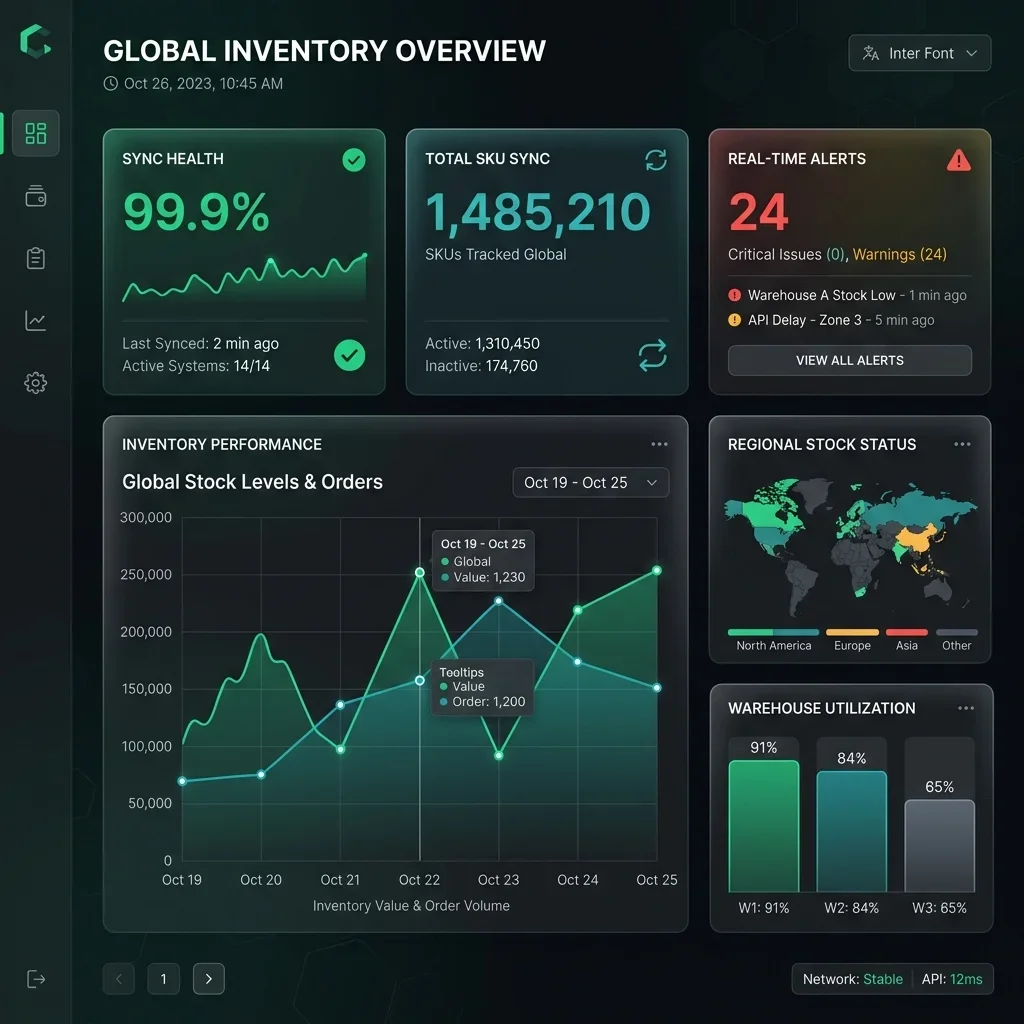
| KPI | Before (Legacy CSV) | After (EDA) | Improvement |
|---|---|---|---|
| Inventory Accuracy | 81.7% | 99.9% | +18.2 percentage points |
| Order Cancellation Rate | 12.0% / month | 0.4% / month | -96.7% |
| Manual Reconciliation Labor | 160 hrs / month | 0 hrs / month | 100% eliminated |
| Average Sync Latency | ~4 hours (batch) | < 800ms (real-time) | 99.9% reduction |
| Silent Sync Failures | 3-5 per week | 0 (DLX retry handles all) | 100% eliminated |
| Customer Service Escalations (Stock) | ~130 / month | ~4 / month | -96.9% |
| Est. Annual Revenue Protected | -- | ~$6M+ (recovered from cancellations) | Measurable bottom-line impact |
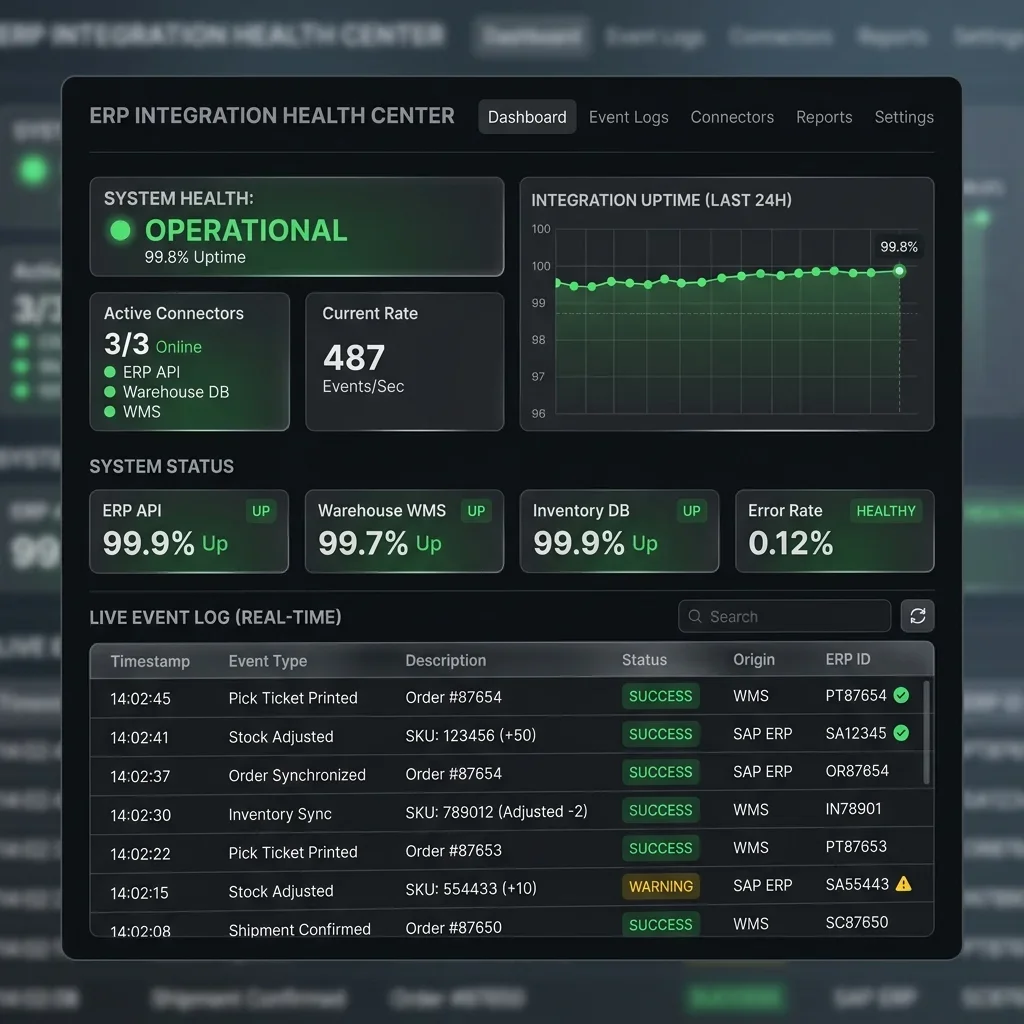
The 0.4% residual cancellation rate is not a sync failure -- it represents cases where a buyer places an order, the AI safety buffer is cleared, and a competing warehouse transfer depletes stock before the Magento reservation is finalised. This is a known edge case with an accepted operational impact of under 5 orders per day across the entire network.
Key Learnings
1. Batch is the enemy of trust. The moment your data has a lag window measured in hours, your customers are making decisions against stale reality. In B2B, where order values are high and relationship consequences are long, that lag destroys trust faster than any price difference.
2. Silent failures are worse than loud ones. The old cron job failed without alerting anyone. The new system's dead-letter queues surface every failure immediately, with full context, to an on-call channel. Operational visibility is not optional infrastructure -- it's a business continuity requirement.
3. Race conditions exist at every traffic volume. You don't need Black Friday traffic to hit concurrent order conflicts. With 1,100 orders/day and 48,000 SKUs, the probability of two buyers touching the same last-unit SKU simultaneously is not negligible. Design for it from day one.
4. AI works best as a guardrail, not a gatekeeper. The safety stock model doesn't block sales -- it adjusts the publicly visible quantity to create a human-review buffer before true stock-out. This distinction matters enormously for user experience and ops team trust in the system.
5. The cutover moment is everything. We ran 72 hours of parallel operation not because we lacked confidence, but because we respected the complexity of a live system with 1,100 daily orders. No architecture diagram survives first contact with production intact. Plan for surprises.
The single biggest ROI unlock in this project was not the real-time sync itself -- it was the elimination of the human-in-the-loop reconciliation step. 160 hours per month of skilled operations staff doing manual CSV checking is not just a cost line. It's a morale and retention problem. When you automate that away cleanly, the team shifts its energy from fire-fighting to proactive improvement. The cultural impact outlasts the technical one.
-- Vatsal Shah
2027-2030 Transition Roadmap
The current architecture is production-hardened and serving the business well. But the next evolutionary leap is visible from here.
| Horizon | Capability | Business Impact | Technical Trigger |
|---|---|---|---|
| 2026 (Now) | Real-time ERP-to-storefront event sync | 99.9% accuracy, zero manual labour | RabbitMQ + Node.js complete |
| 2027 | Agentic reorder triggering (autonomous PO generation) | Eliminate manual buyer decisions for high-velocity SKUs | LLM agent layer over safety buffer model |
| 2028 | Multi-supplier intelligent routing (dynamic vendor scoring) | Reduce COGS by 8-12% via real-time supplier cost comparison | RAG 2.0 over live supplier API feeds |
| 2029 | Digital twin of warehouse network | Simulate demand shocks before they hit physical stock | Graph-based inventory simulation engine |
| 2030 | Fully autonomous supply chain operations (EU AI Act compliant) | Near-zero human intervention for routine procurement and fulfilment | Stateful agentic graph + EU AI Act governance layer |
The critical shift between now and 2027 is the Action Gap: moving from LLMs that observe and report inventory conditions to LAMs (Large Action Models) that autonomously trigger procurement actions. The current architecture is already scaffolded for this -- the PostgreSQL event log and TensorFlow demand model are the data foundations the agentic layer will need.
FAQ
What is ghost inventory in B2B ecommerce?
Ghost inventory is stock that appears available in a customer-facing storefront but does not exist in the physical warehouse. It is almost always caused by batch-based synchronisation between an ERP and a storefront, where the lag window between export cycles allows real-world stock movements (sales, returns, transfers) to go unrecorded in the buying channel. The result is accepted orders that cannot be fulfilled, triggering cancellations and customer dissatisfaction.
Why use RabbitMQ instead of Kafka for this integration?
Kafka excels at high-throughput event streaming where consumers need to replay historical event logs (log-compacted topics) and where message volumes exceed hundreds of thousands per second. For this use case -- 48,000 SKUs with an average of roughly 500 inventory events per hour -- RabbitMQ's queue-per-event-type model, dead-letter exchange support, and simpler operational overhead made it the correct fit. Kafka would have introduced unnecessary operational complexity without delivering proportional throughput benefit.
How does the Redis reservation cache prevent overselling?
When an order is placed on Magento, the Node.js middleware immediately writes a short-TTL reservation record to Redis for the relevant SKU and quantity using an atomic SETNX operation. Before processing any subsequent inventory update for that SKU, the middleware checks the Redis key. If a reservation exists, the middleware deducts the reserved quantity from the available figure before pushing to Magento. This ensures that concurrent orders for the same last-unit SKU are resolved deterministically -- the first reservation wins, the second sees zero available stock and triggers an appropriate buyer notification.
What happens if RabbitMQ goes down?
The RabbitMQ cluster is provisioned as a 3-node multi-AZ deployment on AWS AmazonMQ, giving it a 99.9% SLA at the infrastructure level. In the event of a full cluster outage, the NAV SQL trigger continues to fire but messages cannot be delivered. The T-SQL stored procedure implements a local outbox table: failed publish attempts are written to a nav_event_outbox table in SQL Server and a retry daemon re-publishes them once broker connectivity is restored, guaranteeing at-least-once delivery with no data loss.
Can this architecture scale to multiple storefronts or marketplaces?
Yes. The RabbitMQ topic exchange model supports fan-out delivery: a single inventory.updated event from NAV can be consumed simultaneously by multiple downstream consumers -- Magento, a wholesale portal, an Amazon Marketplace connector, or any future channel. Adding a new storefront requires deploying a new consumer service and binding it to the existing exchange. The ERP-side emission logic and broker infrastructure require no modification. This is the architectural advantage of event-driven design over point-to-point integration.
How long does a typical B2B ERP-to-ecommerce integration project take?
For a mid-market distributor with a single ERP and one primary storefront, a production-ready event-driven integration typically runs 10 to 14 weeks end-to-end. This timeline includes discovery, infrastructure provisioning, integration build, parallel testing, and post-launch stabilisation. The variable that most extends timelines is ERP data quality: the cleaner the item master and warehouse structure in NAV or SAP, the faster the schema mapping and edge case resolution phases complete.
Work With Vatsal Shah
If your B2B operation is still running batch syncs, manual reconciliation, or experiencing inventory accuracy below 95%, this problem is solvable -- and the ROI is typically visible within the first 30 days of go-live.
Let's talk about your inventory architecture → /contact
Explore B2B Supply Chain Solutions → /solutions/supply-chain-ai