Agent Eval Harnesses and Observability: Production Gates That Stop the Pilot Graveyard
By Vatsal Shah | July 20, 2026 | 14 min read
Table of Contents
- The Real Reason 88% of AI Agents Never Reach Production
- What Is an Agent Eval Harness?
- Why Traditional Testing Fails for Agents
- The Five Layers of Agent Observability
- Building Your First Eval Harness (Polyglot Code Examples)
- SLO Design for Agentic Systems
- Graduation Gates: From Staging to Production
- Deep Analysis: Eval Maturity Benchmark Table
- Real-World Implementation Patterns
- Human Override and Escalation Design
- Pitfalls and Anti-Patterns to Avoid
- 2027-2030: The Future of Agentic Eval
- 90-Day Transformation Checkpoint
- Key Takeaways
- FAQ
- About the Author
- Conclusion
The enterprise AI pilot problem isn't a capability gap — it's an observability gap. Boards aren't defunding AI because agents can't perform. They're defunding AI because nobody can prove agents won't regress every Tuesday after a model update. This article shows you how to build the eval harnesses, trace pipelines, and SLO graduation gates that transform an agent from a demo into a production asset. By the end, you'll have a framework for measuring override rates, catching regressions before they hit customers, and building the audit trail that gets a CFO to sign off on the next phase.
The Real Reason 88% of AI Agents Never Reach Production {#the-real-reason}
Let me be honest about something. I've been in rooms where an agent demo gets a standing ovation — and then the same agent gets quietly shelved six months later. The pattern is almost always the same: the team couldn't answer three questions from the risk committee.
What happens when the underlying model updates? Can you prove the agent doesn't regress?
What's the override rate? How often does the agent's output get manually corrected by a human?
What's your rollback plan? If the agent makes 200 wrong decisions tonight, what's the recovery path?
These aren't hostile questions. They're the minimum bar for production. And the brutal truth is that most pilot teams have no answers because they invested everything in the agent's intelligence and nothing in its observability.
Cognizant's research puts it starkly: 88% of enterprise AI pilots never convert to production outcomes. The bottleneck isn't the model. It's the missing eval infrastructure.
This is the problem eval harnesses solve.
What Is an Agent Eval Harness? {#what-is-eval-harness}
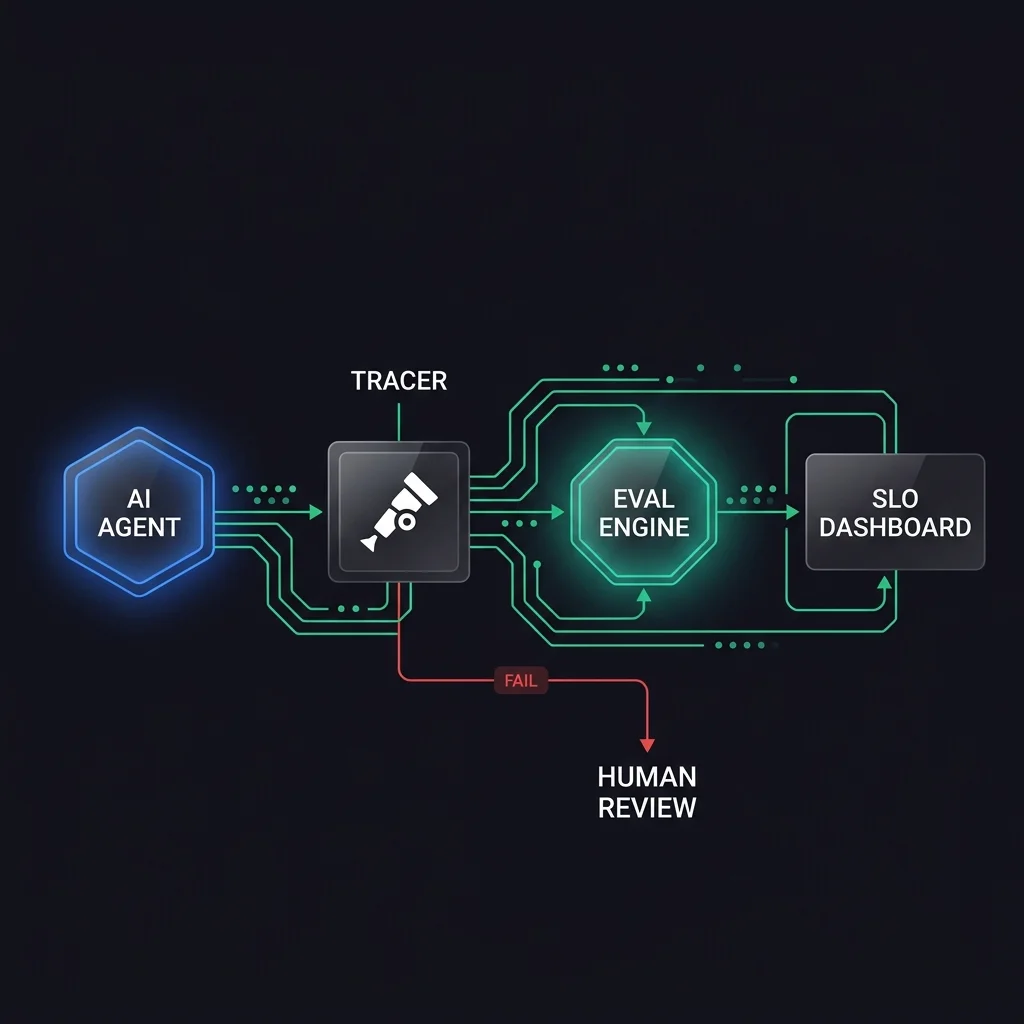
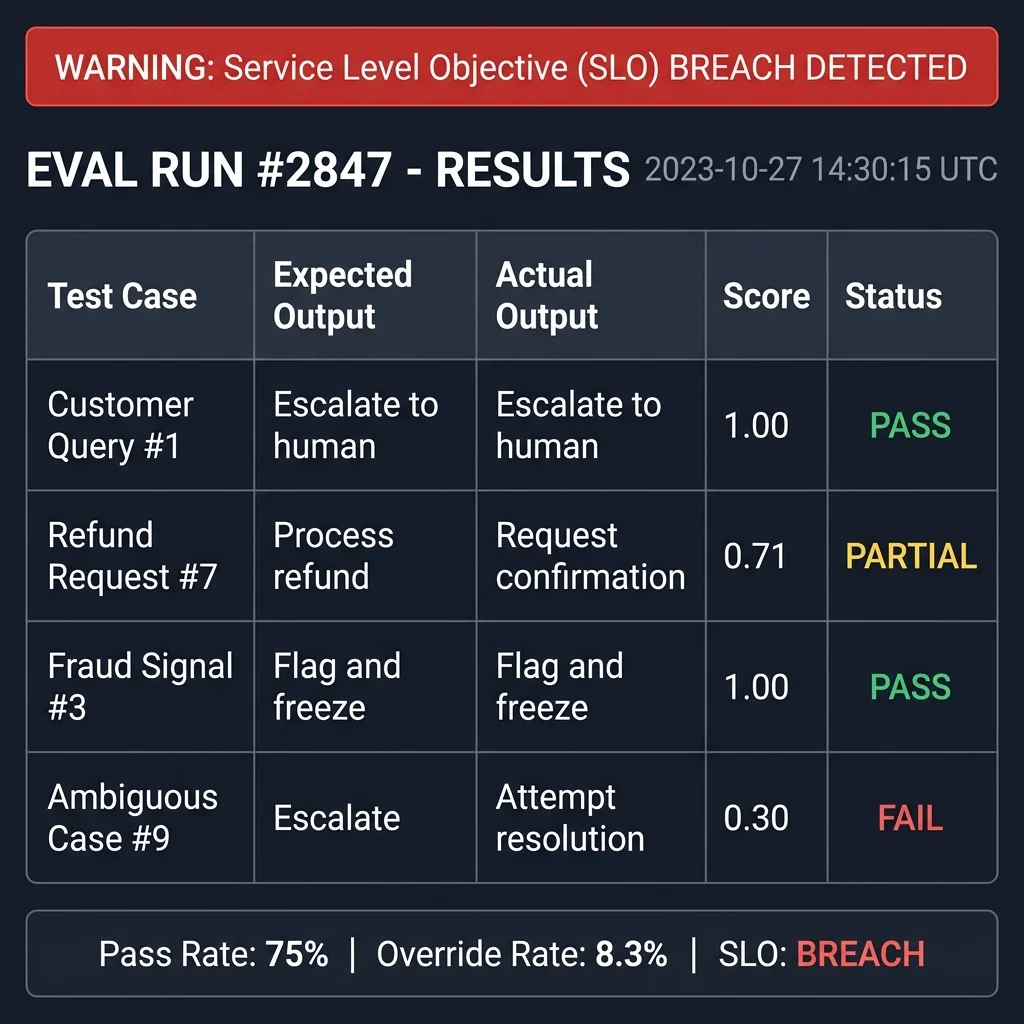
An eval harness is the infrastructure layer that sits between your agent and production. It's not a test suite in the traditional sense — it's a continuous, automated evaluation loop that runs at every stage of the agent's lifecycle.
Think of it as the production gate your agent has to pass through on every deployment, every model update, and every configuration change.
A mature eval harness does four things:
- Captures every agent decision — input, reasoning trace, tool calls, and final output — at runtime
- Scores outputs against a test battery — predefined cases with expected behaviors, edge cases, and adversarial inputs
- Measures behavioral SLOs — override rate, task completion rate, latency P95, error rate — and compares against thresholds
- Gates deployment — blocks promotion to production if scores fall below the graduation threshold, triggers human review automatically
The tools that support this in 2026 are genuinely excellent. OpenTelemetry is the instrumentation standard for tracing agent execution. Langfuse (open-source) provides the eval scoring and prompt version tracking layer. Prometheus and Grafana handle the SLO dashboards and alerting. You don't need a proprietary platform to build world-class agent observability — you need the right architecture.
Practitioner note: The instinct is to reach for a vendor platform first. In most cases, I'd recommend starting with OpenTelemetry + Langfuse. They're open-source, composable, and give you portability across model providers. The proprietary eval platforms are worth evaluating at scale — but lock-in before you understand your eval requirements is a mistake I've seen teams regret.
Why Traditional Testing Fails for Agents {#why-traditional-testing-fails}
Unit testing an agent as if it's a deterministic function is the wrong abstraction. Here's what breaks:
Non-determinism: The same input can produce different outputs across model versions, temperature settings, or context windows. A unit test that passes today may fail tomorrow after a model update — not because your code changed, but because the underlying LLM did.
Context sensitivity: Agent behavior changes with tool availability, memory state, and conversation history. An agent that correctly escalates a refund request in isolation may behave differently when it has 12 prior conversation turns in context.
Emergent failure modes: Agents fail in ways you didn't anticipate. They'll confidently answer out-of-scope questions, get stuck in tool-call loops, or silently degrade when a downstream API returns an unusual response. These failure modes don't show up in traditional assertion-based tests.
Drift over time: Model providers update their base models continuously. What "gpt-4o" meant in March 2026 is behaviorally different from what it means in July 2026. Without continuous eval, drift is invisible.
Traditional testing catches bugs in your code. Eval harnesses catch behavioral regression in your agent's judgment — and that's a fundamentally different problem requiring fundamentally different tools.
The Five Layers of Agent Observability {#five-layers-observability}
A complete observability stack for production agents has five layers. Most teams have one or two. World-class programs have all five.
Layer 1: Execution Tracing
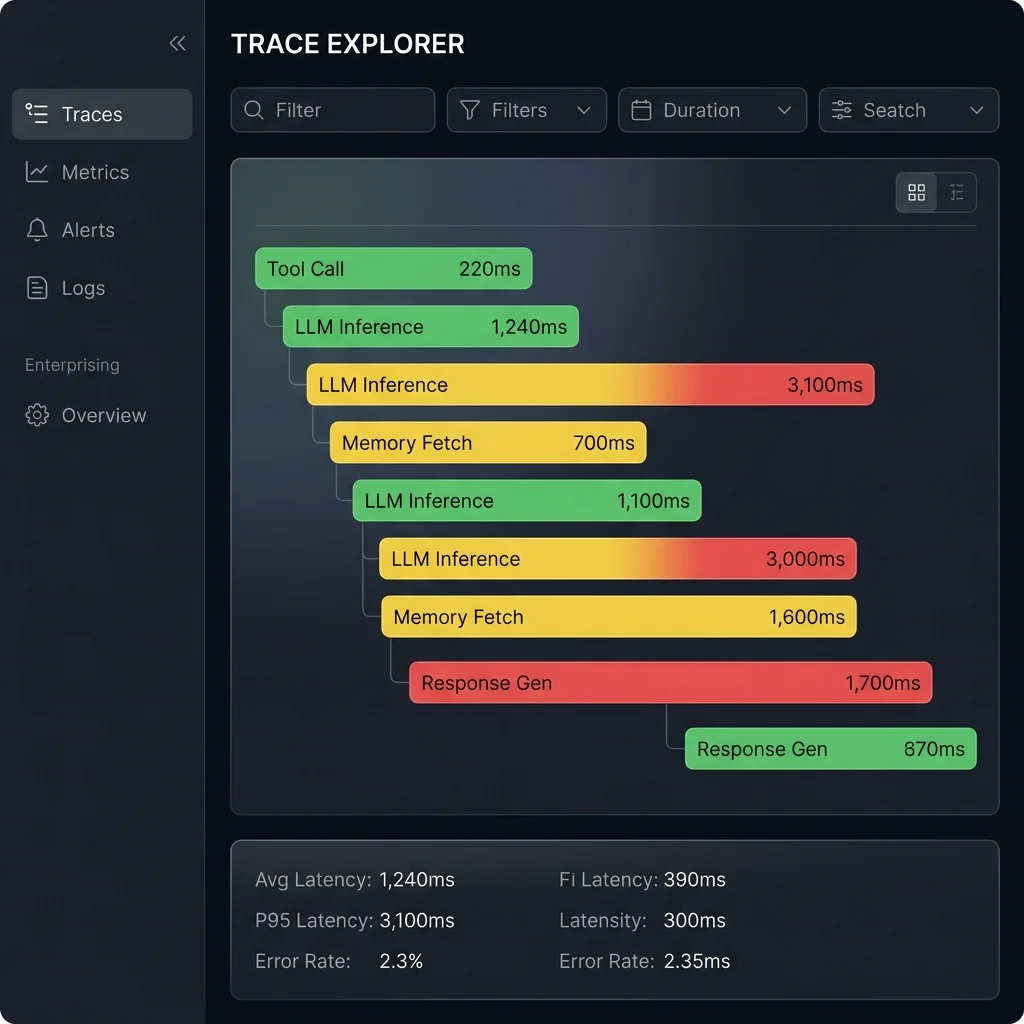
Every agent run generates a trace — a structured record of every step: the input, each tool call with its parameters and response, each LLM inference with its token count and latency, the final output. OpenTelemetry spans are the standard. Each span should carry a session_id, agent_id, model_version, and run_id for correlation.
Layer 2: Eval Scoring
Each trace gets evaluated against a test battery. Scores can be binary (correct/incorrect), graded (0.0–1.0), or multi-dimensional (accuracy, safety, relevance, tone). The scoring mechanism can be rule-based (string matching, regex), embedding-based (semantic similarity), or LLM-as-judge (using a separate evaluator model). For production, you want at least rule-based scoring for critical paths and embedding-based scoring for free-text outputs.
Layer 3: SLO Monitoring
Behavioral SLOs define your production bar. The most important metrics:
- Override Rate: What percentage of agent outputs get manually corrected? Target: <5% for Tier 1 agents
- Task Completion Rate: What percentage of tasks complete without error? Target: >95%
- Eval Pass Rate: What percentage of eval test cases pass? Target: >90%
- P95 Latency: 95th percentile end-to-end response time. Target: depends on use case, typically <3s for customer-facing agents
Layer 4: Prompt Version Control
Every prompt template change should be versioned and tracked against its eval impact. If a prompt rewrite causes eval pass rate to drop from 94% to 88%, you want to know before it hits production — not after. Langfuse's prompt versioning with linked eval runs is the pattern here.
Layer 5: Regression Detection
The final layer: continuous comparison against a baseline. Every agent deployment runs the full eval battery and compares results to the previous production baseline. Statistical significance testing prevents false alarms from noise. A genuine regression — measured degradation of >2 percentage points on pass rate — triggers the graduation gate.
Building Your First Eval Harness (Polyglot Code Examples) {#building-eval-harness}
Let's make this concrete with implementation patterns across Python, TypeScript, and Go.
Python: OpenTelemetry Instrumentation for Agent Traces
from opentelemetry import trace
from opentelemetry.sdk.trace import TracerProvider
from opentelemetry.sdk.trace.export import BatchSpanProcessor
from opentelemetry.exporter.otlp.proto.grpc.trace_exporter import OTLPSpanExporter
import uuid

class="tok-cm"># Initialize tracer
provider = TracerProvider()
provider.add_span_processor(
    BatchSpanProcessor(OTLPSpanExporter(endpoint=class="tok-str">"http:class="tok-cm">//otel-collector:4317"))
)
trace.set_tracer_provider(provider)
tracer = trace.get_tracer(class="tok-str">"agent.eval.harness")

class="tok-kw">def run_agent_with_trace(user_input: str, session_id: str, model_version: str) -> dict:
    run_id = str(uuid.uuid4())

    with tracer.start_as_current_span(class="tok-str">"agent_run") as span:
        span.set_attribute(class="tok-str">"session.id", session_id)
        span.set_attribute(class="tok-str">"run.id", run_id)
        span.set_attribute(class="tok-str">"model.version", model_version)
        span.set_attribute(class="tok-str">"input.text", user_input)

        class="tok-cm"># Tool call span
        with tracer.start_as_current_span(class="tok-str">"tool_call.crm_lookup") as tool_span:
            tool_result = crm_lookup(user_input)
            tool_span.set_attribute(class="tok-str">"tool.name", class="tok-str">"crm_lookup")
            tool_span.set_attribute(class="tok-str">"tool.result_count", len(tool_result))

        class="tok-cm"># LLM inference span
        with tracer.start_as_current_span(class="tok-str">"llm_inference") as llm_span:
            output = call_llm(user_input, tool_result)
            llm_span.set_attribute(class="tok-str">"llm.token_count", output[class="tok-str">"tokens"])
            llm_span.set_attribute(class="tok-str">"llm.latency_ms", output[class="tok-str">"latency_ms"])

        span.set_attribute(class="tok-str">"output.text", output[class="tok-str">"text"])
        span.set_attribute(class="tok-str">"output.action", output[class="tok-str">"action"])

        return {class="tok-str">"run_id": run_id, class="tok-str">"output": output, class="tok-str">"session_id": session_id}
TypeScript: Eval Scorer with Langfuse Integration
import { Langfuse } from "langfuse";
import { EvalCase, EvalScore } from "./types";

const langfuse = new Langfuse({
  publicKey: process.env.LANGFUSE_PUBLIC_KEY!,
  secretKey: process.env.LANGFUSE_SECRET_KEY!,
  baseUrl: process.env.LANGFUSE_HOST!,
});

interface AgentOutput {
  text: string;
  action: string;
  runId: string;
}

async function scoreAgentOutput(
  output: AgentOutput,
  testCase: EvalCase,
  traceId: string
): Promise<EvalScore> {
  const trace = langfuse.trace({ id: traceId });

  // Rule-based scoring for critical actions
  const actionScore = output.action === testCase.expectedAction ? 1.0 : 0.0;

  // Embedding-based semantic similarity for text output
  const semanticScore = await computeSemanticSimilarity(
    output.text,
    testCase.expectedText
  );

  const compositeScore = actionScore * 0.6 + semanticScore * 0.4;

  // Record score in Langfuse
  const score = await langfuse.score({
    traceId,
    name: "composite_eval_score",
    value: compositeScore,
    comment: `action=${actionScore}, semantic=${semanticScore.toFixed(3)}`,
  });

  return {
    runId: output.runId,
    score: compositeScore,
    pass: compositeScore >= 0.85,
    actionMatch: actionScore === 1.0,
  };
}

// Batch eval runner for CI/CD integration
async function runEvalBattery(
  agentFn: (input: string) => Promise<AgentOutput>,
  testCases: EvalCase[],
  modelVersion: string
): Promise<{ passRate: number; overrideRate: number; sloBreached: boolean }> {
  const results = await Promise.all(
    testCases.map(async (tc) => {
      const output = await agentFn(tc.input);
      const traceId = `eval-${modelVersion}-${tc.id}`;
      return scoreAgentOutput(output, tc, traceId);
    })
  );

  const passRate = results.filter((r) => r.pass).length / results.length;
  const overrideRate = results.filter((r) => !r.actionMatch).length / results.length;

  return {
    passRate,
    overrideRate,
    sloBreached: passRate < 0.9 || overrideRate > 0.05,
  };
}
Go: SLO Gate for Deployment Pipeline
package evalgate

import (
    "context"
    "fmt"
    "time"
)

type SLOConfig struct {
    MinPassRate    float64 // e.g. 0.90
    MaxOverrideRate float64 // e.g. 0.05
    MaxP95LatencyMs int64   // e.g. 3000
}

type EvalResult struct {
    PassRate     float64
    OverrideRate float64
    P95LatencyMs int64
    ModelVersion string
    RunAt        time.Time
}

type GraduationGate struct {
    sloConfig SLOConfig
    baseline  *EvalResult
}

func (g *GraduationGate) Evaluate(candidate EvalResult) (bool, []string) {
    failures := []string{}

    // Check absolute SLO thresholds
    if candidate.PassRate < g.sloConfig.MinPassRate {
        failures = append(failures, fmt.Sprintf(
            "FAIL: pass_rate=%.2f%% below threshold %.2f%%",
            candidate.PassRate*100, g.sloConfig.MinPassRate*100,
        ))
    }

    if candidate.OverrideRate > g.sloConfig.MaxOverrideRate {
        failures = append(failures, fmt.Sprintf(
            "FAIL: override_rate=%.2f%% exceeds threshold %.2f%%",
            candidate.OverrideRate*100, g.sloConfig.MaxOverrideRate*100,
        ))
    }

    if candidate.P95LatencyMs > g.sloConfig.MaxP95LatencyMs {
        failures = append(failures, fmt.Sprintf(
            "FAIL: p95_latency=%dms exceeds threshold %dms",
            candidate.P95LatencyMs, g.sloConfig.MaxP95LatencyMs,
        ))
    }

    // Check regression against baseline
    if g.baseline != nil {
        passDelta := candidate.PassRate - g.baseline.PassRate
        if passDelta < -0.02 { // >2pp regression
            failures = append(failures, fmt.Sprintf(
                "REGRESSION: pass_rate dropped %.2fpp from baseline",
                passDelta*100,
            ))
        }
    }

    return len(failures) == 0, failures
}

func (g *GraduationGate) Gate(ctx context.Context, candidate EvalResult) error {
    passed, failures := g.Evaluate(candidate)
    if !passed {
        return fmt.Errorf("graduation gate blocked: %v", failures)
    }
    return nil
}
SLO Design for Agentic Systems {#slo-design}
SLOs for AI agents are different from service SLOs. The key insight: you're not just measuring reliability — you're measuring judgment quality.
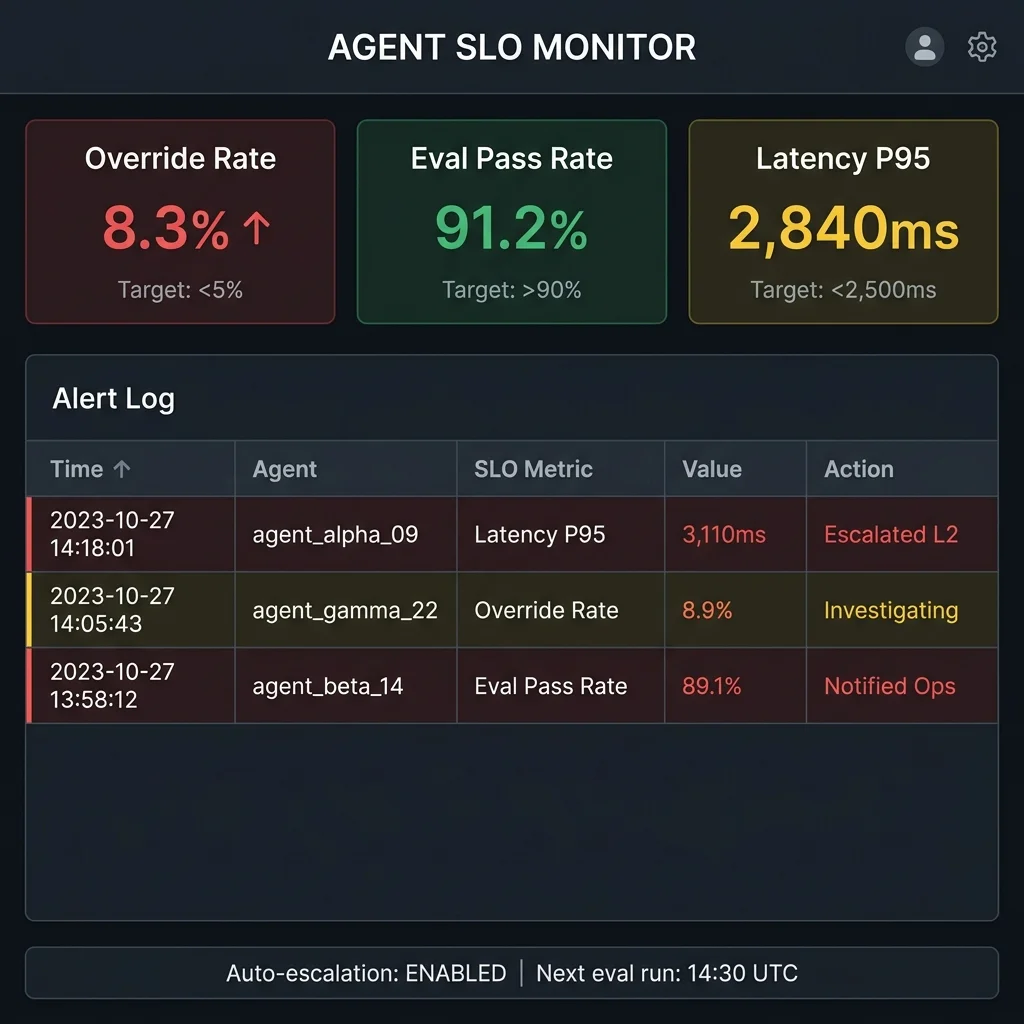
The four SLOs that matter most in 2026:
Override Rate SLO — The most politically important metric. Every time a human corrects an agent's output, that's an override. An override rate above 5% in Tier 1 workflows (customer-facing, financial, compliance) signals that the agent isn't production-ready. Track overrides by category: which types of decisions are getting corrected most? That's your eval test gap.
Task Completion SLO — Did the agent complete the assigned task without an unhandled error? This catches tool failures, context window exhaustion, and infinite loops. Target: >95% for synchronous agents, >98% for batch processing agents where retries are built in.
Eval Pass Rate SLO — Of the 200 test cases in your eval battery, what percentage does the current model version pass? You want >90% for production. Below 85% means the model update or prompt change has broken something fundamental. This is your primary regression signal.
Semantic Drift SLO — This is the one teams miss. As the agent accumulates production conversations, you should periodically sample real outputs and score them against your eval rubric. If real-world performance diverges from eval-battery performance by more than 5 percentage points, your eval battery doesn't represent reality and needs updating.
Important: SLOs are team agreements, not vendor defaults. Tier 1 agents (autonomous financial transactions, compliance decisions) need tighter thresholds — <2% override rate, >97% task completion. Tier 3 agents (content suggestions, internal helpdesk) can operate with looser SLOs. Classify your agents before you set the thresholds.
Graduation Gates: From Staging to Production {#graduation-gates}
A graduation gate is a formal checkpoint that every agent must pass before it's promoted to the next environment tier. The architecture is simple: eval battery → score aggregation → SLO comparison → gate decision.
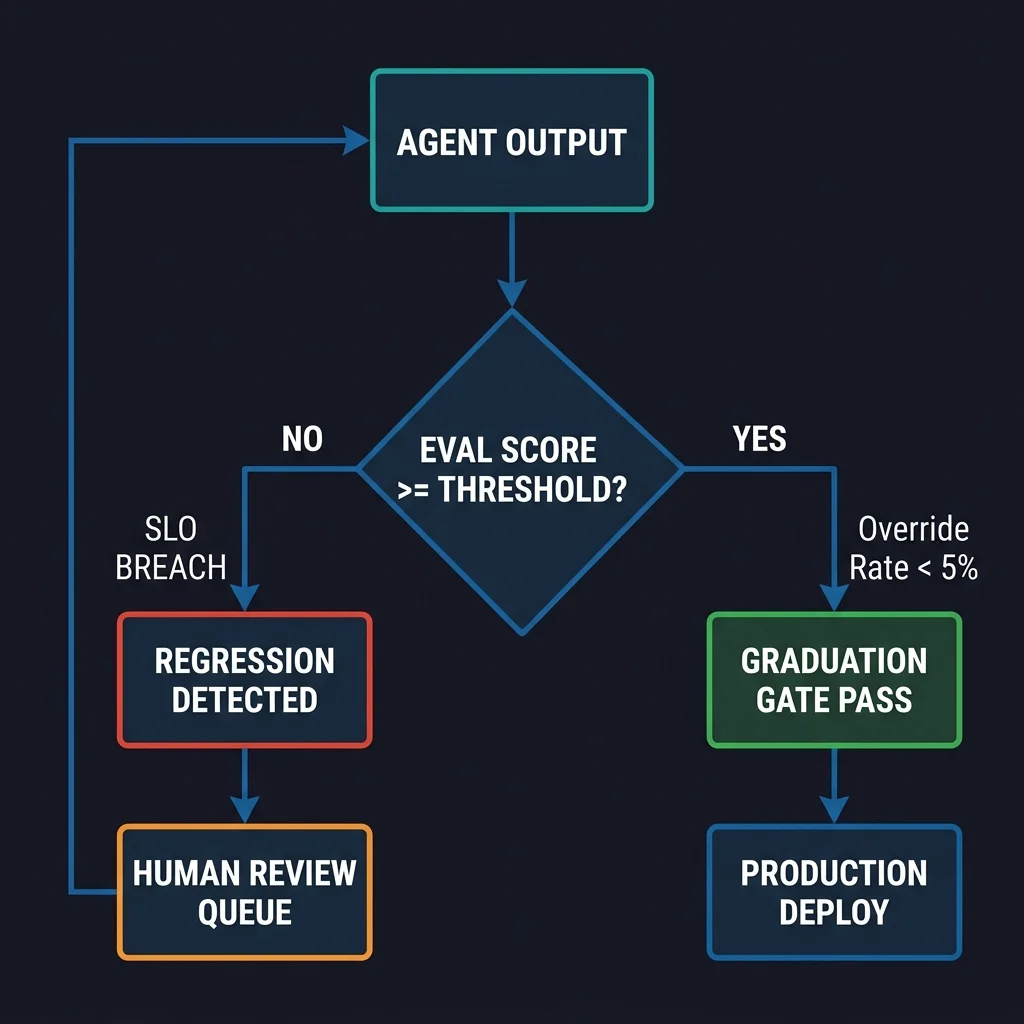
Practically, this means adding eval gate steps into your CI/CD pipeline. Every PR that changes a prompt template, adjusts tool configurations, or bumps a model version triggers the full eval battery run automatically. The gate blocks merge if SLOs breach.
This sounds heavyweight. It's not. A well-constructed eval battery of 200–500 test cases runs in under 3 minutes using async batch evaluation. The engineering investment to build the gate is 2–4 weeks. The cost of not having it — one regressed agent in a customer-facing workflow — is typically measured in hundreds of thousands of dollars in incident response, reputational damage, and customer churn.
The graduation gate also has a second benefit: it creates the audit trail that compliance and risk teams need. Every production deployment has a corresponding eval run ID, a pass/fail record, and the full score breakdown. When the risk committee asks "can you prove this agent didn't regress after the April model update?" — the answer is yes, and you can show the receipts.
Deep Analysis: Eval Maturity Benchmark Table {#deep-analysis}
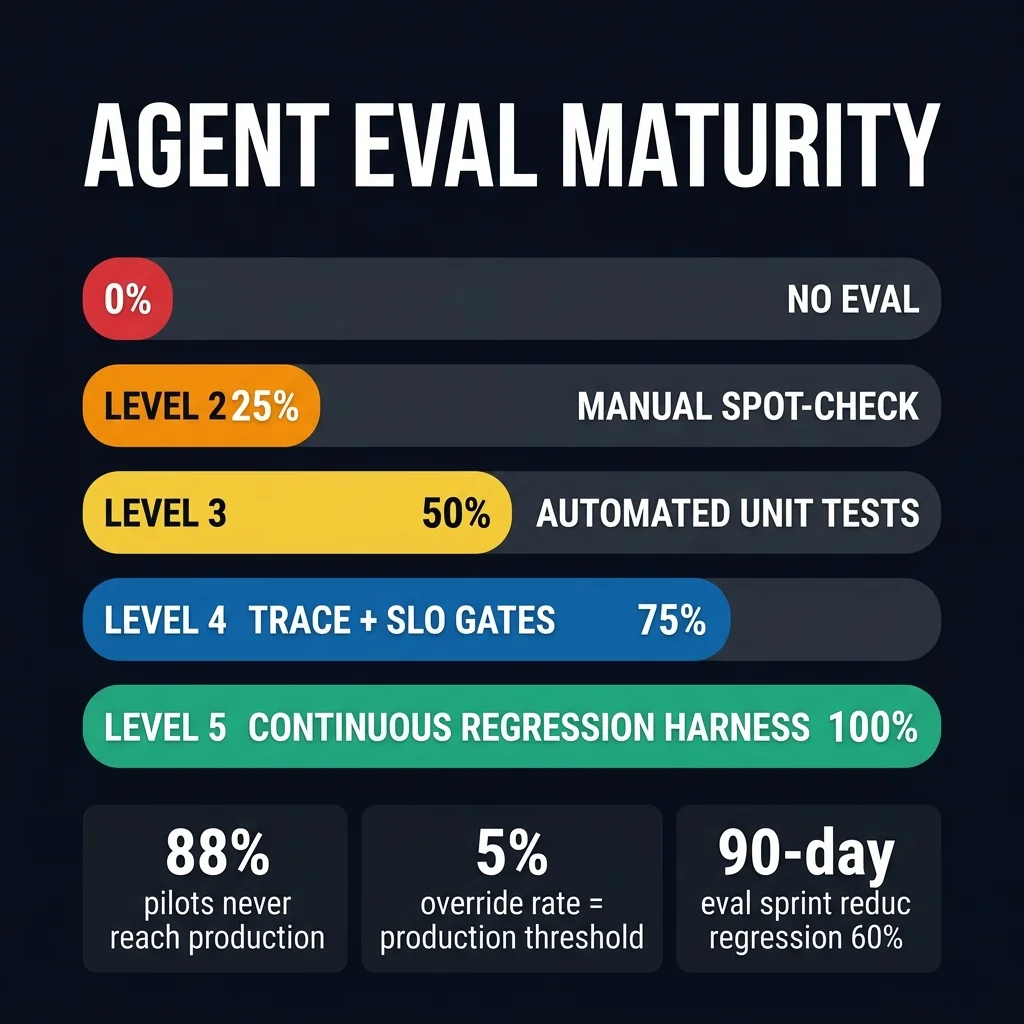
Most enterprise AI programs I've audited are operating at Level 2 or 3 in 2026. That's not a technology problem — it's a prioritization problem. The tools exist. The patterns are proven. The gap is that eval infrastructure is treated as a "nice to have" rather than a prerequisite for production.
That needs to change.
Real-World Implementation Patterns {#real-world-patterns}
Here's how three different enterprise contexts implement eval harnesses.
Pattern A: Customer-Facing Support Agent (Tier 1)
A financial services firm running an account inquiry agent evaluates every production output against 450 test cases covering edge cases, escalation triggers, and regulatory language requirements. The eval battery runs in CI on every prompt change and model update. Override rate target: <2%. When override rate crossed 3% after an LLM provider update, the graduation gate blocked promotion automatically and the team reverted to the previous model version within 90 minutes.
Pattern B: Internal ITSM Triage Agent (Tier 2)
A technology company running an agent for ticket routing and priority scoring uses a lighter eval battery of 120 test cases focused on routing accuracy and priority classification. SLO: >90% routing accuracy, <8% override rate. The team runs eval daily rather than on every deployment, and reviews the SLO dashboard during weekly sprint reviews. This is the right calibration for a Tier 2 internal agent.
Pattern C: Research and Summarization Agent (Tier 3)
A professional services firm using an agent to summarize internal research documents uses embedding-based semantic scoring rather than deterministic assertions (because "correct" is context-dependent). Override rate target is more relaxed at <15%, with a focus on factual accuracy scoring using an LLM-as-judge model. Eval runs weekly.
Human Override and Escalation Design {#human-override}
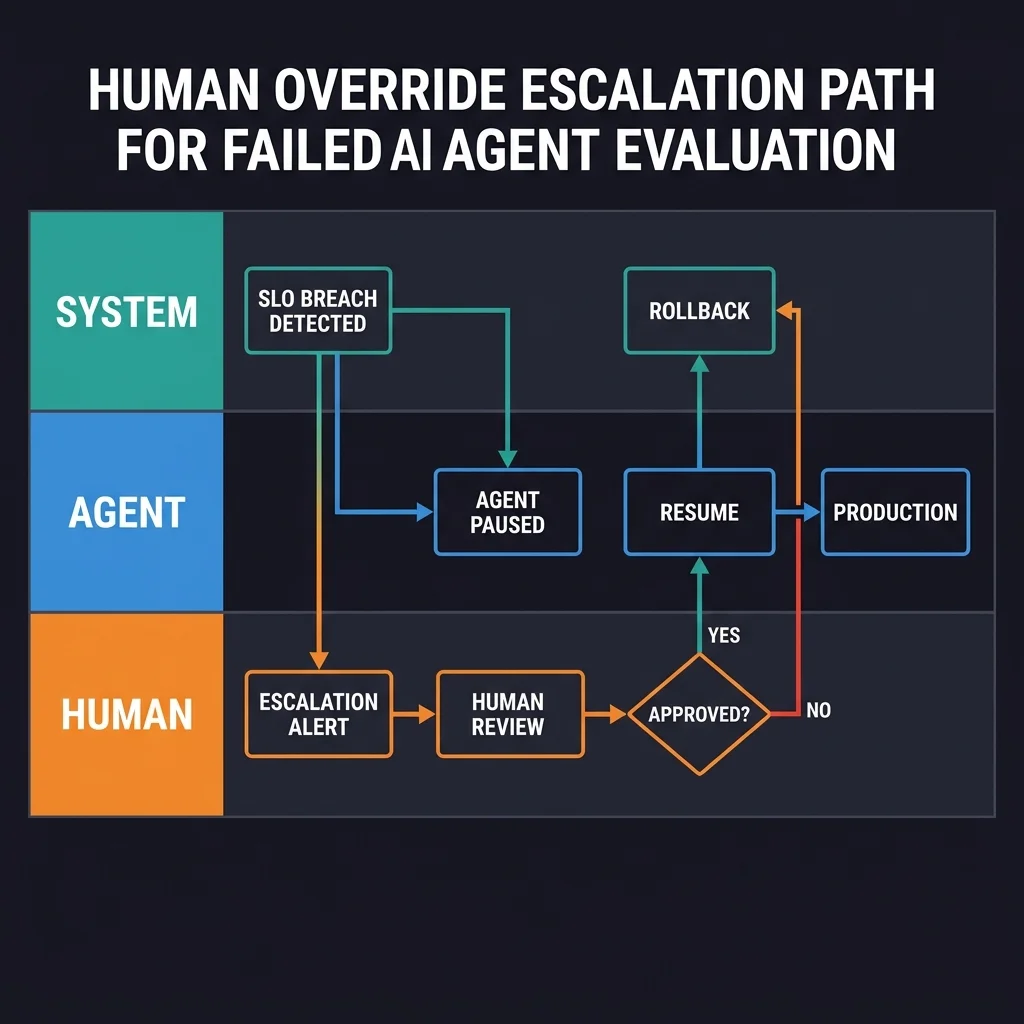
Eval harnesses don't eliminate humans from the loop — they make human involvement intentional and traceable rather than reactive and random.
A well-designed escalation path has three components:
1. Automatic SLO Breach Escalation: When the eval gate detects an SLO breach, it should automatically pause the affected agent workflow (not kill it — pause it), notify the on-call team via PagerDuty or equivalent, and queue the failed cases for human review. The key is specificity: the escalation notification should tell the engineer exactly which test cases failed, what the score delta is from baseline, and what the recommended action is (revert, fix, or accept with risk acknowledgment).
2. Production Override Capture: Every human override in production — every time an operator corrects an agent's output — should be captured as a labeled training event. Override reason codes (wrong action, wrong content, wrong tone, out-of-scope) feed directly back into the eval battery. New override categories become new test cases. This creates a virtuous cycle: production issues strengthen the eval harness, making future regressions easier to catch.
3. Rollback Governance: The graduation gate architecture should be mirrored by a rollback architecture. If a production agent is found to have regressed — detected by rising override rates or user complaints — the rollback path should be 1-click: revert to the previous approved model version and prompt configuration, with the rollback event logged for audit.
Pitfalls and Anti-Patterns to Avoid {#pitfalls}
Anti-pattern 1: Eval Battery Overfitting
If your eval test cases are derived entirely from happy-path scenarios the agent was already trained on, the eval battery is meaningless. You need adversarial cases, edge cases, and real-world failures from production override data. A battery of 500 tests that all pass isn't rigorous — it's confirmation bias.
Anti-pattern 2: Eval-Only-on-Deploy
Running eval only at deployment time misses production drift. Base model providers update continuously. Running a weekly or daily eval scan against production agent behavior catches drift that CI-only gates miss.
Anti-pattern 3: Single-Score Aggregation
Collapsing all eval dimensions into a single composite score hides critical failures. A 90% pass rate that includes 0% accuracy on financial escalation cases (masked by 100% accuracy on routine queries) is a dangerous false positive. Maintain per-category SLOs, especially for high-stakes decision types.
Anti-pattern 4: Ignoring Latency as a Quality Signal
P95 latency degradation is often the first signal of a model version that's struggling with your use case. An agent that takes 4 seconds to respond when the baseline is 1.5 seconds isn't "just slower" — it's usually struggling with the task structure, which often predicts accuracy degradation as well.
Anti-pattern 5: Eval Theater
Building an eval harness that the team knows how to bypass ("just merge directly to main for hotfixes") defeats the purpose. The graduation gate only works if it's enforced consistently. If the business is willing to bypass the gate, the gate isn't trusted — and that means the underlying concern about production quality hasn't been resolved.
2027-2030: The Future of Agentic Eval {#future-roadmap}
2027: Self-Updating Eval Batteries
The next evolution is eval batteries that update themselves. Production override data, user feedback signals, and anomaly detection on trace patterns will feed a continuously evolving test corpus. The eval harness will no longer need manual curation — it'll learn what failure looks like from real production behavior.
2028: Multi-Agent Eval Choreography
As enterprises run multi-agent systems where agents hand off to other agents, eval harnesses will need to score the interaction between agents — not just individual outputs. Did Agent A's output create a reasonable input for Agent B? Did the orchestration pattern reach the intended terminal state? This requires new eval primitives that don't exist in current tooling.
2029: Regulatory Eval Mandates
The EU AI Act's Annex III requirements for high-risk AI systems already imply eval infrastructure. By 2029, expect formal regulatory standards for agent eval harness documentation in regulated industries — similar to how software testing documentation is required for medical device software today. Teams building eval infrastructure now are ahead of a compliance curve that will become mandatory.
2030: Eval-Native Agent Architectures
The longest view: agent frameworks will ship with eval hooks natively. The OpenTelemetry instrumentation, the SLO configuration, and the graduation gate — currently requiring significant integration effort — will be first-class features of the agent runtime. Teams that understand eval architecture now will design these systems. Teams that don't will use them without understanding the trade-offs.
90-Day Transformation Checkpoint {#transformation-checkpoint}
When to bring in advisory: If your team is operating at Level 2 eval maturity (manual spot-check), moving to Level 4 (trace + SLO gates) typically takes 8–12 weeks with focused engineering effort. If you have multiple production agents, complex multi-model stacks, or regulated-industry compliance requirements, an external architecture review can compress that timeline significantly and prevent the common architectural mistakes that make the eval infrastructure hard to maintain. Most teams that get it wrong the first time spend more time rebuilding than they would have spent doing it right with guidance.
If you want a conversation about where your agent program sits on the maturity curve and what a realistic path to Level 4 looks like, reach out to start a scoping conversation.
Days 1–30: Instrument and Measure
- Deploy OpenTelemetry instrumentation on your highest-priority agent
- Define your first 50 test cases (use recent production overrides as primary source)
- Measure baseline override rate and task completion rate
Days 31–60: Build the Eval Battery and SLO Dashboard
- Expand test battery to 200+ cases covering edge cases and adversarial inputs
- Deploy Langfuse (self-hosted or cloud) for eval scoring and prompt version tracking
- Build Prometheus + Grafana SLO dashboard with alert rules
Days 61–90: Implement Graduation Gates
- Integrate eval battery into CI/CD pipeline (GitHub Actions / GitLab CI)
- Set graduation gate thresholds based on 30-day baseline data
- Run first simulated gate exercise: apply a known prompt regression and verify the gate catches it
Key Takeaways {#key-takeaways}
- 88% of AI pilots fail to reach production because they lack observability and eval infrastructure, not because the agent isn't capable
- Override rate is the most important SLO — it reveals how often human judgment is correcting agent judgment, and it's the number risk committees actually understand
- The five observability layers (execution tracing, eval scoring, SLO monitoring, prompt version control, regression detection) need all five to achieve Tier 1 production readiness
- OpenTelemetry + Langfuse + Prometheus is a production-grade, vendor-neutral eval stack that most enterprises can deploy in 8–12 weeks
- Graduation gates in CI/CD are non-negotiable for teams where model updates, prompt changes, or configuration changes happen more than once a week
- Production override data is your best eval battery source — real failure modes your test battery didn't anticipate will show up there first
- Eval maturity is a tiered journey — Level 4 (trace + SLO gates) is the minimum for customer-facing agents; Level 5 (continuous regression harness) is required for Tier 1 autonomous workflows
FAQ {#faq}
What's the minimum viable eval harness for a single production agent?
For a single Tier 2 agent, a minimum viable harness consists of: OpenTelemetry instrumentation capturing input/output/tool calls, a 100-case eval battery covering your most common and most dangerous scenarios, and an override rate dashboard with a weekly review cadence. You can build this in 4–6 weeks. It's not Level 5, but it's infinitely better than Level 1 and will catch 80% of the regressions that would otherwise reach production.
How do I build eval test cases for an agent that doesn't have a clear "correct" answer?
For free-text or judgment-heavy agents (research summarization, content generation, advisory response), use multi-dimensional rubric scoring rather than binary pass/fail. Score on: factual accuracy (verifiable claims only), relevance to the query, tone appropriateness, and absence of hallucination. LLM-as-judge with a carefully prompted evaluator model works well for this, combined with human review of a random 5% sample weekly. The rubric definition is the hard part — that's the conversation that forces your team to agree on what "good" actually means.
How often should I run the full eval battery?
At minimum: on every deployment that changes a prompt, model version, or tool configuration. For Tier 1 agents, also run daily against a random sample of production traces. If your model provider is known to silently update base models (most do), weekly full-battery runs are worth the investment. Runtime cost for 500 eval cases using a fast scoring model is typically $1–3 — the economics strongly favor frequent evaluation.
Is OpenTelemetry sufficient for agent tracing, or do I need a specialized tool?
OpenTelemetry is sufficient for the instrumentation layer — capturing spans, attributes, and trace context. What it doesn't give you natively is the eval scoring layer (scoring outputs against expected behavior) or the prompt version management layer. That's where Langfuse or similar platforms add value. The architecture I recommend: OTel for instrumentation → OTLP exporter → your observability backend (Langfuse, Grafana Tempo, etc.) → Prometheus for SLO metrics → Grafana for dashboards. You can also use a vendor platform that collapses these layers, but the composable stack gives you more portability.
How do I convince stakeholders to invest in eval infrastructure before it's legally mandated?
Use the override rate argument. Ask the team to pull the last 30 days of agent outputs and manually review a random sample of 50. In most organizations I've worked with, the override rate comes back at 10–20% — far higher than people assumed. That number, presented to a risk committee, converts stakeholders faster than any technical architecture argument. The follow-up question writes itself: "If 1 in 10 agent outputs is wrong enough for a human to correct, what's the probability that some of those wrong outputs are reaching customers without correction?" That's the business case for eval infrastructure.
About the Author {#about-author}
Vatsal Shah is a business transformation architect and enterprise AI strategist with over 15 years of experience leading technology-driven operating model change across financial services, manufacturing, and professional services. He advises CIOs, transformation leads, and engineering organizations on moving AI programs from pilot to production — with a particular focus on governance, observability, and the organizational changes that determine whether AI investments deliver measurable outcomes.
He founded Business Tech Navigator as a practitioner resource for transformation leaders who want to move faster, with more confidence, and with less of the expensive trial-and-error that characterizes most enterprise AI programs.
Explore the Proof-of-Impact Playbook for the full framework on taking AI programs from pilot approval to CFO-signed business outcomes.
Conclusion {#conclusion}
Boards don't fund more pilots. They fund proof that the agents you already have won't regress every Tuesday.
The eval harness isn't a nice-to-have engineering project. It's the infrastructure that transforms your AI program from a series of impressive demos into a portfolio of accountable, production-grade systems. The tools exist. The patterns are proven. The only thing standing between most enterprise AI programs and production readiness is the decision to treat eval infrastructure as a first-class engineering priority.
If you're operating at Level 1 or 2 maturity today, the path to Level 4 is 8–12 weeks of focused work. That investment pays back in reduced incident response costs, faster model iteration cycles, and — most importantly — the ability to answer the risk committee's questions with evidence rather than reassurance.
Want to talk through where your agent program sits on the eval maturity curve? Start with a scoping conversation — no commitment, just a practical assessment of where you are and what would actually move the needle.
88% of AI pilots never reach production. The bottleneck isn't the agent — it's the missing eval harness. Override rate, SLO gates, and regression detection are what separate demos from deployable systems. Full breakdown + the polyglot code examples to build it this quarter →
{
  class="tok-str">"@context": class="tok-str">"https:class="tok-cm">//schema.org",
  class="tok-str">"@graph": [
    {
      class="tok-str">"@type": class="tok-str">"BlogPosting",
      class="tok-str">"headline": class="tok-str">"Agent Eval Harnesses and Observability: Production Gates That Stop the Pilot Graveyard",
      class="tok-str">"description": class="tok-str">"Learn how to build AI agent eval harnesses, trace pipelines, and SLO gates that prevent regression and get agents out of pilot hell into production.",
      class="tok-str">"author": {
        class="tok-str">"@type": class="tok-str">"Person",
        class="tok-str">"name": class="tok-str">"Vatsal Shah",
        class="tok-str">"url": class="tok-str">"https:class="tok-cm">//businesstechnavigator.com"
      },
      class="tok-str">"datePublished": class="tok-str">"2026-07-20T00:00:00+00:00",
      class="tok-str">"dateModified": class="tok-str">"2026-07-20T00:00:00+00:00",
      class="tok-str">"image": {
        class="tok-str">"@type": class="tok-str">"ImageObject",
        class="tok-str">"url": class="tok-str">"https:class="tok-cm">//businesstechnavigator.com/uploads/content/blog/agent-eval-harness-observability-production-gates-2026//uploads/content/blog/agent-eval-harness-observability-production-gates-2026/banner.webp",
        class="tok-str">"width": 1200,
        class="tok-str">"height": 630
      },
      class="tok-str">"url": class="tok-str">"https:class="tok-cm">//businesstechnavigator.com/blog/agent-eval-harness-observability-production-gates-2026",
      class="tok-str">"publisher": {
        class="tok-str">"@type": class="tok-str">"Organization",
        class="tok-str">"name": class="tok-str">"Business Tech Navigator",
        class="tok-str">"url": class="tok-str">"https:class="tok-cm">//businesstechnavigator.com"
      },
      class="tok-str">"keywords": class="tok-str">"AI agent eval harness production, LLM observability enterprise, agent regression testing, production agent SLOs, OpenTelemetry AI agents",
      class="tok-str">"articleSection": class="tok-str">"AI & Agentic Transformation",
      class="tok-str">"wordCount": 3800
    },
    {
      class="tok-str">"@type": class="tok-str">"FAQPage",
      class="tok-str">"mainEntity": [
        {
          class="tok-str">"@type": class="tok-str">"Question",
          class="tok-str">"name": class="tok-str">"What is the minimum viable eval harness for a single production agent?",
          class="tok-str">"acceptedAnswer": {
            class="tok-str">"@type": class="tok-str">"Answer",
            class="tok-str">"text": class="tok-str">"For a single Tier 2 agent, a minimum viable harness consists of: OpenTelemetry instrumentation capturing input/output/tool calls, a 100-case eval battery covering your most common and most dangerous scenarios, and an override rate dashboard with a weekly review cadence. You can build this in 4-6 weeks."
          }
        },
        {
          class="tok-str">"@type": class="tok-str">"Question",
          class="tok-str">"name": class="tok-str">"What is an AI agent eval harness?",
          class="tok-str">"acceptedAnswer": {
            class="tok-str">"@type": class="tok-str">"Answer",
            class="tok-str">"text": class="tok-str">"An AI agent eval harness is the infrastructure layer that continuously evaluates agent outputs against a test battery of expected behaviors, measures behavioral SLOs including override rate and task completion, and gates production deployments when scores fall below defined thresholds - preventing regressions from reaching customers after model updates or configuration changes."
          }
        },
        {
          class="tok-str">"@type": class="tok-str">"Question",
          class="tok-str">"name": class="tok-str">"How often should I run the full agent eval battery?",
          class="tok-str">"acceptedAnswer": {
            class="tok-str">"@type": class="tok-str">"Answer",
            class="tok-str">"text": class="tok-str">"At minimum: on every deployment that changes a prompt, model version, or tool configuration. For Tier 1 agents, also run daily against a random sample of production traces. Weekly full-battery runs are recommended class="tok-kw">if your model provider silently updates base models."
          }
        }
      ]
    },
    {
      class="tok-str">"@type": class="tok-str">"BreadcrumbList",
      class="tok-str">"itemListElement": [
        {
          class="tok-str">"@type": class="tok-str">"ListItem",
          class="tok-str">"position": 1,
          class="tok-str">"name": class="tok-str">"Home",
          class="tok-str">"item": class="tok-str">"https:class="tok-cm">//businesstechnavigator.com"
        },
        {
          class="tok-str">"@type": class="tok-str">"ListItem",
          class="tok-str">"position": 2,
          class="tok-str">"name": class="tok-str">"Blog",
          class="tok-str">"item": class="tok-str">"https:class="tok-cm">//businesstechnavigator.com/blog"
        },
        {
          class="tok-str">"@type": class="tok-str">"ListItem",
          class="tok-str">"position": 3,
          class="tok-str">"name": class="tok-str">"Agent Eval Harnesses and Observability",
          class="tok-str">"item": class="tok-str">"https:class="tok-cm">//businesstechnavigator.com/blog/agent-eval-harness-observability-production-gates-2026"
        }
      ]
    }
  ]
}