RevOps Orchestration: Why 82% Want AI Lead Routing But Only 26% Can Enforce It
By Vatsal Shah | July 20, 2026 | 13 min read
Table of Contents
- The Enforcement Gap That's Eating Your Pipeline
- What RevOps Orchestration Actually Means
- Why AI Accelerates Leakage on Broken Routing
- The Four Prerequisites Before AI Routing Works
- Building the Governed Routing Layer (Code Examples)
- SLA Design for Lead-to-Cash Workflows
- Deep Analysis: Routing Maturity Benchmark Table
- Real-World Implementation Patterns
- The GTM Orchestration Stack for 2026
- Pitfalls and Anti-Patterns
- 2027-2030: The Future of Agentic RevOps
- 90-Day Transformation Checkpoint
- Key Takeaways
- FAQ
- About the Author
- Conclusion
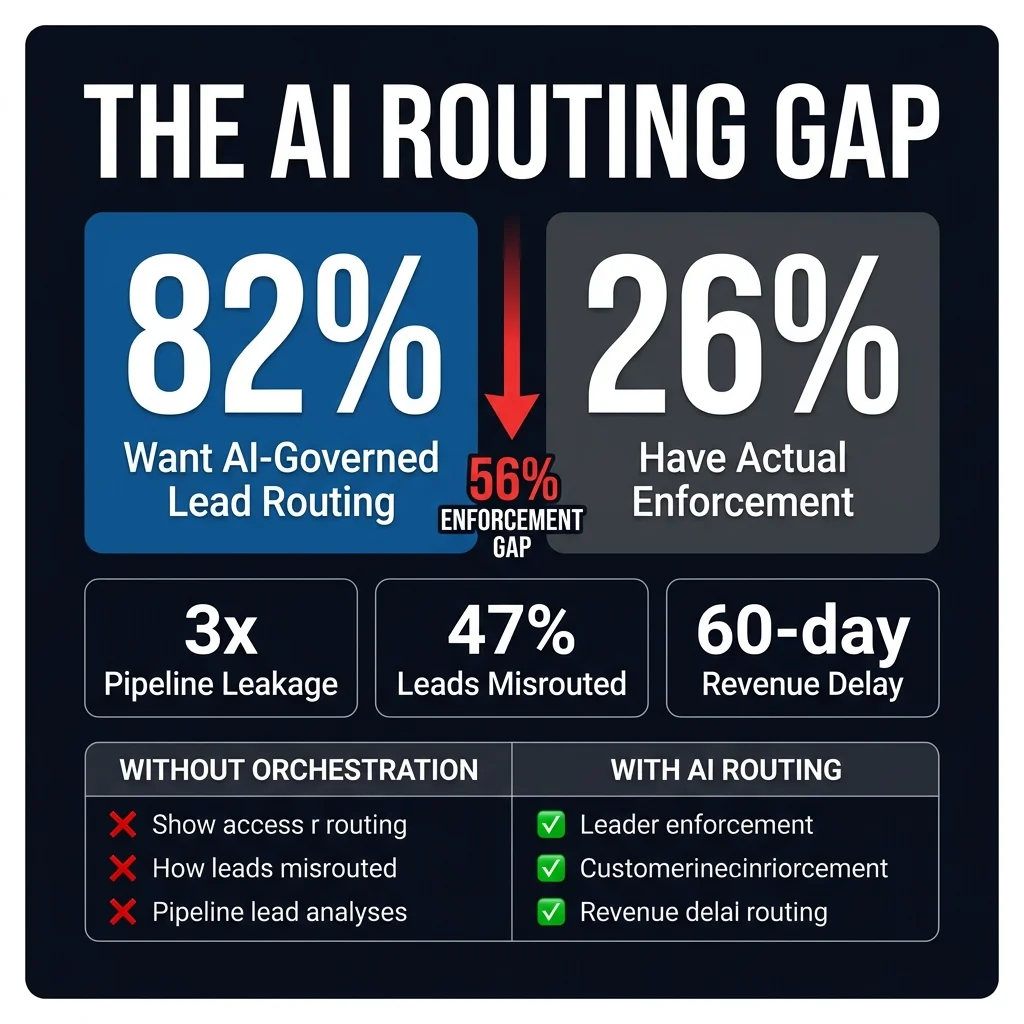
The LeanData/LXA 2026 Revenue Operations State of the Market report surfaced a number that should concern every GTM leader: 82% of revenue organizations agree that clean data and governed process are prerequisites for AI routing — yet only 26% have actual enforcement in place. That 56-point gap isn't a technology problem. It's an orchestration gap. AI doesn't fix broken routing logic. It amplifies it. This article explains what gets misrouted, why AI makes it worse without governance, and exactly how to build the enforcement layer that turns the 82% aspiration into the 26% reality — then beyond.
The Enforcement Gap That's Eating Your Pipeline {#enforcement-gap}
Every quarter, revenue leaders run the same postmortem. The pipeline number is short. The SDR team blames lead quality. Marketing blames hand-off SLAs. Sales ops pulls a routing audit that's already three weeks stale. Nobody can agree on where the leads went — only that they didn't convert.
This isn't a data problem, a people problem, or a tools problem. It's an orchestration problem. And adding AI to an unorchestrated GTM stack doesn't fix it. AI on broken lead routing automates your leakage at machine speed.
The 2026 LeanData/LXA report makes this concrete. 82% of revenue organization leaders agree that clean data and defined routing processes are prerequisites for AI-governed routing. But only 26% report having the enforcement mechanisms — the SLA rules, the routing audit trails, the escalation triggers — that would make that AI actually work.
That's a 56-percentage-point gap between aspiration and reality. And in a high-growth enterprise with 1,200 inbound leads per month, that gap translates to approximately 600 leads per month being routed by rules that nobody is enforcing, monitored by dashboards nobody is reviewing, and falling into queues that SLA timers have already expired for.
The good news: the enforcement layer isn't complicated. It's just unglamorous work that most organizations defer in favor of buying the next AI routing feature.
What RevOps Orchestration Actually Means {#what-revops-orchestration}
Revenue operations orchestration is the discipline of coordinating the data flows, routing rules, handoff protocols, and SLA enforcement mechanisms that connect marketing, sales, and customer success into a coherent lead-to-cash system.
It's not a technology. It's not a platform. It's an operating model decision.
The confusion arises because most GTM platforms — CRMs, marketing automation tools, revenue intelligence platforms — all claim to "orchestrate" your revenue operations. What they actually do is give you tools to build orchestration if you design it correctly. The orchestration itself is the operating model you impose on those tools.
Governed RevOps orchestration has four components:
1. Unified Routing Logic — A single source of truth for who routes leads, under what conditions, in what priority order. Not three different routing rules in three different tools, overriding each other silently.
2. SLA Enforcement — Defined response time commitments for each lead tier, with automated escalation when those timers expire. Not aspirational "we respond in 2 hours" policies — enforced alerts with accountability chains.
3. Audit Trails — Every routing decision logged: what rule fired, which queue received the lead, when the SLA timer started, whether it was honored. Not dashboards showing last week's aggregate — real-time decision logs.
4. Feedback Loops — Routing outcomes (won/lost, conversion by route, SLA compliance by tier) feeding back into routing rule refinement. Not "we'll review the routing rules in Q4" — continuous improvement loops closing weekly.
Without all four, AI routing is applying a powerful optimizer to a system with no ground truth. The AI will optimize — but it will optimize for the wrong thing.
Why AI Accelerates Leakage on Broken Routing {#why-ai-accelerates-leakage}
This is the thing most RevOps practitioners get wrong about AI routing. They assume AI will find the optimal routing path even if the underlying routing rules are messy. It won't.
Here's why. AI routing systems — whether built on ML models, rule engines with intelligence layers, or agentic routing loops — learn from historical routing decisions. If your historical routing decisions are wrong (high-intent enterprise leads going to SDR pools, misscored leads getting senior AE time, SLA-expired leads disappearing into nurture sequences that nobody monitors) then your AI routing system learns to replicate those mistakes at scale.
Worse: AI routing systems execute faster than humans, so the bad decisions accumulate faster. A human SDR might notice that 20 enterprise leads in a row got routed to the wrong queue and flag it. An AI routing system won't notice — it will continue routing them incorrectly until someone reviews the audit logs, which only 26% of organizations have.
The pattern I've seen repeatedly: an organization deploys an "AI routing" feature, lead velocity increases (because the AI routes faster), and then close rates drop two quarters later because the increased velocity was routing the right volume at the wrong people.
Velocity without governance isn't efficiency. It's sophisticated pipeline destruction.
Practitioner note: Before implementing any AI routing layer, run a 30-day routing audit on your current system. Pull every lead from the past 30 days and manually classify it: was it routed correctly? Was the SLA honored? How many are still sitting in a queue with no activity? In most organizations I've worked with, this audit surfaces a 30-40% misrouting rate in systems people assumed were working fine. That's your baseline. That's what you're asking AI to replicate — or fix.
The Four Prerequisites Before AI Routing Works {#four-prerequisites}
The 82% who want AI-governed routing but haven't built enforcement are missing one or more of these four prerequisites. Address all four before activating any AI routing layer.
Prerequisite 1: Clean Lead Scoring Taxonomy
AI routing decisions are only as good as the signal it's routing on. Lead score is the most common routing input, and it's often the most corrupted. If your lead scoring model hasn't been validated against closed-won data in the past 6 months, your routing AI is optimizing on noise.
Clean the taxonomy first: define what a qualified lead actually looks like for each tier (enterprise, mid-market, SMB) using outcome data, not assumptions. Recalibrate scoring thresholds against 12 months of closed-won/lost deals. This takes 4–6 weeks and will change your routing rules substantially.
Prerequisite 2: Single Routing Rule Registry
Most organizations have routing rules in their CRM (Salesforce or HubSpot assignment rules), their marketing automation platform (Marketo or HubSpot workflow routing), their sequencing tool (Outreach or Salesloft), and sometimes in manual processes living in spreadsheets.
These rules conflict. They overlap. They have no audit trail. Before adding AI, consolidate all routing rules into a single authoritative registry — ideally in your primary CRM's routing engine or in a dedicated routing platform. Every rule should have an owner, a last-validated date, and a performance metric.
Prerequisite 3: SLA Definitions by Tier
Define explicit SLA commitments for each lead tier. Not "respond quickly" — specific time targets:
- Tier 1 (Enterprise, ICP match, high intent): 4-hour response SLA, senior AE ownership, immediate escalation if breached
- Tier 2 (Mid-market, qualified): 24-hour response SLA, SDR ownership, manager alert at 20 hours
- Tier 3 (Inbound, unscored): 48-hour nurture sequence initiation, automated, with human review at 72 hours if no response
Once defined, automate the SLA monitoring. Every routing decision gets a timer. Timer expiry triggers escalation automatically, not manually.
Prerequisite 4: Routing Performance Dashboard
You cannot govern what you don't measure. Build a routing performance dashboard with five metrics, reviewed weekly by the RevOps lead:
- Routing accuracy rate (% leads routed to correct tier/owner)
- SLA compliance rate by tier
- Time-to-first-contact by tier and routing path
- Pipeline leakage rate at each hand-off stage
- Conversion rate by routing path
When these four prerequisites are in place, AI routing becomes a multiplier on a functioning system rather than an optimizer on a broken one.
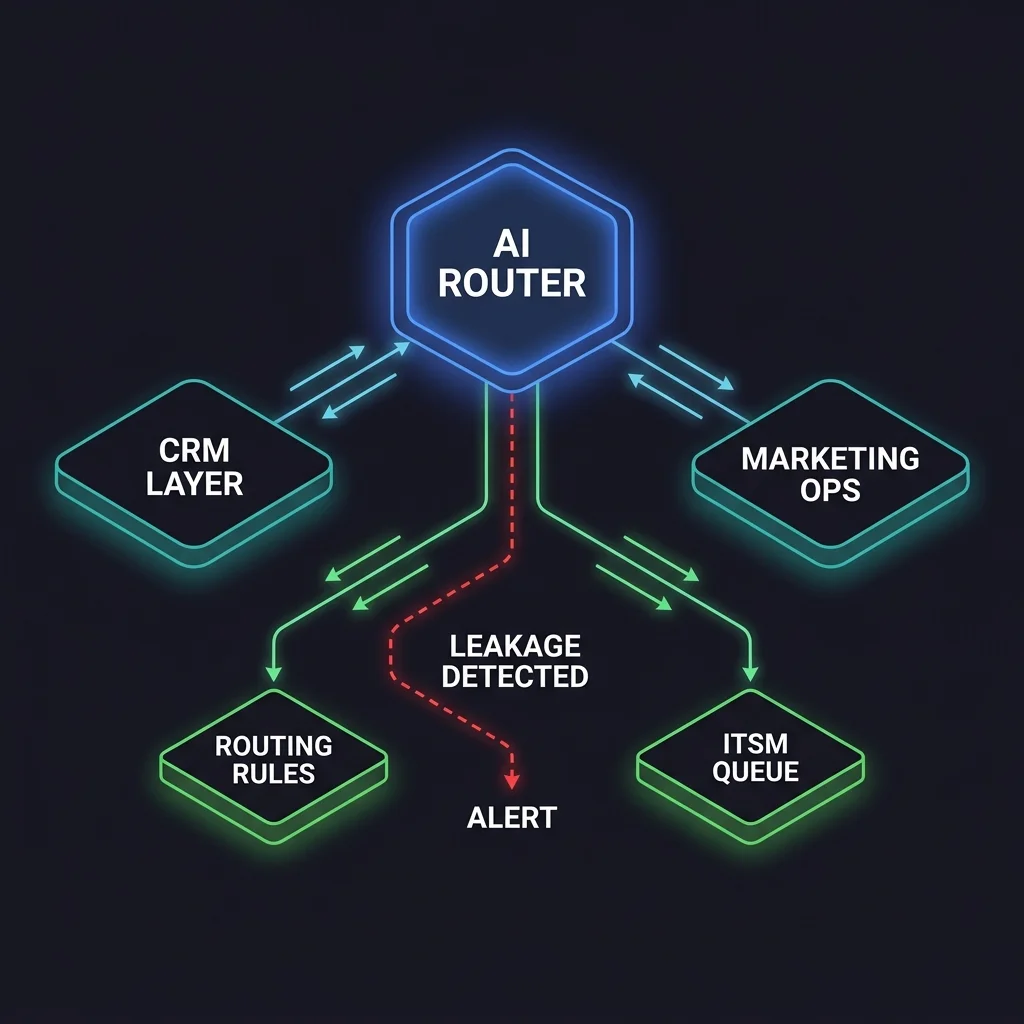
Building the Governed Routing Layer (Code Examples) {#governed-routing-layer}
Here's how to implement governed routing logic across the stack.
Python: Routing Rule Engine with SLA Enforcement
from dataclasses import dataclass, field
from datetime import datetime, timedelta
from typing import Optional
import uuid
@dataclass
class Lead:
id: str
company_name: str
lead_score: int
firmsize: int
intent_signal: str class="tok-cm"># class="tok-str">"high" | class="tok-str">"medium" | class="tok-str">"low"
source: str
created_at: datetime = field(default_factory=datetime.utcnow)
@dataclass
class RoutingDecision:
lead_id: str
rule_name: str
destination_queue: str
destination_owner: Optional[str]
sla_deadline: datetime
decision_id: str = field(default_factory=lambda: str(uuid.uuid4()))
decided_at: datetime = field(default_factory=datetime.utcnow)
rationale: str = class="tok-str">""
class RoutingRuleEngine:
class="tok-str">""class="tok-str">"Single authoritative routing rule registry."class="tok-str">""
ROUTING_RULES = [
{
class="tok-str">"name": class="tok-str">"ENT-High-Intent",
class="tok-str">"priority": 1,
class="tok-str">"conditions": lambda l: l.firmsize >= 500 and l.intent_signal == class="tok-str">"high",
class="tok-str">"destination": class="tok-str">"senior_ae_pool",
class="tok-str">"sla_hours": 4,
},
{
class="tok-str">"name": class="tok-str">"MM-Qualified",
class="tok-str">"priority": 2,
class="tok-str">"conditions": lambda l: 100 <= l.firmsize < 500 and l.lead_score >= 60,
class="tok-str">"destination": class="tok-str">"sdr_pool",
class="tok-str">"sla_hours": 24,
},
{
class="tok-str">"name": class="tok-str">"SMB-Inbound",
class="tok-str">"priority": 3,
class="tok-str">"conditions": lambda l: l.firmsize < 100,
class="tok-str">"destination": class="tok-str">"nurture_sequence",
class="tok-str">"sla_hours": 48,
},
{
class="tok-str">"name": class="tok-str">"FALLBACK-Unscored",
class="tok-str">"priority": 99,
class="tok-str">"conditions": lambda l: True, class="tok-cm"># catch-all
class="tok-str">"destination": class="tok-str">"review_queue",
class="tok-str">"sla_hours": 72,
},
]
class="tok-kw">def route(self, lead: Lead) -> RoutingDecision:
for rule in sorted(self.ROUTING_RULES, key=lambda r: r[class="tok-str">"priority"]):
if rule[class="tok-str">"conditions"](lead):
sla_deadline = lead.created_at + timedelta(hours=rule[class="tok-str">"sla_hours"])
return RoutingDecision(
lead_id=lead.id,
rule_name=rule[class="tok-str">"name"],
destination_queue=rule[class="tok-str">"destination"],
destination_owner=None, class="tok-cm"># resolved by queue manager
sla_deadline=sla_deadline,
rationale=fclass="tok-str">"Rule {rule[&class="tok-cm">#039;name']} matched (priority {rule['priority']})",
)
raise ValueError(fclass="tok-str">"No routing rule matched lead {lead.id}")
class="tok-kw">def check_sla_compliance(decision: RoutingDecision, contacted_at: Optional[datetime]) -> dict:
class="tok-str">""class="tok-str">"Audit SLA compliance for a routing decision."class="tok-str">""
if contacted_at is None:
breached = datetime.utcnow() > decision.sla_deadline
return {class="tok-str">"compliant": not breached, class="tok-str">"contacted": False, class="tok-str">"breached": breached}
compliant = contacted_at <= decision.sla_deadline
return {
class="tok-str">"compliant": compliant,
class="tok-str">"contacted": True,
class="tok-str">"minutes_to_contact": (contacted_at - decision.decided_at).seconds class="tok-cm">// 60,
class="tok-str">"sla_used_pct": (contacted_at - decision.decided_at) / (decision.sla_deadline - decision.decided_at) * 100,
}TypeScript: Real-Time SLA Monitor with Escalation
import { EventEmitter } from "events";

interface RoutingDecision {
  decisionId: string;
  leadId: string;
  ruleName: string;
  destinationQueue: string;
  slaDeadline: Date;
  decidedAt: Date;
}

interface SLABreach {
  decision: RoutingDecision;
  breachedAt: Date;
  hoursOverdue: number;
}

class SLAMonitor extends EventEmitter {
  private decisions: Map<string, RoutingDecision> = new Map();
  private checkIntervalMs: number;

  constructor(checkIntervalMs = 60_000) {
    super();
    this.checkIntervalMs = checkIntervalMs;
    this.startMonitoring();
  }

  register(decision: RoutingDecision): void {
    this.decisions.set(decision.decisionId, decision);
  }

  markContacted(decisionId: string): void {
    this.decisions.delete(decisionId);
  }

  private startMonitoring(): void {
    setInterval(() => {
      const now = new Date();
      for (const [id, decision] of this.decisions) {
        if (now > decision.slaDeadline) {
          const hoursOverdue =
            (now.getTime() - decision.slaDeadline.getTime()) / 3_600_000;
          const breach: SLABreach = {
            decision,
            breachedAt: now,
            hoursOverdue: Math.round(hoursOverdue * 10) / 10,
          };
          this.emit("sla_breach", breach);
        }
      }
    }, this.checkIntervalMs);
  }
}

// Usage
const monitor = new SLAMonitor(60_000);

monitor.on("sla_breach", (breach: SLABreach) => {
  console.error(
    `SLA BREACH: Lead ${breach.decision.leadId} | Rule: ${breach.decision.ruleName} | ${breach.hoursOverdue}h overdue`
  );
  // Fire escalation: PagerDuty / Slack alert / CRM task
  triggerEscalation(breach);
});

async function triggerEscalation(breach: SLABreach): Promise<void> {
  // Post to Slack ops channel
  await fetch(process.env.SLACK_WEBHOOK_URL!, {
    method: "POST",
    body: JSON.stringify({
      text: `⚠️ SLA BREACH: Lead ${breach.decision.leadId} in ${breach.decision.destinationQueue} is ${breach.hoursOverdue}h overdue. Rule: ${breach.decision.ruleName}`,
    }),
  });
}
Go: Routing Audit Log Writer
package revops

import (
    "encoding/json"
    "fmt"
    "os"
    "time"
)

type AuditEntry struct {
    DecisionID    string    `json:"decision_id"`
    LeadID        string    `json:"lead_id"`
    RuleName      string    `json:"rule_name"`
    Destination   string    `json:"destination"`
    SLADeadline   time.Time `json:"sla_deadline"`
    ContactedAt   *time.Time `json:"contacted_at,omitempty"`
    SLACompliant  *bool     `json:"sla_compliant,omitempty"`
    LoggedAt      time.Time `json:"logged_at"`
}

type AuditLogger struct {
    filePath string
    f        *os.File
}

func NewAuditLogger(path string) (*AuditLogger, error) {
    f, err := os.OpenFile(path, os.O_APPEND|os.O_CREATE|os.O_WRONLY, 0644)
    if err != nil {
        return nil, fmt.Errorf("open audit log: %w", err)
    }
    return &AuditLogger{filePath: path, f: f}, nil
}

func (a *AuditLogger) LogDecision(entry AuditEntry) error {
    entry.LoggedAt = time.Now().UTC()
    b, err := json.Marshal(entry)
    if err != nil {
        return err
    }
    _, err = fmt.Fprintf(a.f, "%s\n", b)
    return err
}

func (a *AuditLogger) LogContact(decisionID string, contactedAt time.Time, slaDeadline time.Time) error {
    compliant := contactedAt.Before(slaDeadline)
    return a.LogDecision(AuditEntry{
        DecisionID:   decisionID,
        ContactedAt:  &contactedAt,
        SLACompliant: &compliant,
    })
}
SLA Design for Lead-to-Cash Workflows {#sla-design}
SLA design for revenue operations is different from engineering SLAs. The stakes are revenue, not uptime — but the discipline is similar.
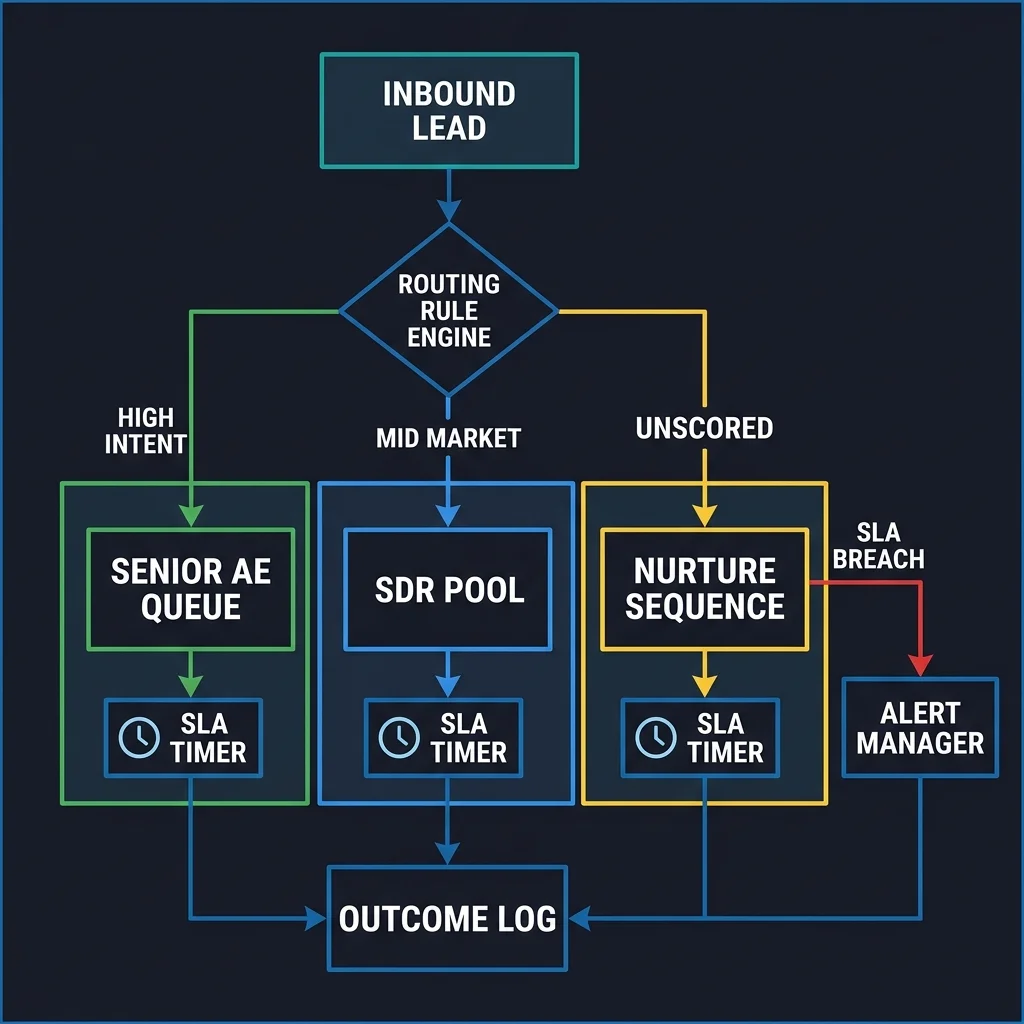
Five principles for RevOps SLA design:
1. Tier-based, not uniform — One SLA for all leads is meaningless. A cold inbound SMB lead and a high-intent enterprise lead from an active evaluation have completely different urgency profiles. Design SLAs per tier, per signal.
2. Cascading escalation, not binary alerts — Don't design an alert that fires when an SLA is breached. Design a cascade: 50% of SLA elapsed → rep reminder. 80% elapsed → manager alert. 100% elapsed → VP notification. Escalation should feel like a rising alarm, not a sudden klaxon.
3. Own the metric, not the activity — The SLA should measure time to first meaningful contact, not time to CRM touch. Reps who log a "sent email" touch on an automated outbound don't count. Define what a qualifying contact is before setting the timer.
4. Audit first, automate second — Build the audit log before the automation. If you can't pull a clean audit of SLA compliance from the past 30 days, you don't have enough information to design reliable SLA rules. Audit first, see what's actually happening, then design the automation.
5. Review weekly, not quarterly — Routing rules and SLA performance should be on the RevOps team's weekly agenda. Quarterly reviews mean you're 3 months behind on routing failures that are actively costing pipeline.
Deep Analysis: Routing Maturity Benchmark Table {#deep-analysis}
The benchmark tells a clear story: organizations need to reach Level 4 (governed orchestration) before AI routing delivers net-positive outcomes. At Level 2 or 3, adding AI routing typically reduces leakage rate by only 2–5 percentage points — while adding complexity and surface area for new failure modes.
At Level 4, the same AI routing reduces leakage by 12–18 percentage points because it's operating on clean signals and enforced rules. That's the difference between AI as a band-aid and AI as a genuine multiplier.
Real-World Implementation Patterns {#real-world-patterns}
Pattern A: Mid-Market SaaS (350 Leads/Month)
A SaaS company running Salesforce with basic assignment rules was losing approximately 22% of qualified inbound leads to routing delays and queue overflow. The RevOps team spent 6 weeks building a governed routing layer: consolidated 7 conflicting routing rules into 4 clean tiers, implemented SLA monitoring in Salesforce with escalation alerts, and built a weekly routing review cadence. Leakage dropped from 22% to 8% without any AI tooling. Then they activated an AI scoring model — which further dropped leakage to 4.2% because it was now operating on clean, enforced routing logic.
Pattern B: Enterprise B2B (1,200 Leads/Month)
A global enterprise software company was running routing rules across Marketo, Salesforce, and a manual SDR assignment spreadsheet — three conflicting systems. The routing audit revealed 34% of enterprise-tier leads were being routed to SMB SDRs due to territorial conflicts between the Marketo rules and the Salesforce rules. The fix took 10 weeks: single rule registry in Salesforce, Marketo rules deprecated, territory conflicts resolved in a GTM governance workshop, SLA cascade implemented. No AI was added — just governance. Leakage dropped from 34% to 11%. The AI routing feature they'd been planning to buy became unnecessary.
Pattern C: High-Growth Series B (80 Leads/Month, but high ACV)
A Series B enterprise startup with high-ACV deals ($180K average) couldn't afford any routing failures. The RevOps team built routing governance before implementing any CRM routing tools: defined ICP precisely, set 4-hour SLA for all leads (small volume made this feasible), built a routing audit log in a Google BigQuery table, and reviewed every routing decision weekly. Conversion rate from MQL to closed-won went from 11% to 19% over two quarters — primarily from eliminating routing failures, not from adding AI.
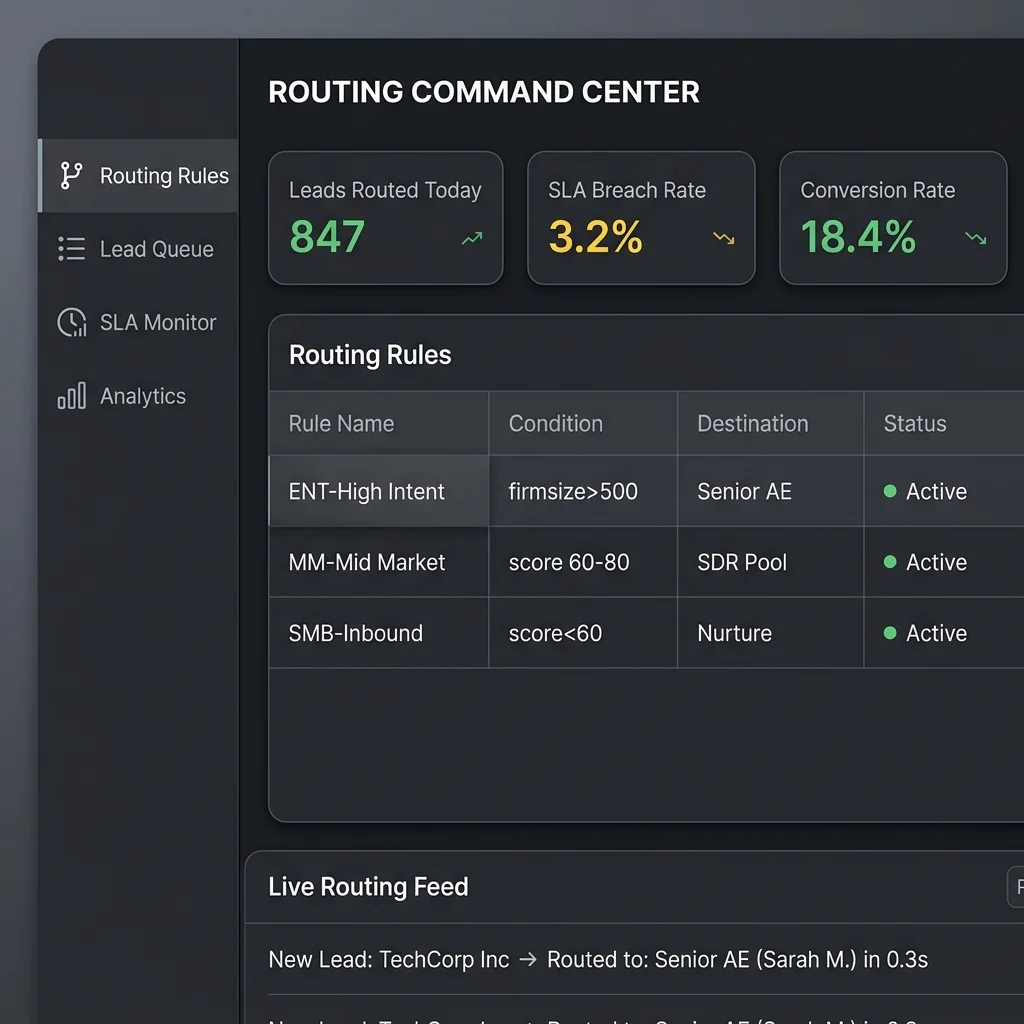
The GTM Orchestration Stack for 2026 {#gtm-stack}
The right GTM orchestration stack is vendor-neutral and composable. Here's the reference architecture:
Layer 1: Signal Aggregation
Firmographic data (company size, industry, tech stack), behavioral signals (website activity, content engagement, product usage if PLG), and intent data (third-party purchase signals) flow into a unified signal layer. The goal: a complete lead scoring input that doesn't depend on any single data source being clean.
Layer 2: Routing Rule Registry
A single source of truth for all routing rules — whether implemented in your CRM (Salesforce flows, HubSpot workflows), a dedicated routing platform (LeanData, Chili Piper, Lean), or custom logic. Every rule has: name, conditions, destination, SLA hours, owner, last validated date, performance metric.
Layer 3: SLA Enforcement
Real-time SLA monitoring. Every routing decision generates a timer. Timer expiry triggers the escalation cascade. The monitor integrates with your communication platform (Slack, Teams, email) and your CRM (creating a task on SLA breach). This layer is fully automatable — once built, it runs without human intervention.
Layer 4: Audit Log and Feedback
Every routing decision, SLA compliance result, and eventual outcome (converted, lost, ghosted) flows into a queryable audit log. Weekly review pulls: routing accuracy by rule, SLA compliance by tier, conversion rate by routing path. This data closes the feedback loop and drives rule refinement.
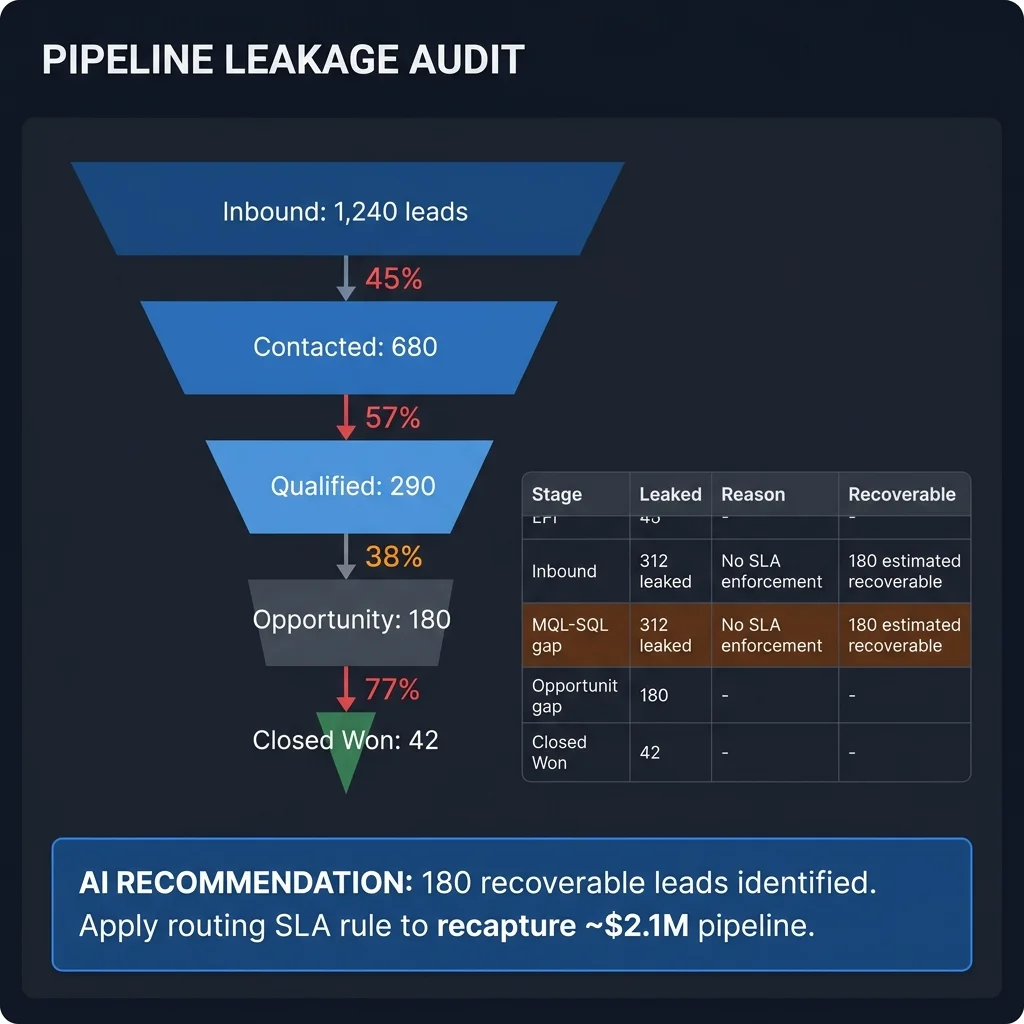
Layer 5: AI Optimization (Level 4+ only)
When Layers 1-4 are functioning with <10% leakage rate, add the AI optimization layer: predictive lead scoring (improving signal quality), intelligent queue balancing (distributing load across rep capacity), and anomaly detection (flagging unusual routing patterns for human review). At this point, AI is amplifying a working system — not substituting for a broken one.
On tool selection: The specific vendors you choose matter less than the governance layer you build on top of them. LeanData, Chili Piper, and Salesforce's native routing tools can all support Level 4 maturity. HubSpot's routing is more limited but workable for sub-500 leads/month volumes. The critical decision is not which tool — it's whether you build the single rule registry and SLA enforcement discipline. That's organizational design, not tool selection.
Pitfalls and Anti-Patterns {#pitfalls}
Anti-pattern 1: Routing Rules in Multiple Systems
Salesforce has one set of rules, Marketo has another, and the SDR manager has a third in a spreadsheet. These conflict silently. You find out when you do a routing audit 6 months later and discover leads have been double-routed or dropped entirely. Fix: one authoritative registry. All other routing tools defer to it.
Anti-pattern 2: "We'll Review Routing in Q4"
Routing rules decay. Territories change, teams resize, ICP definitions evolve. A routing rule that was accurate in January is often actively wrong by October. Make routing rule review a monthly standing agenda item, not a quarterly project.
Anti-pattern 3: Score Thresholds Without Validation
"Leads scoring above 60 go to AEs" — but when was that 60-point threshold last validated against actual conversion data? Lead scoring models drift. Threshold validation against closed-won data should happen quarterly minimum. I've seen organizations running on scoring thresholds set during their Series A that are materially wrong by their Series C.
Anti-pattern 4: Treating Routing as a Tool Problem
The most expensive mistake: buying a routing platform without fixing the governance model. A new routing tool with the same conflicting rules and no SLA enforcement produces the same leakage rate — with an additional 6-month implementation bill. The tool is not the solution. The governance model is the solution. The tool executes it.
Anti-pattern 5: No Feedback Loop
Routing decisions have no value if their outcomes don't inform future routing. If you can't pull a report showing conversion rate by routing rule, you have no visibility into which rules are working and which are leaking pipeline. The feedback loop is the mechanism that turns a routing system into a learning system.
2027-2030: The Future of Agentic RevOps {#future-roadmap}
2027: Intent-Native Routing
By 2027, third-party intent data will be real-time and granular enough to route leads based on current buying signals rather than historical scoring. An enterprise that starts actively evaluating a competitor's pricing page on a Tuesday afternoon will be routed to the right AE before end of business Tuesday — not when their score crosses a threshold on Friday's batch run.
2028: Autonomous Queue Management
Agent-driven queue management will balance routing decisions dynamically against rep capacity, deal velocity, and win-rate signals. If a senior AE has 8 active opportunities at late stage, the agent routes that day's enterprise inbounds to the second AE — not because a rule said so, but because the agent observed the capacity constraint and predicted outcome impact.
2029: Cross-Company Orchestration
Partnership-sourced leads, channel partner routing, and ecosystem-sourced opportunities will require multi-company orchestration protocols. Agentic routing will negotiate routing handoffs between partner systems — with governed SLAs that span organizational boundaries.
2030: Self-Governing Revenue Systems
The long-term horizon: revenue systems that continuously self-audit their own routing performance, propose rule changes, simulate the impact of those changes against historical data, and present refined rules to the RevOps team for approval. Humans set the governance constraints and review high-consequence decisions. The system optimizes within those constraints continuously.
90-Day Transformation Checkpoint {#transformation-checkpoint}
When to bring in advisory: The governance design work — consolidating routing rules, defining SLA tiers, building the audit architecture — is where most RevOps teams get stuck. It's organizational design work that touches GTM strategy, territory design, and sales management — not just tool configuration. If your team has been "planning to fix routing" for more than two quarters without progress, an external facilitated workshop to force the governance decisions is usually the fastest path. The Domain Agent CRM/ITSM Playbook covers the full implementation framework. Start with a scoping conversation if you want a practical assessment of where your routing governance gaps are.
Days 1–30: Audit and Baseline
- Pull 30-day routing audit: classify every lead by tier, check routing accuracy, measure SLA compliance
- Map all existing routing rules across all tools (CRM, MAP, sequencing)
- Identify conflicts and gaps; document current leakage rate
Days 31–60: Consolidate and Govern
- Consolidate all routing rules into single CRM-based registry
- Define SLA tiers and escalation cascades
- Deploy SLA monitoring automation
- Build routing performance dashboard; establish weekly review cadence
Days 61–90: Measure and Optimize
- Measure leakage rate improvement from governance changes (target: 30-50% reduction)
- Validate lead scoring thresholds against closed-won data
- Identify AI-ready routing decisions (high volume, well-defined rules, clean signal)
- Evaluate AI routing layer addition only if leakage is below 10%
Key Takeaways {#key-takeaways}
- 82% want AI routing, 26% have enforcement — the 56-point gap is an orchestration design gap, not a technology gap
- AI amplifies what's already there — broken routing logic becomes broken routing at machine speed when AI is applied without governance
- Four prerequisites must exist before AI routing delivers net-positive outcomes: clean scoring taxonomy, single rule registry, SLA definitions by tier, and a routing performance dashboard
- Level 4 maturity is the AI-ready threshold — at <10% leakage with SLA enforcement active, AI routing multiplies results instead of multiplying failures
- Routing rules are organizational decisions — territory conflicts, tier definitions, and SLA commitments require GTM leadership alignment, not just technical configuration
- Feedback loops close the system — conversion rate by routing rule is the signal that turns a routing engine into a learning system
- Weekly review beats quarterly reports — routing rules decay faster than quarterly review cycles can catch
FAQ {#faq}
What's the most common source of pipeline leakage in RevOps systems?
The MQL-to-SQL hand-off gap. This is the stage where marketing-qualified leads transfer to sales development responsibility, and it's where the most routing failures occur — largely because the SLA governing that hand-off (how quickly a lead must be contacted after becoming an MQL) is either undefined, unenforced, or measured differently by marketing and sales. Most organizations I've audited have a 20-40% drop at this stage that they attribute to lead quality when the real cause is routing delay and SLA non-compliance.
How do I know if my organization is ready to add AI lead routing?
Run the four prerequisite check: Do you have a validated lead scoring model (recalibrated against closed-won data in the past 6 months)? Is there a single authoritative routing rule registry with no conflicting rules in other tools? Are SLA definitions documented by tier and being monitored automatically? Does your routing performance dashboard get reviewed weekly? If you can answer yes to all four, you're ready for AI routing. If you're missing any, fix those first — AI routing on top of those gaps will not close them.
What tools support governed RevOps orchestration at Level 4?
For the routing rule layer: LeanData, Chili Piper, Salesforce Flows (native, works well up to moderate complexity), and HubSpot's workflow routing (lighter, suitable for lower volumes). For SLA monitoring: Salesforce process builder with escalation rules, or custom implementations using the Salesforce REST API triggering your alerting platform. For audit logging: any queryable data store — Salesforce reports for smaller teams, BigQuery or Snowflake for enterprise volume with complex analysis needs. For AI scoring layers (Level 4+): most modern CRM platforms now include native predictive scoring, and dedicated tools like 6sense, Bombora, and Clearbit are integration-compatible with the major CRMs.
How do you handle routing conflicts when CRM territories and AI scoring disagree?
This is a governance decision, not a technical one. The territory system represents organizational ownership commitments; the AI scoring system represents opportunity value signals. When they conflict — a Tier 1 AI-scored lead that falls outside a rep's territory — the governance model needs a pre-defined resolution rule. Most organizations resolve this with a "routing council" principle: territory ownership is the default, but AE managers have authority to re-route specific deal types with a logged rationale. Critically, that decision and rationale must be logged in the audit trail. Don't let the technology make this decision silently.
How long does it take to build a Level 4 governed routing system?
Typically 8-12 weeks for organizations already on a major CRM. The governance design work (consolidating rules, defining SLA tiers, aligning on territory principles) takes 2-4 weeks and requires GTM leadership involvement. The technical implementation (deploying the rule registry, SLA monitoring, audit logging) takes 3-5 weeks depending on your CRM's flexibility. The final 1-3 weeks is validation: running parallel against your old routing system and confirming the new system is routing correctly and SLA monitoring is firing accurately. At 12 weeks, you should have a clean baseline to evaluate AI routing against.
About the Author {#about-author}
Vatsal Shah is a business transformation architect with 15+ years leading technology-driven operating model change across financial services, manufacturing, and professional services. He specializes in revenue operations transformation, agentic workflow design, and the organizational governance frameworks that determine whether enterprise AI investments deliver commercial outcomes.
He founded Business Tech Navigator to give transformation leaders the practitioner framework — not the vendor pitch — for moving AI programs from planning to production.
For the full implementation framework on agentic CRM and ITSM transformation, explore the Domain Agent CRM/ITSM Playbook. For CRM-specific agentic workflow patterns, see Agentic Workflows in Enterprise CRM.
Conclusion {#conclusion}
The 82/26 gap isn't closing on its own. Every quarter an organization defers building routing governance is another quarter of AI features being added to a system that isn't ready for them — and another quarter of pipeline leakage that gets attributed to lead quality instead of operational design.
The fix is not a new platform. It's four weeks of hard governance work, followed by eight weeks of implementation, followed by a weekly review cadence that turns routing from a black box into a managed system.
When that's in place — when you're operating at Level 4 with a clean audit trail, enforced SLAs, and a feedback loop running — AI routing genuinely changes the economics. Override rates drop. Conversion rates lift. The SDR team stops complaining about lead quality because the routing system is now precise enough to prove where the problem actually is.
That's the difference between AI as a feature and AI as an operating model.
Ready to map where your routing governance gaps are? Start with a scoping conversation — it's a practical assessment, not a sales call.
82% of RevOps leaders want AI-governed lead routing. Only 26% have enforcement. AI on broken routing logic doesn't fix your pipeline - it automates your leakage at machine speed. The 4 prerequisites you need before AI routing delivers a net-positive outcome - and the 90-day path to Level 4 maturity →
{
  class="tok-str">"@context": class="tok-str">"https:class="tok-cm">//schema.org",
  class="tok-str">"@graph": [
    {
      class="tok-str">"@type": class="tok-str">"BlogPosting",
      class="tok-str">"headline": class="tok-str">"RevOps Orchestration: Why 82% Want AI Lead Routing But Only 26% Can Enforce It",
      class="tok-str">"description": class="tok-str">"82% of RevOps leaders want AI-governed lead routing. Only 26% have enforcement. Learn how to fix the GTM orchestration gap before AI automates your pipeline leakage.",
      class="tok-str">"author": {
        class="tok-str">"@type": class="tok-str">"Person",
        class="tok-str">"name": class="tok-str">"Vatsal Shah",
        class="tok-str">"url": class="tok-str">"https:class="tok-cm">//businesstechnavigator.com"
      },
      class="tok-str">"datePublished": class="tok-str">"2026-07-20T00:00:00+00:00",
      class="tok-str">"dateModified": class="tok-str">"2026-07-20T00:00:00+00:00",
      class="tok-str">"image": {
        class="tok-str">"@type": class="tok-str">"ImageObject",
        class="tok-str">"url": class="tok-str">"https:class="tok-cm">//businesstechnavigator.com/uploads/content/blog/revops-orchestration-ai-routing-enterprise-2026//uploads/content/blog/revops-orchestration-ai-routing-enterprise-2026/banner.webp",
        class="tok-str">"width": 1200,
        class="tok-str">"height": 630
      },
      class="tok-str">"url": class="tok-str">"https:class="tok-cm">//businesstechnavigator.com/blog/revops-orchestration-ai-routing-enterprise-2026",
      class="tok-str">"publisher": {
        class="tok-str">"@type": class="tok-str">"Organization",
        class="tok-str">"name": class="tok-str">"Business Tech Navigator",
        class="tok-str">"url": class="tok-str">"https:class="tok-cm">//businesstechnavigator.com"
      },
      class="tok-str">"keywords": class="tok-str">"RevOps AI orchestration lead routing, GTM orchestration platform, lead routing automation, revenue operations AI, pipeline leakage AI",
      class="tok-str">"articleSection": class="tok-str">"Revenue Operations & AI Transformation",
      class="tok-str">"wordCount": 3900
    },
    {
      class="tok-str">"@type": class="tok-str">"FAQPage",
      class="tok-str">"mainEntity": [
        {
          class="tok-str">"@type": class="tok-str">"Question",
          class="tok-str">"name": class="tok-str">"Why does AI lead routing fail in most companies?",
          class="tok-str">"acceptedAnswer": {
            class="tok-str">"@type": class="tok-str">"Answer",
            class="tok-str">"text": class="tok-str">"AI lead routing fails when organizations add it before establishing routing governance - a single rule registry, SLA enforcement by lead tier, and an audit trail. Without these four prerequisites, AI amplifies existing routing failures rather than fixing them, accelerating pipeline leakage at machine speed instead of reducing it."
          }
        },
        {
          class="tok-str">"@type": class="tok-str">"Question",
          class="tok-str">"name": class="tok-str">"What is the most common source of pipeline leakage in RevOps?",
          class="tok-str">"acceptedAnswer": {
            class="tok-str">"@type": class="tok-str">"Answer",
            class="tok-str">"text": class="tok-str">"The MQL-to-SQL hand-off gap. This is where marketing-qualified leads transfer to sales development responsibility, and routing failures are highest due to undefined or unenforced SLAs governing how quickly leads must be contacted. Most organizations see a 20-40% drop at this stage attributable to routing delay rather than lead quality."
          }
        },
        {
          class="tok-str">"@type": class="tok-str">"Question",
          class="tok-str">"name": class="tok-str">"How long does it take to build a Level 4 governed routing system?",
          class="tok-str">"acceptedAnswer": {
            class="tok-str">"@type": class="tok-str">"Answer",
            class="tok-str">"text": class="tok-str">"Typically 8-12 weeks for organizations already on a major CRM. Governance design takes 2-4 weeks and requires GTM leadership involvement. Technical implementation takes 3-5 weeks. Validation takes 1-3 weeks running parallel against the old routing system."
          }
        }
      ]
    },
    {
      class="tok-str">"@type": class="tok-str">"BreadcrumbList",
      class="tok-str">"itemListElement": [
        { class="tok-str">"@type": class="tok-str">"ListItem", class="tok-str">"position": 1, class="tok-str">"name": class="tok-str">"Home", class="tok-str">"item": class="tok-str">"https:class="tok-cm">//businesstechnavigator.com" },
        { class="tok-str">"@type": class="tok-str">"ListItem", class="tok-str">"position": 2, class="tok-str">"name": class="tok-str">"Blog", class="tok-str">"item": class="tok-str">"https:class="tok-cm">//businesstechnavigator.com/blog" },
        { class="tok-str">"@type": class="tok-str">"ListItem", class="tok-str">"position": 3, class="tok-str">"name": class="tok-str">"RevOps Orchestration", class="tok-str">"item": class="tok-str">"https:class="tok-cm">//businesstechnavigator.com/blog/revops-orchestration-ai-routing-enterprise-2026" }
      ]
    }
  ]
}