By Vatsal Shah | May 26, 2026 | 15 min read
Table of Contents
- Introduction: The Fragility of the Scripted Bot
- What is Hyperautomation in 2026?
- Why Hyperautomation Matters in 2026
- The 2026 Hyperautomation Maturity Stack
- Step-by-Step: The Enterprise Hyperautomation Roadmap
- Real-World Use Cases (with Polyglot Code Snippets)
- Comparative Intelligence: Traditional RPA vs. Intelligent Automation vs. Hyperautomation
- Procedural Logic: Lifecycle of a Hyperautomated Decision
- Critical Pitfalls & Modern Anti-Patterns
- Futuristic Horizon: 2027-2030 Transition Roadmap
- Key Takeaways
- Frequently Asked Questions (FAQ)
- About the Author
- Conclusion: The 90-Day Architecture Checkpoint
Introduction: The Fragility of the Scripted Bot
For the past decade, Robotic Process Automation (RPA) was sold as the silver bullet for digital transformation. Consulting firms promised that software bots would eliminate manual data entry, streamline operations, and bridge legacy software silos. In reality, most enterprises built an unstable house of cards. Legacy RPA is fundamentally fragile. These bots rely on hardcoded coordinates, rigid selectors, and static user interface (UI) elements. The moment a web form changes its layout, a desktop application receives an update, or a database field is renamed, the bot breaks.
I have spent years auditing enterprise architectures, and the numbers are consistent: over 60% of legacy RPA bots require manual developer intervention every quarter just to stay operational. Organizations are spending more money maintaining their automation fleets than they are saving from the automation itself. This is the "swivel-chair automation trap"—where humans are simply redirected from typing data to babysitting broken scripts.
In 2026, the baseline has shifted. Leading organizations are no longer scaling fragile scripts. They are deploying Hyperautomation—a cohesive, intelligent architecture that orchestrates process mining, API-first integrations, and autonomous AI agents. By combining cognitive reasoning with structured execution, hyperautomation turns fragile scripts into self-healing, end-to-end workflows. This guide maps out the technical architecture and strategic execution playbook required to transition your enterprise beyond RPA.
Hyperautomation is not simply "more RPA with a chat widget." It is a fundamental shift in decision rights. Traditional automation scripts have zero cognitive capabilities; hyperautomation embeds stateful AI agents directly into the execution loop, allowing the system to handle unexpected edge cases, format drift, and complex logic without breaking.
What is Hyperautomation in 2026?
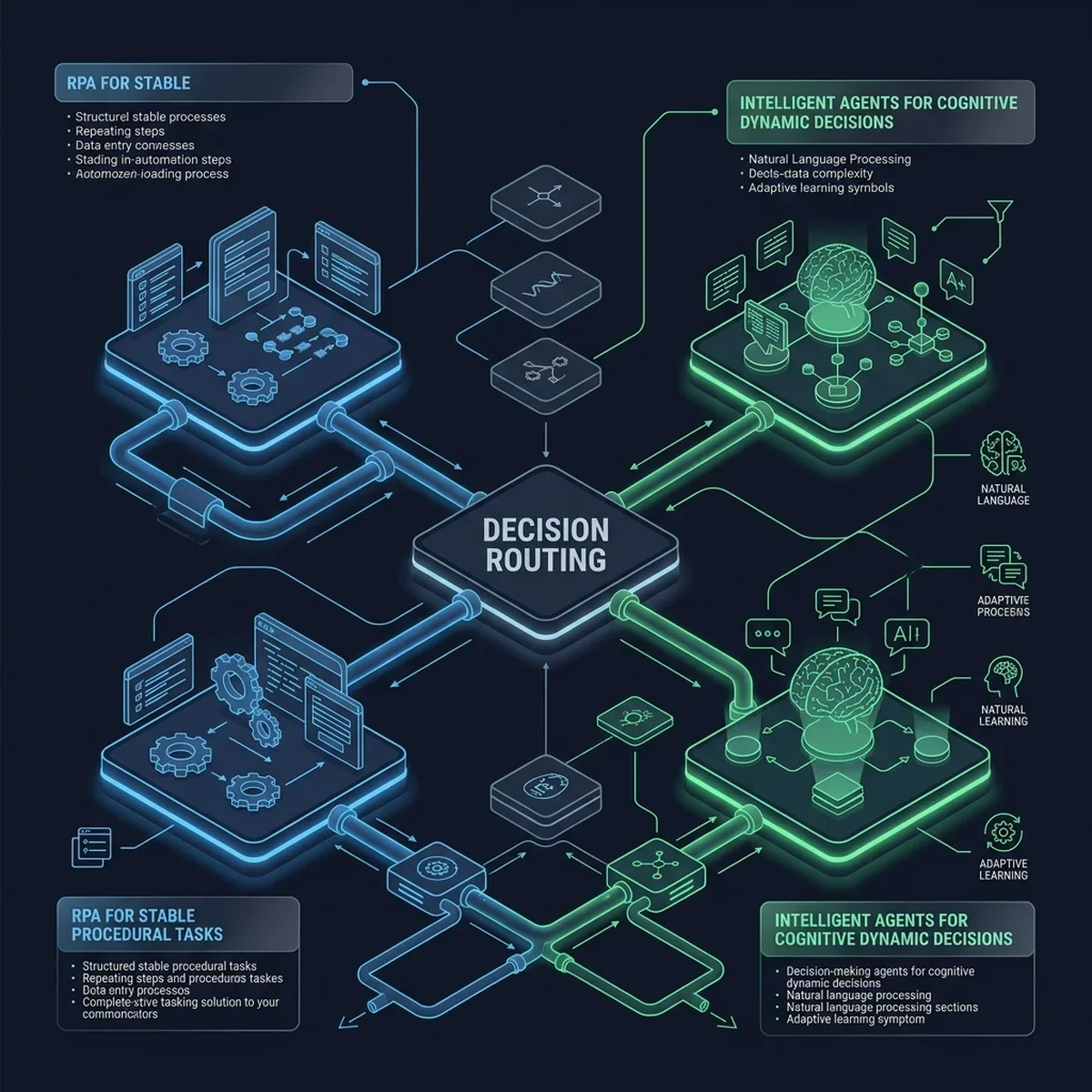
At its core, Hyperautomation is an enterprise-wide strategy that integrates multiple technology layers—robotic process automation (RPA), intelligent process automation (IPA), process mining, and agentic orchestration—to automate complex, end-to-end business workflows.
In 2026, hyperautomation is defined by three major paradigm shifts:
- From UI-Bound to API-First (Action Gap): Instead of writing scripts that mimic human mouse clicks on a screen, hyperautomation prioritizes API-first integrations. When legacy systems lack APIs, rather than relying on brittle DOM selectors, Large Action Models (LAMs) are deployed to dynamically navigate the user interface, self-correcting when layouts shift.
- From Static Rules to Cognitive Decisioning: Traditional RPA follows rigid
IF-THENstructures. Hyperautomation integrates reasoning models that read unstructured documents (contracts, emails, PDF invoices), classify intent, make context-based decisions, and trigger appropriate sub-processes. - Standardized Context (Model Context Protocol - MCP): Rather than writing custom data-mapping connectors for every database and tool, enterprises use standardized communication protocols like Model Context Protocol (MCP) to let autonomous agents securely read and write across the enterprise data layer.
Why Hyperautomation Matters in 2026
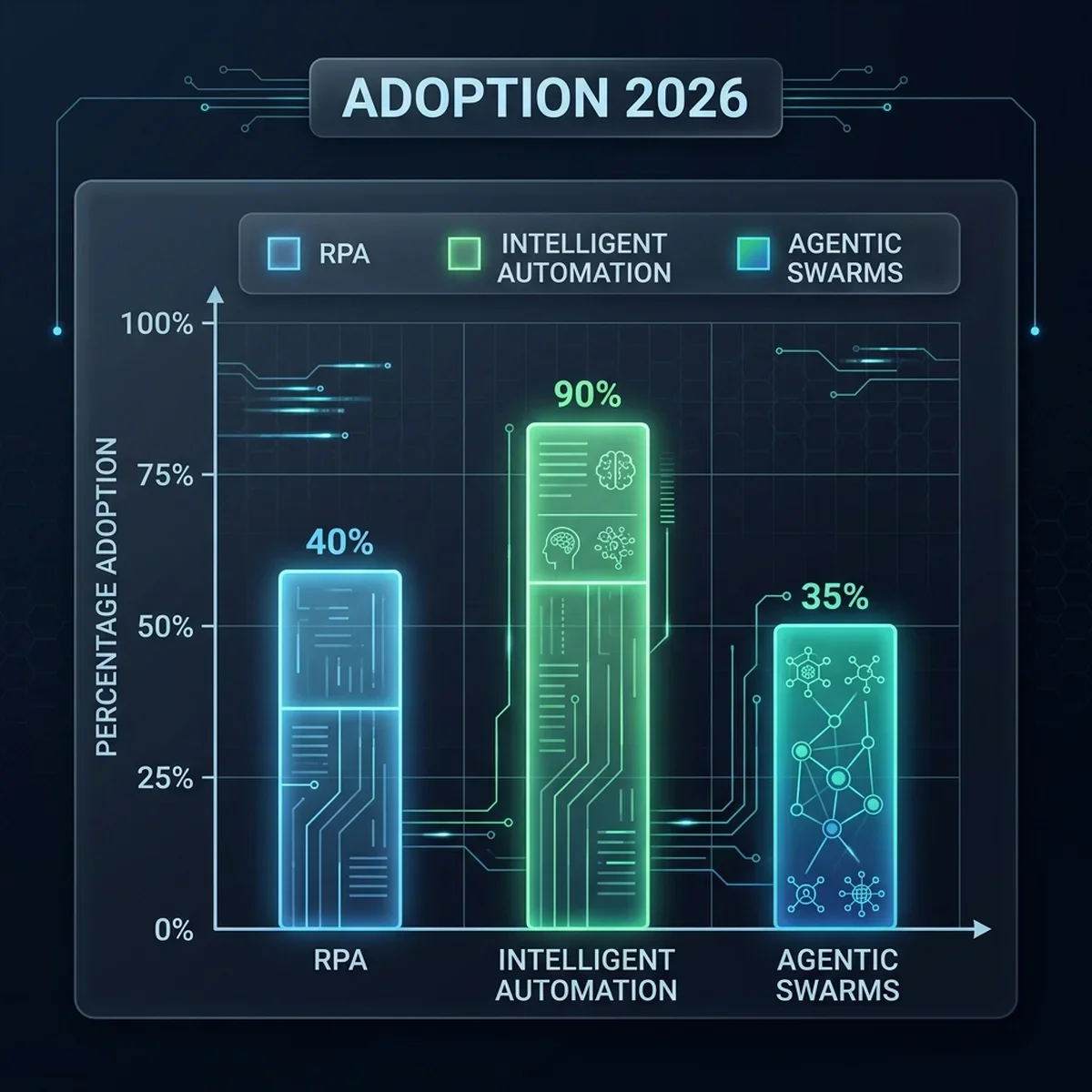
The business case for moving beyond RPA is no longer theoretical. Organizations that continue to rely on traditional scripting are seeing their operational agility decrease as their maintenance backlogs grow. According to industry benchmarks:
- Maintenance Cost Reduction: Enterprises transitioning from traditional RPA to self-healing hyperautomation pipelines see a 70% drop in bot maintenance tickets within the first 6 months.
- Process Velocity: End-to-end processing times for complex workflows (such as customer onboarding or invoice-to-pay) drop by 55% to 80% when cognitive agents replace manual exception handling.
- Resource Efficiency: By replacing manual triage loops with autonomous agents, enterprises recover thousands of engineering and operational hours, redirecting talent toward high-value architecture and strategic integration tasks.
A common anti-pattern is attempting to automate a broken process. In the hyperautomation paradigm, Process Mining is used to discover and optimize the actual path of data before a single line of automation code is deployed.
The 2026 Hyperautomation Maturity Stack
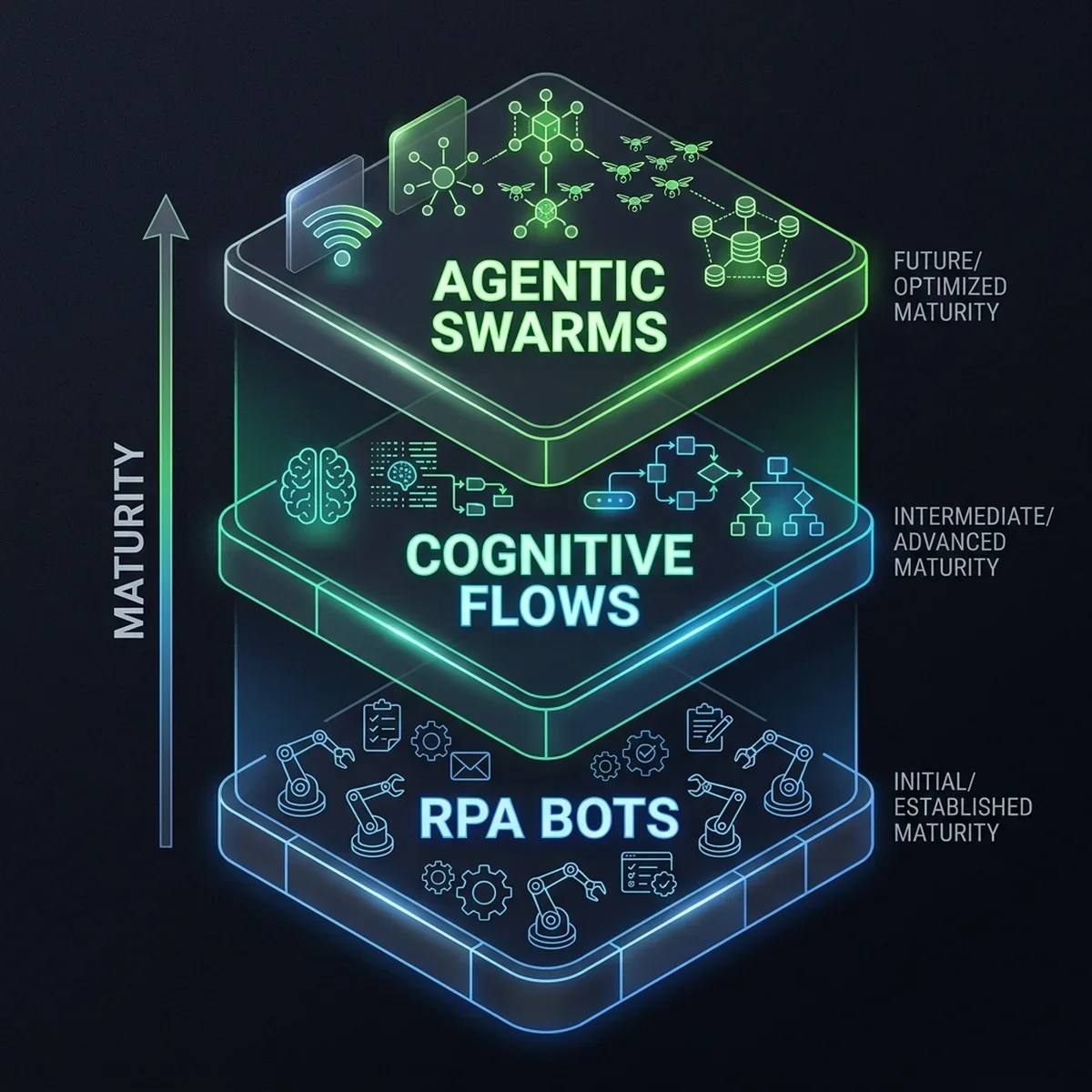
To successfully execute a hyperautomation strategy, you must first locate your organization's current position on the maturity stack.
Level 1: Robotic Process Automation (RPA) - The Scripted Task Layer
This is the baseline level of automation. Tasks are highly structured, repetitive, and rule-based.
- Typical Tools: UiPath, Blue Prism, Power Automate Desktop.
- Characteristics: Screen scraping, keyboard emulation, fixed inputs, zero intelligence.
- Failure Mode: Breaks instantly on UI changes, web app updates, or input format drift.
Level 2: Intelligent Process Automation (IPA) - The Cognitive Flow Layer
At this level, machine learning (ML) models and Natural Language Processing (NLP) are integrated into the workflow to handle semi-structured data.
- Typical Tools: Document understanding pipelines, optical character recognition (OCR) with LLM classifiers, process orchestrators.
- Characteristics: Automatic data extraction from PDF invoices, customer intent classification from emails, sentiment routing.
- Failure Mode: Struggling with complex, multi-system reasoning tasks that require cross-referencing legacy databases.
Level 3: Agentic Process Orchestration (APO) - The Autonomous Swarm Layer
The peak of modern automation. Stateful, autonomous AI agents communicate via standard protocols (like MCP), handle exceptions, self-heal workflow loops, and interact directly with legacy systems of record.
- Typical Tools: LangGraph, Autogen, custom Python agent kernels, MCP-linked databases, event-driven message brokers (Kafka, RabbitMQ).
- Characteristics: Multi-agent collaboration, self-healing execution loops, dynamic tool calling, real-time cost-and-confidence trade-offs.
- Maturity Signal: Zero hardcoded UI coordinates. Agents reason about the system state, formulate plans, execute APIs, and only pull in human operators when confidence thresholds fall below safety limits.
Step-by-Step: The Enterprise Hyperautomation Roadmap
Moving your enterprise beyond legacy RPA requires a structured, multi-phase roadmap. This transition cannot happen overnight; it must be executed systematically to preserve operational stability.
Step 1: Process Discovery and Task Mining
Before deploying agents, you must map the actual workflows. Do not rely on outdated standard operating procedures (SOPs). Use task mining tools to record employee actions, identify system bottlenecks, and locate the highest-ROI candidates for automation.
- Execution: Deploy background desktop agents to log click-stream data and aggregate process variations.
- Outcome: A clean process graph showing where processes deviate and where human exception handling occurs.
Step 2: Decoupling Task Execution from UI Locators
The most critical engineering step to escape the RPA maintenance trap. You must transition your bot fleet from clicking buttons on screens to calling system APIs.
- Execution: Wrap legacy terminal and web applications with lightweight REST API wrappers (such as FastAPI or Express) if native APIs do not exist.
- Outcome: The execution layer communicates via JSON payloads, isolating the automation from visual changes in the front-end layout.
Step 3: Layering Agentic Swarms on Legacy Core Systems
Introduce cognitive reasoning layers using stateful agent swarms. These agents are given access to the newly created APIs and tools.
- Execution: Build a central routing engine using stateful graph frameworks to coordinate agent communication.
- Outcome: Autonomous reasoning capability applied directly to business transactions, reducing the need for hardcoded business rules.
Step 4: Establishing the Human-in-the-Loop (HITL) Governance Framework
Automation must not run entirely unchecked. You must establish strict safety guardrails, confidence levels, and transaction limits.
- Execution: Create exception queues where agents route low-confidence tasks, formatting discrepancies, or high-value transactions directly to human specialists.
- Outcome: Complete risk mitigation. The enterprise gains the speed of autonomous processing while retaining manual verification for high-risk decisions.
Step 5: Continuous ROI Tracking and Autonomous Optimization
Build an analytical telemetry pipeline to track cost savings, manual hours recovered, and system errors in real time.
- Execution: Feed automation logs into a centralized dashboard to track execution stats and automatically adjust agent prompts or tools based on error rates.
- Outcome: Continuous feedback loop showing exact business impact and automatically prioritizing process optimizations.
Real-World Use Cases (with Polyglot Code Snippets)
To demonstrate how these concepts operate in production environments, let's explore two common enterprise hyperautomation use cases, complete with functional code samples.
Use Case 1: Autonomous Invoice Reconciliation in Composable ERP
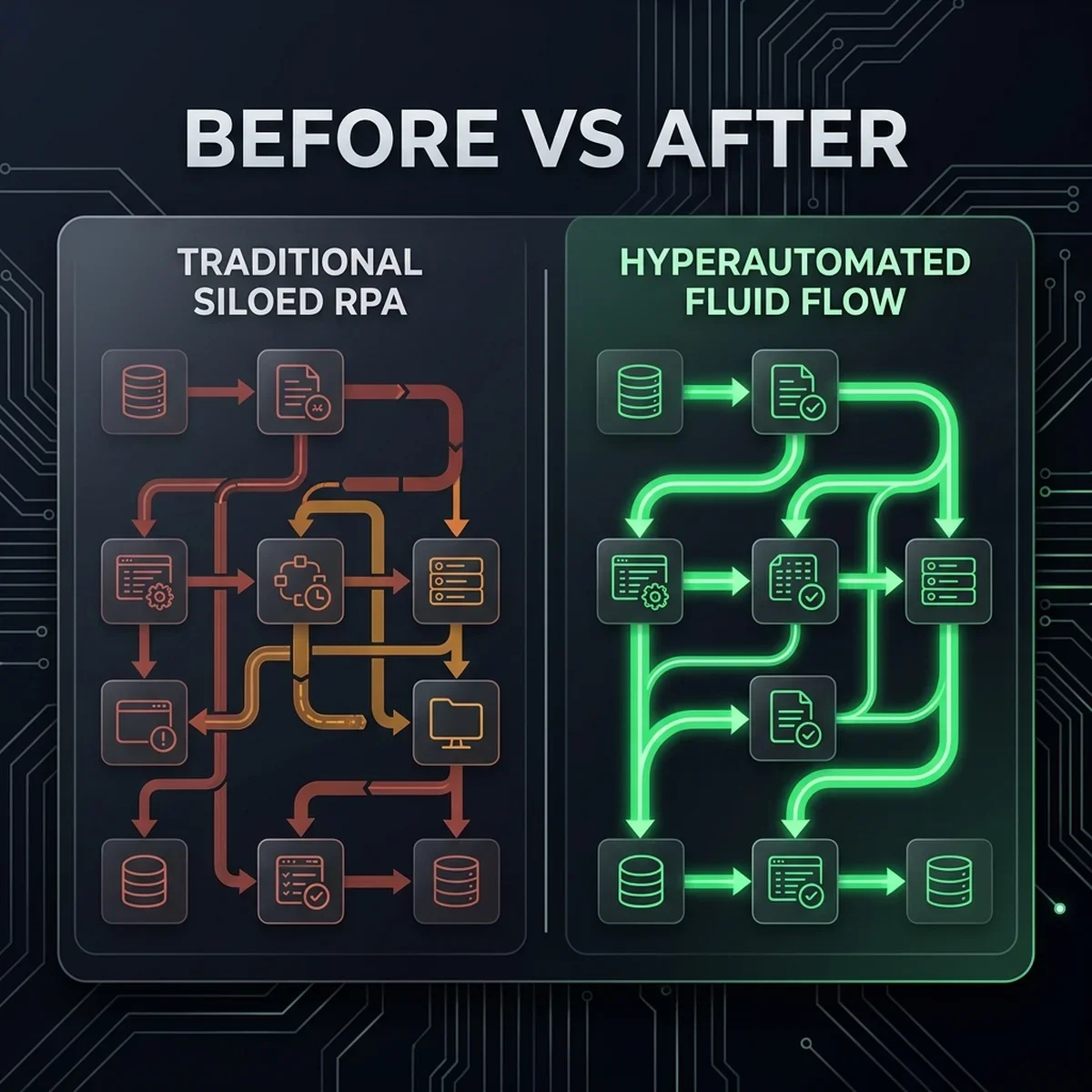
In this scenario, an incoming PDF invoice must be matched against a purchase order (PO) in a legacy database and reconciled. If the values differ slightly due to tax calculations or shipping fees, a traditional RPA bot fails. The hyperautomation pipeline uses a Python agent to read the unstructured document, reason about the discrepancies, check historical data, and decide whether to approve or escalate.
Here is a Python implementation of the reasoning and reconciliation agent:
class="tok-cm"># python
import json
import logging
from typing import Dict, Any

logging.basicConfig(level=logging.INFO)
logger = logging.getLogger(class="tok-str">"InvoiceReconciliation")

class ReconciliationAgent:
    class="tok-kw">def __init__(self, tolerance_pct: float = 2.0):
        self.tolerance_pct = tolerance_pct

    class="tok-kw">def fetch_purchase_order(self, po_id: str) -> Dict[str, Any]:
        class="tok-cm"># Simulated database retrieval from legacy system of record
        database_mock = {
            class="tok-str">"PO-9982": {class="tok-str">"line_total": 12500.00, class="tok-str">"vendor": class="tok-str">"Apex Logistics", class="tok-str">"status": class="tok-str">"APPROVED"},
            class="tok-str">"PO-4412": {class="tok-str">"line_total": 850.50, class="tok-str">"vendor": class="tok-str">"Global Supplies", class="tok-str">"status": class="tok-str">"APPROVED"}
        }
        return database_mock.get(po_id, {})

    class="tok-kw">def evaluate_discrepancy(self, invoice: Dict[str, Any]) -> Dict[str, Any]:
        po_id = invoice.get(class="tok-str">"po_id")
        inv_total = invoice.get(class="tok-str">"total_amount", 0.0)

        po_data = self.fetch_purchase_order(po_id)
        if not po_data:
            return {class="tok-str">"status": class="tok-str">"ESCALATED", class="tok-str">"reason": class="tok-str">"Purchase Order not found in database"}

        po_total = po_data[class="tok-str">"line_total"]
        diff = abs(inv_total - po_total)
        allowed_diff = po_total * (self.tolerance_pct / 100.0)

        logger.info(fclass="tok-str">"Reconciling {po_id}: Inv={inv_total}, PO={po_total}, Diff={diff}, Allowed={allowed_diff}")

        if diff <= allowed_diff:
            return {
                class="tok-str">"status": class="tok-str">"AUTO_APPROVED",
                class="tok-str">"variance": diff,
                class="tok-str">"action": class="tok-str">"Write reconciliation journal to ledger"
            }
        else:
            class="tok-cm"># Cognitive decision step: is the diff accounted for by tax/shipping?
            if invoice.get(class="tok-str">"shipping_fee", 0.0) + invoice.get(class="tok-str">"tax_amount", 0.0) == diff:
                return {
                    class="tok-str">"status": class="tok-str">"AUTO_APPROVED",
                    class="tok-str">"variance": diff,
                    class="tok-str">"action": class="tok-str">"Approved after verifying shipping/tax offsets"
                }
            return {
                class="tok-str">"status": class="tok-str">"ESCALATED",
                class="tok-str">"variance": diff,
                class="tok-str">"reason": class="tok-str">"Discrepancy exceeds allowed tolerance limits"
            }

class="tok-cm"># Execution
if __name__ == class="tok-str">"__main__":
    agent = ReconciliationAgent(tolerance_pct=2.0)

    class="tok-cm"># Example 1: Discrepancy within tolerance
    invoice_1 = {class="tok-str">"po_id": class="tok-str">"PO-9982", class="tok-str">"total_amount": 12620.00, class="tok-str">"shipping_fee": 120.00, class="tok-str">"tax_amount": 0.0}
    res_1 = agent.evaluate_discrepancy(invoice_1)
    print(fclass="tok-str">"Result 1: {json.dumps(res_1, indent=2)}")

    class="tok-cm"># Example 2: Out of tolerance
    invoice_2 = {class="tok-str">"po_id": class="tok-str">"PO-4412", class="tok-str">"total_amount": 920.00, class="tok-str">"shipping_fee": 0.0, class="tok-str">"tax_amount": 0.0}
    res_2 = agent.evaluate_discrepancy(invoice_2)
    print(fclass="tok-str">"Result 2: {json.dumps(res_2, indent=2)}")
Use Case 2: Event-Driven Customer Onboarding Mesh
When a new enterprise customer signs a contract, multiple background systems must sync: CRM, billing engines, IAM platforms, and project hubs. Instead of sequential, synchronous scripts that block on system lag, this TypeScript service processes events asynchronously, coordinating tasks and logging output in a unified dashboard.
Here is a TypeScript implementation of the event listener and routing service:
// typescript
import { EventEmitter } from 'events';
interface OnboardingEvent {
customerId: string;
companyName: string;
tier: 'ENTERPRISE' | 'MID-MARKET';
timestamp: number;
}
class OnboardingMesh extends EventEmitter {
constructor() {
super();
this.registerHandlers();
}
private registerHandlers() {
this.on('new-customer', async (event: OnboardingEvent) => {
console.log(`[Mesh] Ingesting customer: ${event.companyName} (${event.customerId})`);
// Execute parallel automation pathways
await Promise.allSettled([
this.provisionBilling(event),
this.provisionAccess(event),
this.provisionWorkspace(event)
]);
console.log(`[Mesh] Customer ${event.customerId} onboarding pipelines initiated.`);
});
}
private async provisionBilling(event: OnboardingEvent): Promise<void> {
console.log(`[Billing] Creating ledger account for ${event.companyName}`);
// Simulate API call to Stripe/ERP Billing Module
return new Promise(resolve => setTimeout(resolve, 800));
}
private async provisionAccess(event: OnboardingEvent): Promise<void> {
console.log(`[IAM] Provisioning admin credentials for ID ${event.customerId}`);
// Simulate API call to directory service
return new Promise(resolve => setTimeout(resolve, 1200));
}
private async provisionWorkspace(event: OnboardingEvent): Promise<void> {
console.log(`[Workspace] Spinning up secure customer tenant space...`);
// Simulate infra provisioning API call
return new Promise(resolve => setTimeout(resolve, 1500));
}
public triggerOnboarding(customerId: string, companyName: string, tier: 'ENTERPRISE' | 'MID-MARKET') {
const payload: OnboardingEvent = {
customerId,
companyName,
tier,
timestamp: Date.now()
};
this.emit('new-customer', payload);
}
}
// Running the Mesh service
const mesh = new OnboardingMesh();
mesh.triggerOnboarding("CUST-2026-99", "TechCorp Global", "ENTERPRISE");Traditional RPA vs. Intelligent Process Automation vs. Hyperautomation
The following matrix provides a clear operational comparison between the three automation eras:
| Dimension | Traditional RPA (Level 1) | Intelligent Automation (Level 2) | Hyperautomation (Level 3) |
|---|---|---|---|
| Core Objective | Task-level scripting and data entry. | Cognitive data extraction and routing. | End-to-end process orchestration and self-healing. |
| System Interface | UI coordinates and brittle DOM selectors. | Hybrid UI scraping and native REST APIs. | API-first, MCP gateways, and dynamic UI navigation. |
| Decision Logic | Hardcoded IF-THEN rules. | Statistical ML classifiers and routing rules. | Stateful agent reasoning and cyclic workflows. |
| Exception Handling | Manual developer debug, script fails. | Basic fallback queues for manual triage. | Self-healing recovery loops and dynamic agent retry. |
| Maintenance Burden | High (requires frequent updates). | Medium (occasional model drifts). | Low (self-healing architecture). |
Procedural Logic: Lifecycle of a Hyperautomated Decision
When an automated process transitions from linear scripting to cognitive decision-making, the workflow execution follows a structured, cyclic loop.
[Incoming Document / File / Event]
               │
               ▼
   [Process Ingestion Layer] (Extract Metadata)
               │
               ▼
     [Cognitive Classifier] (Understand Document Intent)
               │
      ┌────────┴────────┐
      ▼                 ▼
[High Confidence]  [Low Confidence]
      │                 │
      │                 ▼
      │           [Human Exception Queue] (Manual Triage)
      │                 │
      │                 └─────────┐
      ▼                           ▼
[Tool Calling Execution] ──► [Verify Result against System of Record]
                                  │
                                  ▼
                     [Update Ledger & Close Case]
This state lifecycle ensures that the system handles anomalies safely. If an incoming invoice is missing its vendor number, rather than aborting, the agent calls a database tool to look up the tax registration ID. If that lookup fails, only then does it invoke the Human-in-the-Loop escalation pipeline, preserving the overall process flow.
Critical Pitfalls & Modern Anti-Patterns
Through years of advising IT leaders and engineering teams, I have seen standard automation implementations fall into several predictable traps:
- The UI-First Trap: Choosing to build automation via UI actions simply because it requires no API integration. This is a short-sighted strategy that guarantees long-term maintenance overhead. Always prioritize API-first integration.
- The "RPA Shelfware" Graveyard: Purchasing expensive RPA vendor enterprise licenses before designing a clear, long-term architecture. Organizations end up paying licensing fees for idle runtimes.
- Ungoverned Agent Sprawl: Deploying hundreds of independent AI agents without a central control plane. Without registry governance (such as Agent 365 or similar patterns), the organization risks unauthorized access and data security breaches.
Do not deploy autonomous agents directly onto production systems without rate-limiting and transaction-value safety caps. An agent with uncontrolled tool-calling access can execute recursive operations, generating infinite loop transactions that overload downstream legacy databases.
Futuristic Horizon: 2027-2030 Transition Roadmap
The next wave of hyperautomation goes beyond predefined workflows. As generative technology matures:
- Generative Process Synthesis (2027–2028): Systems will autonomously construct their own integration workflows. When a new system is added to the enterprise stack, process mining agents will write, test, and deploy the integration code dynamically without manual developer intervention.
- Autonomous Self-Healing Fleets (2029–2030): Distributed agent fleets will monitor their own health metrics. When a database latency spike or API update is detected, the fleet will dynamically adjust query speeds, switch endpoints, or patch data payloads on the fly, achieving 99.9% autonomous availability.
Key Takeaways
- Traditional RPA is Fragile: The high maintenance cost of UI-bound scripts is draining enterprise IT budgets.
- API-First is the Standard: Modern hyperautomation relies on API-first execution layers rather than mimicking screen clicks.
- Cognitive Integration is Key: Stateful AI agents allow processes to handle variations and format changes without manual developer intervention.
- Governance is Essential: Structured governance frameworks ensure risk mitigation, compliance tracking, and transaction guardrails.
- Start with Process Mining: Optimize the workflow based on real user actions before writing a single line of automation code.
Frequently Asked Questions (FAQ)
Is hyperautomation a complete replacement for our existing RPA software?
No. Hyperautomation is an orchestration layer that sits on top of your existing tools. You do not need to rip and replace your existing RPA bots; instead, you wrap them with API integrations and orchestrate them alongside cognitive agents to automate end-to-end workflows.
How do we prevent AI agents from executing unauthorized transactions?
By implementing a strict, role-based tool-calling registry. Agents are never given direct, unchecked database access. They interact via middleware layers that enforce rate limits, validation schemas, and transaction-value approval gates.
What is the typical timeline for transitioning from RPA to Hyperautomation?
A standard enterprise transition follows a 9-month phased approach: Process Mining and API wrapping in Phase 1 (Months 1–3), cognitive agent pilots in Phase 2 (Months 4–6), and full agentic swarm deployment with governance controls in Phase 3 (Months 7–9).
Does hyperautomation require custom code or can we use low-code tools?
It requires a hybrid approach. While process discovery and simple task flows can utilize low-code platforms, scaling cognitive agent swarms and API wrappers requires standard software engineering practices (using languages like Python or TypeScript) to maintain code quality.
How do we measure the true ROI of a hyperautomation program?
True ROI is measured across three vectors: Direct operational savings (lower maintenance tickets and runtime fees), velocity improvements (faster process cycle times), and recovered manual hours (employee time redirected to strategic tasks).
About the Author
Vatsal Shah is the founder and principal architect of Business Tech Navigator. With over 15 years of experience modernizing legacy system architectures for mid-market and enterprise organizations, Vatsal specializes in scaling autonomous agent stacks, API-first integrations, and data pipeline governance models that drive real operational transformation.
Conclusion: The 90-Day Architecture Checkpoint
Transitioning beyond the limitations of legacy RPA is not a luxury—it is an operational necessity. Organizations that fail to move toward API-first, agent-driven orchestration will find themselves sinking under the weight of maintenance debt and broken scripts.
If your enterprise is ready to escape the RPA maintenance trap, I recommend initiating a 90-Day Hyperautomation Checkpoint:
- Days 1–30: Run process mining audits across your top 3 highest-maintenance workflows to identify the true bottlenecks.
- Days 31–60: Wrap those target systems with lightweight API interfaces, bypassing the fragile front-end UI.
- Days 61–90: Deploy a cognitive reasoning agent in a sandboxed, Human-in-the-Loop staging environment to validate exception routing and self-healing pipelines.
For help mapping your system architecture, designing an integration roadmap, or running a structured automation maturity audit, reach out to our team at Business Tech Navigator. Let's build a resilient, autonomous digital workforce.
Contact our principal architect today to book a structured Hyperautomation Architecture Review and align your engineering stack with modern, self-healing integration standards.