The Digital-Ready Supply Chain: How AI and Real-Time Data Are Replacing Guesswork
By Vatsal Shah | 2026-06-04 | 15 min read
Table of Contents
- #strategic-overview
- #the-death-of-batch-mode-supply-chains
- #the-pillars-of-an-ai-driven-supply-chain
- #technical-architecture-of-an-intelligent-supply-chain
- #procedural-logic-autonomous-inventory-replenishment
- #deep-analysis-comparing-reactive-predictive-and-autonomous-models
- #step-by-step-implementation-roadmap
- #real-world-use-cases-and-quantifiable-impact
- #pitfalls-and-modern-supply-chain-anti-patterns
- #futuristic-horizon-2027-2030-roadmap
- #key-takeaways
- #operations-dashboards-real-time-monitoring
- #frequently-asked-questions
- #about-the-author
- #conclusion
Strategic Overview
Strategic Overview
- The Challenge: Legacy supply chains run on batch-mode ERP data with a 48–72 hour lag time, causing stockouts, excess inventory write-offs, and an inability to adapt to sudden logistics disruptions.
- The Solution: Integrating real-time IoT feeds and market demand signals with an event-driven AI platform that automates replenishment, optimizes routes, and predicts shipping bottlenecks.
- The Outcome: Shrunk supplier lead times, reduced stockouts, avoided costly freight escalations, and established a resilient, autonomous procurement pipeline.
The Death of Batch-Mode Supply Chains
For decades, global supply chain planning operated on a historical, batch-mode model. Companies gathered sales receipts, calculated inventory averages at the end of the week, and ran material requirements planning (MRP) scripts over the weekend. The resulting procurement orders were pushed to suppliers based on the assumption that the past would predict the future.
However, in today's volatile market, historical assumptions fail. Disruptions such as shipping channel bottlenecks, sudden regional weather changes, and rapid changes in consumer behavior render batch-mode data obsolete before it is even compiled. I've seen many enterprise logistics programs struggle because their systems operate with a 48-to-72-hour lag, leaving planners unable to adapt to real-time disruptions.
The alternative is a transition to an AI supply chain transformation model. By connecting live IoT sensor feeds, real-time freight updates, and dynamic demand signals to a centralized AI platform, organizations replace historical guesswork with predictive execution. This guide outlines the system architecture, integration flows, and implementation roadmaps required to transition to a digital-ready, resilient supply chain.
The Pillars of an AI-Driven Supply Chain
Transitioning from reactive logistics to predictive operations requires four fundamental architectural pillars:
                  [ Pillar 1: Real-Time Visibility ]
                                  │
               [ Pillar 2: Predictive Demand Engine ]
                                  │
               [ Pillar 3: Multi-Echelon Optimization ]
                                  │
             [ Pillar 4: Autonomous Exception Management ]
Pillar 1: Real-Time Visibility Platform
A resilient supply chain requires live telemetry that goes beyond basic GPS coordinates. Modern platforms ingest granular IoT payload schemas that report latitude, longitude, transit velocity, ambient temperature, humidity, physical shocks, and geo-fencing check-in events. This streaming telemetry is processed through edge computing gateways and routed to an event broker. In cold-chain logistics, such as biopharmaceutical shipping or fresh produce distribution, real-time visibility prevents inventory loss by detecting temperature deviations early, allowing system agents to automatically warn warehouse teams or redirect cargo to closer hubs before spoilage occurs.
Pillar 2: Predictive Demand Forecasting
Instead of relying solely on internal historical ledger orders, predictive demand forecasting engines ingest external market signals to capture forward-looking indicators. The AI models—such as Temporal Fusion Transformers (TFT) and gradient-boosted decision trees—process meteorological patterns, local macro-economic indicators, search trends, trade logs, and distributor inventory rates. By analyzing these multi-dimensional datasets, the engine projects demand fluctuations at a localized SKU level. This reduces the Mean Absolute Percentage Error (MAPE) by preventing the systemic over-ordering that occurs when planning teams only look at backward-looking historical sales averages.
Pillar 3: Multi-Echelon Inventory Optimization (MEIO)
AI models evaluate stock requirements across the entire distribution network to combat the bullwhip effect. Traditional logistics systems optimize inventory levels at single nodes, creating artificial shortages or excess buffers as orders move up the supply chain. Under a MEIO framework, the AI platform continuously monitors lead-time uncertainty, transport capacity, and consumption speed across all regional distribution centers, local forward hubs, and end-customer nodes. The system mathematically reallocates inventory buffers dynamically across the network, ensuring high service levels without inflating the overall safety stock carrying costs.
Pillar 4: Autonomous Exception Management
When transit delays occur due to weather anomalies or port bottlenecks, autonomous exception management systems handle the disruption without causing manual planning backlogs. The platform deploys intelligent agents that execute Multi-Criteria Decision-Making (MCDM) algorithms. These agents automatically query shipping APIs, calculate alternative air-to-ground routing timelines, compare spot market shipping rates, and identify available logistics capacity. The agent then generates an optimized mitigation plan, complete with cost estimates and arrival impacts, presenting it as a staged transaction for final human validation.
Technical Architecture of an Intelligent Supply Chain
To orchestrate these components, enterprises deploy an event-driven integration layer that connects legacy databases (ERPs, Warehouse Management Systems) to downstream predictive engines.
The platform uses a message broker (such as Apache Kafka or RabbitMQ) to capture transaction and sensor logs in real time, routing them through validation, prediction, and execution steps.
Procedural Logic: Autonomous Inventory Replenishment
The replenishment pipeline operates as a continuous loop, analyzing data from sensor extraction to purchase order execution:
[IoT Sensor Data Ingested] ──> (Forecast Generation) ──> [Stock Level Check] ──> (Replenishment Approval) ──> [Purchase Order Run]- Telemetry Ingest: IoT sensors send location and status updates to the Kafka broker.
- Forecast Evaluation: The forecasting engine reads ingestion logs and projects inventory requirements for the next 14 days.
- Threshold Check: If projected inventory falls below the safety stock threshold, the system flags the SKU for replenishment.
- Agent Matching: The procurement agent queries supplier registries to find the best lead times, prices, and reliability scores.
- PO Generation: The system stages a purchase order proposal, routing it to the procurement manager's queue for verification.
Below is an example of an automated replenishment evaluation script in Python, designed to calculate safety stock thresholds and generate purchase order proposals:
import numpy as np
import pandas as pd

class="tok-kw">def evaluate_replenishment(sku_id, current_stock, daily_sales_history, lead_time_days, service_level_factor=1.65):
    class="tok-str">""class="tok-str">"
    Calculates safety stock levels and determines if a replenishment purchase order is required.
    "class="tok-str">""
    sales_mean = np.mean(daily_sales_history)
    sales_std = np.std(daily_sales_history)

    class="tok-cm"># Calculate demand during lead time
    demand_during_lead_time = sales_mean * lead_time_days

    class="tok-cm"># Calculate safety stock using standard service level formula
    safety_stock = service_level_factor * sales_std * np.sqrt(lead_time_days)
    reorder_point = demand_during_lead_time + safety_stock

    class="tok-cm"># Check if reorder is required
    reorder_required = current_stock <= reorder_point
    suggested_order_qty = int(sales_mean * 30) if reorder_required else 0  class="tok-cm"># 30 days of average supply

    status = class="tok-str">"REORDER" if reorder_required else class="tok-str">"BALANCED"

    return {
        class="tok-str">"sku_id": sku_id,
        class="tok-str">"current_stock": current_stock,
        class="tok-str">"safety_stock": int(safety_stock),
        class="tok-str">"reorder_point": int(reorder_point),
        class="tok-str">"status": status,
        class="tok-str">"suggested_order_qty": suggested_order_qty
    }

class="tok-cm"># Mock test run
sales_data = [120, 140, 110, 130, 150, 160, 115]  class="tok-cm"># Daily sales units
results = evaluate_replenishment(class="tok-str">"SKU-4821", current_stock=400, daily_sales_history=sales_data, lead_time_days=3)
print(fclass="tok-str">"Replenishment Audit: {results}")
Deep Analysis: Comparing Reactive, Predictive, and Autonomous Models
To understand the evolution of logistics planning, the table below outlines the differences between reactive, predictive, and fully autonomous supply chain models:
Step-by-Step Implementation Roadmap
Transitioning to a predictive supply chain requires a structured, phased execution plan over a 90-day window. Success depends on the clear delegation of responsibilities across four critical roles: the Supply Chain Architect, the Inventory Planner, the Logistics Lead, and the Systems Integrator.
  [ Phase 1: Days 1–30 ]        [ Phase 2: Days 31–60 ]        [ Phase 3: Days 61–90 ]
  Telemetry & Streaming  ─────>   Models & Rules Setup  ─────>   Agent Loops & Launch
Phase 1: Data Integration & Sensor Connectivity (Days 1–30)
The objective of the first phase is to eliminate data latency by establishing continuous telemetry and setting up the event-driven data streaming infrastructure.
- Supply Chain Architect: Designs the telemetry payload schemas, specifies the partition strategy for Kafka message topics, and defines the network topology to support secure ingestion from external carrier endpoints.
- Systems Integrator: Installs the Kafka broker instances, configures connector adapters to capture transaction logs from legacy WMS and ERP databases, and builds data transformation services to sanitize raw event payloads.
- Logistics Lead: Manages the procurement and physical distribution of GPS and temperature-sensitive IoT tracking tags, coordinates with ocean and road carriers to establish tag recovery flows, and configures geofencing boundaries around regional distribution centers.
- Inventory Planner: Reviews legacy data schemas to identify inventory discrepancy patterns, maps existing warehouse location hierarchies, and audits historical sales data quality to prepare training datasets for forecasting engines.
Phase 2: Predictive Engine Integration & Model Calibration (Days 31–60)
The second phase focuses on deploying the machine learning forecasting models and calibrating the automated rules and reorder factors.
- Supply Chain Architect: Wires the streaming data pipes into the predictive model inputs, defines the schema boundaries for AI agent queries, and designs the high-availability failover topology for the predictive decision nodes.
- Systems Integrator: Connects the alternative carrier APIs, integrates freight spot market databases, and writes transactional database procedures that allow downstream agent proposals to write to ERP staging tables.
- Inventory Planner: Configures SKU-level reorder thresholds, establishes service level factor values, audits baseline safety stock calculations, and calibrates seasonality parameters within the forecasting engine.
- Logistics Lead: Validates carrier API response rates, establishes fallback routing matrices with primary shipping partners, and audits transit time estimations against historical GPS telemetry logs.
Phase 3: Automation Loops & Live Execution (Days 61–90)
The final phase brings the automated agent loops online under human-in-the-loop guardrails and launches the real-time visibility command center.
- Supply Chain Architect: Audits the overall system execution security model, validates the integrity of automated decision limits, and establishes backup procedures to gracefully degrade to manual planning if service links fail.
- Systems Integrator: Deploys the operations control room dashboard interfaces, configures notification templates for exception alerts, and binds the final procurement agent loops to transaction approval interfaces.
- Logistics Lead: Runs live validation tests of alternative route redirections, trains control room operators on dashboard operations, and manages carrier SLA feedback loops as alternative spot rates are selected.
- Inventory Planner: Reviews the accuracy of the automated purchase order proposals, checks safety stock adjustments against actual stock levels, and monitors service rates during the initial live replenishment cycles.
"I've worked with supply chains where planners spent 80% of their day firefighting transit delays on the phone. That is operational drag. By moving the scheduling and spot purchasing to autonomous agents, planners can focus on strategic supplier relations." - Vatsal Shah, Logistics Consultant
Real-World Use Cases and Quantifiable Impact
Implementing real-time tracking and automated planning loops yields direct, measurable improvements in financial and operational performance.
Use Case 1: FMCG Distributor Reductions
A regional consumer goods distributor managing over 18,000 SKUs integrated real-time demand feeds with an automated replenishment platform. The system reduced inventory stockouts by 42% while lowering average warehouse carrying costs by 18%, saving over $1.4 million in annual logistics overhead.
Use Case 2: Industrial Parts Manufacturer Optimization
A global manufacturer of automotive components faced regular shipping delays. By deploying an autonomous transit agent that monitored weather patterns and automatically re-routed delayed freight to alternative air or ground carriers, the company cut its average cargo delay latency from 4.2 days to under 6 hours.
Pitfalls and Modern Supply Chain Anti-Patterns
Organizations often fall into three common traps when modernizing their logistics platforms:
1. Treating AI as a Standalone Prediction Tool
Simply generating demand predictions without linking them to automated execution engines creates plan fragmentation. The forecasting engine must connect directly to procurement workflows to make the insights actionable.
2. Relying on Single-Vendor Walled Gardens
Selecting proprietary integration frameworks blocks data sharing across different shipping partners. Always utilize open-standard API protocols to ensure easy data exchange between suppliers, carriers, and warehouses.
3. Ignoring Data Normalization Needs
AI algorithms cannot interpret inconsistent data. Before deploying matching logic, normalize raw transaction files, location names, and measurement units across all regional warehouses.
  [ Legacy ERP Database ] ──> Manual Batch CSVs ──> Spreadsheet Logs ──> [ Delayed Dispatch ]

  [ Real-Time Data Ingest ] ──> API Normalization ──> Agent Triage ──> [ Instant Alternative Route ]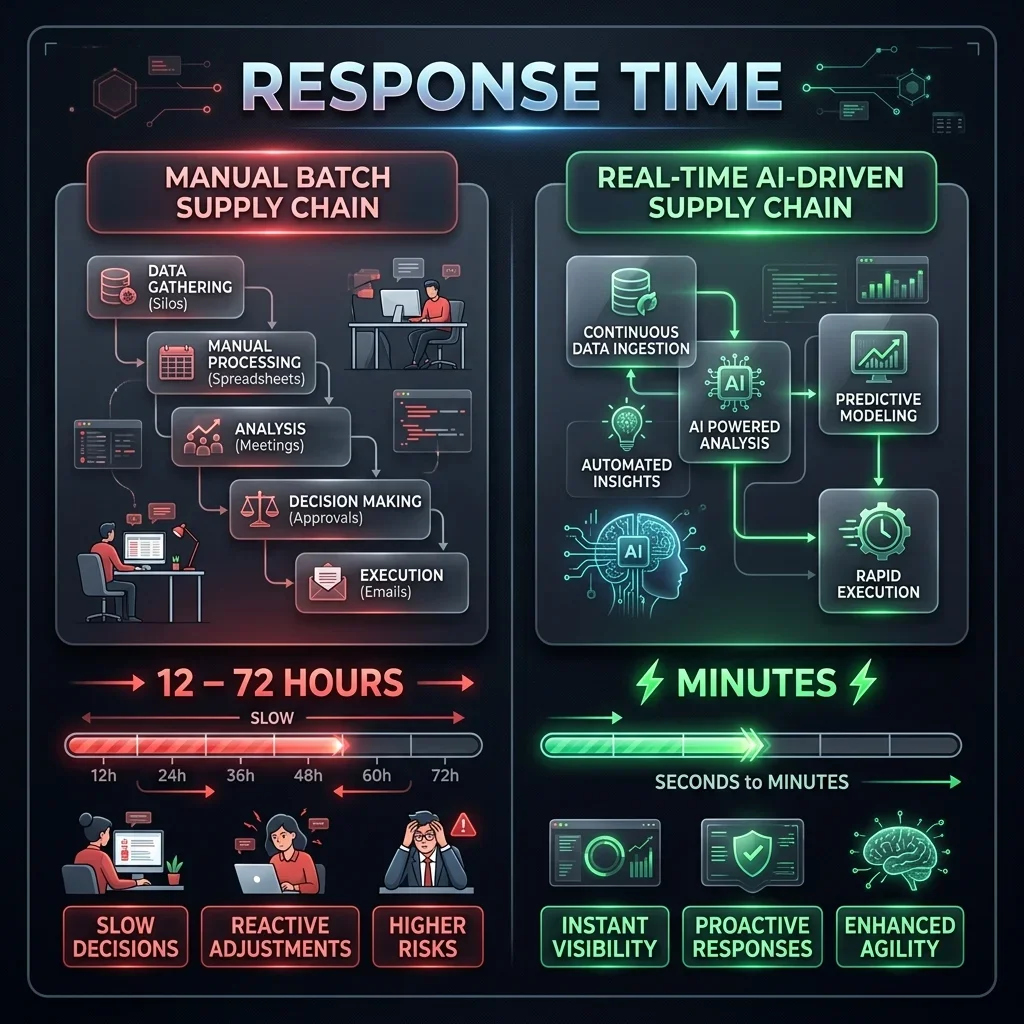
Futuristic Horizon: 2027–2030 Roadmap
The next phase of supply chain evolution will transition from predictive logistics to distributed autonomous networks:
- 2027: Multi-Carrier A2A Integrations: Standardized Agent-to-Agent protocols will allow supplier and carrier agent swarms to negotiate cargo allocations directly without human intervention.
- 2028: Decentralized Inventory Ledger Networks: Blockchain-backed ledger meshes will provide real-time, tamper-proof tracking of goods across multi-national borders, eliminating paperwork delays.
- 2029–2030: Self-Optimizing Supply Meshes: Global logistics networks will self-correct in real time, shifting resource allocations globally to mitigate regional shipping disruptions.
Key Takeaways
- Eliminate Batch Latency: Set up event-driven database connections to replace slow weekly spreadsheet consolidations.
- Combine External Signals: Ingest weather, market, and local events data to improve demand forecasting accuracy.
- Maintain Gate Guardrails: Keep direct execution behind human-in-the-loop validation limits to prevent unauthorized procurement.
- Focus on Standardized APIs: Use open integration patterns to connect all logistics partners to a single visibility console.
Operations Dashboards & Real-Time Monitoring
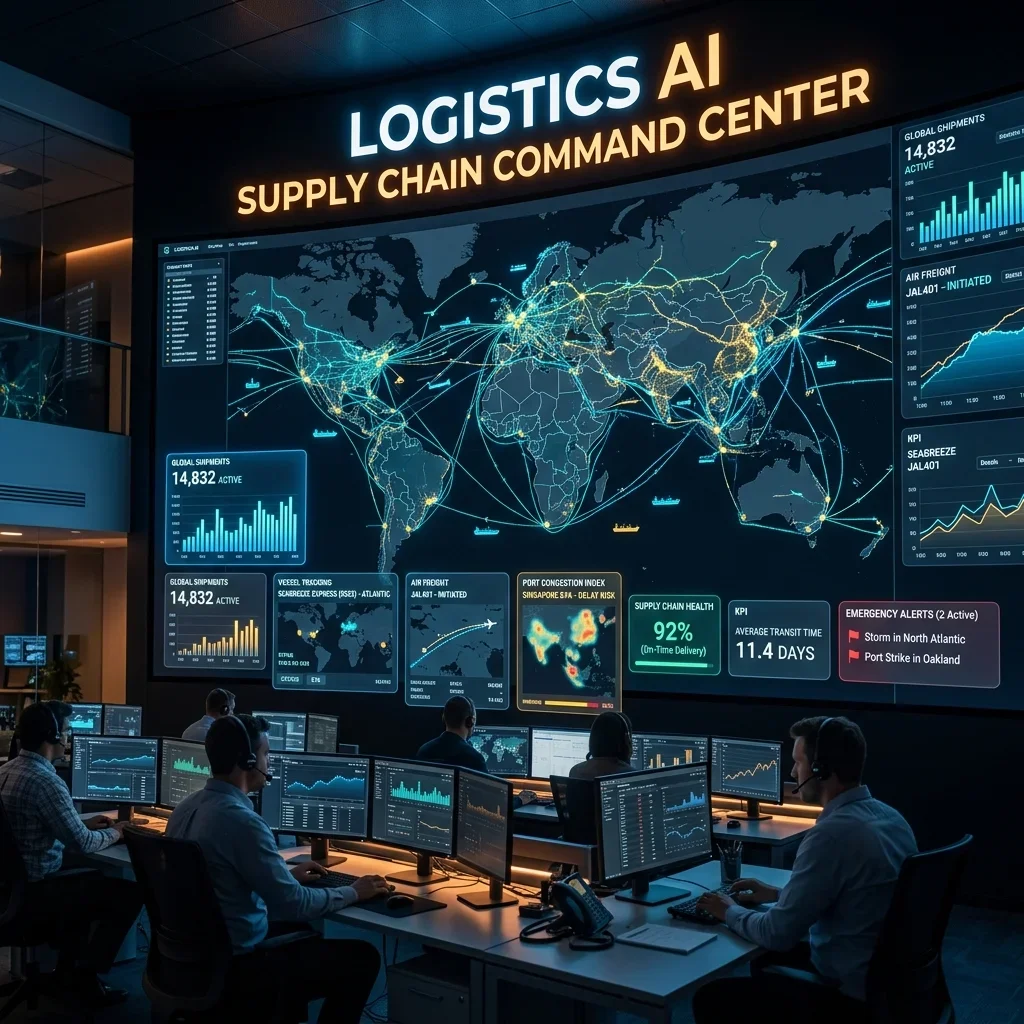
The following interfaces showcase the administrative consoles used by logistics teams to track supply chain performance.
1. Supply Chain Platform Architecture & Flow
The diagram below details the platform architecture connecting databases, events, and execution nodes.
| Interface Component | System Diagram | Core Functional Insight |
|---|---|---|
| System Architecture | 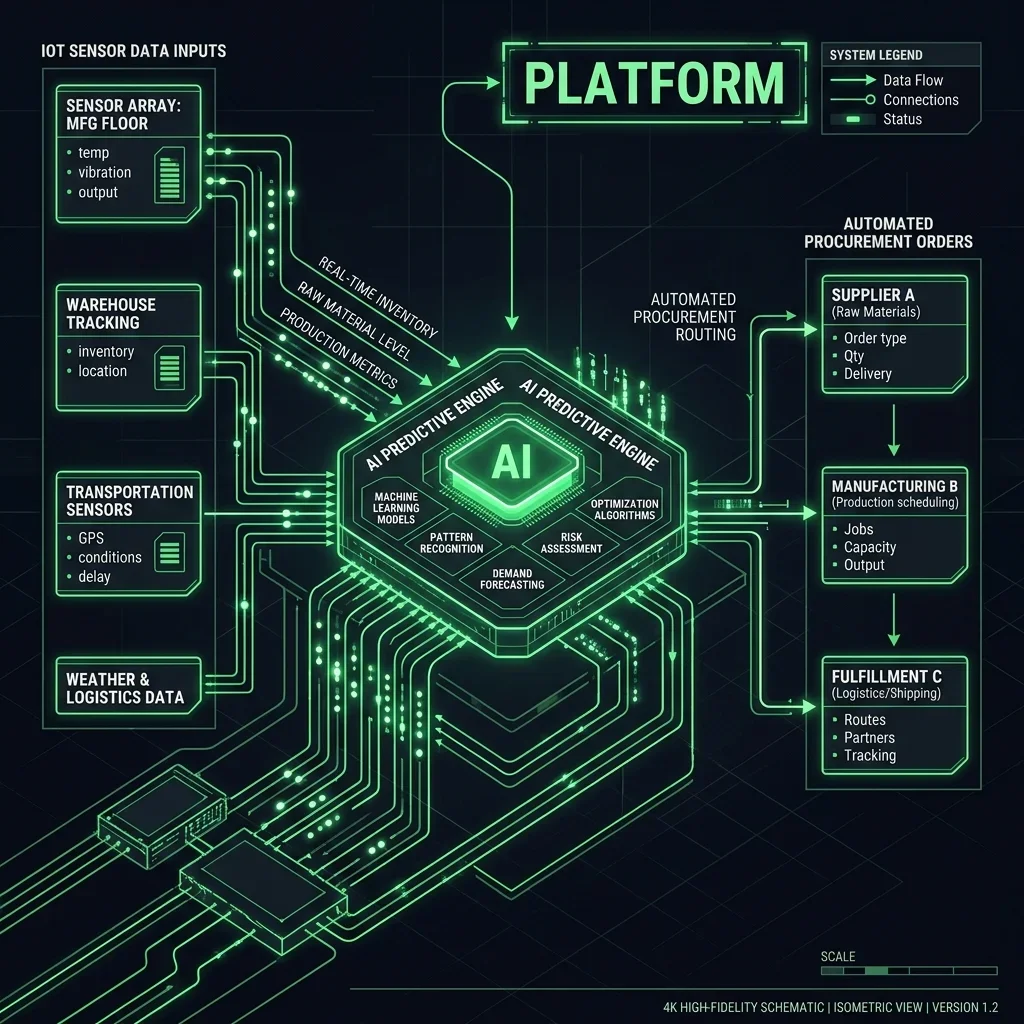 | Illustrates the data flow from physical sensors to the central event broker and downstream planning systems. |
| Replenishment Flow | 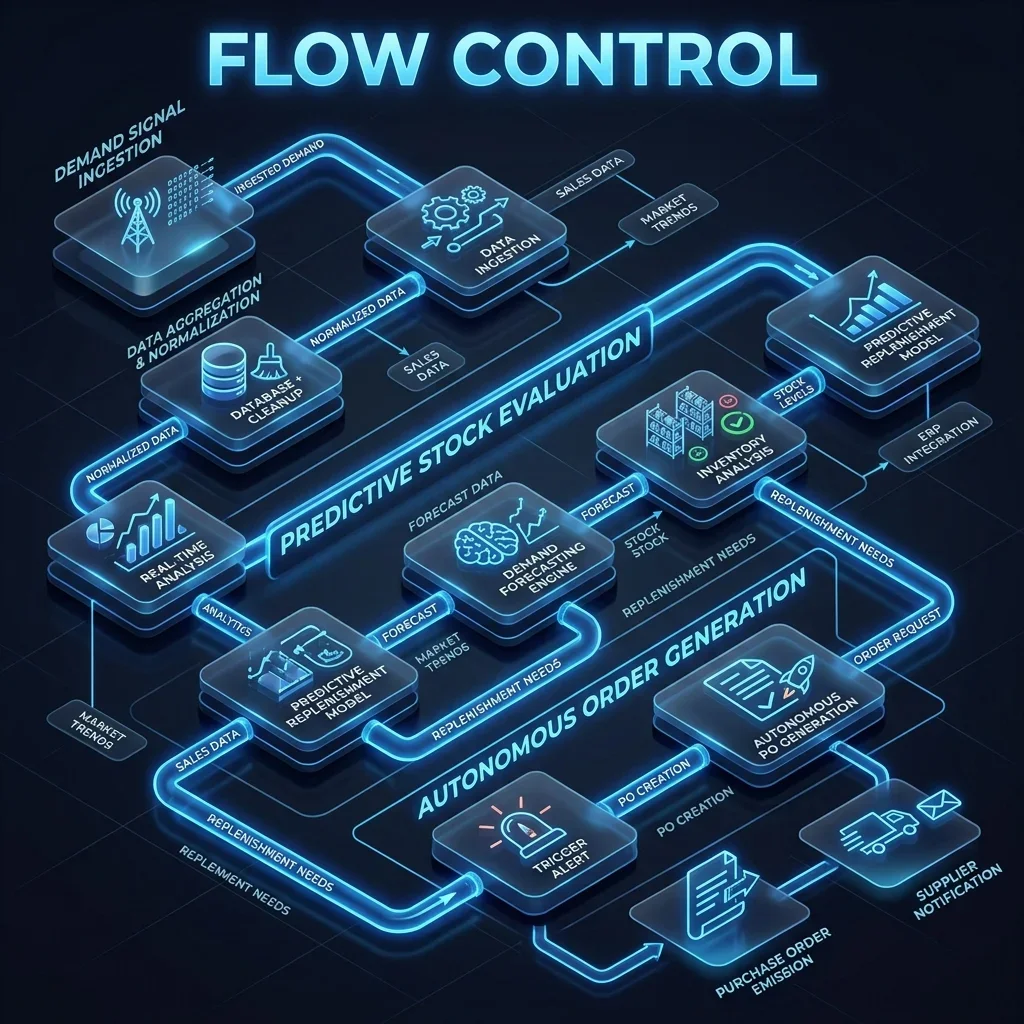 | Details the step-by-step logic used by agents to check stock, calculate safety limits, and draft order proposals. |
2. Visibility & Forecast Consoles
The workspaces below show how tracking and prediction screens look in practice.
| Interface Component | System Screenshot | Core Functional Insight |
|---|---|---|
| Visibility Dashboard | 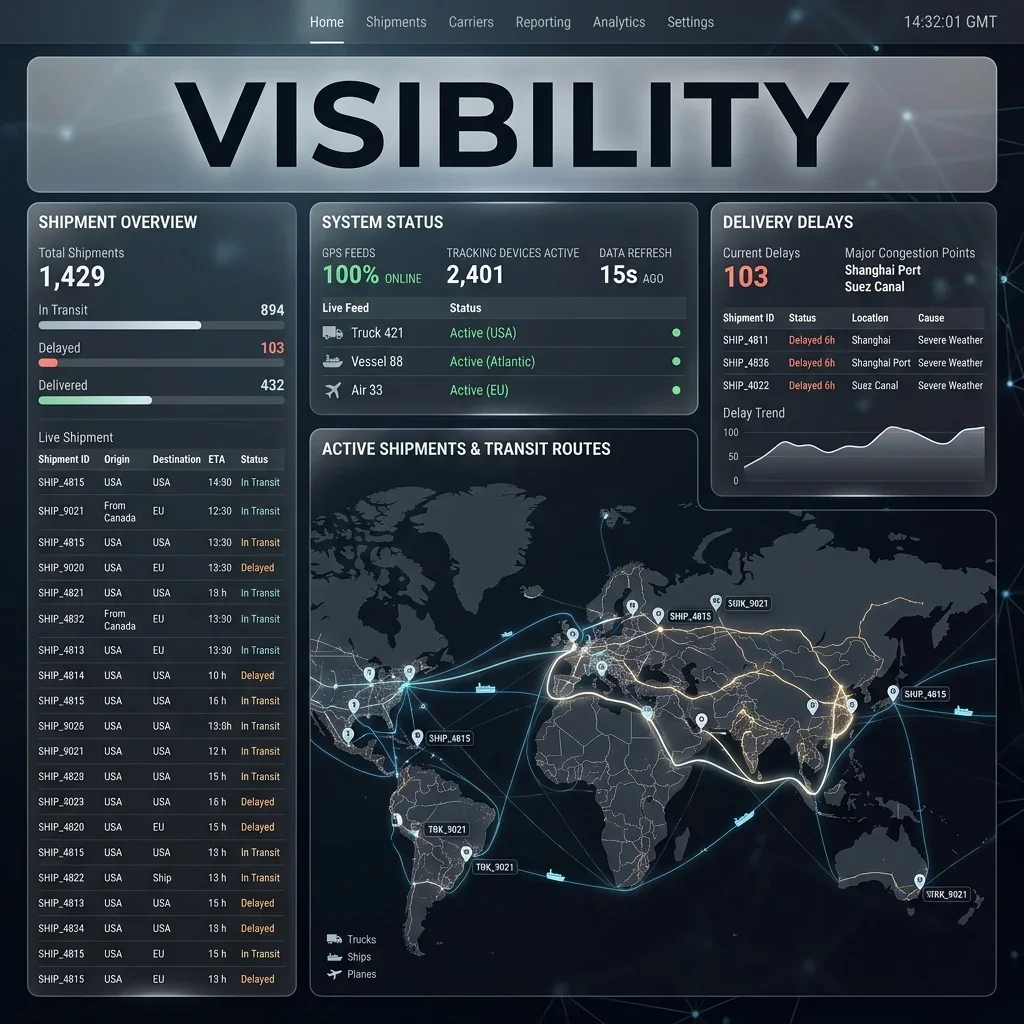 | Allows managers to locate freight in real time, monitor shipping lane delays, and review delivery predictions. |
| Demand Forecasting | 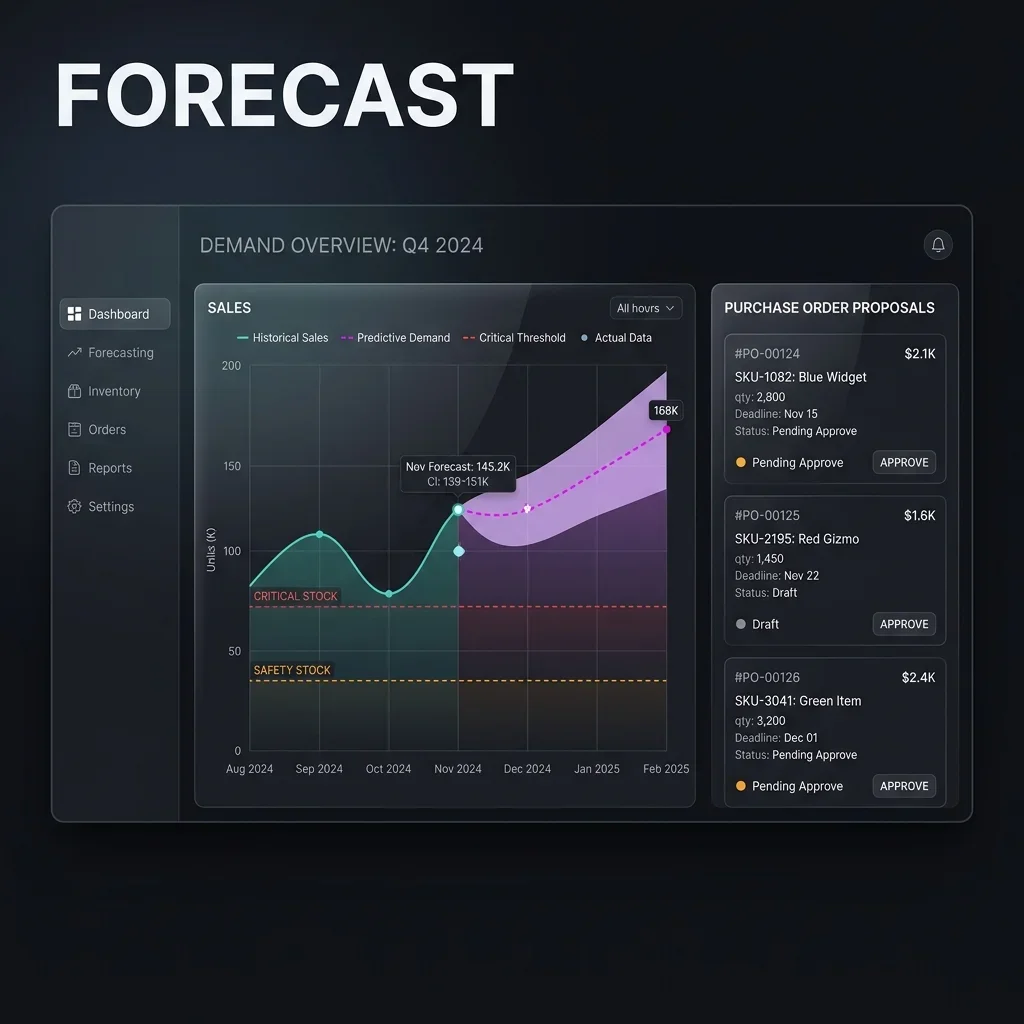 | Visualizes AI-generated sales projections, highlights low-stock risks, and proposes inventory orders. |
| Disruption Alert Center | 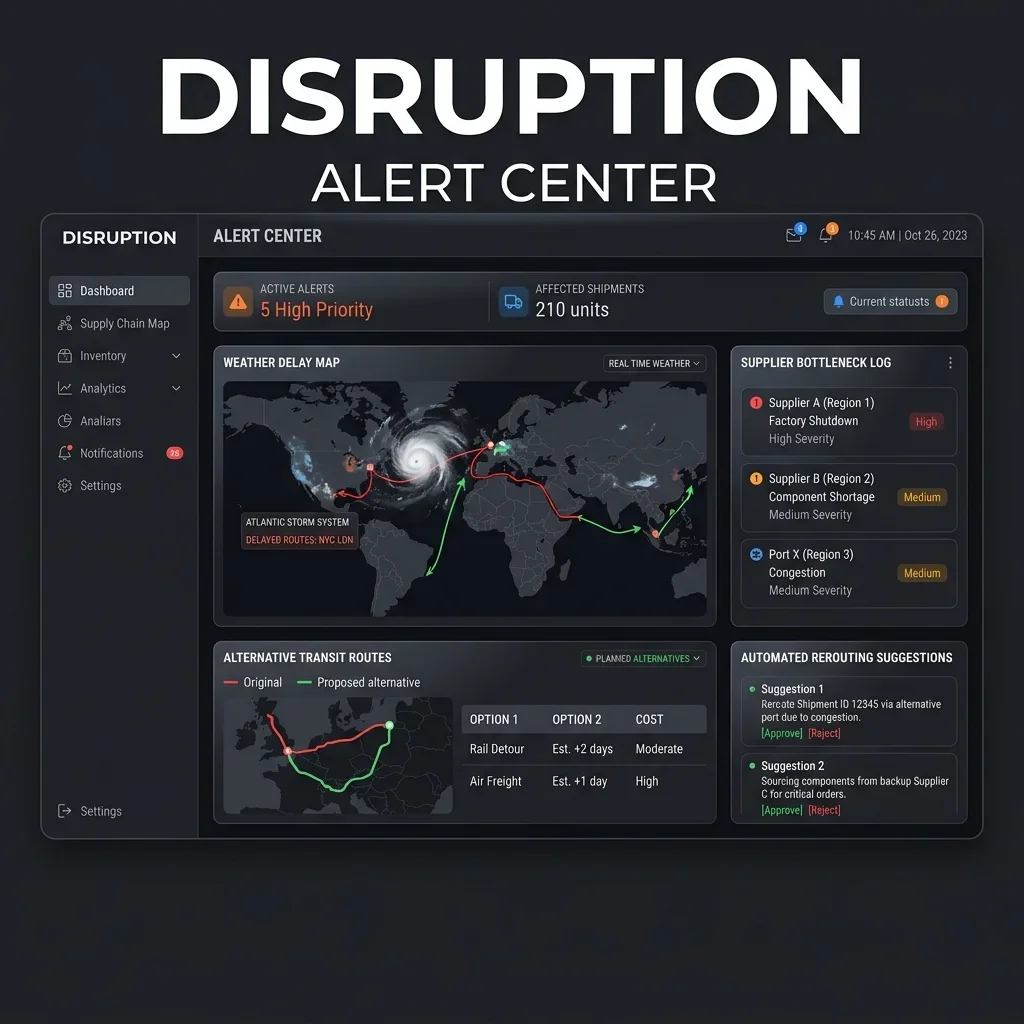 | Logs shipping lane exceptions, displaying delay detail levels, supplier risk scores, and alternative transit routes. |
3. AI Adoption Benchmarks
The metrics scoreboard below details adoption levels across corporate supply chains.
| Interface Component | System Screenshot | Core Functional Insight |
|---|---|---|
| Adoption Scoreboard | 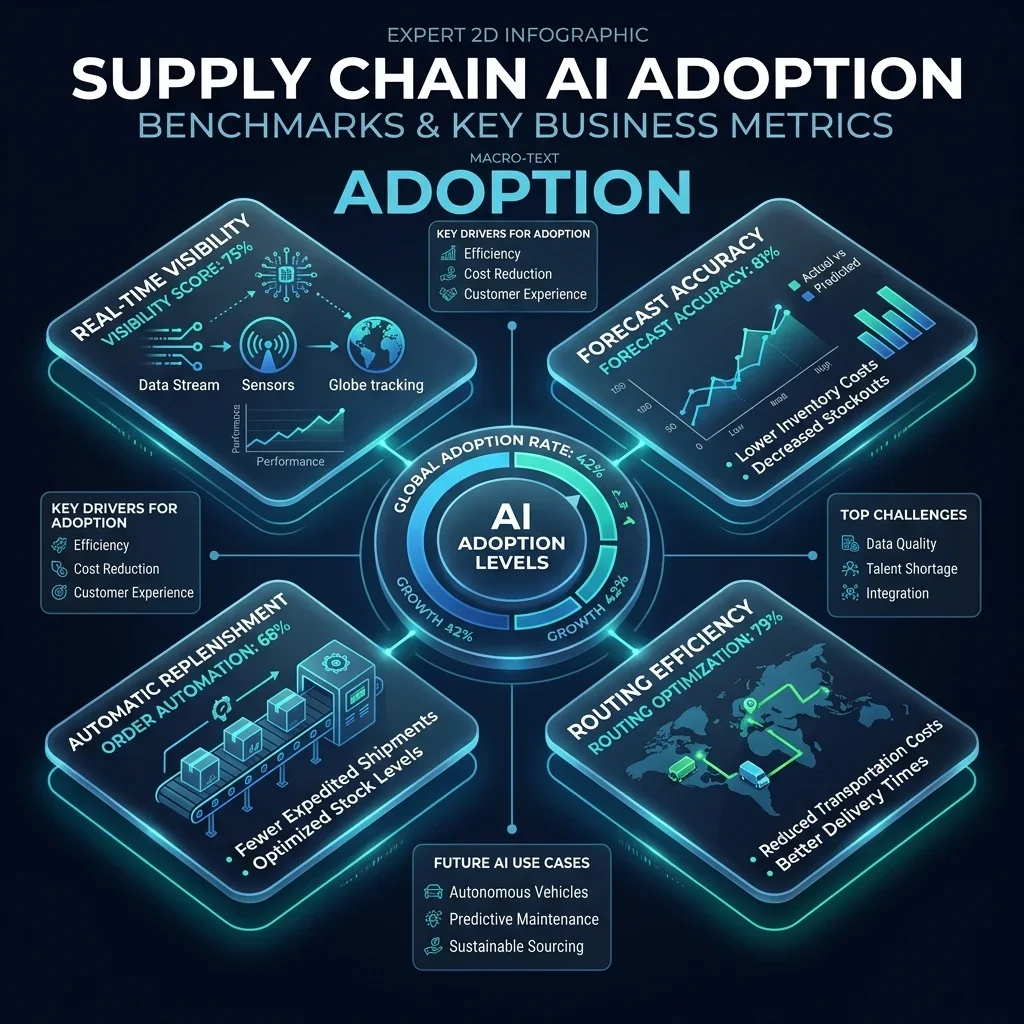 | Displays industry-standard adoption levels, helping organizations benchmark their own modernization progress. |
Frequently Asked Questions
How does the forecasting engine handle highly seasonal products?
The engine utilizes seasonal decomposition models that compare historical sales patterns with real-time weather and event feeds to adjust projections dynamically.
Do autonomous agents buy shipping spot space without approval?
No. While agents identify options and negotiate pricing, actual purchases are staged as proposals requiring manager sign-off.
Can the platform integrate with legacy ERP databases?
Yes. By using custom API connectors and message brokers, the platform can sync with legacy ERP tables without requiring database schema changes.
What occurs if an IoT sensor tag loses connectivity during transit?
The visibility platform flags the shipment status as "Signal Lost" and estimates the container's location based on the last known velocity and carrier data.
What is the average timeline for implementing a visibility platform?
Completed in 12 weeks: 4 weeks for sensor installation (Phase 1), 4 weeks for API and event configuration (Phase 2), and 4 weeks for dashboard verification (Phase 3).
About the Author
Vatsal Shah is a Senior AI/ML Architect and Digital Transformation consultant. He partners with enterprise supply chain and operations boards to design compliant, real-time tracking systems, automate demand forecasting, and modernize legacy logistics platforms.
Conclusion
Transitioning to a real-time, predictive logistics environment requires secure data integrations, clean database mapping, and structured validation guardrails. As an enterprise consultant, I partner with organizations to modernize their supply chains and deploy secure automation systems:
- Logistics Pipeline Mapping: We review your data flows, identify queue delays, and design custom modernization plans.
- Event-Driven Integrations: We configure Kafka pipelines and API connectors to link your division ledgers and warehouse records.
- Compliance Control Engineering: We build validation filters and human-in-the-loop approval gates to secure agent operations.
To explore how these logistics modernization strategies can secure your team's supply chain operations, review our services at /services. To schedule a detailed system architecture review or design a custom integration playbook, connect with us at /contact.
You can also read our related blog post on shadow AI governance and control registry and learn about scaling operations in our analysis of hyperautomation strategies in 2026.