OpenAI DeployCo vs Anthropic: Two Opposite Bets on Who "Embeds" AI in the Enterprise
By Vatsal Shah · 2026-05-25 · AI / Technology
AI SUMMARY
- OpenAI DeployCo: OpenAI launched a majority-owned subsidiary backed by $4 billion from 19 firms (including Bain Capital and TPG) to deploy AI agents onsite.
- Embedded Engineering: DeployCo utilizes "Forward Deployed Engineers" (FDEs) following Palantir's integration model to customize enterprise workflows.
- Anthropic Platform Play: Anthropic countered with consulting services for mid-market clients, alongside self-hosted sandboxes and MCP tunnels for security isolation.
- Strategic Divergence: OpenAI is betting on a people-heavy consulting model, while Anthropic is prioritizing software-defined, self-service infrastructure.
What Happened
In May 2026, the enterprise artificial intelligence landscape shifted from a race focused on model benchmarks to a battle over hands-on deployment. The strategic divergence between the two primary competitors became clear with the launch of major implementation divisions by OpenAI and Anthropic.
On May 11, 2026, OpenAI announced the launch of the OpenAI Deployment Company, commercially referred to as DeployCo. Backed by a $4 billion investment from a consortium of 19 firms, including Bain Capital, TPG (as lead investor), Brookfield, and major advisory houses like McKinsey and Capgemini, DeployCo is a majority-owned subsidiary. Its mission is to embed Forward Deployed Engineers (FDEs) directly within corporate environments to integrate AI agents into complex systems of record, such as ERP, supply chain, and HR software. To kickstart this effort, OpenAI acquired Tomoro, a specialized AI consulting firm, instantly absorbing 150 experienced integration engineers.
Shortly after DeployCo's debut, Anthropic announced its own enterprise deployment services division. Rather than chasing the massive Fortune 100 consulting engagements targeted by OpenAI, Anthropic is focusing on mid-market organizations, including regional banks, healthcare networks, and mid-sized manufacturing plants. This effort is backed by firms such as Blackstone, General Atlantic, Hellman & Friedman, and Sequoia Capital. To support this market, Anthropic also launched self-hosted execution sandboxes in public beta and Model Context Protocol (MCP) tunnels in research preview. These technical features allow enterprises to run Claude-powered agents locally, ensuring that sensitive data remains within their own security perimeter.
Why It Matters
This development represents a mature phase in enterprise AI adoption. For two years, boards have funded proof-of-concepts that failed to reach production. The bottleneck was never the language model's cognitive ability; it was the integration into legacy database structures and corporate security rules. OpenAI and Anthropic are addressing this "deployment gap" with opposite philosophies.
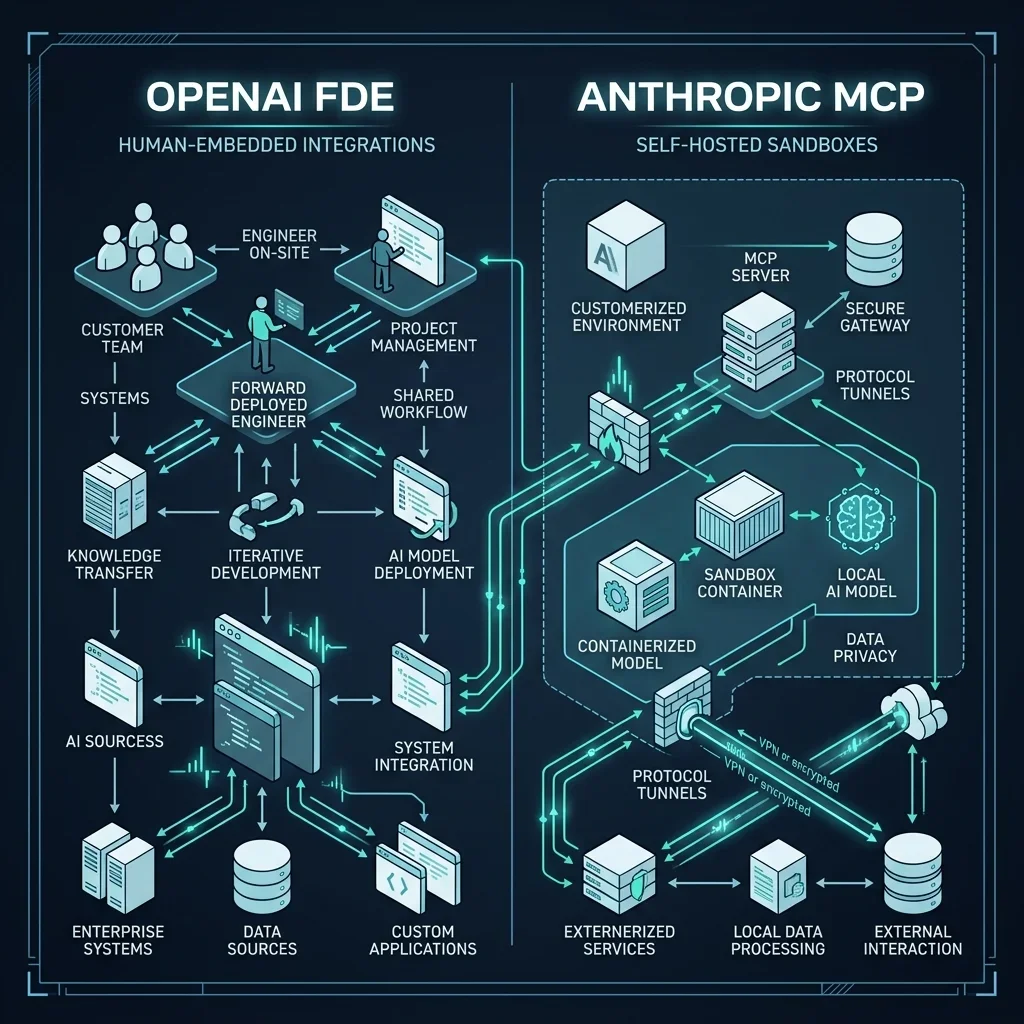
OpenAI is betting on a people-heavy consulting model, reminiscent of Palantir’s early deployment strategy. By sending teams of FDEs into a company, OpenAI can handle the customized integrations needed to connect AI models with legacy ERPs or legacy databases. This approach assumes that large-scale business transformation cannot be achieved with generic templates or self-service APIs. It requires experienced engineers who can map workflows, write custom orchestrations, and manage security guardrails onsite. The primary drawback of this model is cost; a multi-million dollar consulting engagement restricts DeployCo to large enterprises with significant transformation budgets.
       [ OPENAI DEPLOYCO ]                     [ ANTHROPIC ENTERPRISE ]
                │                                         │
        ┌───────┴───────┐                         ┌───────┴───────┐
        ▼               ▼                         ▼               ▼
   Onsite FDEs     Custom ERP                 Local Sandboxes  Self-Serve
   (embedded)     Integrations               (data isolation)  MCP Tunnels
        │               │                         │               │
        └───────┬───────┘                         └───────┬───────┘
                ▼                                         ▼
     Fortune 100 Focus ($$$)                    Mid-Market Focus ($$)
Anthropic is taking a software-defined, self-service infrastructure approach. By focusing on self-hosted sandboxes and Model Context Protocol tunnels, they are building tools that allow internal corporate developers to safely deploy AI agents without needing external consultants. This approach addresses the primary security concern of CIOs: data privacy. By keeping model context isolated inside the client's own cloud or local servers, Anthropic eases compliance worries, especially in regulated industries like banking and healthcare.
Deployment Strategy Comparison
To help technology leaders evaluate these paths, the table below compares the key attributes of the OpenAI DeployCo model against Anthropic's software-driven enterprise approach.
| Dimension | OpenAI DeployCo Model | Anthropic Enterprise Model |
|---|---|---|
| Primary Resource | Forward Deployed Engineers (FDEs) embedded onsite | Self-hosted sandboxes, MCP tunnels, and SMB workflow templates |
| Target Audience | Large global conglomerates (Fortune 100) | Mid-market (regional banks, healthcare, mid-size manufacturing) |
| Security & Data Perimeter | Shared cloud gateways with corporate APIs mapped by engineers | Strictly isolated, self-hosted execution environments and sandboxes |
| Implementation TCO | High (multi-million dollar customized service engagements) | Medium-low (SaaS-scale subscriptions, template-driven) |
| Transformation Approach | People-heavy, high-touch custom system modernization | Software-defined, self-service infrastructure and connectors |
For operators, the choice between these models dictates the structure of their internal AI teams. Choosing OpenAI DeployCo means relying on external specialists to design and maintain agent architectures, which is useful when internal engineering talent is limited. Conversely, standardizing on Anthropic's platform encourages building internal capabilities, using standardized protocols like MCP to connect models with internal data sources.
In practice, what actually happens is that mid-market firms find the self-service model more practical. Because they cannot afford $2 million consulting fees, they rely on pre-built templates and regional system integrators. By utilizing Anthropic's sandboxes and MCP tunnels, they bypass complex database migrations and wire models directly into existing APIs. This allows them to achieve similar automation outcomes at a fraction of the cost, making the self-serve model highly competitive.
What to Watch Next
As these deployment strategies roll out, three trends will shape the enterprise AI market:
- The Rise of the Forward Deployed AI Engineer: The demand for engineers who understand both machine learning models and enterprise database architecture is growing. FDEs will become a highly sought-after professional class, bridging the gap between model research and operational reality.
- Standardization on Model Context Protocol (MCP): Anthropic's open-source MCP is gaining support. As more enterprise databases and applications launch native MCP servers, the need for custom integration code will decrease, favoring the self-service deployment model.
- Mid-Market AI Networks: Regional banks and healthcare systems will form collaborative deployment networks. By sharing secure agent templates and sandbox configurations, they will compete with the highly customized solutions built by DeployCo for larger institutions.
Source
Read the original announcements and industry analysis: