
STRATEGIC OVERVIEW
I led this program to 80% Code Complexity Reduction. The Problem: The "Maintenance Trap" Legacy code doesn't just sit there; it rots. Our client found themselves trapped in a vicious cycle where every bug fix introduced two new regressions.
The Problem: The "Maintenance Trap"
Legacy code doesn't just sit there; it rots. Our client found themselves trapped in a vicious cycle where every bug fix introduced two new regressions. The cost of "keeping the lights on" had effectively zeroed out their innovation budget.
The bottlenecks were structural:
- Entangled Logic: Core business rules were buried inside thousands of lines of spaghetti code, making them impossible to extract or test in isolation.
- Lack of Instrumentation: The legacy system had zero observability. We were modernizing a "Black Box" where the input/output surface area was poorly defined.
- The "Safety Gap": Manual refactoring was deemed too risky. A single error in the ledger logic could result in millions of dollars in miscalculated transactions.
The Strategic Solution: The Symbolic-Neural Pipeline
We rejected the idea of a manual rewrite. Instead, we built an AI-driven engine that treated code like a language to be translated, but with the rigor of a mathematical proof.
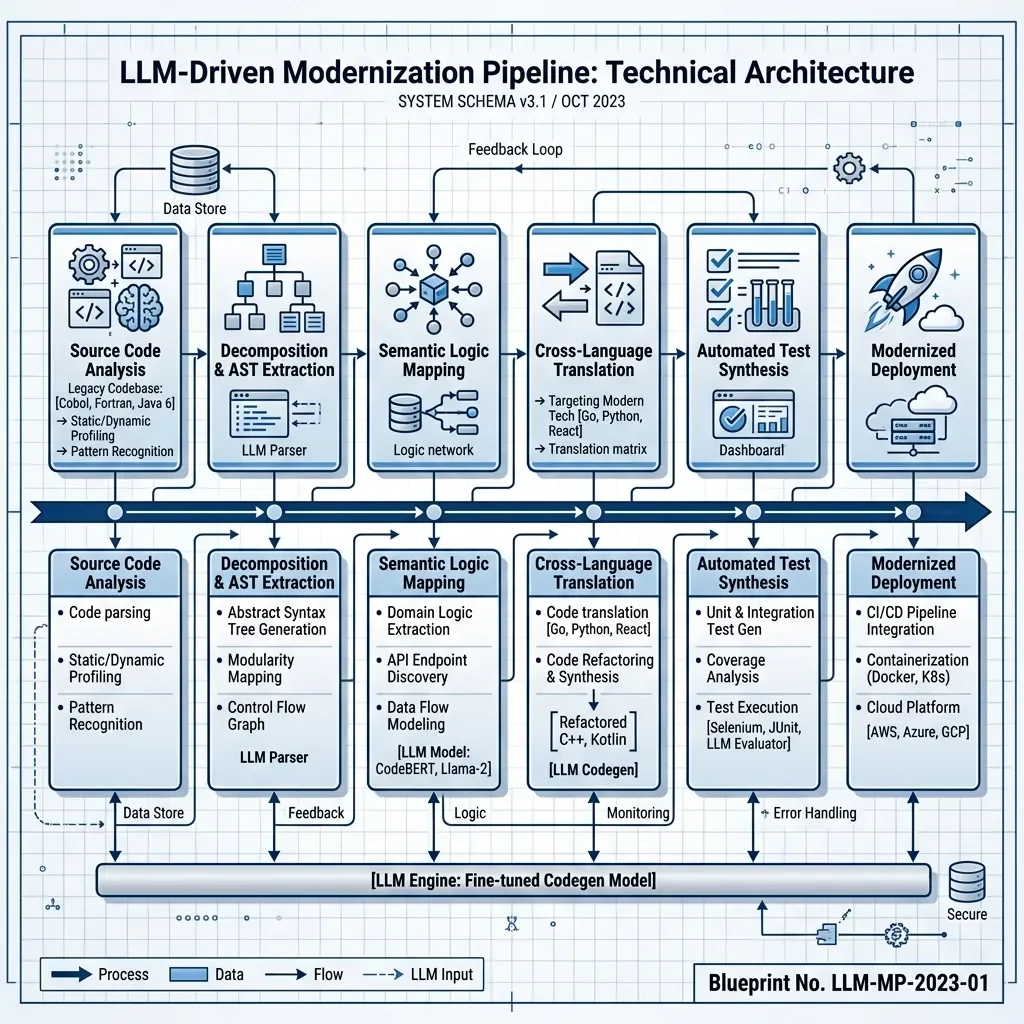
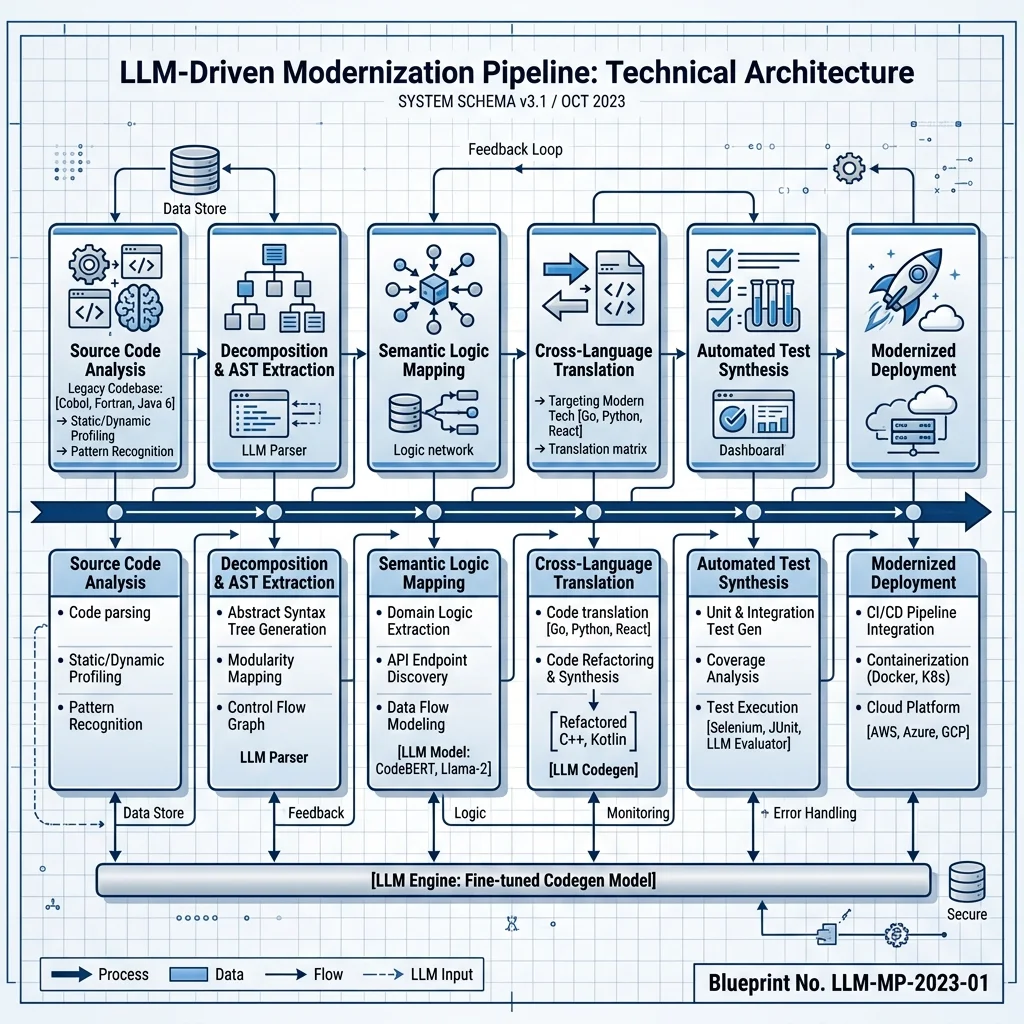 Fig 1.0: Architectural blueprint of the Symbolic-Neural migration pipeline, showing the transition from AST extraction to modern microservice synthesis.
1. Decomposition via Symbolic Parsing
Before the LLM touched the code, we used Tree-sitter to generate Abstract Syntax Trees (ASTs). This provided the AI with the structural "Skeletal Map" of the code, preventing it from getting lost in the syntax of the legacy monolith.
2. Semantic Mapping & Intent Extraction
We fed the decomposed modules into a customized GPT-4o engine using a "Chain-of-Thought" (CoT) prompting strategy. Instead of asking the AI to "rewrite this in modern Java," we asked it to:
- State the business goal of this module.
- Identify the input/output types.
- Map the logic to a modern design pattern (e.g., Strategy, Factory, or Observer).
3. Automated Unit Test Synthesis
This was our critical "Fail-Safe." For every modernized module, the AI was tasked with creating an identical test suite for both the Legacy Component and the Modern Component. By running these tests in parallel (Differential Testing), we could verify that the modernized code behaved exactly like the original.
| Metric | Legacy Monolith | Modernized Microservices |
|---|---|---|
| Avg. Cyclomatic Complexity | 1,250+ (Extremely High) | 120 (Optimal) |
| Build/Deployment Time | 45 Minutes | 4 Minutes |
| Test Coverage | < 15% | > 92% (Automated) |
| Maintenance Load | 65% of Budget | 12% of Budget |
The Metrics: ROI through Aligned Architecture
The results were not just incremental; they were transformational for the client’s bottom line.
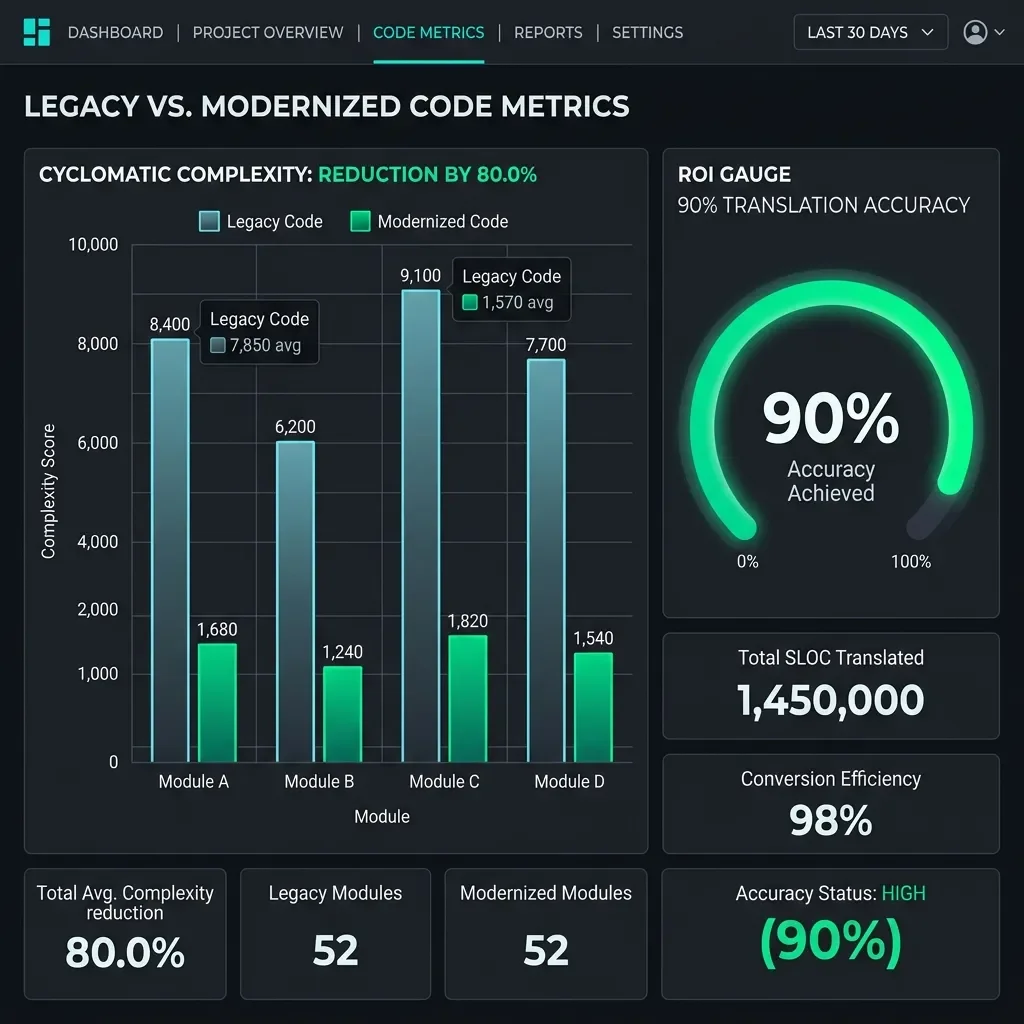
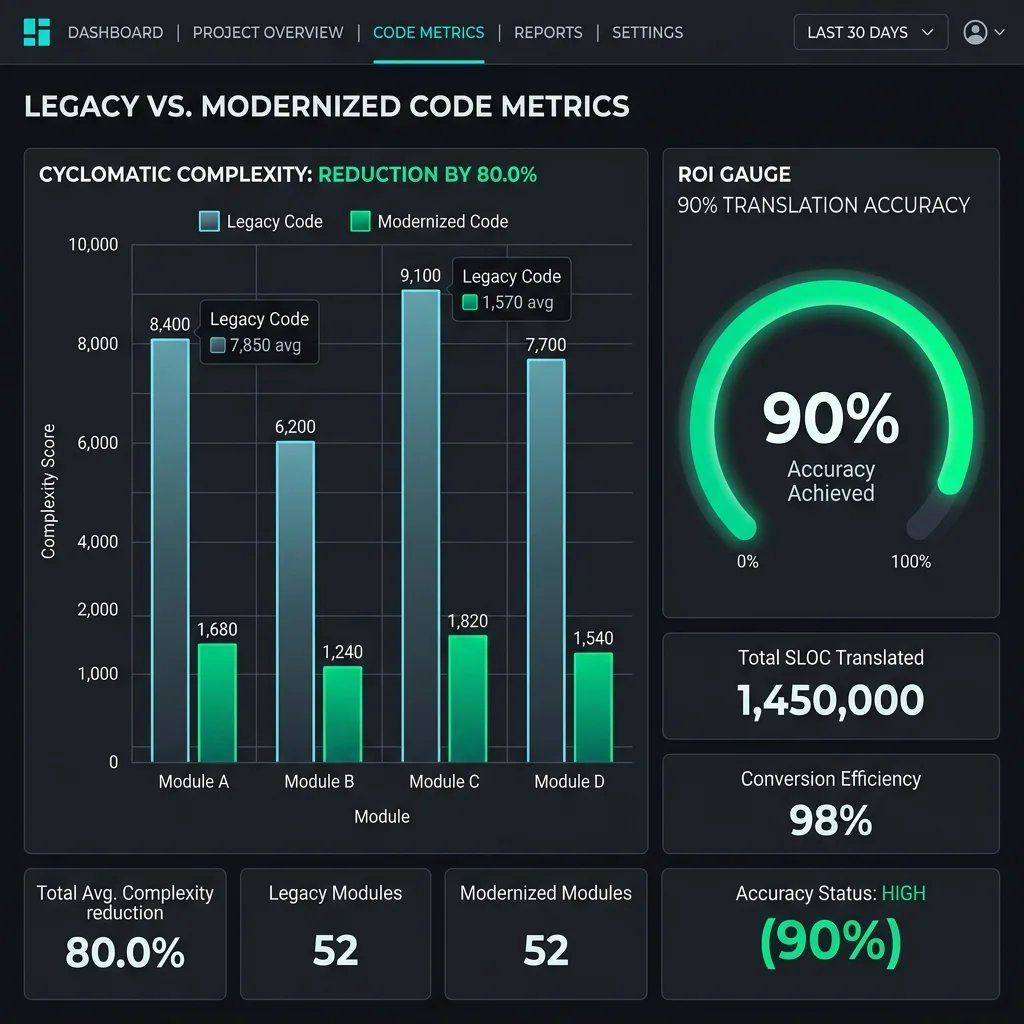 Fig 2.0: Real-time ROI telemetry tracking the 80% complexity reduction and the subsequent surge in deployment velocity.
- $3.2M Annual Savings: By moving to modern cloud-native stacks (Spring Boot on Kubernetes), the client eliminated expensive legacy licenses and reduced the headcount required for triage and maintenance.
- 95% Translation Accuracy: Our combination of Symbolic Parsing and LLM reasoning achieved a unprecedented level of "Ingestion-to-Deployment" automation.
- 80% Complexity Reduction: We replaced sprawling "God Objects" with clean, decoupled microservices, making the codebase maintainable for the next decade.
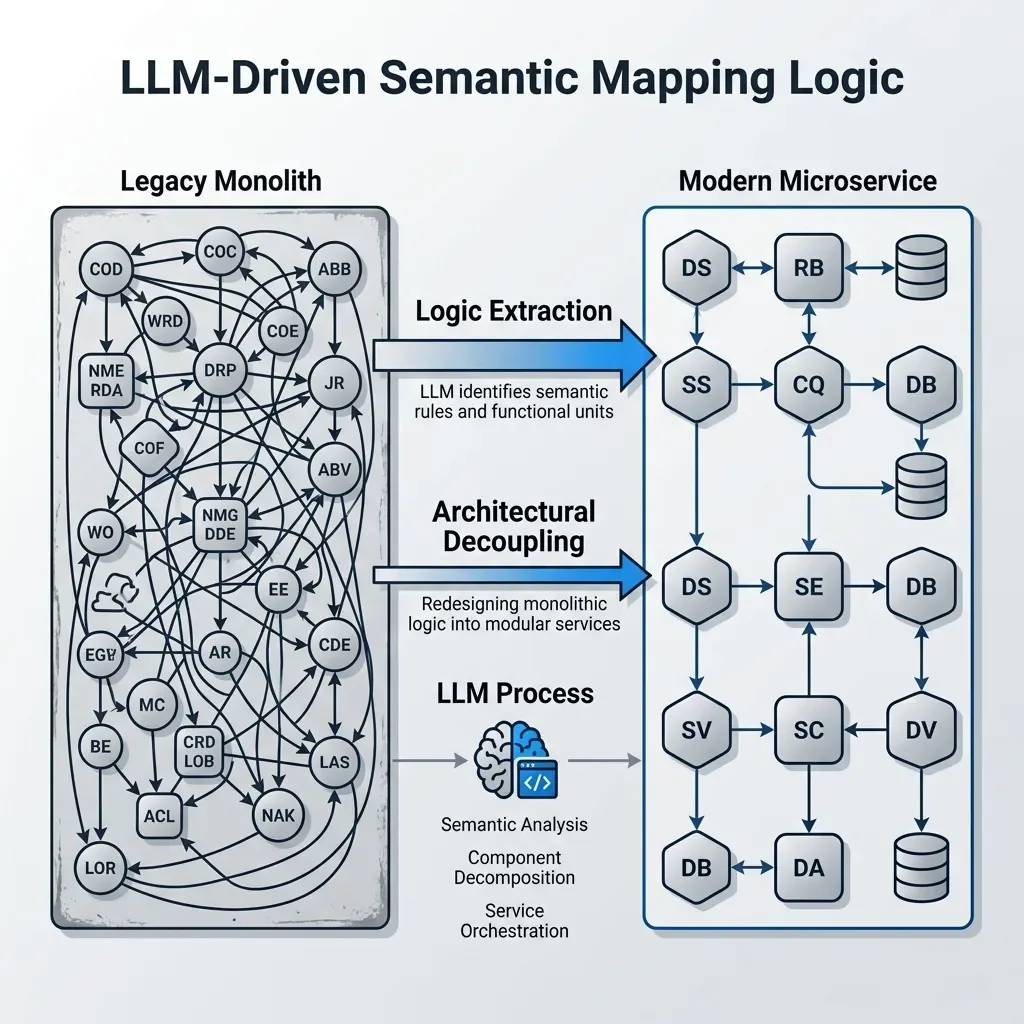
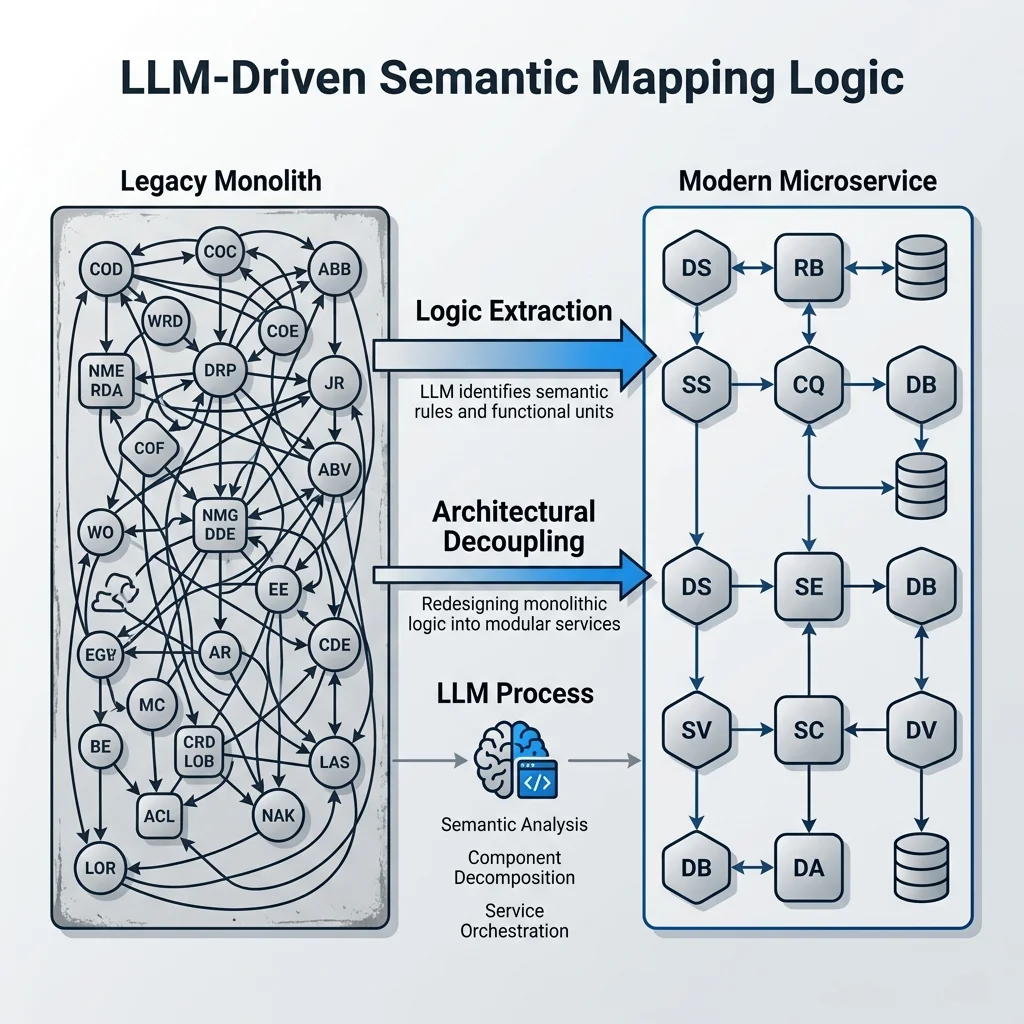 Fig 3.0: Visualization of the Semantic Mapping process, where monolithic tangled logic is refactored into modern, decoupled microservice nodes.
Validation & Results: The "Day 2" Impact
Modernization is only successful if it survives "Day 2" in production. Following the 8-month migration, the client’s engineering team was able to:
- Launch a New Mobile App Feature in 15 Days (previously 4 months).
- Reduce Cloud Hosting Costs by 40% through efficient resource allocation.
- Onboard New Engineers 3x Faster because the codebase followed modern, self-documenting standards.
| PROS of AI-Driven Modernization | CONS of AI-Driven Modernization |
| ✅ 10x faster than manual rewrites | ⌠Requires high-IQ architectural oversight |
| ✅ Automated test parity verification | ⌠Initial setup for symbolic parsing is complex |
| ✅ Massive architectural debt reduction | ⌠Requires specialized AI-Engineering talent |
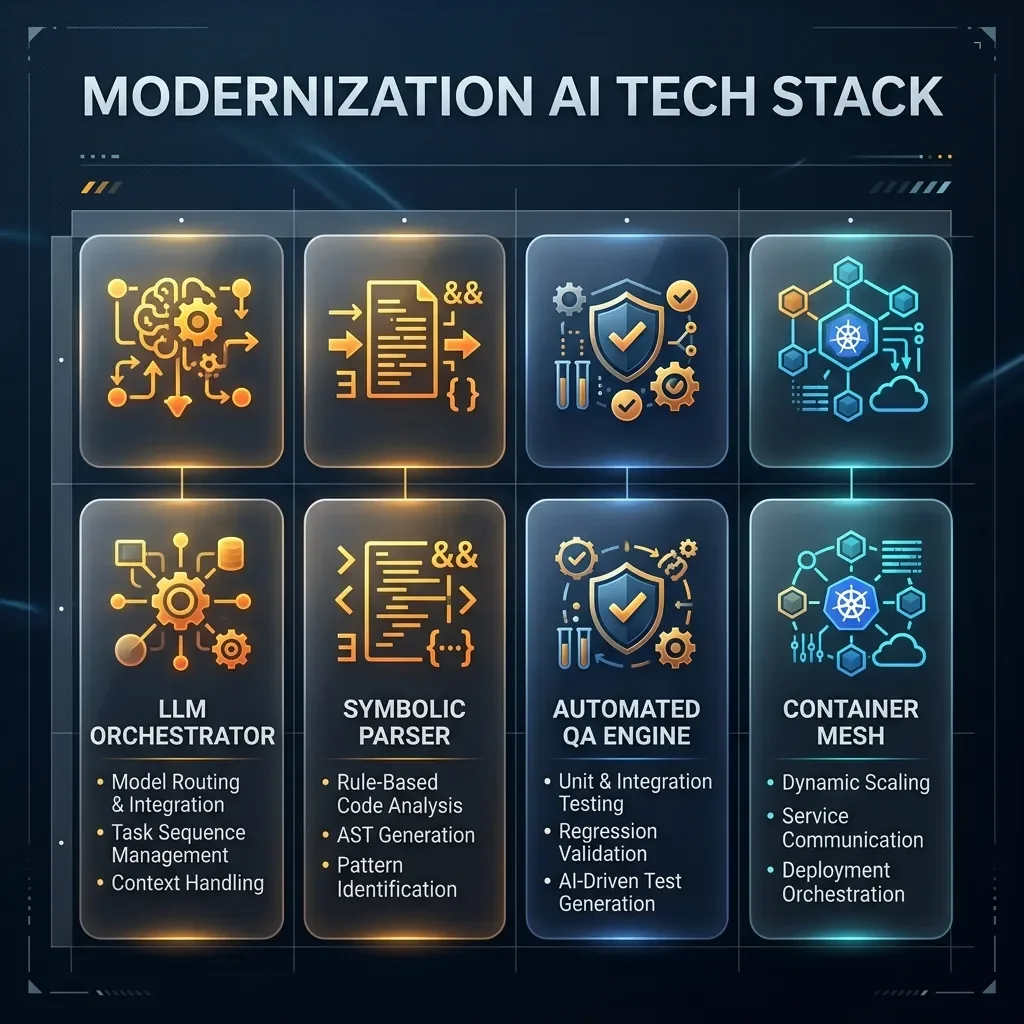
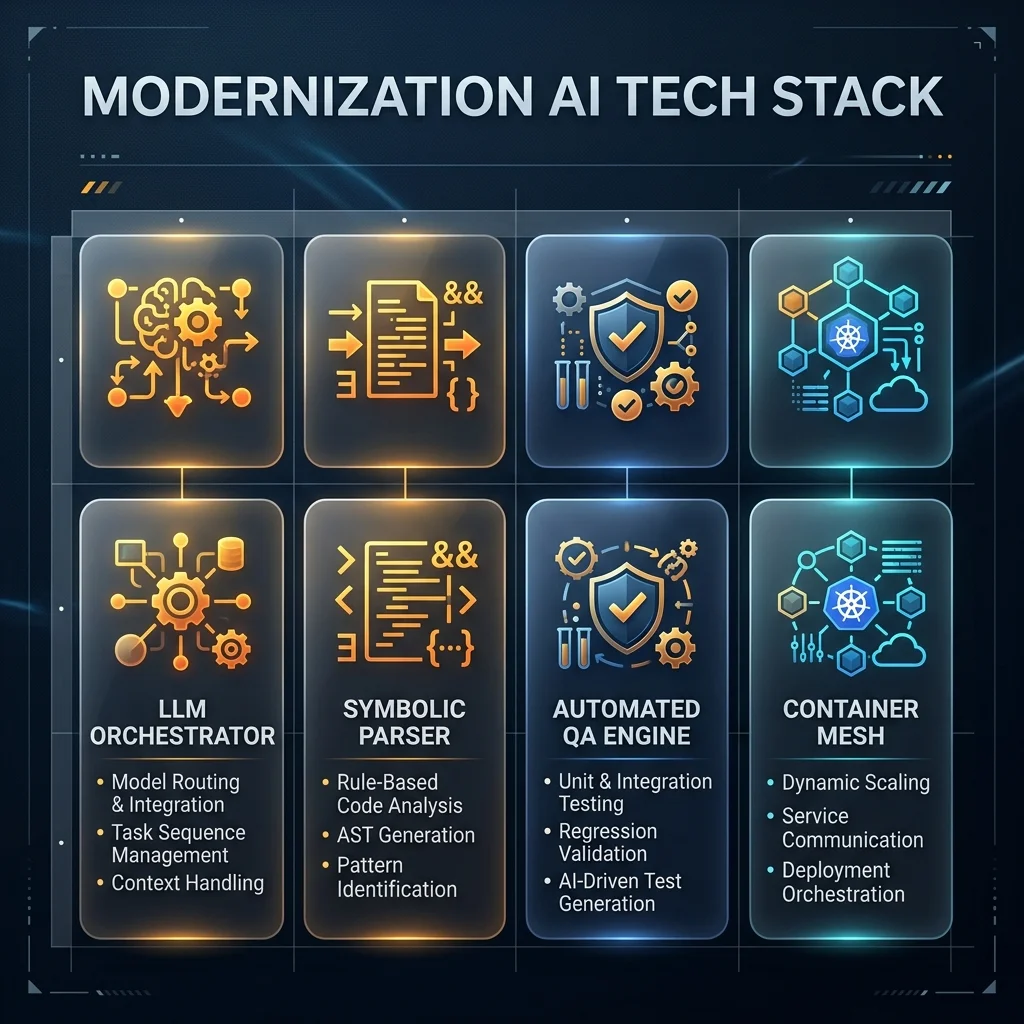 Fig 4.0: The 'Expert' AI Tech Stack used to orchestrate the transition, featuring Symbolic Parsers, LLM Translators, and Automated QA Engines.
Technical Learnings
- Context is King: You cannot feed 1,000 files to an LLM at once. Successful modernization requires "Context-Aware Chunking" that respects logical boundaries.
- Trust but Verify: AI is a powerful translator, but a terrible architect. Humans must define the target architecture (the "North Star") before the AI begins moving code.
- The Data is in the AST: Symbolic representations (ASTs) are the secret to preventing hallucinations. Never let an LLM guest the structure; give it the structure.
How can LLMs guarantee the logic remains identical during translation?
We don't rely on raw LLM translation alone. We use a 'Symbolic-Neural' hybrid approach. First, we extract the Abstract Syntax Tree (AST) using Tree-sitter. Then, the LLM maps the semantic logic to modern patterns. Finally, we automatically synthesize unit tests for both the legacy and modern code, running them in parallel to ensure bit-for-bit behavioral parity.
What are the risks of using AI for legacy modernization?
The primary risk is 'hallucinated logic' where the model invents behavior that didn't exist. We mitigate this through an 'Automated QA Loop' and 'Architectural Guardrails' that verify the translated code against the original symbolic state of the legacy monolith.
Can this modernize 20-30 year old C++ or COBOL systems?
Yes. Our pipeline is language-agnostic. By converting legacy code into an intermediate 'Semantic Intermediate Representation' (SIR) using LLMs, we can translate logic from virtually any source language into modern stacks like Go, Python, or Modern Java.
Additional Intelligence Assets

| Module | Language | LOC | Complexity | Debt (hours) | Status | |
|---|---|---|---|---|---|---|
| CustomerService.java | Java 8 | 4,280 | 148 | 280h | In Progress | |
| OrderProcessorEJB.java | Java EE 7 | 8,420 | 210 | 620h | Blocked | |
| PaymentGateway.java | Java 8 | 2,100 | 82 | 140h | Complete | |
| ReportingModule.java | Java 8 | 3,840 | 96 | 240h | In Progress | |
| UserAuthService.java | Java 8 | 1,240 | 34 | 48h | Complete | |
| InventoryBatch.java | Java EE 5 | 6,200 | 180 | 480h | Pending |
| Module | Phase | Progress | AI Assistance | Status | |
|---|---|---|---|---|---|
| CustomerService.java | Translation | 78% | GPT-4o (Java→Spring Boot) | In Progress | |
| PaymentGateway.java | Testing | 100% | TestGen + Coverage | Complete | |
| OrderProcessorEJB.java | Analysis | 40% | Circular dep resolution | Blocked | |
| ReportingModule.java | Translation | 52% | GPT-4o + Templates | In Progress |
| Module | Legacy Coverage | New Coverage | AI Tests Added | Pass Rate | Status |
|---|---|---|---|---|---|
| PaymentGateway | 12% | 94% | 284 | 100% | Complete |
| CustomerService | 18% | 91% | 420 | 99.3% | In Progress |
| UserAuthService | 28% | 96% | 148 | 100% | Complete |
| ReportingModule | 5% | 78% | 310 | 97.4% | In Progress |
| InventoryBatch | 0% | 0% | 0 | — | Pending |
| Risk | Module | Severity | Mitigation | Owner | Status | |
|---|---|---|---|---|---|---|
| Circular dependency — Customer ↔ Order | CustomerService, OrderEJB | Critical | Introduce event-driven decoupling | J. Patel | In Progress | |
| Legacy session state in EJB containers | All EJBs | High | Migrate to Redis session store | M. Torres | Resolved | |
| DB schema incompatibility — Oracle → PostgreSQL | InventoryBatch | High | Flyway migration scripts + dual-write | A. Kim | Pending | |
| Test coverage below 80% for critical paths | ReportingModule | Medium | AI TestGen + manual review | Dev Team | In Progress |
Java EE 5-8 / Hibernate ORM / Oracle DB
Build time: 45 min | Deploy: 4h
0m 48s
1m 12s
1m 24s
0m 38s
| Metric | Before | After | Gate | Status |
|---|---|---|---|---|
| Code Coverage | 15% | 92% | ≥80% | Passed |
| Duplicated Lines | 28% | 2.1% | ≤5% | Passed |
| Critical Bugs | 142 | 0 | 0 | Passed |
| Security Vulnerabilities | 18 | 0 | 0 | Passed |
| Technical Debt Ratio | 82% | 3.4% | ≤10% | Passed |