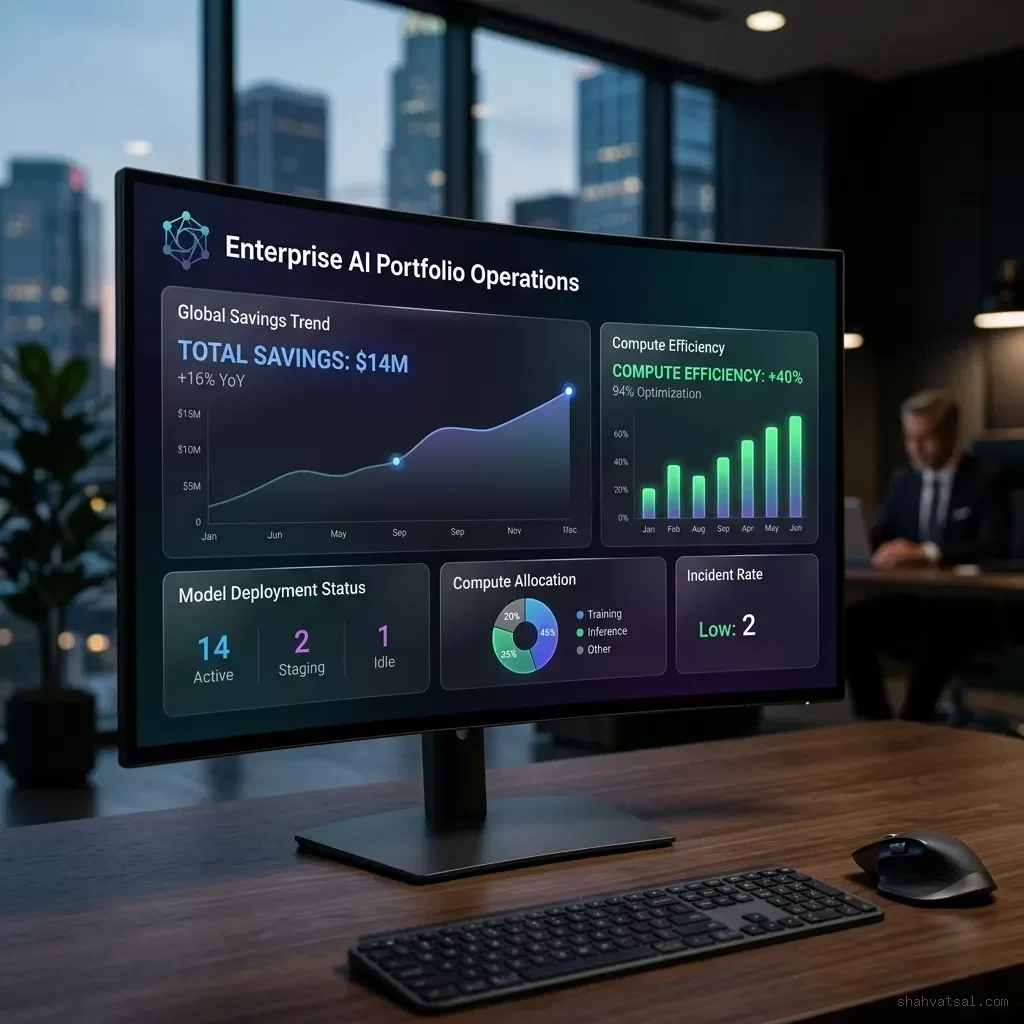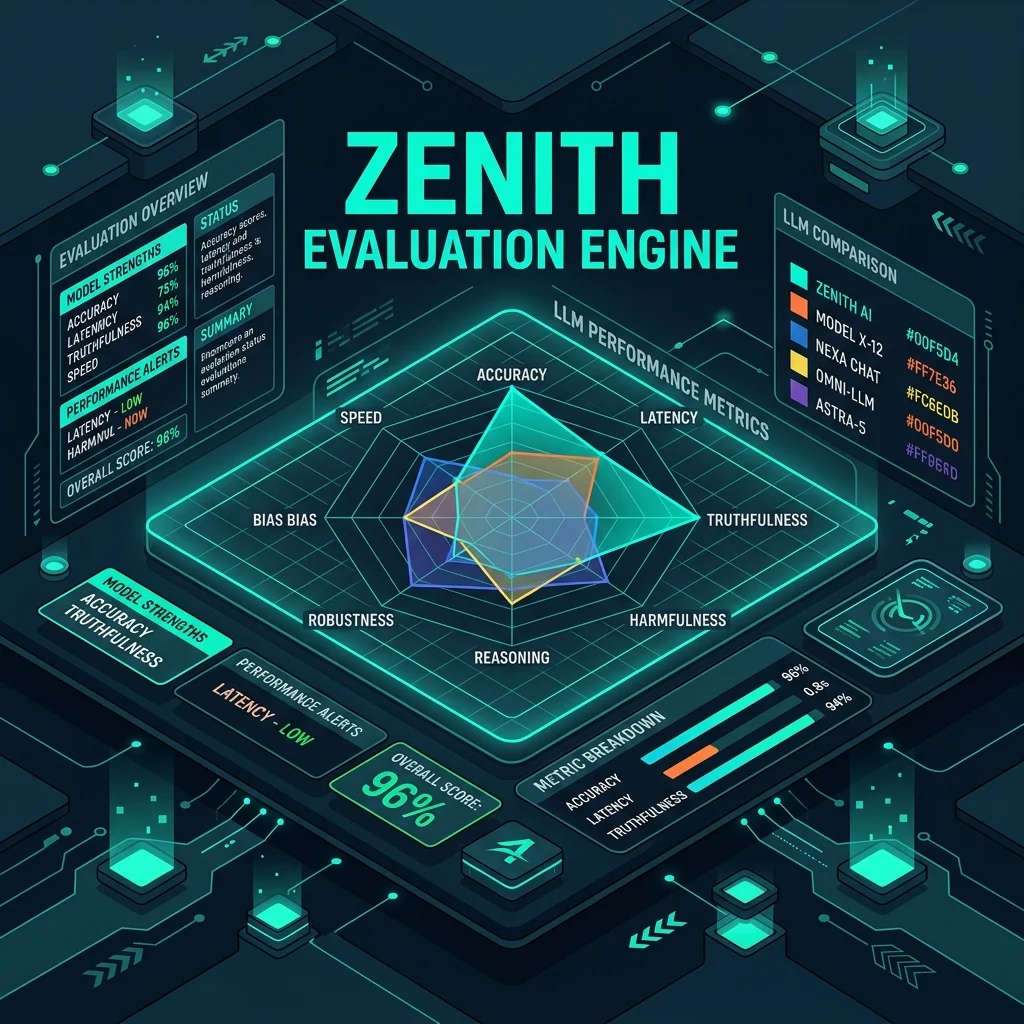

STRATEGIC OVERVIEW
I led this program to M Annual Savings. Client / Problem Overview - **Industry**: Financial Services & Global Banking - **Scale**: 85,000+ Employees globally - **Business Challenge**: The client deployed numerous isolated LLM applications.
Client / Problem Overview
- Industry: Financial Services & Global Banking
- Scale: 85,000+ Employees globally
- Business Challenge: The client deployed numerous isolated LLM applications without centralized oversight, leading to exponential API cost overruns and fragmented operational silos.
Leadership & Execution Focus
As the Technical Project Manager and Solution Architect for this global engagement, I actively led the transformation from end-to-end. I successfully managed, delivered, and architected the highest level of business strategy while simultaneously diving deep into the technical execution required to centralize the bank's AI portfolio.
Challenges & The Cost of Doing Nothing
The organization was facing three distinct threats to their AI roadmap. Leaving these unchecked was not just an operational flaw—it was a critical financial liability.
- Runaway Compute Costs: Unoptimized API calls and lack of caching mechanisms led to a $2.5M monthly Azure OpenAI run rate.
- Shadow AI Implementations: Business units were deploying unsanctioned models utilizing sensitive internal data, bypassing Infosec protocols.
- Compliance Liabilities: Without centralized logging, auditing AI inferences for HIPAA, SOC2, and internal risk management was impossible.
"Generative AI without a strict central governance gateway isn't innovation—it's just scalable shadow IT."
Solution Approach
To halt the cost hemorrhage while scaling capability, we implemented an Enterprise AI Gateway & Governance Platform. Rather than departments accessing external LLM APIs directly, all traffic was routed through a centralized proxy layer. This allowed us to introduce systemic monitoring, caching, and role-based access control (RBAC).

Strategic Routing & Efficiency
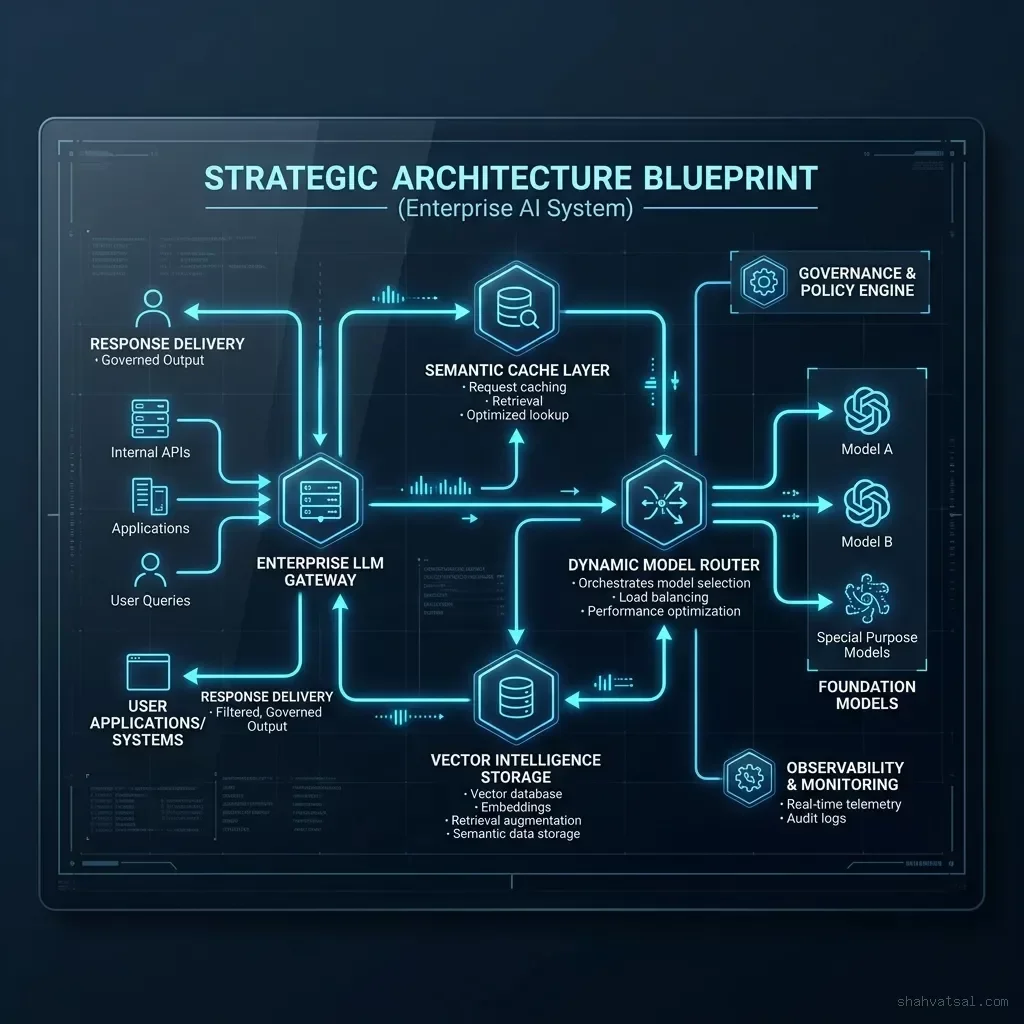
 System Visualization: AI Model Routing & Cost Optimization Engine
Architecture
The foundation of the turnaround was the new centralized architecture. All department-level AI queries were routed through the Zenith Gateway, enabling real-time auditing and semantic caching.

Architecture: High-Fidelity Infrastructure Design
| Condition | Route To | Fallback | Cost/1K | Enabled |
|---|---|---|---|---|
| tokens < 500 && task=summarize | llama-3-finserv | gpt4o-mini | $0.002 | |
| task=complex_analysis | azure-gpt4o | claude-3.5 | $0.015 | |
| task=embedding | text-emb-3-large | ada-002 | $0.00013 | |
| semantic_cache_hit=true | cache | — | $0.000 | |
| compliance_flag=true | azure-gpt4o (audit) | none | $0.015 |
| Query Pattern | Hits | Similarity Threshold | TTL | Saved Tokens |
|---|---|---|---|---|
| "Summarize Q2 earnings call transcript" | 284 | 0.92 | 24h | 142K |
| "What is our Basel IV capital ratio?" | 218 | 0.95 | 4h | 109K |
| "Explain SOFR transition impact" | 196 | 0.91 | 48h | 98K |
| "List high-risk counterparties" | 142 | 0.97 | 1h | 71K |
| "Draft regulatory filing boilerplate" | 124 | 0.93 | 72h | 62K |
| App Name | BU | Model | Monthly Cost | Requests/day | Status | |
|---|---|---|---|---|---|---|
| FraudDetect Pro | Risk | gpt4o | $24,400 | 480,000 | Active | |
| ComplianceCopilot | Legal | llama-3-finserv | $1,200 | 28,000 | Active | |
| SupportBot v2 | Customer | gpt4o-mini | $3,400 | 92,000 | Active | |
| LegacyAnalyzer | IT | gpt-3.5 (old) | $0 | 0 | Deprecated | |
| ShadowReports | Unknown | azure-gpt4 (direct) | $2,800 | 14,000 | Shadow |
| Business Unit | Apps | Spend | Budget | Variance | Trend |
|---|---|---|---|---|---|
| Risk & Fraud | 48 | $498K | $520K | ▼ $22K | ↓ 4% |
| Customer & CX | 36 | $212K | $200K | ▲ $12K | ↑ 6% |
| Compliance / Legal | 28 | $148K | $160K | ▼ $12K | ↓ 8% |
| Research | 14 | $187K | $180K | ▲ $7K | Flat |
| Operations / IT | 22 | $89K | $100K | ▼ $11K | ↓ 11% |
| Shadow AI | 4 | $166K | $0 | Unauthorized | Escalated |
| Timestamp | Event | App | User | Model Used | DLP Action | Hash (Snowflake) |
|---|---|---|---|---|---|---|
| 09:14:24 | REQUEST | FraudDetect Pro | sys-agent | azure-gpt4o | Clean | a8f3b2c1d4e5 |
| 09:14:22 | DLP_BLOCK | ShadowReports | r.chen | azure-gpt4 (direct) | SSN blocked | c2e9d4f8a1b3 |
| 09:14:18 | REQUEST | ComplianceCopilot | l.torres | llama-3-finserv | Clean | f7a1c8b2d3e4 |
| 09:14:15 | CACHE_HIT | SupportBot v2 | sys-agent | cache | N/A | 3b8e2f1a7c9d |
| Framework | Controls | Passed | Evidence Items | Status |
|---|---|---|---|---|
| HIPAA — PHI Protection | 14 | 14 | 42 items | Compliant |
| SOC 2 Type II — AI Systems | 18 | 18 | 86 items | Compliant |
| FINRA — Supervisory Controls | 10 | 9 | 31 items | 1 Gap |
| OCC AI Risk Guidance | 8 | 8 | 24 items | Compliant |
| GDPR — Data Processing | 12 | 12 | 36 items | Compliant |
| App Name | Department | API Used | Est. Monthly Cost | Risk | Detected | Action |
|---|---|---|---|---|---|---|
| ShadowReports | Finance — R. Chen | Azure OpenAI (direct) | $2,800 | High | Jun 20 | |
| QuickSummarize | Legal — unknown | ChatGPT API | $420 | Medium | Jun 18 | |
| TradingBot | Research — T. Morel | Anthropic API | $1,200 | High | Jun 17 | |
| MeetingAI | HR — Unknown | OpenAI Whisper | $180 | Low | Jun 15 |