STRATEGIC OVERVIEW
The $0 Developer: Economics of the 100% Agentic Workforce By Vatsal Shah · June 12, 2026 · Business / Economics Table of Contents 1. The Demise of the Headcount-Centric Software Model 2. The Structural Inefficiencies of Human Engineering Teams 3.
The $0 Developer: Economics of the 100% Agentic Workforce
By Vatsal Shah · June 12, 2026 · Business / Economics
Table of Contents
- The Demise of the Headcount-Centric Software Model
- The Structural Inefficiencies of Human Engineering Teams
- The Marginal Cost of Code: Why Software is Becoming Too Cheap to Meter
- Mathematical Formulation of Token Economics
- Managing the Digital Ghost Workforce: 24/7 Operations Without Payroll
- Self-Healing Architecture and Tool Negotiation Dynamics
- The Sovereign Founder: Scaling Equity Without Dilution
- The Autonomous P&L: Comparing Human-Heavy and Agentic Models
- Detailed P&L Line Item Breakdown and Regulatory Capitalization
- Architecting the Autonomous Enterprise
- The Risk and Reward Dynamics of Agentic Workforces
- The 2027–2030 Transition Roadmap
- What to Do Monday Morning
- Frequently Asked Questions
- Headcount Shift: Software development is transitioning from a cost-per-head model to a compute-per-task model, decoupling execution scale from payroll growth.
- The $0 Marginal Cost: AI agent execution drops the marginal cost of code close to zero, fundamentally altering the economics of maintaining and extending legacy enterprise systems.
- Digital Ghost Workforce: Asynchronous, self-healing agent fleets operate continuously, reducing coordination overhead and accelerating software delivery lifecycles.
- Equity Sovereignty: Individual founders and small teams can retain 100% of corporate equity while leveraging agentic architectures to achieve billion-dollar operational scale.
- LAM (Large Action Model): An AI model trained to understand and execute complex actions on user interfaces and APIs, bridging the gap between text reasoning and active system manipulation.
- MCP (Model Context Protocol): A standardized, open protocol enabling foundation models to dynamically discover, query, and integrate external tools, data sources, and context windows.
- RSC (React Server Components): A modern web rendering architecture where UI components execute and render on the server, minimizing client-side JavaScript payloads.
- LAM Loops: Repetitive, cyclic execution paths where an agent receives system state, reasons, chooses a tool, evaluates the outcome, and iterates until the target goal is met.
- Stateful Graphs: Architectural data structures that track agent execution state, branch decisions, and recovery paths across long-horizon processes.
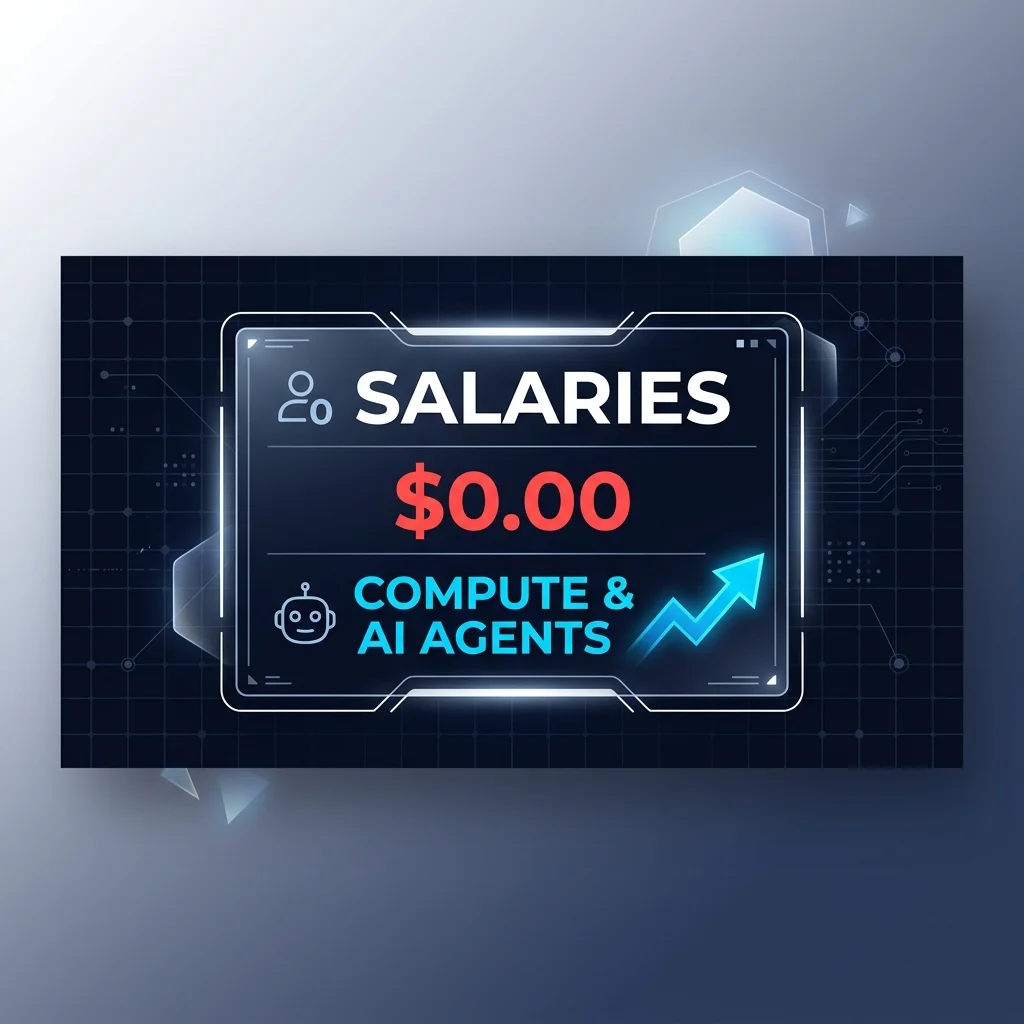
The Demise of the Headcount-Centric Software Model
For over half a century, the software industry has operated on a linear economic assumption: if you want to write more software, maintain larger systems, or build more features, you must hire more engineers. Headcount was the primary proxy for capability. When venture capitalists evaluated startups, "engineering team size" was cited as a major metric of enterprise value.
In 2026, this headcount-centric model has collapsed. The linear link between software output and payroll has been broken by autonomous agent fleets. Organizations are realizing that human developers, while highly capable of creative architectural design and complex problem solving, represent a significant operational bottleneck when it comes to repetitive code generation, testing, dependency management, and routine updates.
Historically, software development went through three major phases of scaling:
- The Artisan Phase (1960–1990): Code was crafted by individual specialists directly on hardware. Teams were tiny, and systems scaled through sheer programmer focus.
- The Industrial Outsourcing Phase (1990–2015): Companies scaled engineering capacity by moving R&D centers to low-cost regions. While payroll grew, unit costs dropped, but at the cost of high communication latency and integration fragmentation.
- The Agile SaaS Wave (2015–2025): Development cycles shortened with CI/CD and DevOps. However, payroll costs reached historic highs, with engineering salaries eating up 50% to 70% of a typical SaaS startup's operating budget.
Today, we are entering the fourth phase: Autonomous Synthesis. In this phase, code is synthesized directly in isolated sandboxes by agents running at scale. The cost structure shifts from capital-expenditure labor overhead to operational-expenditure compute consumption.
The Structural Inefficiencies of Human Engineering Teams
To evaluate the economic shift, we must look beyond basic salaries. A senior software engineer in the United States or Europe does not just cost their base wage. When you calculate the fully loaded cost, you must include:
- Recruiting and Onboarding Friction: The average time-to-hire for a senior engineer is 42 days, with recruiting agency fees averaging 15% to 22% of first-year salary. Once hired, onboarding takes 3 to 6 months before the engineer achieves full operational velocity. Human employees require continuous management, periodic reviews, conflict resolution, and career path alignment, creating massive organizational overhead.
- Benefits and Overhead: Payroll taxes, health insurance, retirement matching, office space, hardware, software licenses, and administrative support add an average of 30% to 40% on top of base salary.
- Coordination Overhead: According to Brooks' Law, adding programmers to a late software project makes it later. In a team of $N$ people, the number of communication channels scales quadratically:
$$C = \frac{N(N-1)}{2}$$
As teams grow, engineers spend less time writing code and more time in meetings, writing status updates, resolving merge conflicts, and aligning on API contracts.
- Context Switching and Fatigue: Humans require sleep, vacations, and mental breaks. A single context switch (e.g., stopping work to attend a daily standup) costs an engineer an average of 23 minutes of focused deep-work time.
Furthermore, human teams are bounded by biological working hours. Even with international distributed teams, time-zone alignment meetings introduce delays. A critical hotfix might sit in a pull request queue for 12 hours waiting for a review because the team in San Francisco is asleep while the team in Bangalore is online.
By contrast, an AI agent fleet does not require recruiting pipelines, benefits, or alignment meetings. It operates directly at the execution layer, scales up or down instantly in response to queue volume, and communicates asynchronously via structured JSON payloads, bypassing human coordination bottlenecks.
The Marginal Cost of Code: Why Software is Becoming Too Cheap to Meter
In classical economics, the marginal cost is the cost added by producing one additional unit of a product. In traditional software development, the marginal cost of reproducing software (copying a compiled binary or serving a web page) is zero. However, the marginal cost of producing new software (writing a new feature, fixing a bug, writing a database migration) has always been high, dictated by the hourly rate of the human engineer.
With the advent of autonomous agentic systems, the marginal cost of producing code is trending toward zero. We are entering an era where software is becoming "too cheap to meter."
The Token Math of Agentic Code Production
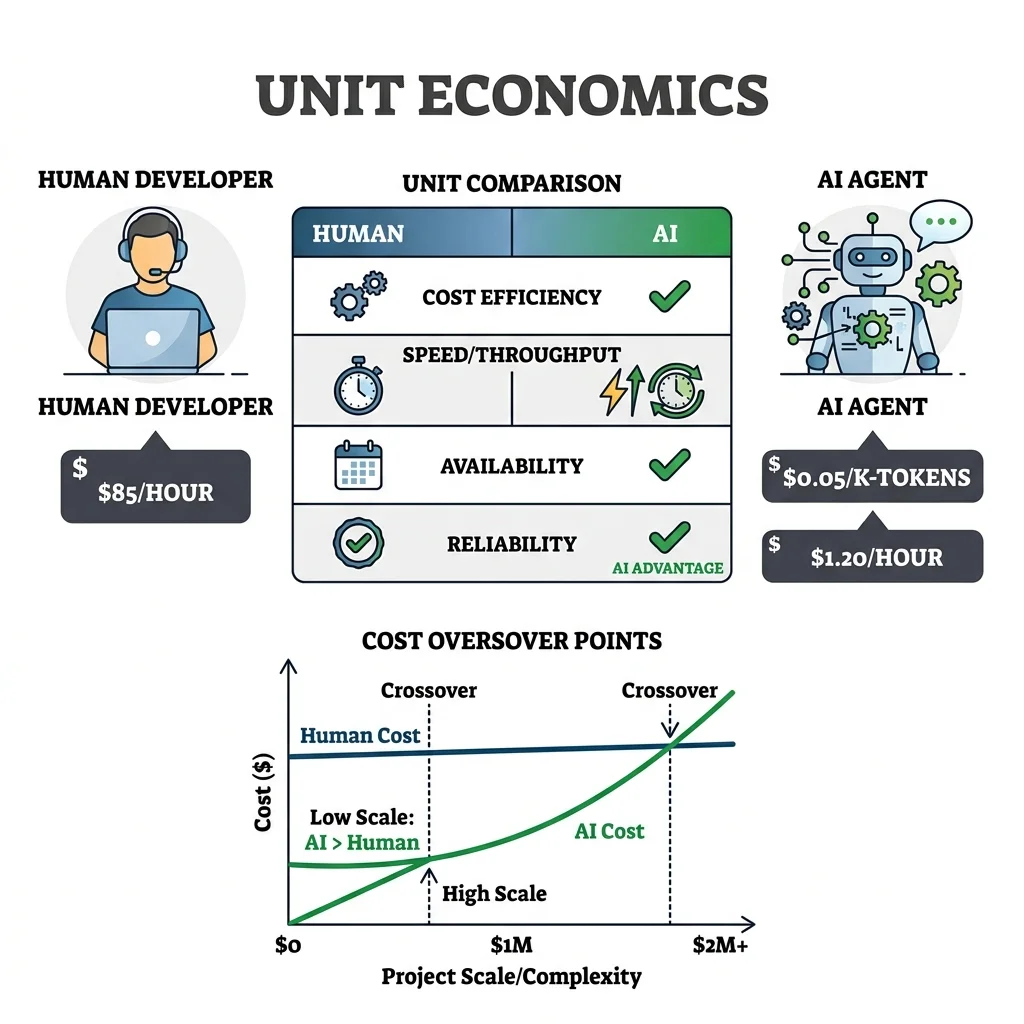
To understand why the cost is dropping so dramatically, let's examine the token economics of an agentic run. Consider a standard bug-fixing task: an agent receives a bug report, reads the relevant codebase files, reasons about the fix, writes a patch, runs the test suite, and submits a pull request.
Let's compare the financial cost of this workflow using standard API pricing for a leading frontier model (e.g., $10 per million input tokens, $30 per million output tokens):
- Input Context: 100,000 tokens of codebase context (files, schemas, test outputs) = $1.00
- Output Generation: 4,000 tokens of reasoning steps and patch code = $0.12
- Agent Loops: 3 iterative correction loops to fix failing tests = $3.36
- Total Execution Cost: $4.48
A senior human developer executing the same fix might take 3 hours. At a fully loaded rate of $85/hour, the human cost is $255.00. The agent achieves the same functional result at 1.75% of the financial cost, and completes the work in under 3 minutes compared to the human's 3 hours.
As model efficiency increases and hardware acceleration scales, these token costs are dropping by 50% to 70% annually. By 2027, the financial cost of an agentic code run will fall below $0.50, representing a complete dematerialization of software engineering costs.
Mathematical Formulation of Token Economics
To formalize this model, we can represent the cost of software development as a function of task complexity and execution time.
Let the cost of human development for a set of tasks $T$ be represented by:
$$C_{human}(T) = \sum_{t \in T} \left( H_t \cdot R_{fully\loaded} \right) + K{coordination}(N)$$
Where:
- $H_t$ is the human hours spent on task $t$.
- $R_{fully\_loaded}$ is the fully loaded hourly rate of a developer.
- $K_{coordination}(N)$ is the coordination cost as a function of team size $N$.
For an agentic workforce, the cost function becomes:
$$C_{agent}(T) = \sum_{t \in T} \sum_{i=1}^{L_t} \left( T_{in\i} \cdot P{in} + T_{out\i} \cdot P{out} \right) + C_{sandbox}$$
Where:
- $L_t$ is the number of execution loops required to complete task $t$.
- $T_{in\_i}$ is the input token count for loop $i$.
- $T_{out\_i}$ is the output token count for loop $i$.
- $P_{in}$ and $P_{out}$ are the unit pricing rates per token.
- $C_{sandbox}$ is the container resource runtime cost.
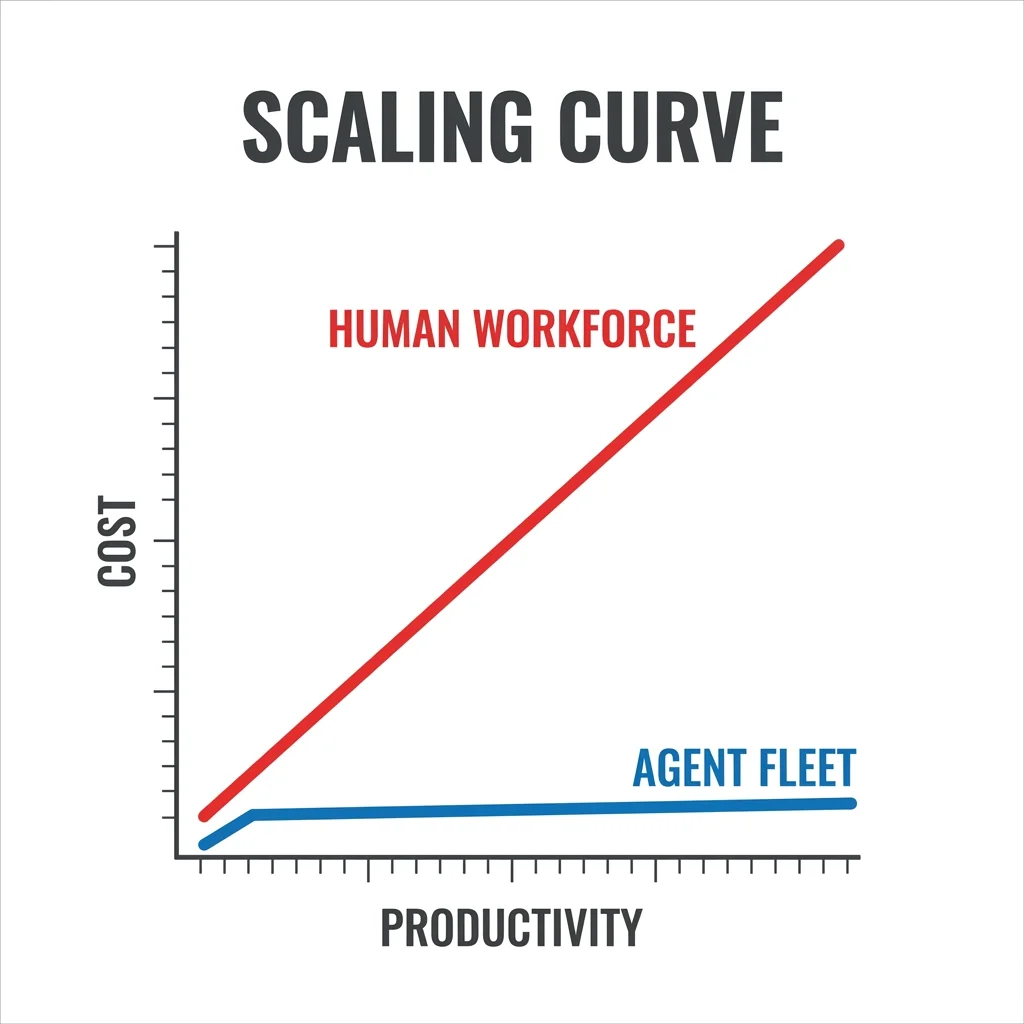
Because $P_{in}$ and $P_{out}$ are orders of magnitude smaller than $R_{fully\loaded}$, and $K{coordination}$ drops to zero because agent interactions are managed asynchronously by local pipelines, $C_{agent}(T)$ scale remains flat even as task volume and execution scale grow.
Managing the Digital Ghost Workforce: 24/7 Operations Without Payroll
The shift to an agentic workforce introduces the concept of the "Digital Ghost Workforce." These are autonomous agents that run continuously in the background of your enterprise systems, monitoring queues, refactoring code, patching security vulnerabilities, and responding to production alerts without human intervention.
Decentralized Asynchronous Workflows
In a traditional engineering organization, work is highly synchronous. Developers wait for code reviews, product managers wait for feature mockups, and QA testers wait for staging deployments. This synchronization creates massive latency in the software development lifecycle (SDLC).
An agentic workforce operates asynchronously. Because agents can read, write, and execute code simultaneously across thousands of isolated sandboxes, they do not block each other. If a test fails, the testing agent spawns a debugging subagent, which writes a patch, tests it, and returns the result to the main coordinator.
The following Python example demonstrates a lightweight asynchronous supervisor agent that monitors a task queue, spawns worker agents, and handles task routing dynamically:
import asyncio
import json
import logging
from typing import Dict, Any

logging.basicConfig(level=logging.INFO)
logger = logging.getLogger(class="tok-str">"GhostWorkforce")

class AgentSupervisor:
    class="tok-kw">def __init__(self, task_queue: asyncio.Queue):
        self.task_queue = task_queue
        self.active_workers = 0

    async class="tok-kw">def start(self):
        logger.info(class="tok-str">"[Supervisor] Initializing Digital Ghost Workforce...")
        while True:
            task = await self.task_queue.get()
            logger.info(fclass="tok-str">"[Supervisor] Dispatching Task: {task[&class="tok-cm">#039;id']} - {task['type']}")
            asyncio.create_task(self.spawn_worker(task))
            self.task_queue.task_done()

    async class="tok-kw">def spawn_worker(self, task: Dict[str, Any]):
        self.active_workers += 1
        worker_id = fclass="tok-str">"worker_{self.active_workers}"
        logger.info(fclass="tok-str">"[{worker_id}] Initializing agent for task: {task[&class="tok-cm">#039;id']}")

        try:
            class="tok-cm"># Simulate agent reasoning and execution loop
            await asyncio.sleep(1.5)
            logger.info(fclass="tok-str">"[{worker_id}] Analyzing codebase files using MCP...")
            await asyncio.sleep(2.0)

            class="tok-cm"># Simulated tool call execution
            result = {class="tok-str">"status": class="tok-str">"success", class="tok-str">"patch_size_bytes": 1024, class="tok-str">"tests_passed": True}

            logger.info(fclass="tok-str">"[{worker_id}] Task {task[&class="tok-cm">#039;id']} completed successfully. Result: {json.dumps(result)}")
        except Exception as e:
            logger.error(fclass="tok-str">"[{worker_id}] Critical failure on task {task[&class="tok-cm">#039;id']}: {e}")
        finally:
            self.active_workers -= 1

async class="tok-kw">def main():
    queue = asyncio.Queue()
    class="tok-cm"># Populate queue with some software development tasks
    for i in range(1, 6):
        await queue.put({
            class="tok-str">"id": fclass="tok-str">"task_{100+i}",
            class="tok-str">"type": class="tok-str">"REFRACTOR_TELEMETRY" if i % 2 == 0 else class="tok-str">"FIX_SQL_INJECTION",
            class="tok-str">"priority": class="tok-str">"HIGH"
        })

    supervisor = AgentSupervisor(queue)
    await supervisor.start()

if __name__ == class="tok-str">"__main__":
    asyncio.run(main())
This asynchronous execution pattern allows enterprises to compress weeks of development time into hours, running continuous integration and deployment loops at scale without payroll costs.
Self-Healing Architecture and Tool Negotiation Dynamics
The operational magic of the digital ghost workforce lies in self-healing architectures. When a system crashes or an alert triggers, instead of paging an on-call engineer at 3:00 AM, the runtime orchestrator spawns a recovery agent.
This recovery agent:
- Reads Logs: Dynamically connects to logging services (Elasticsearch, Loki) via MCP.
- Isolates Bug: Identifies the exact stack trace and related repository code.
- Spawns Sandbox: Launches a clean container mimicking the staging environment.
- Negotiates Tools: Uses MCP to connect to the SQL parser, test runners, and deployment endpoints.
- Applies Patch: Edits the source code, validates tests, and deploys.
This self-healing cycle happens in less than a minute. The human engineers wake up to a Git pull request and a clean deployment log, rather than a broken system and angry customers.
The Sovereign Founder: Scaling Equity Without Dilution
One of the most profound business implications of the agentic workforce is the rise of the Sovereign Founder. In the past, if a founder wanted to build a large-scale software business, they had to raise millions of dollars in venture capital to hire an engineering team. This capital came at the cost of massive equity dilution. By the time the company reached an exit, the founders often owned less than 10% of their business.
Today, a single founder can leverage an agentic workforce to write the code, manage the infrastructure, handle marketing, and support customers. They can build a "Company of One" that generates millions in revenue while retaining 100% of the equity.
Equity Dilution vs. Compute Spend
Let's look at the financial math of a startup scaling to $5M in annual recurring revenue (ARR):
- Traditional VC Route:
- Raise $1.5M Seed Round (gives up 20% equity)
- Hire 8 human developers, 1 PM, 1 designer, 1 support rep (Payroll: $1.2M/year)
- Raise $5M Series A to scale (gives up another 20% equity)
- Founder equity after Series A: ~60% (split among co-founders)
- Monthly operational cash burn: $120,000
- Sovereign Founder Route:
- Bootstraps with personal savings or small grant
- Builds core architecture using an agentic IDE and MCP-based code agents
- Deploys an agent fleet to handle customer tickets, server infrastructure, and localized deployments
- Monthly compute cost (API tokens + hosting): $4,500
- Founder equity: 100%
- Monthly operational cash burn: $5,000
By swapping human salaries for compute resources, the founder converts a massive, fixed monthly payroll expense into a variable compute cost that scales directly with product usage. If customer demand drops, they scale down their active agent instances instantly, reducing operational expenses to near-zero. They avoid the risk of layoffs, payroll shortfalls, and equity dilution.
Historically, companies like WhatsApp scaled to 450 million users with only 55 engineers. In the agentic era, that ratio will drop even further. We will see companies with a single human founder reaching unicorn status ($1B+ valuation) by leveraging thousands of coordinated background agents.
The Autonomous P&L: Comparing Human-Heavy and Agentic Models
To ground this shift in corporate finance, let's analyze how this transition affects the Profit and Loss (P&L) statement of a mid-sized software enterprise. We will compare two companies: LegacySoft Co. (operating a traditional human-heavy engineering organization) and SovereignCorp (operating a fully agentic workforce). Both generate $20,000,000 in annual revenue.
| P&L Line Item | LegacySoft Co. (Human-Heavy) | SovereignCorp (Agent-Only) | Variance Notes |
|---|---|---|---|
| Gross Revenue | $20,000,000 | $20,000,000 | Both match on market size and sales velocity. |
| Cost of Goods Sold (COGS) | $3,200,000 (16% of Rev) | $1,800,000 (9% of Rev) | SovereignCorp benefits from automated cloud resource optimization. |
| R&D Payroll (Engineering) | $9,500,000 (65 FTEs) | $340,000 (2 Architect FTEs) | 96.4% reduction in payroll costs. Human roles shift to oversight. |
| Compute & Token Costs | $150,000 (basic licenses) | $820,000 (agent API tokens) | SovereignCorp spends heavily on compute instead of salaries. |
| SG&A (Sales, Marketing, HR) | $4,100,000 | $650,000 | Agentic marketing pipelines and zero HR administration costs. |
| Operating Profit (EBITDA) | $3,050,000 (15.2% Margin) | $16,390,000 (81.9% Margin) | SovereignCorp achieves software profit margins comparable to SaaS utility costs. |
The contrast in EBITDA margin (15.2% vs 81.9%) is staggering. By shifting R&D expenses from fixed labor overhead to variable compute costs, SovereignCorp is not only more profitable but also resilient to market downturns. If revenue drops, the compute spend immediately declines in lockstep, preserving cash flow.
Detailed P&L Line Item Breakdown and Regulatory Capitalization
To satisfy regulatory standards like US GAAP (ASC 350-40) or IFRS (IAS 38), corporate finance departments must classify software development costs as either Capital Expenditures (CapEx) or Operating Expenditures (OpEx).
In a human-heavy R&D model, companies use developer timesheets to capitalize a portion of engineering salaries as CapEx:
- Human CapEx: Hours spent on building new features are capitalized to the balance sheet and amortized over 3–5 years, artificially boosting short-term operating profit.
- Human OpEx: Hours spent on bug fixes, server maintenance, and general support are directly expensed, reducing current period EBITDA.
In an agentic workforce model, this accounting logic shifts. Because agents log their execution runs with exact token and API trace metadata, companies can programmatically audit R&D costs down to the byte:
- Agentic CapEx: Token costs associated with the initialization and synthesis of new features are automatically tagged, capitalized as internal-use software development costs, and amortized.
- Agentic OpEx: General background execution, unit test verification runs, and self-healing patches are categorized as operational maintenance.
This high-fidelity trace capability eliminates manual timesheets, provides auditors with clean execution logs, and allows CFOs to dynamically track and optimize CapEx/OpEx ratios in real time.
Architecting the Autonomous Enterprise
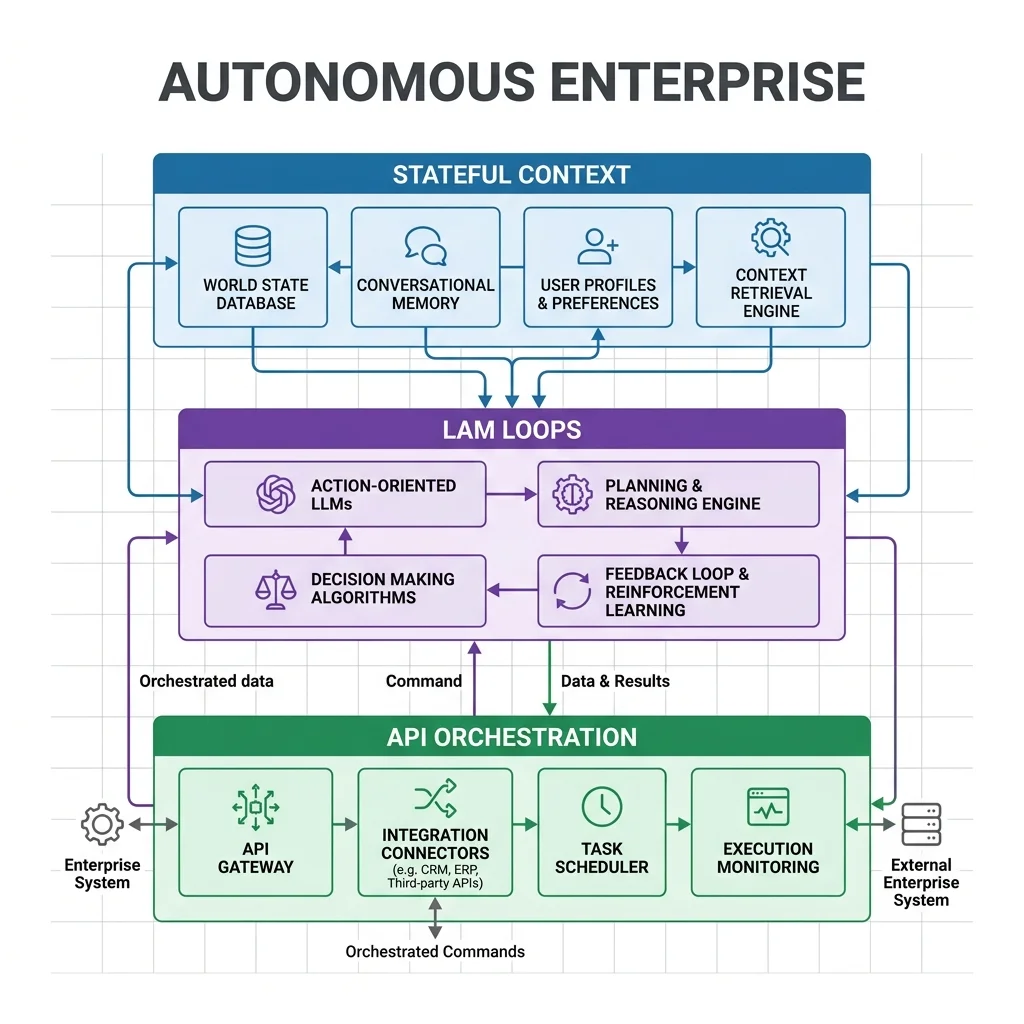
To transition from a human-driven organization to an agentic workforce, you cannot simply hand developers a chat interface and expect cost savings. You must build an Autonomous Enterprise Architecture that connects models directly to your operating environment via standardized protocols.
The core architecture rests on three pillars:
- Model Context Protocol (MCP): Providing foundation models with secure access to files, databases, and services.
- Stateful Execution Graphs: Orchestrating agent interactions so they can execute multi-step tasks without losing context or getting stuck in loops.
- Execution Layer Security: Running agent operations in isolated sandbox environments to prevent malicious code execution or data breaches.
Standardized Tool Integration (MCP)
Rather than writing custom API wrappers for every database and deployment tool, the autonomous enterprise leverages MCP. An agent queries the local network, discovers available MCP servers, reads their schemas, and executes tool calls natively.
The following TypeScript code illustrates how an enterprise gateway agent uses MCP to dynamically resolve tools and perform database queries:
import { Client } from "@modelcontextprotocol/sdk";
import { Database } from "sqlite3";

class CoreAgentEngine {
  private mcpClient: Client;
  private db: Database;

  constructor(dbPath: string) {
    this.db = new Database(dbPath);
    this.mcpClient = new Client({
      name: "EnterpriseGatewayAgent",
      version: "1.0.0"
    });
  }

  public async initialize() {
    console.log("[Agent Core] Initializing database connection...");
    await this.connectDatabase();

    console.log("[Agent Core] Establishing Model Context Protocol session...");
    await this.mcpClient.connect();

    // Register local tools via MCP schema
    this.mcpClient.registerTool({
      name: "query_inventory",
      description: "Queries the corporate database for product inventory counts.",
      execute: async (args: { sku: string }) => {
        return this.queryInventory(args.sku);
      }
    });
  }

  private queryInventory(sku: string): Promise<string> {
    return new Promise((resolve, reject) => {
      this.db.get("SELECT quantity FROM inventory WHERE sku = ?", [sku], (err, row: any) => {
        if (err) {
          reject(err);
        } else {
          resolve(JSON.stringify({ sku, quantity: row ? row.quantity : 0 }));
        }
      });
    });
  }

  private connectDatabase(): Promise<void> {
    return new Promise((resolve, reject) => {
      this.db.serialize(() => resolve());
    });
  }
}

// Instantiate and initialize agent core
const engine = new CoreAgentEngine("./data/enterprise.db");
engine.initialize().then(() => {
  console.log("[Agent Core] Agent is active and listening for execution tasks.");
});
By using standardized MCP boundaries, you create a plug-and-play environment where new tools and agents can be added to your system without breaking existing integration code.
The Risk and Reward Dynamics of Agentic Workforces
Every major architectural shift introduces trade-offs. While the economics of an agentic workforce are compelling, organizations must evaluate the risks associated with deploying autonomous code executors.
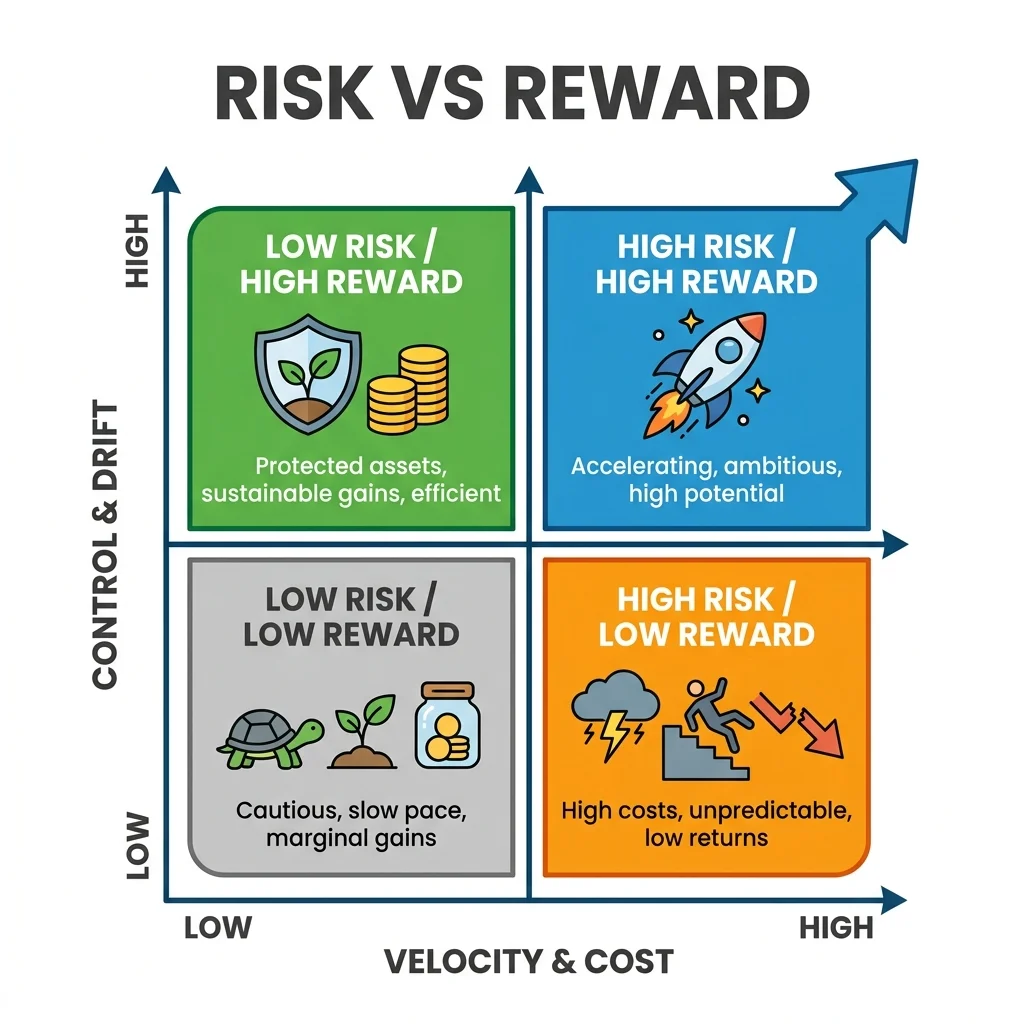
Let's examine the primary risk vectors:
- Prompt Drift and Context Decay: In long-horizon execution runs, agents can experience context decay. The model may lose track of the main instruction and begin generating incorrect code or looping on the same tool call. Mitigating this requires implementing structured stateful graphs that validate output correctness at every step.
- Security Vulnerabilities (OWASP Top 10 for GenAI): Giving an LLM direct access to write and run code opens up security risks. An attacker could inject malicious instructions into a database field (Prompt Injection) that tricks the database-reading agent into executing system commands or exposing secrets.
- Loss of Intellectual Property: If you run your agent loops through external APIs without enterprise agreements, your proprietary codebase could be used to train future public models.
- Maintenance of Agent Code: While agents generate software, humans must still maintain the prompt templates, graph definitions, and sandboxed runtimes. If the underlying models update their APIs or change their reasoning behaviors, the agent code can break.
To mitigate these issues, enterprises must build robust runtime guardrails, use local/fine-tuned models for sensitive operations, and enforce human-in-the-loop validation for high-risk actions (e.g., merging code to production or executing financial transactions).
The 2027–2030 Transition Roadmap
The transition to a fully agentic workforce will not happen overnight. It is a multi-phase evolution that requires organizations to gradually build capability, trust, and safety guardrails.
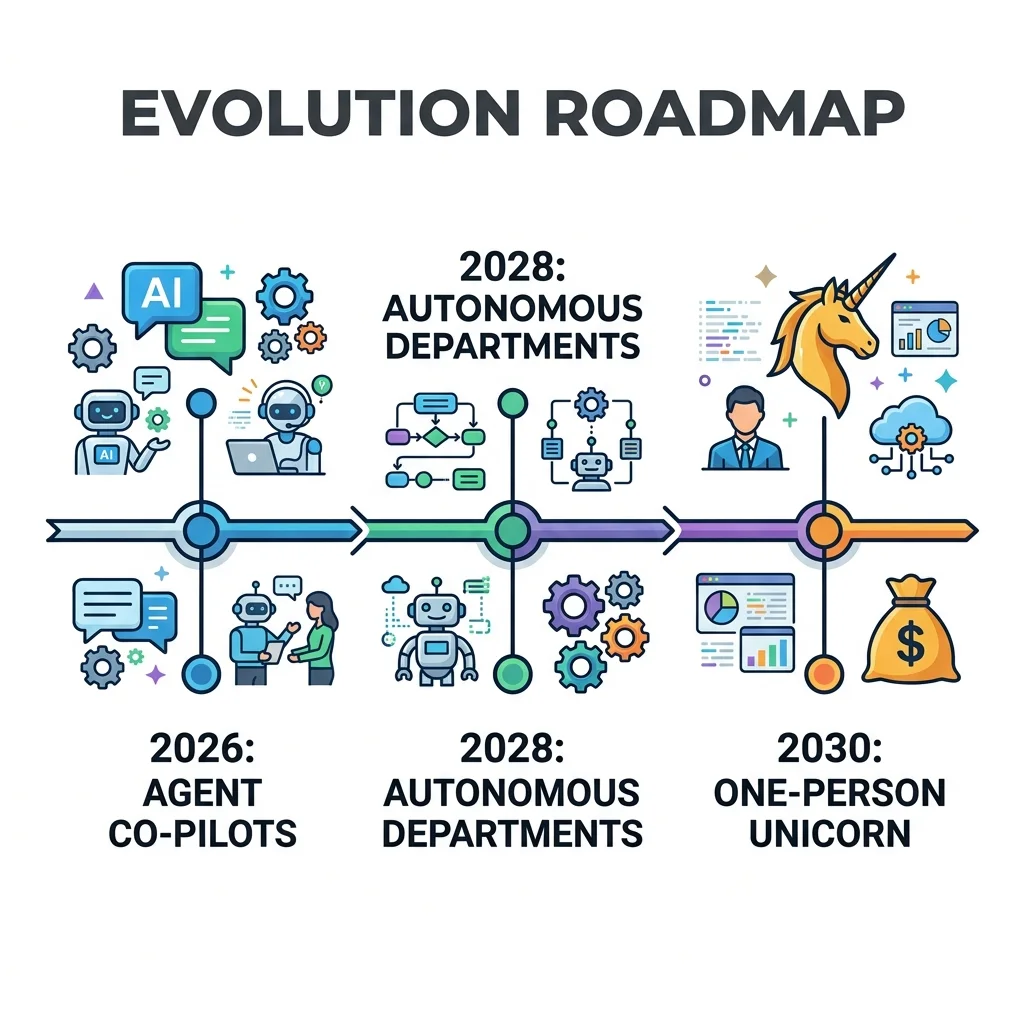
Here is the transition roadmap for the next four years:
Phase 1: Agentic Co-Pilots (2026)
- Objective: Standardize on agentic IDEs and local model pipelines to accelerate human developers.
- Milestone: Human engineers use autonomous tools to handle testing, documentation, and routine code generation, doubling individual output.
- Focus: Integrating MCP servers for databases, APIs, and cloud consoles.
Phase 2: Autonomous Departments (2028)
- Objective: Establish independent, agent-driven operational units within the enterprise.
- Milestone: Tasks like bug triaging, dependency updates, and continuous security patching are fully delegated to agent fleets.
- Focus: Implementing stateful execution graphs and isolated sandbox runtimes to safely run LAM loops.
Phase 3: One-Person Unicorns (2030)
- Objective: The emergence of multi-million dollar software enterprises owned and operated by a single human.
- Milestone: A single founder uses a unified agent control plane to design, deploy, scale, and support a global SaaS platform serving millions of users.
- Focus: Advanced cognitive orchestration platforms, zero-latency model routing, and decentralized compute markets.
What to Do Monday Morning
To prepare your engineering organization or startup for the agentic economy, you cannot afford to wait. You must take concrete steps to align your architecture and team structure.
1. Audit Your SDLC for Bottlenecks
Examine your current development lifecycle. Identify where code reviews, test runs, or environment setup steps create idle time for developers. Focus on automating these handoffs first.
2. Standardize on Model Context Protocol (MCP)
Before building new internal developer APIs, ensure they are wrapped in MCP schemas. This makes them immediately discoverable and usable by autonomous agents.
3. Deploy Sandboxed Execution Environments
Begin building isolated container runtimes (e.g., using Docker or gVisor) where code-generation tools and agents can safely run, compile, and test code without exposing your main servers.
Frequently Asked Questions
Will AI agents replace human developers entirely? +
AI agents will handle the majority of routine code generation, maintenance, testing, and deployment. Human roles will shift from writing code syntax to system architecture, security auditing, product design, and business logic definition.
How do token costs scale as codebases grow? +
Token costs scale with context size. To prevent cost drift, organizations must implement semantic file search, codebase indexing, and context compression so that agents only load files relevant to their active task instead of the entire project repository.
Is the code generated by agents secure? +
Not automatically. Agentic code must run through automated static analysis (SAST) and security testing frameworks in sandboxed environments. Humans must audit high-impact security configurations and database schemas.
Developer: Economics of the 100% Agentic Workforce — practitioner notes from the architecture room.
LINKEDIN_BODY:
- The
Developer: Economics of the 100% Agentic Workforce — practitioner notes from the architecture room.
LINKEDIN_BODY:
- The
Developer: Economics of the 100% Agentic Workforce — practitioner notes from the architecture room.
LINKEDIN_BODY:
- The
Developer: Economics of the 100% Agentic Workforce — practitioner notes from the architecture room.
LINKEDIN_BODY:
- The
Developer: Economics of the 100% Agentic Workforce — practitioner notes from the architecture room.
LINKEDIN_BODY:
- The
Developer: Economics of the 100% Agentic Workforce — practitioner notes from the architecture room.
LINKEDIN_BODY:
- The
Developer: Economics of the 100% Agentic Workforce — practitioner notes from the architecture room.
LINKEDIN_BODY:
- The
Developer: Economics of the 100% Agentic Workforce — practitioner notes from the architecture room.
LINKEDIN_BODY:
- The
Developer: Economics of the 100% Agentic Workforce — practitioner notes from the architecture room.
LINKEDIN_BODY:
- The
Developer: Economics of the 100% Agentic Workforce — practitioner notes from the architecture room.
LINKEDIN_BODY:
- The
Developer: Economics of the 100% Agentic Workforce — practitioner notes from the architecture room.
LINKEDIN_BODY:
- The
Developer: Economics of the 100% Agentic Workforce — practitioner notes from the architecture room.
LINKEDIN_BODY:
- The
Developer: Economics of the 100% Agentic Workforce — practitioner notes from the architecture room.
LINKEDIN_BODY:
- The