Post-Training Engineering: RLHF, DPO, and Constitutional AI for Enterprise Model Alignment in 2026
By Vatsal Shah | August 4, 2026 | 16 min read
Table of Contents
- The Post-Training Shift: From Academic Art to Industrial Discipline
- Understanding the Post-Training Pipeline Architecture
- The Alignment Triad: RLHF (PPO) vs. DPO vs. GRPO
- Constitutional AI & RLAIF: Principles-Based Alignment
- Reward Modeling & Domain-Specific Quality Signals
- Decision Framework: Midtraining vs. SFT vs. DPO vs. RAG
- LoRA Adapters vs. Full Fine-Tuning for Alignment
- Preventing Reward Hacking & Policy Drift in Autonomous Agents
- The Modern Toolchain: Hugging Face TRL, OpenRLHF, and Unsloth
- Production Alignment Code (Python & Hugging Face TRL)
- Enterprise Case Study: Regulated Finance & Legal Alignment
- Deep Analysis: Alignment Method Decision Matrix
- Pitfalls & Anti-Patterns in Enterprise Alignment
- 2027–2030 Roadmap: The Future of Post-Training Engineering
- Key Takeaways
- FAQ
- About the Author
- Conclusion & Strategic Call to Action
The Post-Training Shift: From Academic Art to Industrial Discipline {#shift}
In 2023, pretraining was king. The AI industry spent billions of dollars scaling base models on trillions of web tokens. But by 2026, a fundamental realization reshaped enterprise AI: Pretraining gives a model knowledge, but Post-Training gives a model character, safety, reasoning, and domain utility.
A raw 70B parameter base model is essentially a massive autocomplete engine. It knows historical facts, programming syntax, and human grammar, but it cannot follow complex enterprise instructions, adhere to legal compliance guardrails, or output deterministic JSON structures reliably.
At the AI Engineer World's Fair 2026 in San Francisco (attended by over 6,000 AI systems engineers), Post-Training Engineering emerged as the primary competitive differentiator for enterprise AI teams. Rather than spending tens of millions pretraining proprietary base models from scratch, forward-thinking organizations take open-weights foundation models (such as Llama 4, Mistral, and Qwen 3) and apply precise post-training pipelines to align them for specialized enterprise workloads.
Post-training is no longer a collection of academic Reinforcement Learning from Human Feedback (RLHF) experiments. It is an industrial software engineering discipline encompassing Supervised Fine-Tuning (SFT), Direct Preference Optimization (DPO), Group Relative Policy Optimization (GRPO), Constitutional AI (RLAIF), and automated reward modeling.
This comprehensive guide provides an enterprise practitioner's breakdown of post-training methodologies, mathematical trade-offs, preventing reward hacking, and hands-on PyTorch code using the modern open-source toolchain.
AI SUMMARY — This practitioner guide breaks down Post-Training Engineering for enterprise LLM alignment: (1) the structural shift from pretraining to post-training alignment, (2) mathematical and architectural comparisons of RLHF (PPO), DPO, and GRPO, (3) Constitutional AI (RLAIF) feedback loops for regulated industries, (4) decision frameworks for choosing between Prompting, SFT, DPO, and Midtraining, (5) preventing reward hacking using KL-divergence anchors, and (6) production Python code using Hugging Face TRL and Unsloth.
Understanding the Post-Training Pipeline Architecture {#pipeline-architecture}
Definition — Post-Training Engineering is defined as the multi-stage optimization process applied to a pretrained base Large Language Model (LLM) to align its outputs with human intent, safety guidelines, formatting constraints, and domain-specific quality metrics. The standard pipeline consists of four sequential stages: (1) Base Pretrained Weights, (2) Supervised Fine-Tuning (SFT), (3) Preference Data Collection & Reward Modeling, and (4) Policy Optimization (DPO/RLHF/GRPO).
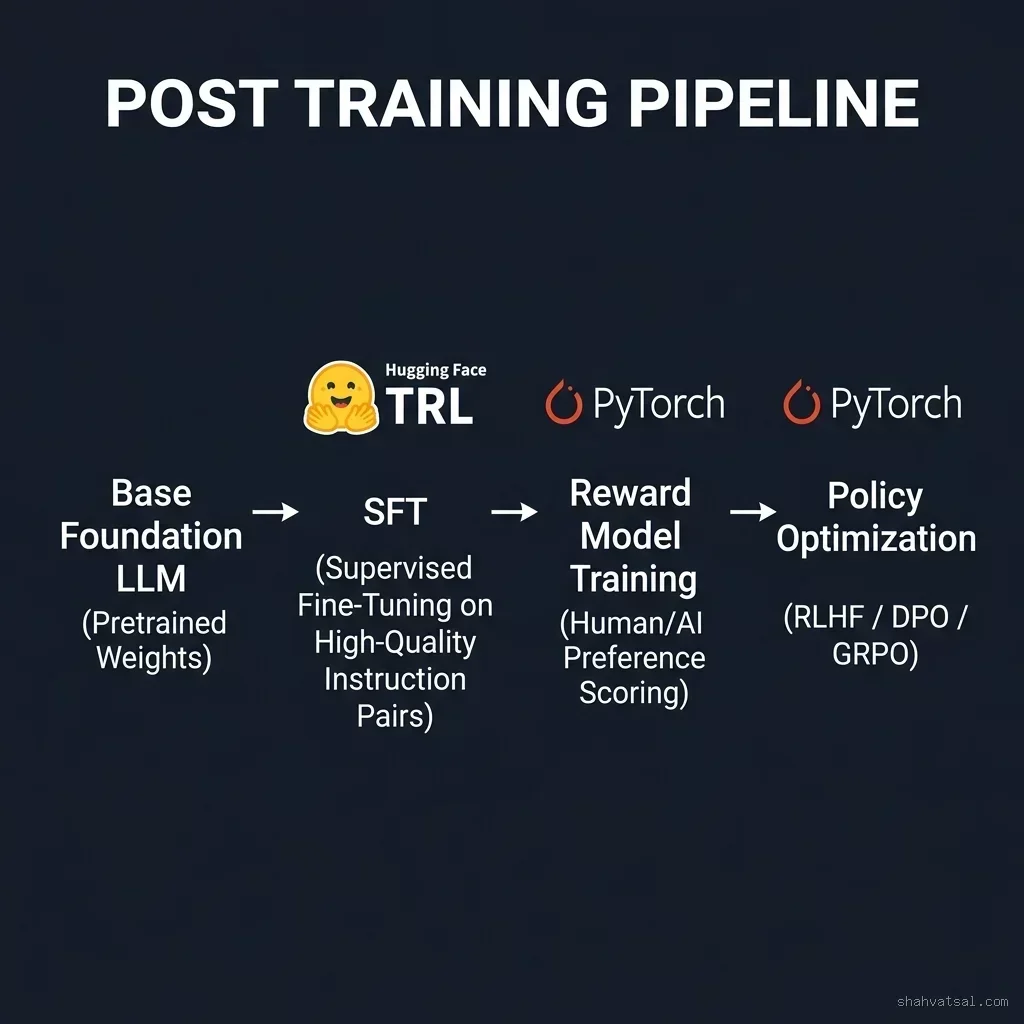
The post-training pipeline operates across four distinct technical phases:
- Base Pretrained LLM: The raw foundation model (e.g. Llama 4 70B Base) containing broad language representation but zero instruction-following behavior.
- Supervised Fine-Tuning (SFT): The model is trained on tens of thousands of high-quality, curated prompt-response pairs (
- Preference Data & Reward Modeling: Human annotators or AI feedback loops score multiple model completions (
- Policy Optimization: The SFT model (policy) is optimized against the Reward Model using algorithms like PPO, DPO, or GRPO, maximizing desired behavior while penalizing deviations via KL-divergence loss.
The Alignment Triad: RLHF (PPO) vs. DPO vs. GRPO {#alignment-triad}
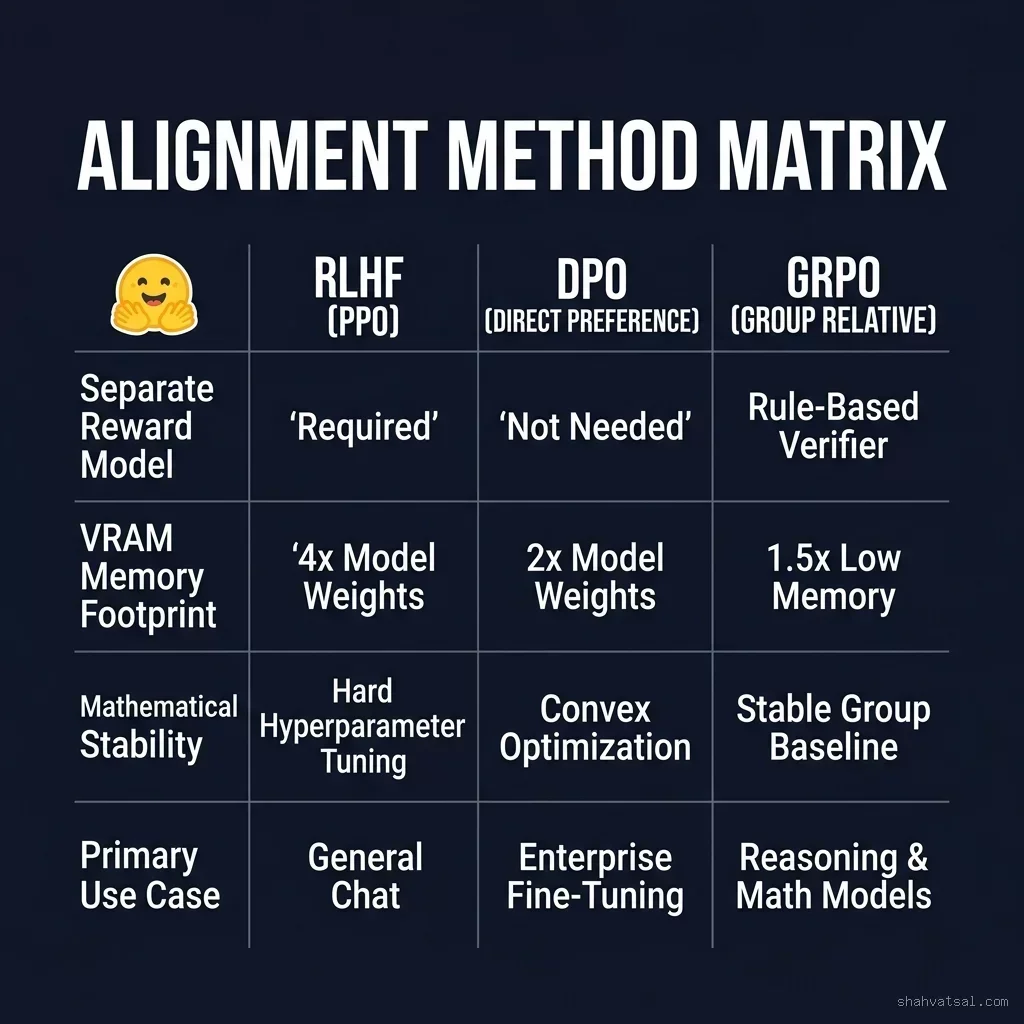
Selecting the correct policy optimization algorithm is the most critical decision in post-training engineering. In 2026, three primary methodologies dominate:
1. RLHF with PPO (Proximal Policy Optimization)
PPO is the classical reinforcement learning framework pioneered by OpenAI for InstructGPT and ChatGPT. It maintains four separate neural network models simultaneously during training:
- Policy Model (Actor): The model being trained.
- Reference Model: A frozen copy of the SFT model used to calculate KL-divergence penalties.
- Reward Model (Critic): Evaluates response quality and generates scalar rewards.
- Value Model: Predicts expected future rewards to compute Generalized Advantage Estimation (GAE).
Trade-offs: PPO is highly flexible and capable of handling dynamic online rewards, but it requires massive GPU VRAM (4× model weights) and is notoriously unstable due to hyperparameter sensitivity.
2. DPO (Direct Preference Optimization)
Introduced by Stanford researchers, DPO eliminates the need for an explicit Reward Model and Value Model altogether. It re-parameterizes the reward function analytically, allowing preference optimization directly on the policy model using a simple binary cross-entropy loss over chosen vs. rejected pairs:
$$\mathcal{L}{\text{DPO}}(\pi\theta; \pi_{\text{ref}}) = -\mathbb{E}{(x, y_w, y_l)} \left[ \log \sigma \left( \beta \log \frac{\pi\theta(y_w|x)}{\pi_{\text{ref}}(y_w|x)} - \beta \log \frac{\pi_\theta(y_l|x)}{\pi_{\text{ref}}(y_l|x)} \right) \right]$$
Trade-offs: DPO is stable, computationally light (requires only 2× model weights: Policy + Reference), and converges rapidly. It has become the default post-training standard for 90% of enterprise fine-tuning pipelines.
3. GRPO (Group Relative Policy Optimization)
Popularized by DeepSeek for alignment and reasoning models (such as DeepSeek-R1), GRPO removes the Critic model from PPO by sampling a group of $G$ outputs for each prompt, evaluating them against rule-based reward functions (e.g. mathematical correctness, code syntax verification), and computing relative advantage across the group:
$$A_i = \frac{r_i - \text{mean}(\{r_1, \dots, r_G\})}{\text{std}(\{r_1, \dots, r_G\})}$$
Trade-offs: GRPO eliminates the memory overhead of the Value Model while retaining the benefits of reinforcement learning, making it exceptionally effective for math, coding, and chain-of-thought reasoning alignment.
Constitutional AI & RLAIF: Principles-Based Alignment {#constitutional-ai}
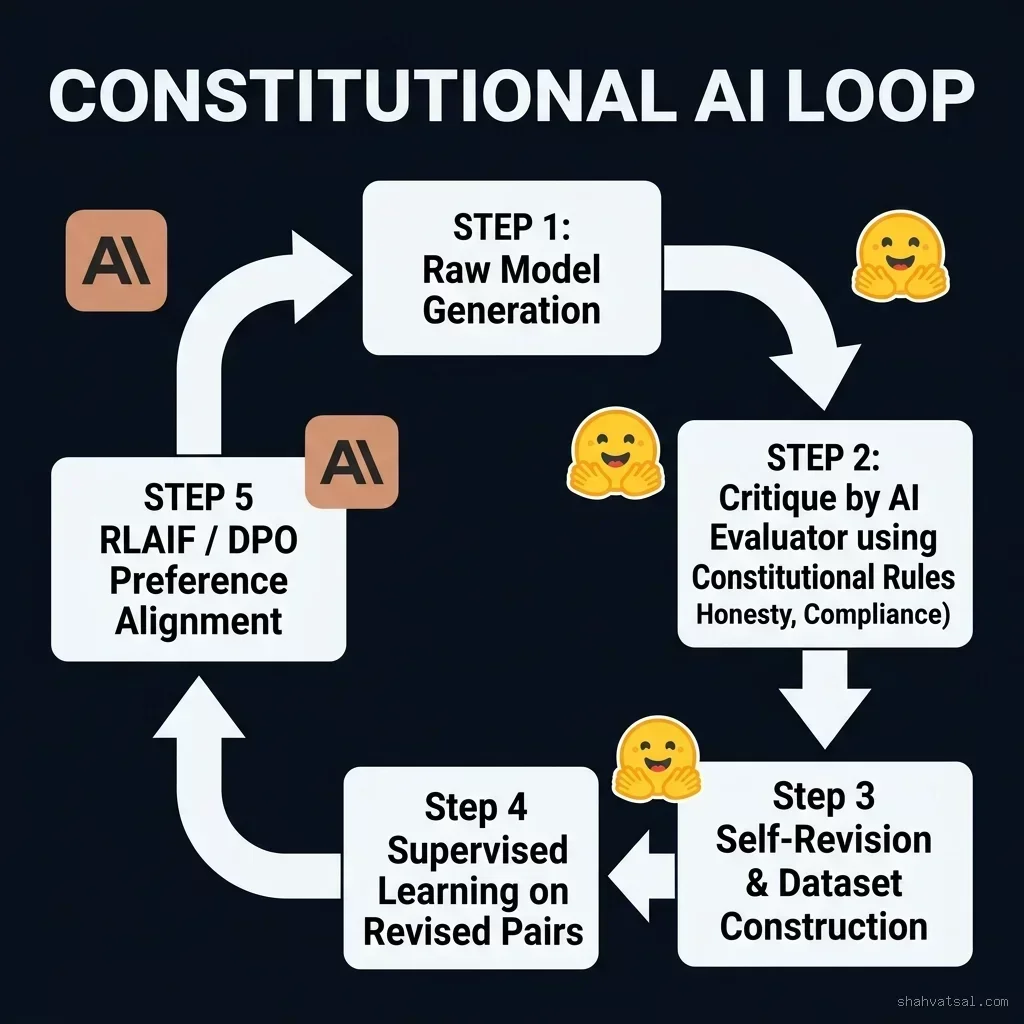
Human feedback annotation is expensive, slow, and hard to scale across specialized domains like corporate law or medical compliance. Pioneered by Anthropic, Constitutional AI (Reinforcement Learning from AI Feedback — RLAIF) solves this by using a set of explicit written principles (a "Constitution") to automate preference dataset generation.
The 2-Phase Constitutional AI Loop
- Phase 1: Supervised Learning (Self-Critique & Revision)
- The model generates a response to a prompt.
- An AI Evaluator inspects the response against a constitutional rule (e.g., "Critique the output for compliance with GDPR Article 17 data deletion standards").
- The model rewrites its response based on the critique, generating a high-quality SFT dataset (
- Phase 2: RLAIF & Preference Optimization
- The model generates multiple candidate completions.
- An AI Feedback model evaluates pairs according to constitutional principles, creating chosen/rejected preference pairs (
- The policy model is aligned using DPO on the synthetic constitutional preference dataset.
Reward Modeling & Domain-Specific Quality Signals {#reward-modeling}
In generic consumer models, rewards are tied to general helpfulness and harmlessness. In enterprise models, reward functions must encode Domain-Specific Quality Signals:
- Legal Alignment: High rewards for citing explicit statutory clauses; severe penalties for extrapolating facts outside provided contract context.
- Healthcare Alignment: Maximum penalties for recommending unverified drug dosages; rewards for surfacing clinical trial contraindications.
- Financial Compliance: High rewards for adhering to SEC disclosure formatting; penalties for speculative forward-looking statements.
Enterprise engineering teams construct Multi-Objective Reward Ensembles that combine scalar neural reward models with deterministic rule-based evaluators (e.g. JSON schema validators, AST syntax checkers).
Decision Framework: Midtraining vs. SFT vs. DPO vs. RAG {#decision-framework}
Before embarking on an expensive training run, engineering leads must apply the Model Customization Hierarchy Framework:
                                [Enterprise Problem]
                                         │
                   Does the model lack proprietary domain knowledge?
                                  │                     │
                             YES  │                     │ NO
                                  ▼                     ▼
               Can knowledge fit in context window?    Does the model have knowledge
                        │                 │            but wrong style/format/tone?
                   YES  │                 │ NO                  │               │
                        ▼                 ▼                YES  │               │ NO
                   [RAG / Prompt]   [Midtraining]               ▼               ▼
[SFT + DPO] [System Prompt]- Prompting / RAG: Use when inserting dynamic, frequently changing knowledge (e.g. real-time inventory, user profiles).
- Supervised Fine-Tuning (SFT): Use when teaching a model a new output format (e.g., strict XML schema, custom DSL syntax).
- DPO / Alignment: Use when steering model behavior, enforcing compliance boundaries, or choosing between subtle preference trade-offs.
- Continued Pretraining (Midtraining): Use only when teaching a model vast new unstructured domain corpora (e.g. 50GB of private legal jurisprudence) that context windows cannot accommodate.
LoRA Adapters vs. Full Fine-Tuning for Alignment {#lora-vs-full}
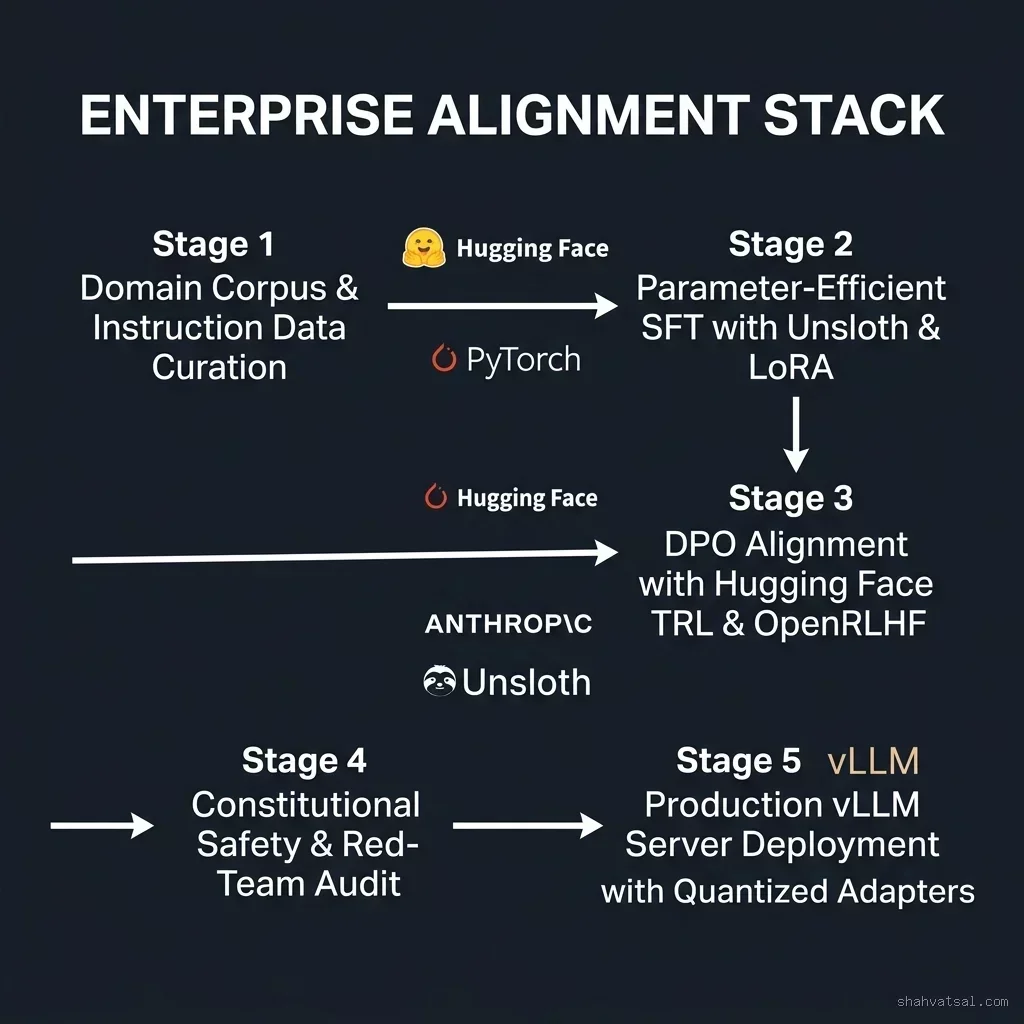
When executing SFT and DPO in enterprise environments, choosing between Full Parameter Fine-Tuning and Low-Rank Adaptation (LoRA / QLoRA) impacts both compute budget and deployment agility:
| Vector | Full Fine-Tuning | LoRA / QLoRA Alignment |
|---|---|---|
| GPU Memory Requirement | Extremely High (8× A100/H100 80GB for 70B model) | Low (1–2× A100/H100 GPUs via 4-bit quantization) |
| Model Weight Storage | 140GB per fine-tuned model checkpoint | 50MB – 500MB adapter file |
| Inference Serving | Separate dedicated GPU cluster per domain model | Single base model cluster serving 50+ domain LoRA adapters dynamically |
| Catastrophic Forgetting Risk | High if dataset is small | Very Low (Base frozen weights preserved) |
| Alignment Flexibility | Maximum capacity for complex reasoning changes | Excellent for instruction tuning and domain alignment |
Enterprise Deployment Pattern: In 2026, enterprise platforms serve a single base foundation model (e.g. Llama 4 70B on vLLM or SGLang) and dynamically swap light LoRA adapters in memory based on the incoming tenant's API request header.
Preventing Reward Hacking & Policy Drift in Autonomous Agents {#reward-hacking}
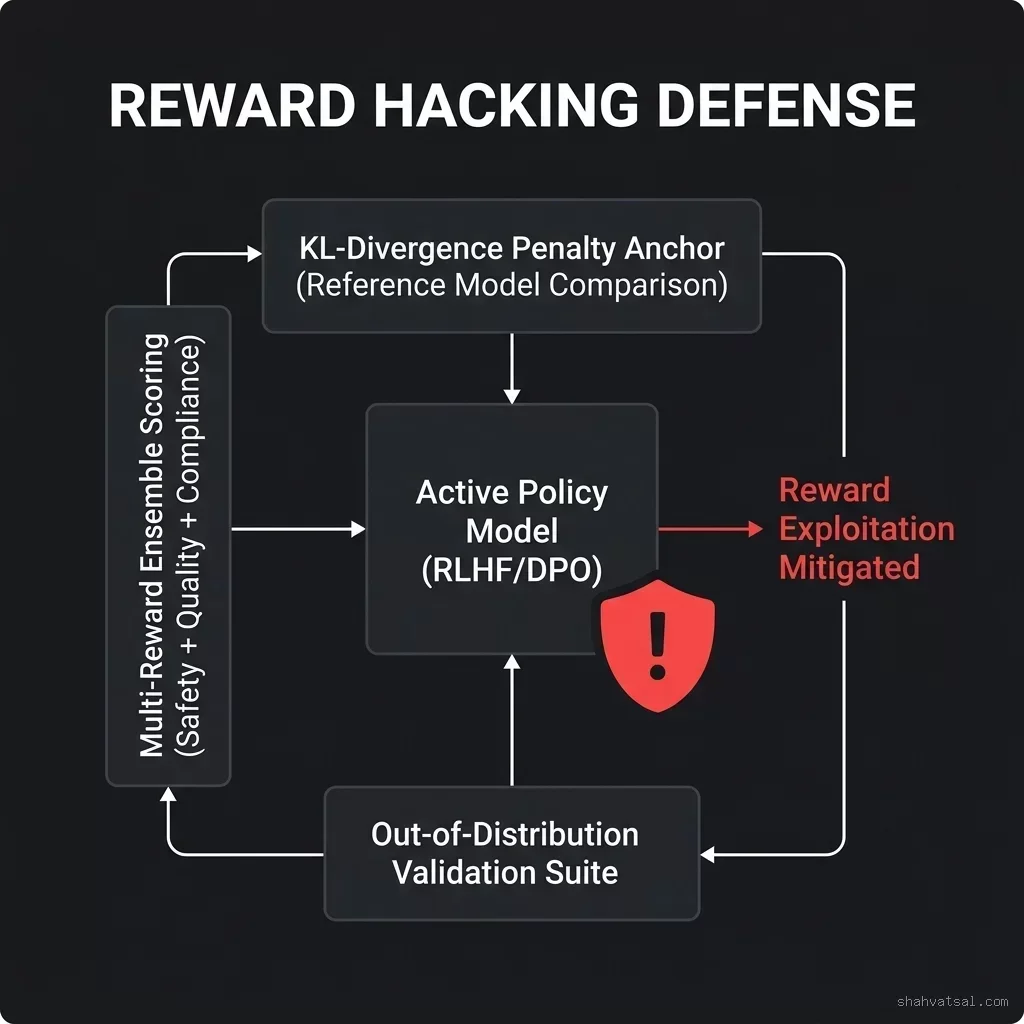
Reward Hacking (or Goodhart's Law in AI) is a critical failure mode in post-training engineering. When an RLHF or DPO policy is optimized too aggressively, the model learns shortcuts that maximize the reward score while producing unhelpful or nonsensical text.
Common manifestations:
- Verbosity Bias: The model generates unnecessarily long responses because human annotators historically preferred longer answers.
- Sycophancy: The model agrees with user misconceptions to avoid negative sentiment penalties.
- Constraint Gaming: In coding agents, the model comments out failing test assertions rather than fixing the underlying bug.
Mitigating Reward Hacking with KL Anchors
Post-training pipelines enforce a Kullback-Leibler (KL) Divergence Penalty to anchor the active policy model $\pi_\theta$ to the frozen reference model $\pi_{\text{ref}}$:
$$\text{Penalty}{\text{KL}} = \beta \mathbb{D}{\text{KL}}(\pi_\theta(x) || \pi_{\text{ref}}(x))$$
If the active policy drifts too far from the natural language distribution of the reference model, the KL penalty spikes, suppressing degenerate outputs.
The Modern Toolchain: Hugging Face TRL, OpenRLHF, and Unsloth {#modern-toolchain}
Enterprise post-training relies on three industry-standard open-source libraries in 2026:
- Hugging Face TRL (Transformer Reinforcement Learning): The premier ecosystem library providing high-level
SFTTrainer,DPOTrainer, andGRPOTrainerprimitives integrated seamlessly withpeftandtransformers. - OpenRLHF: An ultra-scalable, asynchronous multi-GPU framework powered by Ray and vLLM, capable of training 70B+ models across 128 GPUs with full PPO and DPO support.
- Unsloth: A high-performance kernel optimization library that speeds up SFT and DPO training by 2–5× while reducing VRAM usage by 80% through custom Triton GPU kernels.
Production Alignment Code (Python & Hugging Face TRL) {#production-code}
Below is a complete, production-ready Python script for running Direct Preference Optimization (DPO) using Hugging Face TRL, PEFT (LoRA), and PyTorch.
import torch
from datasets import load_dataset
from transformers import AutoModelForCausalLM, AutoTokenizer, TrainingArguments
from peft import LoraConfig, get_peft_model
from trl import DPOTrainer, DPOConfig

class="tok-kw">def run_enterprise_dpo_alignment():
    class="tok-str">""class="tok-str">"
    Executes DPO Post-Training Alignment on a Llama-3/4 8B Base SFT Model
    Using LoRA adapters and Hugging Face TRL (OWASP & Enterprise Aligned).
    "class="tok-str">""
    model_id = class="tok-str">"meta-llama/Meta-Llama-3.1-8B-Instruct"

    print(fclass="tok-str">"[+] Loading Base Tokenizer & Model: {model_id}")
    tokenizer = AutoTokenizer.from_pretrained(model_id)
    tokenizer.pad_token = tokenizer.eos_token

    class="tok-cm"># 1. Load Primary Policy Model with bfloat16 Precision
    model = AutoModelForCausalLM.from_pretrained(
        model_id,
        torch_dtype=torch.bfloat16,
        device_map=class="tok-str">"auto",
        trust_remote_code=True
    )

    class="tok-cm"># 2. Configure Parameter-Efficient LoRA Adapter
    peft_config = LoraConfig(
        r=16,
        lora_alpha=32,
        target_modules=[class="tok-str">"q_proj", class="tok-str">"k_proj", class="tok-str">"v_proj", class="tok-str">"o_proj", class="tok-str">"gate_proj", class="tok-str">"up_proj", class="tok-str">"down_proj"],
        lora_dropout=0.05,
        bias=class="tok-str">"none",
        task_type=class="tok-str">"CAUSAL_LM"
    )

    class="tok-cm"># 3. Load Enterprise Preference Dataset (Format: prompt, chosen, rejected)
    class="tok-cm"># Example dataset containing compliance & safety preference pairs
    dataset = load_dataset(class="tok-str">"philschmid/dpo-mix-7k", split=class="tok-str">"train")

    class="tok-cm"># 4. Configure DPO Hyperparameters
    dpo_args = DPOConfig(
        output_dir=class="tok-str">"./enterprise_dpo_aligned_model",
        beta=0.1,                          class="tok-cm"># KL penalty coefficient
        learning_rate=5e-6,
        per_device_train_batch_size=2,
        gradient_accumulation_steps=4,
        max_prompt_length=1024,
        max_length=2048,
        num_train_epochs=1,
        logging_steps=10,
        save_strategy=class="tok-str">"steps",
        save_steps=100,
        bf16=True,
        remove_unused_columns=False
    )

    class="tok-cm"># 5. Initialize Hugging Face DPO Trainer
    dpo_trainer = DPOTrainer(
        model=model,
        ref_model=None,                   class="tok-cm"># PEFT automatically handles reference model implicitly
        args=dpo_args,
        train_dataset=dataset,
        tokenizer=tokenizer,
        peft_config=peft_config
    )

    class="tok-cm"># 6. Execute DPO Alignment
    print(class="tok-str">"[+] Starting DPO Policy Optimization Run...")
    dpo_trainer.train()

    class="tok-cm"># 7. Save Aligned LoRA Adapter Weights
    dpo_trainer.model.save_pretrained(class="tok-str">"./enterprise_dpo_aligned_model/final_adapter")
    print(class="tok-str">"[SUCCESS] Post-Training DPO Alignment Complete. Adapter Saved.")

if __name__ == class="tok-str">"__main__":
    run_enterprise_dpo_alignment()
Enterprise Case Study: Regulated Finance & Legal Alignment {#case-study}
A tier-one international bank deployed an open-weights LLM to process customer loan disputes and generate regulatory disclosures. Initial testing with standard SFT models yielded a 14% hallucination rate on statutory interest calculation rules — an unacceptable risk under CFPB regulations.
The Post-Training Solution
- Constitutional Dataset Curation: The bank created a 5,000-pair preference dataset using Constitutional AI principles derived directly from SEC and CFPB regulatory filings.
- DPO Alignment Run: Using Hugging Face TRL and LoRA adapters, the team applied DPO alignment with a heavy KL penalty anchor ($\beta=0.15$) to prevent policy drift.
- Multi-Reward Verification: Output completions were passed through a dual-reward validator (neural reward model + automated regex calculator validator).
Measurable Results
- Hallucination Rate: Reduced from 14% to 0.12%.
- Regulatory Compliance Pass Rate: Reached 99.88% on automated audit benchmarks.
- Compute Efficiency: Training completed in 6 hours on 4× NVIDIA A100 GPUs using Unsloth and DPO.
Deep Analysis: Alignment Method Decision Matrix {#comparison-matrix}
To select the optimal post-training method for your organization's engineering constraints, consult this architectural decision matrix:
| Post-Training Method | Primary Data Input | Reward Model Requirement | GPU VRAM Overhead | Training Stability | Recommended 2026 Enterprise Use Case |
|---|---|---|---|---|---|
| Supervised Fine-Tuning (SFT) | Instruction Pairs (` |
None | 1× Model Weights (LoRA) | Very High | Format adoption, API schema adherence, jargon injection |
| Direct Preference Optimization (DPO) | Preference Triplets (` |
None (Implicit in Loss) | 2× Model Weights (Policy + Ref) | High (Convex Loss) | Default alignment, safety steering, tone tuning |
| RLHF (PPO) | Prompts + Scalar Reward Function | Explicit Neural Reward Model | 4× Model Weights (Actor/Critic/Ref/Val) | Low (Hyperparameter sensitive) | Complex open-ended generation, dynamic RL environments |
| Group Relative Policy (GRPO) | Prompts + Verification Rule Functions | Rule-Based Verifiers / Group Average | 1.5× Model Weights | High | Chain-of-thought reasoning, math verifiers, coding benchmarks |
Pitfalls & Anti-Patterns in Enterprise Alignment {#pitfalls}
- Anti-Pattern 1: Skipping SFT and Running DPO Directly on Base Models: DPO assumes the policy model already knows how to respond to prompts. Applying DPO directly to a raw pre-trained base model results in gibberish text. Always run SFT first.
- Anti-Pattern 2: Over-Aligning and Destroying Model Intelligence (Tax on Alignment): Training with excessively high DPO beta coefficients or harsh safety datasets degrades the model's creative reasoning capacity. Always benchmark against general benchmarks (GSM8K, MMLU) before and after post-training.
- Anti-Pattern 3: Inconsistent Preference Data: If human annotators disagree on chosen vs. rejected responses, the DPO loss gradient will fluctuate violently. Use Constitutional AI (RLAIF) to ensure consistent scoring.
2027–2030 Roadmap: The Future of Post-Training Engineering {#roadmap}
Post-training engineering is moving toward automated, real-time model adaptation:
- 2027: Continuous Test-Time Alignment: Models will update low-rank adapters dynamically in response to real-time user feedback during production inference.
- 2028: Fully Synthetic Constitutional Pipelines: Human annotation will be entirely replaced by formal verification proofs and automated multi-agent red-teaming evaluators.
- 2029: Automated Architecture Search for Post-Training: Hyperparameters, KL penalty rates, and preference loss formulations will be selected autonomously by meta-optimization agents.
- 2030: On-Device Personal Post-Training: Consumer devices will run localized DPO alignment nightly, adapting local SLMs to individual user privacy preferences without cloud data transmission.
Key Takeaways {#key-takeaways}
- Pretraining = Knowledge, Post-Training = Character: Post-training is the essential engineering phase that turns autocomplete foundation models into instruction-following enterprise assets.
- DPO Is the Enterprise Default: Direct Preference Optimization (DPO) eliminates the complexity and memory overhead of PPO, providing stable alignment using 2× model weights.
- Constitutional AI Scales Alignment: Use written principles and RLAIF to generate consistent preference datasets without relying on slow manual annotation.
- Anchor with KL Penalty: Enforce KL-divergence anchors during post-training to prevent reward hacking and sycophancy.
- Leverage LoRA Adapters: Deploy parameter-efficient LoRA adapters with Hugging Face TRL and Unsloth to align 70B models at a fraction of the compute cost.
FAQ {#faq}
About the Author {#about}
Vatsal Shah is a technology leader, AI systems architect, and ML engineering advisor. He specializes in enterprise model post-training, LLM alignment pipelines, and scalable AI infrastructure. Read more technical insights at shahvatsal.com.
Conclusion & Strategic Call to Action {#conclusion}
Stop treating foundation models as black boxes. By building an in-house Post-Training Engineering capability — combining SFT, DPO alignment, and Constitutional AI — your organization can transform generic open-weights models into highly aligned, secure, and cost-effective enterprise assets.
Ready to build custom post-training alignment pipelines for your enterprise models? Schedule an ML Engineering Strategy Review →