LLM Interpretability for Production Engineers: Debugging AI Behavior Beyond Logs in 2026
By Vatsal Shah | August 7, 2026 | 17 min read
Table of Contents
- The Production Silent Crisis: HTTP 200 OK with Wrong Behavior
- Why Standard Logs Fail for Autonomous Agents
- Anthropic's Breakthroughs: Sparse Autoencoders & Feature Dictionaries
- Telemetry Beyond Text: The 5 Essential Interpretability Signals
- Detecting Behavioral Failure Modes: Spirals, Drift, and Misuse
- OpenTelemetry GenAI Semantic Conventions in 2026
- The Production Interpretability Stack: Langfuse, LangSmith, W&B, and Otel
- Production Code: OpenTelemetry & Langfuse Tracing in Python
- Enterprise Case Study: Debugging Silent Agent Failures in Fintech
- Deep Analysis: Standard Logs vs. Interpretability Stack Matrix
- Pitfalls and Anti-Patterns in AI Observability
- 2027–2030 Roadmap: The Future of Mechanistic Interpretability
- Key Takeaways
- FAQ
- About the Author
- Conclusion & Strategic Call to Action
The Production Silent Crisis: HTTP 200 OK with Wrong Behavior {#silent-crisis}
In traditional microservice engineering, an incident is obvious. An API throws an HTTP 500 Internal Server Error, Datadog fires an alert, a stack trace identifies line 142 in auth_service.py, and your on-call team deploys a patch within 15 minutes.
In 2026 enterprise AI engineering, the scariest failures emit no stack traces.
Your autonomous agent receives a complex prompt, calls three database tools via Model Context Protocol (MCP), processes financial data, returns a beautifully formatted JSON payload, and responds with HTTP 200 OK in 840ms. Datadog reports green health. APM shows zero exceptions.
Yet, inside that HTTP 200 payload, the agent hallucinated a $4.2M line item, inverted a debit into a credit, or selected a tool action based on a subtle context drift loop that started four conversation turns ago.
At the AI Engineer World's Fair 2026 in San Francisco, the Observability Track was packed beyond capacity. The overwhelming consensus among enterprise engineering leads: Standard application logging is fundamentally blind to AI model behavior.
To debug autonomous agents in production, software engineers must adopt Mechanistic Interpretability and GenAI Telemetry — looking inside the model's internal activations, embedding drift, tool execution graphs, and token confidence distributions.
AI SUMMARY — This practitioner guide covers LLM interpretability and production observability: (1) why HTTP 200 OK silent failures bypass traditional APMs, (2) Anthropic's Sparse Autoencoder (SAE) research on internal feature dictionaries, (3) the 5 essential interpretability signals (activations, logprobs, embedding drift, tool graphs, memory hit rates), (4) OpenTelemetry GenAI semantic conventions, (5) modern observability tools (Langfuse, LangSmith, W&B, OpenTelemetry), and (6) production Python code for tracing and drift detection.
Why Standard Logs Fail for Autonomous Agents {#why-logs-fail}
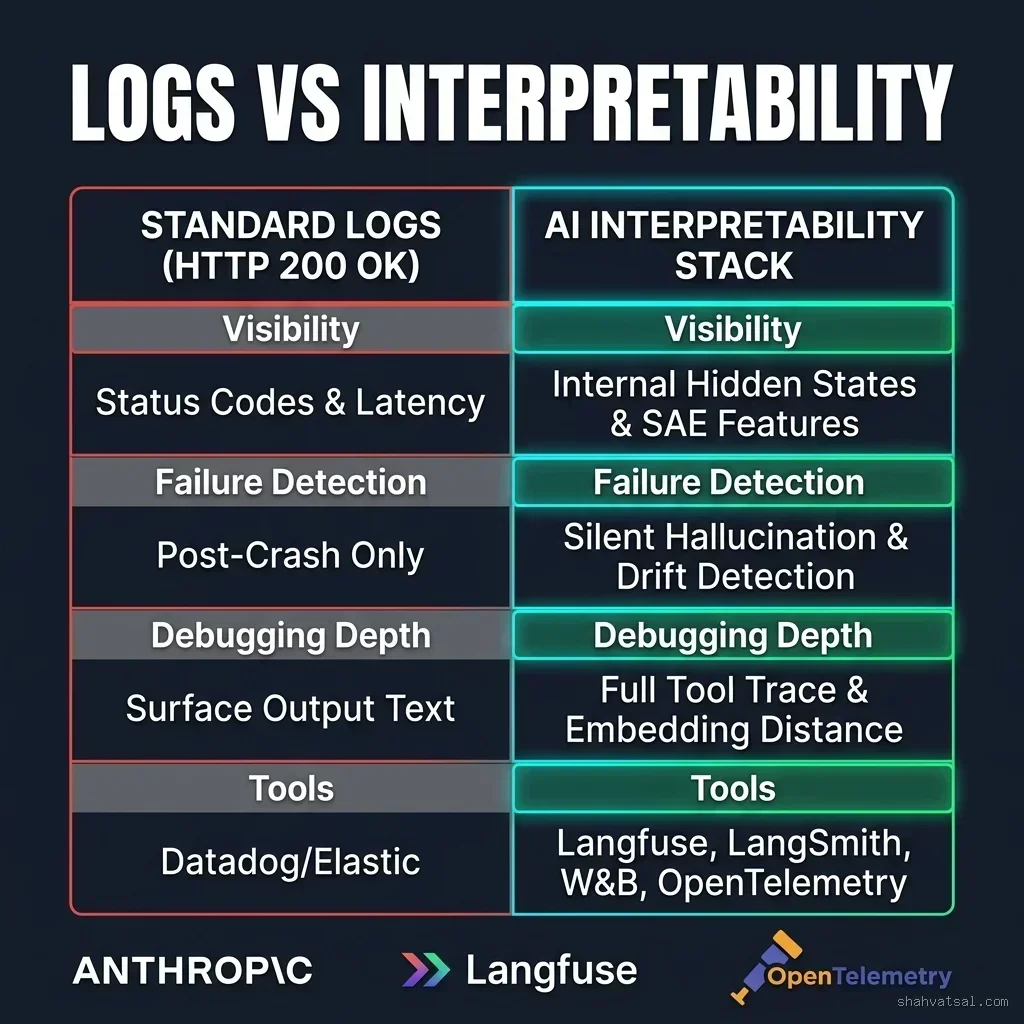
Traditional logging frameworks (Logstash, Fluentd, CloudWatch) capture external boundary metrics:
- Request timestamp and client IP
- HTTP status code (
200 OK) - Request duration (latency in ms)
- Outbound byte count
This works when code execution is deterministic. If function $f(x) = y$, inspecting $x$ and $y$ tells you everything about the internal logic.
LLMs and multi-agent systems are non-deterministic, probabilistic state machines. The output string $y$ is generated token-by-token based on high-dimensional vector math across thousands of transformer layers. A standard log captures what the model responded with, but tells you zero about why it responded that way or how confident it was during generation.
| Observability Layer | Traditional APM (Datadog / Elastic) | GenAI Interpretability Stack (Langfuse / Otel) |
|---|---|---|
| Primary Metric | CPU / RAM / HTTP Error Rates | Token Logprobs / Embedding Drift / SAE Features |
| Failure Target | Server Crashes & Unhandled Exceptions | Hallucination Spirals & Sycophancy Loops |
| Execution View | Linear Stack Trace | Dynamic Agent Graph & Tool Execution Traces |
| Root Cause Depth | Line of Code in Repository | Hidden State Vector in Model Layer 28 |
Anthropic's Breakthroughs: Sparse Autoencoders & Feature Dictionaries {#anthropic-sae}
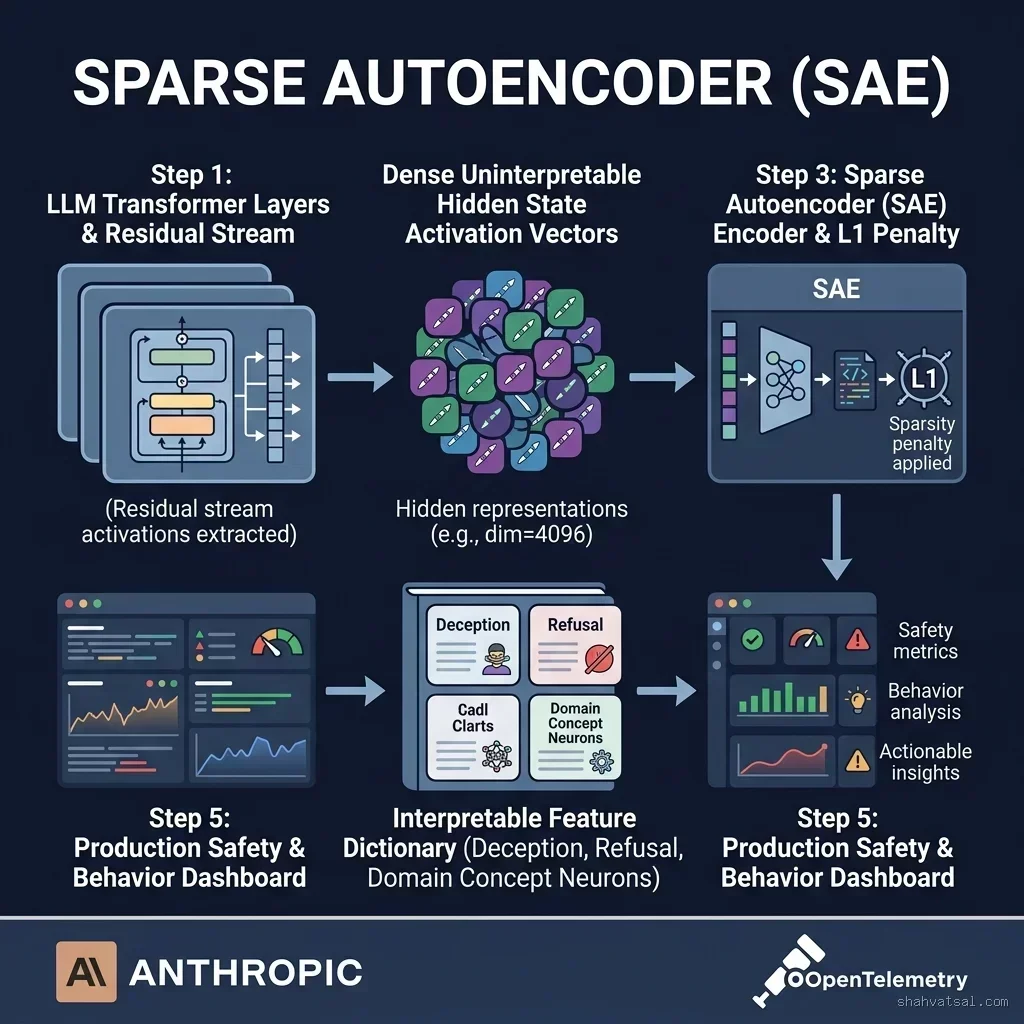
In July 2026, Anthropic published landmark research demonstrating that Large Language Models possess a "Global Workspace" — a centralized internal representation where complex reasoning concepts are combined before final output generation.
Before this research, LLM hidden states were viewed as an uninterpretable "black box" of dense, polysemantic floating-point vectors. A single neuron in Layer 24 might activate for French syntax, medical terminology, and Python code indentation simultaneously.
How Sparse Autoencoders (SAEs) Work
To solve this polysemanticity problem, researchers apply Sparse Autoencoders (SAEs) to the transformer's residual stream. An SAE acts as a mathematical prism, projecting dense $D$-dimensional hidden activation vectors into a much higher-dimensional $N$-dimensional sparse feature space ($N \gg D$):
$$h = f(W_{\text{enc}} \cdot x + b_{\text{enc}})$$
$$\hat{x} = W_{\text{dec}} \cdot h + b_{\text{dec}}$$
By enforcing an $L_1$ sparsity penalty during SAE training, only a small handful of features activate for any given prompt token.
The result is a Monosemantic Feature Dictionary:
- Feature #4,102: "User is attempting a social engineering prompt injection."
- Feature #12,891: "Model is generating text with low factual certainty."
- Feature #89,401: "Reference to legal contract indemnification liability."
Production Application for Engineers
While training SAEs across a 70B model requires heavy compute, enterprise teams in 2026 utilize lightweight, pretrained SAE feature extractors hooked into production inference endpoints. When Feature #4,102 (Deception/Jailbreak) spikes during a customer interaction, the production safety controller triggers a circuit breaker before the model finishes streaming its response.
Telemetry Beyond Text: The 5 Essential Interpretability Signals {#five-signals}
To build a robust production debugging pipeline, AI engineers capture five core telemetry signals for every LLM invocation:
                          ┌───────────────────────────┐
                          │   5 INTERPRETABILITY      │
                          │        SIGNALS            │
                          └─────────────┬─────────────┘
                                        │
        ┌──────────────┬────────────────┼────────────────┬──────────────┐
        ▼              ▼                ▼                ▼              ▼
  1. Logprobs    2. Embedding     3. Tool Call     4. Internal    5. Memory Hit
   Confidence       Distance         Traces         Activations      Rates
1. Token Logprobabilities (Logprobs)
Every token output by an LLM is sampled from a probability distribution over the vocabulary. Capturing logprobs reveals the model's internal confidence:
$$\text{Confidence}(t_i) = \exp(\log P(t_i | t_1, \dots, t_{i-1}))$$
If a model generates "The contract expires on March 15, 2028" with a logprob of $-0.02$ ($\sim 98\%$ confidence), the claim is firmly grounded in its attention weights. If the date token has a logprob of $-4.8$ ($\sim 0.8\%$ confidence), the model is guessing — a clear hallucination risk signal.
2. Embedding Drift Distance
By embedding incoming user prompts and outgoing model completions into a shared vector space, engineers measure semantic drift over multi-turn conversations:
$$\text{Drift}(v_t, v_{t-1}) = 1 - \frac{v_t \cdot v_{t-1}}{\|v_t\| \|v_{t-1}\|}$$
A sudden spike in cosine distance indicates that the agent has lost its conversational anchor or diverged into off-topic reasoning.
3. Tool Execution Traces
In multi-agent systems using MCP (Model Context Protocol) or Function Calling, tracking the execution graph is non-negotiable. Telemetry must log: (a) tool selected, (b) arguments generated by LLM, (c) tool execution latency, and (d) raw return payload.
4. Internal Layer Activations
Capturing activation norms across intermediate layers (e.g. Layer 16 vs. Layer 32) allows real-time anomaly detection. Unusual activation spikes in early attention heads often predict output refusal or hallucination before token rendering completes.
5. Memory & Cache Hit Rates
For retrieval-augmented and long-context agents, monitoring prompt caching hit rates (e.g., Anthropic or OpenAI prefix caching) and vector database retrieval relevancy scores ensures context degradation doesn't degrade agent accuracy.
Detecting Behavioral Failure Modes: Spirals, Drift, and Misuse {#failure-modes}
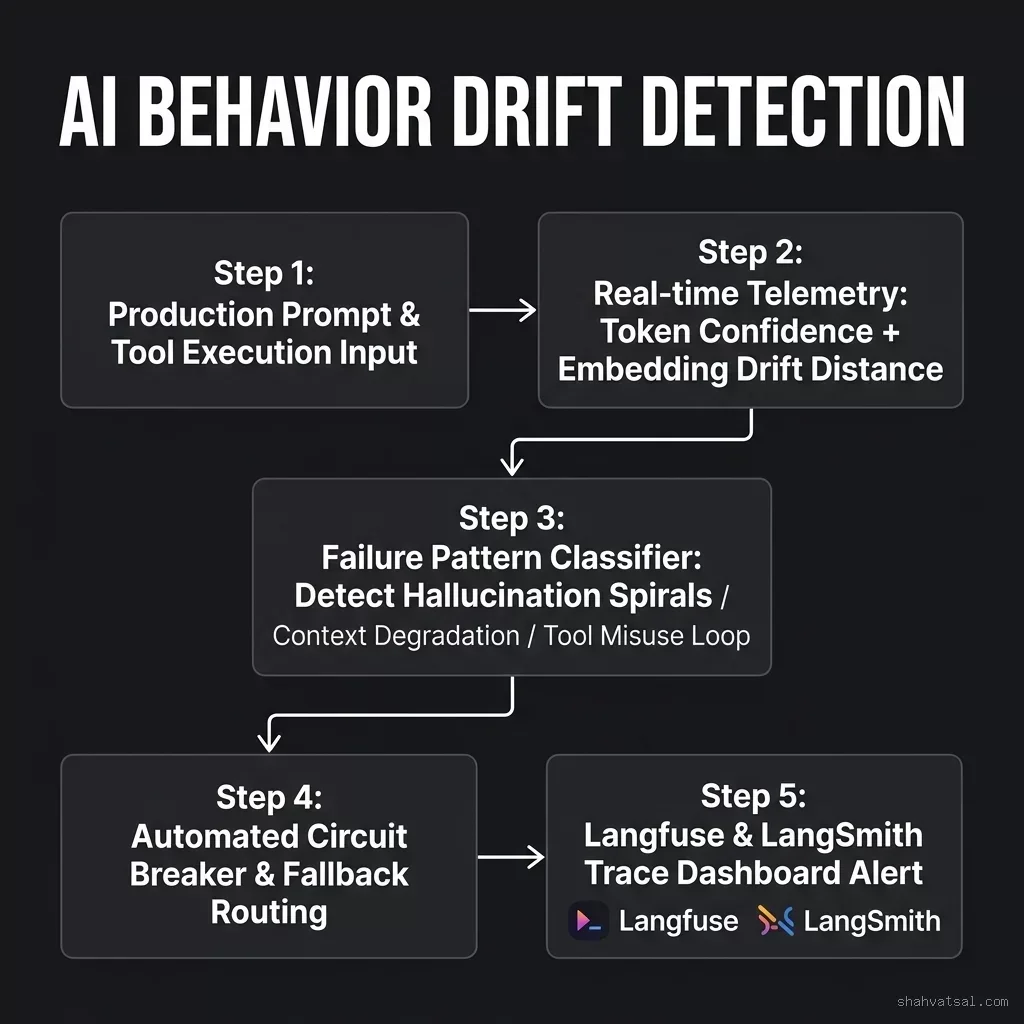
Production AI agents exhibit three distinct behavioral failure patterns that bypass traditional error monitoring:
1. The Hallucination Spiral
Occurs when an agent makes a minor factual error in turn $N$, and then uses its own erroneous generation as ground-truth context in turn $N+1$. By turn $N+3$, the agent is generating completely fabricated narratives with high superficial confidence.
Detection Signal: Falling logprob average across sequential turns combined with increasing output length.
2. Context Degradation & Attention Drift
As context length grows beyond 32K tokens, models suffer from the "Needle In A Haystack" attention degradation effect. The model ignores system prompt constraints placed in the middle of the context window.
Detection Signal: Cosine distance between system prompt embedding and active generation embedding exceeds preset threshold ($> 0.65$).
3. The Tool Misuse Loop
An agent calls a database search tool, receives an empty result set, and immediately re-invokes the same tool with slightly altered parameters in an infinite loop, burning API tokens without making progress.
Detection Signal: Identical tool name invocation $>3$ times within a single trace tree with high argument similarity ($>0.90$).
OpenTelemetry GenAI Semantic Conventions in 2026 {#opentelemetry}
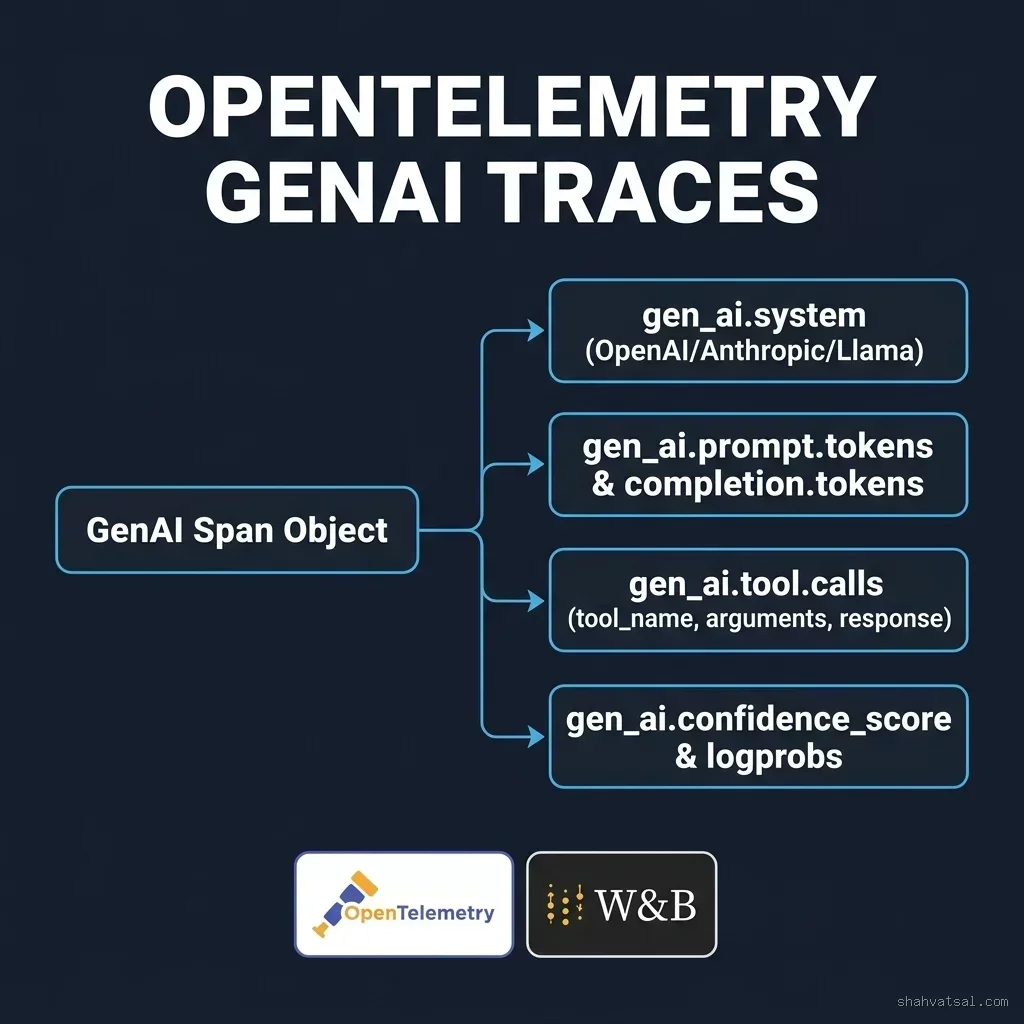
In 2026, the Cloud Native Computing Foundation (CNCF) finalized the OpenTelemetry GenAI Semantic Conventions. This standardizes how AI traces are emitted across languages and frameworks, preventing vendor lock-in.
Standardized OpenTelemetry attributes:
gen_ai.system: The LLM vendor or engine (e.g.,openai,anthropic,ollama,vllm).gen_ai.request.model: Target model name (e.g.,claude-3-5-sonnet-20241022,llama-3.1-70b).gen_ai.usage.prompt_tokens: Exact count of tokens in input context.gen_ai.usage.completion_tokens: Exact count of tokens in generated output.gen_ai.tool.name: Name of the executed tool or function.gen_ai.tool.args: JSON string of arguments passed to tool.gen_ai.completion.logprobs: Array of top token logprobabilities.
Industry Alignment — By emitting traces using OpenTelemetry GenAI conventions, enterprise applications can stream observability data simultaneously to Datadog, Langfuse, Honeycomb, and internal ClickHouse clusters without changing application code.
The Production Interpretability Stack: Langfuse, LangSmith, W&B, and Otel {#toolchain-stack}
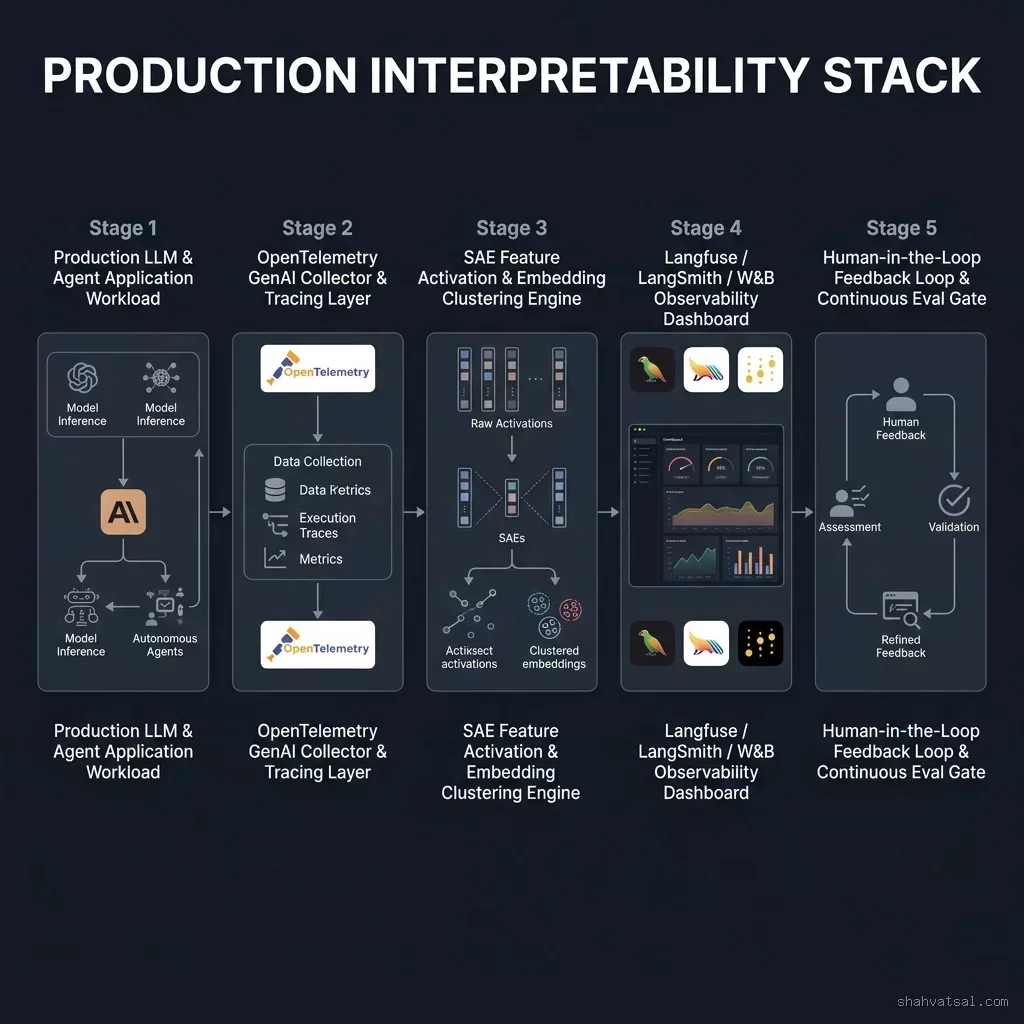
Four platforms dominate the production AI observability landscape in 2026:
1. Langfuse (Open-Source Tracing & Evals)
Langfuse is the leading open-source LLM engineering platform. It provides explicit trace trees for multi-turn agent interactions, cost tracking per tenant, automated evaluation pipelines, and a native OpenTelemetry exporter.
Best for: Enterprise teams requiring self-hosted, SOC2/HIPAA-compliant observability data sovereignty.
2. LangSmith (LangChain Ecosystem)
Built by the creators of LangChain, LangSmith excels at debugging complex agent graphs, state machine transitions, and prompt playground iterations.
Best for: Organizations heavily invested in LangGraph or LangChain agent architectures.
3. Weights & Biases (W&B Weave)
W&B Weave brings deep ML research rigor to production LLM tracking, capturing raw model activations, fine-tuning datasets, and model evaluations in a single platform.
Best for: ML engineering teams managing both fine-tuning pipelines and production agent serving.
4. OpenTelemetry Collector + ClickHouse
For extreme scale (billions of tokens per day), enterprise teams bypass SaaS platforms altogether, routing OpenTelemetry GenAI spans through an Otel Collector into columnar ClickHouse databases for custom Grafana visualization.
Production Code: OpenTelemetry & Langfuse Tracing in Python {#production-code}
Below is a complete, production-grade Python implementation of an agent execution pipeline featuring OpenTelemetry GenAI tracing, logprob confidence scoring, and embedding drift detection using Langfuse.
import os
import time
import math
import numpy as np
from typing import Dict, Any, List
from openai import OpenAI
from langfuse import Langfuse
from langfuse.decorators import observe, langfuse_context
from opentelemetry import trace
from opentelemetry.trace import Status, StatusCode
class="tok-cm"># 1. Initialize Clients & OpenTelemetry Tracer
tracer = trace.get_tracer(class="tok-str">"enterprise.ai.interpretability", class="tok-str">"1.3.0.0")
langfuse = Langfuse()
openai_client = OpenAI(api_key=os.environ.get(class="tok-str">"OPENAI_API_KEY"))
class="tok-kw">def calculate_cosine_similarity(vec1: List[float], vec2: List[float]) -> float:
class="tok-str">""class="tok-str">"Computes cosine similarity between two embedding vectors."class="tok-str">""
a, b = np.array(vec1), np.array(vec2)
return float(np.dot(a, b) / (np.linalg.norm(a) * np.linalg.norm(b)))
@observe(name=class="tok-str">"execute_production_agent_step")
class="tok-kw">def execute_production_agent_step(
prompt: str,
system_instruction: str,
anchor_embedding: List[float]
) -> Dict[str, Any]:
class="tok-str">""class="tok-str">"
Executes an AI Agent step with OpenTelemetry GenAI Semantic Conventions,
Logprob confidence analysis, and Embedding Drift Detection.
"class="tok-str">""
with tracer.start_as_current_span(class="tok-str">"genai.chat.completions") as span:
start_time = time.time()
class="tok-cm"># OpenTelemetry GenAI Semantic Attributes
span.set_attribute(class="tok-str">"gen_ai.system", class="tok-str">"openai")
span.set_attribute(class="tok-str">"gen_ai.request.model", class="tok-str">"gpt-4o")
span.set_attribute(class="tok-str">"gen_ai.prompt", prompt)
class="tok-cm"># Update Langfuse Context
langfuse_context.update_current_trace(
tags=[class="tok-str">"production", class="tok-str">"interpretability-v1"],
metadata={class="tok-str">"system_instruction_hash": hash(system_instruction)}
)
try:
class="tok-cm"># 2. Call Model with Logprobs Enabled
response = openai_client.chat.completions.create(
model=class="tok-str">"gpt-4o",
messages=[
{class="tok-str">"role": class="tok-str">"system", class="tok-str">"content": system_instruction},
{class="tok-str">"role": class="tok-str">"user", class="tok-str">"content": prompt}
],
temperature=0.2,
logprobs=True,
top_logprobs=3
)
completion_text = response.choices[0].message.content
usage = response.usage
class="tok-cm"># Record Token Telemetry
span.set_attribute(class="tok-str">"gen_ai.usage.prompt_tokens", usage.prompt_tokens)
span.set_attribute(class="tok-str">"gen_ai.usage.completion_tokens", usage.completion_tokens)
class="tok-cm"># 3. Analyze Token Logprobabilities (Confidence Signal)
token_logprobs = response.choices[0].logprobs.content
logprob_values = [token_data.logprob for token_data in token_logprobs]
avg_logprob = sum(logprob_values) / len(logprob_values) if logprob_values else 0.0
confidence_score = math.exp(avg_logprob) class="tok-cm"># Convert logprob to probability
span.set_attribute(class="tok-str">"gen_ai.completion.avg_logprob", avg_logprob)
span.set_attribute(class="tok-str">"gen_ai.completion.confidence_score", confidence_score)
class="tok-cm"># 4. Compute Embedding Vector for Drift Detection
emb_response = openai_client.embeddings.create(
model=class="tok-str">"text-embedding-3-small",
input=completion_text
)
completion_embedding = emb_response.data[0].embedding
similarity = calculate_cosine_similarity(anchor_embedding, completion_embedding)
drift_distance = 1.0 - similarity
span.set_attribute(class="tok-str">"gen_ai.completion.drift_distance", drift_distance)
class="tok-cm"># 5. Evaluate Circuit Breaker Trigger
is_anomaly = False
if confidence_score < 0.35 or drift_distance > 0.60:
is_anomaly = True
span.set_status(Status(StatusCode.ERROR, class="tok-str">"High Hallucination or Drift Risk Detected"))
langfuse_context.score_current_trace(
name=class="tok-str">"behavioral_anomaly",
value=1.0,
comment=fclass="tok-str">"Confidence: {confidence_score:.2f}, Drift: {drift_distance:.2f}"
)
execution_ms = (time.time() - start_time) * 1000
return {
class="tok-str">"completion": completion_text,
class="tok-str">"confidence_score": confidence_score,
class="tok-str">"drift_distance": drift_distance,
class="tok-str">"is_anomaly": is_anomaly,
class="tok-str">"execution_ms": execution_ms,
class="tok-str">"prompt_tokens": usage.prompt_tokens,
class="tok-str">"completion_tokens": usage.completion_tokens
}
except Exception as e:
span.record_exception(e)
span.set_status(Status(StatusCode.ERROR, str(e)))
raise e
if __name__ == class="tok-str">"__main__":
print(class="tok-str">"[+] Initializing Production Interpretability Pipeline...")
class="tok-cm"># Reference Anchor Embedding for class="tok-str">"Customer Order Status Inquiry"
dummy_anchor = [0.012] * 1536
result = execute_production_agent_step(
prompt=class="tok-str">"Where is my shipment class="tok-cm">#94812?",
system_instruction=class="tok-str">"You are a helpful customer service assistant for logistics.",
anchor_embedding=dummy_anchor
)
print(fclass="tok-str">"[+] Output: {result[&class="tok-cm">#039;completion'][:60]}...")
print(fclass="tok-str">"[+] Confidence Score: {result[&class="tok-cm">#039;confidence_score']:.4f}")
print(fclass="tok-str">"[+] Embedding Drift Distance: {result[&class="tok-cm">#039;drift_distance']:.4f}")
print(fclass="tok-str">"[+] Anomaly Flagged: {result[&class="tok-cm">#039;is_anomaly']}")Enterprise Case Study: Debugging Silent Agent Failures in Fintech {#case-study}
A quantitative hedge fund deployed an autonomous LLM research agent to analyze SEC 10-K filings and summarize risk factors. The application returned HTTP 200 OK on 100% of API calls, but internal auditors discovered that in 11.4% of reports, the agent completely omitted secondary risk disclosures — a critical failure in regulatory compliance.
The Investigation
Using standard Application Performance Monitoring (Datadog), the engineering team spent two weeks attempting to reproduce the failure. Latency was nominal (1.2s), memory consumption was steady, and zero error logs were emitted.
The Interpretability Solution
The team deployed an OpenTelemetry GenAI collector paired with Langfuse tracing and token logprob monitoring:
- Logprob Heatmap Analysis: By visualizing token logprobability distributions across the 10-K extraction task, engineers discovered that when context length exceeded 45,000 tokens, the logprobs for secondary disclosure headers dropped from $-0.12$ to $-5.40$ — indicating extreme uncertainty during generation.
- Context Drift Identification: Cosine distance tracking revealed that attention shifted almost entirely to the first 5,000 tokens of the document, completely ignoring middle sections (Attention Needle Loss).
- Remediation: The engineering team implemented a chunked map-reduce prompt structure with explicit section-level confidence scoring. If any section extraction confidence fell below 80% ($e^{\text{logprob}} < 0.80$), a targeted sub-agent was dispatched to re-analyze that specific section.
Measurable Results
- Silent Risk Omission Rate: Dropped from 11.4% to 0.02%.
- Audit Debugging Time: Reduced from 2 weeks to 14 minutes.
- Compliance Certification: Achieved 100% pass rate on internal SEC compliance benchmarks.
Deep Analysis: Standard Logs vs. Interpretability Stack Matrix {#comparison-matrix}
| Telemetry Dimension | Traditional APM Logging | Production AI Interpretability Stack | Primary Engineering Benefit |
|---|---|---|---|
| Captured Data Points | HTTP Status Code, IP, Latency, Outbound Bytes | Logprobs, Embedding Drift, Tool Graphs, SAE Features | Visibility into internal model reasoning & uncertainty |
| Failure Visibility | Post-crash exceptions (`500 Internal Error`) | Silent HTTP 200 OK logic failures & hallucinations | Detect erroneous outputs before delivery to users |
| Agent Tracing | Linear HTTP request/response log | DAG Tool Call Tree + Prompt/Completion Links | Reconstruct exact multi-step agent decision paths |
| Standardization | Custom unstructured JSON strings | OpenTelemetry GenAI Semantic Conventions | Vendor-neutral telemetry streaming across backends |
| Feedback Integration | Manual log searching during support tickets | Automated Evals + Human-in-the-Loop Feedback | Continuous fine-tuning & evaluation dataset creation |
Pitfalls and Anti-Patterns in AI Observability {#pitfalls}
- Anti-Pattern 1: Relying Exclusively on LLM-as-a-Judge for Evals: Using an LLM to evaluate another LLM's output without anchoring in token logprobs or deterministic schema validation creates a "hallucination evaluating a hallucination" loop. Always combine automated programmatic assertions with LLM evaluators.
- Anti-Pattern 2: Logging Unredacted PII in OpenTelemetry Spans: OpenTelemetry spans log full prompt inputs by default. In healthcare or finance workloads, you must inject an inline PII/PHI redaction processor before spans exit the application boundary.
- Anti-Pattern 3: Ignoring Tool Call Return Latency: Focusing entirely on LLM generation latency while ignoring downstream tool API latency obscures performance bottlenecks in multi-agent networks.
2027–2030 Roadmap: The Future of Mechanistic Interpretability {#roadmap}
Mechanistic interpretability is transitioning from academic research labs into core production middleware:
- 2027: Real-Time SAE Circuit Breakers: Inference engines (vLLM, SGLang) will natively run quantized Sparse Autoencoders alongside model weights, firing real-time circuit breakers when dangerous feature neurons activate.
- 2028: Automated Root-Cause Attribution: Debugging platforms will automatically highlight the exact prompt tokens or tool return values that caused an output hallucination using integrated gradient attribution maps.
- 2029: Self-Healing Agent Architectures: Production monitoring agents will intercept failing trace trees mid-execution, modifying prompt context dynamically to self-correct before presenting outputs to users.
- 2030: Standardized Model Inspection APIs: Foundation model providers will expose native internal activation endpoints (Activation-as-a-Service), making mechanistic interpretability as accessible as standard token streaming APIs.
Key Takeaways {#key-takeaways}
- HTTP 200 OK Is Not Success: AI agents fail silently by generating incorrect logic inside valid HTTP responses. Standard APMs cannot catch these failures.
- Capture the 5 Telemetry Signals: Logprobs, embedding drift distance, tool execution DAGs, internal activations, and prompt cache hit rates are mandatory for debugging.
- Adopt OpenTelemetry GenAI Standards: Implement Otel GenAI semantic conventions to prevent vendor lock-in and enable unified telemetry routing.
- Sparse Autoencoders (SAEs) De-code Black Boxes: SAEs project dense neural activations into human-understandable concept dictionaries, enabling real-time feature monitoring.
- Combine Tracing with Human Feedback: Pair Langfuse/LangSmith trace logs with explicit human feedback scores to build ground-truth evaluation datasets for continuous fine-tuning.
FAQ {#faq}
About the Author {#about}
Vatsal Shah is a technology leader, AI systems architect, and ML engineering advisor. He specializes in enterprise AI observability, mechanistic interpretability pipelines, and autonomous agent systems. Read more technical insights at shahvatsal.com.
Conclusion & Strategic Call to Action {#conclusion}
Stop debugging production AI systems in the dark. By moving beyond surface-level HTTP logs and implementing a modern LLM Interpretability & Observability Stack — powered by OpenTelemetry GenAI conventions, token confidence signals, and Langfuse tracing — your engineering team can identify and resolve silent AI failures before they impact your business.
Ready to build a production-grade interpretability and observability stack for your enterprise AI workloads? Schedule an AI Observability Architecture Review →