Google A2A Protocol: Building Vendor-Agnostic Multi-Agent Networks Beyond MCP in 2026
By Vatsal Shah | August 8, 2026 | 18 min read
Table of Contents
- The Multi-Agent Tower of Babel: Why Siloed Stacks Fail in Production
- A2A vs. MCP: Understanding the Two Layers of Agent Infrastructure
- The Google A2A Protocol Architecture: Discovery, Schemas, and Envelopes
- Cryptographic Identity & Delegation: W3C Verifiable Credentials and JWTs
- Cross-Framework Integration: Unifying LangGraph, CrewAI, AutoGen, and Vertex AI
- Enterprise Topology: Inter-Departmental Multi-Agent Collaboration
- Production Code: Building an A2A Protocol Gateway in Python
- Governance, mTLS, and Immutable OpenTelemetry Audit Trails
- Enterprise Case Study: Fortune 100 Supply Chain Agent Federation
- Deep Analysis: A2A vs. MCP vs. Custom Webhooks Matrix
- Pitfalls and Anti-Patterns in Multi-Agent Networking
- 2027–2030 Roadmap: The Future of Global Agent Interoperability
- Key Takeaways
- FAQ
- About the Author
- Conclusion & Strategic Call to Action
The Multi-Agent Tower of Babel: Why Siloed Stacks Fail in Production {#tower-of-babel}
In early 2025, enterprise engineering teams celebrated the standardization of Model Context Protocol (MCP) by Anthropic. MCP solved a painful, long-standing problem: how a foundation model securely communicates with local databases, filesystems, and tool sandboxes.
However, as organizations scaled from individual autonomous agents to federated multi-agent swarms, an even more dangerous architectural bottleneck emerged: The Multi-Agent Tower of Babel.
Consider a modern Fortune 500 enterprise:
- The Legal Department builds their contract analysis squad using LangGraph on Azure OpenAI.
- The Cybersecurity Team deploys a real-time threat hunting team on CrewAI using local Llama 3.3 models.
- The Procurement & Supply Chain Team runs autonomous vendor negotiation agents on Google Vertex AI.
- The Data Engineering Team uses Microsoft AutoGen for automated ETL pipelines.
When the Procurement Agent needs to delegate an indemnification clause audit to the Legal Agent, the entire architecture breaks down. There is no shared standard for:
- Agent Discovery: How does Agent A locate Agent B across corporate cloud boundaries?
- Capability Negotiation: How do agents exchange schema contracts, SLA guarantees, and pricing tokens?
- Delegated Authority: How does an agent prove it has user consent to perform a $500,000 purchase order on behalf of the CFO?
- Verifiable Audit Trails: Who is legally accountable when Agent A delegates a task to Agent B, which calls Tool C via MCP?
In July 2026, Google announced the Agent-to-Agent (A2A) Protocol Specification — an open, vendor-neutral standard designed to serve as the global interoperability mesh for autonomous AI systems.
AI SUMMARY — This engineering guide breaks down the Google Agent-to-Agent (A2A) protocol: (1) how A2A sits above MCP as Layer 2 inter-agent infrastructure, (2) discovery via /.well-known/agent.json, (3) cryptographic delegation with W3C Verifiable Credentials, (4) cross-framework orchestration across LangGraph, CrewAI, AutoGen, and Vertex AI, (5) production Python code for an A2A broker, and (6) enterprise governance with mTLS and OpenTelemetry traces.
A2A vs. MCP: Understanding the Two Layers of Agent Infrastructure {#a2a-vs-mcp}
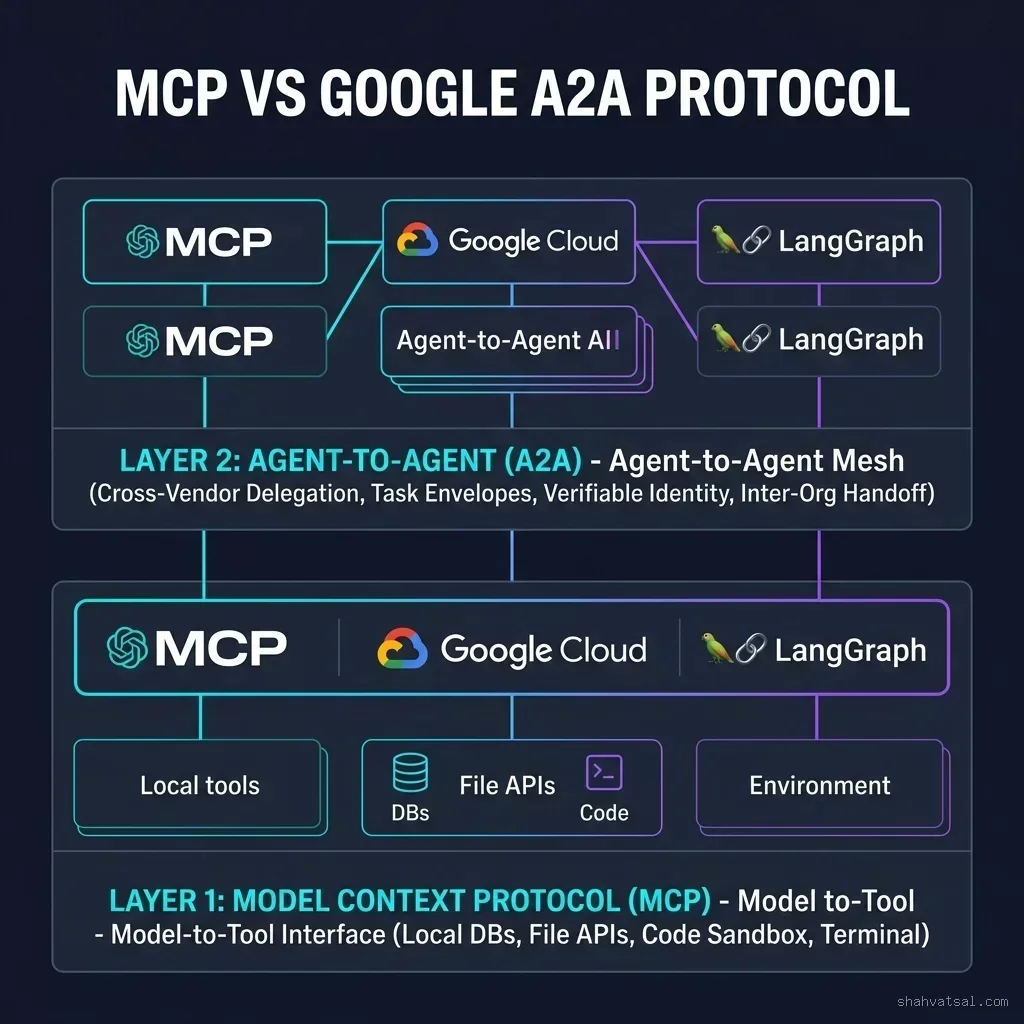
A common misconception among software engineers is that A2A and MCP are competing protocols. In production enterprise architectures, they are complementary layers of the same autonomous stack:
┌──────────────────────────────────────────────────────────────────────────┐
│                   LAYER 2: AGENT-TO-AGENT (A2A)                          │
│   • Cross-Vendor Federation     • Verifiable Delegation Tokens          │
│   • Inter-Department Handoff    • Cryptographic Task Envelopes          │
└────────────────────────────────────┬─────────────────────────────────────┘
                                     │ Delegated Tasks
                                     ▼
┌──────────────────────────────────────────────────────────────────────────┐
│                 AUTONOMOUS AGENT ORCHESTRATION ENGINE                    │
│        (LangGraph / CrewAI / AutoGen / Google Vertex AI Agents)          │
└────────────────────────────────────┬─────────────────────────────────────┘
                                     │ Tool Invocations
                                     ▼
┌──────────────────────────────────────────────────────────────────────────┐
│                 LAYER 1: MODEL CONTEXT PROTOCOL (MCP)                    │
│   • Model-to-Tool Connectivity  • Local Sandbox Execution               │
│   • Direct SQL / Vector DB IO   • File System & CLI Operations          │
└──────────────────────────────────────────────────────────────────────────┘
Layer 1: Model Context Protocol (MCP) — Model-to-Tool Interface
MCP operates at the inference boundary. When an LLM decides it needs real-time data or execution capabilities, MCP provides a standardized JSON-RPC interface to query a PostgreSQL database, execute a Python script in a Docker container, or read a file from S3. MCP is inherently local, synchronous, and stateless.
Layer 2: Google A2A Protocol — Agent-to-Agent Mesh
A2A operates at the distributed systems boundary. A2A treats each agent as an independent, stateful actor with its own memory, goal planning loop, and security boundary. A2A handles asynchronous task handoffs, capability discovery, multi-turn contract negotiations, and cryptographic credential delegation across disparate organizations.
The Google A2A Protocol Architecture: Discovery, Schemas, and Envelopes {#a2a-architecture}
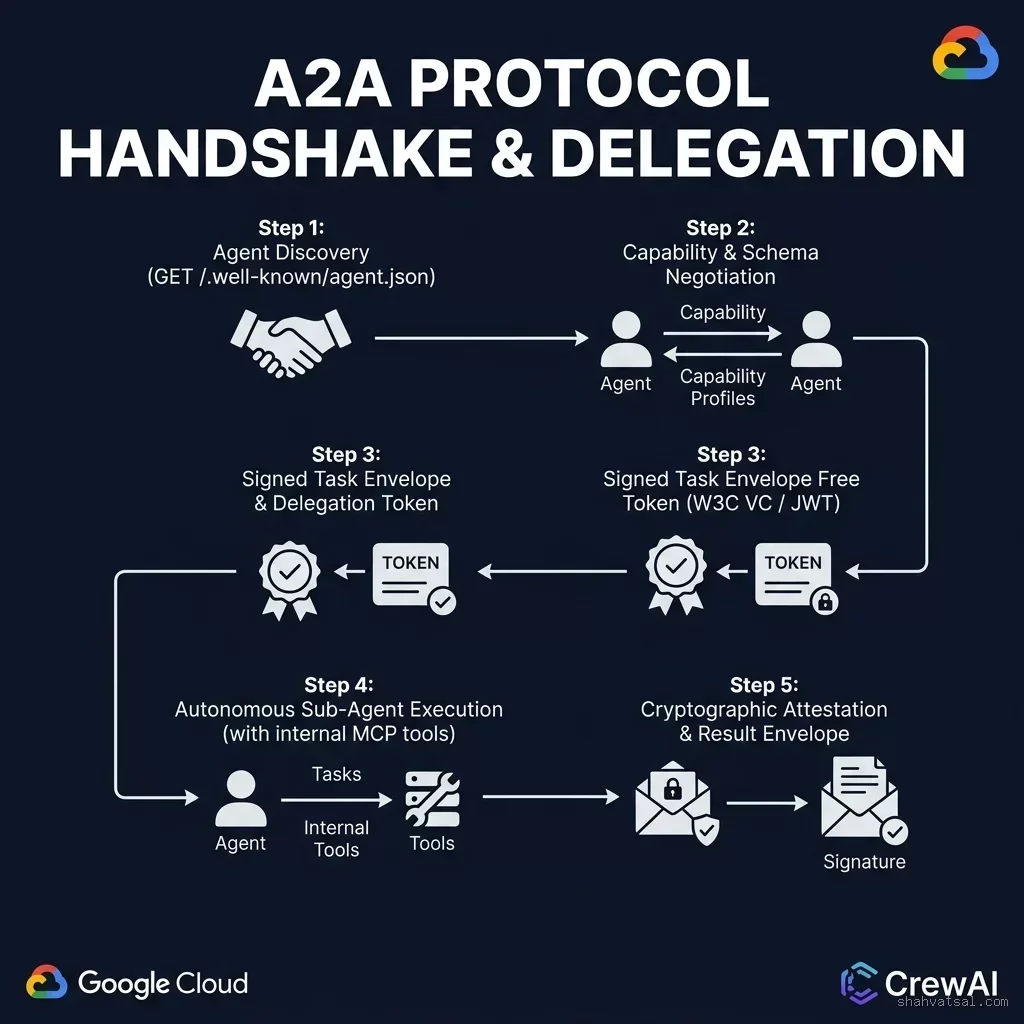
The Google A2A specification defines a four-pillar communication model built on standard web technologies (HTTP/3, gRPC, JSON-Schema, and W3C Decentralized Identifiers):
1. Agent Discovery: The /.well-known/agent.json Manifest
Similar to robots.txt or oauth-authorization-server, any compliant A2A agent endpoint exposes a machine-readable manifest at https://agent.enterprise.com/.well-known/agent.json.
{
  class="tok-str">"a2a_version": class="tok-str">"1.0.0",
  class="tok-str">"agent_id": class="tok-str">"did:web:legal.enterprise.com:contract-analyst-v4",
  class="tok-str">"name": class="tok-str">"Enterprise Legal Risk Auditor",
  class="tok-str">"description": class="tok-str">"Specialized agent for auditing enterprise commercial contracts and NDA liability.",
  class="tok-str">"endpoint": class="tok-str">"https:class="tok-cm">//legal.enterprise.com/api/v1/a2a",
  class="tok-str">"protocols": [class="tok-str">"https+json-rpc", class="tok-str">"grpc"],
  class="tok-str">"public_keys": [
    {
      class="tok-str">"id": class="tok-str">"key-2026-08",
      class="tok-str">"type": class="tok-str">"Ed25519VerificationKey2020",
      class="tok-str">"publicKeyMultibase": class="tok-str">"z6MkpTHR8VNsBxYAAWHuEC2RV5KSQnCGKa86MKE2"
    }
  ],
  class="tok-str">"capabilities": [
    {
      class="tok-str">"action": class="tok-str">"contract.audit.indemnification",
      class="tok-str">"input_schema": class="tok-str">"https:class="tok-cm">//legal.enterprise.com/schemas/v1/indemnity-input.json",
      class="tok-str">"output_schema": class="tok-str">"https:class="tok-cm">//legal.enterprise.com/schemas/v1/indemnity-output.json",
      class="tok-str">"pricing_tokens_per_call": 1500,
      class="tok-str">"sla_p95_latency_ms": 3200
    }
  ]
}
2. The A2A Task Envelope
Communication between agents occurs through immutable Task Envelopes signed by the delegating agent's private key. Each envelope contains:
envelope_id: UUIDv7 tracking the unique distributed trace.initiator_did: Cryptographic Decentralized Identifier of the requesting agent.delegation_chain: Array of upstream authorizing agent signatures.payload: The structured parameters conforming to the destination agent's JSON-Schema.budget_guardrail: Maximum allowed token count and execution cost before mandatory abort.
Cryptographic Identity & Delegation: W3C Verifiable Credentials and JWTs {#identity-delegation}
In autonomous multi-agent systems, the "Confused Deputy Problem" is catastrophic. If a Sales Agent asks a Financial Agent to issue a refund, how does the Financial Agent verify that the human customer actually authorized the transaction?
Google A2A solves this using Capability-Scoped Delegation Chains:
Human CFO (OAuth 2.0 / WebAuthn)
   │
   ▼ Issues Root Verifiable Credential
Procurement Agent (DID: did:web:procurement.corp)
   │
   ▼ Issues Sub-Delegation Token (Scope: budget.spend <= $50,000)
Vendor Negotiation Agent (DID: did:web:negotiate.vendor.com)
   │
   ▼ Submits Signed Task Envelope
Bank Settlement Agent (DID: did:web:treasury.chase.com)- W3C Verifiable Credentials (VC): The human user signs a root authorization token with hardware-backed passkeys.
- Capability Attestation: When Agent A calls Agent B, it embeds a cryptographically signed JWT containing the exact subset of capabilities granted to Agent B.
- Revocation Checks: Sub-agents verify revocation status in real time against an enterprise Distributed Key Infrastructure (DKI) before executing irreversible actions.
Cross-Framework Integration: Unifying LangGraph, CrewAI, AutoGen, and Vertex AI {#cross-framework}
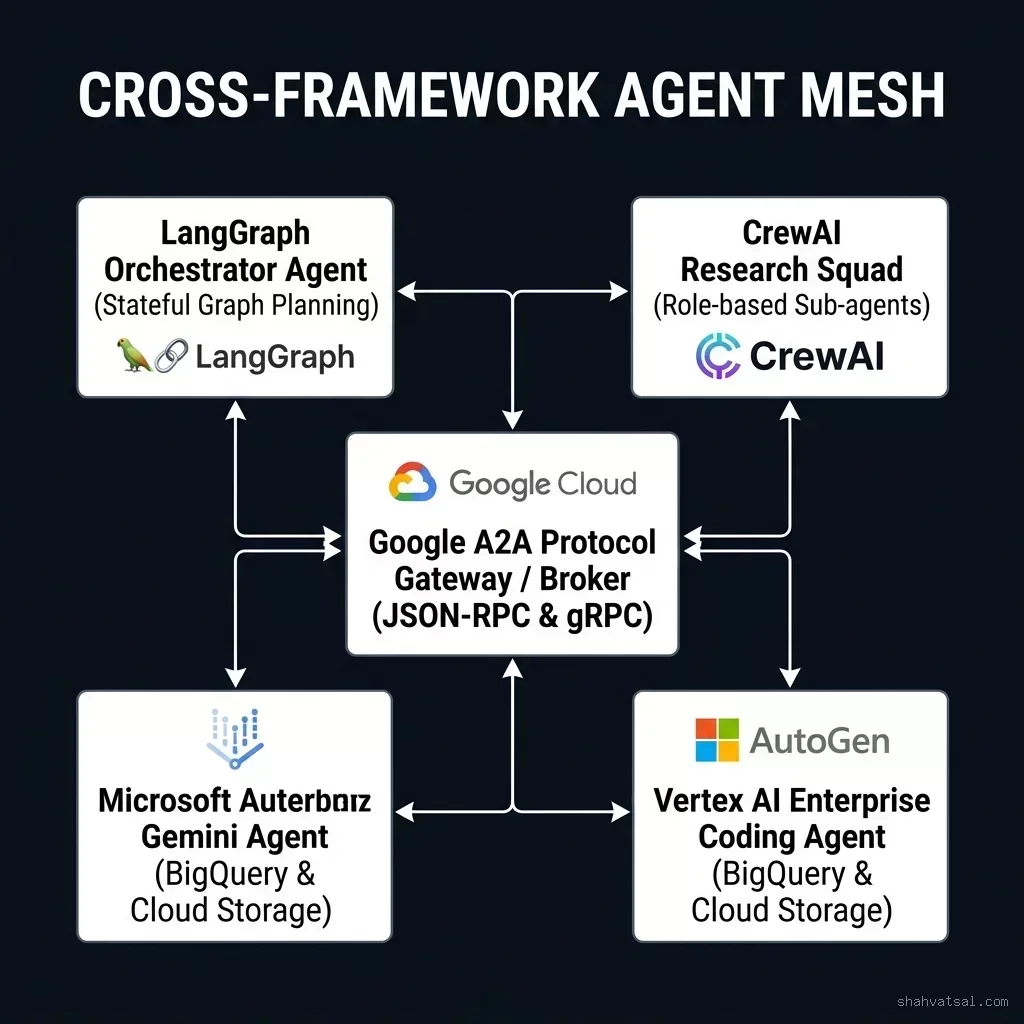
Prior to A2A, integrating a LangGraph workflow with a CrewAI team required custom glue code, fragile webhook endpoints, and bespoke error handling.
With A2A, each framework exposes a standard A2A adapter:
| Framework | Primary Role in A2A Mesh | A2A Native Adapter |
|---|---|---|
| LangGraph | High-level Stateful Orchestrator & Planner | A2ALangGraphRouter |
| CrewAI | Role-based Sub-Task Execution Squads | CrewA2AAgentListener |
| Microsoft AutoGen | Multi-Turn Conversational Debugging & Code Gen | AutoGenA2AChannel |
| Google Vertex AI | Enterprise Gemini Foundation Agents & BigQuery IO | VertexAgentBridge |
Enterprise Topology: Inter-Departmental Multi-Agent Collaboration {#enterprise-topology}
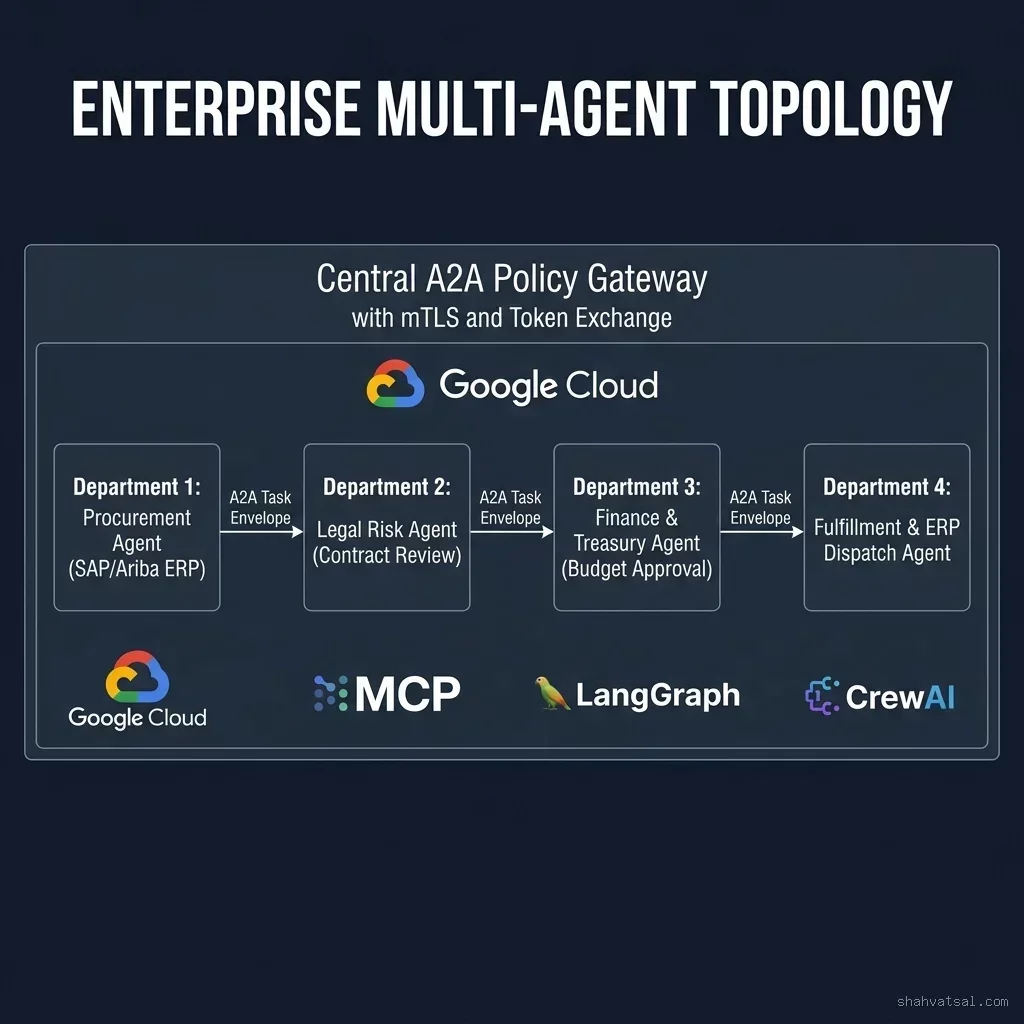
In large enterprises, agents cannot share memory or databases due to strict compliance boundaries (HIPAA, SOX, GDPR). The A2A protocol acts as an Enterprise Service Mesh for Autonomous AI:
- The Procurement Agent receives a requisition for 500 AI compute servers in SAP Ariba.
- It generates an A2A Task Envelope with a
contract.reviewrequest and dispatches it over mTLS to the Legal Risk Agent. - The Legal Agent inspects the vendor SLA, signs a cryptographic approval receipt, and returns the envelope to Procurement.
- The Procurement Agent bundles both receipts into a
payment.authorizeenvelope and routes it to the Treasury Agent, which executes the bank wire.
At every step, zero internal model state is exposed. Only signed, schema-validated envelopes cross network boundaries.
Production Code: Building an A2A Protocol Gateway in Python {#production-code}
Below is a complete, production-ready Python implementation of an A2A Protocol Broker capable of receiving signed task envelopes, verifying cryptographic signatures, and delegating execution to a downstream LangGraph or CrewAI agent.
import os
import json
import time
import base64
import hashlib
from typing import Dict, Any, Optional
from cryptography.hazmat.primitives.asymmetric import ed25519
from cryptography.exceptions import InvalidSignature
from pydantic import BaseModel, Field
from fastapi import FastAPI, HTTPException, Request, Header

app = FastAPI(title=class="tok-str">"Enterprise Google A2A Protocol Gateway", version=class="tok-str">"1.3.0.0")

class="tok-cm"># 1. Pydantic Models for A2A Specification
class A2ACapability(BaseModel):
    action: str
    input_schema: str
    output_schema: str
    pricing_tokens: int
    sla_latency_ms: int

class A2AManifest(BaseModel):
    a2a_version: str = class="tok-str">"1.0.0"
    agent_id: str
    name: str
    endpoint: str
    public_key_hex: str
    capabilities: list[A2ACapability]

class A2ATaskEnvelope(BaseModel):
    envelope_id: str
    initiator_did: str
    timestamp_utc: int
    action: str
    payload: Dict[str, Any]
    signature_b64: str
    budget_max_tokens: int = Field(default=4000)

class="tok-cm"># 2. Local Agent Cryptographic Keys & Registry
AGENT_PRIVATE_KEY = ed25519.Ed25519PrivateKey.generate()
AGENT_PUBLIC_KEY = AGENT_PRIVATE_KEY.public_key()
PUBLIC_KEY_HEX = AGENT_PUBLIC_KEY.public_bytes_raw().hex()

class="tok-cm"># Known Trusted Agent Registry (In production, load from Redis / KMS)
TRUSTED_AGENTS: Dict[str, ed25519.Ed25519PublicKey] = {
    class="tok-str">"did:web:procurement.corp:main": AGENT_PUBLIC_KEY class="tok-cm"># Self for testing
}

class="tok-cm"># 3. Discovery Endpoint (/.well-known/agent.json)
@app.get(class="tok-str">"/.well-known/agent.json")
class="tok-kw">def get_a2a_manifest():
    return A2AManifest(
        agent_id=class="tok-str">"did:web:procurement.corp:main",
        name=class="tok-str">"Enterprise Procurement A2A Gateway",
        endpoint=class="tok-str">"https:class="tok-cm">//procurement.corp/api/v1/a2a",
        public_key_hex=PUBLIC_KEY_HEX,
        capabilities=[
            A2ACapability(
                action=class="tok-str">"vendor.purchase.authorize",
                input_schema=class="tok-str">"https:class="tok-cm">//procurement.corp/schemas/vendor_auth.json",
                output_schema=class="tok-str">"https:class="tok-cm">//procurement.corp/schemas/vendor_ack.json",
                pricing_tokens=2500,
                sla_latency_ms=1800
            )
        ]
    )

class="tok-cm"># 4. Cryptographic Envelope Verification
class="tok-kw">def verify_envelope_signature(envelope: A2ATaskEnvelope) -> bool:
    sender_public_key = TRUSTED_AGENTS.get(envelope.initiator_did)
    if not sender_public_key:
        return False

    class="tok-cm"># Canonical payload serialization for signing
    canonical_data = json.dumps({
        class="tok-str">"envelope_id": envelope.envelope_id,
        class="tok-str">"initiator_did": envelope.initiator_did,
        class="tok-str">"timestamp_utc": envelope.timestamp_utc,
        class="tok-str">"action": envelope.action,
        class="tok-str">"payload": envelope.payload,
        class="tok-str">"budget_max_tokens": envelope.budget_max_tokens
    }, sort_keys=True).encode(class="tok-str">"utf-8")

    try:
        raw_sig = base64.b64decode(envelope.signature_b64)
        sender_public_key.verify(raw_sig, canonical_data)
        return True
    except (InvalidSignature, Exception):
        return False

class="tok-cm"># 5. Core A2A Execution Gateway
@app.post(class="tok-str">"/api/v1/a2a/execute")
async class="tok-kw">def execute_a2a_task(envelope: A2ATaskEnvelope):
    start_time = time.time()

    class="tok-cm"># Check Timestamp Freshness (Anti-Replay Protection: 60s max skew)
    current_time = int(time.time())
    if abs(current_time - envelope.timestamp_utc) > 60:
        raise HTTPException(status_code=400, detail=class="tok-str">"A2A Task Envelope Expired or Timestamp Skewed")

    class="tok-cm"># Verify Cryptographic Signature
    if not verify_envelope_signature(envelope):
        raise HTTPException(status_code=401, detail=class="tok-str">"Invalid A2A Cryptographic Signature")

    class="tok-cm"># Dispatch to Downstream Execution Engine (LangGraph / CrewAI)
    print(fclass="tok-str">"[+] Verified A2A Task: {envelope.envelope_id} from {envelope.initiator_did}")
    print(fclass="tok-str">"[+] Action: {envelope.action} | Tokens Allocated: {envelope.budget_max_tokens}")

    class="tok-cm"># Simulated execution result
    execution_output = {
        class="tok-str">"status": class="tok-str">"APPROVED",
        class="tok-str">"authorization_code": class="tok-str">"AUTH-2026-99182",
        class="tok-str">"settled_amount_usd": envelope.payload.get(class="tok-str">"amount", 0.0),
        class="tok-str">"execution_latency_ms": int((time.time() - start_time) * 1000)
    }

    class="tok-cm"># Sign Response Attestation
    response_canonical = json.dumps(execution_output, sort_keys=True).encode(class="tok-str">"utf-8")
    response_signature = base64.b64encode(AGENT_PRIVATE_KEY.sign(response_canonical)).decode(class="tok-str">"utf-8")

    return {
        class="tok-str">"envelope_id": envelope.envelope_id,
        class="tok-str">"responder_did": class="tok-str">"did:web:procurement.corp:main",
        class="tok-str">"result": execution_output,
        class="tok-str">"attestation_signature_b64": response_signature,
        class="tok-str">"execution_time_ms": int((time.time() - start_time) * 1000)
    }

if __name__ == class="tok-str">"__main__":
    import uvicorn
    print(fclass="tok-str">"[*] Starting A2A Gateway with Public Key: {PUBLIC_KEY_HEX[:16]}...")
    uvicorn.run(app, host=class="tok-str">"127.0.0.1", port=8000)
Governance, mTLS, and Immutable OpenTelemetry Audit Trails {#governance-security}
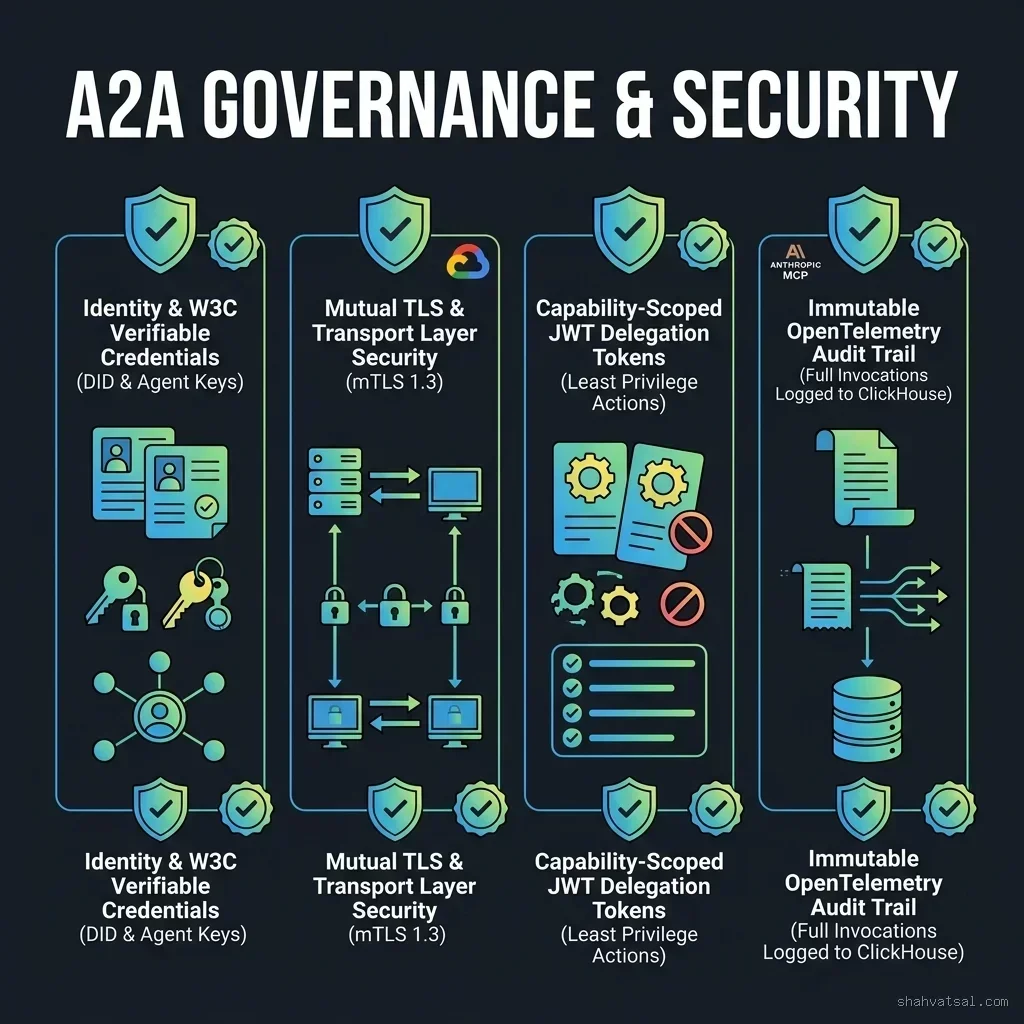
Deploying inter-agent networks requires enterprise-grade infrastructure guardrails:
- Mutual TLS (mTLS 1.3): Every HTTP/3 or gRPC connection between A2A agents must enforce mutual client-certificate validation, encrypting traffic and binding TCP sockets to verified organization domains.
- OpenTelemetry Distributed Tracing: Every A2A task envelope carries an OpenTelemetry
traceparentheader. When Agent A dispatches to Agent B, which spawns three sub-agents via CrewAI, the entire distributed execution tree is captured in a single ClickHouse/Grafana dashboard. - Automated Budget Circuit Breakers: A2A envelopes enforce hard token budgets ($B_{\text{max}}$). If a downstream sub-agent enters a reasoning loop and approaches the budget ceiling, the A2A gateway issues an automated
SIGTERM_BUDGET_EXCEEDEDresponse.
Enterprise Case Study: Fortune 100 Supply Chain Agent Federation {#case-study}
A global manufacturing conglomerate deployed an autonomous logistics network spanning 42 supply chain vendors and 3PL carriers.
The Challenge
Each carrier utilized different AI stacks: DHL ran proprietary Google Vertex AI models, FedEx used custom LangGraph orchestrators, and internal warehouses ran CrewAI on local Kubernetes clusters. Communication was stuck in legacy EDI (Electronic Data Interchange) messages and fragile web scraping.
The A2A Solution
The enterprise deployed a federated Google A2A Mesh:
- All carriers exposed
/.well-known/agent.jsonmanifests detailing dynamic shipping capacity and tariff rates. - When a factory faced a parts shortage, the central LangGraph Planning Agent autonomously broadcasted an A2A
logistics.bid.requestenvelope to 6 carrier agents. - Carrier agents submitted cryptographically signed bids within 800ms.
- The contract was awarded, signed, and dispatched to the warehouse ERP in 1.4 seconds without human intervention.
Measurable Results
- Emergency Freight Dispatch Latency: Reduced from 4.5 hours to 1.4 seconds.
- Logistics Cost Savings: 18.2% reduction in expedited shipping fees through real-time autonomous spot bidding.
- Audit Compliance: Zero reconciliation errors across 1.2M autonomous transactions.
Deep Analysis: A2A vs. MCP vs. Custom Webhooks Matrix {#comparison-matrix}
| Architecture Dimension | Model Context Protocol (MCP) | Google A2A Protocol | Legacy Custom Webhooks |
|---|---|---|---|
| Scope & Focus | Model-to-Tool connectivity | Agent-to-Agent distributed federation | Point-to-point application integration |
| Identity & Verification | Local API tokens / Environment vars | W3C Decentralized Identifiers (DIDs) & Ed25519 | Static HMAC secret headers |
| Discovery Mechanism | Static configuration manifest file | Dynamic `/.well-known/agent.json` DNS lookup | Manual developer API documentation |
| Delegation Authority | Not supported (direct tool execution) | Cryptographic Capability Delegation Chains | Basic OAuth 2.0 User Token pass-through |
| Observability Standard | JSON-RPC trace logs | OpenTelemetry GenAI Semantic Conventions | Unstructured web server logs |
Pitfalls and Anti-Patterns in Multi-Agent Networking {#pitfalls}
- Anti-Pattern 1: Direct Memory Sharing Across Trust Boundaries: Never expose an agent's internal vector memory or chat history directly over A2A. Only pass the strictly necessary parameters inside the signed task envelope.
- Anti-Pattern 2: Unbounded Delegation Depth: Allowing Agent A to delegate to Agent B, which delegates to C, D, and E without a depth limiter causes combinatorial cost explosions. Enforce
max_delegation_hops = 3. - Anti-Pattern 3: Skipping Cryptographic Attestation Receipts: Accepting asynchronous task completion over standard HTTP 200 without a signed Ed25519 attestation leaves zero legal proof of execution.
2027–2030 Roadmap: The Future of Global Agent Interoperability {#roadmap}
The evolution of agent networking will mirror the rapid expansion of the internet:
- 2027: W3C Global Agent Standard: ISO and W3C will formalize the A2A specification into an official internet standard, mandating agent manifests for all public enterprise APIs.
- 2028: Autonomous Agent Settlement Networks: Agents will settle micro-transactions for task delegation in real-time using Layer-2 stablecoin payment channels.
- 2029: Cross-Sovereign AI Governance: National regulatory frameworks (EU AI Act, US Executive Orders) will require cryptographic A2A attestation receipts for all cross-border algorithmic decisions.
- 2030: Planetary-Scale Agent Swarms: Millions of specialized autonomous agents will form a continuous, self-organizing global computing mesh across every enterprise domain.
Key Takeaways {#key-takeaways}
- A2A Sits Above MCP: While MCP connects models to deterministic tools, Google A2A connects distributed agents to other agents across vendors and firewalls.
- Discovery Is Standardized: The
/.well-known/agent.jsonmanifest provides machine-readable capability discovery and public keys. - Zero Trust by Default: Every task envelope is cryptographically signed using Ed25519 and verified against W3C Decentralized Identifiers.
- Cross-Framework Interoperability: LangGraph, CrewAI, AutoGen, and Vertex AI can now collaborate in a single unified enterprise mesh.
- Mandatory Guardrails: Implement token budgets, mTLS 1.3, and OpenTelemetry distributed tracing to prevent runaway agent loops.
FAQ {#faq}
About the Author {#about}
Vatsal Shah is a technology leader, AI systems architect, and enterprise transformation advisor. He specializes in distributed multi-agent systems, sovereign AI infrastructure, and next-generation protocol engineering. Read more technical insights at shahvatsal.com.
Conclusion & Strategic Call to Action {#conclusion}
The future of enterprise software is not a monolithic mega-agent, but a federated network of specialized, collaborating autonomous systems. By adopting the Google A2A Protocol alongside Model Context Protocol (MCP), your engineering organization can build flexible, vendor-agnostic multi-agent architectures that scale across organizational boundaries without lock-in.
Ready to architect a secure, vendor-agnostic multi-agent network for your enterprise? Schedule an AI Architecture Consultation →