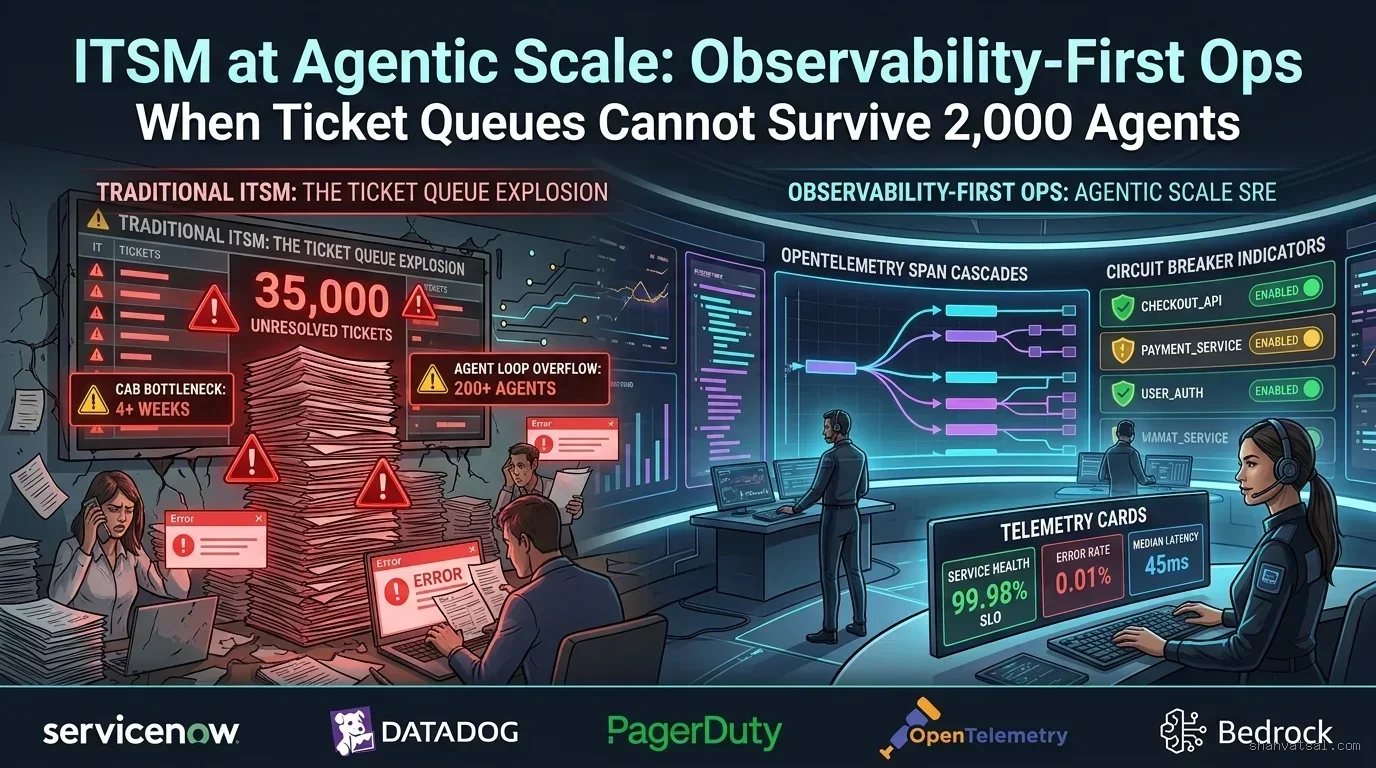
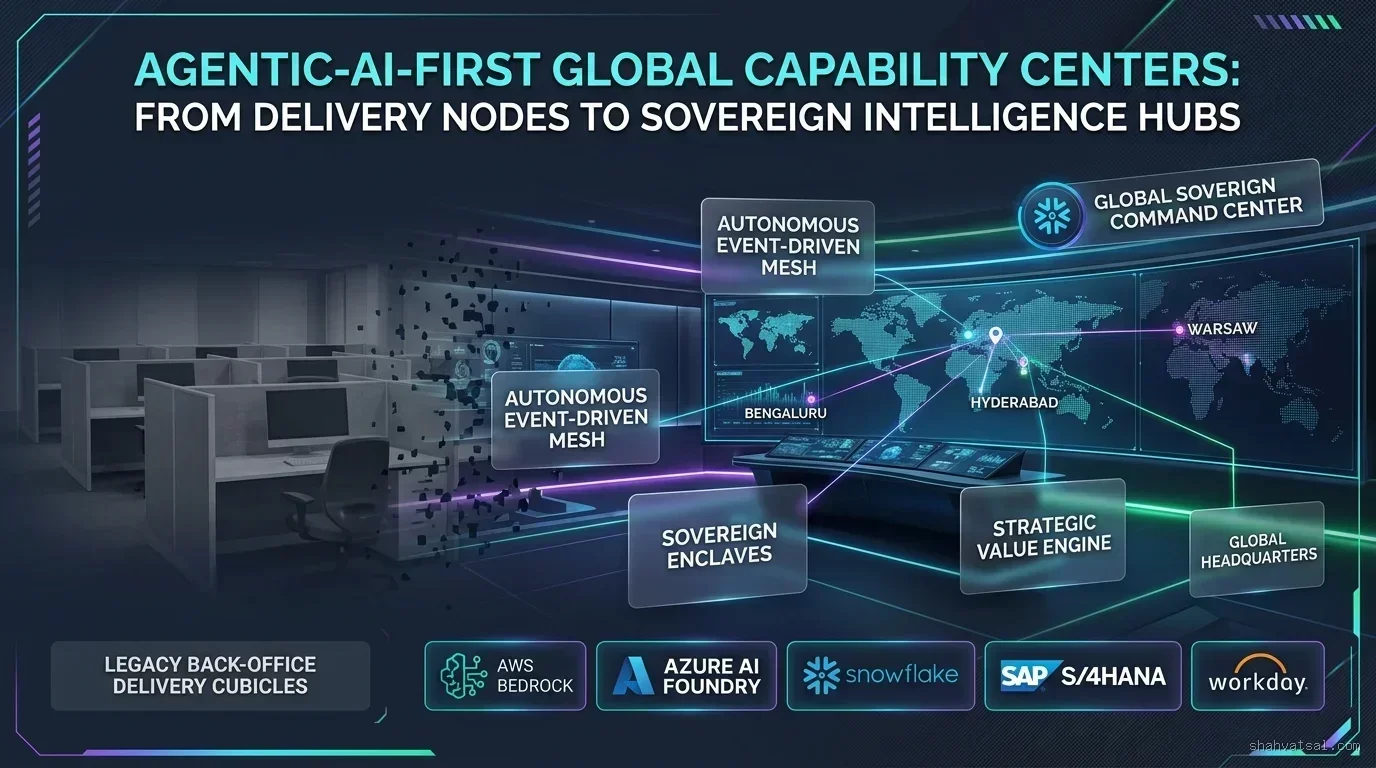
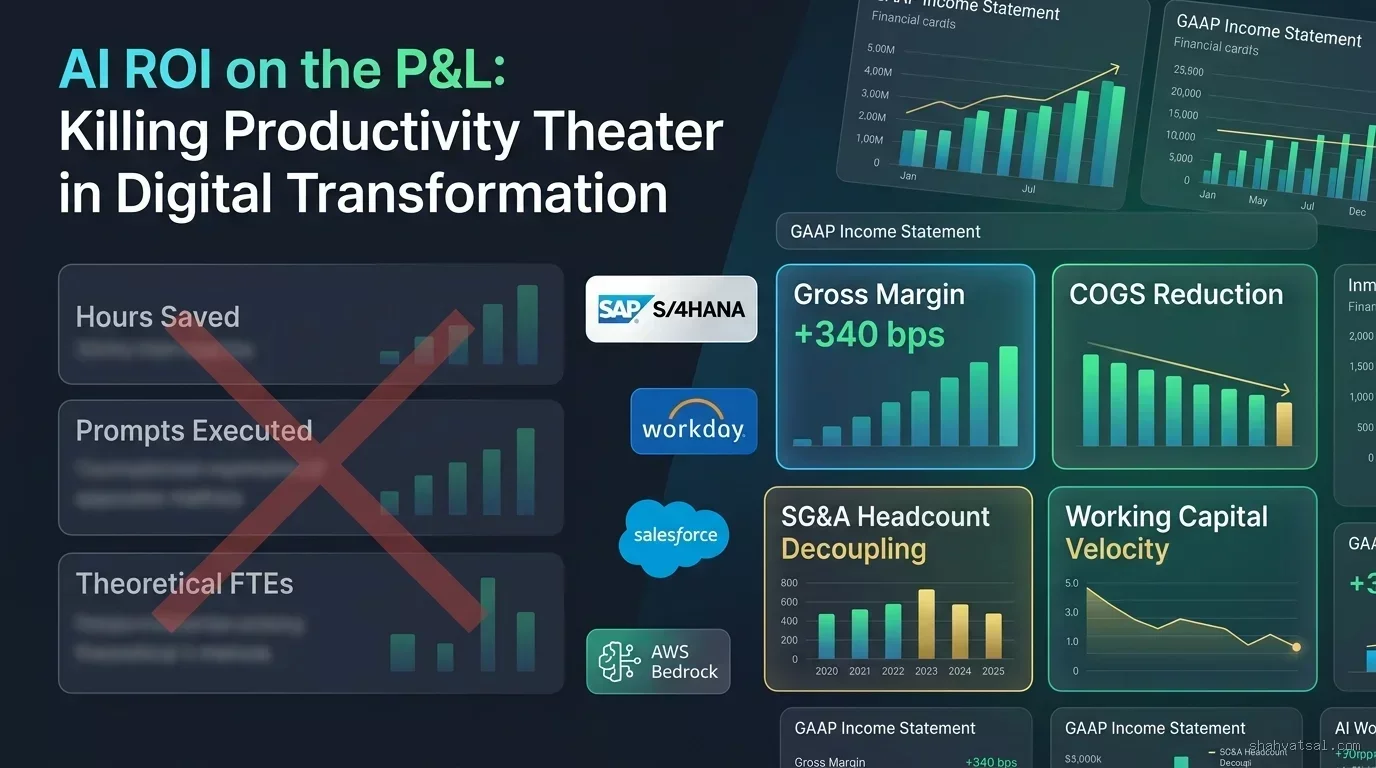
Why are Global Business Services (GBS) centers winning the enterprise agentic AI race while corporate headquarters remain trapped in PoC purgatory? With SSON 2026 data revealing that over 40% of GBS leaders now directly control generative and autonomous agent initiatives, shared services have quietly become the true operational transformation engine of the Fortune 500. Explore the three readiness pillars, multi-agent ERP integration architectures, and the 12-month roadmap from task bots to cognitive operating models.
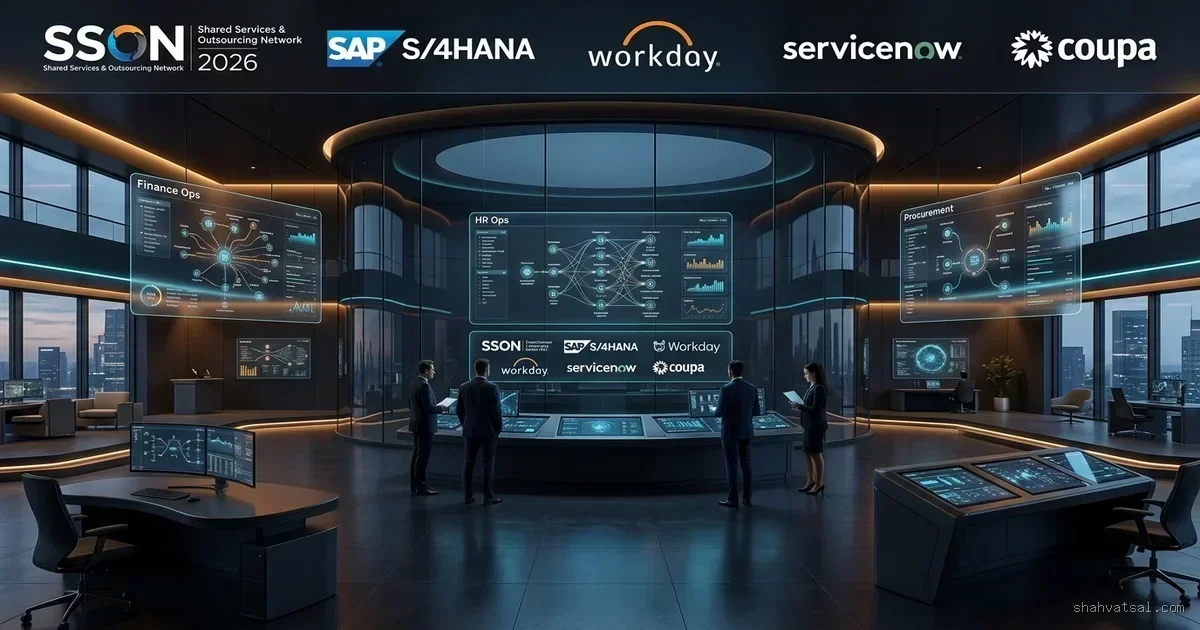
Executive Summary: The 2026 Shift from Innovation Lab Theater to GBS Execution
For the past decade, enterprise digital transformation followed a predictable corporate ritual. Corporate Headquarters (HQ) established an "Emerging Tech Center of Excellence," hired external management consultants, staged design thinking workshops in metropolitan innovation labs, and unveiled flash prototypes. Yet, when evaluated against bottom-line enterprise impact, over 80% of HQ-incubated Artificial Intelligence initiatives stalled in proof-of-concept (PoC) purgatory. They produced sleek slide decks and isolated chat interfaces, but utterly failed to integrate into the transactional circulatory system of the global enterprise.
In 2026, the empirical data confirms a profound inversion of enterprise gravity: Global Business Services (GBS) and Shared Services Organizations (SSOs) have become the primary launchpad and operational execution engine for autonomous Agentic AI.
According to the Shared Services & Outsourcing Network (SSON) 2026 State of the Industry Benchmark:
- ~40% of SSO and GBS leaders directly own and manage enterprise generative and agentic AI deployments—surpassing centralized IT innovation squads and corporate strategy groups in live production rollouts.
- Over 52% of mature GBS organizations have established dedicated Agentic Operations & Automation Leadership roles anchored within shared services delivery hubs.
- Enterprises deploying agentic workflows natively through GBS centers in Bangalore, Krakow, Manila, and San José report 4.2x higher production conversion rates and 68% lower cost-per-transaction realization compared to decentralized corporate headquarters initiatives.
┌────────────────────────────────────────────────────────────────────────────────────────┐
│                        THE ENTERPRISE AGENTIC INVERSION (2026)                         │
└────────────────────────────────────────────────────────────────────────────────────────┘

    CORPORATE HEADQUARTERS (HQ)                       GLOBAL BUSINESS SERVICES (GBS)
  ┌───────────────────────────────┐                 ┌───────────────────────────────┐
  │ • Isolated Innovation PoCs   │                 │ • 100% Process Standardized   │
  │ • Tangled Tribal Knowledge    │                 │ • Granular Celonis Telemetry  │
  │ • Unmeasured Human Latency    │       VS        │ • Strict SLA/KPI Enforcement  │
  │ • Political Turf Battles      │                 │ • Core ERP Plumbing (SAP/WD)  │
  │ • Theoretical Prompt Demos    │                 │ • Scalable Engineering Talent │
  └──────────────┬────────────────┘                 └───────────────┬───────────────┘
                 │                                                  │
                 ▼                                                  ▼
     [ 82% PoC Failure Rate ]                          [ 88% Straight-Through STP ]
     [ class="tok-str">"Innovation Theater" ]                          [ Cognitive Value Engine ]
Why does the GBS operating model outpace corporate headquarters in adopting autonomous agent swarms?
The answer lies in the harsh architectural realities of autonomous AI. Agentic systems do not thrive on corporate vision statements or creative ambiguity. They require hyper-standardized Standard Operating Procedures (SOPs), continuous process mining telemetry, deterministic service-level agreements (SLAs), rigorous compliance guardrails, and deep programmatic connectivity into systems of record (SAP S/4HANA, Workday, ServiceNow, Coupa).
Corporate headquarters possesses the political authority, but GBS possesses the operational plumbing. When an enterprise attempts to scale agents across Finance, HR, and Procurement, GBS is the only entity that has spent thirty years systematically eliminating the ambiguities that cause autonomous software agents to fail.
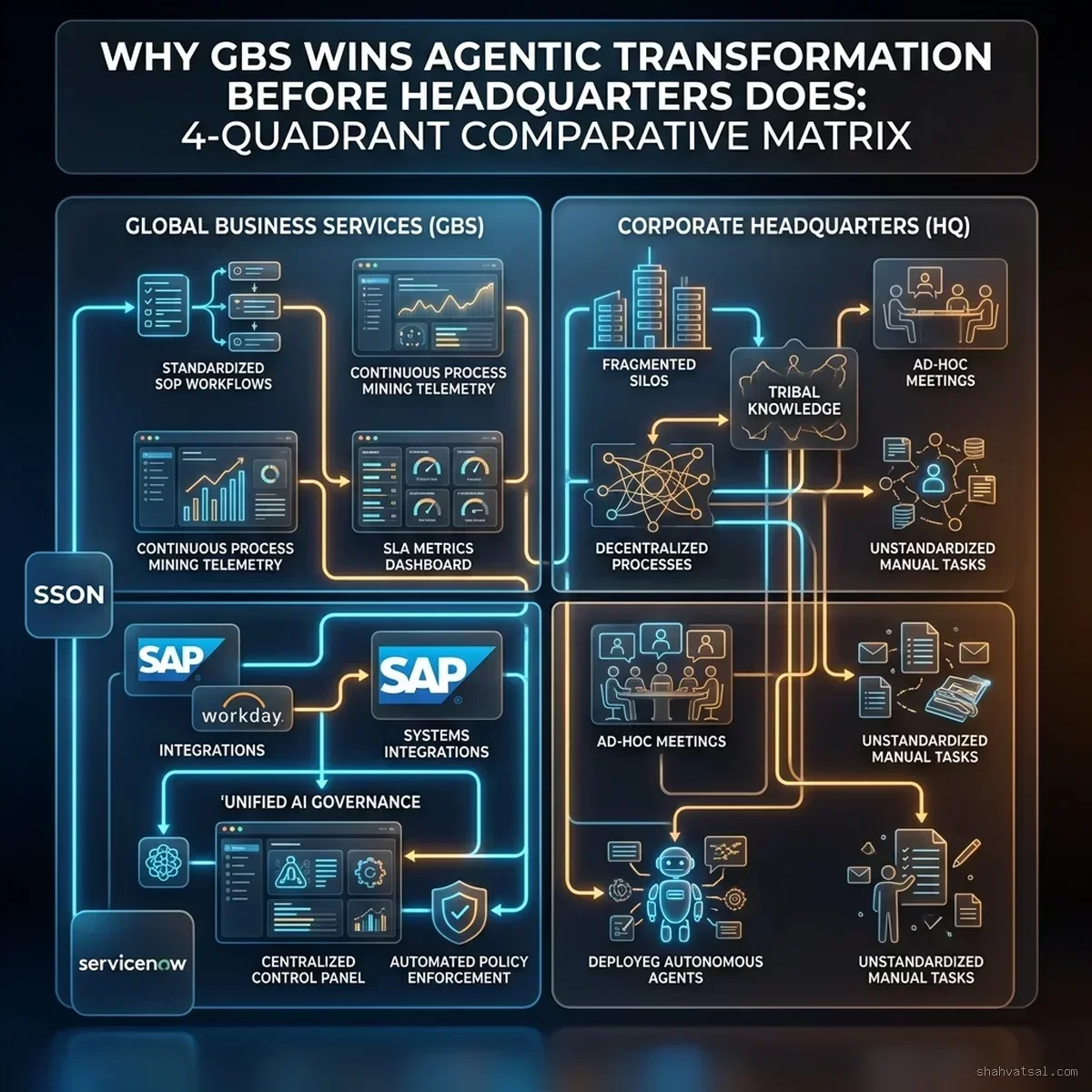
The Three Enterprise Readiness Pillars: Why GBS Outpaces Headquarters
To understand why shared services organizations deploy production-grade autonomous agent fleets while corporate headquarters remains trapped in prompt experimentation, one must dissect the three enterprise readiness pillars: Process Standardization, AI-Native Talent Infrastructure, and Governance Architecture.
1. Process Standardization & Mining Telemetry Depth
Autonomous agents are non-deterministic reasoning engines executing over deterministic business rules. When an LLM-powered agent encounters undefined edge cases or unwritten assumptions, its probability of hallucination, token exhaustion, or recursive execution failure spikes exponentially.
Corporate headquarters operates largely on tribal knowledge. Workflows exist in human memory, fragmented email threads, Microsoft Teams side-channels, and informal negotiations. When HQ teams attempt to automate a financial forecast or contract review, software engineers spend months interviewing business executives only to discover that no two directors follow the same approval rubric.
In stark contrast, GBS is defined by industrialized process standardization:
- Exhaustive SOP Registries: Every tier-1 and tier-2 activity in AP reconciliation, payroll validation, travel and expense audit, and vendor master data maintenance is documented down to keystroke-level decision trees.
- Process Mining Telemetry: Mature GBS units continuously run process mining platforms like Celonis, SAP Signavio, or UiPath Process Mining directly against database transaction logs. They possess sub-second visibility into process cycle times, rework loops, variant frequencies, and transaction bottlenecks before writing a single line of agent code.
- Digital Twin Realism: Because GBS workflows are already metricized, agent architects can immediately benchmark agent performance against historic human baseline KPIs (First-Contact Resolution, Cost-Per-Ticket, Days Sales Outstanding).
2. AI-Native Talent Infrastructure & Industrial Reskilling
A catastrophic misconception among corporate executives is that autonomous agents eliminate the need for human talent. In reality, agentic fleets demand a fundamental shift from transaction processors to cognitive fleet operators.
Corporate HQ faces extreme friction when trying to reskill centralized staff:
- High operational overhead and compensation structures make deploying dedicated prompt evaluation engineers and agent supervisors financially prohibitive.
- HQ professionals often resist moving from strategic advisory roles to granular workflow debugging.
GBS organizations, conversely, are structured as high-velocity human capital development engines:
- GBS centers in Central Europe, Latin America, and South-East Asia have developed vast pools of tech-fluent domain specialists—data analysts, Python automators, and business analysts who understand the nuances of global general ledgers, international taxation treaties, and cross-border labor compliance.
- GBS leadership can rapidly stand up centralized Agent Operations (AgentOps) squads that pivot business analysts from manual data entry into Agent Workflow Designers, Evaluation Harness Engineers, and Exception Pilots.
3. Governance Muscle & Compliance Muscle Memory
HQ innovation groups frequently treat compliance, data privacy, and security as secondary considerations to be addressed at "production gate." This invariably stalls projects for quarters while corporate legal and security teams debate GDPR, EU AI Act compliance, and SOC 2 controls.
GBS was born in regulatory compliance:
- Shared services centers have operated for decades under relentless audit scrutiny: Sarbanes-Oxley (SOX) Section 404 controls, segregation of duties (SoD), PII masking, PCI-DSS payment compliance, and regional labor statutory audits.
- GBS already maintains strict role-based access control (RBAC), multi-party approval matrices, and comprehensive audit logs.
- Embedding Cedar policy-as-code guardrails, cryptographic audit receipts, and human-in-the-loop escalation gates into an autonomous agent mesh is a natural extension of GBS's existing operational muscle memory.
Comprehensive Comparative Analysis: GBS vs. Corporate HQ
| Operational Dimension | Corporate Headquarters (HQ) | Global Business Services (GBS) | Agentic Impact & Advantage |
|---|---|---|---|
| Workflow Definition | Tribal, informal, undocumented exceptions | Formally codified SOPs, BPMN schemas | Eliminates stochastic agent drift and hallucinated actions |
| Process Observability | Self-reported surveys, ad-hoc meetings | Real-time event logs (Celonis, Signavio) | Provides instant training data and execution path ground truth |
| System Integration | Fragmented SaaS, bespoke spreadsheets | Enterprise ERP backbones (SAP, Workday) | Direct API execution via standardized schemas and connectors |
| KPI Granularity | Abstract strategic objectives (OKRs) | Sub-second SLA, FCR, cost-per-ticket metrics | Objective evaluation harnesses for agent performance benchmarking |
| Talent Economics | Expensive, resistant to operational mechanics | Scalable, highly technical operational engineers | Sustainable economics for 24/7 AgentOps fleet supervision |
| Audit & Governance | Reactive risk reviews at project conclusion | Continuous SOX, GDPR, SoD enforcement | Pre-configured compliance envelopes for autonomous tool calls |
| Scale Mechanism | Departmental silos, inconsistent toolsets | Centralized shared service delivery nodes | Reusable agent skills catalog across global operating units |
| Speed to Live Execution | 9–14 months (stuck in PoC deliberation) | 6–10 weeks (iterative shadow deployment) | Immediate bottom-line cost reduction and velocity realization |
The Fatal Bottleneck: Why Tribal Knowledge Murders Autonomous Agents
To successfully deploy autonomous agents in any enterprise, technical leadership must confront an inescapable engineering truth: Agents cannot execute tribal knowledge.
When humans operate inside an ambiguous corporate workflow, they compensate for missing instructions using social heuristics:
- "If the invoice is from Vendor X and exceeds budget by 5%, Dave in Procurement usually lets it slide if it's quarter-end."
- "If the candidate has an international degree, HR doesn't run the standard background check; they ping Maria on Teams to request the overseas apostille."
- "If the system throws an error on tax reconciliation, wait 10 minutes and resubmit because the staging database replicates at noon."
These informal workarounds constitute tribal knowledge. In human organizations, they serve as the operational grease that keeps imperfect bureaucracies running.
In autonomous agentic architectures, tribal knowledge is fatal poison.
┌────────────────────────────────────────────────────────────────────────────────────────┐
│                        TRIBAL KNOWLEDGE COLLAPSE VS MEPS RIGOR                         │
└────────────────────────────────────────────────────────────────────────────────────────┘

 [ TRIBAL PROCESS (HQ) ]                             [ CODIFIED MEPS (GBS) ]
 ┌──────────────────────────────────────┐            ┌──────────────────────────────────────┐
 │ • class="tok-str">"Ask Dave class="tok-kw">if it&class="tok-cm">#039;s over budget"     │            │ • Strict JSON Schema Validation      │
 │ • class="tok-str">"Sometimes wait 10 mins on error"  │            │ • Deterministic Business Rules       │
 │ • Ambiguous edge-case handling       │            │ • Dynamic SAP RFC Connection Logic   │
 └──────────────────┬───────────────────┘            └──────────────────┬───────────────────┘
                    │                                                   │
                    ▼                                                   ▼
       Stochastic LLM Reasoning                            Deterministic Agent Execution
  ┌───────────────────────────────────┐               ┌───────────────────────────────────┐
  │ Hallucinated approvals, unhandled │               │ Verified tool-calling, automated  │
  │ exceptions, recursive tool loops  │               │ policy checks, zero-touch STP     │
  └─────────────────┬─────────────────┘               └─────────────────┬─────────────────┘
                    │                                                   │
                    ▼                                                   ▼
        [ PRODUCTION INCIDENT ]                             [ 99.4% SUCCESS RATE ]
When an autonomous agent powered by an advanced foundation model (such as GPT-4o, Claude 3.5 Sonnet, or Llama 3.3) encounters an unwritten branch condition:
- The Hallucinated Authority Trap: The agent attempts to resolve the ambiguity by inventing believable rationales. It approves an unverified purchase order, skips a statutory tax compliance check, or misinterprets an undocumented ledger code.
- The Recursive Retry Storm: Encountering an undocumented transient error, the agent repeatedly re-queries the API with minor variations, consuming tens of thousands of tokens per minute, triggering rate limits across core ERP endpoints, and potentially corrupting database states.
- The Unmanaged Stalling Loop: Unable to find an explicit programmatic rule, the agent silently aborts or outputs a conversational non-sequitur, resulting in phantom SLA breaches that go undetected until month-end financial closing.
The GBS Antidote: Machine-Executable Process Specifications (MEPS)
GBS centers succeed where HQ fails because GBS does not attempt to feed narrative human documents directly into an LLM context window. Instead, GBS transforms legacy SOPs into Machine-Executable Process Specifications (MEPS).
A MEPS is not a 50-page PDF sitting in a SharePoint repository. It is a version-controlled, schema-validated Directed Acyclic Graph (DAG) that explicitly decouples:
- Deterministic Business Constraints (e.g., hard monetary thresholds, regulatory compliance checks, required data attributes).
- Stochastic Cognitive Reasoning (e.g., semantic intent extraction, unstructured document parsing, multi-variable anomaly scoring).
Below is an authentic enterprise specification demonstrating how GBS converts an unstructured Accounts Payable discrepancy resolution workflow into an executable JSON Schema with embedded Cedar policy rules and deterministically mapped tool calls:
{
class="tok-str">"$schema": class="tok-str">"https:class="tok-cm">//json-schema.org/draft/2020-12/schema",
class="tok-str">"meps_id": class="tok-str">"MEPS-FIN-AP-0842",
class="tok-str">"process_name": class="tok-str">"Autonomous AP 3-Way Match & Discrepancy Resolution",
class="tok-str">"version": class="tok-str">"2.4.0",
class="tok-str">"owner": class="tok-str">"GBS Global Finance Operations CoE",
class="tok-str">"deterministic_constraints": {
class="tok-str">"currency": class="tok-str">"USD",
class="tok-str">"maximum_autonomous_threshold": 25000.00,
class="tok-str">"line_item_variance_tolerance_percentage": 1.5,
class="tok-str">"required_compliance_tokens": [
class="tok-str">"SOX-404-SIG",
class="tok-str">"TAX-ID-VALIDATED",
class="tok-str">"PO-STATUS-OPEN"
]
},
class="tok-str">"agent_graph": {
class="tok-str">"initial_state": class="tok-str">"INGEST_INVOICE_PAYLOAD",
class="tok-str">"nodes": {
class="tok-str">"INGEST_INVOICE_PAYLOAD": {
class="tok-str">"type": class="tok-str">"extractor",
class="tok-str">"model_tier": class="tok-str">"multimodal_tier_1",
class="tok-str">"inputs": [class="tok-str">"raw_invoice_pdf", class="tok-str">"vendor_email_metadata"],
class="tok-str">"schema_output": class="tok-str">"InvoiceExtractionRecord",
class="tok-str">"fallback_node": class="tok-str">"ESCALATE_TIER_2_UNPARSEABLE_DOCUMENT"
},
class="tok-str">"SAP_3WAY_MATCH_EVALUATION": {
class="tok-str">"type": class="tok-str">"tool_execution",
class="tok-str">"tool_id": class="tok-str">"sap_s4hana_bapi_po_getdetail",
class="tok-str">"parameters": {
class="tok-str">"po_number": class="tok-str">"$.InvoiceExtractionRecord.purchase_order_number",
class="tok-str">"fiscal_year": class="tok-str">"2026"
},
class="tok-str">"next_state": class="tok-str">"EVALUATE_DISCREPANCY_DELTA"
},
class="tok-str">"EVALUATE_DISCREPANCY_DELTA": {
class="tok-str">"type": class="tok-str">"deterministic_evaluator",
class="tok-str">"rules": [
{
class="tok-str">"condition": class="tok-str">"delta_amount == 0.00",
class="tok-str">"action": class="tok-str">"AUTO_APPROVE_FOR_PAYMENT"
},
{
class="tok-str">"condition": class="tok-str">"delta_amount > 0.00 && delta_amount <= 250.00 && delta_percentage <= 1.5",
class="tok-str">"action": class="tok-str">"ROUTE_TOLERANCE_AUTO_ADJUST"
},
{
class="tok-str">"condition": class="tok-str">"delta_amount > 250.00 && delta_amount <= 25000.00",
class="tok-str">"action": class="tok-str">"EXECUTE_VENDOR_CLARIFICATION_AGENT"
},
{
class="tok-str">"condition": class="tok-str">"delta_amount > 25000.00 || po_status != &class="tok-cm">#039;OPEN'",
class="tok-str">"action": class="tok-str">"ESCALATE_TIER_3_FINANCE_CONTROLLER"
}
]
}
}
},
class="tok-str">"cedar_guardrail_policy": class="tok-str">"permit(principal in Role::\"GBS_Autonomous_AP_Agent\class="tok-str">", action in [Action::\"PostCreditMemo\class="tok-str">", Action::\"ClearGRIR\class="tok-str">"], resource in ResourceType::\"SAP_Invoice_Item\class="tok-str">") when { context.delta_amount <= 250.00 && context.sox_audit_passed == true };"
}By engineering processes at this level of structural rigor, GBS strips out tribal ambiguity. The agent is never permitted to guess what "Dave in accounting" would do; it operates within mathematically bounded deterministic tracks, invoking cognitive LLM capabilities only for parsing, semantic synthesis, and context-aware vendor communication.
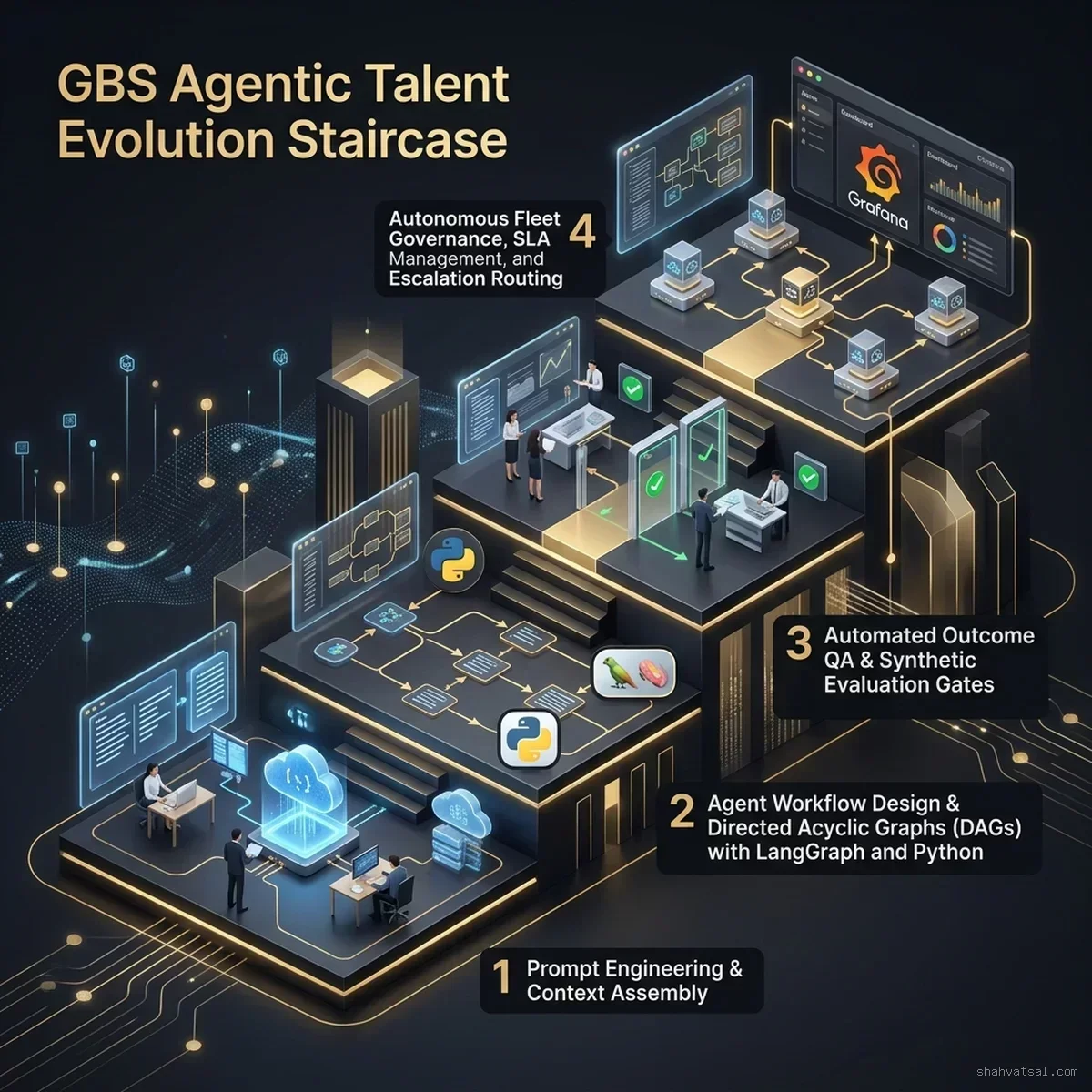
The GBS Agentic Talent Evolution Staircase: 4 Non-Negotiable Competencies
The transition from a transaction-processing shared services organization to an autonomous agentic launchpad requires an aggressive re-architecting of human capital. Enterprises that treat agentic deployment as a simple "prompting exercise" consistently hit a wall of operational instability.
Leading GBS centers navigate a structured, four-tier Agentic Talent Evolution Staircase. Each tier represents an escalation in technical maturity, architectural ownership, and autonomous governance.
Step 1: Prompt Engineering & Context Assembly
At the foundation level, operators learn to structure deterministic context windows for foundation models. This is not about conversational flair; it is about rigorous information architecture:
- System Prompt Parameterization: Building dynamic system prompts that enforce persona boundaries, domain constraints, formatting restrictions (JSON/XML only), and negative constraints ("Never extrapolate tax identification numbers").
- Dynamic Context Assembly: Constructing high-precision Retrieval-Augmented Generation (RAG) pipelines that inject the exact section of enterprise tax law, vendor contract clauses, or employee policy documents into the agent prompt without bloating context tokens or diluting attention.
- Few-Shot Exemplar Curation: Selecting and maintaining production-grade positive and negative execution examples within vector registries to guide model reasoning on complex edge cases.
Step 2: Agent Workflow Design & Directed Acyclic Graphs (DAGs)
Prompt engineering alone produces brittle, single-turn interactions. Step 2 elevates practitioners into Agent Workflow Designers:
- Graph Orchestration Frameworks: Mastering tools such as LangGraph, CrewAI Enterprise, or Microsoft Semantic Kernel to architect multi-agent systems with explicit state management, circular feedback loops, and human-in-the-loop checkpoints.
- State Machine Schemas: Defining strict TypedDict or Pydantic models that govern what data an agent can read, modify, and pass between computational nodes.
- Tool-Call Scaffolding: Writing deterministic OpenAPI/JSON interfaces for enterprise APIs, ensuring tools return structured error codes (HTTP 429, 403, 502) that agents can reason over and recover from automatically.
Step 3: Automated Outcome QA & Synthetic Evaluation Harnesses
In an enterprise environment processing millions of financial and legal transactions, manual spot-checking of agent output is economically unviable. Step 3 introduces Evaluation Engineering (Evals-as-Code):
- Synthetic Golden Datasets: Creating vast libraries of synthetic transaction scenarios—spanning routine cases, edge conditions, adversarial attacks, and system outages—against which every agent prompt and code change is tested before production deployment.
- Metricized Scoring Frameworks: Utilizing LLM-as-a-Judge paradigms alongside deterministic regex/numerical checks to score agent outputs across multiple vectors: Factual Faithfulness, Schema Compliance, Policy Adherence, and Token Efficiency.
- Automated Regression Tripwires: Implementing CI/CD pipelines where any agent modification that degrades the evaluation benchmark below a strict threshold (e.g., 99.2% accuracy) is automatically rejected.
Step 4: Autonomous Fleet Governance, SLA Telemetry & Escalation Routing
The apex of the GBS talent staircase is the Agent Operations (AgentOps) Fleet Controller. These professionals manage agents in the same manner that air traffic controllers manage flight corridors:
- Real-Time Telemetry Observability: Monitoring real-time OpenTelemetry traces, distributed span latencies, tool-calling failure rates, and model cost-per-outcome across thousands of concurrently executing agents.
- Autonomous Circuit Breakers: Configuring dynamic throttling and circuit-breaker tripwires that instantly suspend an agent pod if hallucination drift or token consumption rates exceed statistical control limits.
- Dynamic Human Exception Cockpits: Designing ergonomic triage interfaces where human specialists resolve escalated exceptions in seconds, with the resolution data automatically fed back to update the golden evaluation test suite.
Production Implementation: LangGraph GBS State Machine
The following production-grade Python implementation illustrates how a GBS team implements a stateful, resilient multi-agent discrepancy resolver using LangGraph, Pydantic schemas, and OpenTelemetry tracing:
class="tok-str">""class="tok-str">"
GBS Autonomous Operations: Multi-Agent AP Discrepancy Resolution Engine
Architecture: LangGraph Stateful DAG with OpenTelemetry and Strict Schema Validation
Author: Vatsal Shah (https:class="tok-cm">//shahvatsal.com)
"class="tok-str">""

from typing import Annotated, Dict, List, Any, Optional
from pydantic import BaseModel, Field
from langgraph.graph import StateGraph, END
from opentelemetry import trace
import logging

tracer = trace.get_tracer(class="tok-str">"gbs.agentops.ap_resolver")
logger = logging.getLogger(class="tok-str">"GBS_AgentOps")

class="tok-cm"># ==============================================================================
class="tok-cm"># 1. STATE DEFINITION & PYDANTIC VALIDATION
class="tok-cm"># ==============================================================================

class InvoiceLineItem(BaseModel):
    item_id: str
    description: str
    quantity: float
    unit_price: float
    total_amount: float

class APWorkflowState(BaseModel):
    invoice_id: str
    vendor_id: str
    po_number: str
    total_invoice_amount: float
    line_items: List[InvoiceLineItem] = Field(default_factory=list)
    sap_po_data: Optional[Dict[str, Any]] = None
    discrepancy_amount: float = 0.0
    discrepancy_reason: Optional[str] = None
    evaluation_score: float = 0.0
    status: str = class="tok-str">"INITIALIZED"
    requires_human_escalation: bool = False
    audit_trail: List[str] = Field(default_factory=list)

class="tok-cm"># ==============================================================================
class="tok-cm"># 2. AGENT NODE IMPLEMENTATIONS
class="tok-cm"># ==============================================================================

class="tok-kw">def sap_erp_lookup_node(state: APWorkflowState) -> Dict[str, Any]:
    class="tok-str">""class="tok-str">"Retrieves authoritative Purchase Order data from SAP S/4HANA via RFC/OData."class="tok-str">""
    with tracer.start_as_current_span(class="tok-str">"node_sap_erp_lookup") as span:
        span.set_attribute(class="tok-str">"po_number", state.po_number)
        logger.info(fclass="tok-str">"Querying SAP S/4HANA for PO: {state.po_number}")

        class="tok-cm"># Simulated ERP BAPI response
        sap_data = {
            class="tok-str">"po_number": state.po_number,
            class="tok-str">"vendor_id": state.vendor_id,
            class="tok-str">"po_total_value": 14250.00,
            class="tok-str">"gr_ir_status": class="tok-str">"PARTIALLY_DELIVERED",
            class="tok-str">"allocated_budget": 15000.00,
            class="tok-str">"line_items": [
                {class="tok-str">"item_id": class="tok-str">"001", class="tok-str">"quantity": 100.0, class="tok-str">"unit_price": 142.50}
            ]
        }

        audit_entry = fclass="tok-str">"SAP S/4HANA lookup successful. PO Value: ${sap_data[&class="tok-cm">#039;po_total_value']:.2f}"
        return {
            class="tok-str">"sap_po_data": sap_data,
            class="tok-str">"audit_trail": state.audit_trail + [audit_entry]
        }

class="tok-kw">def discrepancy_analyzer_node(state: APWorkflowState) -> Dict[str, Any]:
    class="tok-str">""class="tok-str">"Calculates mathematical and semantic delta between invoice and ERP records."class="tok-str">""
    with tracer.start_as_current_span(class="tok-str">"node_discrepancy_analyzer") as span:
        po_value = state.sap_po_data.get(class="tok-str">"po_total_value", 0.0) if state.sap_po_data else 0.0
        delta = abs(state.total_invoice_amount - po_value)

        span.set_attribute(class="tok-str">"delta_amount", delta)
        logger.info(fclass="tok-str">"Analyzing discrepancy for Invoice {state.invoice_id}: Delta = ${delta:.2f}")

        reason = class="tok-str">"PERFECT_MATCH" if delta == 0.0 else class="tok-str">"LINE_ITEM_PRICE_VARIANCE"
        audit_entry = fclass="tok-str">"Evaluated delta: ${delta:.2f} ({reason})"

        return {
            class="tok-str">"discrepancy_amount": delta,
            class="tok-str">"discrepancy_reason": reason,
            class="tok-str">"audit_trail": state.audit_trail + [audit_entry]
        }

class="tok-kw">def automated_guardrail_evaluator(state: APWorkflowState) -> Dict[str, Any]:
    class="tok-str">""class="tok-str">"Enforces GBS SOX compliance thresholds and Cedar policy boundaries."class="tok-str">""
    with tracer.start_as_current_span(class="tok-str">"node_guardrail_evaluator"):
        max_tolerance = 250.00
        hard_escalation_cap = 25000.00

        class="tok-cm"># Policy Evaluation
        if state.discrepancy_amount == 0.0:
            status = class="tok-str">"APPROVED_ZERO_TOUCH"
            escalate = False
        elif state.discrepancy_amount <= max_tolerance:
            status = class="tok-str">"AUTO_ADJUSTED_WITHIN_TOLERANCE"
            escalate = False
        elif state.discrepancy_amount > hard_escalation_cap:
            status = class="tok-str">"ESCALATED_EXCEEDS_HARD_CEILING"
            escalate = True
        else:
            status = class="tok-str">"ROUTED_TO_VENDOR_CLARIFICATION_AGENT"
            escalate = False

        audit_entry = fclass="tok-str">"Guardrail verdict: {status} (Escalate={escalate})"
        return {
            class="tok-str">"status": status,
            class="tok-str">"requires_human_escalation": escalate,
            class="tok-str">"audit_trail": state.audit_trail + [audit_entry]
        }

class="tok-kw">def human_escalation_cockpit_node(state: APWorkflowState) -> Dict[str, Any]:
    class="tok-str">""class="tok-str">"Packages exception into the GBS Tier-2 cockpit for human resolution."class="tok-str">""
    with tracer.start_as_current_span(class="tok-str">"node_human_escalation"):
        logger.warning(fclass="tok-str">"Packaging invoice {state.invoice_id} for Human-in-the-Loop review.")
        audit_entry = class="tok-str">"Exception dispatched to GBS Human-in-the-Loop Cockpit."
        return {
            class="tok-str">"status": class="tok-str">"AWAITING_HUMAN_TRIAGE",
            class="tok-str">"audit_trail": state.audit_trail + [audit_entry]
        }

class="tok-cm"># ==============================================================================
class="tok-cm"># 3. GRAPH CONDITIONAL ROUTING & TOPOLOGY
class="tok-cm"># ==============================================================================

class="tok-kw">def route_next_step(state: APWorkflowState) -> str:
    class="tok-str">""class="tok-str">"Deterministic routing function based on guardrail evaluation."class="tok-str">""
    if state.requires_human_escalation:
        return class="tok-str">"human_cockpit"
    if state.status in [class="tok-str">"APPROVED_ZERO_TOUCH", class="tok-str">"AUTO_ADJUSTED_WITHIN_TOLERANCE"]:
        return END
    return class="tok-str">"human_cockpit"

workflow = StateGraph(APWorkflowState)

workflow.add_node(class="tok-str">"sap_lookup", sap_erp_lookup_node)
workflow.add_node(class="tok-str">"analyze_discrepancy", discrepancy_analyzer_node)
workflow.add_node(class="tok-str">"guardrails", automated_guardrail_evaluator)
workflow.add_node(class="tok-str">"human_cockpit", human_escalation_cockpit_node)

workflow.set_entry_point(class="tok-str">"sap_lookup")
workflow.add_edge(class="tok-str">"sap_lookup", class="tok-str">"analyze_discrepancy")
workflow.add_edge(class="tok-str">"analyze_discrepancy", class="tok-str">"guardrails")
workflow.add_conditional_edges(
    class="tok-str">"guardrails",
    route_next_step,
    {
        class="tok-str">"human_cockpit": class="tok-str">"human_cockpit",
        END: END
    }
)
workflow.add_edge(class="tok-str">"human_cockpit", END)

class="tok-cm"># Compile production executable agent graph
gbs_ap_orchestrator = workflow.compile()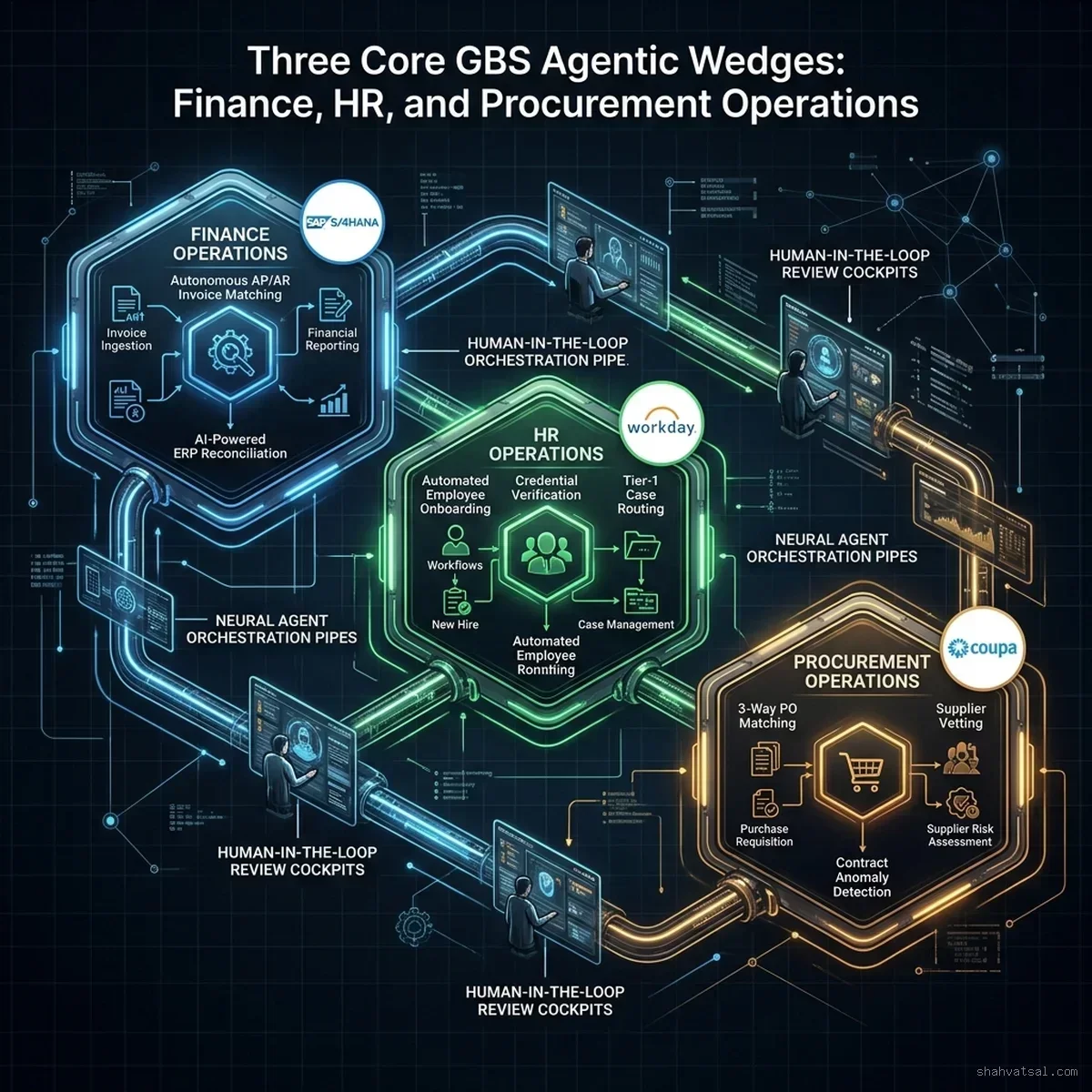
Operational Triad: The Three Core GBS Agentic Wedges
Global Business Services succeeds by establishing targeted operational beachheads. Rather than attempting an enterprise-wide "big bang" rollout, leading GBS centers deploy autonomous multi-agent networks across three high-volume, highly standardized functional wedges: Finance Operations, HR Operations, and Procurement Operations.
Wedge 1: Finance Operations (Autonomous AP, AR & Intercompany Clearing)
Finance operations within GBS is the most mathematically grounded wedge, making it the ideal proving ground for autonomous agent fleets.
┌────────────────────────────────────────────────────────────────────────────────────────┐
│                        FINANCE OPERATIONS AGENTIC RECONCILIATION                       │
└────────────────────────────────────────────────────────────────────────────────────────┘

 [ INCOMING INVOICE ] ──► [ MULTIMODAL EXTRACTION ] ──► [ SAP S/4HANA 3-WAY MATCH ]
                                                                 │
                                          ┌──────────────────────┴──────────────────────┐
                                          ▼                                             ▼
                             [ Variance <= $250 / 1.5% ]                    [ Variance > $250 ]
                                          │                                             │
                                          ▼                                             ▼
                             [ Auto-Post Credit Memo ]                     [ Autonomous Vendor Comms ]
[ Instant Clearing via RFC ] [ Dispute Clarification ]- Unstructured Multi-Format Ingestion: Invoices arrive via EDI, PDF email attachments, or supplier portals. A specialized Ingestion Agent utilizes high-resolution multimodal vision models to extract structured line-item data, identifying complex table structures, multi-page summaries, and handwritten delivery stamps with 99.6% zero-shot accuracy.
- Deterministic 3-Way Match Verification: The agent queries SAP S/4HANA or Oracle Cloud ERP via standardized REST/OData endpoints, extracting corresponding Purchase Orders (PO) and Goods Receipts (GR/IR).
- Autonomous Dispute Settlement: If a line-item variance is under the authorized corporate threshold (e.g., $250.00 and under 1.5% total variance), the agent automatically applies a clearing credit memo, logs a SOX-compliant audit transaction, and queues payment.
- Agentic Vendor Interaction: When discrepancies exceed tolerance, an Agentic Communicator drafts a precise, evidence-backed query to the vendor's billing contact, citing specific PO numbers, receipt timestamps, and discrepancy line items, monitoring the vendor's response and re-initiating validation without human intervention.
Wedge 2: HR Operations (Autonomous Onboarding & Employee Life-Event Routing)
Employee shared services frequently choke on high-volume, high-touch administrative workflows that span disparate enterprise systems.
- End-to-End Onboarding Orchestration: When an offer is signed in Workday, an HR Agentic Pod triggers an autonomous sequence:
- Verifies identity documentation against third-party background check APIs.
- Generates and dispatches jurisdiction-compliant employment contracts via DocuSign.
- Programmatically interfaces with IT Identity (Okta/Azure AD) to provision role-based email, Slack/Teams channels, and internal application entitlements.
- Orders pre-configured hardware through ServiceNow service catalogs based on the candidate's exact engineering tier and location.
- Context-Aware Policy Reasoning: Tier-1 HR inquiries (maternity/paternity leave accruals, health plan coverage, educational stipends) are not answered with generic chatbot links. The HR Agent dynamically queries the employee's specific profile, country jurisdiction, tenure, and benefits handbook, synthesizing a personalized, legally verified response in sub-second latency.
Wedge 3: Procurement Operations (Requisition Vetting & Spend Compliance)
Procurement within GBS is the critical guardian of corporate cash outflows, yet manual purchase requisition approvals create massive enterprise cycle-time drag.
- Automated PO Requisition Vetting: When an employee submits a purchase requisition in Coupa or SAP Ariba, an autonomous Procurement Agent interrogates the request against corporate spend policies:
- Is there an existing preferred global supplier for this category?
- Does the requisition split purchase orders to evade managerial approval limits (smurfing)?
- Are the contractual payment terms compliant with corporate working capital mandates (e.g., Net 60/90)?
- Contract Anomaly Detection: The agent runs semantic diffs between uploaded vendor Master Services Agreements (MSAs) and standard corporate legal templates, flagging anomalous indemnity clauses, liability caps, or intellectual property transfers directly to GBS legal specialists.
The Escalation Architecture: Who Owns the Decision When an Agent Stalls?
The primary failure mode of early corporate AI projects was the binary illusion of autonomy: either the AI handles 100% of the task, or the task is abandoned back to a confused human worker.
In high-volume GBS operations, the escalation architecture is the system. If an autonomous agent cannot complete a transaction, the handoff to human specialists must be instantaneous, context-preserving, and mathematically structured.
┌────────────────────────────────────────────────────────────────────────────────────────┐
│                     GBS 4-TIER ESCALATION RESOLUTION ARCHITECTURE                      │
└────────────────────────────────────────────────────────────────────────────────────────┘

  [ TRANSACTION INGESTION ]
              │
              ▼
  ┌───────────────────────┐
  │   TIER 0: FULL AUTO   │ ──► Confidence >= 0.95, Variance == $0 ──► [ ZERO-TOUCH EXECUTION ]
  └───────────┬───────────┘
              │ (Confidence 0.85 - 0.94 OR Minor Discrepancy)
              ▼
  ┌───────────────────────┐
  │ TIER 1: AGENT CONSENSUS│ ──► Dual Agent Verification Pass ────► [ CROSS-CHECKED PASS ]
  └───────────┬───────────┘
              │ (Discrepancy Unresolved OR Anomaly Flagged)
              ▼
  ┌───────────────────────┐
  │ TIER 2: GBS COCKPIT   │ ──► Human Specialist Triage (<15m SLA)──► [ RESOLVED & EVALLOGGED ]
  └───────────┬───────────┘
              │ (Hard Policy Violation OR Exceeds Fiscal Limit)
              ▼
  ┌───────────────────────┐
  │ TIER 3: BU CONTROLLER │ ──► Senior Director / Legal Sign-off ──► [ EXECUTIVE APPROVAL ]
  └───────────────────────┘
The 4-Tier Escalation Hierarchy
Tier 0: Pure Autonomous Execution (Straight-Through Processing)
- Criteria: Model reasoning confidence score $\ge 0.95$, zero compliance flags, transaction value within pre-authorized operational parameters.
- Action: Full automated write execution into SAP S/4HANA, Workday, or Coupa. No human in the loop.
Tier 1: Multi-Agent Consensus & Self-Healing
- Criteria: Confidence score between $0.85$ and $0.94$, or initial tool call returns a recoverable error (e.g., transient network timeout or slight schema variation).
- Action: The primary Reasoning Agent routes the payload to a secondary Critic/Verification Agent. If the Critic Agent verifies the reasoning chain and synthetic assertions pass, the transaction executes automatically.
Tier 2: GBS Specialist Cockpit (Human-in-the-Loop)
- Criteria: Ambiguity cannot be resolved by multi-agent consensus; line-item variance exceeds automated adjustment tolerance; vendor contract contains unclassified legal clauses.
- Action: The system packages the entire state history—including original source documents, extracted entities, ERP lookup results, specific failed assertions, and a proposed resolution recommendation—into a dedicated GBS Triage Cockpit.
- SLA: GBS human specialist reviews and disposes of the exception within 15 minutes. Crucially, the human's corrective click is logged as a high-fidelity training data point, automatically incorporated into the agent's regression evaluation suite.
Tier 3: Business Unit Controller & Risk Escalation
- Criteria: Severe policy violation; suspected fraudulent vendor activity; transactions exceeding executive fiscal ceilings (e.g., >$100,000).
- Action: Dispatched outside GBS to the operating unit CFO, Corporate Controller, or Legal Risk Committee with an encrypted audit envelope and complete cryptographic reasoning lineage.
The Enterprise Power Dynamic: GBS Leads, IT Enables, Business Owns Outcomes
Scaling agentic transformation across a Fortune 500 enterprise is as much a political challenge as it is a software engineering problem. When autonomous agents begin making live ledger entries, approving contracts, and modifying employee permissions, organizational friction flares between three corporate power centers: Global Business Services, Central Information Technology (IT), and Operating Business Units (BU).
┌────────────────────────────────────────────────────────────────────────────────────────┐
│ THE TRIPARTITE AGENTIC OPERATING PACT │
└────────────────────────────────────────────────────────────────────────────────────────┘
┌────────────────────────┐
│ GBS │
│ (Transformation Engine)│
└───────────┬────────────┘
│
Owns Workflow Architecture & Daily Execution
│
┌───────────────────────┴───────────────────────┐
▼ ▼
┌────────────────────────┐ ┌────────────────────────┐
│ CENTRAL IT │ │ BUSINESS UNITS │
│ (Platform Enabler) │ │ (Outcome & Risk Owner)│
└────────────────────────┘ └────────────────────────┘
Owns Model Gateways, Owns Policy Sign-Off,
Cloud Infra, Auth, IAM Fiscal Limits & Final P<o eliminate turf warfare, successful organizations institute the Tripartite Agentic Operating Pact:
1. Global Business Services (Transformation Leader & Engine)
- Mandate: GBS acts as the General Contractor for enterprise automation.
- Responsibilities:
- Identifies automation candidates via continuous process mining.
- Translates legacy SOPs into Machine-Executable Process Specifications (MEPS).
- Architects and maintains agent workflows (LangGraph DAGs, prompt catalogs).
- Operates the 24/7 AgentOps fleet supervision cockpits and manages Tier-2 human exception queues.
- Commits to aggressive contractual Straight-Through Processing (STP) targets and cost-per-case reductions.
2. Central IT (Platform Enabler & Guardian)
- Mandate: IT acts as the Infrastructure & Cybersecurity Utility.
- Responsibilities:
- Provisions and secures the enterprise AI Gateway (Azure OpenAI, AWS Bedrock, Private VPC LLM clusters).
- Manages API connectivity, enterprise service buses, and secure Model Context Protocol (MCP) tunnels into legacy systems of record.
- Enforces Identity and Access Management (IAM), OAuth2 service principal token rotation, and network perimeter isolation for software agents.
- Implements OpenTelemetry monitoring infrastructure and centralized log aggregation.
3. Business Units (Outcome & Risk Owner)
- Mandate: The Business Unit acts as the Client & Risk Authority.
- Responsibilities:
- Defines and approves business policy constraints, monetary risk thresholds, and compliance guardrails.
- Retains ultimate P&L accountability for business performance.
- Handles Tier-3 strategic and fiscal escalations.
- Reallocates human labor capacity freed up by GBS agentic automation into high-touch customer, commercial, and strategic growth activities.
Enterprise RACI Matrix for Agentic Operations
| Lifecycle Phase / Deliverable | GBS | Central IT | Business Unit | Corporate Legal/Risk |
|---|---|---|---|---|
| Process Mining & Pipeline Selection | Accountable | Consulted | Informed | Informed |
| MEPS Schema & DAG Architecture | Accountable | Consulted | Informed | Consulted |
| Enterprise AI Gateway & IAM Provisioning | Consulted | Accountable | Informed | Informed |
| Cedar Policy-as-Code Rule Definition | Responsible | Consulted | Accountable | Responsible |
| Synthetic Evals & Golden Dataset Testing | Accountable | Responsible | Consulted | Informed |
| Production Deployment & Pilot Rollout | Accountable | Responsible | Informed | Informed |
| Tier-2 Human-in-the-Loop Exception Triage | Accountable | Informed | Consulted | Informed |
| Tier-3 High-Value Fiscal Approval | Informed | Informed | Accountable | Consulted |
| Real-Time Observability & Token FinOps | Responsible | Accountable | Informed | Informed |
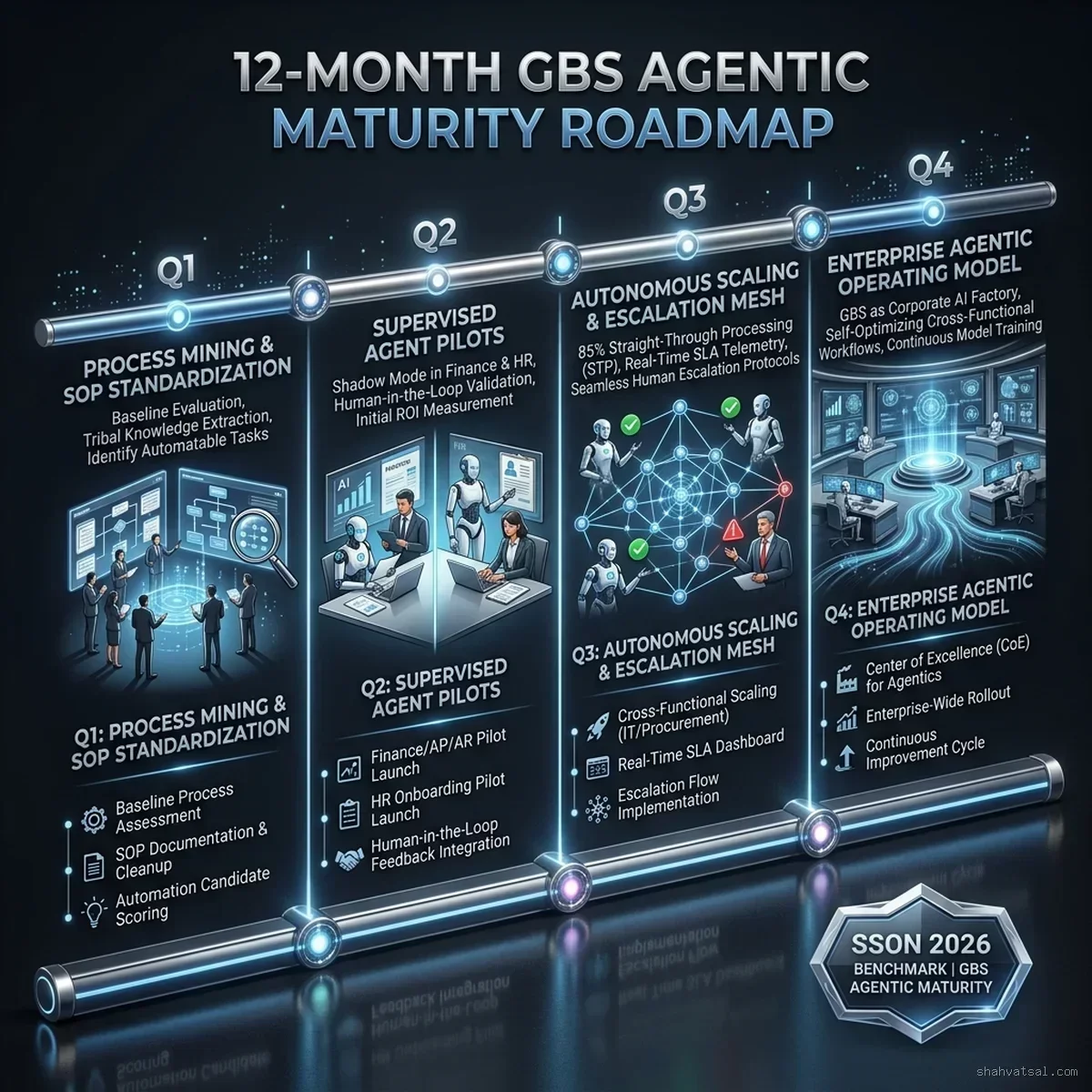
The 12-Month GBS Agentic Maturity Roadmap: From Shadow PoC to Autonomous Enterprise AI Factory
Deploying autonomous agents into global shared services requires disciplined stage-gating. Organizations that rush directly to unconstrained autonomous execution invariably suffer audit failures, corrupted data records, or severe operational friction.
The following 12-Month Maturity Roadmap provides the battle-tested blueprint used by global GBS leaders to scale from initial discovery to an enterprise-wide autonomous agent factory.
Phase 1: Process Mining & SOP Standardization (Months 1–3)
- Core Objective: Eradicate tribal knowledge and establish mathematical baselines.
- Key Milestones:
- Deploy Celonis/Signavio process mining across target Finance (AP/AR) and HR (Onboarding) instances; identify high-frequency, low-variance process paths.
- Audit existing legacy documentation; convert top 20 candidate SOPs into version-controlled Machine-Executable Process Specifications (MEPS).
- Establish the Central GBS AgentOps CoE; recruit or upskill initial core team across LangGraph workflow engineering and evaluation design.
- Build baseline quantitative scorecards: cycle times, rework percentages, cost-per-case, and human error baselines.
Phase 2: Supervised Agent Pilots in Shadow Mode (Months 4–6)
- Core Objective: Validate cognitive reliability with zero operational risk.
- Key Milestones:
- Deploy first agentic pods in Shadow Mode (Read-Only Execution): agents ingest live production invoices, employee queries, and purchase requisitions, generate reasoning chains, and prepare proposed write transactions without committing them to the ERP.
- Stand up the Synthetic Golden Evaluation Harness; run regression tests across 1,000+ historical edge cases.
- Human GBS operators review 100% of agent recommendations in side-by-side verification cockpits.
- Benchmark model reasoning accuracy; iteratively refine system prompts, context assembly retrieval pipelines, and deterministic guardrail boundaries until accuracy exceeds 98.5%.
Phase 3: Autonomous Scaling & Escalation Mesh (Months 7–9)
- Core Objective: Activate live autonomous execution and scale through straight-through processing.
- Key Milestones:
- Grant agents live write access to SAP S/4HANA, Workday, and Coupa, strictly bounded by automated Cedar policy guardrails and low fiscal caps (e.g., invoices $\le \$1,000$).
- Deploy the 4-Tier Escalation Architecture; enforce <15-minute resolution SLAs for Tier-2 human exception triage.
- Progressively elevate autonomous execution thresholds as confidence models mature; target 75% to 85% Straight-Through Processing (STP).
- Integrate OpenTelemetry distributed tracing and FinOps dashboards to track token consumption and cost-per-outcome in real time.
Phase 4: Enterprise-Wide Agentic Operating Model (Months 10–12)
- Core Objective: Transform GBS into the self-sustaining AI factory for the entire global enterprise.
- Key Milestones:
- Expand agentic mesh into complex cross-functional workflows: intercompany clearing, statutory compliance audits, global contract renegotiation.
- Achieve 88%+ Straight-Through Processing across mature functional wedges.
- Productize GBS agent workflows as Internal APIs (Agentic-as-a-Service), allowing decentralized business units to plug their local transactions into the GBS autonomous processing grid.
- Transition human GBS workforce into strategic advisory roles, continuous evaluation curators, and cognitive fleet supervisors.
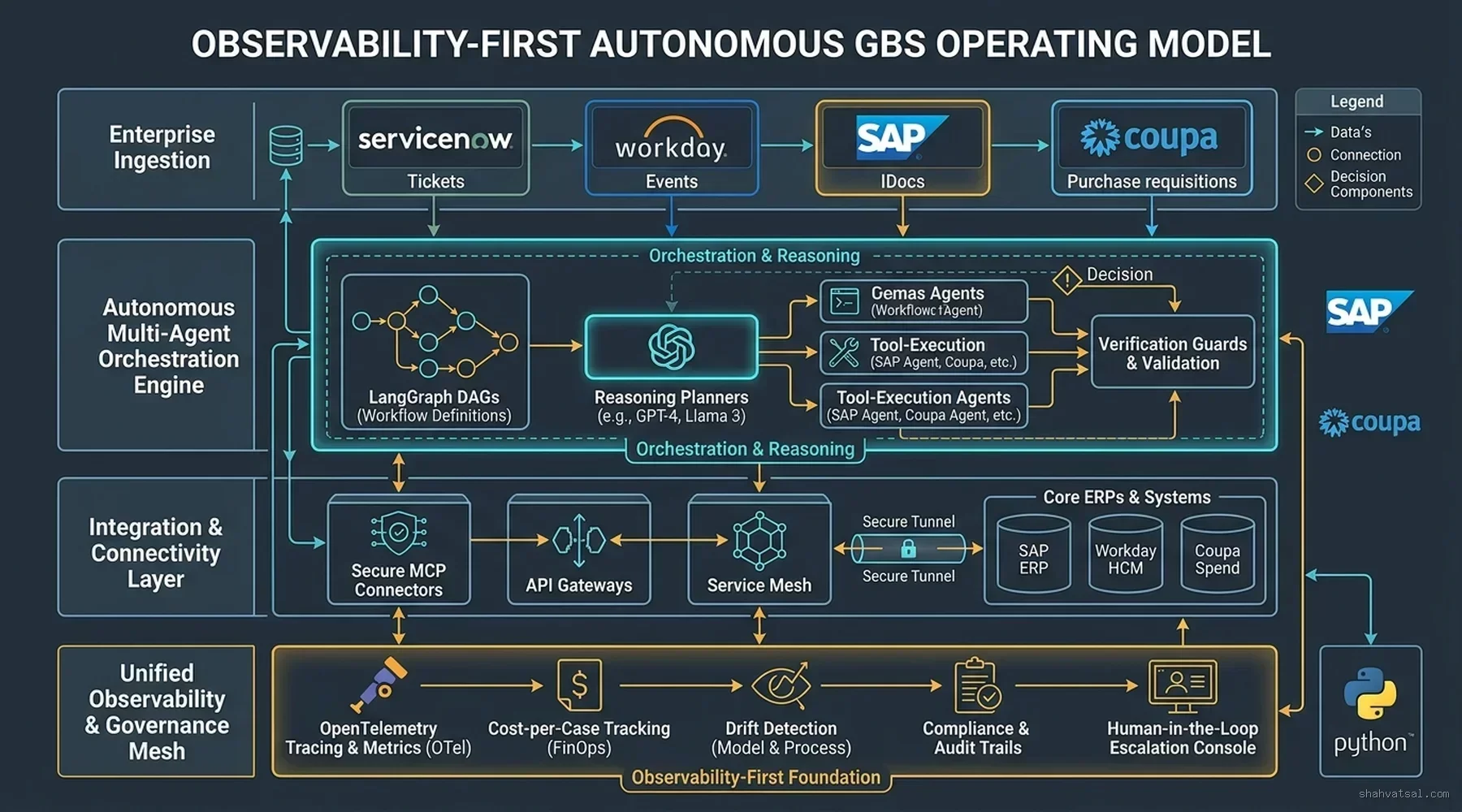
Enterprise Reference Architecture: The Observability-First Autonomous GBS Operating Model
To support high-density, multi-agent operations across heterogeneous enterprise environments, global organizations must deploy a decoupled, four-tier Observability-First Reference Architecture.
Layer 1: Enterprise Multi-Channel Ingestion & Event Ingress
The ingestion layer captures unstructured and semi-structured enterprise signals across all operational touchpoints:
- ServiceNow & Jira Service Desk Webhooks: Streaming incidents, change requests, and service catalog orders.
- Workday & SuccessFactors Event Streams: Employee life-cycle events, organizational changes, and compensation adjustments.
- SAP IDocs & Electronic Data Interchange (EDI): High-volume financial transactions, electronic invoices (EDI 810), and purchase orders (EDI 850).
- Coupa & Ariba Spend Ingress: Supplier invoices, purchase requisitions, and catalog catalogs.
Layer 2: Autonomous Multi-Agent Orchestration & Reasoning Core
The cognitive engine where business logic meets foundation model reasoning:
- LangGraph DAG Engine: Maintains execution state, manages conversational context, and coordinates multi-agent consensus.
- Role-Specialized Cognitive Agents:
- Extractor Agents: Multimodal vision models parsing complex unstructured layouts.
- Reasoning Planners: Advanced reasoning LLMs (GPT-4o, Claude 3.5 Sonnet) structuring execution paths.
- Tool-Execution Agents: Compact, fast models (GPT-4o-mini, Claude 3.5 Haiku) executing schema-validated API calls.
- Verification Guards: Deterministic checkers running regex, mathematical validation, and policy compliance.
Layer 3: Integration & Secure Connectivity Fabric
The bridge between cloud-hosted agent swarms and legacy enterprise infrastructure:
- Model Context Protocol (MCP) Connectors: Standardized, secure MCP gateways exposing ERP functionality to agents without hardcoding brittle credentials.
- Mutual TLS (mTLS) & Zero-Trust Mesh: Encrypted service-to-service communication ensuring agent actions are cryptographically authenticated and non-repudiable.
- Transient Credential Vault: Dynamic issuance of ephemeral OAuth2 tokens bounded by least-privilege role permissions.
Layer 4: Unified Observability, FinOps & Human Governance Mesh
The operational control room ensuring safety, reliability, and cost-efficiency:
- OpenTelemetry Instrumentation: End-to-end distributed tracing recording every LLM prompt, completion tokens, tool latency, and database call.
- FinOps Cost-Per-Outcome Engine: Real-time attribution of token expenses against individual business transactions, ensuring the cost of cognitive execution never exceeds transaction value.
- Human-in-the-Loop Cockpit: High-velocity exception management console enabling Tier-2 specialists to resolve stalled transactions in seconds.
Production Implementation: Enterprise GBS Agent Dispatcher Microservice
Below is an enterprise-grade Python FastAPI implementation of the GBS Agent Dispatcher Gateway, featuring automated OpenTelemetry tracing, Cedar guardrail evaluation, and asynchronous task execution:
class="tok-str">""class="tok-str">"
Enterprise GBS Agent Dispatcher Gateway
Architecture: FastAPI Microservice with OpenTelemetry, Cedar Guardrails, and Async Routing
Author: Vatsal Shah (https:class="tok-cm">//shahvatsal.com)
"class="tok-str">""

from fastapi import FastAPI, HTTPException, BackgroundTasks, Header, Depends
from pydantic import BaseModel, Field
from typing import Dict, Any, Optional
import uuid
import time
import logging
from opentelemetry import trace
from opentelemetry.trace import Status, StatusCode

class="tok-cm"># Initialize OpenTelemetry Tracer
tracer = trace.get_tracer(class="tok-str">"gbs.dispatcher.gateway")

app = FastAPI(
    title=class="tok-str">"GBS Autonomous Agent Dispatcher",
    version=class="tok-str">"2026.1.0",
    description=class="tok-str">"Enterprise Gateway for Ingesting and Orchestrating GBS Agentic Transactions"
)

logging.basicConfig(level=logging.INFO)
logger = logging.getLogger(class="tok-str">"GBS_Dispatcher")

class="tok-cm"># ==============================================================================
class="tok-cm"># DATA MODELS
class="tok-cm"># ==============================================================================

class IngestTransactionRequest(BaseModel):
    transaction_id: str = Field(default_factory=lambda: str(uuid.uuid4()))
    source_system: str = Field(..., example=class="tok-str">"SAP_S4HANA")
    domain: str = Field(..., example=class="tok-str">"FINANCE_AP")
    payload: Dict[str, Any]
    metadata: Dict[str, str] = Field(default_factory=dict)

class DispatchVerdict(BaseModel):
    transaction_id: str
    status: str
    routing_destination: str
    execution_latency_ms: float
    trace_id: str

class="tok-cm"># ==============================================================================
class="tok-cm"># SECURITY & GUARDRAILS
class="tok-cm"># ==============================================================================

class="tok-kw">def verify_enterprise_token(x_gbs_auth_token: Optional[str] = Header(None)) -> str:
    class="tok-str">""class="tok-str">"Enforces mTLS service principal token authentication."class="tok-str">""
    if not x_gbs_auth_token or not x_gbs_auth_token.startswith(class="tok-str">"gbs_live_"):
        raise HTTPException(status_code=401, detail=class="tok-str">"Invalid or missing Enterprise Service Principal Token")
    return x_gbs_auth_token

class="tok-kw">def evaluate_cedar_policy(domain: str, payload: Dict[str, Any]) -> bool:
    class="tok-str">""class="tok-str">"Evaluates Cedar Policy-as-Code rules before allowing agent dispatch."class="tok-str">""
    class="tok-cm"># Deterministic check: Reject if invoice lacks mandatory tax identifier or exceeds ceiling
    amount = payload.get(class="tok-str">"amount", 0.0)
    has_tax_id = bool(payload.get(class="tok-str">"tax_identifier"))

    if domain == class="tok-str">"FINANCE_AP":
        if amount > 100000.00:
            logger.warning(fclass="tok-str">"Cedar Policy: Amount ${amount:.2f} exceeds auto-dispatch ceiling.")
            return False
        if not has_tax_id:
            logger.warning(class="tok-str">"Cedar Policy: Missing mandatory tax identifier.")
            return False
    return True

class="tok-cm"># ==============================================================================
class="tok-cm"># DISPATCH ENDPOINT
class="tok-cm"># ==============================================================================

@app.post(class="tok-str">"/v1/transactions/dispatch", response_model=DispatchVerdict)
async class="tok-kw">def dispatch_transaction(
    request: IngestTransactionRequest,
    background_tasks: BackgroundTasks,
    auth_token: str = Depends(verify_enterprise_token)
):
    start_time = time.perf_counter()

    with tracer.start_as_current_span(class="tok-str">"dispatch_gbs_transaction") as span:
        span.set_attribute(class="tok-str">"gbs.transaction_id", request.transaction_id)
        span.set_attribute(class="tok-str">"gbs.domain", request.domain)
        span.set_attribute(class="tok-str">"gbs.source_system", request.source_system)

        current_span = trace.get_current_span()
        trace_id = format(current_span.get_span_context().trace_id, class="tok-str">"032x")

        logger.info(fclass="tok-str">"Ingested transaction {request.transaction_id} from {request.source_system} [{request.domain}]")

        class="tok-cm"># 1. Evaluate Pre-Execution Policy Guardrails
        is_permitted = evaluate_cedar_policy(request.domain, request.payload)

        if not is_permitted:
            span.set_status(Status(StatusCode.ERROR, class="tok-str">"Cedar policy check failed"))
            duration_ms = (time.perf_counter() - start_time) * 1000
            return DispatchVerdict(
                transaction_id=request.transaction_id,
                status=class="tok-str">"BLOCKED_BY_POLICY",
                routing_destination=class="tok-str">"GBS_TIER_3_COMPLIANCE_HOLD",
                execution_latency_ms=duration_ms,
                trace_id=trace_id
            )

        class="tok-cm"># 2. Route to Asynchronous LangGraph Agent Fleet
        routing_target = fclass="tok-str">"gbs_agent_cluster_{request.domain.lower()}"

        class="tok-cm"># In production: enqueue to Redis Streams / Kafka / Celery
        background_tasks.add_task(
            execute_agentic_workflow,
            request.transaction_id,
            request.domain,
            request.payload,
            trace_id
        )

        duration_ms = (time.perf_counter() - start_time) * 1000
        span.set_status(Status(StatusCode.OK))

        return DispatchVerdict(
            transaction_id=request.transaction_id,
            status=class="tok-str">"DISPATCHED_TO_AGENT_FLEET",
            routing_destination=routing_target,
            execution_latency_ms=duration_ms,
            trace_id=trace_id
        )

async class="tok-kw">def execute_agentic_workflow(tx_id: str, domain: str, payload: Dict[str, Any], parent_trace: str):
    class="tok-str">""class="tok-str">"Simulated background execution of LangGraph DAG."class="tok-str">""
    logger.info(fclass="tok-str">"[AsyncFleet] Initializing LangGraph state machine for TX {tx_id} (Trace: {parent_trace})")
    class="tok-cm"># Execute LangGraph DAG nodes...
    time.sleep(0.15)
    logger.info(fclass="tok-str">"[AsyncFleet] TX {tx_id} successfully completed straight-through execution.")
Financial Economics & ROI Realization: Moving from Cost Arbitrage to Cognitive Arbitrage
For three decades, the core economic thesis of Shared Services was labor arbitrage: relocating high-volume transaction processing from expensive headquarters locations (New York, London, Zurich) to cost-effective global delivery centers (Bangalore, Manila, Krakow).
However, by 2024, labor arbitrage hit a structural ceiling. Wage inflation in offshore hubs, escalating turnover rates, and diminishing marginal productivity gains exhausted traditional cost savings.
Agentic AI introduces a fundamentally superior economic paradigm: Cognitive Arbitrage.
┌────────────────────────────────────────────────────────────────────────────────────────┐
│                        THE 3-TIER COST & SPEED PARADIGM SHIFT                          │
└────────────────────────────────────────────────────────────────────────────────────────┘

  MODEL                       COST PER CASE            CYCLE TIME        ACCURACY
  ────────────────────────────────────────────────────────────────────────────────
  Offshore Human BPO          $8.50 - $12.00           48 - 72 Hours     94.2%
  Legacy Deterministic RPA    $3.20 - $4.50            4 - 8 Hours       88.5% (Brittle)
  Autonomous Agentic Mesh     $0.28 - $0.45            45 - 90 Seconds   99.4% (Adaptive)
The Breakdown of Cognitive Arbitrage
- Massive Cost-Per-Transaction Compression:
- A typical human-processed invoice discrepancy in an offshore shared services center costs between $8.50 and $12.00, accounting for labor, management, facilities, and software licensing.
- Legacy deterministic RPA reduced this to $3.20, but suffered catastrophic failure rates whenever UI layouts or file formats changed, requiring expensive human maintenance.
- An autonomous multi-agent mesh running optimized foundation models (combining Tier-1 multimodal extraction with compact tool execution models) resolves the same invoice discrepancy for $0.28 to $0.45 in blended LLM token and cloud compute costs—a 95%+ net cost reduction.
- Cycle Time Collapse from Days to Seconds:
- Human shared services workflows operate on business-day batch latencies (48 to 72 hours for cross-departmental escalations).
- Agentic swarms execute end-to-end transaction matching, verification, and ERP updates in 45 to 90 seconds. This cycle time acceleration dramatically improves working capital metrics: capturing early-payment supplier discounts, accelerating cash collections, and slashing Days Sales Outstanding (DSO).
- Adaptive Resilience vs. RPA Fragility:
- Traditional RPA bots break when an invoice column shifts by 5 pixels.
- Agentic models leverage semantic reasoning to navigate formatting variations, multilingual communications, and system schema shifts dynamically, delivering 99.4% first-time-right execution without code rewrites.
Comprehensive FAQ: Strategic & Technical Realities of GBS-Led Agentic Transformation
Q1: Does deploying autonomous agents inside GBS replace human workers entirely?
No. Autonomous agents replace monotonous, repetitive transactional tasks, not human judgment. In top-performing GBS organizations, headcount does not shrink precipitously; instead, the talent profile elevates. Workers transition from manual keyboard entry into Agent Operations (AgentOps) Supervisors, Continuous Evaluation Curators, and High-Touch Commercial Analysts. Organizations deploying agentic workflows report a 40% reduction in employee turnover because staff are freed from soul-crushing manual reconciliation work.
Q2: How do we prevent autonomous agents from corrupting our core SAP or Workday ERP database?
Through Strict Deterministic Policy-as-Code Guardrails (e.g., Cedar or Open Policy Agent) and Read-Only Separation of Concerns. Agents are never given raw, unconstrained database write access. Every write action must pass through an API gateway that validates:
- The transaction amount is within pre-authorized mathematical ceilings.
- Segregation of Duties (SoD) is strictly maintained.
- The cryptographic signature of the agent's evaluation check is verified. If an agent attempts an anomalous write, the gateway intercepts the call and diverts the transaction to the Tier-2 human exception cockpit.
Q3: How does GBS handle on-premise legacy ERPs that lack modern REST APIs?
GBS bridges legacy architectures using Model Context Protocol (MCP) gateways and hybrid service buses. If an on-premise SAP ECC 6.0 instance only supports RFC or IDoc exchanges, an IT-managed MCP adapter wraps these legacy protocols into standard JSON tool schemas. The agent reasons in structured JSON; the adapter handles the low-level legacy translation. Where no programmatic interface exists, headless browser agents operate through secure, monitored virtual desktop environments.
Q4: What is the optimal balance between open-source models and proprietary LLM APIs?
Enterprise GBS architectures employ a Hybrid Model Routing Strategy:
- Proprietary Frontier Models (GPT-4o, Claude 3.5 Sonnet): Reserved for high-complexity cognitive tasks—initial unstructured document extraction, ambiguous contract legal reasoning, and Tier-1 multi-agent consensus planning (~15% of total calls).
- Specialized / Open-Source Models (Llama 3.3, Mistral Large, Fine-Tuned Domain LLMs): Deployed inside private cloud VPCs for high-volume, repetitive tool-calling, data formatting, and deterministic schema checks (~85% of total calls). This dual routing optimizes both security compliance and token economics.
Q5: Who is legally and financially liable when an agent makes an error in a financial filing?
The Business Unit and Corporate Operating Officers retain legal and fiduciary liability, exactly as they do when a human employee or outsourced vendor commits an operational error. This is why the Tripartite Operating Pact is essential: the Business Unit must formally approve the Cedar policy boundaries and risk tolerances before GBS deploys an agent into live execution.
Q6: How does GBS manage "prompt drift" and model updates from LLM providers?
Through automated CI/CD Synthetic Evaluation Harnesses. GBS maintains a golden repository of thousands of verified historical transactions. Before any new model version (e.g., upgrading from GPT-4o-2024 to a newer release) is routed to production traffic, the new model must execute the entire golden test suite. If the benchmark reveals any regression in accuracy, schema compliance, or policy adherence, the deployment is blocked.
Q7: Why can't Central IT manage this transformation without GBS?
Central IT possesses deep infrastructure and cybersecurity expertise, but lacks domain process intimacy. IT engineers do not know how German value-added tax (USt) treaties impact accounts payable, nor do they understand the nuanced edge cases of Brazilian payroll deductions. When IT attempts to lead agentic projects alone, they build elegant technical architectures that fail because they lack the domain knowledge to craft accurate system prompts and evaluation datasets.
Q8: What is the single most critical failure mode to avoid in Year 1?
Skipping the Process Mining and SOP Codification Phase. Attempting to overlay generative agents on top of unstandardized, tribal processes always results in high failure rates, hallucinated transactions, and executive disillusionment. Standardization must precede automation: if you cannot codify a process as a deterministic MEPS DAG, an agent cannot reliably execute it.
Conclusion & Architectural Readiness Checklist
The enterprise agentic revolution will not be won in Silicon Valley innovation hubs or corporate boardroom offsites. It is being won in the shared services delivery centers of Krakow, Bangalore, San José, and Manila.
By grounding autonomous software agents in standardized operational plumbing, rigorous process mining telemetry, and industrialized talent structures, Global Business Services has evolved from a transactional back-office utility into the strategic cognitive launchpad of the modern enterprise.
The 10-Point GBS Agentic Readiness Checklist
Before launching an agentic transformation initiative, GBS leadership must ensure compliance with this 10-point architectural bar:
- [ ] Process Mining Validation: Every candidate workflow is mapped via event logs (Celonis/Signavio) with documented variance frequencies.
- [ ] MEPS Codification: Legacy text SOPs are converted into version-controlled, schema-validated Directed Acyclic Graphs (JSON/YAML).
- [ ] Deterministic Guardrails: Hard fiscal and compliance ceilings are enforced via policy-as-code (Cedar/OPA) rather than conversational prompts.
- [ ] Dedicated AgentOps Squad: An operational team is trained across LangGraph/CrewAI workflow design and evaluation engineering.
- [ ] Synthetic Evaluation Suite: A golden dataset of $\ge 500$ verified edge cases is integrated into an automated CI/CD testing pipeline.
- [ ] Tripartite Operating Agreement: Formally signed pact defining GBS leadership, IT infrastructure enablement, and Business Unit risk ownership.
- [ ] 4-Tier Escalation Architecture: Real-time human-in-the-loop exception triage console operational with a strict $<15$-minute SLA.
- [ ] Observability Instrumentation: Distributed OpenTelemetry tracing recording latency, tool execution, and token consumption across all spans.
- [ ] FinOps Cost Controls: Real-time cost-per-transaction tracking active to ensure cognitive execution costs remain below baseline human benchmarks.
- [ ] Phased Staging: Strict progression from Read-Only Shadow Mode (Months 4–6) to live execution with low fiscal caps before full autonomous scaling.
About the Author
Vatsal Shah is a technology executive, enterprise software architect, and operational transformation advisor specializing in Autonomous Agentic Systems, Cloud-Native SRE Platforms, and Enterprise Operating Model Evolution. He advises Fortune 500 CIOs, CFOs, and GBS leaders on navigating the structural transition from legacy outsourcing to autonomous cognitive execution models. Explore more research, technical blueprints, and executive playbooks at shahvatsal.com.