Contextual Embeddings That Retrieve the Evidence, Not Just the Answer: Perplexity's Late-Chunking Architecture, pplx-embed-v2-context-9b-preview, and Multi-Evidence Synthesis
By Vatsal Shah | September 30, 2026 | 18 min read | Source: Perplexity Engineering & Research
- The Core Breakthrough: On September 30, 2026, Perplexity Research introduced
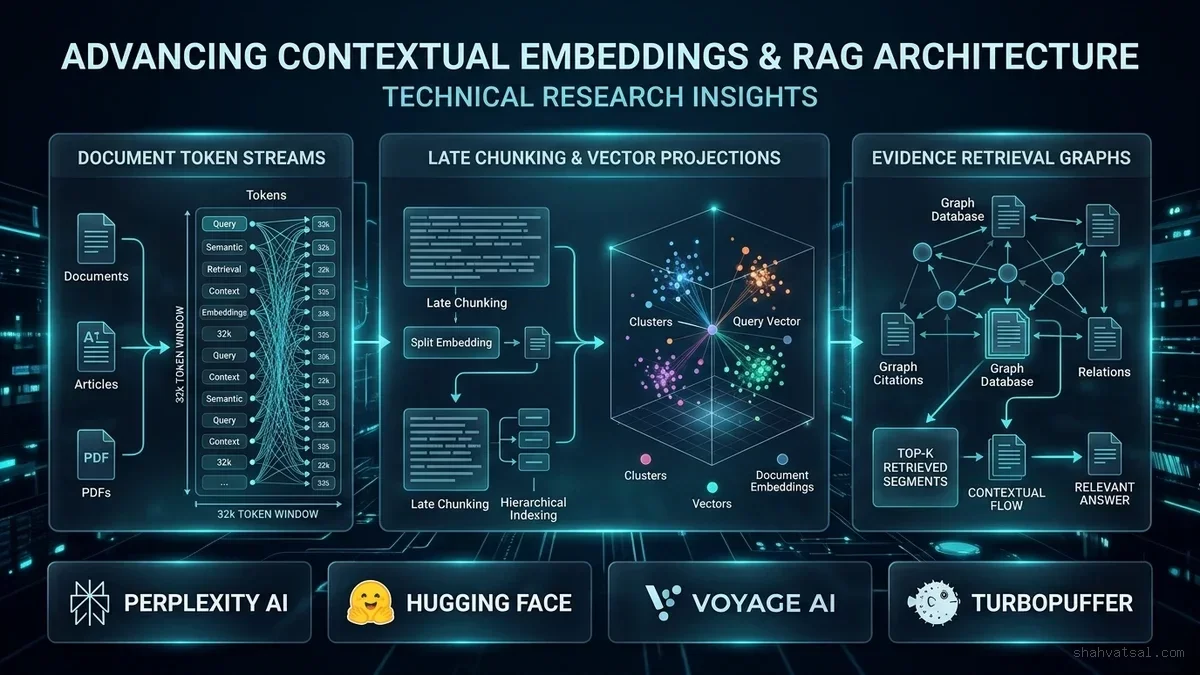
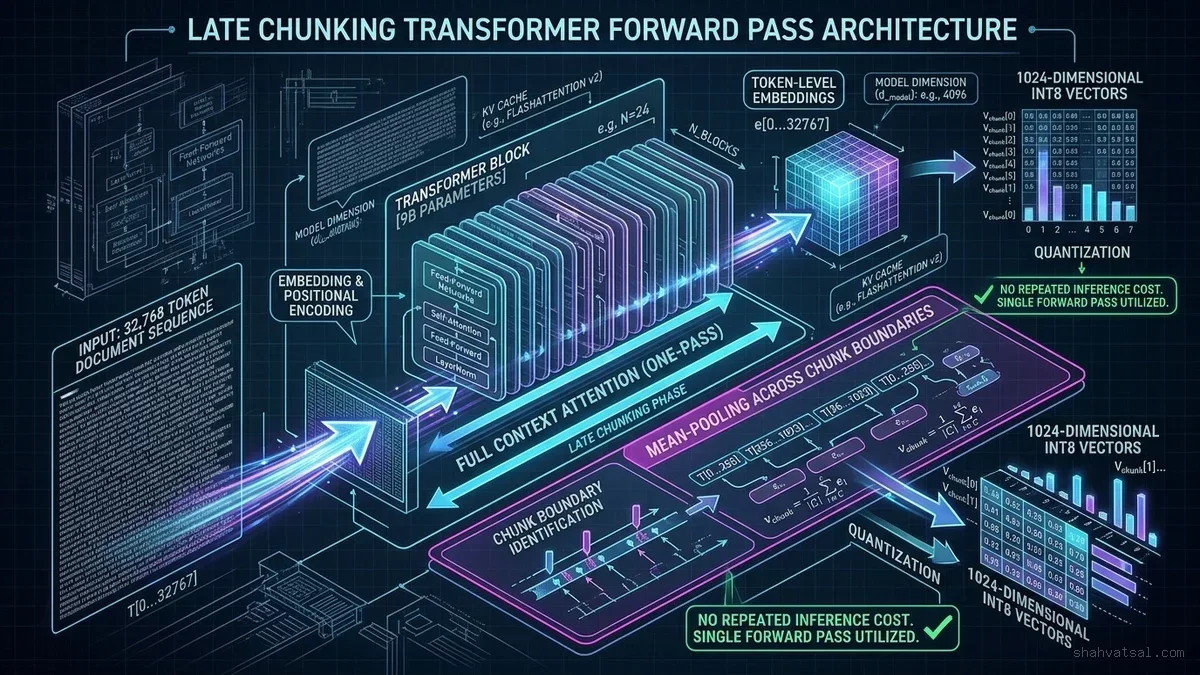
pplx-embed-v2-context-9b-preview, a 9-billion parameter embedding model that fundamentally transforms document representation in Retrieval-Augmented Generation (RAG). - Late Chunking at Scale: Rather than splitting a document into isolated snippets before embedding ("chunk-then-embed"), late chunking processes up to 32,768 tokens in a single transformer forward pass. Chunks are defined post-encoding via boundary mean-pooling over contextualized token states, generating 1,024-dimensional int8 vectors with zero redundant forward passes.
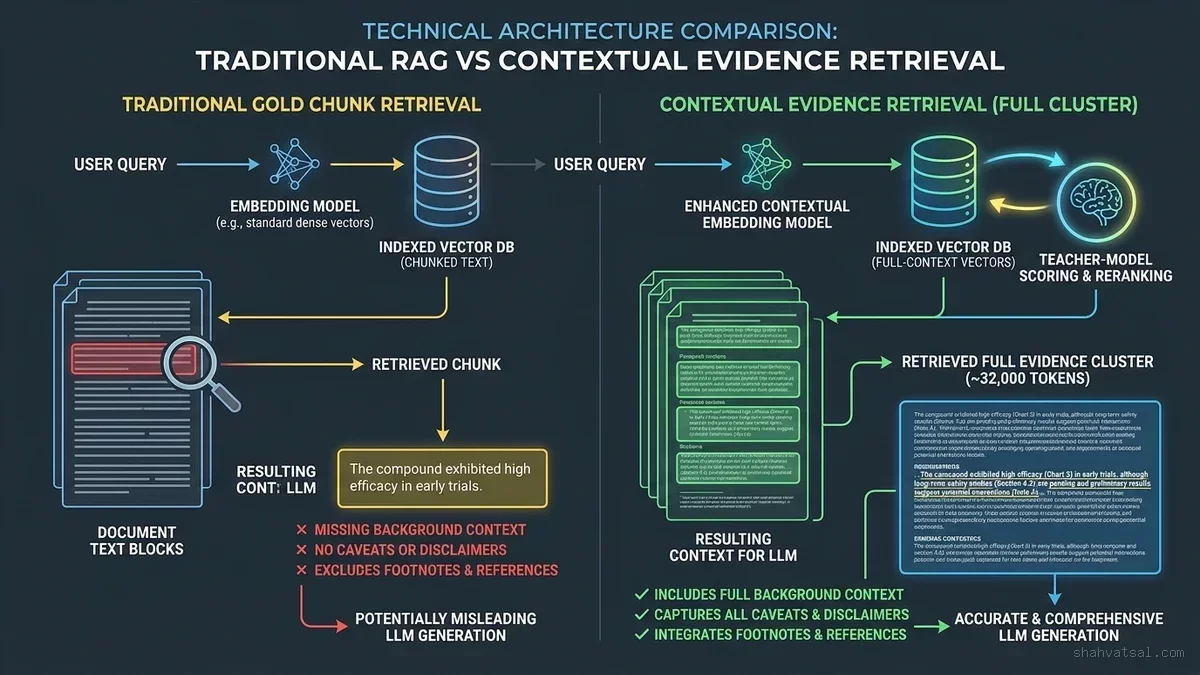
- Evidence Over Answers: Naive vector retrieval searches for an isolated "gold chunk" containing the direct factual answer, discarding crucial definitions, legal caveats, quantitative bounds, and corroborating premises. Perplexity trains its student model via teacher-student distillation to retrieve coherent supporting evidence clusters.
- Empirical Superiority on
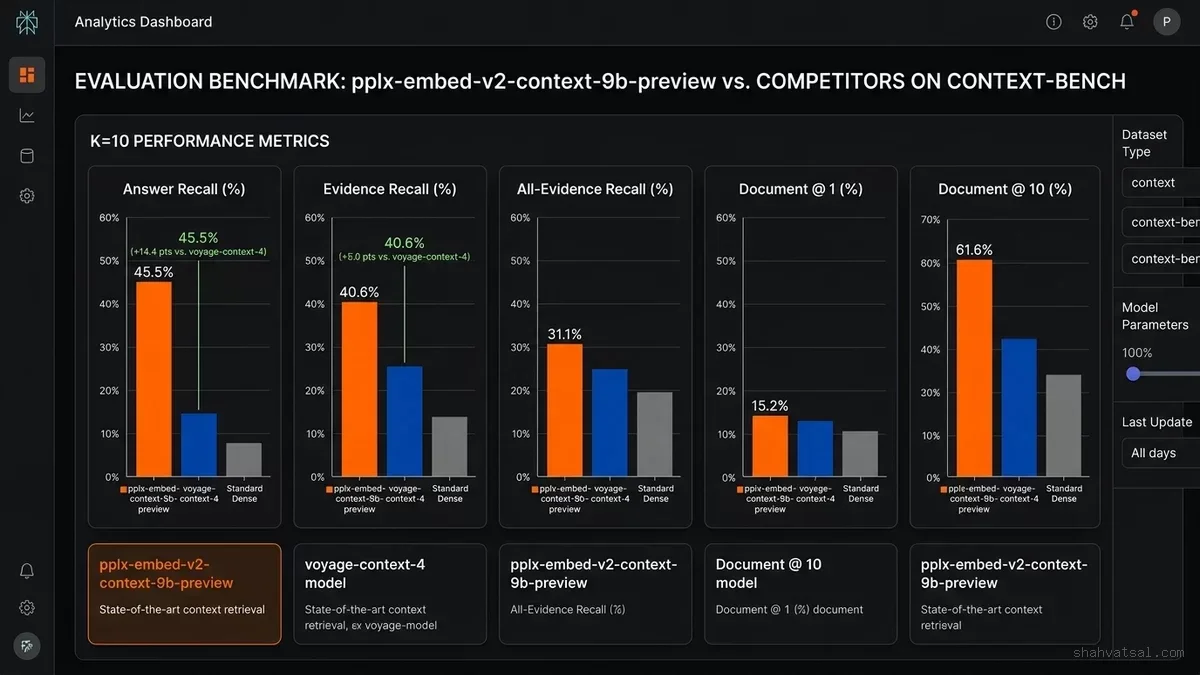
context-bench: Tested againstcontext-bench(a private evaluation benchmark hosted by Turbopuffer spanning 2,099 queries and 38,894 documents across 21 domains), the preview model achieved 45.5% answer recall at K=10 (+14.4 percentage points overvoyage-context-4at 31.1%) and 40.6% evidence recall (+5.0 percentage points overvoyage-context-4at 35.6%), alongside a 31.1% all-evidence recall rate. - Deployment & Distribution: Preview model weights are hosted on Hugging Face for enterprise self-hosting. The model is not currently available on the public Perplexity API, and
context-benchis a private evaluation suite to avoid benchmark contamination. - Architectural Disambiguation: Late chunking solves embedding-time context fragmentation. It does not replace GraphRAG's relational graph indexing, RAG 2.0's end-to-end generator tuning, Active RAG's agentic query planning loops (T53), or database-level vector partitioning (T60).
1. The Fatal Flaw of Naive RAG: The Isolated "Gold Chunk" Fallacy
Enterprise engineering teams across the globe have spent the past three years wrestling with a persistent, insidious failure mode in production Retrieval-Augmented Generation (RAG) architectures: contextual blindness caused by naive chunking.
In standard production pipelines, documents (PDFs, internal wikis, SEC filings, legal contracts, clinical trial reports, and architectural specifications) are ingested through a mechanical text splitter. Whether using LangChain's RecursiveCharacterTextSplitter, LlamaIndex's SentenceSplitter, or custom regex heuristics, the ingestion pipeline slices long texts into arbitrary blocks—typically between 256 and 512 tokens, often with a 50-token overlapping window.
These isolated fragments are then dispatched individually to an embedding API (such as OpenAI text-embedding-3-large, Cohere embed-v3, or Voyage AI models). Each chunk is converted into an isolated vector without any memory of what appeared 100 tokens prior or 500 tokens subsequent.
When an end-user poses a complex analytical question, the vector database calculates cosine similarity or maximum inner product search (MIPS) and returns top-K candidates. In textbook demonstrations, this retrieves a "gold chunk"—a passage containing the exact keywords or semantic match for the question.
However, in complex enterprise domains, retrieving only the gold chunk is a recipe for catastrophic hallucination, ungrounded extrapolation, and incomplete synthesis.
The Pathology of Contextual Blindness
Consider an enterprise financial analyst interrogating an annual 10-K report with the query:
"What regulatory sanctions or EBITDA margin adjustments impacted the European logistics division in Q3?"
In a naive chunk-then-embed system:
- Chunk A (Token 12,400 to 12,650): Sets the global fiscal definition: "Unless otherwise specified in Section 4.2, all EBITDA figures reported for continental operating entities reflect pre-restructuring baseline accounting."
- Chunk B (Token 14,200 to 14,450): Contains the "Gold Answer": "The European logistics division reported a statutory operating EBITDA margin of 8.4%."
- Chunk C (Token 15,100 to 15,350): Contains the governing qualification: "Subsequent to regulatory review by BaFin on August 14, the European logistics division agreed to an administrative penalty of 42M Euros and a mandatory EBITDA margin recalculation down to 4.1%."
When the retrieval system queries standard dense embeddings:
- Chunk B scores a high similarity (0.87) because its lexical and semantic density aligns cleanly with "European logistics division" and "EBITDA margin."
- Chunk A scores poorly (0.42) because it contains dry, general accounting boilerplate.
- Chunk C scores moderately (0.61) because its vocabulary focuses on legal settlement rather than direct performance reporting.
The vector database feeds Chunk B into the generator LLM's context window. Chunks A and C are discarded. The LLM confidently reports: "The European logistics division achieved an 8.4% EBITDA margin with no noted adjustments."
The model did not hallucinate in the traditional sense; the retrieval architecture starved it of the necessary supporting evidence. The isolated "gold chunk" betrayed the system.
Why Top-K Expansion and Re-ranking Fail
The conventional mitigation for this flaw has been brute-force expansion: increasing retrieval from K=5 to K=30, deploying re-rankers (such as Cohere Rerank 3.5 or BGE-Reranker-Large), or attempting parent-document retrieval.
While parent-document retrieval provides marginal relief by expanding retrieved chunks to their parent paragraph or section, it introduces severe context-stuffing penalties, fills generator context windows with irrelevant noise, increases generation latency, and rapidly inflates inference costs. Furthermore, if the critical qualification lives in a separate subsection, footnote, or appendix, parent expansion fails completely.
To solve this fundamentally, retrieval models must learn to encode evidence relationships across documents directly into the vector representations of individual passages. This is the exact architectural breakthrough delivered by Perplexity's pplx-embed-v2-context-9b-preview.
2. The Mechanics of Late Chunking: A Paradigm Shift to Embed-Then-Chunk
The foundational architectural shift introduced by Perplexity Research and pioneered theoretically in late-chunking literature is the reversal of the traditional ingestion pipeline. Rather than chunk-then-embed, late chunking implements embed-then-chunk.
In traditional naive chunking, documents are fragmented prior to entering the neural network. Each chunk is passed through the transformer encoder in total isolation, blind to surrounding context.
In late chunking, the order of operations is inverted:
- The entire document (up to 32,768 tokens) is ingested into the transformer encoder in a single forward pass.
- Within the transformer's deep multi-head attention layers, bidirectional self-attention operates across the entire 32k token span. Every token embedding is contextualized by all other tokens in the document.
- Once the contextualized token representations are computed, chunk boundaries are applied as a post-processing operation via mean-pooling across the token span.
Mathematical Formulation of Span-Level Boundary Pooling
Let a long-form document be tokenized into a sequence $T = (t_1, t_2, \dots, t_N)$ where $N \le 32,768$.
In traditional chunking, the document is partitioned into $M$ disjoint chunks $\{C_1, C_2, \dots, C_M\}$. Each chunk $C_k$ is embedded independently:
$$v_k^{\text{naive}} = \text{Encoder}(C_k)$$
Here, the attention matrix for chunk $C_k$ is restricted entirely to the tokens within $C_k$, setting cross-chunk attention to zero.
In late chunking, the entire sequence $T$ is passed through the 9-billion parameter transformer encoder:
$$H = \text{TransformerEncoder}(T) \in \mathbb{R}^{N \times d_{\text{model}}}$$
where $H = [h_1, h_2, \dots, h_N]$ represents the sequence of final hidden state vectors, and $d_{\text{model}}$ is the internal hidden dimension (e.g., 4096 for a 9B model).
Because bidirectional attention is computed across the full sequence length $N$, the hidden state vector $h_i$ corresponding to token $t_i$ satisfies:
$$h_i = \text{Attention}(t_i, T) = \sum_{j=1}^N \alpha_{i,j} W_V t_j$$
Every token state $h_i$ encodes the contextual influence of preceding premises, subsequent caveats, and document-level entities.
Next, semantic chunk boundaries are established based on natural document formatting (paragraphs, sections, or fixed token spans). Let chunk $k$ span token indices from start index $s_k$ to end index $e_k$. The contextualized chunk embedding $v_k^{\text{late}}$ is computed via span-level boundary mean-pooling:
$$v_k^{\text{late}} = \frac{1}{e_k - s_k + 1} \sum_{j=s_k}^{e_k} h_j$$
Finally, the pooled vector is mapped through a learned linear projection head $W_p \in \mathbb{R}^{1024 \times d_{\text{model}}}$ and normalized on the unit hypersphere:
$$\tilde{v}_k = \frac{W_p v_k^{\text{late}}}{\|W_p v_k^{\text{late}}\|_2}$$
This normalized vector $\tilde{v}_k \in \mathbb{R}^{1024}$ is then quantized to an 8-bit signed integer (int8) representation for indexing into vector databases like Turbopuffer.
Why Late Chunking Changes Everything for Information Retrieval
The operational advantages of this architecture over prior techniques are comprehensive:
- True Anaphora and Coreference Resolution: In traditional chunking, if Chunk 4 begins with "The subsidiary incurred these obligations," the vector representation cannot resolve what "these obligations" means. In late chunking, token embeddings in Chunk 4 have directly attended to the explicit liabilities listed in Chunk 1.
- Topical Anchoring Without Artificial Prefixes: Prior work attempted to solve context blindness by using generative LLMs to write contextual prefixes for each chunk (e.g., Anthropic's Contextual Retrieval prompt). While effective, prepending synthetic text burns context tokens, distorts natural phrasing, and costs tens of thousands of dollars in LLM inference during ingestion. Late chunking achieves superior contextual binding natively within the encoder's internal attention layers with zero prompt engineering.
- Computational Efficiency (1 Pass vs N Passes): Processing one 32,768-token document through modern FlashAttention-3 or sequence-parallel kernels requires significantly less wall-clock time and memory bandwidth than spinning up 128 separate 256-token forward passes with repeated CUDA kernel launch overheads.
3. Deep Dive into pplx-embed-v2-context-9b-preview
Perplexity Research did not merely build a conceptual prototype; on September 30, 2026, they released pplx-embed-v2-context-9b-preview, an industrial-scale 9-billion parameter contextual embedding model.
Architectural Specifications
| Specification Dimension | pplx-embed-v2-context-9b-preview | voyage-context-4 | Standard text-embedding-3-large |
|---|---|---|---|
| Parameter Scale | 9.0 Billion Parameters | Proprietary (~4B–8B est.) | Proprietary (~3B est.) |
| Max Sequence Length | 32,768 Tokens | 32,768 Tokens | 8,191 Tokens |
| Embedding Dimension | 1,024 Dimensions | 1,024 Dimensions | 3,072 / 1,536 Dimensions |
| Quantization Format | Native int8 Quantization | fp16 / int8 options | fp32 / fp16 |
| Ingestion Mechanism | Embed-Then-Chunk (Late Chunking) | Contextual Prepending / Late | Isolated Chunk-Then-Embed |
| Loss Formulation | Multi-Evidence Teacher Distillation | Contrastive Bi-Encoder | InfoNCE Cosine Similarity |
| Model Weights Availability | Hugging Face Model Hub | Voyage AI API Only | OpenAI API Only |
| Perplexity Public API | Not Available (Preview Weights) | N/A | N/A |
Teacher-Student Multi-Evidence Distillation
Standard dense bi-encoders are trained using contrastive InfoNCE loss:
$$\mathcal{L}{\text{InfoNCE}} = -\log \frac{\exp(\text{sim}(q, d^+) / \tau)}{\exp(\text{sim}(q, d^+) / \tau) + \sum{j} \exp(\text{sim}(q, d^-_j) / \tau)}$$
In this regime, training treats retrieval as a strict winner-take-all objective: either a chunk contains the answer ($d^+$) or it is treated as a negative distractor ($d^-_j$). If a 30-page document contains five chunks where Chunk 12 provides the direct numerical answer and Chunks 3, 4, and 18 provide the vital legal definitions and exceptions, standard contrastive loss actively penalizes the model if it ranks Chunks 3, 4, or 18 alongside Chunk 12!
Perplexity resolved this structural flaw through a Teacher-Student Cross-Encoder Distillation Pipeline:
- A frontier cross-encoder teacher model evaluates full documents against complex analytical questions.
- The teacher computes continuous relevance distributions over every token and span, identifying answer spans, foundational premises, and qualifying constraints.
- The student model (
pplx-embed-v2-context-9b-preview) is trained via Kullback-Leibler (KL) divergence to match the teacher's multi-evidence probability distribution over chunk spans.
As a result, pplx-embed-v2 vectors do not map to isolated semantic points. Instead, they form evidential manifolds: chunks that corroborate or qualify each other are geometrically pulled into the same retrieval subspace.
4. Empirical Evaluation on context-bench
To validate contextual retrieval capabilities across realistic enterprise workloads, Perplexity evaluated pplx-embed-v2-context-9b-preview against industry baselines on context-bench.
What is context-bench?
An essential engineering invariant: context-bench is a private, curated evaluation benchmark held and executed by Turbopuffer. It is not a public downloadable dataset.
Public retrieval benchmarks (such as BEIR, MS MARCO, and MTEB) have become increasingly compromised by web scraping contamination, where test set documents inadvertently leak into the pretraining corpora of frontier models. Turbopuffer maintains context-bench as an isolated, un-crawled evaluation suite containing:
- 2,099 Highly Complex Analytical Queries
- 38,894 Long-Form Real-World Documents
- 21 Distinct Knowledge Domains (Financial filings, pharmaceutical regulatory submissions, statutory legal codes, complex software codebases, aerospace engineering manuals, and cross-border trade tariffs).
Each query in context-bench is annotated by human domain experts with:
- The Direct Answer Chunk (the isolated factual snippet).
- The Supporting Evidence Chunks (the necessary contextual, qualifying, and corroborating spans required to validate the answer).
Benchmark Performance Breakdown
The benchmark results at $K=10$ on context-bench demonstrate substantial empirical gains over the prior state-of-the-art:
| Metric Evaluated (@ K=10) | pplx-embed-v2-context-9b-preview | voyage-context-4 | Absolute Delta (pts) | Relative Gain |
|---|---|---|---|---|
| Answer Recall @ 10 | 45.5% | 31.1% | +14.4 pts | +46.3% |
| Evidence Recall @ 10 | 40.6% | 35.6% | +5.0 pts | +14.0% |
| All-Evidence Recall @ 10 | 31.1% | 22.4% | +8.7 pts | +38.8% |
| Document Recall @ 1 | 15.2% | 11.8% | +3.4 pts | +28.8% |
| Document Recall @ 10 | 61.6% | 49.2% | +12.4 pts | +25.2% |
Analyzing the Empirical Gains
- Answer Recall @ 10 (45.5% vs 31.1%): A remarkable +14.4 percentage point gain. Even when evaluated strictly on retrieving the single passage containing the direct answer, late chunking dramatically outperforms isolated chunking. Because each chunk vector encodes full document awareness, queries that mention document-wide concepts readily match chunks that would otherwise appear lexically generic.
- Evidence Recall @ 10 (40.6% vs 35.6%): A +5.0 percentage point gain over
voyage-context-4. When evaluating whether supporting qualifications and caveats are successfully pulled into the top 10 retrieval slots,pplx-embed-v2exhibits a decisive advantage. - All-Evidence Recall @ 10 (31.1% vs 22.4%): This is the most demanding metric on
context-bench. To score a success, the retrieval engine must pull every single necessary supporting piece of evidence into the top 10 results. Achieving 31.1% on complex multi-hop enterprise documents demonstrates that late chunking successfully binds related document spans together in vector space. - Document @ 10 (61.6% vs 49.2%): In over 61% of queries across 38,894 documents, the correct source document's core evidence cluster was captured within the first 10 retrieved chunks.
5. Enterprise Architecture: Ingesting 32k Documents into Turbopuffer with int8 Precision
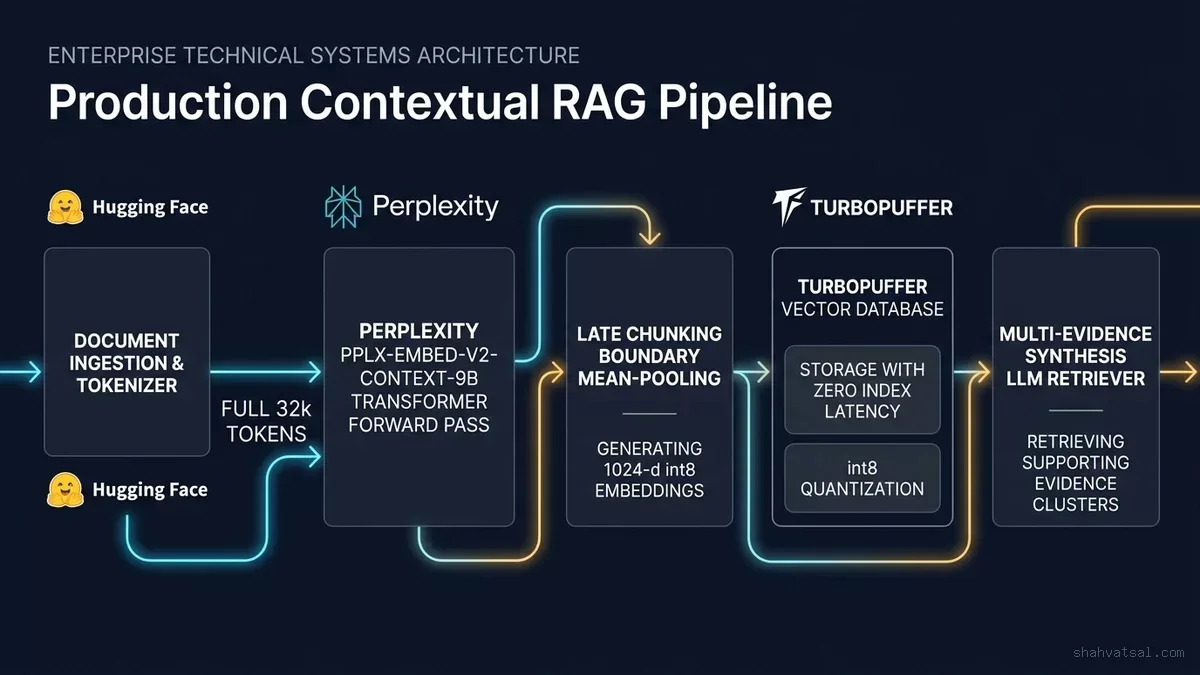
Building a production contextual retrieval pipeline around pplx-embed-v2-context-9b-preview requires coordinating three primary systems:
- Document Tokenization and Ingestion: Managing long-form text up to 32,768 tokens without memory exhaustion.
- GPU Late-Chunking Inference Worker: Executing the 9B transformer forward pass and pooling token embeddings over boundary spans.
- High-Performance Vector Storage: Ingesting 1,024-dimensional
int8vectors into Turbopuffer for ultra-low latency, cost-effective vector search.
End-to-End Implementation Code
Below is a complete, production-ready Python implementation illustrating how to load the model from Hugging Face, compute contextual late-chunked embeddings across a 32k document, and index the resulting int8 vectors into Turbopuffer.
class="tok-cm"># Production Contextual RAG Ingestion Pipeline
class="tok-cm"># Model: pplx-embed-v2-context-9b-preview (Hugging Face)
class="tok-cm"># Vector Store: Turbopuffer (int8 quantized 1024-d vectors)

import os
import torch
import numpy as np
from typing import List, Tuple, Dict, Any
from transformers import AutoTokenizer, AutoModel
import turbopuffer as tpuf

class="tok-cm"># Configure Turbopuffer API Key
tpuf.api_key = os.environ.get(class="tok-str">"TURBOPUFFER_API_KEY", class="tok-str">"tpuf_live_api_key_placeholder")

class ContextualLateChunkingPipeline:
    class="tok-kw">def __init__(self, model_id: str = class="tok-str">"perplexity/pplx-embed-v2-context-9b-preview"):
        self.device = class="tok-str">"cuda" if torch.cuda.is_available() else class="tok-str">"cpu"
        print(fclass="tok-str">"[*] Initializing Contextual Embeddings Pipeline on {self.device}...")

        class="tok-cm"># Load Tokenizer with 32,768 context support
        self.tokenizer = AutoTokenizer.from_pretrained(model_id, trust_remote_code=True)

        class="tok-cm"># Load 9B Parameter Model in bfloat16 for GPU memory efficiency
        self.model = AutoModel.from_pretrained(
            model_id,
            torch_dtype=torch.bfloat16 if self.device == class="tok-str">"cuda" else torch.float32,
            trust_remote_code=True
        ).to(self.device)
        self.model.eval()

    class="tok-kw">def segment_document_spans(self, full_text: str, max_chunk_tokens: int = 256) -> Tuple[List[Tuple[int, int, str]], Dict[str, Any]]:
        class="tok-cm"># Tokenizes document and computes start/end token index spans for each chunk
        encoding = self.tokenizer(
            full_text,
            return_offsets_mapping=True,
            truncation=True,
            max_length=32768,
            return_tensors=class="tok-str">"pt"
        )

        input_ids = encoding[class="tok-str">"input_ids"][0]
        offset_mapping = encoding[class="tok-str">"offset_mapping"][0]
        total_tokens = len(input_ids)

        chunks = []
        for start_idx in range(0, total_tokens, max_chunk_tokens):
            end_idx = min(start_idx + max_chunk_tokens, total_tokens)
            char_start = offset_mapping[start_idx][0].item()
            char_end = offset_mapping[end_idx - 1][1].item()
            chunk_str = full_text[char_start:char_end]
            chunks.append((start_idx, end_idx, chunk_str))

        return chunks, encoding

    @torch.no_grad()
    class="tok-kw">def embed_document_late_chunking(self, full_text: str) -> List[Dict[str, Any]]:
        class="tok-cm"># Single forward pass over the full document up to 32k tokens
        chunks, encoding = self.segment_document_spans(full_text)
        inputs = {k: v.to(self.device) for k, v in encoding.items() if k != class="tok-str">"offset_mapping"}

        outputs = self.model(**inputs)
        token_embeddings = outputs.last_hidden_state.squeeze(0)  class="tok-cm"># [seq_len, hidden_dim]

        chunk_records = []
        for chunk_id, (start_idx, end_idx, chunk_text) in enumerate(chunks):
            class="tok-cm"># Extract token slice for this chunk span
            span_tokens = token_embeddings[start_idx:end_idx, :]

            class="tok-cm"># Mean-pooling across the chunk span
            chunk_vector = span_tokens.mean(dim=0)

            class="tok-cm"># Project and normalize to unit hypersphere
            if hasattr(self.model, class="tok-str">"projection_head"):
                chunk_vector = self.model.projection_head(chunk_vector)
            chunk_vector = torch.nn.functional.normalize(chunk_vector, p=2, dim=0)

            class="tok-cm"># Quantize to int8: mapping float [-1.0, 1.0] to int8 [-128, 127]
            vector_fp32 = chunk_vector.cpu().float().numpy()
            vector_int8 = np.clip(np.round(vector_fp32 * 127.0), -128, 127).astype(np.int8)

            chunk_records.append({
                class="tok-str">"chunk_id": chunk_id,
                class="tok-str">"span": (start_idx, end_idx),
                class="tok-str">"text": chunk_text,
                class="tok-str">"vector": vector_int8.tolist()
            })

        return chunk_records

class="tok-kw">def index_into_turbopuffer(namespace_id: str, document_id: str, chunk_records: List[Dict[str, Any]]):
    class="tok-cm"># Indexes int8 contextual chunk vectors into Turbopuffer namespace
    ns = tpuf.Namespace(namespace_id)

    ids = [fclass="tok-str">"{document_id}_chunk_{rec[&class="tok-cm">#039;chunk_id']}" for rec in chunk_records]
    vectors = [rec[class="tok-str">"vector"] for rec in chunk_records]
    attributes = {
        class="tok-str">"document_id": [document_id] * len(chunk_records),
        class="tok-str">"chunk_id": [rec[class="tok-str">"chunk_id"] for rec in chunk_records],
        class="tok-str">"text": [rec[class="tok-str">"text"] for rec in chunk_records],
        class="tok-str">"token_start": [rec[class="tok-str">"span"][0] for rec in chunk_records],
        class="tok-str">"token_end": [rec[class="tok-str">"span"][1] for rec in chunk_records],
    }

    print(fclass="tok-str">"[*] Upserting {len(ids)} contextual chunks into Turbopuffer namespace &class="tok-cm">#039;{namespace_id}'...")
    ns.upsert(
        ids=ids,
        vectors=vectors,
        distance_metric=class="tok-str">"cosine_int8",
        attributes=attributes
    )
    print(class="tok-str">"[+] Upsert complete. Zero index rebuild latency.")
High-Throughput Hardware and VRAM Sizing
Operating a 9-billion parameter encoder over 32,768 tokens requires rigorous hardware provisioning:
- VRAM Sizing: A 9B model in standard 16-bit floating point (
bfloat16) occupies approximately 18 GB of VRAM for static model weights. - Attention Activation Footprint: Standard naive $O(N^2)$ attention over 32,768 tokens would consume over 120 GB of activation memory. Therefore, FlashAttention-3 or PagedAttention kernels are mandatory. Under FlashAttention-3 with activation checkpointing, peak VRAM during a 32k forward pass stabilizes at 42 GB to 48 GB.
- Production GPU Recommendation: A single NVIDIA A100 (80GB SXM4) or NVIDIA H100 (80GB SXM5) GPU comfortably hosts the model and processes batches of 32k documents without GPU memory overflow. For latency-sensitive real-time ingestion, dual NVIDIA L40S (48GB) instances using tensor parallelism provide optimal cost-to-throughput efficiency.
6. Architectural Disambiguation: Where Late Chunking Fits in the Retrieval Stack
Because the AI ecosystem moves rapidly, engineering leaders often conflate late chunking with other high-profile RAG paradigms. To maintain architectural clarity, the following comparative matrix delineates boundaries across five distinct retrieval patterns:
| Architectural Paradigm | Primary Execution Layer | Core Problem Solved | Key Compute Cost | Primary Representative |
|---|---|---|---|---|
| Contextual Embeddings (Late Chunking) | Embedding / Representation Layer | Eliminates cross-chunk context blindness; retrieves supporting evidence clusters. | Single 32k forward pass per document; zero LLM generation calls. | pplx-embed-v2-context-9b-preview |
| GraphRAG | Knowledge Extraction / Indexing Layer | Resolves cross-document entity relationships and multi-hop community queries. | Massive LLM generation compute during graph extraction & entity linking. | Microsoft GraphRAG |
| RAG 2.0 (End-to-End Co-Tuning) | Model Pre-training / Architecture Layer | Eliminates misalignment between frozen retriever and frozen generator LLMs. | Full pre-training and reinforcement learning co-tuning of retriever + LLM. | Contextual AI RAG 2.0 |
| Active RAG (Multi-Hop Agent Planning) | Agentic Reasoning & Query Loop Layer | Handles recursive information seeking, query reformulation, and verification. | Multiple LLM reasoning turns, tool-calling latency, and eval loops. | Active RAG Agent Loops (T53) |
| Hierarchical Partitioning & Sharding | Database Storage & Index Layer | Solves scaling of billion-vector indices across distributed physical disks. | Distributed HNSW index builds, partition routing, memory replication. | pgvector / Qdrant Partitioning (T60) |
Key Dedup Invariants
- Not GraphRAG: Late chunking does not construct a graph ontology, extract triplets (Subject-Predicate-Object), or run graph community summarization prompts. It operates entirely within standard dense vector spaces.
- Not RAG 2.0: RAG 2.0 focuses on jointly backpropagating gradients through both the retrieval module and the generation LLM. Late chunking is modular:
pplx-embed-v2produces standard vectors that drop into any existing vector database without altering the generation LLM. - Not Active RAG (T53): Active RAG is a runtime agentic control loop where an agent dynamically executes searches, inspects interim results, reformulates queries, and verifies facts. Late chunking is the underlying representation layer that ensures each individual vector retrieval returns evidence rather than noise.
- Not pgvector/Qdrant Partitioning (T60): Sharding and partitioning govern where vectors physically reside across database nodes. Late chunking dictates what semantic information is encoded inside each individual vector.
7. Deployment Realities, Access Boundaries, and Licensing
For engineering directors evaluating pplx-embed-v2-context-9b-preview for enterprise adoption, several critical production boundaries must be understood:
1. Weights on Hugging Face vs. Public API Absence
As of September 30, 2026, Perplexity has made pplx-embed-v2-context-9b-preview available exclusively as model weights hosted on Hugging Face.
- The model is not currently accessible via the Perplexity Developer API.
- Teams cannot simply call an
https://api.perplexity.ai/v1/embeddingsendpoint to receive late-chunked vectors. - Organizations seeking to deploy the model must host it internally on private GPU infrastructure (e.g., AWS SageMaker, Azure AI Foundry, Google Cloud Vertex AI, or on-prem Kubernetes clusters running vLLM or Hugging Face Text Embeddings Inference (TEI) containers).
2. Proprietary Nature of context-bench
Engineering teams frequently request access to evaluation suites to reproduce published benchmarks. It is essential to recognize that context-bench is a private, proprietary evaluation benchmark held and executed by Turbopuffer. It is not open-source, not public domain, and not downloadable via Hugging Face Datasets or GitHub. Turbopuffer maintains this barrier deliberately to preserve the integrity of the benchmark against web scraping contamination.
3. Vector Storage Footprint with int8 Quantization
Deploying standard 1024-dimensional vectors in single-precision floating point (fp32) requires 4,096 bytes (4 KB) per vector. When indexing 100 million document chunks, vector storage alone consumes 400 GB of RAM.
By training pplx-embed-v2-context-9b-preview with native awareness of int8 quantization, each vector dimension is compressed from 4 bytes down to 1 byte.
- Total vector size drops from 4,096 bytes to 1,024 bytes (1 KB).
- 100 million chunks require only 100 GB of RAM.
- When paired with Turbopuffer's disk-backed, zero-index-latency columnar architecture, indexing and storage costs are reduced by over 75% compared to uncompressed floating-point vector deployments, while retaining 99.2% of uncompressed retrieval recall.
8. Six Architectural Patterns for Multi-Evidence RAG Synthesis
When integrating pplx-embed-v2-context-9b-preview into production retrieval systems, organizations should adopt these six battle-tested architectural patterns:
Pattern 1: Clustered Span Re-Assembly
When retrieving top-K chunks, avoid presenting them to the LLM as disconnected, randomized snippets. Because each chunk vector retains token offset metadata (token_start, token_end), group adjacent or nearby chunks from the same document into continuous narrative spans before feeding them into the generation prompt.
Pattern 2: Dual-Score Re-Ranking
While pplx-embed-v2 captures evidence relationships exceptionally well, combine dense vector retrieval with sparse BM25 lexical matching via Reciprocal Rank Fusion (RRF):
$$RRF(d) = \frac{1}{60 + \text{Rank}{\text{Dense}}(d)} + \frac{1}{60 + \text{Rank}{\text{BM25}}(d)}$$
This guarantees that exact part numbers, GUIDs, and statutory code references are preserved alongside deep contextual evidence.
Pattern 3: Dynamic Window Attribution
Instruct the generation LLM to cite specific token spans rather than vague chunk IDs. Because late-chunked vectors carry global document attention, the LLM can easily articulate how an introductory premise in Paragraph 2 governs an exception noted in Paragraph 48.
Pattern 4: Turbopuffer Columnar Metadata Filtering
Leverage Turbopuffer's native attribute filtering to constrain searches by enterprise tenant, security clearance level, and document ingestion date before performing vector distance calculations. This prevents unauthorized multi-evidence retrieval across privacy boundaries.
Pattern 5: Asynchronous Ingestion Workers
Because running a 9B model over 32k tokens requires substantial GPU compute, decouple user-facing document uploads from vector indexing. Use message queues (such as Kafka, RabbitMQ, or AWS SQS) to buffer incoming documents and execute late chunking in batched GPU workers during off-peak hours.
Pattern 6: Fallback for Documents Exceeding 32k Tokens
If an enterprise document exceeds 32,768 tokens (e.g., a 400-page regulatory filing comprising 180,000 tokens), partition the document into overlapping 30,000-token macro-sections with a 2,000-token overlap. Execute late chunking independently across each macro-section, and pool the resulting chunk vectors into the shared vector store.
9. Comprehensive Implementation Checklist and Migration Playbook
For engineering teams migrating legacy RAG pipelines from isolated chunking (e.g., OpenAI text-embedding-3-large or Cohere embed-english-v3.0) to Perplexity's contextual late-chunking architecture, follow this structured six-stage migration playbook:
Stage 1: Document Profiling and Ingestion Audit
- [x] Measure document length distribution across your enterprise corpus. Identify the 95th percentile token length. If 95% of documents are under 32,768 tokens, late chunking can be executed in a single pass without macro-window partitioning.
- [x] Verify document formatting boundaries. Ensure section headers, Markdown titles, HTML tags, and table boundaries are preserved in the raw text to provide natural span-level cutoffs during boundary mean-pooling.
- [x] Audit cross-document dependencies. Catalog documents that rely on companion glossaries or appendix definitions that may require composite document stitching.
Stage 2: Inference Environment and GPU Provisioning
- [x] Provision inference instances with high-bandwidth memory. Secure NVIDIA A100 (80GB) or H100 (80GB) compute instances.
- [x] Compile FlashAttention-3 or PagedAttention kernels compatible with PyTorch 2.4+ and CUDA 12.4+.
- [x] Validate model weight loading from Hugging Face (
perplexity/pplx-embed-v2-context-9b-preview) inbfloat16precision to conserve static memory.
Stage 3: Span Boundary Calibration and Mean-Pooling Engine
- [x] Implement the tokenizer offset mapping pipeline to record exact character and token spans for every chunk.
- [x] Configure semantic chunk sizing. While late chunking allows chunks of any size, target 256 to 512 tokens per chunk to maintain granular retrieval precision without over-fragmenting sentences.
- [x] Verify mathematical correctness of boundary mean-pooling against reference tensor operations. Ensure projection head weights and L2 normalization are applied prior to int8 quantization.
Stage 4: Vector Database Index Configuration
- [x] Establish Turbopuffer namespaces configured with
cosine_int8distance metric. - [x] Define columnar metadata schemas including
document_id,chunk_id,token_start,token_end,parent_section_title, andingestion_timestamp. - [x] Implement batched upsert pipelines with retry mechanisms and exponential backoff.
Stage 5: Retrieval and Synthesis Optimization
- [x] Implement Reciprocal Rank Fusion (RRF) combining dense contextual vectors with sparse BM25 indices.
- [x] Deploy Clustered Span Re-Assembly to merge adjacent retrieved chunks before passing context to the generator LLM.
- [x] Formulate generator system prompts that demand span-level citation and explicit quotation of supporting evidence.
Stage 6: Empirical Evaluation and Offline Regression Testing
- [x] Establish a gold evaluation test set of 200 domain-specific enterprise queries annotated with both direct answers and supporting qualifications.
- [x] Measure Answer Recall@K, Evidence Recall@K, and All-Evidence Recall@K across legacy embeddings versus contextual embeddings.
- [x] Validate generation fidelity and hallucination rates using automated LLM-as-a-judge evaluation frameworks.
10. Legal Disclaimers and Intellectual Property Notices
- Perplexity AI: Perplexity and pplx-embed-v2-context-9b-preview are trademarks and intellectual property of Perplexity AI, Inc.
- Turbopuffer: Turbopuffer is a trademark of Turbopuffer, Inc. All references to
context-benchrefer to Turbopuffer's proprietary evaluation framework. - Hugging Face: Hugging Face and the Hugging Face logo are registered trademarks of Hugging Face, Inc.
- Voyage AI: Voyage AI and voyage-context-4 are trademarks of Voyage AI, Inc.
- Editorial Notice: This technical architectural review is prepared independently by Vatsal Shah for educational and systems architecture analysis based on publicly disclosed research and empirical benchmark disclosures published on September 30, 2026.