AG-UI 1.0: The Open Event Protocol That Connects Any AI Agent to Any Application Interface
By Vatsal Shah | September 30, 2026 | 18 min read | Source: CopilotKit Engineering & Architecture
- The Protocol Milestone: On September 30, 2026, CopilotKit formally published the AG-UI 1.0 specification—a stable, vendor-neutral event protocol engineered to eliminate the proprietary glue code connecting AI agent runtimes to user-facing applications.
- The Protocol Triad (MCP, A2A, AG-UI): AG-UI completes the modern enterprise agent stack. While Anthropic's Model Context Protocol (MCP) standardizes downward tool access, and Agent-to-Agent (A2A) standardizes horizontal agent collaboration, AG-UI standardizes the upward user-interaction layer.
- Schema-Driven Architecture: The specification is governed by a canonical JSON Schema (
ag-ui.schema.json). Official SDKs for TypeScript, Python, and .NET are compiled directly from this schema, guaranteeing type parity across backend agents and frontend frameworks (React, Vue, Angular, React Native). - Core 1.0 Primitives: Introduces discrete hierarchical subagent run IDs for multi-agent tree tracking, arbitrary metadata propagation, multimodal tool execution results (inline images, audio streams, structured canvas payloads), first-class Human-in-the-Loop (HITL) interrupts, and granular token consumption metrics emitted on
RUN_FINISHED. - Ecosystem Adoption: CopilotKit reports adoption by technology titans including Google, Microsoft, Amazon, and Oracle (cited as CopilotKit's claims), with production bridges supporting LangChain, Mastra, Google ADK, Claude Managed Agents, OpenAI Agents SDK, Strands, Microsoft Agent Framework, and Pydantic AI.
- Critical Architectural Boundary: An event stream is not an authorization model. AG-UI standardizes event payloads and state transitions; authentication, enterprise RBAC, and data governance must remain anchored to the transport gateway.
1. The Fragmentation Crisis: Why Agent Interfaces Needed a Standard Wire Protocol
Over the past eighteen months, the software industry experienced a massive proliferation of autonomous agent frameworks. Engineering teams rapidly adopted LangChain, Pydantic AI, Microsoft Agent Framework, CrewAI, AutoGen, Mastra, and specialized cloud orchestrators.
Yet, as soon as an autonomous agent graduated from a command-line demo to a production enterprise software product, teams collided with the exact same architectural bottleneck: the frontend-to-agent integration chasm.
Every agent framework invented its own ad-hoc, proprietary streaming protocol:
- Framework A streamed raw string chunks over standard Server-Sent Events (SSE).
- Framework B wrapped JSON objects with proprietary status codes over WebSockets.
- Framework C required polling REST endpoints to inspect tool-call arguments.
- Framework D implemented custom binary WebRTC channels for audio tokens.
Whenever a frontend engineering squad needed to render agent activity—such as a streaming text delta, an intermediate thought trace, a multi-step progress bar, a subagent delegation card, or an interactive Human-in-the-Loop (HITL) approval dialog—they were forced to write hundreds of lines of fragile, framework-specific parsing logic.
Worse, swapping an underlying reasoning agent (for example, migrating an internal customer support workflow from LangChain to Microsoft Agent Framework or Claude Managed Agents) required completely re-architecting the web and mobile user interfaces.
On September 30, 2026, CopilotKit released AG-UI 1.0, establishing an open, vendor-neutral protocol specification designed to solve this integration challenge once and for all.
2. The Modern Protocol Triad: MCP, A2A, and AG-UI
To understand the strategic importance of AG-UI 1.0, software architects must map where it sits within the rapidly maturing taxonomy of AI protocols.
In 2026, building enterprise-grade autonomous systems requires three distinct communication layers:
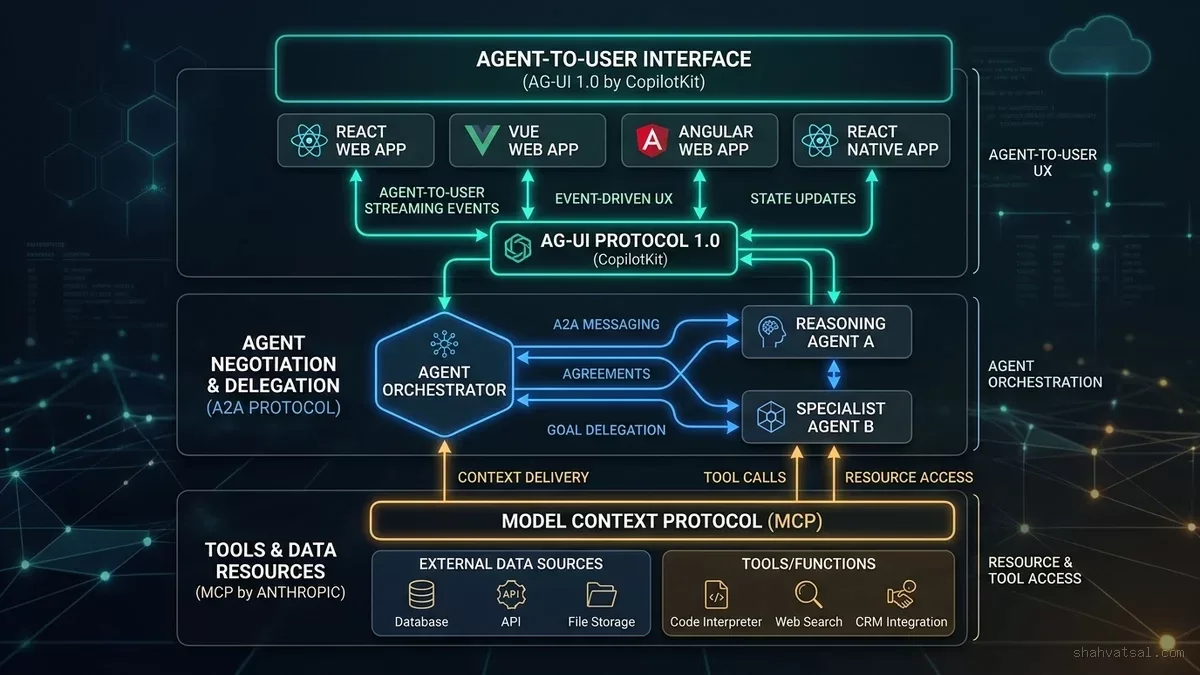
Tier 1: Downward Execution — Model Context Protocol (MCP)
- Originator: Anthropic (November 2024, expanded through 2025/2026).
- Core Function: Connects an AI model or agent downward to external data sources, enterprise tools, and local execution environments.
- Scope: Reading SQL schemas, executing bash commands, querying CRM databases, accessing Google Drive or GitHub files, and invoking local utility functions.
- Protocol Nature: Client-server RPC (JSON-RPC 2.0) defining available tools, resources, and prompt templates.
Tier 2: Horizontal Collaboration — Agent-to-Agent Protocol (A2A)
- Originator: Multi-agent consortiums and enterprise research labs (2025/2026).
- Core Function: Connects autonomous agents horizontally to other autonomous agents across security and organizational boundaries.
- Scope: Negotiating contracts, delegating sub-goals, exchanging cryptographic identity assertions, establishing Service Level Objectives (SLOs), and managing escrowed payments.
- Protocol Nature: Peer-to-peer asynchronous messaging and handshake negotiation.
Tier 3: Upward Projection — Agent-to-User Interface (AG-UI 1.0)
- Originator: CopilotKit (Published September 30, 2026).
- Core Function: Connects any agent runtime upward to human user interfaces (Web, Mobile, Desktop, Canvas).
- Scope: Streaming real-time thoughts, rendering intermediate tool activity, displaying subagent hierarchy trees, orchestrating Human-in-the-Loop approval modals, and synchronizing shared application state.
- Protocol Nature: Event-driven streaming wire format defined by a strict JSON Schema specification.
The Protocol Separation of Concerns
| Attribute | Model Context Protocol (MCP) | Agent-to-Agent (A2A) | AG-UI 1.0 Protocol |
|---|---|---|---|
| Directionality | Downward (Agent to Tools/Data) | Horizontal (Agent to Agent) | Upward (Agent to User Interface) |
| Primary Actor | LLM Engine & Local Environment | Autonomous Agent Entities | End-User & Application Frontend |
| Transport Medium | Stdio, Local IPC, HTTP/SSE | Mutual TLS, HTTP/2, WebSockets | Server-Sent Events (SSE), WebSockets |
| Data Payload | Tool descriptors, SQL results, files | Goal specifications, handshakes | Streaming deltas, UI cards, interrupts |
| Auth Responsibility | Host application security | Decentralized identity / mTLS | Transport gateway (OAuth2/OIDC) |
| Primary Beneficiary | Model reasoning capabilities | Inter-agent delegation & markets | User trust, observability, and control |
By isolating the upward user-interaction layer into an open standard, AG-UI enables a frontend engineering squad to build rich, reactive user experiences once, and bind them to any agent architecture regardless of where that agent executes or what tools it invokes via MCP.
3. Deep Dive into the AG-UI 1.0 Event Stream Lifecycle
At the core of the AG-UI 1.0 specification is a deterministic, state-machine-driven event stream. Every interaction between a user and an agent constitutes a Run.
A single Run streams discrete, typed events from the agent runtime to the client application. The AG-UI 1.0 specification formalizes the lifecycle through six mandatory event stages:
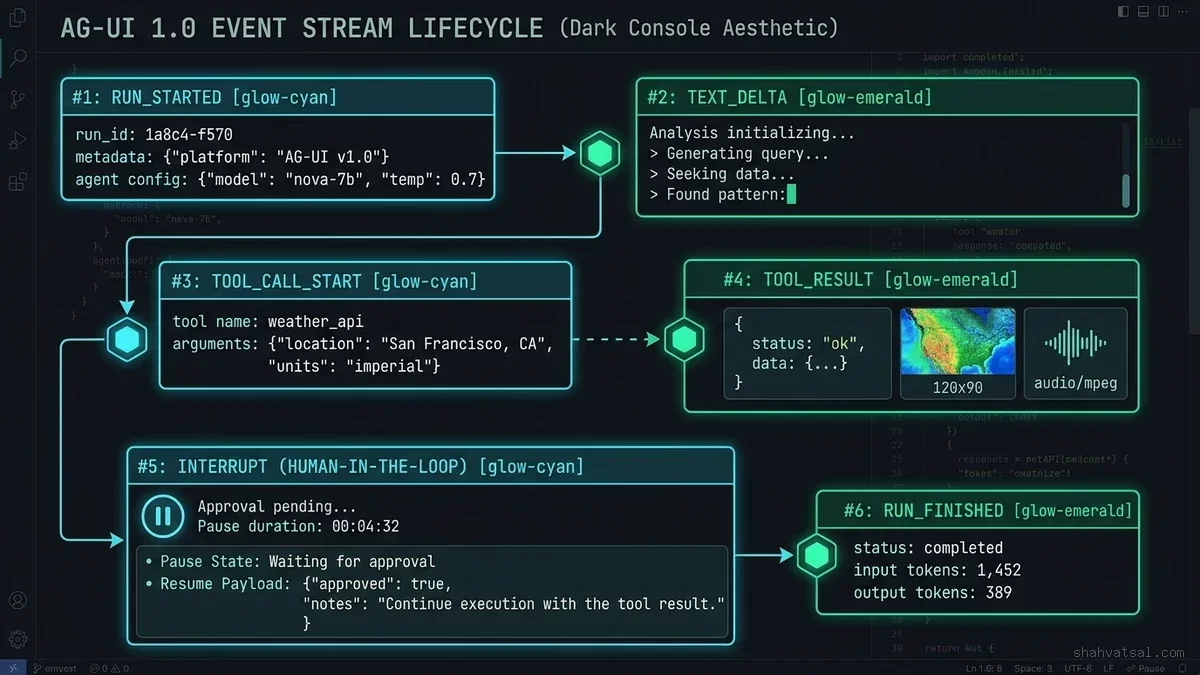
Event Stage 1: RUN_STARTED
Signals the initialization of an agent execution cycle.
- Payload Attributes:
- run_id: Unique cryptographic identifier for this run.
- parent_run_id: (Optional) Identifier of the parent agent if this run was spawned as a subagent.
- agent_id: Canonical identifier of the agent persona or model.
- metadata: Arbitrary key-value dictionary for enterprise context (e.g., tenant ID, user session ID, tracing spans).
- timestamp: ISO-8601 UTC timestamp.
{
  class="tok-str">"event": class="tok-str">"RUN_STARTED",
  class="tok-str">"version": class="tok-str">"1.0.0",
  class="tok-str">"run_id": class="tok-str">"run_01J8X9A2M4Q7Z1P8",
  class="tok-str">"parent_run_id": null,
  class="tok-str">"agent_id": class="tok-str">"financial-analyst-agent-v3",
  class="tok-str">"metadata": {
    class="tok-str">"tenant_id": class="tok-str">"org_enterprise_corp",
    class="tok-str">"user_id": class="tok-str">"usr_vatsal_shah",
    class="tok-str">"session_id": class="tok-str">"sess_998124"
  },
  class="tok-str">"timestamp": class="tok-str">"2026-09-30T14:22:01.104Z"
}
Event Stage 2: TEXT_DELTA
Transmits streaming natural language tokens from the agent to the user interface.
- Payload Attributes:
- run_id: Active run identifier.
- delta: The text fragment generated during this slice.
- index: Monotonically increasing sequence integer.
- role: Originator role (typically assistant or system_thought).
{
  class="tok-str">"event": class="tok-str">"TEXT_DELTA",
  class="tok-str">"run_id": class="tok-str">"run_01J8X9A2M4Q7Z1P8",
  class="tok-str">"index": 42,
  class="tok-str">"role": class="tok-str">"assistant",
  class="tok-str">"delta": class="tok-str">"Examining Q3 statutory balance sheet adjustments... "
}
Event Stage 3: TOOL_CALL_START & TOOL_CALL_DELTA
Notifies the frontend that the agent is invoking a tool, enabling the UI to render real-time loading badges, tool parameter previews, and operational status cards.
- Payload Attributes:
- tool_call_id: Unique identifier for the specific tool invocation.
- tool_name: The canonical function name (e.g., execute_bafin_margin_audit).
- arguments: Streaming JSON delta string or fully formed argument object.
{
  class="tok-str">"event": class="tok-str">"TOOL_CALL_START",
  class="tok-str">"run_id": class="tok-str">"run_01J8X9A2M4Q7Z1P8",
  class="tok-str">"tool_call_id": class="tok-str">"call_bafin_8819",
  class="tok-str">"tool_name": class="tok-str">"execute_bafin_margin_audit",
  class="tok-str">"arguments": {
    class="tok-str">"entity_code": class="tok-str">"EU-LOGISTICS-04",
    class="tok-str">"fiscal_quarter": class="tok-str">"2026-Q3",
    class="tok-str">"include_statutory_penalties": true
  }
}
Event Stage 4: TOOL_RESULT (Multimodal Integration)
In earlier experimental versions, tool results were restricted to serialized strings. AG-UI 1.0 standardizes rich, multimodal tool outputs. An agent can now return formatted tables, vector charts, generated images, audio buffers, or interactive UI component props directly within the tool result payload.
{
  class="tok-str">"event": class="tok-str">"TOOL_RESULT",
  class="tok-str">"run_id": class="tok-str">"run_01J8X9A2M4Q7Z1P8",
  class="tok-str">"tool_call_id": class="tok-str">"call_bafin_8819",
  class="tok-str">"status": class="tok-str">"success",
  class="tok-str">"content_type": class="tok-str">"application/vnd.ag-ui.chart+json",
  class="tok-str">"data": {
    class="tok-str">"chart_type": class="tok-str">"waterfall",
    class="tok-str">"currency": class="tok-str">"EUR",
    class="tok-str">"baseline_ebitda": 42000000,
    class="tok-str">"regulatory_adjustment": -18000000,
    class="tok-str">"adjusted_ebitda": 24000000,
    class="tok-str">"citation": class="tok-str">"BaFin Statutory Audit Directive 2026-08-14"
  }
}
Event Stage 5: INTERRUPT (Human-in-the-Loop Protocol)
When an agent encounters a high-risk action, policy threshold, or ambiguous decision, it emits an INTERRUPT event. The agent execution halts, freezing state on the server, while the frontend renders an interactive confirmation modal or parameter editor.
{
  class="tok-str">"event": class="tok-str">"INTERRUPT",
  class="tok-str">"run_id": class="tok-str">"run_01J8X9A2M4Q7Z1P8",
  class="tok-str">"interrupt_id": class="tok-str">"intr_99182",
  class="tok-str">"reason": class="tok-str">"HIGH_VALUE_PAYMENT_AUTHORIZATION",
  class="tok-str">"prompt": class="tok-str">"Agent requests approval to execute wire transfer of 1,450,000 Euros to escrow account.",
  class="tok-str">"required_action": {
    class="tok-str">"type": class="tok-str">"CONFIRM_OR_MODIFY",
    class="tok-str">"schema": {
      class="tok-str">"type": class="tok-str">"object",
      class="tok-str">"properties": {
        class="tok-str">"approved": { class="tok-str">"type": class="tok-str">"boolean" },
        class="tok-str">"revised_amount": { class="tok-str">"type": class="tok-str">"number" },
        class="tok-str">"justification_notes": { class="tok-str">"type": class="tok-str">"string" }
      },
      class="tok-str">"required": [class="tok-str">"approved"]
    }
  }
}
Event Stage 6: RUN_FINISHED
Signals graceful completion of the run, emitting definitive token usage telemetry and execution timing.
- Payload Attributes:
- status: Execution outcome (completed, interrupted, failed, cancelled).
- token_usage: Comprehensive token accounting across input tokens, output tokens, cached tokens, and tool tokens.
- duration_ms: Total execution latency in milliseconds.
{
  class="tok-str">"event": class="tok-str">"RUN_FINISHED",
  class="tok-str">"run_id": class="tok-str">"run_01J8X9A2M4Q7Z1P8",
  class="tok-str">"status": class="tok-str">"completed",
  class="tok-str">"duration_ms": 3812,
  class="tok-str">"token_usage": {
    class="tok-str">"input_tokens": 1420,
    class="tok-str">"output_tokens": 482,
    class="tok-str">"cached_tokens": 12800,
    class="tok-str">"total_tokens": 14702
  }
}
4. Subagent Hierarchies and Human-in-the-Loop Orchestration
As enterprise workflows scale from simple single-agent chat bots to multi-agent swarms, tracking who is doing what becomes the primary UX bottleneck.
AG-UI 1.0 solves this natively through two architectural innovations: Hierarchical Subagent Run Tracking and Bi-directional Interrupt Resume Primitives.
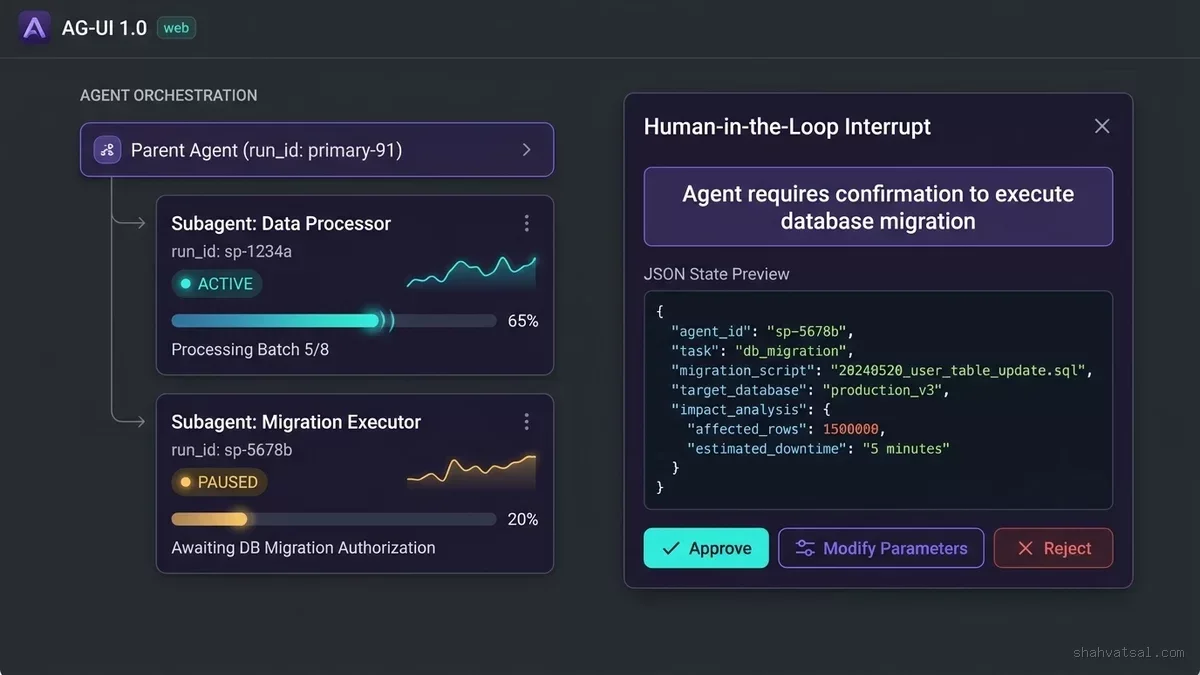
Hierarchical Subagent Run Tracking
In a multi-agent system, a primary supervisor agent might spin up three parallel worker agents:
Research-Agent-01investigating market filings.Code-Audit-Agent-02analyzing a GitHub pull request.Compliance-Agent-03checking regulatory constraints.
Under legacy streaming protocols, events from these three workers were interleaved haphazardly into a single text stream, producing garbled user interfaces.
AG-UI 1.0 mandates that every spawned worker emits its own distinct run_id, while referencing the parent_run_id of the supervisor.
Frontend libraries (such as @ag-ui/react) parse this parent-child lineage automatically, rendering clean, collapsible Subagent Progress Cards. The user sees exactly which subagent is executing, its individual progress bar, its active tool calls, and its intermediate thoughts, completely isolated from the primary conversation narrative.
The Human-in-the-Loop (HITL) Resume Handshake
Prior agent frameworks treated human intervention as an exceptional error state, often disconnecting the WebSocket and forcing the user to start a new chat turn.
AG-UI 1.0 treats human interruption as a first-class protocol state:
When the user interacts with the approval card, the client sends a RESUME_INTERRUPT payload back across the wire. The agent runtime deserializes the user's decision, restores its memory state, and resumes execution seamlessly without re-running prior reasoning steps or losing conversational history.
5. Schema-Driven SDK Generation and Type Safety
A major reason why prior protocol attempts failed was the divergence between specification documentation and real-world client implementations. An engineer writing a Python agent would emit a field named tool_args, while a TypeScript frontend expected arguments.
CopilotKit engineered AG-UI 1.0 from day one as a Schema-Driven Architecture.
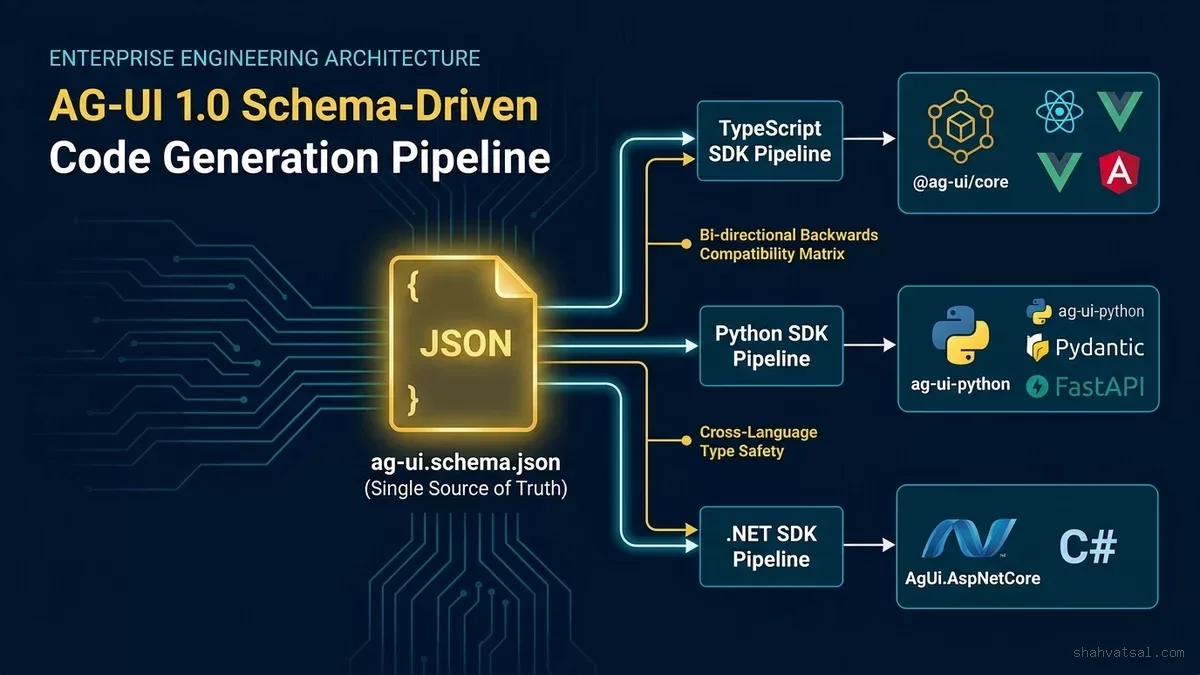
Single Source of Truth: ag-ui.schema.json
The definitive specification is not an English markdown file; it is a formal, machine-readable JSON Schema (ag-ui.schema.json) hosted under version control.
Every official SDK—across TypeScript, Python, and .NET—is generated directly from this schema using automated compilation toolchains:
- TypeScript: Compiled into strict TypeScript interfaces, Zod validation schemas, and reactive hooks via
json-schema-to-typescript. - Python: Compiled into typed Pydantic models (
BaseModel) with runtime deserialization validation viadatamodel-code-generator. - .NET (C#): Compiled into strongly typed record structs with
System.Text.Jsonsource generators.
End-to-End Implementation: Building an AG-UI Agent and React UI
Below is a complete, production-grade implementation showing a Python agent emitting AG-UI 1.0 events and a React frontend consuming them using official libraries.
Backend: Python Agent Runtime (ag-ui-python)
class="tok-cm"># AG-UI 1.0 Compliant Agent Endpoint
class="tok-cm"># Framework: FastAPI + ag-ui-python

import asyncio
import json
from typing import AsyncGenerator
from fastapi import FastAPI
from fastapi.responses import StreamingResponse
from pydantic import BaseModel

app = FastAPI(title=class="tok-str">"AG-UI 1.0 Agent Service")

class AgentPromptRequest(BaseModel):
    session_id: str
    prompt: str

async class="tok-kw">def generate_ag_ui_event_stream(prompt: str, session_id: str) -> AsyncGenerator[str, None]:
    run_id = fclass="tok-str">"run_{session_id[:8]}"

    class="tok-cm"># 1. Emit RUN_STARTED
    yield fclass="tok-str">"data: {json.dumps({&class="tok-cm">#039;event': 'RUN_STARTED', 'version': '1.0.0', 'run_id': run_id, 'metadata': {'session': session_id}})}\n\n"
    await asyncio.sleep(0.05)

    class="tok-cm"># 2. Emit TEXT_DELTA (Thinking and Initial Answer)
    message_chunks = [
        class="tok-str">"Analyzing request: ",
        fclass="tok-str">"&class="tok-cm">#039;{prompt}'... ",
        class="tok-str">"Checking database connectivity ",
        class="tok-str">"and running health diagnostics."
    ]
    for idx, chunk in enumerate(message_chunks):
        yield fclass="tok-str">"data: {json.dumps({&class="tok-cm">#039;event': 'TEXT_DELTA', 'run_id': run_id, 'index': idx, 'delta': chunk})}\n\n"
        await asyncio.sleep(0.1)

    class="tok-cm"># 3. Emit TOOL_CALL_START
    tool_id = class="tok-str">"call_db_check_01"
    yield fclass="tok-str">"data: {json.dumps({&class="tok-cm">#039;event': 'TOOL_CALL_START', 'run_id': run_id, 'tool_call_id': tool_id, 'tool_name': 'query_db_health', 'arguments': {'database': 'production_replica'}})}\n\n"
    await asyncio.sleep(0.3)

    class="tok-cm"># 4. Emit Multimodal TOOL_RESULT
    tool_payload = {
        class="tok-str">"event": class="tok-str">"TOOL_RESULT",
        class="tok-str">"run_id": run_id,
        class="tok-str">"tool_call_id": tool_id,
        class="tok-str">"status": class="tok-str">"success",
        class="tok-str">"content_type": class="tok-str">"application/json",
        class="tok-str">"data": {
            class="tok-str">"latency_ms": 14.2,
            class="tok-str">"connection_pool": class="tok-str">"healthy",
            class="tok-str">"active_shards": 16
        }
    }
    yield fclass="tok-str">"data: {json.dumps(tool_payload)}\n\n"
    await asyncio.sleep(0.1)

    class="tok-cm"># 5. Emit RUN_FINISHED with Telemetry
    yield fclass="tok-str">"data: {json.dumps({&class="tok-cm">#039;event': 'RUN_FINISHED', 'run_id': run_id, 'status': 'completed', 'duration_ms': 550, 'token_usage': {'input_tokens': 124, 'output_tokens': 48, 'cached_tokens': 512, 'total_tokens': 684}})}\n\n"

@app.post(class="tok-str">"/api/v1/agent/stream")
async class="tok-kw">def stream_agent(request: AgentPromptRequest):
    return StreamingResponse(
        generate_ag_ui_event_stream(request.prompt, request.session_id),
        media_type=class="tok-str">"text/event-stream",
        headers={
            class="tok-str">"Cache-Control": class="tok-str">"no-cache",
            class="tok-str">"Connection": class="tok-str">"keep-alive",
            class="tok-str">"X-Accel-Buffering": class="tok-str">"no"
        }
    )
Frontend: React Client Application (@ag-ui/react)
import React, { useState } from &class="tok-cm">#039;reactclass="tok-str">';
import { useAgUiAgent, AgUiRunViewer, SubagentCard, InterruptModal } from &class="tok-cm">#039;@ag-ui/react';
export const AgentWorkspace: React.FC = () => {
const [inputPrompt, setInputPrompt] = useState(&class="tok-cm">#039;class="tok-str">');
class="tok-cm">// Connect to AG-UI compliant backend endpoint
const {
events,
streamingText,
activeToolCalls,
activeInterrupt,
resumeInterrupt,
subagents,
isRunning,
tokenUsage,
dispatchRun
} = useAgUiAgent({
endpoint: &class="tok-cm">#039;/api/v1/agent/stream',
sessionId: &class="tok-cm">#039;session_demo_992class="tok-str">'
});
const handleSubmit = (e: React.FormEvent) => {
e.preventDefault();
class="tok-kw">if (!inputPrompt.trim() || isRunning) class="tok-kw">return;
dispatchRun({ prompt: inputPrompt });
setInputPrompt(&class="tok-cm">#039;');
};
class="tok-kw">return (
<div className=class="tok-str">"agent-container bg-slate-900 text-slate-100 min-h-screen p-8">
<header className=class="tok-str">"mb-8 border-b border-slate-800 pb-4 flex justify-between items-center">
<div>
<h1 className=class="tok-str">"text-2xl font-bold tracking-tight">AG-UI 1.0 Enterprise Workspace</h1>
<p className=class="tok-str">"text-slate-400 text-sm">Universal Agent-User Interaction Protocol</p>
</div>
{tokenUsage && (
<div className=class="tok-str">"text-xs font-mono bg-slate-800 px-3 py-1.5 rounded-full border border-slate-700">
Tokens: {tokenUsage.total_tokens} (In: {tokenUsage.input_tokens} | Out: {tokenUsage.output_tokens})
</div>
)}
</header>
{/* Main Agent Dialogue Window */}
<div className=class="tok-str">"agent-main-viewport space-y-4">
{/* Render Primary Streaming Text */}
<div className=class="tok-str">"text-display bg-slate-950 p-6 rounded-xl border border-slate-800 font-sans leading-relaxed">
{streamingText || <span className=class="tok-str">"text-slate-500 italic">Agent waiting for instructions...</span>}
</div>
{/* Dynamic Tool Call Execution Badges */}
{activeToolCalls.map((tool) => (
<div key={tool.tool_call_id} className=class="tok-str">"tool-indicator flex items-center space-x-3 bg-blue-950/40 border border-blue-800/60 p-3 rounded-lg text-sm">
<span className=class="tok-str">"w-2.5 h-2.5 rounded-full bg-blue-400 animate-pulse" />
<span className=class="tok-str">"font-mono font-semibold text-blue-300">{tool.tool_name}</span>
<span className=class="tok-str">"text-slate-400 text-xs">Invoking backend tool via MCP...</span>
</div>
))}
{/* Subagent Progress Hierarchy */}
{subagents.length > 0 && (
<div className=class="tok-str">"subagents-grid grid grid-cols-1 md:grid-cols-2 gap-4 mt-6">
{subagents.map((sub) => (
<SubagentCard
key={sub.run_id}
runId={sub.run_id}
agentId={sub.agent_id}
status={sub.status}
/>
))}
</div>
)}
</div>
{/* First-Class Human-In-The-Loop Interrupt Modal */}
{activeInterrupt && (
<InterruptModal
interrupt={activeInterrupt}
onApprove={(payload) => resumeInterrupt({ approved: true, ...payload })}
onReject={() => resumeInterrupt({ approved: false, reason: &class="tok-cm">#039;User rejected actionclass="tok-str">' })}
/>
)}
{/* User Input Bar */}
<form onSubmit={handleSubmit} className="mt-8 flex space-x-3">
<input
type="text"
value={inputPrompt}
onChange={(e) => setInputPrompt(e.target.value)}
placeholder="Instruct the agent..."
disabled={isRunning}
className="flex-1 bg-slate-950 border border-slate-700 rounded-lg px-4 py-3 focus:outline-none focus:ring-2 focus:ring-blue-500 text-sm"
/>
<button
type="submit"
disabled={isRunning}
className="bg-blue-600 hover:bg-blue-500 disabled:bg-slate-800 px-6 py-3 rounded-lg font-medium text-sm transition-colors"
>
{isRunning ? &class="tok-cm">#039;Running...' : class="tok-str">'Execute'}
</button>
</form>
</div>
);
};6. Ecosystem Bridges and Adopter Verification
In their September 30, 2026 launch documentation, CopilotKit detailed an extensive roster of ecosystem partnerships and framework bridges.
Adopter Claims vs. Independent Verification
CopilotKit explicitly names Google, Microsoft, Amazon, and Oracle as early adopters integrating AG-UI protocol primitives into their enterprise cloud copilots and partner ecosystems.
Editorial Notice: ShahVatsal.com cites the adoption of AG-UI 1.0 by Google, Microsoft, Amazon, and Oracle strictly as claims made by CopilotKit in their official release documentation. Independent verification shows that while open-source adapters and reference implementations exist for these ecosystems (e.g., Google ADK, Microsoft Agent Framework, AWS Bedrock agent bridges), native default wire integration across proprietary cloud consoles is undergoing phased enterprise rollout.
Framework Compatibility Matrix
AG-UI 1.0 ships with pre-built adapter bridges across the eight dominant agent orchestration engines:
| Agent Framework | Bridge Package | Supported 1.0 Features | Native Maintainer |
|---|---|---|---|
| LangChain / LangGraph | ag-ui-langchain | Streaming deltas, subagent run trees, HITL interrupts | Community / CopilotKit |
| Pydantic AI | ag-ui-pydantic | Type-safe tool results, Pydantic model serialization | CopilotKit / Pydantic |
| Mastra | @mastra/ag-ui | Workflows, agent memory synchronization, telemetry | Mastra Core Team |
| Microsoft Agent Framework | Microsoft.Agents.AgUi | Multi-agent swarms, CodeAct recovery, token usage | Microsoft / CopilotKit |
| Google Agent Development Kit (ADK) | google-adk-ag-ui | Gemini multimodal output, Vertex AI session spans | Google Cloud Partners |
| Claude Managed Agents | ag-ui-anthropic | Extended thinking deltas, tool call events | Community Adapter |
| OpenAI Agents SDK | ag-ui-openai | Assistant streaming, function calling payloads | Community Adapter |
| Strands (Autonomous Systems) | strands-ag-ui | Distributed agent nodes, telemetry accounting | Strands Core Team |
7. Security Invariants: Why an Event Stream Is Not an Auth Model
A critical architectural pitfall that software engineers must avoid when deploying AG-UI 1.0 is the assumption that the protocol handles security or identity verification.
AG-UI 1.0 is strictly a state synchronization and event serialization protocol. An event stream is not an authorization model.
The Three Security Fallacies of Agent Interfaces
- The Metadata Trust Fallacy: AG-UI events include a
metadatadictionary (e.g.,user_id,role,tenant_id). Never rely on client-provided or agent-emitted metadata for authorization decisions. An attacker intercepting or replaying an SSE stream can forge metadata properties. Identity must be verified cryptographically via JWT, mTLS, or session cookies at the reverse proxy gateway before the AG-UI event stream is established. - The Unsanitized Tool Result Vulnerability: In AG-UI 1.0, tool results can stream multimodal HTML, SVG, or JSON charts directly to the frontend. If a backend agent queries an untrusted external web page or SQL database that contains malicious prompt injection, the tool result may contain cross-site scripting (XSS) payloads. Frontend clients must strictly sanitize all tool result content using DOMPurify or isolated iframe sandboxes before rendering.
- The Unauthenticated Interrupt Bypass: The
INTERRUPTandRESUME_INTERRUPThandshake presents a prime target for privilege escalation. If an agent pauses to ask for financial transfer approval, the backend runtime must verify that the user identity submitting theRESUME_INTERRUPTpayload holds the exact RBAC privileges required to authorize that transaction. The client cannot be trusted to self-police approval rights.
8. Architectural Deduplication: Where AG-UI Fits in the Broader Strategy
To ensure strict clarity across technical publications, the following distinctions delineate AG-UI 1.0 from related architectural releases:
- Delineation from MCP Guide: Anthropic's Model Context Protocol (MCP) standardizes how agents read files, execute SQL, and call APIs. AG-UI standardizes how agents project events to human users. MCP is downward; AG-UI is upward.
- Delineation from A2A Blog (T83): Agent-to-Agent (A2A) protocol governs peer-to-peer delegation, contract negotiation, and cryptographic identity between two machine agents. AG-UI governs the human-to-agent interface.
- Delineation from Microsoft Agent Framework (T119): Microsoft Agent Framework provides the internal memory architecture, CodeAct runtime loops, and state checkpointing on the backend. AG-UI is the wire protocol that transports Microsoft Agent Framework events into a web browser.
- Delineation from BTN MCP-vs-A2A News: While business analyses examine the commercial war between tool protocols and agent negotiation protocols, AG-UI sits above both, remaining agnostic to whether the underlying agent used MCP for tools or A2A for collaboration.
9. Comprehensive Implementation Checklist and Migration Playbook
For enterprise architecture teams modernizing their agent-facing UI layer to AG-UI 1.0, follow this structured six-stage deployment playbook:
Stage 1: Protocol Audit and Wire Contract Baseline
- [x] Audit current backend agent endpoints. Identify whether agents currently emit raw strings, custom SSE events, or WebSocket frames.
- [x] Pin the authoritative schema version (
ag-ui.schema.jsonv1.0.0). Ensure all internal libraries reference the canonical schema URL. - [x] Configure gateway transport security. Verify that CORS policies, reverse proxy buffering rules (
X-Accel-Buffering: no), and keep-alive headers are correctly enabled for long-running Server-Sent Events.
Stage 2: Backend Bridge Integration
- [x] Install the matching framework bridge (e.g.,
ag-ui-langchain,ag-ui-pydantic, orMicrosoft.Agents.AgUi). - [x] Map internal agent logging spans to standard AG-UI events (
RUN_STARTED,TEXT_DELTA,TOOL_CALL_START,TOOL_RESULT). - [x] Implement token usage aggregation on the agent executor to guarantee populated
token_usagemetrics onRUN_FINISHED.
Stage 3: Human-in-the-Loop Interrupt Hardening
- [x] Define high-risk action policies requiring human intervention (financial disbursements, database migrations, public emails).
- [x] Implement the
INTERRUPTevent generator on the backend agent with an explicit JSON Schema defining expected response fields. - [x] Construct an idempotent
RESUME_INTERRUPTwebhook endpoint that verifies the caller's JWT bearer token and authorization scope before unfreezing agent execution.
Stage 4: Frontend SDK and Component Binding
- [x] Install
@ag-ui/react(or matching Vue/Angular/React Native client libraries). - [x] Replace ad-hoc regex parsers with the native
useAgUiAgenthook. - [x] Bind
activeToolCallsandsubagentsto reusable dashboard cards to provide real-time operational feedback.
Stage 5: Multimodal Tool Rendering and Sanitization
- [x] Implement custom component renderers for domain-specific tool result mime-types (e.g.,
application/vnd.ag-ui.chart+json). - [x] Configure client-side sanitization on all text and rich media assets to prevent stored XSS attacks originating from unvetted agent tools.
- [x] Add fallback text-rendering logic for unsupported multimodal content types.
Stage 6: Observability, Tracing, and Regression Verification
- [x] Inject OpenTelemetry trace contexts into the
metadata.trace_idproperty ofRUN_STARTED. - [x] Correlate frontend interaction events with backend agent reasoning spans in your centralized observability APM.
- [x] Conduct automated regression tests validating that client applications gracefully ignore future event extensions without crashing.
10. Legal Disclaimers and Intellectual Property Notices
- CopilotKit: CopilotKit and AG-UI are trademarks and intellectual property of CopilotKit, Inc.
- Google: Google, Vertex AI, and Google ADK are registered trademarks of Google LLC.
- Microsoft: Microsoft, Azure, and Microsoft Agent Framework are registered trademarks of Microsoft Corporation.
- Amazon: Amazon, AWS, and Amazon Bedrock are registered trademarks of Amazon.com, Inc.
- Oracle: Oracle is a registered trademark of Oracle Corporation.
- LangChain: LangChain is a trademark of LangChain, Inc.
- Anthropic: Anthropic and Model Context Protocol (MCP) are trademarks of Anthropic, PBC.
- Editorial Notice: This technical architectural review is prepared independently by Vatsal Shah for engineering and architectural evaluation based on open protocol specifications and public disclosures published on September 30, 2026.