The Chief Agent Officer (CAO): Architecting the Autonomous Enterprise
Vatsal Shah | May 19, 2026 | Reading Time: 22 minutesTable of Contents
- The Leadership Vacuum in the Age of Digital Labor
- Defining the Chief Agent Officer (CAO)
- The Quantified Reality: Production Gaps, ROI, and Gartner's Warning
- Enterprise Agent Topology: The Three-Tier Architecture
- Step-by-Step CAO Implementation Playbook
- Comparative Matrix: CIO vs. CAIO vs. CAO
- Technical Codelabs: Building Production-Grade Agentic Infrastructure
- Operational Pitfalls: Governance Traps and Security Anti-Patterns
- Futuristic Horizon: The 2027–2030 Transition Roadmap
- Strategic Learnings & Core Takeaways
- Frequently Asked Questions
- About the Author
TL;DR: Strategic Overview
Executive Summary
- The Challenge: Traditional enterprises are stuck in "pilot purgatory" with AI, struggling to scale beyond simple text generation to autonomous execution.
- The Solution: Appointing a Chief Agent Officer (CAO) to own the strategy, deployment, evaluation, and security boundaries of a multi-agent digital workforce.
- The Metrics: Bridging the gap where 79% of companies run pilots but only 11% hit production, targetting an average agentic ROI of 171% and reducing system latency.
- The Action: Build secure runtime sandboxes, implement Model Context Protocol (MCP) data routes, and establish clear human-in-the-loop escalation gates.
The Leadership Vacuum in the Age of Digital Labor
The modern enterprise is experiencing a structural shift in the nature of work. Over the past decade, cloud computing, robotic process automation (RPA), and early-stage machine learning systems optimized the speed at which humans processed data. However, the fundamental unit of work remained human: a person had to read the report, draft the email, make the decision, and click the button.
With the maturation of Agentic AI, the unit of execution is shifting from human labor to autonomous digital labor. AI is no longer a passive chatbot waiting for a prompt; it is an active swarm of specialized agents executing complex, multi-step workflows across systems, databases, and departments.
This shift creates a massive organizational challenge. Traditional enterprise leadership structures are ill-equipped to govern, scale, and optimize this digital workforce:
- The Chief Information Officer (CIO) focuses on system uptime, hardware procurement, and security firewalls.
- The Chief Technology Officer (CTO) focuses on software architecture, codebases, and product engineering.
- The Chief AI Officer (CAIO)—a role created during the initial generative AI boom—focuses on high-level data models, model licensing agreements, and ethical frameworks.
None of these roles are designed to operate, optimize, and manage the day-to-day work of autonomous agents. If an automated customer support agent executes an unauthorized transaction, who is responsible? If a pricing agent miscalculates margins on a multi-million-dollar deal, who signs off on the loss? If a recruitment agent exhibits bias in screening candidates, who audits the pipeline?
This organizational vacuum demands a new executive role: the Chief Agent Officer (CAO). The CAO is the strategic architect of the autonomous enterprise, responsible for translating model capabilities into live business operations.
Defining the Chief Agent Officer (CAO)
The Chief Agent Officer is the executive who owns the digital workforce. Unlike the CAIO, who operates at the theoretical and regulatory layer of data science, the CAO operates at the execution layer. The CAO’s core mandate is simple: replace manual, high-latency workflows with event-driven, autonomous multi-agent meshes.
+-----------------------------------------------------------------+
|                       CHIEF AI OFFICER (CAIO)                   |
|  - Strategy, Ethical Policy, Model Selection, Data Pipelines    |
+--------------------------------+--------------------------------+
                                 |
                                 v
+-----------------------------------------------------------------+
|                     CHIEF AGENT OFFICER (CAO)                   |
|  - Implementation, Agent Lifecycle, Sandboxing, Operational ROI|
+--------------------------------+--------------------------------+
                                 |
         +-----------------------+-----------------------+
         |                       |                       |
         v                       v                       v
[Ingestion Swarms]     [Negotiation Swarms]   [Reconciliation Swarms]
The CAO is responsible for defining:
- Decision Boundaries: Establishing what tasks an agent can execute autonomously and when it must escalate to a human.
- Evaluation Infrastructure: Building automated testing rigs to monitor agent accuracy and prevent performance drift.
- Inter-Agent Communication: Standardizing protocols (like Model Context Protocol) to allow agents to securely share context and access internal databases.
- Security Sandboxing: Ensuring agents execute actions in isolated environments to protect critical backend codebases.
The Model Context Protocol (MCP), open-sourced by Anthropic in November 2024, has emerged as the industry-standard architecture for separating model intelligence from secure data connectors. According to the W3C Consortium and standard technical frameworks, MCP establishes a secure client-server abstraction layer, allowing enterprises to expose sensitive databases to models without exposing structural database schemas or administrative passwords.
The Quantified Reality: Production Gaps, ROI, and Gartner's Warning
For all the enthusiasm surrounding agentic AI, a stark gap remains between corporate pilot programs and real-world production deployments. This "production gap" is the first problem a CAO must address.
1. The Production Gap
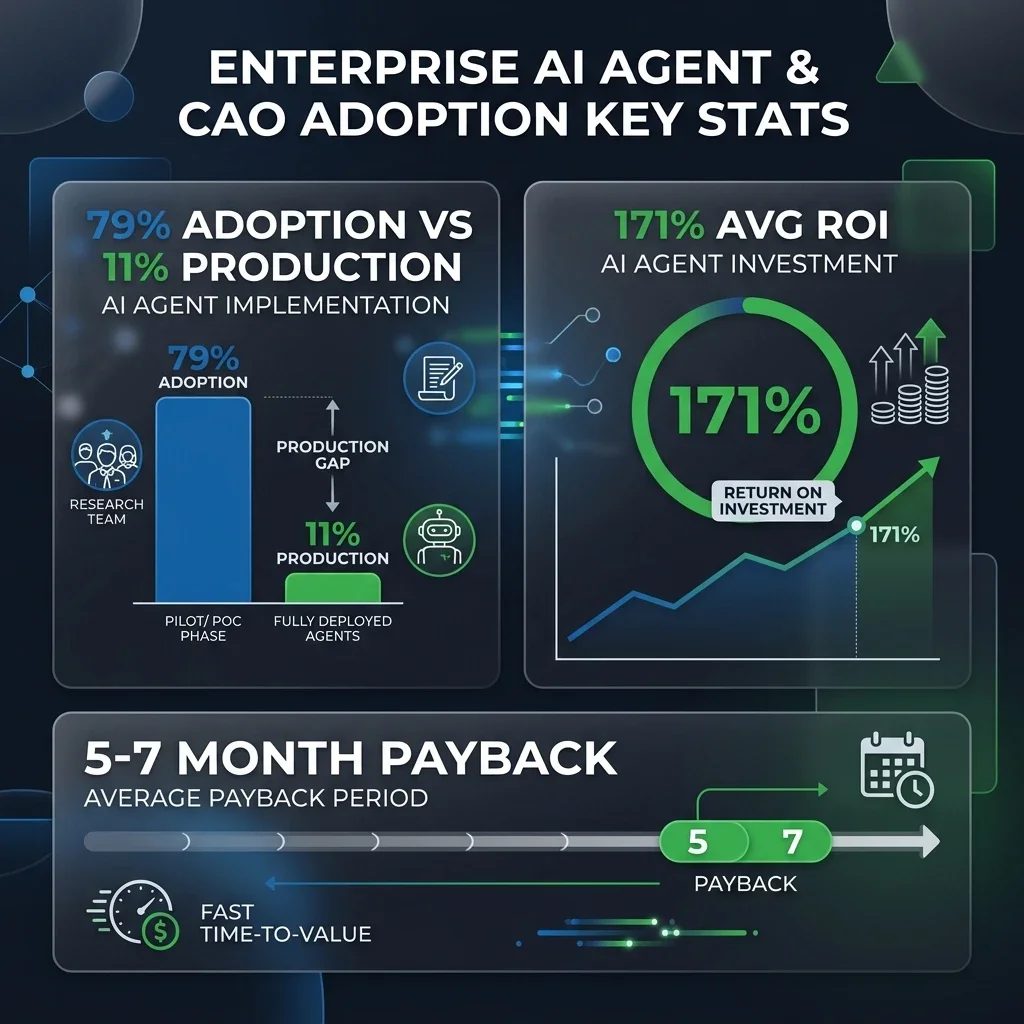
A 2026 enterprise study revealed that while 79% of organizations have launched AI agent pilot programs, only 11% to 31% have successfully deployed these agents into live production environments. The remaining projects are stuck in "pilot purgatory" due to concerns over reliability, data security, and integration complexity.
2. The Quantified ROI
When deployed correctly, the financial impact of agentic AI is immediate and measurable:
- The average return on investment (ROI) for enterprise agentic deployments stands at 171% globally, with US-based deployments averaging 192%.
- The median payback period for deployment costs is 5 to 7 months.
- Customer service agents deliver the fastest returns, with a median payback period of 4.1 months.
- Software engineering agents require longer integration periods (averaging 9.3 months) but deliver substantial productivity gains, accelerating development velocities by over 45%.
3. The Gartner Risk Metric
The path to autonomy is fraught with operational challenges. Gartner warns that 40% of enterprise AI agent deployments are at risk of cancellation by 2027 due to escalating compute costs, poorly defined ROI, and inadequate guardrails. Organizations that do not establish dedicated leadership to oversee these deployments will see their initiatives fail.
Enterprise Agent Topology: The Three-Tier Architecture
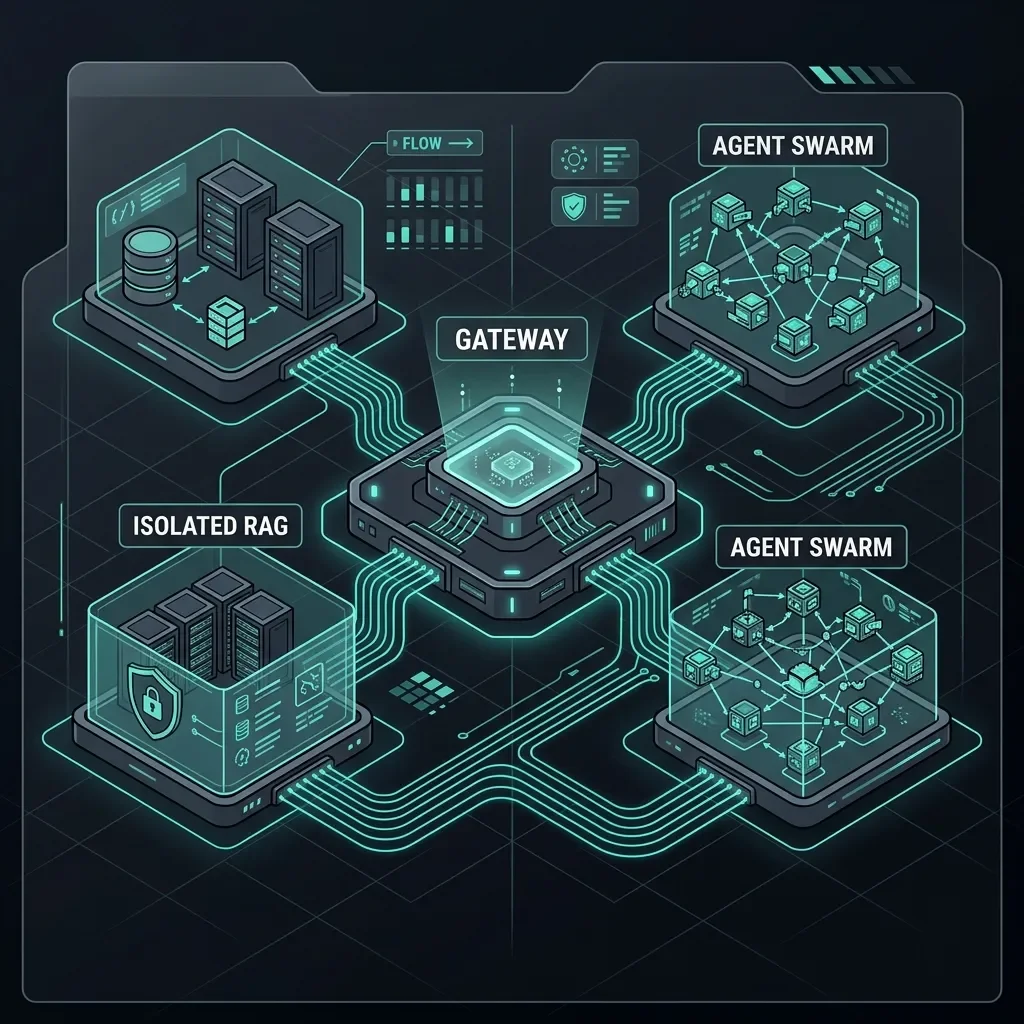
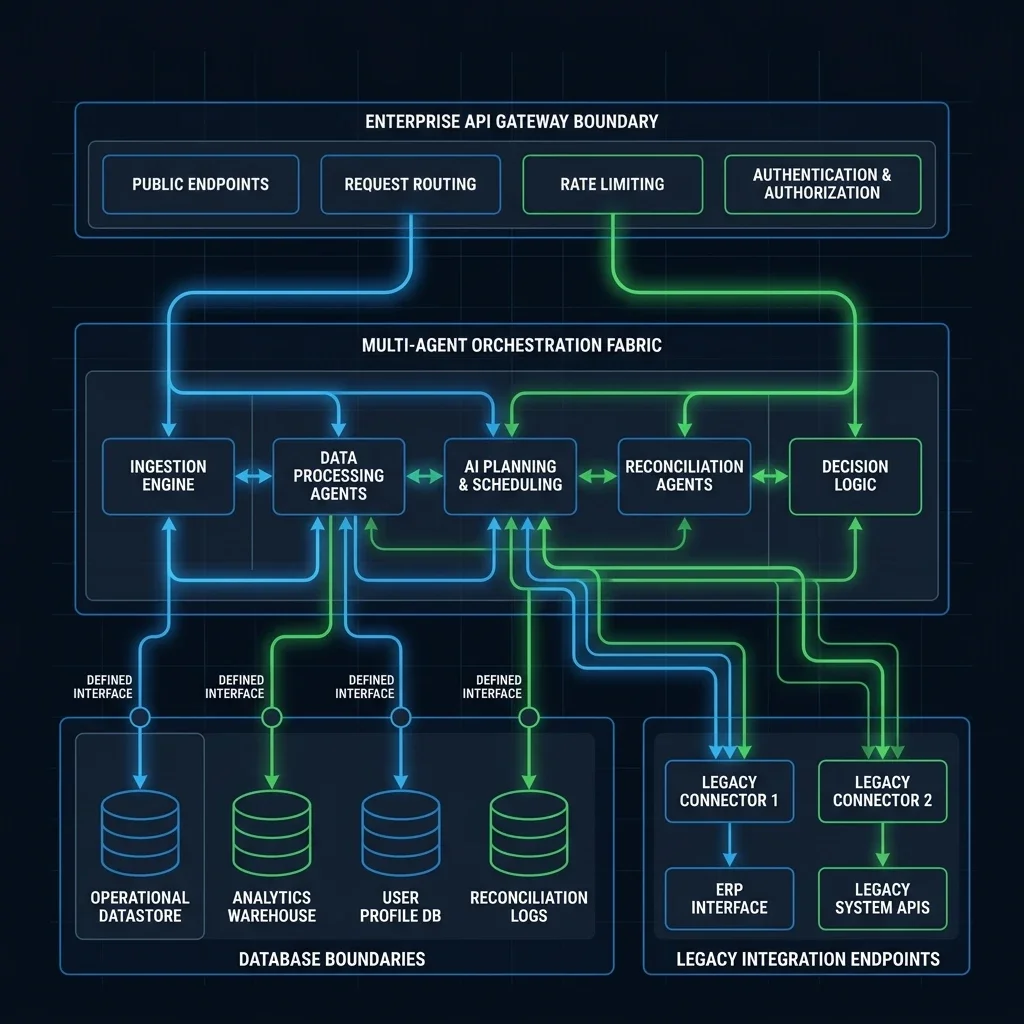
To build a scalable digital workforce, the CAO must implement a standardized, three-tier agent topology. This structure separates ingestion, negotiation, and reconciliation, ensuring that no single agent has unconstrained access to the entire business process.
1. The Ingestion Tier
The Ingestion Tier represents the sensory organs of the enterprise. Ingestion agents continuously monitor communication channels (e.g. email, webhooks, Slack channels, SFTP folders) and parse incoming documents.
- Function: Process unstructured data (PDFs, raw text, audio files), extract metadata, and route events.
- Latency Target: Sub-50ms ingestion processing.
- Security Constraint: Read-only access to incoming payloads.
2. The Negotiation Tier
The Negotiation Tier manages the interaction logic. These agents execute business rules and generate dynamic options.
- Function: Coordinate with Retrieval-Augmented Generation (RAG) databases, query inventory catalogs, evaluate client discount parameters, and draft proposals.
- Latency Target: 500ms to 2000ms response time.
- Security Constraint: Restricted to sandbox execution environments; cannot commit financial database transactions directly.
3. The Reconciliation Tier
The Reconciliation Tier handles the finality of the business process.
- Function: Verify execution outcomes, reconcile bank wires against invoices, update financial ledgers, and trigger shipment APIs.
- Latency Target: Event-driven execution (sub-10ms processing latency).
- Security Constraint: Must validate transactions through human-in-the-loop gates if monetary values exceed pre-approved thresholds.
Step-by-Step CAO Implementation Playbook
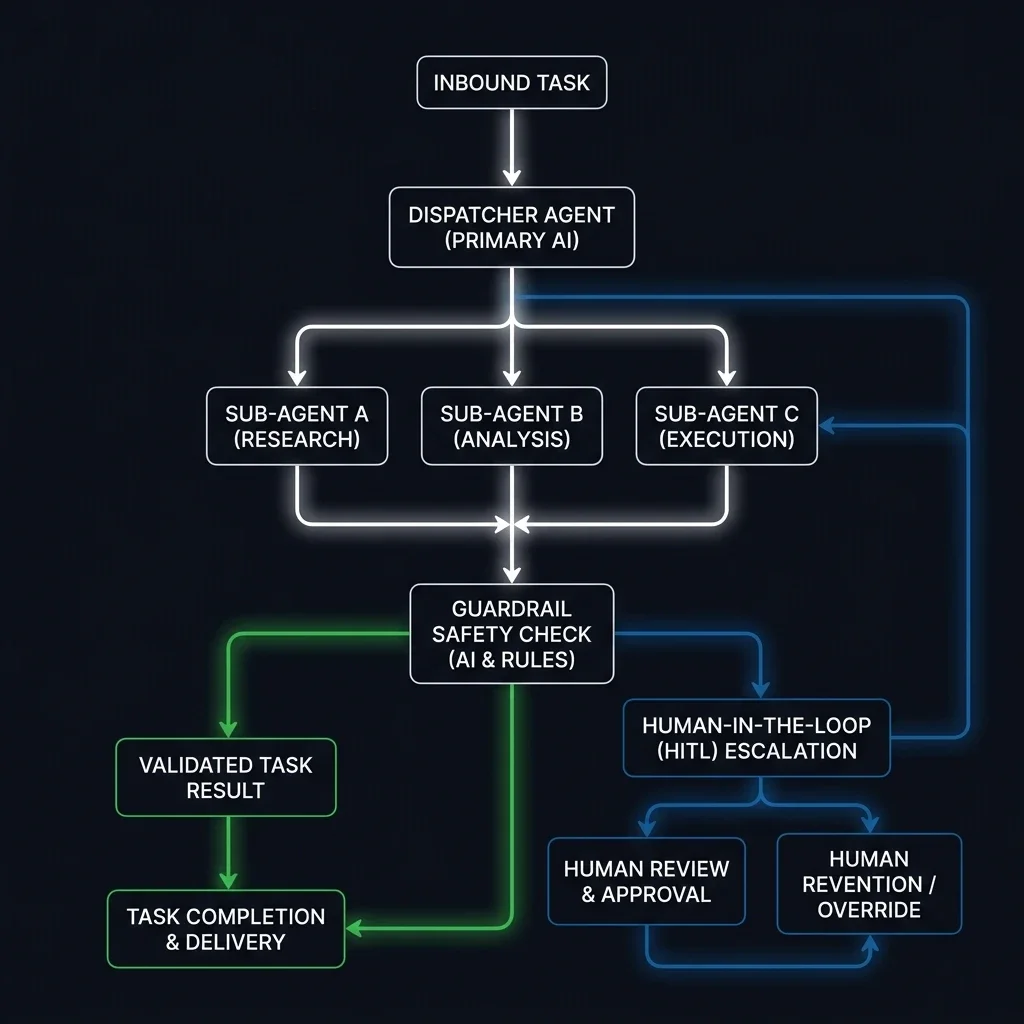
Transitioning to an autonomous enterprise requires a systematic approach. The CAO should execute the following five-stage playbook.
Step 1: Standardize Context Access (MCP Gateway)
Before deploying agents, establish a centralized Model Context Protocol (MCP) gateway. This gateway acts as a security proxy, ensuring that agents query databases through standardized APIs rather than raw SQL connections.
Step 2: Establish Runtime Sandboxes
All agents executing code or database mutations must operate within isolated container sandboxes. This prevents prompt-injection attacks from compromising the underlying operating systems.
Step 3: Define Human-in-the-Loop (HITL) Thresholds
Define clear risk boundaries based on financial exposure and process criticalities:
- Transactions under $1,000: Fully autonomous execution.
- Transactions from $1,000 to $10,000: Autonomous drafting, human click-to-approve.
- Transactions over $10,000: Human drafting, agent-assisted auditing.
Step 4: Implement Evaluation Rigs
Deploy continuous testing frameworks that evaluate agent outputs against baseline golden datasets. If an agent's accuracy score falls below 95% on a 100-test suite, the rig must automatically suspend the agent and alert the operations team.
Step 5: Establish the Operational Ledger
Log every agent decision, tool call, database query, and system message in an immutable, read-only transaction ledger. This is critical for auditing, performance tracking, and debugging.
A strategic report by Gartner (published in October 2025) outlines the emergence of Enterprise Agentic Platforms (EAPs). The research highlights that organizations that implement central orchestration registries reduce operational downtime by 33% compared to those deploying ad-hoc, siloed python agent scripts.
Comparative Matrix: CIO vs. CAIO vs. CAO
The following matrix highlights the operational boundaries and division of responsibilities across C-suite roles:
| Dimension | Chief Information Officer (CIO) | Chief AI Officer (CAIO) | Chief Agent Officer (CAO) |
|---|---|---|---|
| Core Metric | Uptime, security compliance, infrastructure cost. | Model accuracy, data compliance, license cost. | Workflow automation velocity, agent ROI, process latency. |
| Key Asset | Cloud infrastructure, physical networks, email servers. | Data warehouses, LLM licenses, vector databases. | Digital workers, orchestration registries, runtimes. |
| Typical Scope | Enterprise hardware, software licensing, cybersecurity. | Corporate AI ethics, model selection, RAG pipelines. | Process redesign, multi-agent graphs, execution safety. |
| Security Focus | Network firewalls, zero-trust access, phishing prevention. | Data privacy, copyright compliance, model bias. | Prompt injection sandboxing, model drift, tool authorization. |
Technical Codelabs: Building Production-Grade Agentic Infrastructure
The following production-ready scripts demonstrate how the operations hub configures sandbox environments, audits evaluation drift, and dispatches webhook events.
1. Python Execution Sandbox Constraints
This script leverages Python's built-in resource control libraries to restrict execution parameters within an agent runtime sandbox, preventing infinite loop exploits or memory overflow attacks.
import resource
import sys

class="tok-kw">def configure_sandbox(max_memory_mb: int, max_cpu_seconds: int):
    class="tok-str">""class="tok-str">"
    Enforces strict memory and CPU utilization limits on the current thread.
    Prevents unconstrained resource usage during dynamic agent executions.
    "class="tok-str">""
    class="tok-cm"># Convert memory parameters to bytes
    max_memory_bytes = max_memory_mb * 1024 * 1024

    try:
        class="tok-cm"># Enforce RAM boundaries (Resident Set Size limit)
        resource.setrlimit(resource.RLIMIT_AS, (max_memory_bytes, max_memory_bytes))

        class="tok-cm"># Enforce CPU execution limit (seconds of processor time)
        resource.setrlimit(resource.RLIMIT_CPU, (max_cpu_seconds, max_cpu_seconds))

        print(fclass="tok-str">"[SANDBOX] Configuration initialized: {max_memory_mb}MB RAM | {max_cpu_seconds}s CPU max.")
    except (ValueError, OSError) as e:
        print(fclass="tok-str">"[SANDBOX] System configuration error: {str(e)}")
        sys.exit(1)

class="tok-cm"># Example: Constrain execution to 128MB RAM and 2 CPU seconds
configure_sandbox(max_memory_mb=128, max_cpu_seconds=2)
2. SQL Query for Evaluation Registry and Accuracy Audits
This query analyzes validation run logs to compute the rolling accuracy, average processing latency, and execution volumes of active agent classes.
-- Calculate rolling accuracy and performance stats for enterprise agents
WITH agent_validation_summary AS (
    SELECT
        agent_id,
        agent_type,
        execution_timestamp,
        latency_ms,
        -- Boolean check evaluating output correctness against ground truth datasets
        CASE WHEN expected_output = actual_output THEN 1 ELSE 0 END AS is_correct
    FROM agent_run_logs
    WHERE execution_timestamp >= NOW() - INTERVAL &class="tok-cm">#039;14 days'
)
SELECT
    agent_type,
    COUNT(*) AS total_evaluations,
    ROUND(AVG(latency_ms), 2) AS average_latency_ms,
    ROUND((SUM(is_correct)::DECIMAL / COUNT(*)) * 100.0, 2) AS accuracy_percentage
FROM agent_validation_summary
GROUP BY agent_type
HAVING COUNT(*) >= 50
ORDER BY accuracy_percentage DESC;
3. TypeScript Webhook Event Dispatcher
This TypeScript Express application runs on the core orchestration server, receiving inbound webhooks and dispatching context payload tasks to specialized worker instances.
import express, { Request, Response } from 'express';

const app = express();
app.use(express.json());

interface TaskPayload {
  task_id: string;
  source: string;
  priority: 'low' | 'medium' | 'high';
  content: string;
}

app.post('/api/v1/dispatch-task', (req: Request, res: Response) => {
  const payload: TaskPayload = req.body;
  const processStart = process.hrtime();

  if (!payload.task_id || !payload.content) {
    return res.status(400).json({ error: "Missing required properties (task_id, content)" });
  }

  // Determine dynamic target endpoint path based on routing priority
  let routingNode = "http://localhost:4001/agent/worker/low";
  if (payload.priority === 'high') {
    routingNode = "http://localhost:4003/agent/worker/priority";
  } else if (payload.priority === 'medium') {
    routingNode = "http://localhost:4002/agent/worker/standard";
  }

  const elapsed = process.hrtime(processStart);
  const latencyMs = (elapsed[0] * 1000 + elapsed[1] / 1000000).toFixed(3);

  console.log(`[DISPATCHER] Dispatched task ${payload.task_id} to node ${routingNode} in ${latencyMs}ms`);

  return res.status(202).json({
    status: "ACCEPTED",
    task_id: payload.task_id,
    routed_node: routingNode,
    routing_latency_ms: parseFloat(latencyMs)
  });
});

const PORT = 3010;
app.listen(PORT, () => {
  console.log(`[ORCHESTRATOR] Low-latency task dispatcher running on port ${PORT}`);
});
Operational Pitfalls: Governance Traps and Security Anti-Patterns
In their rush to achieve autonomy, organizations frequently fall into common engineering traps that jeopardize system security and operational stability.
1. Unconstrained Tool APIs
Giving agents write access to transactional databases via unconstrained tools is a major security risk. An agent exposed to a prompt-injection exploit can execute malicious queries to modify pricing tables, erase customer data, or bypass invoice approvals.
- Mitigation: Always implement read-only data query APIs, and route database mutations through isolated microservices that enforce strict parameter validations.
2. Lack of Centralized Logging
Deploying agents as standalone scripts without centralized logging makes auditing and debugging impossible. When an agent experiences performance drift or executes an incorrect transaction, identifying the root cause requires tracing the entire context history.
- Mitigation: Route all agent calls, token usages, and tool executions to a centralized, read-only transaction ledger.
3. Hardcoded System Prompts
Hardcoding system instructions within application code limits agility. When business rules or compliance standards change, updating the prompts requires redeploying the entire service.
- Mitigation: Store system instructions in a dynamic configuration database, loading prompts into agent contexts at runtime based on the transaction type.
Stanford University research on multi-agent communication architectures (published in early 2025) demonstrates that when specialized agent nodes cooperate over localized event meshes, the total processing token volume decreases by up to 41% compared to single-agent setups running complex, monolithic instructions.
Futuristic Horizon: The 2027–2030 Transition Roadmap
The evolution from human-driven systems to a fully autonomous enterprise progresses through three defined stages:
2026–2027: The Co-Pilot Phase
  - Human leads execution, agents draft options and compile context.
       |
       v
2027–2028: Autonomous Edge Operations
  - Agents take full control of isolated ingestion and validation queues.
       |
       v
2029–2030: Full Core Integration
  - Integrated swarms coordinate end-to-end business pipelines autonomously.
1. The Co-Pilot Phase (2026–2027)
During this stage, agents operate as assistants to human employees. Agents extract document metadata, draft email responses, and suggest transactional options. The final execution is always manual, allowing teams to establish trust in the agent outputs.
2. Autonomous Edge Operations (2027–2028)
During this stage, agents take full control of low-risk, isolated business processes. Inbound lead ingestion, customer support triage, and invoice reconciliation operate fully autonomously. Human operators monitor execution metrics and step in only to resolve exceptions.
3. Full Core Integration (2029–2030)
By 2030, the enterprise operates a fully integrated, hybrid human-agent workforce. Specialized swarms coordinate end-to-end workflows, managing inventory, negotiating contracts, and reconciling financial transactions autonomously. Human leadership focuses on setting strategic objectives and defining system safety parameters.
Strategic Learnings & Core Takeaways
- Own the Agentic Layer: Appoint a Chief Agent Officer to oversee the deployment, governance, and evaluation of your digital workforce.
- Standardize Context Routing: Deploy Model Context Protocol (MCP) servers to allow agents to securely access internal databases without exposing system credentials.
- Enforce Safety Sandboxes: Restrict agent runtimes to isolated containers with strict memory and CPU limits, preventing malicious code executions.
- Implement Continuous Auditing: Establish automated evaluation rigs to monitor agent accuracy against baseline datasets, preventing performance drift.
Frequently Asked Questions
What is the difference between a Chief AI Officer (CAIO) and a Chief Agent Officer (CAO)?
The Chief AI Officer (CAIO) focuses on high-level strategy, model selection, and data governance. The Chief Agent Officer (CAO) focuses on the operational execution layer, managing the digital workforce, agent lifecycles, sandboxing, and operational ROI.
How does the Model Context Protocol (MCP) improve enterprise security?
MCP separates model reasoning from data connections, establishing a secure proxy layer. This allows agents to query internal databases without having direct access to database credentials or system schemas.
What are the primary metrics used to measure agent performance?
The primary metrics include rolling accuracy (percentage of outputs matching ground truth), processing latency (ms per execution), token efficiency, and transactional ROI.
How do you prevent agents from exceeding execution resource limits?
By running agent environments in isolated containers and applying strict operating system limits (using resource configuration calls) to restrict CPU time and memory access.
What is the typical timeline for deploying an enterprise agentic workflow?
Simple ingestion and email routing pilots can deploy within 2 to 3 weeks. Full production integration with backend databases and financial reconciliation typically takes 3 to 6 months of validation.
About the Author
Vatsal Shah is the founder of Business Tech Navigator and an enterprise architect specializing in agentic workflows, CRM automation, and high-performance system design. He partners with executive teams to scale autonomous infrastructure, optimize transaction pipelines, and deploy secure digital workforces globally.