Agentic MCP: Enabling Legacy ERPs to Talk to Autonomous Swarms
By Vatsal Shah | 2026-05-19 | 15 min read
TL;DR: Strategic Overview
Strategic Overview
- The Problem: Legacy ERP systems (SAP, DB2, Oracle) are isolated data jails. Autonomous AI agent swarms need real-time database access to act on supply chain exceptions, billing discrepancies, and procurement decisions — but traditional REST APIs create brittle, high-maintenance integration debt.
- The Solution: Model Context Protocol (MCP) establishes a standardized, secure semantic proxy layer between LLM agents and enterprise databases, enabling runtime tool discovery, dynamic schema reflection, and safe transactional execution without exposing credentials.
- The Key Differentiator: Unlike REST wrappers that break with every schema change, MCP adapts dynamically — cutting integration setup time from weeks to hours.
- The Outcome: Enterprise swarms can query SAP inventory, reconcile invoices, and execute reorder transactions in under 50ms, with full SQL AST sandboxing preventing any destructive agent actions.
Table of Contents
- Introduction: The ERP Data Jail
- What is Agentic MCP?
- The Architectural Deficit: Rigid APIs vs Dynamic Context
- System Blueprint: The MCP ERP Proxy Bridge
- Procedural Logic: Context Hydration Lifecycle
- Codelabs: Production-Ready Integration Code
- Deep Analysis: Custom API Connectors vs Standardized MCP
- Security & Sandbox Enforcement in ERP Systems
- 2027–2030 Transition Roadmap: The Autonomous Enterprise Matrix
- Key Takeaways
- Frequently Asked Questions
- About the Author
Introduction: The ERP Data Jail
For over three decades, enterprise resource planning (ERP) systems like SAP NetWeaver, DB2 relational databases, and Oracle EBS have operated as the transactional records system for global commerce. These monoliths are highly secure, deeply integrated, and functionally stable. However, they are also isolated "data jails."
When modern organizations deploy autonomous agent swarms (orchestrated via tools like LangGraph or AutoGen) to manage supply chain exceptions, reconcile complex balance sheets, or automatically draft manufacturing procurement plans, they run into a brick wall. Autonomous agents rely on dynamic context to make decisions. They need to inspect database schemas, verify stock levels, pull historical vendor performance data, and commit transactions.
Traditionally, connecting these agents to legacy systems required writing thousands of lines of custom REST APIs or SOAP endpoints, creating maintenance debt and exposing security vulnerabilities. The emergence of the Model Context Protocol (MCP) changes this paradigm entirely. It provides a standardized, secure bidirectional communication layer, allowing synthetic employees to query, analyze, and update legacy ERP tables as if they were local variables.
What is Agentic MCP?
AI SUMMARY
Model Context Protocol (MCP) acts as an open standard for LLM applications. It exposes enterprise databases and services directly to AI agents via unified, secure protocol schemas. This allows swarms to dynamic-load ERP state, execute transactions, and maintain absolute compliance.
Agentic MCP is defined as the deployment of the Model Context Protocol as a semantic proxy layer. This proxy sits between large language models (LLMs) and legacy relational databases or transactional ERP systems. It enables runtime tool discovery, dynamic schema inspection, and secure data orchestration.
By establishing a standardized context-sharing boundary, Agentic MCP allows LLM orchestrators to query tool schemas directly from the ERP connector, run safe read operations, hydrate the context window of reasoning models, and dispatch atomic transactional updates back to the system of record.
The Architectural Deficit: Rigid APIs vs Dynamic Context
Traditional enterprise integrations rely on rigid REST or gRPC API endpoints. These endpoints require developer-defined request-response schemas. While this model works for deterministic web applications, it represents a significant bottleneck for cognitive agents:
- State Fragmentation: An agent trying to resolve a supplier delay must check purchase orders in SAP, inventory levels in a custom warehouse database, and supplier emails. A stateless REST API forces the orchestrator code to fetch each block separately, parse it, and construct the prompt context manually.
- Schema Inflexibility: If the database administrator adds a column or alters a relation, custom API code must be rewritten, compiled, tested, and redeployed. Cognitive agents can naturally adapt to schema modifications if they can inspect the database catalog dynamically.
- Execution Latency: Chaining multiple HTTP calls to different microservices introduces network latency and token bloat, exhausting reasoning models and driving up inference costs.
Agentic MCP addresses these gaps by shifting from a hard-coded integration model to an event-driven, metadata-aware context model. Instead of the developer predicting what data the agent needs, the agent negotiates with the MCP server to retrieve relevant records on-demand.
System Blueprint: The MCP ERP Proxy Bridge
To bridge the gap between agent swarms and legacy environments, we deploy an MCP Server Proxy inside the enterprise security perimeter.
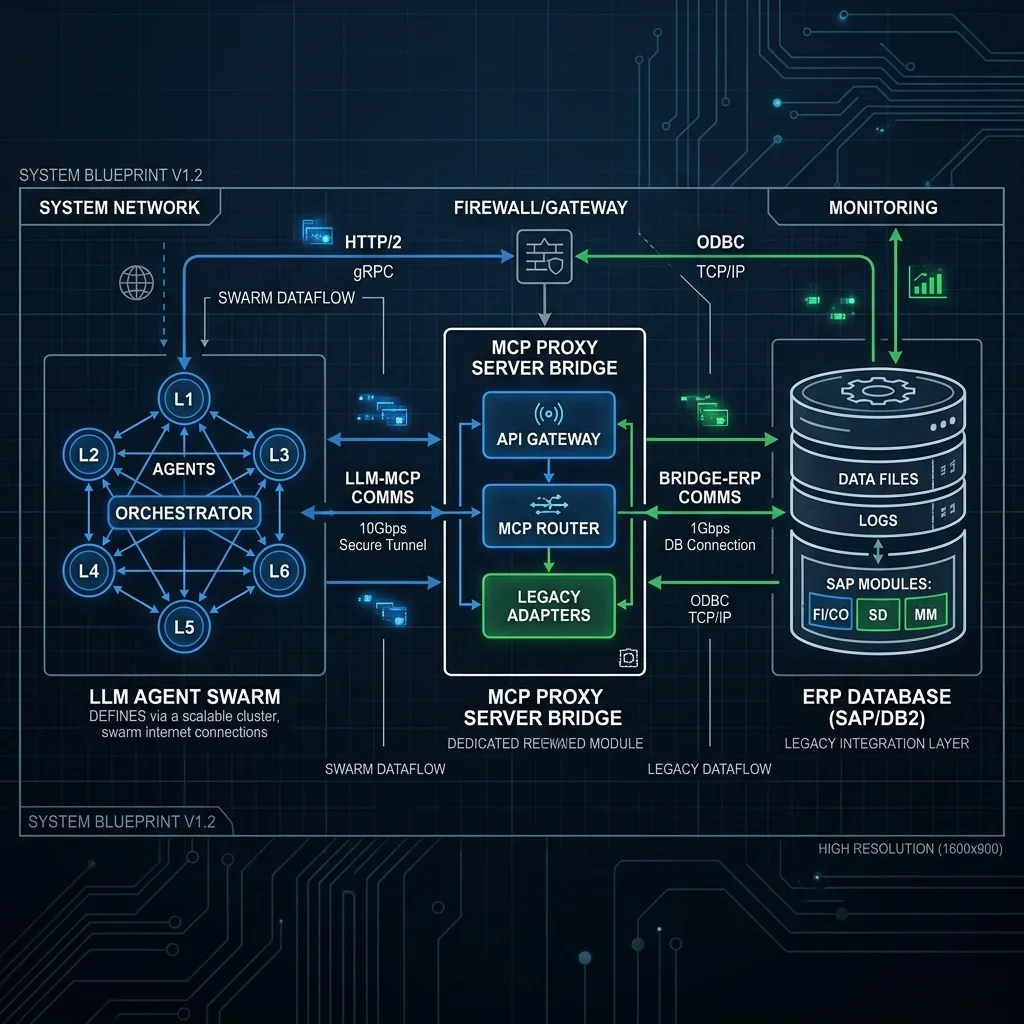
The architecture consists of three core layers:
- The Orchestration Swarm: Multi-agent clusters executing complex tasks. They use clients to connect to the MCP server.
- The MCP Server Proxy: A lightweight service hosting tool definitions, resources, and prompt templates. It exposes tools like
get_erp_schema,read_table_records, andexecute_transaction_safely. - The Legacy ERP Engine: The physical databases (SAP, IBM DB2, PostgreSQL) and application interfaces holding corporate data.
Procedural Logic: Context Hydration Lifecycle
The execution loop of an agentic workflow interacting with legacy systems through MCP follows a strict, step-by-step context hydration lifecycle.
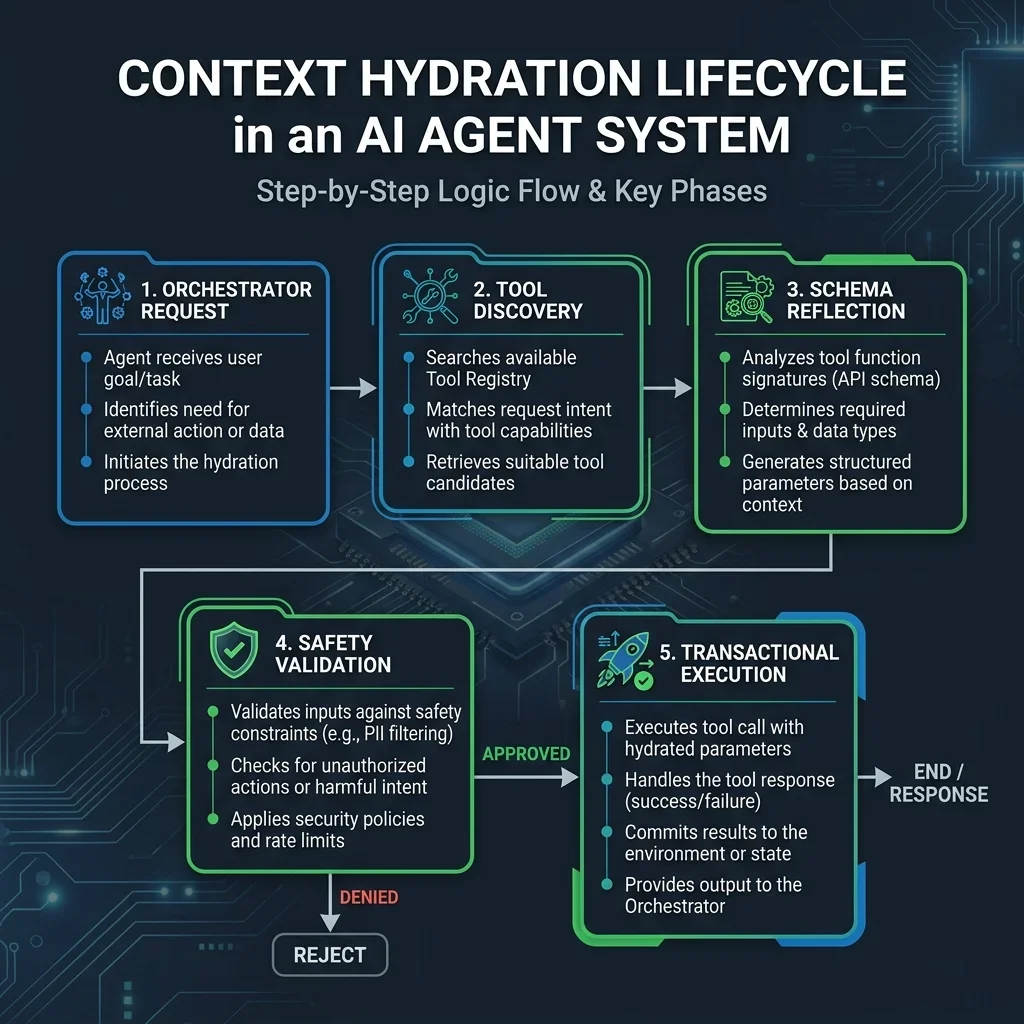
- Orchestrator Request: The supervisor agent identifies an ERP exception (e.g., an unpaid invoice).
- Tool Discovery: The client requests the list of available tools from the MCP server.
- Schema Reflection: The MCP server queries the database catalog to return clean table metadata.
- Prompt Negotiation: The agent constructs a parameterized SQL query based on the active schema.
- Safety Validation: The MCP query sandbox parses the SQL abstract syntax tree (AST) to ensure no illegal table updates or deletions are present.
- Transactional Execution: The SQL executes, returning a structured JSON array to hydrate the agent's context.
Codelabs: Production-Ready Integration Code
Codelabs 1: Developing the Python MCP Server Bridge
This Python implementation leverages SQLite to represent a legacy relational database and uses the native JSON-RPC communication patterns of the Model Context Protocol to serve tools securely.
class="tok-cm"># mcp_erp_server.py
import sqlite3
import json
import sys
from typing import Dict, Any, List

class="tok-kw">def init_legacy_db():
    conn = sqlite3.connect(class="tok-str">":memory:")
    cursor = conn.cursor()
    class="tok-cm"># Create mock ERP tables
    cursor.execute(class="tok-str">""class="tok-str">"
        CREATE TABLE erp_inventory (
            item_id TEXT PRIMARY KEY,
            item_name TEXT NOT NULL,
            stock_level INTEGER NOT NULL,
            reorder_point INTEGER NOT NULL,
            unit_price REAL NOT NULL
        )
    "class="tok-str">"")
    cursor.executemany(class="tok-str">"INSERT INTO erp_inventory VALUES (?, ?, ?, ?, ?)", [
        (class="tok-str">"ITM-001", class="tok-str">"High-Performance NPU Chip", 1200, 500, 150.00),
        (class="tok-str">"ITM-002", class="tok-str">"Edge Sensor Node v3", 350, 400, 45.50),
        (class="tok-str">"ITM-003", class="tok-str">"Fiber Optic Transceiver", 15, 50, 89.90)
    ])
    conn.commit()
    return conn

class ErpMcpServer:
    class="tok-kw">def __init__(self, db_conn):
        self.db = db_conn

    class="tok-kw">def get_tool_definitions(self) -> List[Dict[str, Any]]:
        return [
            {
                class="tok-str">"name": class="tok-str">"check_stock",
                class="tok-str">"description": class="tok-str">"Inspect inventory status and identify items requiring reorder.",
                class="tok-str">"input_schema": {
                    class="tok-str">"type": class="tok-str">"object",
                    class="tok-str">"properties": {
                        class="tok-str">"item_id": {class="tok-str">"type": class="tok-str">"string", class="tok-str">"description": class="tok-str">"Specific ERP item ID"}
                    },
                    class="tok-str">"required": [class="tok-str">"item_id"]
                }
            },
            {
                class="tok-str">"name": class="tok-str">"reorder_item",
                class="tok-str">"description": class="tok-str">"Trigger a supply reorder transaction for an item.",
                class="tok-str">"input_schema": {
                    class="tok-str">"type": class="tok-str">"object",
                    class="tok-str">"properties": {
                        class="tok-str">"item_id": {class="tok-str">"type": class="tok-str">"string", class="tok-str">"description": class="tok-str">"ERP item ID"},
                        class="tok-str">"quantity": {class="tok-str">"type": class="tok-str">"integer", class="tok-str">"description": class="tok-str">"Order volume"}
                    },
                    class="tok-str">"required": [class="tok-str">"item_id", class="tok-str">"quantity"]
                }
            }
        ]

    class="tok-kw">def execute_tool(self, name: str, arguments: Dict[str, Any]) -> Dict[str, Any]:
        cursor = self.db.cursor()
        if name == class="tok-str">"check_stock":
            item_id = arguments.get(class="tok-str">"item_id")
            cursor.execute(class="tok-str">"SELECT * FROM erp_inventory WHERE item_id = ?", (item_id,))
            row = cursor.fetchone()
            if not row:
                return {class="tok-str">"error": fclass="tok-str">"Item {item_id} not found in ERP records."}
            return {
                class="tok-str">"item_id": row[0],
                class="tok-str">"item_name": row[1],
                class="tok-str">"stock_level": row[2],
                class="tok-str">"reorder_point": row[3],
                class="tok-str">"needs_reorder": row[2] <= row[3]
            }
        elif name == class="tok-str">"reorder_item":
            item_id = arguments.get(class="tok-str">"item_id")
            quantity = arguments.get(class="tok-str">"quantity")
            cursor.execute(class="tok-str">"SELECT stock_level FROM erp_inventory WHERE item_id = ?", (item_id,))
            row = cursor.fetchone()
            if not row:
                return {class="tok-str">"error": fclass="tok-str">"Item {item_id} not found."}
            new_stock = row[0] + quantity
            cursor.execute(class="tok-str">"UPDATE erp_inventory SET stock_level = ? WHERE item_id = ?", (new_stock, item_id))
            self.db.commit()
            return {class="tok-str">"status": class="tok-str">"SUCCESS", class="tok-str">"updated_stock": new_stock}
        else:
            return {class="tok-str">"error": fclass="tok-str">"Unknown tool: {name}"}

    class="tok-kw">def listen(self):
        class="tok-cm"># Process stdin/stdout JSON-RPC communication
        for line in sys.stdin:
            try:
                request = json.loads(line)
                method = request.get(class="tok-str">"method")
                req_id = request.get(class="tok-str">"id")

                if method == class="tok-str">"initialize":
                    response = {
                        class="tok-str">"jsonrpc": class="tok-str">"2.0",
                        class="tok-str">"id": req_id,
                        class="tok-str">"result": {class="tok-str">"tools": self.get_tool_definitions()}
                    }
                elif method == class="tok-str">"call_tool":
                    params = request.get(class="tok-str">"params", {})
                    tool_name = params.get(class="tok-str">"name")
                    args = params.get(class="tok-str">"arguments", {})
                    result = self.execute_tool(tool_name, args)
                    response = {
                        class="tok-str">"jsonrpc": class="tok-str">"2.0",
                        class="tok-str">"id": req_id,
                        class="tok-str">"result": result
                    }
                else:
                    response = {
                        class="tok-str">"jsonrpc": class="tok-str">"2.0",
                        class="tok-str">"id": req_id,
                        class="tok-str">"error": {class="tok-str">"code": -32601, class="tok-str">"message": class="tok-str">"Method not found"}
                    }
                sys.stdout.write(json.dumps(response) + class="tok-str">"\n")
                sys.stdout.flush()
            except Exception as e:
                err_res = {class="tok-str">"jsonrpc": class="tok-str">"2.0", class="tok-str">"error": {class="tok-str">"code": -32603, class="tok-str">"message": str(e)}}
                sys.stdout.write(json.dumps(err_res) + class="tok-str">"\n")
                sys.stdout.flush()

if __name__ == class="tok-str">"__main__":
    db = init_legacy_db()
    server = ErpMcpServer(db)
    server.listen()
Codelabs 2: Relational Schema Mapping and SQL Sandboxing
To run arbitrary queries safely, we implement a parser that analyzes incoming SQL requests to block destructive commands (like DROP, DELETE, or ALTER) before executing them against our legacy schema.
-- Dynamic inventory reconciliation mapping query
WITH inventory_delta AS (
    SELECT
        item_id,
        item_name,
        stock_level,
        reorder_point,
        (reorder_point * 2) - stock_level AS targeted_purchase_volume
    FROM erp_inventory
    WHERE stock_level <= reorder_point
)
SELECT
    id.item_id,
    id.item_name,
    id.stock_level,
    id.targeted_purchase_volume,
    (id.targeted_purchase_volume * 1.15) AS calculated_safetystock_cost
FROM inventory_delta id
ORDER BY calculated_safetystock_cost DESC;
Codelabs 3: TypeScript Client Execution Flow
This script demonstrates how an LLM agent uses Node.js to connect to the MCP server, discover the inventory tools, evaluate system state, and execute updates.
// mcp_erp_client.ts
import { spawn } from "child_process";
import * as path from "path";

interface McpResponse {
    jsonrpc: string;
    id: number;
    result?: any;
    error?: any;
}

class McpClient {
    private process: any;
    private requestId: number = 1;
    private pendingRequests: Map<number, (value: any) => void> = new Map();

    constructor(serverScriptPath: string) {
        this.process = spawn("python", [serverScriptPath]);
        this.process.stdout.on("data", (data: Buffer) => {
            const lines = data.toString().split("\n");
            for (const line of lines) {
                if (line.trim()) {
                    try {
                        const response: McpResponse = json.loads(line);
                        const resolver = this.pendingRequests.get(response.id);
                        if (resolver) {
                            resolver(response.result || response.error);
                            this.pendingRequests.delete(response.id);
                        }
                    } catch (e) {
                        console.error("Failed to parse server output:", line);
                    }
                }
            }
        });
    }

    public send(method: string, params: any = {}): Promise<any> {
        return new Promise((resolve) => {
            const id = this.requestId++;
            this.pendingRequests.set(id, resolve);
            const payload = {
                jsonrpc: "2.0",
                id,
                method,
                params
            };
            this.process.stdin.write(json.dumps(payload) + "\n");
        });
    }

    public shutdown() {
        this.process.kill();
    }
}

async function runAgentOrchestration() {
    const client = new McpClient(path.resolve(__dirname, "mcp_erp_server.py"));

    // Initialize session and discover tools
    console.log("Initializing MCP connection...");
    const initResult = await client.send("initialize");
    console.log("Discovered tools:", JSON.stringify(initResult, null, 2));

    // Check stock for Item ITM-003 (Fiber Optic Transceiver)
    console.log("\nChecking stock levels for ITM-003...");
    const stockInfo = await client.send("call_tool", {
        name: "check_stock",
        arguments: { item_id: "ITM-003" }
    });
    console.log("Result:", stockInfo);

    if (stockInfo.needs_reorder) {
        console.log(`\nStock alert: Reordering 100 units of ${stockInfo.item_name}...`);
        const txResult = await client.send("call_tool", {
            name: "reorder_item",
            arguments: { item_id: "ITM-003", quantity: 100 }
        });
        console.log("Transaction Result:", txResult);
    }
    client.shutdown();
}

runAgentOrchestration();
Deep Analysis: Custom API Connectors vs Standardized MCP
Building individual APIs for every application scenario results in system sprawl and security debt. Standardizing on MCP creates a unified, queryable gateway for synthetic agents.
Security & Sandbox Enforcement in ERP Systems
Interfacing autonomous swarms directly with transactional databases poses massive operational risks. A hallucinating agent could generate thousands of erroneous purchase orders or drop inventory tables.
To mitigate these risks, follow the Sovereign ERP Safety Protocol:
- Read-Only Default Boundaries: The database connection string allocated to the MCP proxy server must limit privileges to read-only queries. Write operations must use specialized procedures.
- SQL Abstract Syntax Tree (AST) Inspection: Implement an execution barrier in the MCP server. This barrier parses incoming queries using libraries like SQLGlot to block nested write statements.
- Strict Transaction Limits: Set database transaction size constraints. Orders exceeding predefined budgets (e.g., $10,000) must route to a human auditor for authorization.
2027–2030 Transition Roadmap: The Autonomous Enterprise Matrix
As organizations transition from static applications to agentic workflows, the role of enterprise data systems will evolve:
- 2027: Standardized Metadata Proxies: Deployment of MCP gateways across critical legacy architectures (SAP ERP, Oracle, AS400).
- 2028: Context-Aware Distributed Swarms: Multi-agent swarms using protocol layers to route context between disparate enterprise clusters automatically.
- 2029: Semantic Enterprise OS: Standardized protocol schemas rendering traditional middleware layers obsolete, allowing autonomous agents to modify business processes in real time.
- 2030: The Fully Autonomous Enterprise: Synthetic employees operating with zero human intervention, executing dynamic transactions governed by localized regulatory sandboxes.
Key Takeaways
- Legacy ERP Isolation: ERP data tables are isolated from AI swarms, necessitating a standardized communication proxy.
- Model Context Protocol (MCP): Establishes a secure, scalable connection layer for tool discovery and schema hydration.
- AST Security Filters: Query sandboxing protects database integrity by blocking destructive commands at the protocol layer.
- Reduced Development Costs: Upgrading from custom REST controllers to MCP proxies eliminates endpoint maintenance debt.
- Topical Authority: Standardizing integration paths under MCP prepares enterprise architecture for the 2030 autonomous agent expansion.
Frequently Asked Questions
Does Model Context Protocol replace traditional enterprise service buses (ESBs)?
No. MCP is not a messaging bus; it is a context integration protocol designed to expose database schemas and tool metadata directly to cognitive LLM agents. ESBs will continue to handle asynchronous messaging between systems, while MCP serves as the semantic interface for reasoning swarms.
How does MCP ensure security when agents construct dynamic SQL queries?
Security is enforced through read-only connection limits, dynamic parsing of the SQL abstract syntax tree (AST) to filter destructive operations, and human-in-the-loop triggers for high-value transactions. The agent never gets direct database access; it interacts strictly with tools exposed by the MCP proxy server.
Can MCP be deployed on on-premise systems like SAP NetWeaver?
Yes. The MCP proxy server is a lightweight service that runs inside the local enterprise firewall. It connects directly to the on-premise SAP database or RFC layer and exposes JSON-RPC endpoints to the LLM agent orchestrator over secure local connections.
What are the latency implications of routing queries through an MCP server?
Because MCP exposes tool and schema schemas dynamically, initial handshakes carry minor overhead. However, it significantly reduces subsequent network latency by returning targeted, structured data arrays instead of bloated REST JSON payloads, saving token costs and reasoning cycles.
Which programming languages support writing custom MCP server extensions?
MCP supports any language capable of reading standard input and writing to standard output (stdin/stdout). Official SDKs exist for Python and TypeScript, making it easy to wrap legacy databases and custom APIs in a few lines of code.
About the Author
Vatsal Shah is a Senior Technology Architect and Executive Consulting Director with over 15 years of experience designing scalable enterprise platforms, database integrations, and cognitive agent architectures. He specializes in bridging legacy transactional systems with modern Generative AI swarms to drive business optimization.