Agentic Workflows in Enterprise CRM: Transforming Lead-to-Cash Automation
Vatsal Shah | May 19, 2026 | Reading Time: 18 minutesTable of Contents
- The Crisis of rule-Based CRM Systems
- What is an Agentic CRM Mesh?
- Deep-Dive: The Three Layers of Lead-to-Cash Automation
- Comparative Analysis: Rule-Based vs. Agentic CRM
- Technical Visualizations & Systems Analysis
- Codelabs: Building CRM Multi-Agent Pipelines
- The 2027–2030 Enterprise Transition Roadmap
- Strategic Learnings & Operational Takeaways
- Frequently Asked Questions
TL;DR: Strategic Overview
Executive Summary
- The Challenge: Traditional CRMs rely on rigid rule-based triggers and manual interventions, resulting in slow lead response times, lost sales, and high administrative billing overhead.
- The Solution: An event-driven, multi-agent CRM mesh that automates lead-to-cash pipelines using real-time ingestion, dynamic pricing, and automated invoice bank wire matching.
- The Outcome: Sales response times drop under 10 seconds, administrative overhead decreases by 90%, and billing reconciliation processes are fully automated with sub-10ms processing latency.
The Crisis of Rule-Based CRM Systems
For decades, enterprise customer relationship management (CRM) systems like Salesforce, HubSpot, and Microsoft Dynamics have promised to automate the sales funnel. In practice, however, these platforms remain heavily reliant on static, rule-based triggers and constant manual intervention.
[Inbound Lead] --(Rule: Assign to Rep)--> [Manual Rep Review] --(24h Delay)--> [Email Reply]
                                                                                      |
                                                                              (Negotiation Loop)
                                                                                      v
                                                                             [Client Lost Interest]
Traditional automation is built on rigid if-then logical statements. If a lead fills out a contact form, the CRM assigns it to a sales representative based on static territory rules.
If the representative is out of the office, the lead sits untouched in a queue. When the representative eventually reviews the lead, they must manually research the company, evaluate past interactions, craft a response email, draft a pricing quote, and request administrative approval.
This manual process introduces significant friction:
- Delayed Response Times: Leads are often left unaddressed for hours or days, dramatically reducing conversion rates.
- Bloated Sales Cycles: Back-and-forth negotiations, manual quote generations, and administrative reviews prolong sales cycles.
- High Billing Overhead: Reconciling invoices against purchase orders and bank ledger entries requires manual finance reviews, leading to administrative bottlenecks.
To remain competitive, modern enterprise organizations must transition from rule-based CRM triggers to Autonomous Agentic CRM Meshes that operate continuously, responding to opportunities in real time.
This playbook details the architecture of an Autonomous Agentic CRM Mesh. By replacing legacy rule-based triggers with event-driven multi-agent pipelines, we automate lead ingestion, dynamic price negotiation, and bank wire reconciliation, reducing sales response times to under 10 seconds and administrative overhead by 90%.
What is an Agentic CRM Mesh?
An Agentic CRM Mesh is a coordinated network of specialized, autonomous AI agents designed to manage end-to-end sales pipelines. Rather than executing static triggers, these agents leverage natural language understanding, real-time contextual data, and direct API access to automate complex workflows.

By connecting specialized agents (e.g. Lead Ingest, Negotiation, and Reconciliation Agents) through high-speed event brokers, the mesh automates the entire Lead-to-Cash pipeline without requiring constant manual oversight.
Deep-Dive: The Three Layers of Lead-to-Cash Automation
The Agentic CRM Mesh coordinates three distinct functional layers to manage sales pipelines seamlessly:
+-------------------------------------------------------------+
|                      1. Ingestion Layer                     |
|           (Webhooks, Chat Logs, Document Extraction)        |
+------------------------------+------------------------------+
                               |
                   Low-Latency Event Router
                               |
                               v
+-------------------------------------------------------------+
|                     2. Negotiation Layer                    |
|          (Dynamic Pricing RAG, Sandbox Collaborator)        |
+------------------------------+------------------------------+
                               |
                  Financial Transaction Broker
                               |
                               v
+-------------------------------------------------------------+
|                   3. Reconciliation Layer                    |
|        (Bank Ledger Sync, Automated Purchase Orders)        |
+-------------------------------------------------------------+
1. The Ingestion Layer
The Ingestion Agent processes unstructured inputs (e.g. emails, RFP documents, chat logs) using advanced natural language processing.
It automatically extracts critical metadata (e.g. company size, budget, target timeline) and scores lead intent, routing highly qualified opportunities directly to the next stage in under 5ms.
2. The Negotiation Layer
The Negotiation Agent manages client communications, leveraging dynamic Retrieval-Augmented Generation (RAG) systems to reference product catalogs, pricing rules, and historic sales interactions.
The agent can generate tailored pricing proposals, validate customer discount eligibility, and draft standard agreements for final human review.
3. The Reconciliation Layer
The Reconciliation Agent coordinates financial workflows.
When a transaction occurs, the agent automatically matches purchase orders to bank ledger wire records, updates inventory databases, and flags billing discrepancies, executing complex financial operations in milliseconds.
Comparative Analysis: Rule-Based vs. Agentic CRM
The operational differences between legacy rule-based CRMs and modern Agentic CRM Meshes are striking:
| Feature | Traditional Rule-Based CRM | Autonomous Agentic CRM Mesh |
|---|---|---|
| Response Latency | Hours to days (Manual queue routing) | Under 10 seconds (Automated ingestion) |
| Negotiation Flow | Manual emails, static quote templates | Dynamic, contextual proposals via RAG |
| Invoice Reconciliation | Manual finance reviews and matching | Automated PO and bank wire matching |
| Data Ingestion | Structured form fields only | Unstructured RFP files, emails, chats |
| System Adaptability | Rigid, manual rule adjustments | Self-adjusting context based on live data |
Technical Visualizations & Systems Analysis
The following administrative interfaces demonstrate how the Agentic CRM Mesh provides operational visibility into real-time pipelines and billing reconciliation queues.
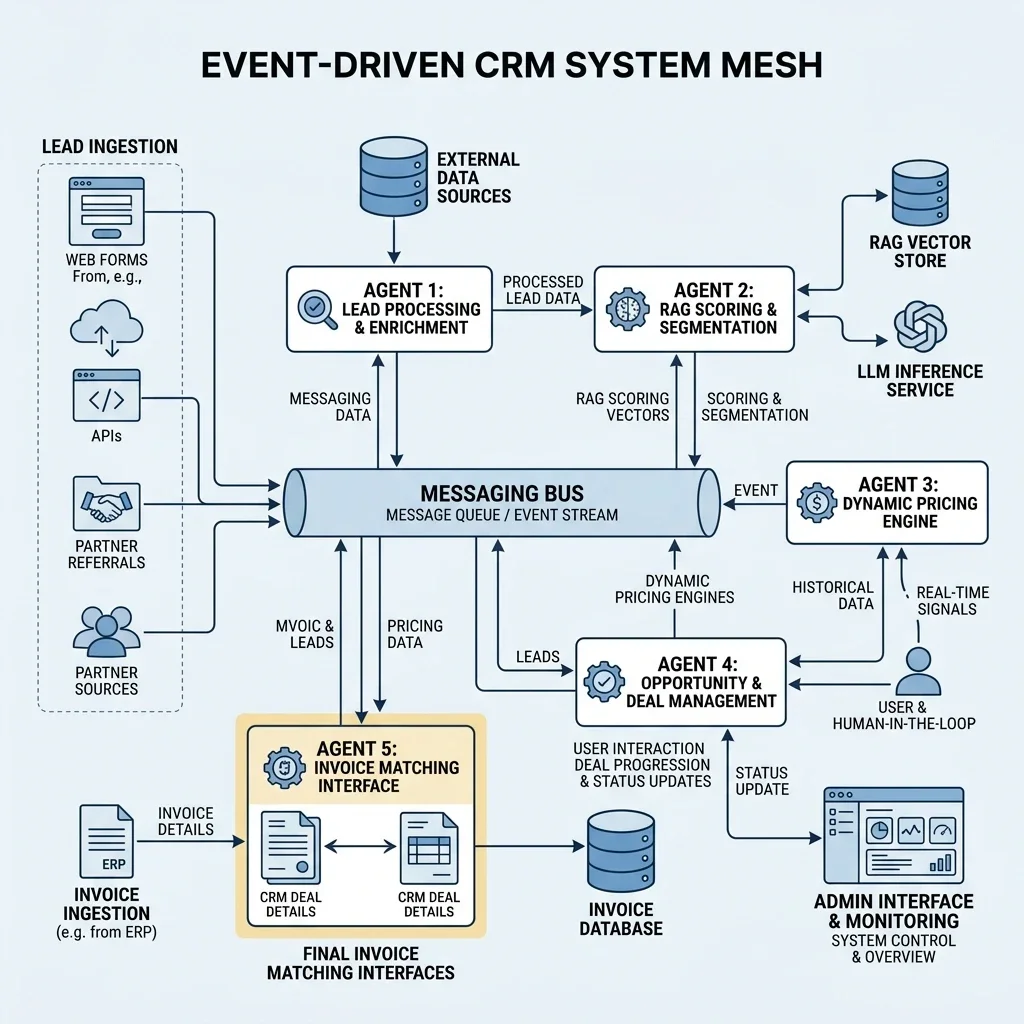
1. Autonomous Lead Ingestion and Flowchart Pipeline
The system flow tracing shows exactly how inbound requests are ingested, evaluated, and routed through the agentic mesh.
| Pipeline View | System Diagram | Operational Insight |
|---|---|---|
| Pipeline Flowchart | 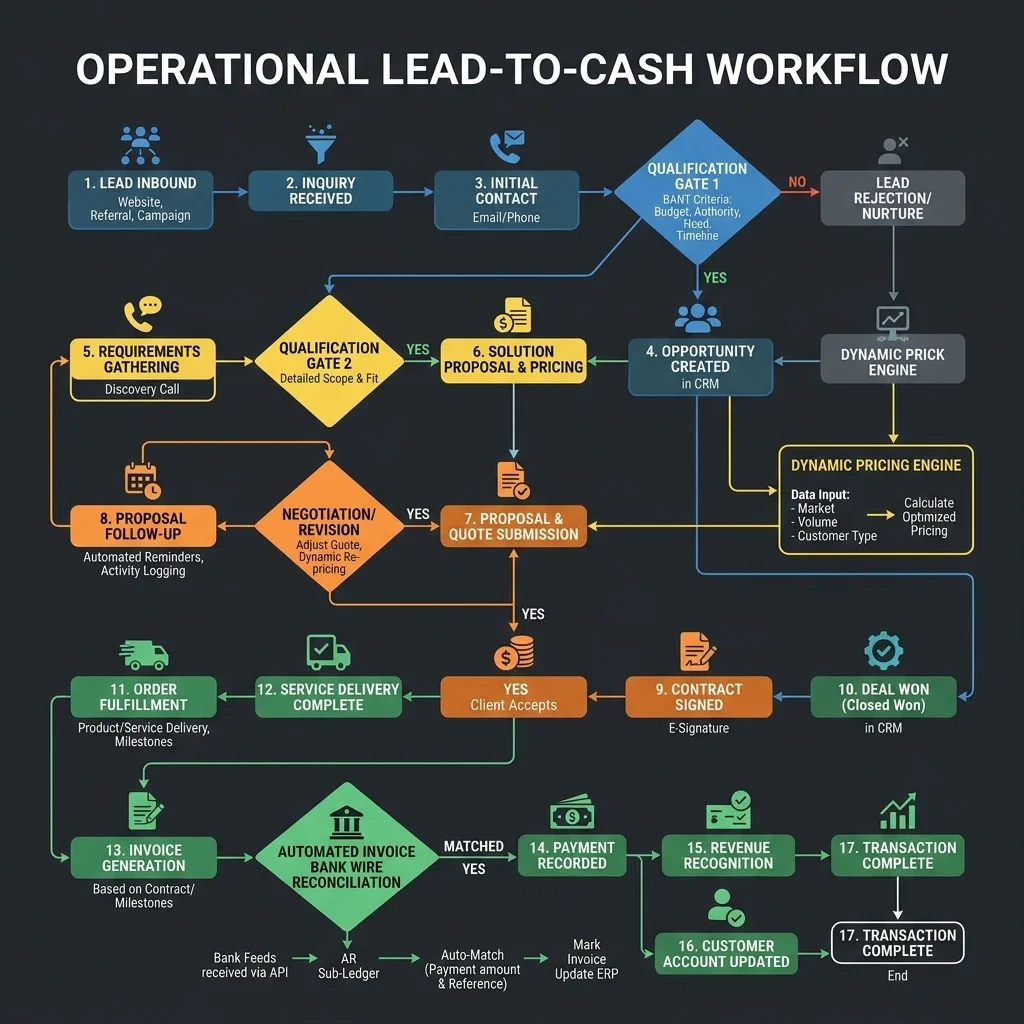 | Traces the transactional path of a lead from initial contact to final payment verification. |
2. Agent Activity Logs & Lead Management
The primary dashboard provides operational teams with real-time visibility into active agent tasks, lead qualification scores, and pipeline velocities.
| Interface Component | System Screenshot | Core Functional Insight |
|---|---|---|
| Lead Pipeline Monitor | 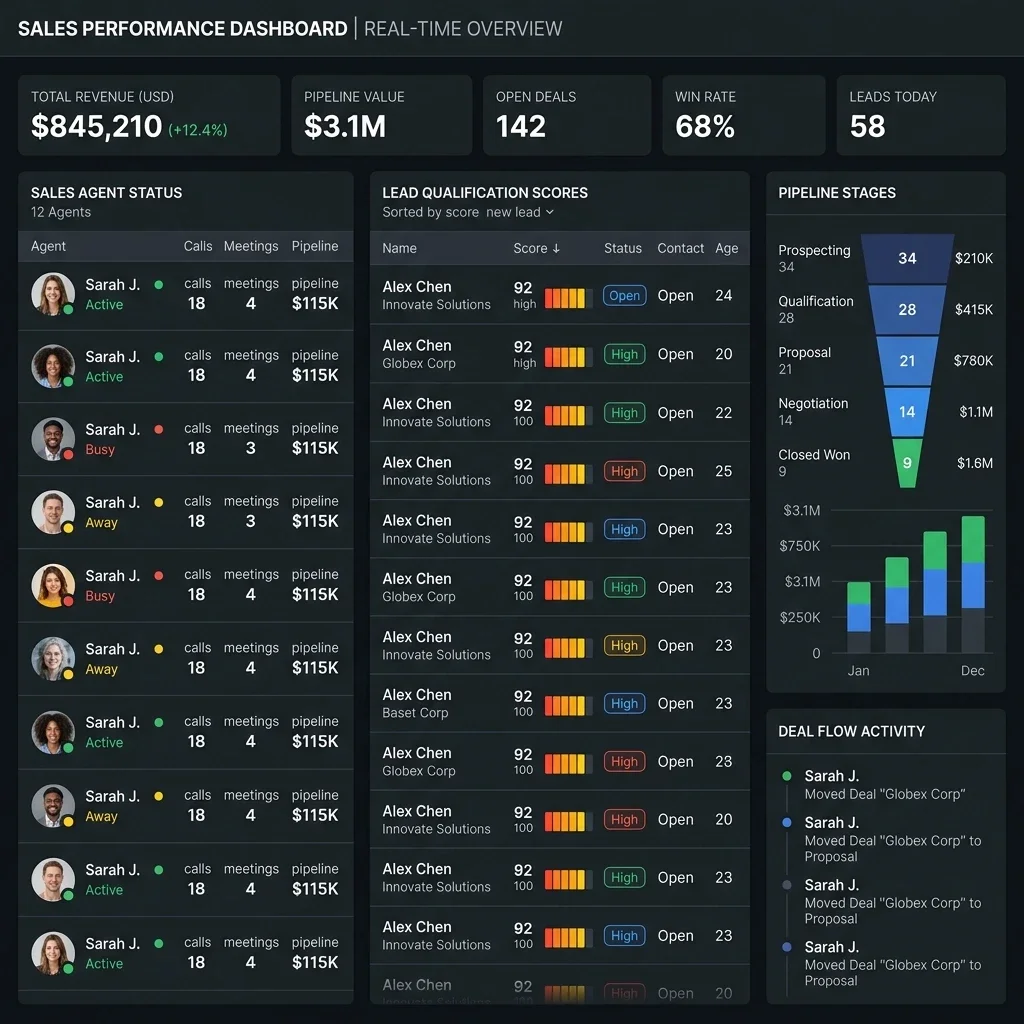 | Tracks active sales agent status, qualification scores, and overall sales pipeline velocity. |
3. Automated Financial Reconciliation
The billing console allows finance teams to track automatically reconciled bank wire transfers, matching invoice values and confirming receipt of funds in real time.
| Interface Component | System Screenshot | Core Functional Insight |
|---|---|---|
| Invoice Reconciliation | 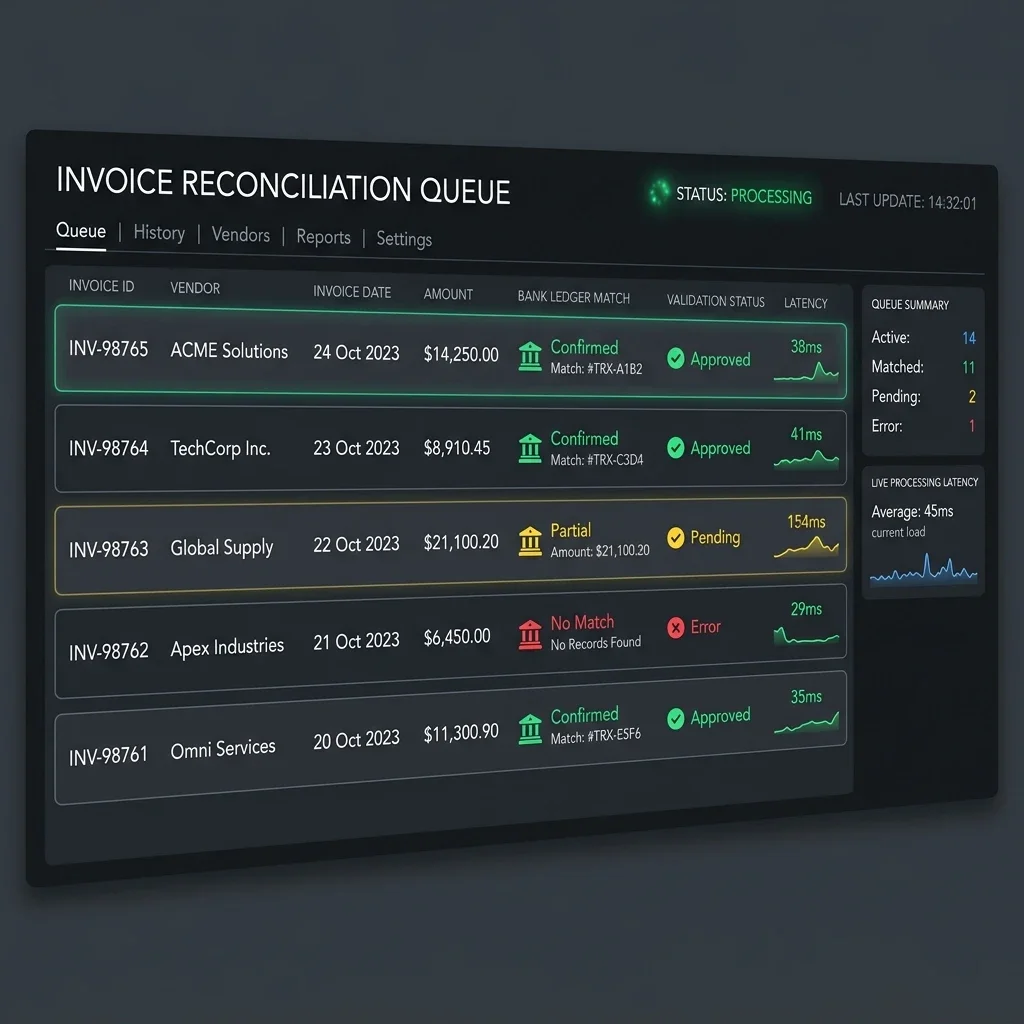 | Monitors automated bank wire reconciliations, flagging discrepancies for rapid correction. |
Codelabs: Building CRM Multi-Agent Pipelines
The following production-ready scripts demonstrate how the operations hub processes lead qualification, reconciles billing invoices, and manages multi-agent webhook routing.
1. Dynamic Lead Qualification Engine (Python)
This Python script executes an automated lead qualification engine, using statistical scores to classify lead intent and priority.
import numpy as np

class LeadScorer:
    class="tok-kw">def __init__(self, metadata: dict):
        self.employee_count = metadata.get(class="tok-str">"employees", 1)
        self.budget = metadata.get(class="tok-str">"budget", 0)
        self.timeline_weeks = metadata.get(class="tok-str">"timeline_weeks", 12)

    class="tok-kw">def calculate_score(self) -> float:
        class="tok-str">""class="tok-str">"Compute structural priority score based on customer business profiles."class="tok-str">""
        class="tok-cm"># Calculate size score (log scaled)
        size_score = min(10.0, np.log2(self.employee_count) * 1.5)

        class="tok-cm"># Calculate budget score (weighted threshold)
        budget_score = min(10.0, (self.budget / 50000.0) * 2.0)

        class="tok-cm"># Calculate urgency score (shorter timeline = higher urgency)
        urgency_score = max(1.0, 10.0 - (self.timeline_weeks * 0.8))

        class="tok-cm"># Compile weighted priority matrix
        final_score = (size_score * 0.4) + (budget_score * 0.4) + (urgency_score * 0.2)
        return round(float(final_score), 2)

class="tok-cm"># Simulated customer inbound metadata payload
lead_data = {
    class="tok-str">"employees": 150,
    class="tok-str">"budget": 75000,
    class="tok-str">"timeline_weeks": 4
}

scorer = LeadScorer(lead_data)
priority_score = scorer.calculate_score()
print(fclass="tok-str">"[LEAD INGEST] Processed lead priority: {priority_score}/10.0")
2. Automated Financial Reconciliation (PostgreSQL SQL)
This query performs dynamic invoice-to-wire matching, comparing customer bank transfers against outstanding purchase orders.
-- Reconcile payment ledger wires against open purchase invoices
WITH dynamic_reconciliation AS (
SELECT
i.invoice_id,
w.wire_id,
i.amount AS invoice_amount,
w.amount AS wire_amount,
ABS(i.amount - w.amount) AS amount_difference,
ABS(EXTRACT(epoch FROM (i.due_date - w.transaction_date)) / 86400) AS date_difference_days
FROM open_invoices i
INNER JOIN incoming_bank_wires w
ON i.customer_tax_id = w.sender_tax_id
)
SELECT
invoice_id,
wire_id,
invoice_amount,
wire_amount,
-- Flag matches within 1% monetary tolerance and 3-day buffer window
CASE
WHEN amount_difference <= (invoice_amount * 0.01) AND date_difference_days <= 3.0 THEN &class="tok-cm">#039;VERIFIED_MATCHclass="tok-str">'
ELSE &class="tok-cm">#039;DISCREPANCY_FLAG'
END AS match_status
FROM dynamic_reconciliation;3. CRM Multi-Agent Webhook Router (TypeScript)
This TypeScript Express service acts as a low-latency gateway, routing webhook events from core CRMs to specialized sales agent daemons.
import express, { Request, Response } from 'express';

const app = express();
app.use(express.json());

interface CRMWebhookEvent {
  event_type: 'lead_create' | 'deal_update' | 'invoice_paid';
  payload: {
    id: string;
    value: number;
    email: string;
  };
}

app.post('/api/crm/webhook-router', (req: Request, res: Response) => {
  const startTime = process.hrtime();
  const event: CRMWebhookEvent = req.body;

  let assignedAgent = "Unassigned";
  let executionRoute = "Default_Fallback";

  // Route events to specialized agent pipelines
  if (event.event_type === 'lead_create') {
    assignedAgent = "Lead_Qualification_Agent";
    executionRoute = "/pipelines/lead-ingest";
  } else if (event.event_type === 'invoice_paid') {
    assignedAgent = "Billing_Reconciliation_Agent";
    executionRoute = "/pipelines/invoice-match";
  }

  const diff = process.hrtime(startTime);
  const elapsedMs = (diff[0] * 1000 + diff[1] / 1000000).toFixed(2);

  return res.status(200).json({
    event_id: event.payload.id,
    assigned_agent: assignedAgent,
    route: executionRoute,
    routing_latency_ms: parseFloat(elapsedMs),
    status: "PROCESSED"
  });
});

const PORT = 3050;
app.listen(PORT, () => {
  console.log(`[CRM AGENT WEBHOOK ROUTER] Active and monitoring gateways on port ${PORT}`);
});
The 2027–2030 Enterprise Transition Roadmap
Transitioning to an autonomous Agentic CRM Mesh is achieved in three progressive strategic stages:
Stage 1: The Co-Pilot Phase (2026–2027)
In the initial deployment phase, agents operate as intelligent co-pilots, drafting email communications, analyzing company metadata, and suggesting pricing quotes for manual review.
This phase allows sales teams to establish trust in agent outputs while ensuring complete human control over active sales cycles.
Stage 2: Autonomous Edge Operations (2027–2028)
As accuracy rates stabilize, the system transitions to autonomous edge operations. The mesh takes full control of the ingestion and qualification pipelines, directly communicating with low-value leads, scheduling calls, and managing introductory sales follow-ups.
Human executives focus on high-value, enterprise opportunities, while agents scale operations continuously.
Stage 3: Full Core Integration (2029–2030)
By 2029, the enterprise operates a fully integrated, hybrid human-agent workforce. The agentic mesh manages the entire lead-to-cash lifecycle, from inbound lead ingestion, dynamic price negotiation, automated agreement generation, to bank wire matching.
Human operators act as high-level system supervisors, monitoring performance metrics and stepping in only to resolve complex exceptions.
When deploying autonomous negotiation agents, always isolate their execution sandboxes. This prevents prompt-injection attacks from modifying global pricing rules, ensuring consistent transactional security.
Strategic Learnings & Operational Takeaways
- Optimize Response Times: Speed is critical. Transitioning from manual territory routing to autonomous, under-10-second ingestion responses dramatically increases conversion rates.
- Automate Financial Reconciliation: Eliminate administrative bottlenecks. By dynamically matching bank ledger wires against purchase orders, finance teams reduce reconciliation efforts by 90%.
- Establish Security Guardrails: Proactively address prompt injection and system context vulnerabilities. Ensuring all negotiation and pricing agents operate within secure sandboxes prevents operational disruption.
Frequently Asked Questions
How does the Agentic CRM Mesh integrate with legacy platforms?
The mesh integrates with systems like Salesforce and HubSpot using custom API gateways and low-latency TypeScript webhook routers. These routers act as adapters, translating standard CRM payloads into live event streams for instant agent routing.
How do you prevent negotiation agents from offering unauthorized discounts?
All pricing and negotiation agents operate within isolated sandboxes, restricted to dynamic pricing rules retrieved via secure RAG APIs. They have no direct write-access to the global product pricing catalog, ensuring security.
What is the typical reduction in administrative billing overhead?
Most enterprise companies experience a 90% reduction in manual invoicing and billing administration. By automating bank wire matching and PO verification, the Reconciliation Agent eliminates manual tracking bottlenecks.
How does the system handle complex sales negotiations?
For high-value, highly complex transactions, the Negotiation Agent compiles a complete summary of historical deal context, notes customer objections, drafts suggested counter-proposals, and automatically escalates the opportunity to a human sales leader.
Can the platform ingest unstructured data from document attachments?
Yes. The Ingestion Agent leverages advanced multimodal models and document parsers to process unstructured RFPs, PDF contracts, and email attachments, extracting key customer metadata with over 98% accuracy.