The CEO Operating Model for AI Transformation — From Pilots to P&L Proof
By Vatsal Shah | June 22, 2026 | 58 min read
Table of Contents
- The Strategic Overview — Why This Playbook Exists
- Chapter 1: Transformation vs. Deployment — The Diagnostic
- Chapter 2: Value Chain Redesign — Integrated AI Flows
- Chapter 3: Funding, TMO, and Decision Rights
- Chapter 4: Talent, Unions, and Change Saturation
- Chapter 5: Geopolitics, Sovereignty, and Scenario Planning
- The 2026–2030 CEO AI Maturity Roadmap
- Key Takeaways
- FAQ
- About the Author
Strategic Overview
The conversation in every boardroom has changed. In 2023, CEOs asked: "Can AI work?" In 2024, they asked: "Where should we pilot?" In 2026, the only question that matters is: "How does AI change my operating model and P&L?"
Deloitte's 2026 AI Pulse Survey reveals the uncomfortable truth: most enterprises have deployed AI — but fewer than 12% have transformed with it. The gap between deployment and transformation is not a technology gap. It's a governance, operating model, and leadership gap.
This playbook is the CEO operating system for closing that gap. Across five chapters, we go from diagnostic framework to value chain redesign, from TMO architecture to talent strategy, from geopolitical scenario planning to the 2030 sovereignty map.
Who this is for: CEOs, COOs, and Chief Transformation Officers running enterprise AI programs. Board members who sit on AI strategy committees. CFOs who need P&L accountability frameworks for AI investments.
What you will build: A transformation operating model — not a pilot portfolio.
Time to apply: The frameworks take 90 days to operationalize. The cultural change takes 18 months. The P&L proof should be visible in 12.
The Problem Every CEO Recognizes But Won't Say Out Loud
Seventy-four percent of enterprises have at least one AI pilot in production. Fewer than 12% report that AI has materially changed how their business operates.
That's not a technology failure. That's a leadership failure.
The 2026 Deloitte AI Pulse Study calls it the "deployment-vs-transformation gap." Capgemini's Top Tech Trends report frames it as "intelligent core versus value-chain orchestration." EY's CEO Outlook describes it as the shift from "disciplined experimentation" to "disciplined scaling."
They're all describing the same thing: AI that doesn't change your operating model doesn't change your P&L.
I've watched this pattern play out across dozens of enterprise engagements. The AI team ships something impressive. The demo gets applause in the boardroom. The pilot report shows 40% efficiency improvement in a single process. Then six months later, nothing has moved at the business level. No headcount redeployment. No cost structure change. No revenue improvement that traces back to AI.
The problem isn't the AI. It's the absence of an operating model to absorb and amplify what AI makes possible.
This playbook builds that operating model — chapter by chapter, from diagnostic to deployment.
Chapter 1: Transformation vs. Deployment — The Diagnostic {#ch1-transformation-vs-deployment}
What you will build in this chapter
- A working definition of transformation that separates it from deployment
- A 10-question CEO diagnostic to identify where your organization sits
- The four failure modes of pilot-stage AI programs
- The economic model that explains why deployment economics differ from transformation economics
The Semantic Problem That's Costing You Millions
The word "deployment" is doing a lot of damage in enterprise AI strategy.
When an engineering team says they've "deployed" an AI model, they mean it's running in a production environment. When a business unit says they've "deployed" AI, they mean they're using a vendor tool. When a CEO says they've "deployed" AI, they usually mean they've funded a pilot.
None of these are transformation.
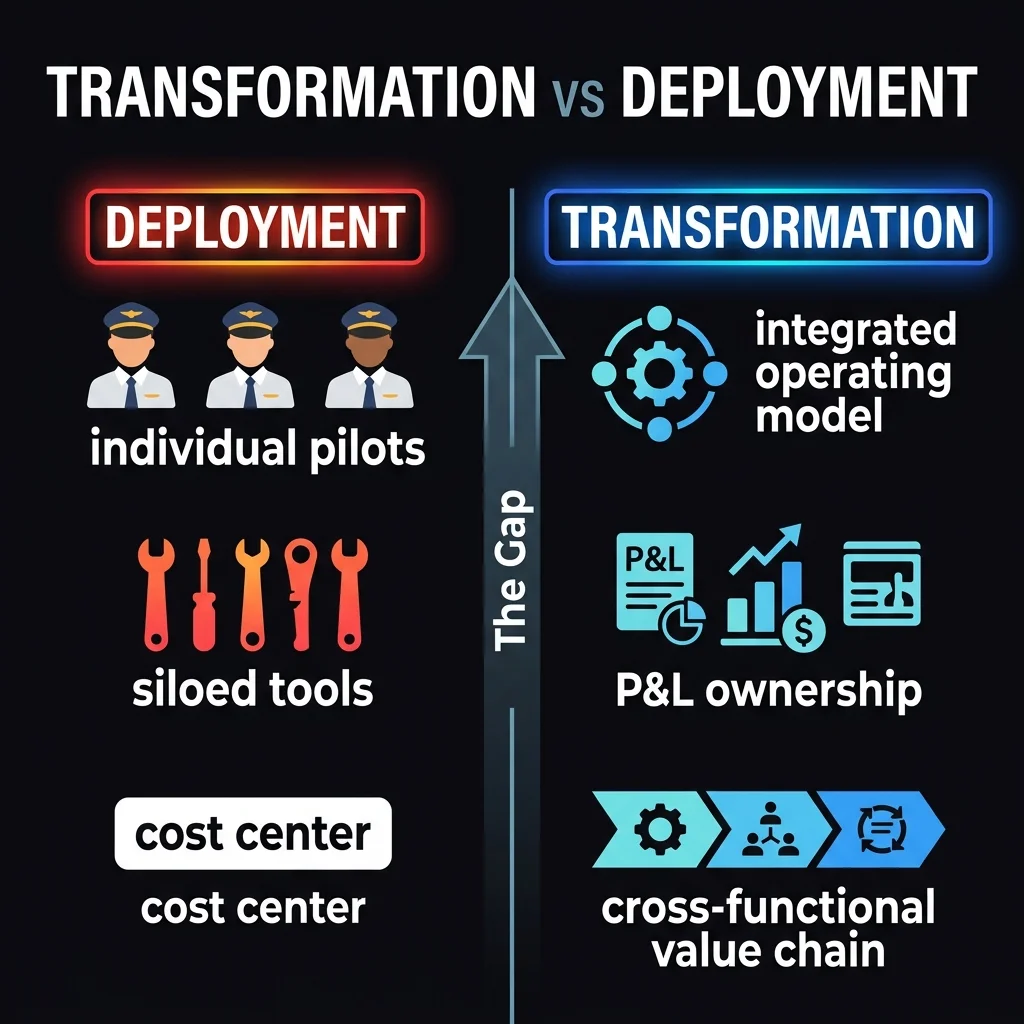
Transformation means AI has changed how your business functions — not just how one team does one task. It means redesigned workflows, new accountability structures, measurable shifts in cost-to-serve or revenue-per-employee, and governance mechanisms that prevent regression.
The distinction matters financially. A deployed AI tool typically costs money and reduces cost in one localized area. A transformed business function costs the same money and generates systemic leverage across multiple P&L lines.
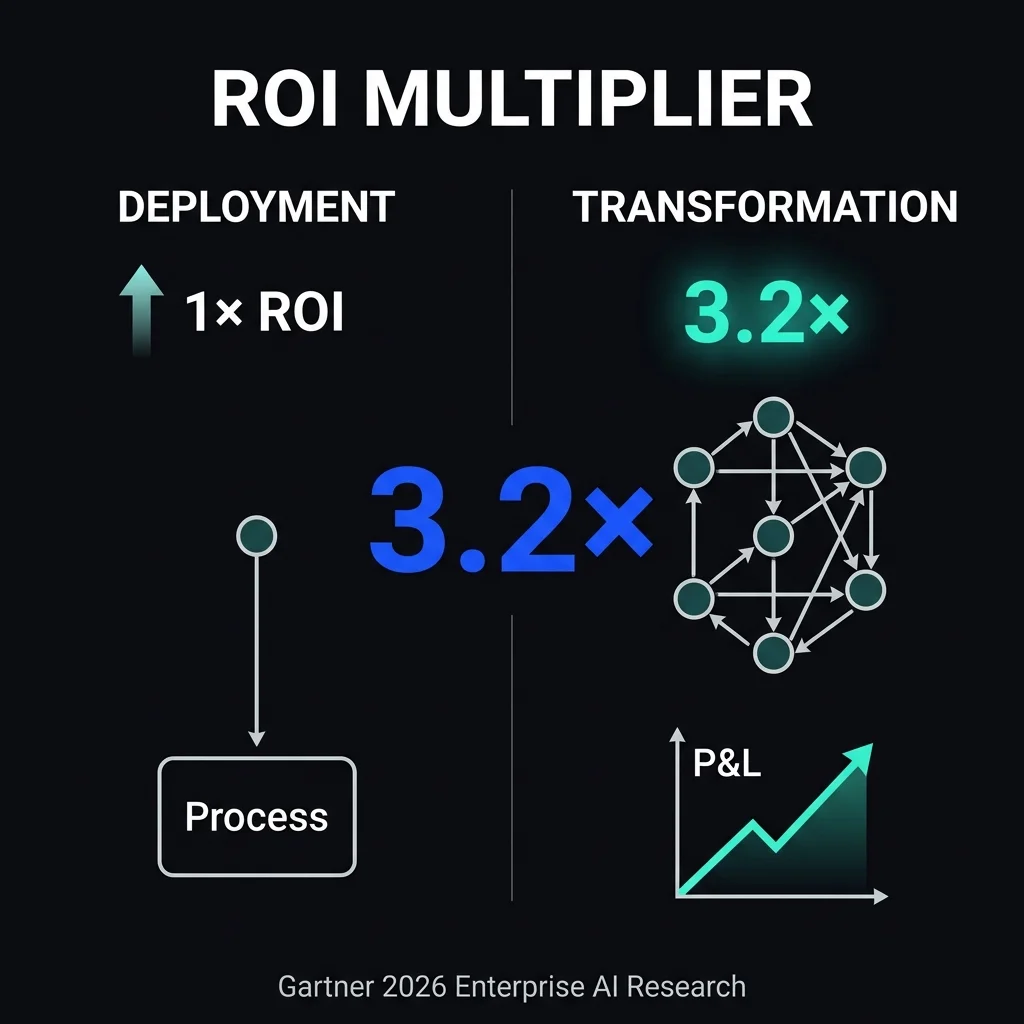
Gartner's 2026 research shows enterprises that reach what they call "AI business transformation" (where AI is embedded in operating model design, not just process optimization) generate 3.2× the ROI of deployment-only approaches. That multiplier is the operating model premium.
The Four Failure Modes of Pilot-Stage AI
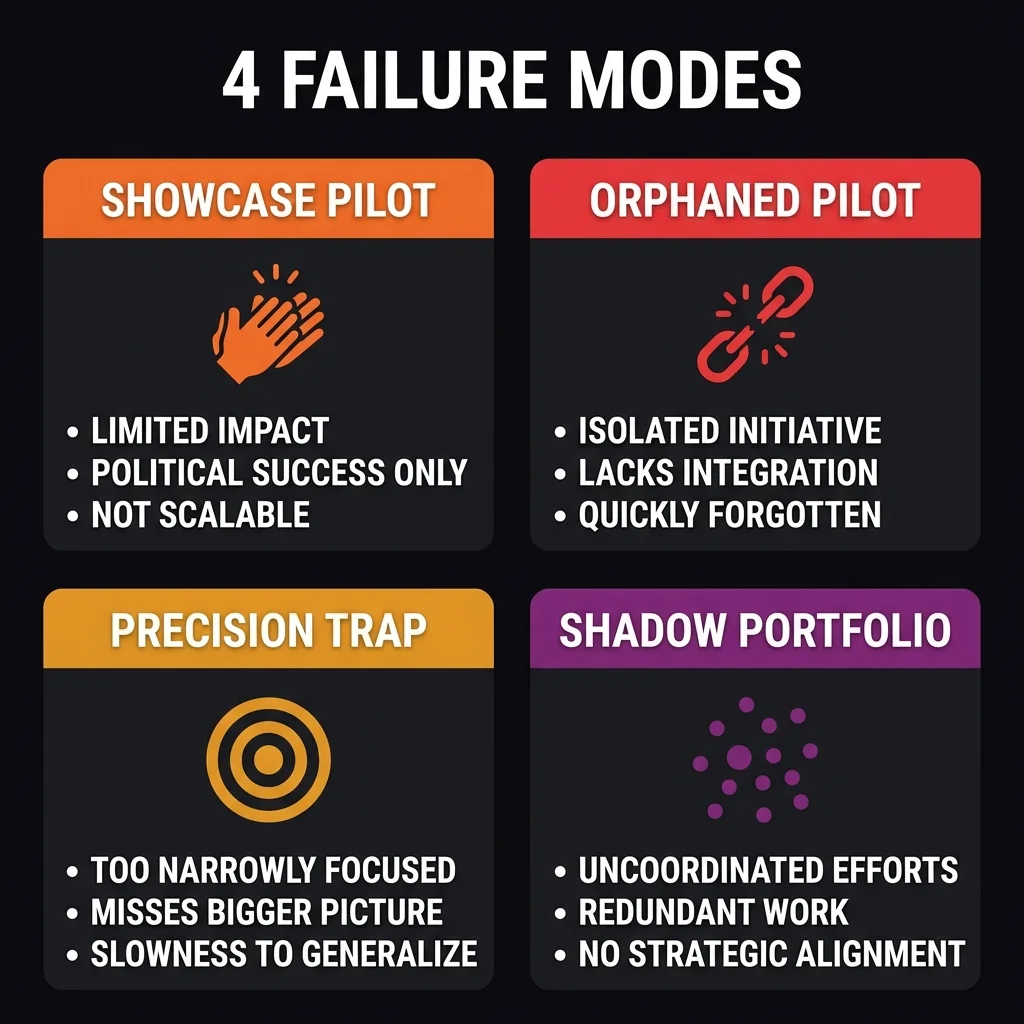
Understanding why pilots stay pilots is the first step to escaping pilot purgatory. There are four structural failure modes.
Failure Mode 1: The Showcase Pilot
This pilot was designed to demonstrate capability, not to create capability. The AI team selected a problem that's easy to model, impressive to demo, and limited in business scope. The organization has seen the demo. The pilot report went to the board. And then it stopped.
Showcase pilots fail because they're not connected to any workflow redesign, headcount plan, or cost structure. They prove AI works in a controlled environment. They don't prove AI changes the business.
Failure Mode 2: The Orphaned Pilot
This pilot was championed by an individual leader who has since moved on, reorganized, or lost budget priority. The AI is technically running, but nobody owns it. The model hasn't been retrained in eight months. The business users have gone back to their old process because the AI output isn't trustworthy anymore.
Orphaned pilots fail because AI is treated as a project, not a product. Products have owners, roadmaps, and investment cycles. Projects have end dates.
Failure Mode 3: The Precision Trap
This pilot was so successful in its narrow domain that the business now uses it obsessively — and has stopped redesigning the surrounding workflow. The AI does one thing perfectly. Everything upstream and downstream is unchanged. The bottleneck has moved, but the system hasn't improved.
The precision trap is seductive. It's easier to optimize a single node than to redesign the network. But P&L impact comes from network redesign, not node optimization.
Failure Mode 4: The Shadow Portfolio
This is the most expensive failure mode. The organization has 40, 60, or 100 separate AI pilots across business units — some vendor tools, some internally built, some acquired via M&A. None of them are connected. None share a data foundation. Each has separate governance. The total annual spend is in the millions. The aggregate business impact is diffuse and unmeasurable.
Shadow portfolios fail because they optimize for local autonomy at the cost of enterprise coherence. Each unit gets what it wants. The CEO gets nothing systemic.
The CEO Diagnostic: 10 Questions
Before designing a transformation operating model, you need to know where you are. These 10 questions reveal your current state honestly.
Score each question 1 (not at all) to 5 (fully in place). A score below 30 means you're in deployment mode. 30–40 means you're transitioning. Above 40 means you're building transformation infrastructure.
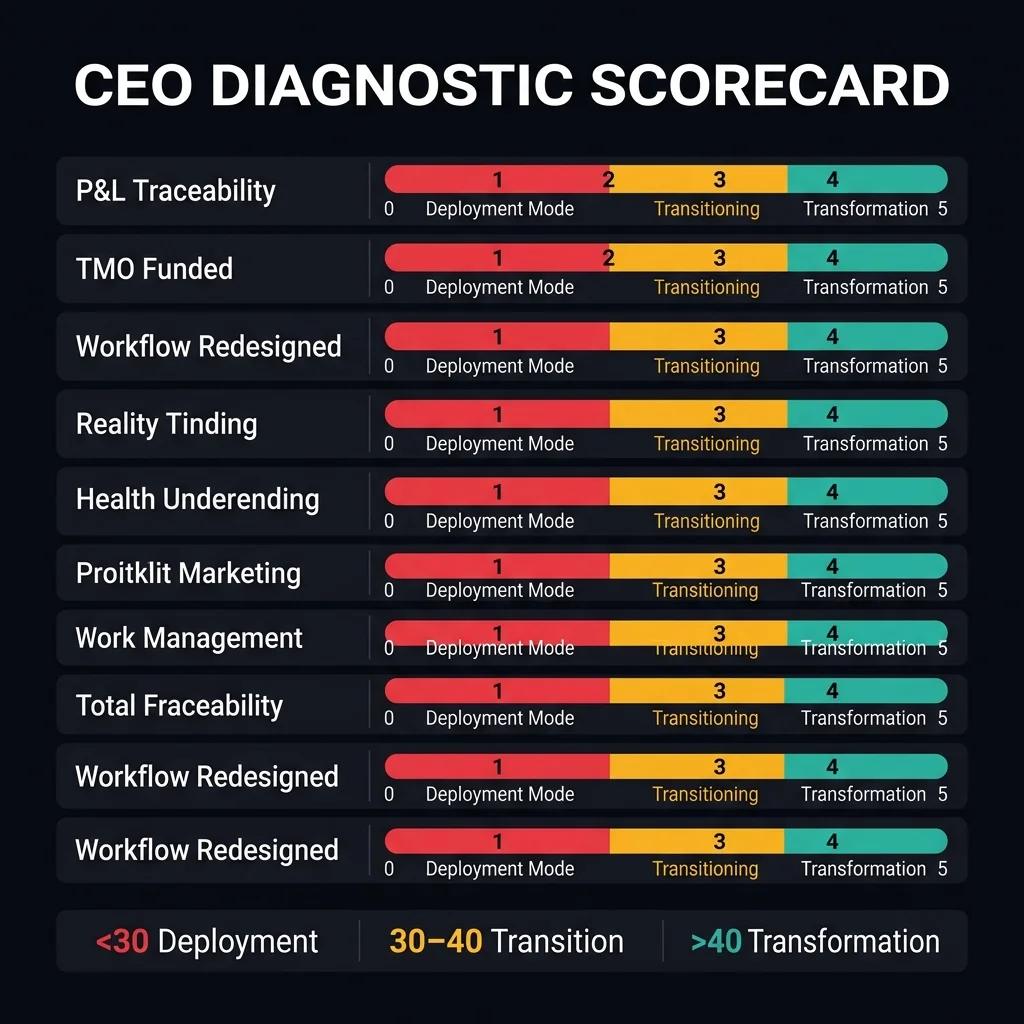
| Diagnostic Question | Score (1–5) | What Low Score Signals |
|---|---|---|
| Do we have a single AI portfolio registry visible to the C-suite? | __/5 | Shadow portfolio risk |
| Can we trace any AI initiative to a specific P&L line? | __/5 | No accountability chain |
| Do AI projects have named business owners (not IT owners)? | __/5 | Orphaned pilot risk |
| Has AI caused any workflow redesign (not just process automation)? | __/5 | Precision trap |
| Is there a funded Transformation Management Office (TMO)? | __/5 | Governance gap |
| Have we redeployed or reskilled any headcount due to AI? | __/5 | No operating model change |
| Do our AI investments have explicit ROI baselines and tracking? | __/5 | No measurement chain |
| Is AI on the board agenda with measurable outcomes (not just updates)? | __/5 | Board governance gap |
| Do our AI initiatives share a common data foundation? | __/5 | Siloed data architecture |
| Has the CEO publicly committed to transformation metrics (not activity metrics)? | __/5 | Leadership signaling gap |
The Economics of Transformation vs. Deployment
The math of AI investment looks different depending on which mode you're in.
A deployment investment generates point improvements. You automate a task. The task takes 60% less time. You reallocate 40% of that time to higher-value work (if your operating model allows it — most don't). The ROI is real but bounded.
A transformation investment generates leverage. When AI is embedded in operating model design, the same capability improvement ripples across interconnected workflows. A 40% improvement in one step compounds because adjacent steps were redesigned to absorb and amplify the gain.
Here's the concrete example. A logistics company deploys AI route optimization. In deployment mode, routes improve by 18%. Fuel costs drop. Delivery times improve. ROI is clear.
In transformation mode, route optimization feeds into dynamic pricing (because delivery confidence is higher), which feeds into demand sensing (because pricing signals shape order behavior), which feeds into procurement (because demand patterns become more predictable). The same AI capability generates multiplied impact because the operating model was redesigned around it.
The Capgemini Top Tech Trends 2026 research calls this "intelligent core versus value-chain orchestration." The companies achieving 3–5× AI ROI are doing value-chain orchestration. The majority are still doing intelligent-core point solutions.
Practitioner Take: Every CEO I've spoken with can name their top three AI pilots. Almost none can name three business processes that have been structurally redesigned because of AI. That gap — between knowing what AI can do and redesigning how you work — is where transformation gets stuck. The diagnostic questions above aren't rhetorical. Do the exercise with your executive team. The discomfort in the room will tell you more than the scores.
Chapter 1 Next Steps
- Run the CEO diagnostic with your full executive team. Publish the scores. Naming the current state removes the ambiguity that lets deployment get mistaken for transformation.
- Audit your AI portfolio for the four failure modes. Shadow portfolios and showcase pilots are the most common and the most fixable.
- Assign a business owner (not an IT owner) to every active AI initiative within 30 days. If no business owner can be identified, pause the initiative.
Chapter 2: Value Chain Redesign — Integrated AI Flows {#ch2-value-chain-redesign}
What you will build in this chapter
- The Capgemini integrated flow model adapted for AI transformation
- A value chain mapping exercise for identifying AI insertion points
- The five principles of AI-integrated workflow design
- A practical example of value chain redesign in a financial services context
- The "sense-decide-act-learn" operating loop as a replacement for sequential planning cycles
Why Traditional Value Chains Break Under AI
Michael Porter's value chain model was built for a world where information flows were sequential and slow. Raw materials came in. Value was added at each stage. Products went out. The constraint was physical capacity.
AI disrupts this model at the informational layer. The constraint in most modern businesses is not physical capacity — it's decision latency. How long does it take for information from the market to reach a decision, and how long does it take for that decision to reach execution?
Traditional value chains have three to six decision handoffs between sensing a market signal and acting on it. Each handoff adds days, sometimes weeks. Each handoff is a point of data loss and interpretation drift.
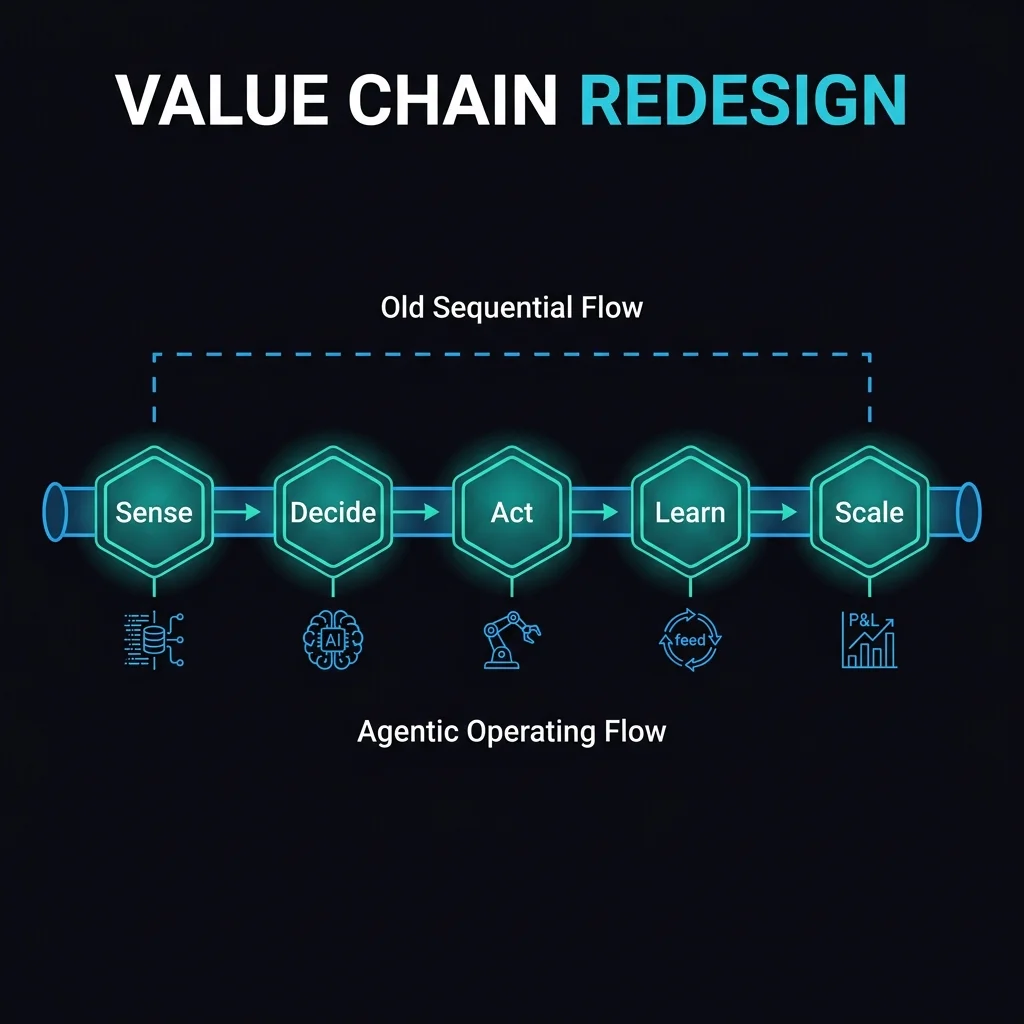
AI compresses decision latency to near-zero when properly embedded. But "properly embedded" means redesigning the value chain to eliminate handoffs, not just automating individual handoffs.
The Sense-Decide-Act-Learn Loop
Capgemini's 2026 intelligent operations framework introduces what they call "integrated flows" — continuous operating cycles where AI connects sensing (data ingestion), deciding (automated or human-assisted judgment), acting (workflow execution), and learning (feedback and model improvement).
This replaces the Plan-Do-Check-Act cycle, which was designed for quarterly cadences, with a continuous loop that operates at the speed of data.
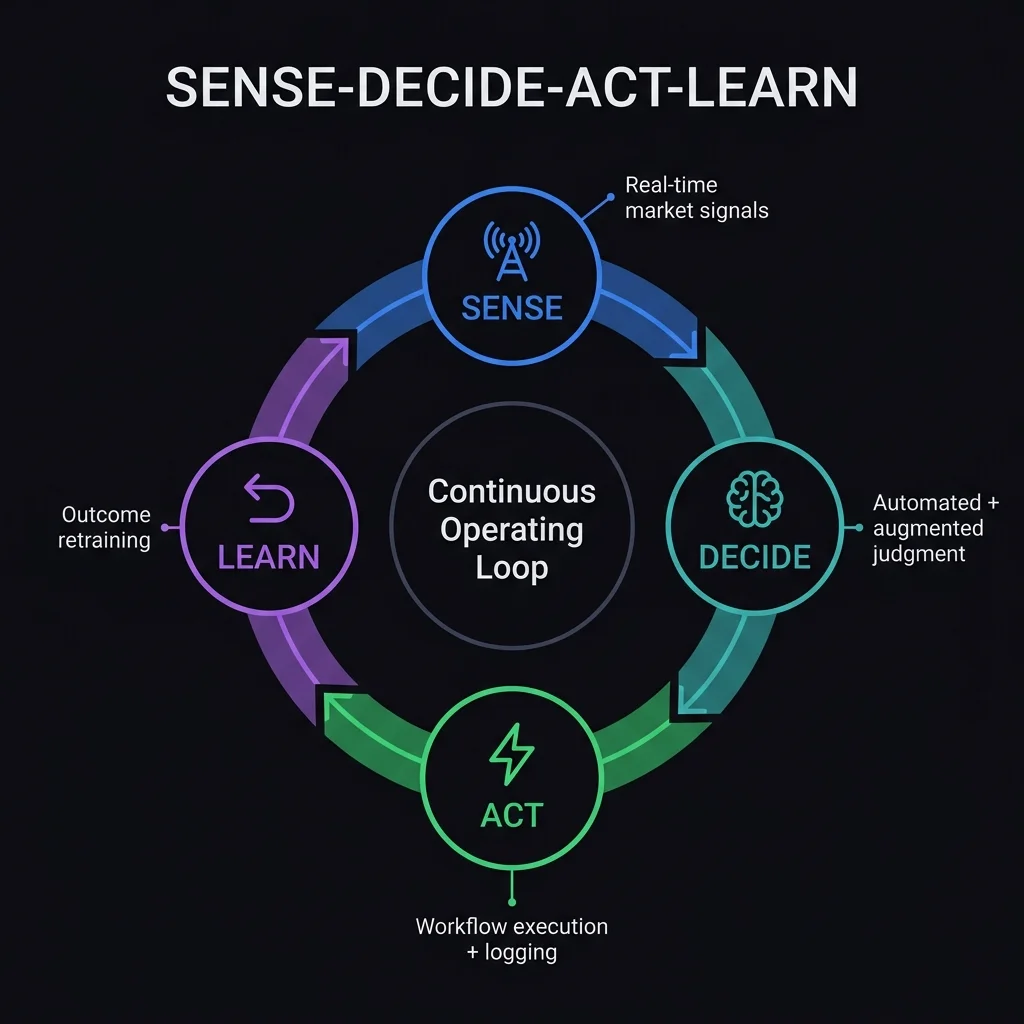
Here's what each node means in practice:
SENSE — Continuous ingestion of market signals, operational data, customer behavior, and external feeds. This is not a reporting function. It's a real-time state management function. The AI is always watching — inventory levels, customer churn signals, supply disruption indicators, competitive pricing moves.
DECIDE — Automated or augmented judgment. For decisions within policy bounds, AI acts autonomously. For decisions at or near policy boundaries, AI presents options with confidence scores to a human decision-maker. The key design principle: the human reviews AI recommendations, not raw data.
ACT — Workflow execution. The decision triggers downstream action — a purchase order, a price change, a customer communication, a staff redeployment. The action is logged, timestamped, and tagged to the AI recommendation for traceability.
LEARN — Outcome feedback. Was the decision correct? Did the action achieve the intended result? The feedback signal retrains the model and adjusts future decision thresholds. This is the self-improvement engine that separates AI operating models from static automation.
SCALE — Portfolio expansion. When a sense-decide-act-learn loop proves value in one domain, the operating model template is applied to adjacent domains. Scale is not adding more pilots — it's applying proven operating model patterns.
Value Chain Mapping: Finding Your AI Insertion Points
Not every step in your value chain is equally valuable to redesign. The highest-impact AI insertion points share three characteristics:
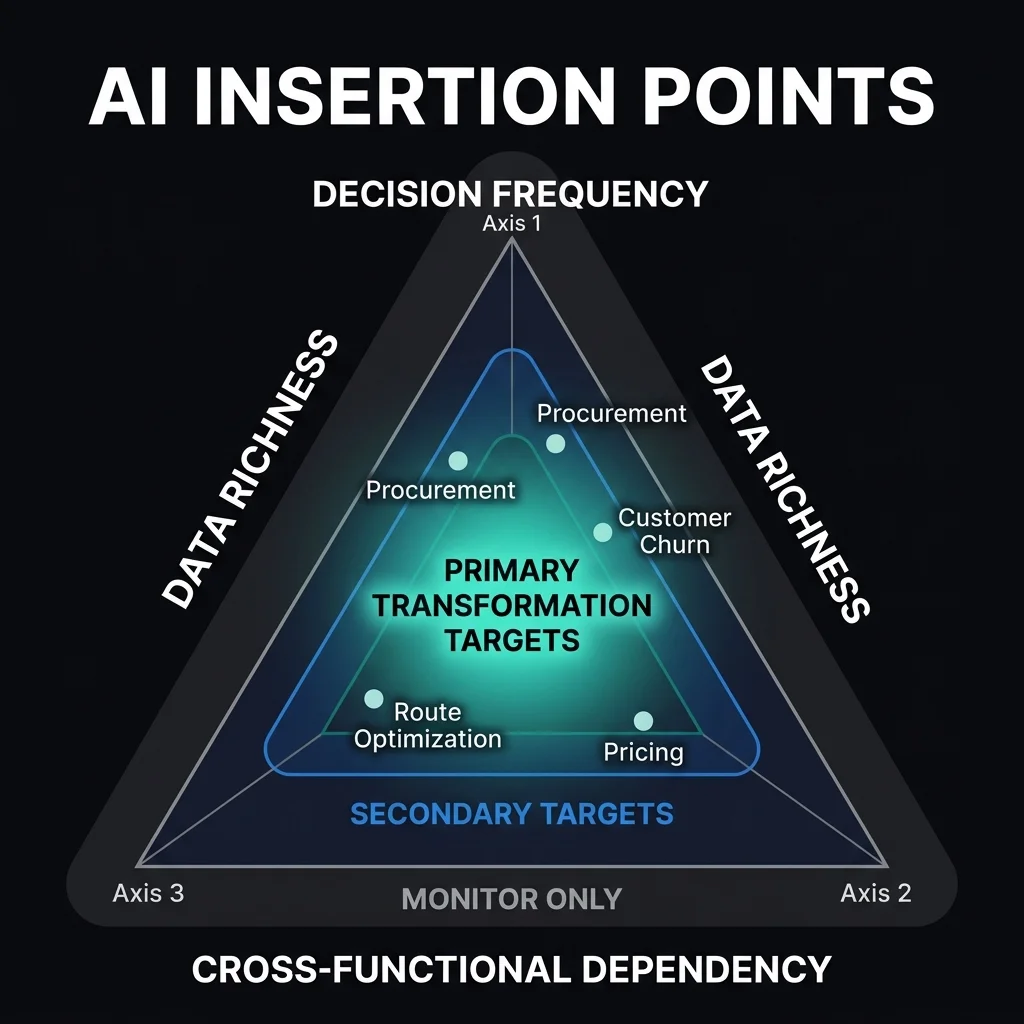
- High decision frequency — The step involves many decisions made repeatedly. Automated sensing and deciding delivers compounding value because the volume is high.
- High data richness — The step generates or consumes large amounts of structured data. AI models perform better in data-rich environments.
- High cross-functional dependency — The step's output feeds multiple downstream processes. AI improvement here has multiplied impact because it removes bottlenecks for several teams simultaneously.
Here's how to map your value chain for AI insertion points:
Step 1: List your top 20 business processes by annual revenue or cost impact. Not by technology complexity. By business impact.
Step 2: Score each process on decision frequency (1–5), data richness (1–5), and cross-functional dependency (1–5). Processes scoring 12 or above are your primary transformation targets.
Step 3: Map the handoffs in your top-5 scoring processes. Draw the information flow. Count the decision points. Identify where data is lost or transformed in ways that reduce its accuracy.
Step 4: Design the loop for your top target. What does sensing look like? What does deciding look like? Where does a human stay in the loop? What action does the AI trigger? How does feedback flow back?
This mapping exercise typically takes a cross-functional team two days. The output is more actionable than any vendor AI roadmap because it's grounded in your actual operating structure.
Case Study: Value Chain Redesign in Financial Services
Here's a composite example drawn from multiple engagements in the financial services sector.
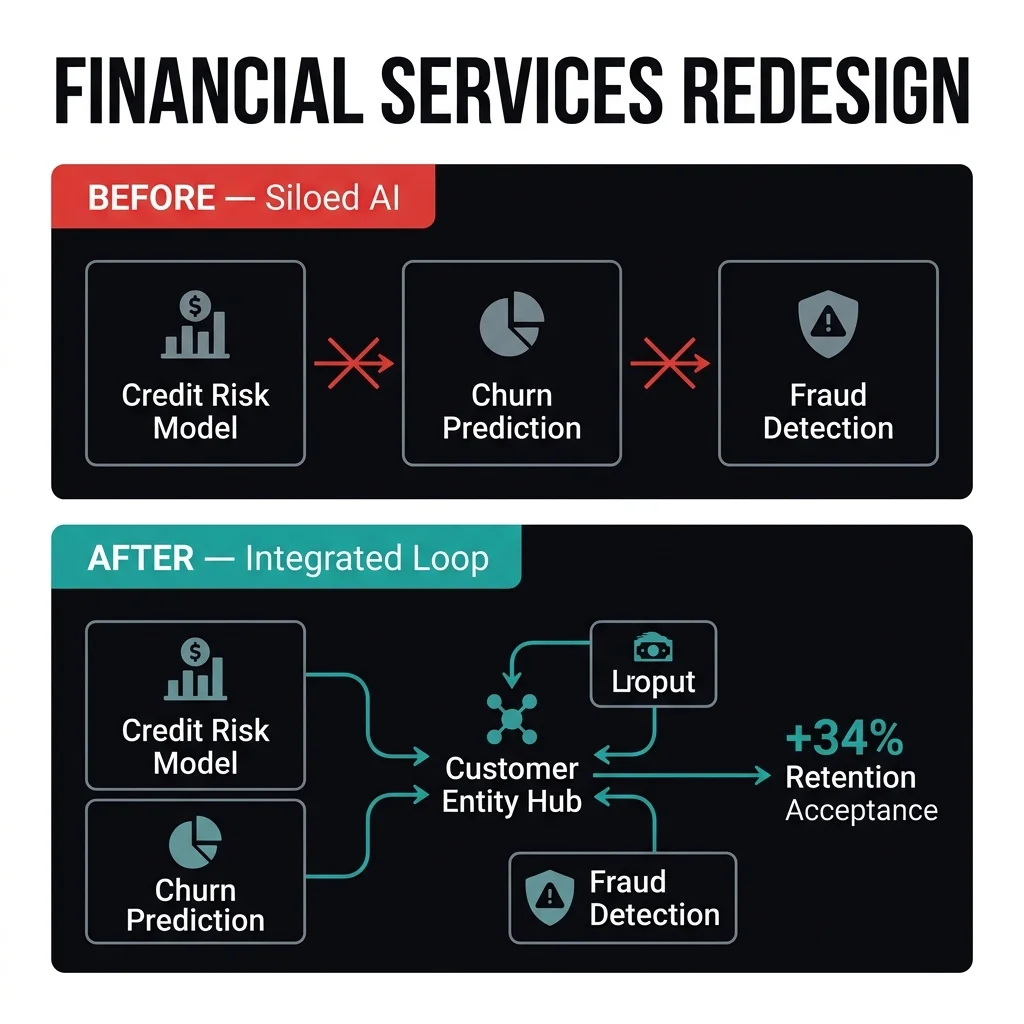
A mid-market bank had deployed AI in three places: a credit risk model, a customer churn prediction model, and a fraud detection model. All three were technically performing well. None of them were connected.
The credit risk model identified a customer as lower risk. That information did not flow to the customer success team that was planning a retention outreach. The churn prediction model flagged the same customer as at-risk for churn. The customer success team sent a generic retention offer without knowing the customer's credit risk profile or current product usage. The fraud detection model flagged a transaction from the same customer as unusual — but the flag didn't reach the customer outreach team before the retention email landed, making the customer feel surveilled.
Three AI models, zero integrated intelligence. The operating model was still siloed even though the AI wasn't.
The redesign mapped the customer lifecycle as a single value chain. The sense-decide-act-learn loop was built around the customer entity, not around individual department processes. When the churn model flagged risk, it triggered a multi-factor decision: What is this customer's credit profile? What is their fraud risk? What products are they most likely to respond to? The decision surfaced to a relationship manager with a recommended action, not a generic script.
The result: a 34% improvement in retention offer acceptance rate, a 21% reduction in churn, and — critically — a measurable impact on the lifetime value line of the P&L. Not a pilot. Not a demo. A transformation.
Value chain redesign principle: Always map from the customer outcome backward, not from the data source forward. The question isn't "what can we do with this data?" It's "what customer or business outcome do we want to change, and what data and decisions stand between us and that outcome?"
The Five Principles of AI-Integrated Workflow Design
These principles come from observing what separates successful value chain redesigns from expensive failures.
Principle 1: Design for the exception, not the average
AI handles average cases well. The value is in handling exceptions faster and better than humans can. Design your AI-integrated workflow so that exception routing — to the right human with the right context — is the core feature, not an afterthought.
Principle 2: Make AI recommendations visible before they become actions
Never let AI act without a traceable recommendation record. Every AI action should have a parent recommendation that can be reviewed, overridden, and audited. This isn't just governance — it's how you train operators to trust AI appropriately and override it correctly.
Principle 3: Preserve human override at every threshold
Define the decision thresholds at which human override is mandatory. Below the threshold, AI acts. At the threshold, AI recommends and waits. Above the threshold, AI informs and escalates. The threshold design is a strategic decision, not a technical one.
Principle 4: Design the feedback loop before you design the model
The model will drift without feedback. The feedback loop that keeps it calibrated must be designed into the operating model from day one. This means capturing outcome data — not just model performance metrics — and routing it back to model governance.
Principle 5: Measure workflow velocity, not model accuracy
Model accuracy is a technical metric. What the CEO cares about is how much faster and better decisions are being made. Measure the business metric — time-to-decision, cost-per-decision, quality-of-decision (downstream outcome) — not the model metric.
Chapter 2 Next Steps
- Run the value chain mapping exercise this quarter. Involve finance, operations, and the AI team together. The cross-functional conversation is as valuable as the output.
- Pick one high-scoring process and design the sense-decide-act-learn loop for it in detail. Validate with the business owner before building anything.
- Redesign the governance model for that process to accommodate AI-driven decisions. What approvals change? What oversight is added? What reports are retired?
Chapter 3: Funding, TMO, and Decision Rights {#ch3-funding-tmo-decision-rights}
What you will build in this chapter
- The Transformation Management Office (TMO) design for AI programs
- A funding model that separates AI investment from IT operations
- Decision rights frameworks for enterprise AI (who decides what at which threshold)
- The portfolio governance cadence that connects AI investment to P&L accountability
- How to avoid the three most common TMO failure modes
The Funding Model Problem
Most enterprises fund AI the way they fund IT projects: through annual budget cycles, capital expenditure approvals, and business case gates that require precise ROI projections before funding is approved.
This model is wrong for AI transformation for three reasons.
First, AI value compounds non-linearly. The first model iteration rarely shows the full value. Value accumulates as the model learns, as adjacent processes are redesigned, and as the operating model absorbs the capability. Year-3 value of an AI investment is often 4× the year-1 value. Annual budget cycles can't fund compounding assets.
Second, AI requires sustained operational investment, not one-time capital. A software license has a capital cost. An AI capability has ongoing costs: compute, model maintenance, retraining, data pipeline management, human oversight. Most enterprises use capital budgets for AI build and then strip the operational budget, starving the model of the investment it needs to stay valuable.
Third, traditional ROI projections are wrong. Requiring precise ROI projections before approval creates pressure to over-promise. Teams inflate projections to get approved. The projections don't come true. AI gets a credibility problem. The correct model is portfolio-based ROI, where investment is spread across a portfolio of AI initiatives and expected value is assessed at the portfolio level, not the individual project level.
The Transformation Management Office Architecture
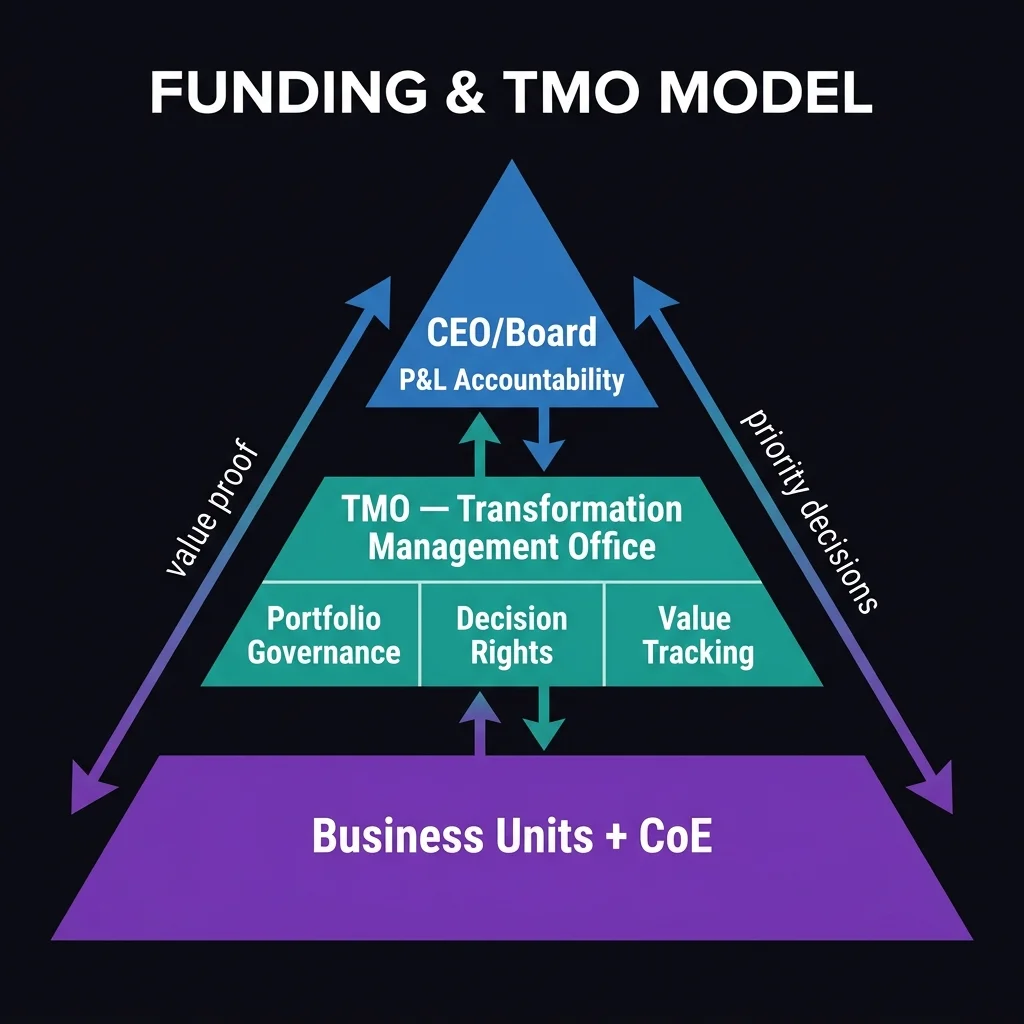
The TMO is the organizational mechanism that connects AI investment to business transformation outcomes. It is not an IT governance committee. It is not a center of excellence. It is an executive-level function with budget authority, portfolio oversight, and direct P&L accountability.
The well-designed TMO has three core functions:
Portfolio Governance — The TMO maintains the enterprise AI portfolio registry. Every active AI initiative is registered, categorized by value chain domain, scored on impact potential and delivery confidence, and reviewed on a quarterly basis. Initiatives below a threshold are terminated. Resources are reallocated to higher-impact initiatives.
Decision Rights — The TMO defines and enforces the decision authority matrix for AI. This answers the question: who can approve what kind of AI initiative, at what investment level, with what governance requirement? This prevents the shadow portfolio problem by creating clear channels for AI investment.
Value Tracking — The TMO owns the business case for each portfolio initiative and tracks actual P&L impact against projection. The quarterly TMO review is not a status update — it's a business accountability session.
The TMO should be led by a Chief Transformation Officer or Chief AI Officer — a business leader, not a technology leader. The reporting line should be to the CEO, not the CTO.
The Decision Rights Matrix
One of the most underbuilt governance artifacts in enterprise AI is the decision rights matrix. It answers: who can make what decisions about AI, at what scale, with what oversight?
| Decision Type | Authority Level | Oversight Requirement | Escalation Trigger |
|---|---|---|---|
| AI tool procurement (< $50K/yr) | Business unit head | TMO registration | PII data access |
| AI initiative build ($50K–$500K) | TMO + Business VP | Portfolio review + risk tier | Customer-facing scope |
| Enterprise AI platform investment (> $500K) | C-suite + Board awareness | Full business case + ROI baseline | Regulatory scope or M&A impact |
| Autonomous AI action (no human review) | CAIO + Risk sign-off | Audit logging + threshold definition | Any > $10K single action or customer impact |
| Operating model redesign (AI-driven) | CEO + Affected C-suite | Board informing; workforce impact review | Union engagement or regulatory disclosure |
The decision rights matrix is not a bureaucratic control mechanism. It's a clarity mechanism. Most AI governance failures happen because teams don't know who has authority to approve what. The shadow portfolio grows precisely because there's no clear channel — so teams use shadow channels.
The Portfolio Governance Cadence
The TMO operates on a quarterly governance cadence. Here's what each review cycle covers:
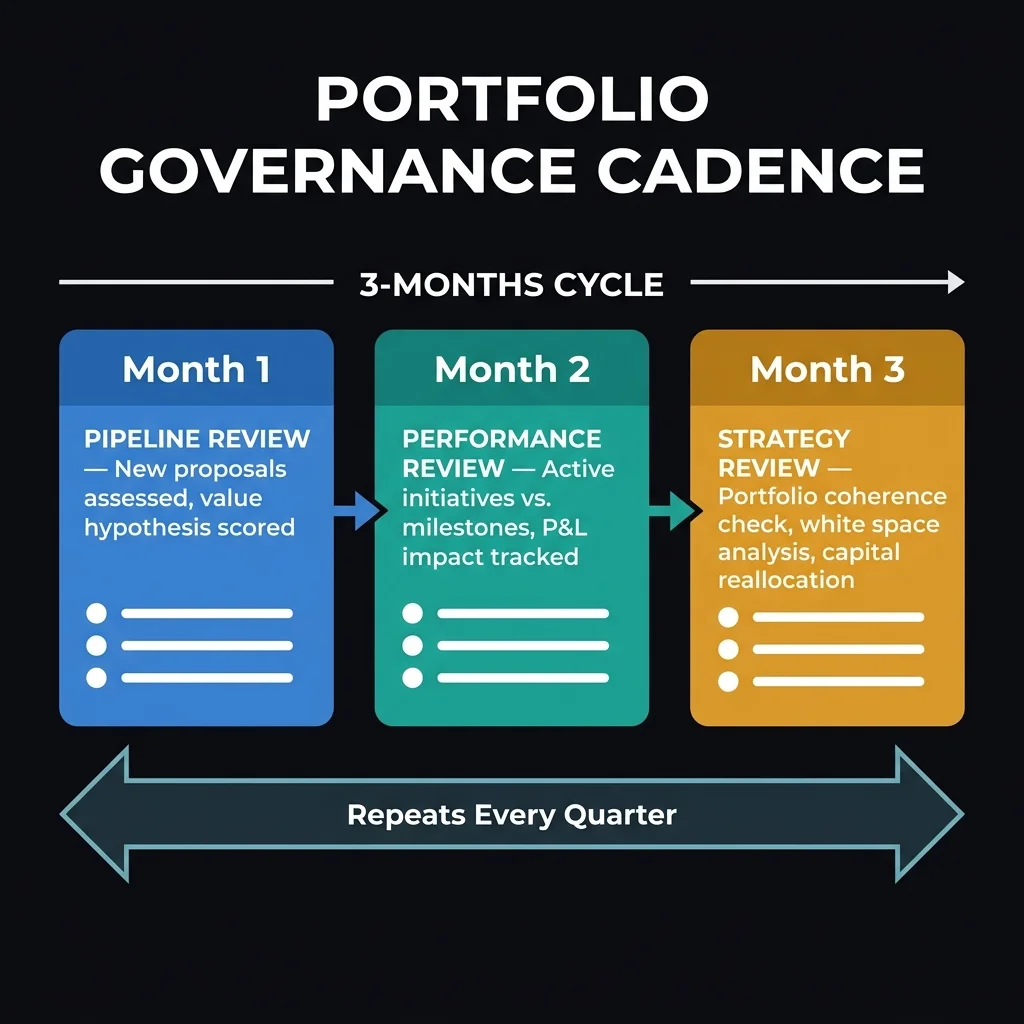
Month 1 of each quarter — Pipeline review: New AI initiative proposals are assessed against the portfolio strategy. Does this fit a priority domain? What's the value hypothesis? What's the delivery risk? New initiatives are either approved into the portfolio, sent back for more business case development, or declined.
Month 2 — Performance review: Active initiatives are assessed against their value milestones. Is the pilot delivering expected business outcomes? Is the workflow redesign happening? Is the P&L impact traceable? Initiatives that miss two consecutive milestones are restructured or terminated.
Month 3 — Strategy review: The portfolio is assessed as a whole. Are we building towards transformation or accumulating more deployment? Are there white spaces in the value chain that aren't covered? Are any domains over-invested? Is the data foundation keeping pace with model ambition?
This cadence keeps the portfolio honest. It prevents the natural organizational tendency to protect initiatives once they're funded, regardless of their actual business value.
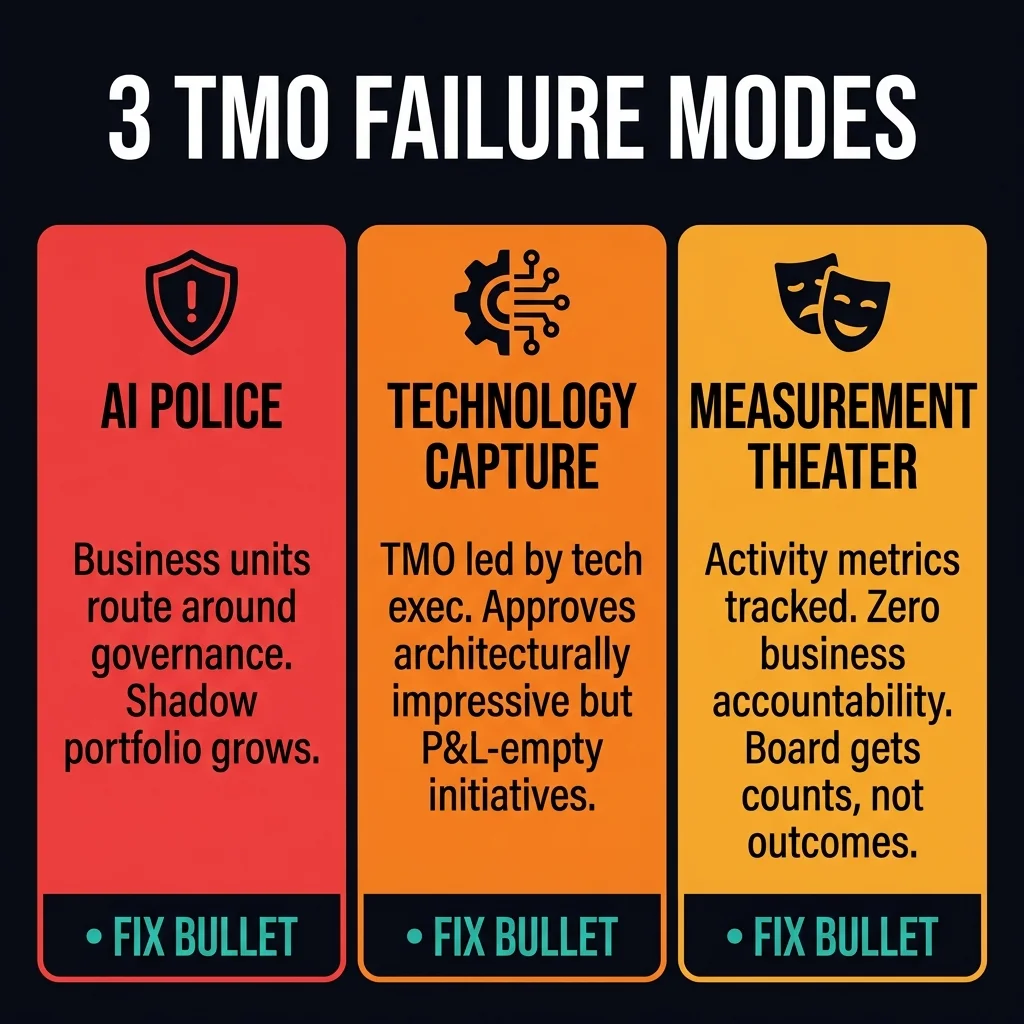
The Three TMO Failure Modes
TMOs fail in predictable ways. Avoiding these failure modes is as important as building the right structure.
TMO Failure Mode 1: Becoming the AI police
When the TMO is perceived primarily as a governance and control function, business units route around it. They use shadow budgets, vendor direct-pays, and IT discretionary spend to fund AI initiatives outside the TMO's visibility. The shadow portfolio grows, and the TMO has visibility into a shrinking fraction of enterprise AI spend.
The fix: The TMO must provide value to business units, not just oversight. Value can include shared data infrastructure, model deployment templates, vendor contract negotiation leverage, and fast-track approval paths for lower-risk initiatives.
TMO Failure Mode 2: Technology capture
When the TMO is led by a technology executive rather than a business executive, it optimizes for technical elegance rather than business impact. Initiatives are approved because they're architecturally interesting. The portfolio fills with technically sophisticated AI that doesn't move any P&L line.
The fix: The TMO leader must be a P&L owner, not a technology owner. Technical expertise belongs in the CoE, not the TMO.
TMO Failure Mode 3: Measurement theater
The TMO tracks activities (number of models deployed, number of use cases initiated, number of training hours delivered) rather than outcomes (cost reduction, revenue improvement, process cycle time, quality improvement). The board gets impressive activity reports and no business accountability.
The fix: Every portfolio initiative must have a baseline measurement before it begins. The TMO must define what the P&L or operational metric will be, what the pre-AI baseline is, and what the target is. Without baselines, there's no accountability.
Practitioner Take: The best-run TMOs I've seen operate like internal venture capital firms. They fund a portfolio of AI initiatives with different risk profiles and time horizons. They measure portfolio-level ROI. They actively kill underperformers to redeploy capital. They celebrate terminations as signs of portfolio discipline, not failure. If your TMO has never terminated an initiative for poor business performance, it's not doing its job.
How to Fund AI Transformation (The Right Budget Model)
The correct AI transformation funding model has three separate budget pools:
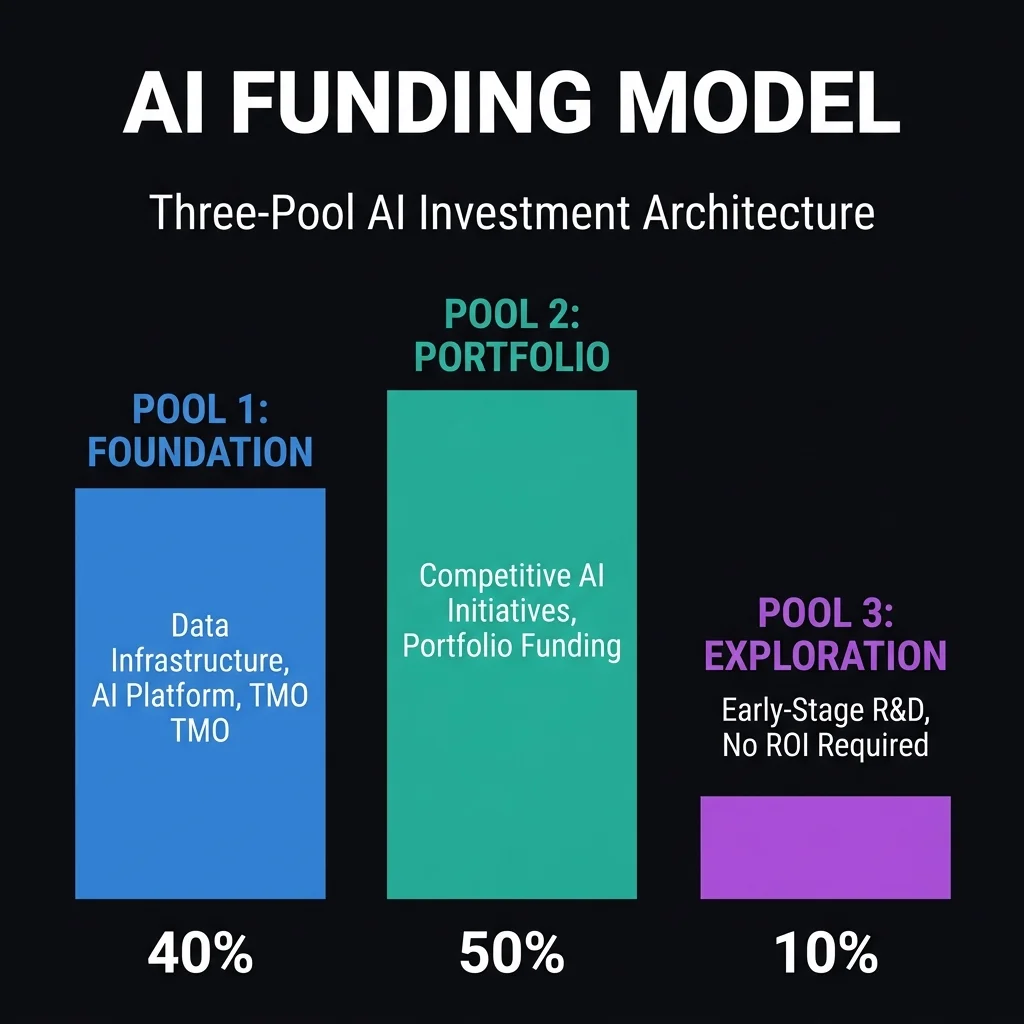
Pool 1: Foundation investment — Ongoing funding for the shared data infrastructure, AI platform capabilities, security and governance infrastructure, and TMO operations. This is an operational budget, not a capital budget. It doesn't require individual ROI justification. It funds the transformation capability that makes everything else possible.
Pool 2: Portfolio investment — Competitive funding for specific AI initiatives, allocated through the TMO. Initiatives compete for portfolio funding based on value hypothesis strength, domain priority, and delivery confidence. Successful initiatives get additional rounds. Underperformers don't.
Pool 3: Exploration allocation — A small budget (typically 5–10% of total) for early-stage exploration of AI capabilities with no immediate business case requirement. This is where novel ideas get tested before they're mature enough to compete in the portfolio.
The ratio varies by maturity: early transformation programs might allocate 40% foundation, 50% portfolio, 10% exploration. Mature transformation programs shift toward 25% foundation, 70% portfolio, 5% exploration.
Chapter 3 Next Steps
- Audit your current AI funding model against the three-pool architecture. Where is AI spend currently sitting? Is it in IT capex? Business unit discretionary? Shadow procurement? Getting clarity on where money is actually going is step one.
- Design or validate your TMO structure. If you don't have a TMO, design one. If you have one, assess it against the three function model (Portfolio Governance, Decision Rights, Value Tracking). Which function is weakest?
- Build the decision rights matrix for your organization. Start with the five rows shown above and customize the thresholds for your industry and risk tolerance.
Chapter 4: Talent, Unions, and Change Saturation {#ch4-talent-unions-change}
What you will build in this chapter
- The talent model for the agentic enterprise (three new role archetypes)
- A change saturation diagnostic for AI programs
- A framework for union engagement on AI transformation
- The skills development approach that scales beyond training programs
- The leadership behaviors that accelerate transformation adoption
The Talent Mistake Every CEO Makes
The most common talent mistake in AI transformation is treating it as a skills problem. "We need more data scientists." "We need to upskill our workforce in AI." "We need to hire prompt engineers."
All of these are correct and all of them are insufficient.
The skills problem is real. But the deeper problem is organizational. Who owns the outcomes of AI? Who has authority to redesign workflows? Who manages the relationship between AI systems and the humans who work alongside them? These are role design questions, not skills questions.
EY's CEO Outlook 2026 describes this as the "intent gap" — the distance between AI capability and human intent ownership. AI can do more than most organizations know what to do with. The constraint is the organizational design that determines who directs AI capability toward which outcomes.
The Three Role Archetypes of the Agentic Enterprise
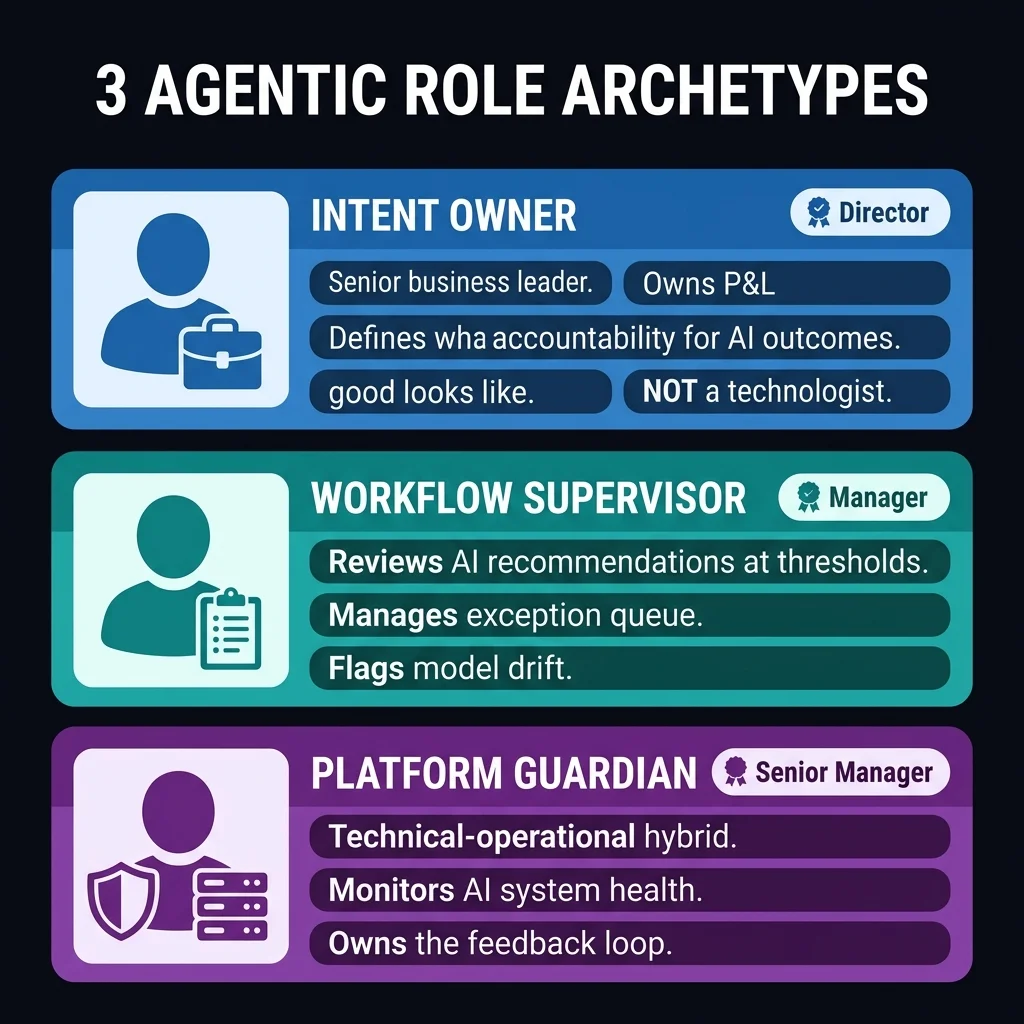
AI transformation requires new roles that don't exist in traditional organizational charts. These three archetypes appear consistently in organizations that successfully transform.
Archetype 1: The Intent Owner
The Intent Owner is a senior business professional — typically director or VP level — who owns the business objective that an AI system is designed to serve. They are not a technologist. They define what "good" looks like for an AI outcome, what decisions require human oversight, and what business results the AI is accountable for delivering.
The Intent Owner is distinct from the data scientist who builds the model and the engineer who deploys it. They're the business mind that keeps AI grounded in business reality. Every significant AI initiative should have a named Intent Owner.
Archetype 2: The AI Workflow Supervisor
The Workflow Supervisor is an operational professional who manages the day-to-day interface between AI systems and human workflows. They review AI recommendations at decision thresholds. They flag model drift when AI output no longer matches business reality. They manage the exception queue — the cases that fall outside AI confidence bounds.
This role replaces neither the manager who previously made these decisions nor the junior staff who previously processed cases. It's a new role that sits between AI capability and human authority.
Archetype 3: The Platform Guardian
The Platform Guardian is a technical-operational hybrid who manages the AI platform infrastructure for a business domain. They're not a data scientist — they don't build models. They're not an IT engineer — they don't manage servers. They ensure that AI systems in their domain are monitored, maintained, and performing as intended. They own the feedback loop from operational reality back to model development.
These three archetypes need to be designed into the organization, not organically evolved. The Intent Owner and Workflow Supervisor roles particularly need explicit organizational authority and budget, or they'll be absorbed into existing roles without the authority to drive change.
Change Saturation: The Hidden Killer of AI Transformation
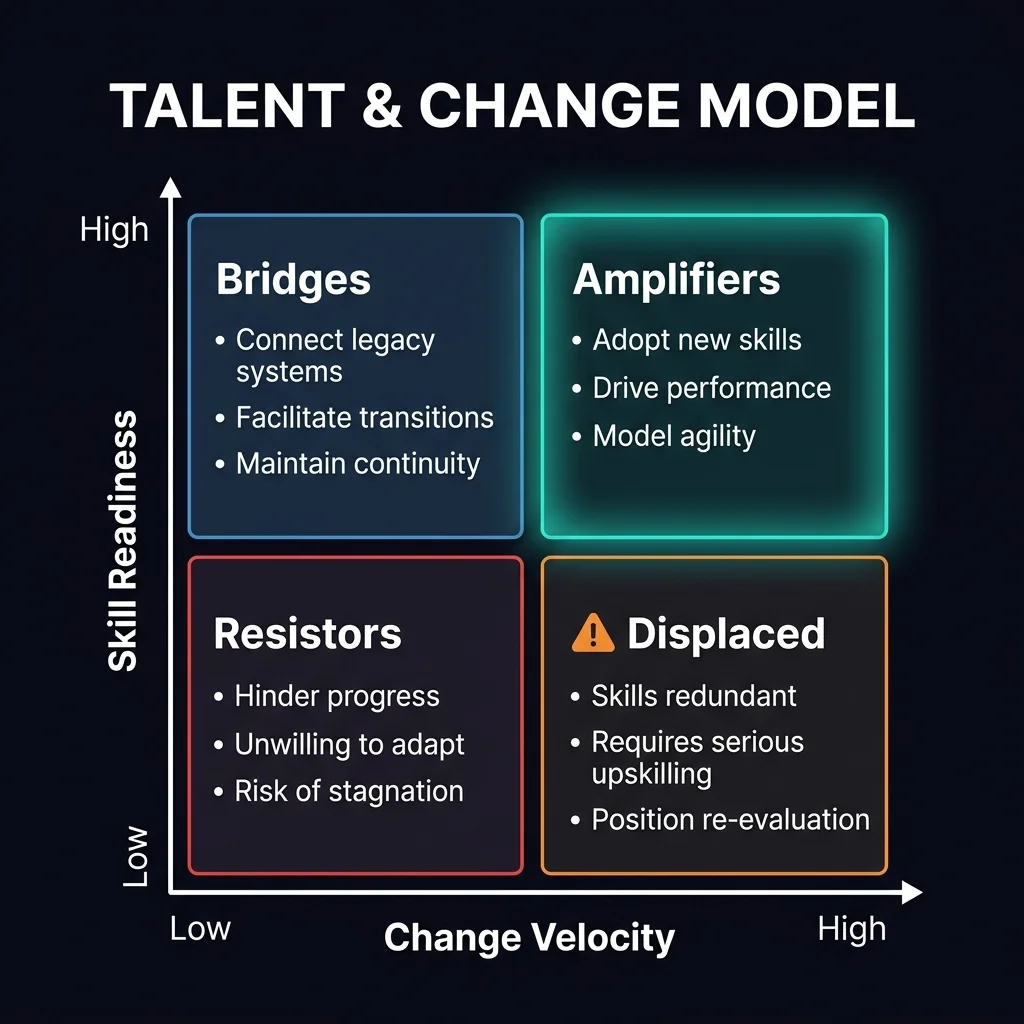
Change saturation is the point at which an organization's capacity to absorb change is exceeded by the volume of change being imposed on it. Every organization has a change absorption threshold. Most enterprises running large AI transformation programs are well above that threshold.
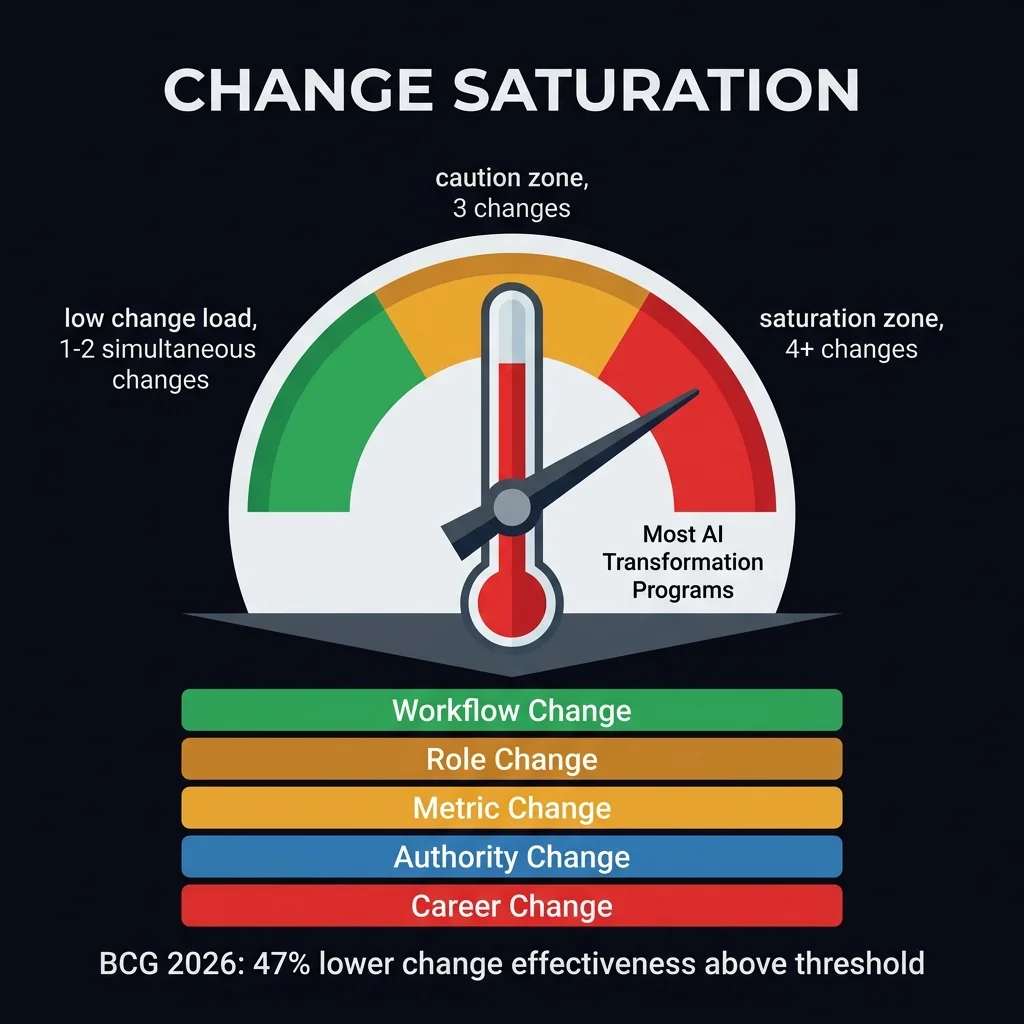
BCG's 2026 organizational resilience research shows that enterprises running more than three simultaneous major transformation programs report 47% lower change effectiveness than enterprises running one or two. The programs don't fail individually — they fail collectively because the organization can't process that many simultaneous changes to how work is done.
AI transformation is particularly prone to triggering change saturation because:
- It changes workflows (operational change)
- It changes role definitions (organizational change)
- It changes performance metrics (measurement change)
- It changes what decisions require human judgment (authority change)
- It changes what training and skills are valued (career change)
That's five simultaneous change dimensions for every AI-transformed process. Multiply by 20 active AI initiatives and you've triggered organizational paralysis.
The change saturation diagnostic is simple: ask frontline managers how many different process or role changes they're currently managing. If the answer is more than three, you're saturated.
The fix for change saturation is sequencing, not slowing. Don't reduce the pace of AI transformation. Reduce the simultaneous change surface. Complete one workflow redesign fully before beginning the next adjacent one. The transformation sequence matters more than the transformation speed.
Union Engagement: The Conversation Most CEOs Avoid
For enterprises with unionized workforces, AI transformation without proactive union engagement is an operational and reputational risk.
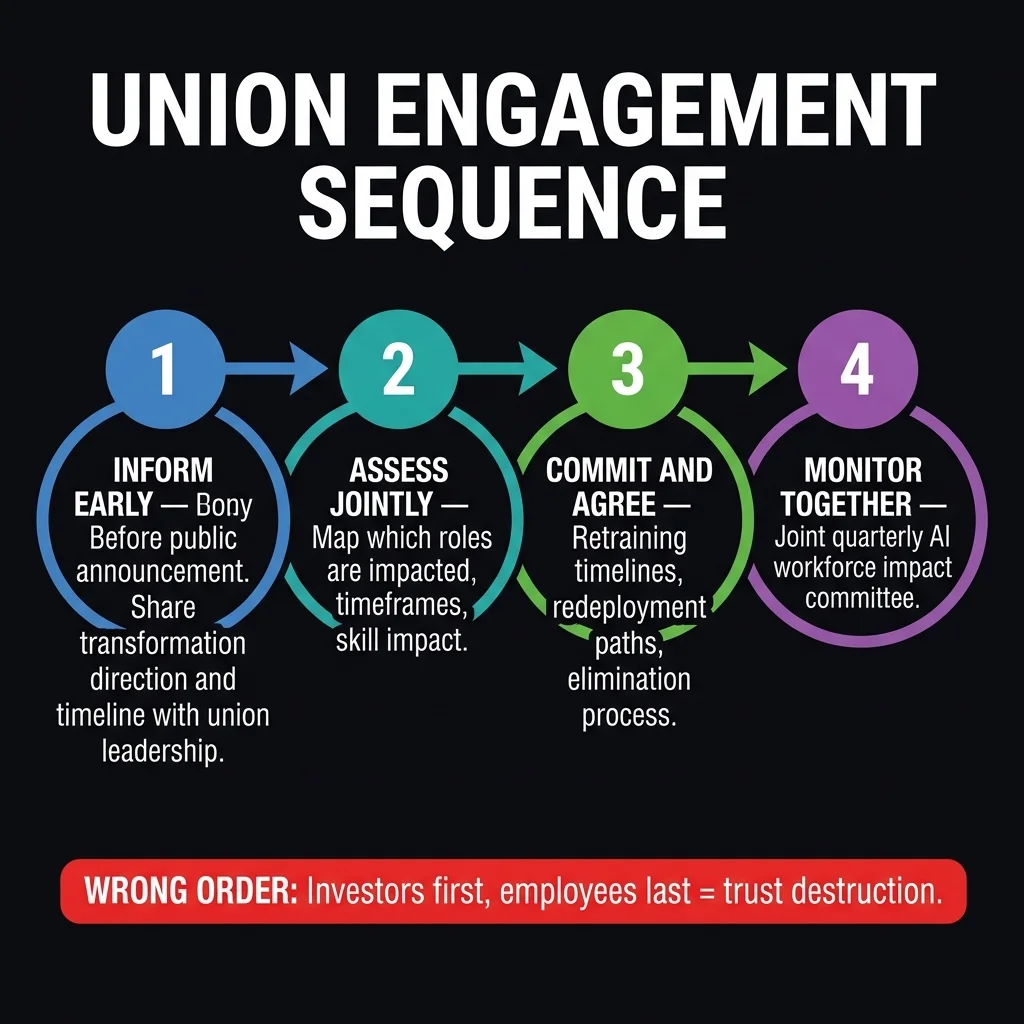
The conversation most CEOs avoid is the honest one: AI is going to change what work looks like. Some roles will be reduced. New roles will be created. The timeline and process for these changes can be negotiated, but the direction cannot.
The CEOs who manage this well have a common approach. They engage union leadership early — before transformation planning is complete, not after. They frame the conversation around workforce transition, not workforce reduction. They commit to specific timelines for transparency on role impact. They offer retraining commitments before restructuring announcements.
The organizations that do this poorly announce AI transformation programs to the market, discuss efficiency gains with investors, and tell employees months later. This sequence — external before internal, investors before workers — destroys trust and creates the union resistance that slows transformation.
Union engagement framework: The conversation should happen in this sequence: (1) Inform union leadership of the transformation direction and timeline before public announcement. (2) Jointly assess which roles will be most impacted and over what time horizon. (3) Agree on retraining commitments, redeployment pathways, and the process for handling roles that are eliminated. (4) Create a joint monitoring committee that reviews AI impact on employment quarterly. This is not a negotiation of whether AI happens — it's a negotiation of how the workforce transition is managed.
The Skills Development Model That Actually Works
Training programs don't create transformation. They create trained individuals in organizations that haven't changed.
The skills development model for AI transformation has three components that work together:
Component 1: Capability building at the point of work
AI skills are built most effectively when they're applied immediately to real work, not learned in workshops and applied later. The most effective AI capability building programs embed AI tools directly into existing workflows and provide coaching on AI use within the context of actual job responsibilities.
Component 2: Permission to redesign
Individuals trained in AI who don't have permission to redesign their work will use AI to do their existing work slightly faster. They won't use AI to do fundamentally different work. The permission to redesign — explicit from their manager and enabled by workflow flexibility — is as important as the training itself.
Component 3: Recognition of AI-augmented performance
How performance is measured shapes how people work. If performance metrics are unchanged from the pre-AI era, employees have no incentive to use AI in ways that change how they perform. Metrics need to shift from activity measures (number of calls handled, number of reports produced) to outcome measures (customer issue resolution quality, decision accuracy, cycle time).
Leadership Behaviors That Accelerate AI Transformation
The CEO's visible behavior is the most powerful change management tool in an AI transformation. Organizational cultures take their cues from leaders.
The behaviors that accelerate AI transformation:
Use AI publicly. When the CEO is seen using AI tools in meetings — summarizing reports, generating options, questioning outputs — it normalizes AI use for the entire organization. When the CEO doesn't visibly use AI, the silent message is that AI is for the technology team, not for leaders.
Reference AI impact in business reviews. When AI-driven outcomes appear in business review conversations — "our AI-redesigned procurement process saved us $12M this quarter" — it signals that AI business impact is what the CEO cares about, not AI technical sophistication.
Terminate projects that aren't transforming. The single most powerful signal to the organization about the seriousness of transformation is visible termination of AI projects that aren't producing business outcomes. If nothing ever gets stopped, there's no accountability signal.
Acknowledge what you don't know. CEOs who pretend to understand AI deeply when they don't create organizational cultures where admitting AI uncertainty is stigmatized. Admitting "I'm learning this too" while actively learning creates psychological safety for the organization to do the same.
Chapter 4 Next Steps
- Design the three archetypes into your organizational structure. Identify which existing roles could evolve into Intent Owner, Workflow Supervisor, and Platform Guardian roles in your priority domains.
- Run the change saturation diagnostic with your frontline management layer. Sequence your transformation wave based on current absorption capacity.
- Schedule union leadership engagement if applicable — not after the transformation plan is finalized, but during it.
Chapter 5: Geopolitics, Sovereignty, and Scenario Planning {#ch5-geopolitics-sovereignty}
What you will build in this chapter
- The three geopolitical AI scenarios for 2026–2030
- A sovereignty risk assessment for enterprise AI programs
- The data localization framework for multinational AI operations
- EY's CEO Outlook "disciplined scaling" framework adapted for geopolitical risk
- A 90-day sovereignty readiness audit
Why Geopolitics Is Now an AI Strategy Topic
Three years ago, enterprise AI strategy didn't include geopolitics. The AI stack was dominated by US hyperscalers, models were trained on global data, and the regulatory environment was nascent enough to be manageable.
That world is ending.
The EU AI Act's high-risk enforcement begins in August 2026. The US-China technology competition has resulted in export controls on advanced AI chips that constrain what technology is available in which markets. Governments from India to Japan to the EU are funding sovereign AI models that will compete with and, in regulated domains, replace US commercial models. The GDPR has been interpreted to mean that certain personal data cannot leave the EU — which means AI models trained on that data cannot be deployed on infrastructure outside the EU.
For multinational enterprises, this creates a fragmented AI landscape that requires a sovereign operating model — not just a technical architecture, but a governance framework for operating AI across jurisdictions with different rules.
EY's 2026 CEO Outlook research identifies geopolitical AI risk as the top-3 concern for 61% of global enterprise CEOs. The same research shows that fewer than 22% have a specific governance framework to manage it.
The Three Geopolitical Scenarios
EY's scenario planning framework for enterprise AI in 2026–2030 identifies three scenarios. Understanding which scenario your markets are trending toward shapes your sovereignty operating model.
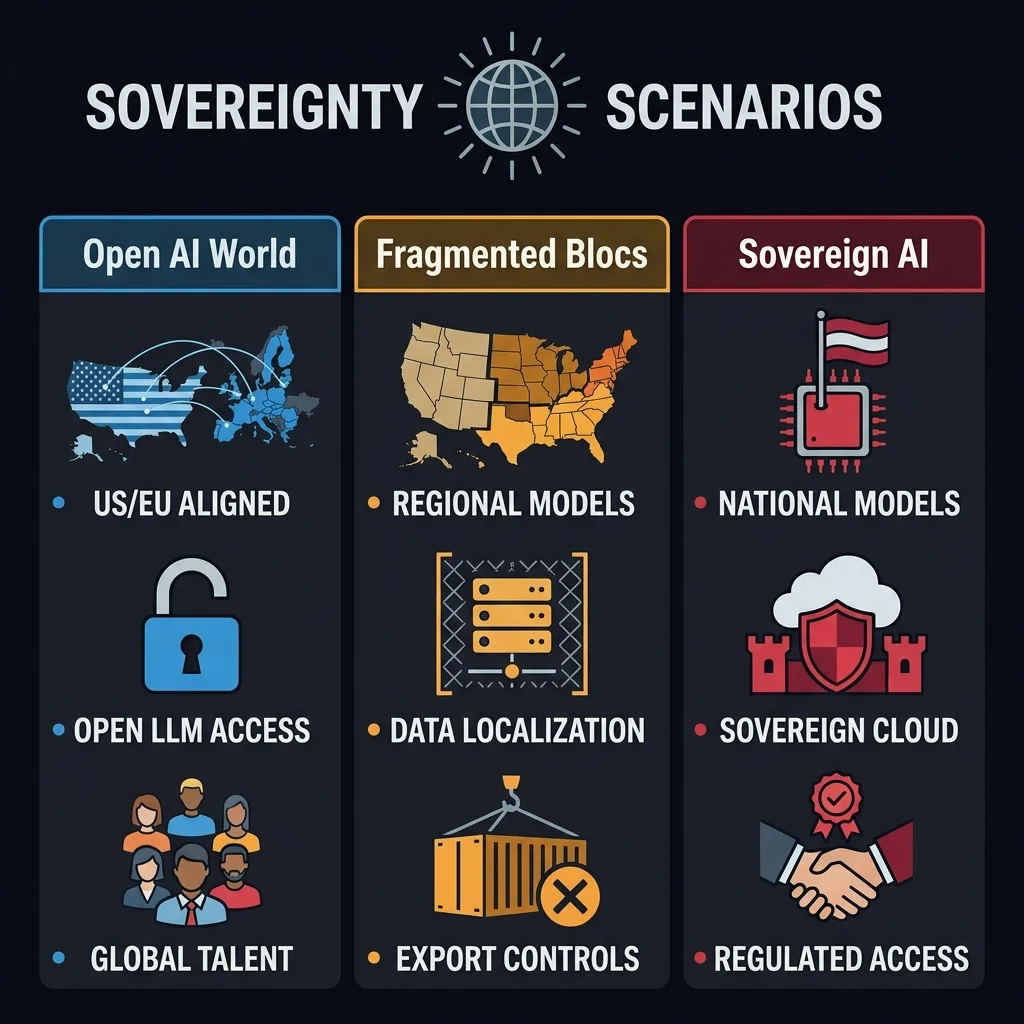
Scenario 1: Open AI World
US and EU AI regulation converges toward interoperability. Commercial AI models from major providers remain globally deployable. Data flows remain relatively open, with strong consent and transparency mechanisms but no hard localization requirements. Enterprises can operate a unified global AI stack.
This is the most favorable scenario for AI transformation economics. It's also the least likely scenario for regulated industries in the EU and select Asian markets.
Probability assessment (EY 2026): 25% probability for most enterprise sectors. Higher for technology-native companies in liberal data regimes.
Scenario 2: Fragmented Blocs
The EU, US, China, and emerging AI powers each develop distinct regulatory frameworks that are broadly interoperable but require compliance customization. Data localization requirements mean that some data types cannot leave their originating jurisdiction. Enterprises need regional AI stacks that share architecture but have jurisdiction-specific compliance layers.
This is the most likely near-term scenario for most multinational enterprises. It's manageable but expensive.
Probability assessment (EY 2026): 60% probability for enterprise sectors with EU, APAC, or regulated market exposure.
Scenario 3: Sovereign AI
National AI programs develop models that must be used for certain applications within their jurisdictions. The EU requires AI-Act-compliant models for high-risk applications. India requires data localization for healthcare and financial data. China's Cyberspace Administration imposes algorithmic governance requirements that practically require domestic model use.
Enterprises operating in multiple markets may need to run multiple sovereign AI stacks for regulated domains, connected by governance but not by shared model infrastructure.
Probability assessment (EY 2026): 40% probability for enterprises in healthcare, financial services, and government sectors. Already partially realized in EU and Chinese markets.
The Sovereignty Risk Assessment
The sovereignty risk assessment determines your current exposure to geopolitical AI fragmentation. It operates on five dimensions.
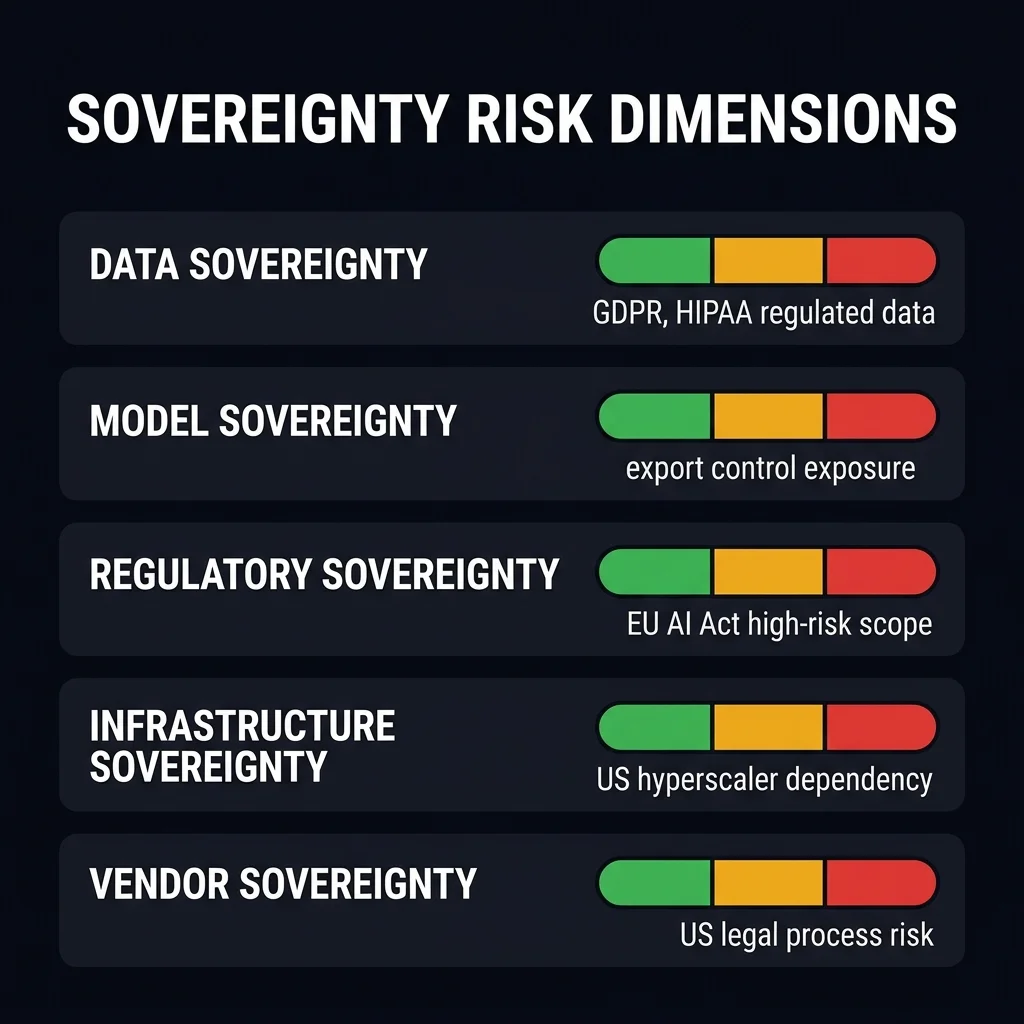
Dimension 1: Data sovereignty
Where does your enterprise data sit? Who owns it? Which jurisdictions have legal claims on it? Can your AI models be trained on data that can't leave a specific jurisdiction?
Enterprises with GDPR-regulated customer data in the EU already face this constraint. AI models trained on EU personal data may need to be trained and hosted in EU infrastructure — which changes the vendor selection, cost structure, and deployment architecture.
Dimension 2: Model sovereignty
Which AI models are you dependent on? What are the export control implications of those models? If the US restricts access to advanced AI models to certain allied nations, which of your markets are affected?
This is particularly relevant for enterprises with operations in markets that US export controls might target. Understanding your model supply chain — which vendors, which models, which cloud infrastructure — is essential.
Dimension 3: Regulatory sovereignty
Which jurisdictions have regulations that constrain what AI can do in your sector? The EU AI Act's high-risk classification applies to AI used in employment, education, credit, and critical infrastructure. If you operate in those domains in the EU, you need a conformity roadmap by August 2026.
Dimension 4: Infrastructure sovereignty
Where is your AI compute running? Cloud hyperscalers domiciled in the US may face restrictions on providing services to enterprises in certain markets. On-premise or regional cloud alternatives may be required for certain data types or applications.
Dimension 5: Vendor sovereignty
Which of your AI vendors are subject to which national laws? A US-based AI vendor is subject to US legal process, which means your data held by that vendor may be accessible to US government agencies under certain legal processes. For enterprises with EU operations, this creates GDPR risk.
The Data Localization Framework
For enterprises operating in multiple jurisdictions, data localization is the most immediate sovereignty challenge. The framework has four steps:
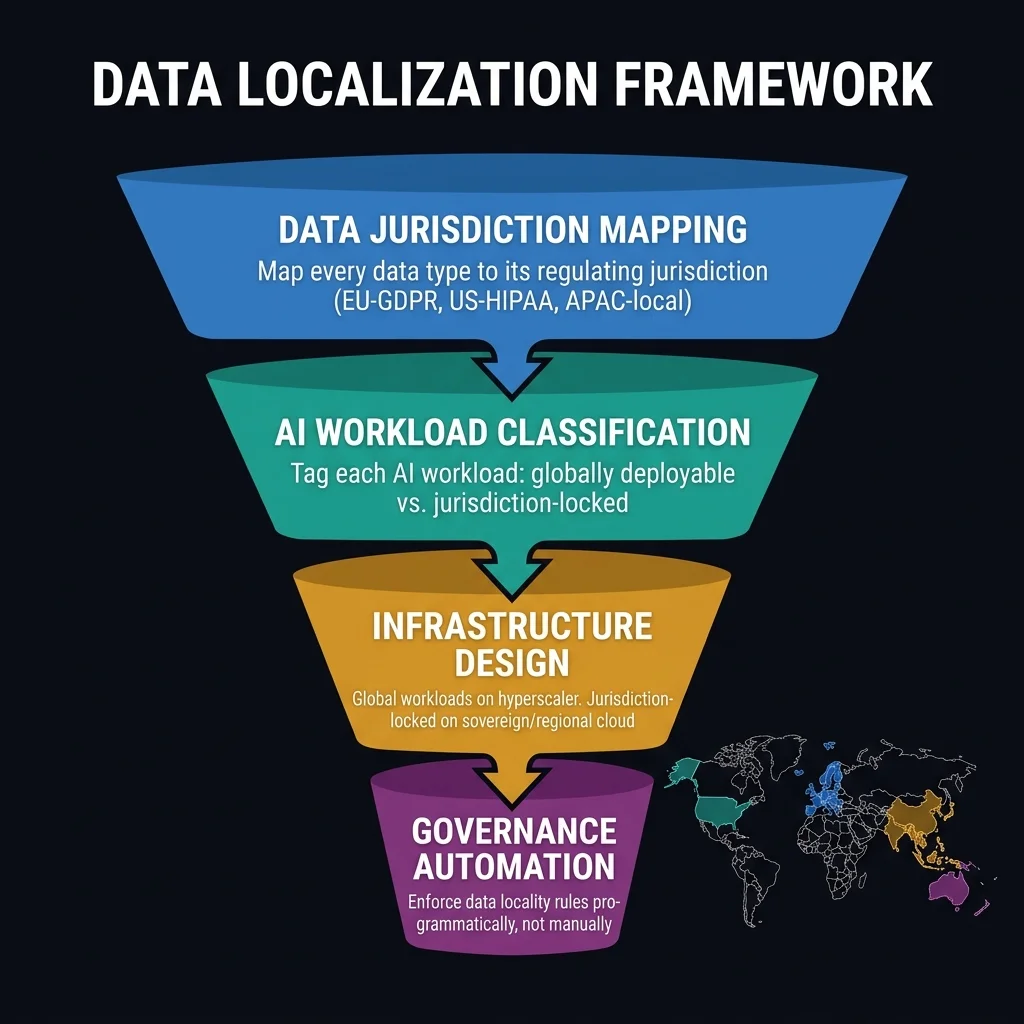
Step 1: Data jurisdiction mapping
Map every data type your enterprise generates or holds to the jurisdiction that regulates it. Personal data generated in the EU is regulated by GDPR. Health data from US-covered entities is regulated by HIPAA. Financial data from certain jurisdictions has specific storage requirements. This mapping reveals which data can be moved globally and which is jurisdiction-locked.
Step 2: AI workload classification
Classify each AI workload by the data it uses. Workloads that use only non-regulated data are globally deployable. Workloads that use jurisdiction-regulated data need to run in jurisdiction-compliant infrastructure.
Step 3: Infrastructure design
Design the infrastructure to match the workload classification. Global workloads on global hyperscaler infrastructure. Jurisdiction-locked workloads on regional or sovereign cloud infrastructure. The architectural complexity increases cost — factor this into transformation investment planning.
Step 4: Governance design
Create governance mechanisms that enforce the data jurisdiction mapping. Which teams can access which data? Which AI models can be trained on which data? Which vendors have access to which infrastructure? The governance design should be automated where possible — manual controls fail in complex multinational environments.
Disciplined Scaling Under Geopolitical Uncertainty
EY's "disciplined scaling" concept from their CEO Outlook framework is the practical response to operating in an uncertain geopolitical environment. It has three components:
Modularity first. Build AI capabilities as modular components that can be swapped, replicated, or isolated by jurisdiction. Don't build monolithic global AI systems that become brittle when regulatory requirements force architecture changes.
Portfolio diversification. Don't bet your AI transformation on a single model vendor, cloud provider, or regulatory scenario. Maintain capability across multiple model providers. Design for portability. The enterprises that win in a fragmented AI landscape are those that can adapt their stack to regulatory reality without rebuilding from scratch.
Regulatory investment. Treat compliance as a strategic asset, not a cost center. Enterprises with mature regulatory compliance capabilities can enter regulated markets faster and at lower risk than competitors who treat compliance as an afterthought. In markets where the EU AI Act applies, the enterprise that achieves conformity first has a significant competitive advantage.
90-Day Sovereignty Readiness Audit
This 90-day audit gives enterprises a practical starting point for sovereignty risk management.
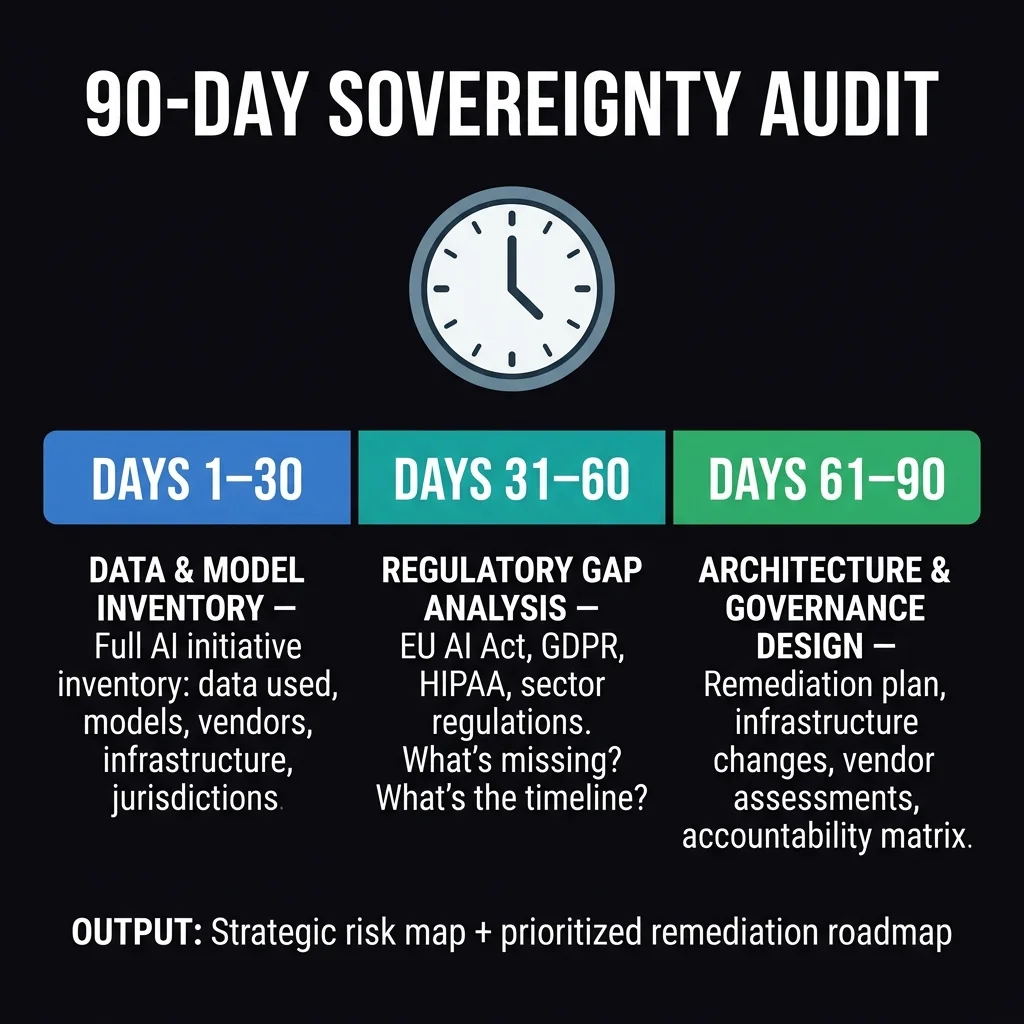
Days 1–30: Data and model inventory
Produce a complete inventory of all AI initiatives, including the data they use, the models they use, the vendors they depend on, and the infrastructure they run on. For each initiative, note the jurisdictions involved and any known regulatory constraints.
Days 31–60: Regulatory gap analysis
Against the inventory, assess each initiative for regulatory gaps. Which initiatives involve data or actions regulated by the EU AI Act, GDPR, HIPAA, or sector-specific regulations? What compliance steps are missing? What is the remediation timeline?
Days 61–90: Architecture and governance design
For initiatives with identified gaps, design the remediation. This includes infrastructure changes, governance controls, vendor assessments, and compliance documentation. Create a prioritized implementation roadmap with accountability assigned.
The 90-day audit isn't a compliance exercise. It's a strategic risk assessment. The output is a clear view of where geopolitical AI fragmentation creates operational and competitive risk — and a plan to address it.
Practitioner Take: The enterprises that are building modular AI architectures today — where model components can be swapped, data locality enforced, and vendor dependencies isolated — are not doing it because they've predicted exactly how geopolitical AI regulation will evolve. They're doing it because they've accepted that it will evolve in ways they can't fully predict, and modularity is the hedge. Rigidity in AI architecture is the same as rigidity in business strategy: it works brilliantly when the environment is stable and fails catastrophically when it's not.
Chapter 5 Next Steps
- Run the five-dimension sovereignty risk assessment for your enterprise AI portfolio. Which dimensions have the highest exposure? Where are the immediate remediation priorities?
- Model the three geopolitical scenarios against your current AI architecture and vendor stack. Which scenario creates the most disruption? What would you need to change to operate confidently under that scenario?
- Commission the 90-day sovereignty readiness audit with your CAIO, General Counsel, and CTO. The cross-functional involvement is essential — sovereignty risk is not a single-function problem.
The 2026–2030 CEO AI Maturity Roadmap {#roadmap-2030}
The five chapters of this playbook describe the building blocks. The roadmap describes the sequence.
| Time Horizon | Maturity Stage | Key Operating Model Milestone | P&L Signal |
|---|---|---|---|
| Q3–Q4 2026 | Foundation | TMO live; portfolio registry complete; decision rights matrix published; first sense-decide-act-learn loop designed | Cost avoidance from shadow portfolio cleanup |
| Q1–Q2 2027 | Integration | First two value chain loops operational; Intent Owner roles staffed; data foundation upgrade complete | First workflow cost reduction visible in P&L |
| Q3–Q4 2027 | Scale | Operating model patterns from first domains replicated across three additional domains; sovereignty compliance complete | Revenue line improvements visible; headcount productivity metrics improving |
| 2028 | Optimization | AI operating model is the standard operating procedure; human oversight structures mature; agentic capabilities deployed in high-confidence domains | Operating leverage improvement (revenue growing faster than headcount) |
| 2029–2030 | Reinvention | Business model itself has changed because AI has changed what's economically possible; new revenue streams from AI-native capabilities | Business model economics materially different from pre-transformation baseline |
The roadmap is not linear. Sovereignty constraints, organizational change saturation, and talent development timelines will create non-linearity. Plan for 12–18 months of buffer in the integration phase. Enterprises that try to rush from Foundation to Scale without allowing integration to prove out typically fail and have to rebuild the foundation.
The 2029–2030 reinvention stage is the one that most CEOs underestimate in their 2026 planning. AI doesn't just make your existing business more efficient. At sufficient maturity, it makes previously impossible business models possible. The CEO who plans only for efficiency improvement is building for a world that will look very different from the one they'll actually be operating in.
Key Takeaways {#key-takeaways}
- The deployment-transformation gap is a leadership problem, not a technology problem. Enterprises with strong AI technology but weak AI operating models generate 3× less ROI than enterprises with integrated operating models.
- Transformation requires operating model redesign — not just process automation. AI that doesn't change how decisions are made, how workflows are designed, and how P&L accountability is assigned isn't transformation.
- The Sense-Decide-Act-Learn loop replaces sequential planning cycles. Continuous operating loops enabled by AI generate decision velocity that sequential planning cannot match.
- The TMO is the mechanism that connects AI investment to business transformation. Without portfolio governance, decision rights clarity, and P&L accountability, AI programs accumulate without transforming.
- Change saturation is the most underestimated risk in AI transformation programs. Sequencing transformation waves based on organizational absorption capacity matters more than transformation speed.
- Union engagement must precede transformation announcement. The sequence — internal before external, employees before investors — is the difference between managed transition and organizational resistance.
- Geopolitical AI fragmentation is a strategic risk that requires modularity, not a compliance requirement to be managed at the regulatory layer. Enterprises that build modular AI architectures today will adapt faster when regulatory reality diverges from any single scenario.
- The 2029–2030 reinvention horizon requires business model imagination now. AI transformation that only plans for efficiency improvement is planning for a world that won't exist by the time the plan is complete.
FAQ {#faq}
Q: How long does AI transformation actually take for a large enterprise?
A: Honest answer: longer than most AI vendors will tell you. The Foundation phase — TMO, decision rights, first operating loop — takes 6–12 months. The Integration phase — proving value chain loops, staffing Intent Owners — takes another 12–18 months. The Scale phase begins in year 3 and takes another 12–24 months. Total: 3–4 years to reach what I'd call genuine AI transformation. Enterprises that claim transformation in 12 months have usually transformed one domain or one process, not their operating model.
Q: What's the single most important thing a CEO can do to accelerate AI transformation?
A: Assign a business leader (not a technology leader) to own AI transformation outcomes and give them budget authority. The second most important thing is to measure AI impact in business terms — revenue, cost, decision quality — not technology terms. Model accuracy, deployment count, and training hours are not transformation metrics.
Q: How do we handle AI in a heavily regulated industry where the regulator hasn't yet clarified the rules?
A: Design for modularity and defensibility. Don't wait for regulatory clarity before transforming. Design AI systems with clear audit trails, human oversight at decision thresholds, and documented governance — this is defensible to any regulator regardless of the specific rules they eventually publish. The enterprises that wait for perfect regulatory clarity will be 2–3 years behind by the time it arrives.
Q: Our union is hostile to AI transformation. How do we move forward?
A: Acknowledge the hostility as rational, not obstructive. Unions represent workers whose livelihoods are at stake. The hostility dissipates when the enterprise demonstrates that transformation includes a genuine commitment to workforce transition — retraining with real timelines, redeployment with real opportunities, and transparent communication about role impact. The enterprises that break through union resistance do so with transparency and commitment, not by trying to move fast before the union can respond.
Q: What's the right size for a TMO?
A: Smaller than you think. A TMO with more than 15 people typically becomes bureaucratic. The core TMO team — portfolio governance, decision rights enforcement, value tracking — can operate with 6–10 people. The heavy lifting is done by the business units and CoE they coordinate. A large TMO staff is a warning sign that the TMO is doing execution instead of governance.
Q: How do we manage a CEO who doesn't understand AI well enough to lead transformation?
A: This is the most common question I get, usually from the person one level below the CEO. The practical answer: lead up. Provide the CEO with structured learning — 30-minute briefings on specific AI concepts tied directly to business decisions they're already making. CEOs who don't understand AI can still lead AI transformation if they trust the governance structure and hold the organization accountable for business outcomes. Understanding the technology isn't the prerequisite. Understanding what accountability for outcomes requires is.
Q: Should we build AI capabilities internally or use vendors?
A: This isn't a binary choice. Build the capabilities that are strategic differentiators — proprietary data processing, domain-specific models, unique workflow integration. Buy the capabilities that are commoditizing — general-purpose foundation models, standard document processing, off-the-shelf analytics. The balance shifts over time as the market matures. The governance question — who owns the outcome regardless of build/buy — never changes.
Q: How do we prevent the AI transformation from becoming an excuse to cut headcount without investing in new capabilities?
A: This is a governance question. The TMO should require that every AI initiative with headcount impact has an explicit workforce transition plan — what roles are impacted, what the redeployment path is, what the retraining commitment is. Transformation that only cuts and doesn't create new capability is efficiency improvement, not transformation, and it typically destroys the employee trust that future transformation depends on.
Q: What should the CEO's AI transformation be communicating to investors?
A: The same thing you track internally: business outcomes, not technology activity. Investor communication about AI transformation should reference specific P&L impacts, operational improvements, and strategic positioning advantages — not the number of AI models deployed or the size of the AI team. Investors are increasingly sophisticated about distinguishing AI activity from AI value creation.
Q: Is there a difference between AI transformation in manufacturing vs. services vs. knowledge work?
A: The principles are the same. The implementation differs. Manufacturing AI transformation centers on supply chain, quality, and predictive maintenance — high-frequency operational decisions with rich sensor data. Services AI transformation centers on customer interaction, service delivery, and exception handling — high-volume decisions with variable data quality. Knowledge work AI transformation centers on content, decision support, and expertise augmentation — high-judgment decisions with unstructured data. The sense-decide-act-learn loop applies in all three, but the "sense" and "decide" layers look different in each context.
About the Author {#about}
Start Your Transformation
AI transformation isn't a technology program. It's a business leadership program enabled by technology.
The operating model described in this playbook — diagnostic clarity, value chain redesign, TMO governance, talent design, and sovereignty strategy — isn't a blueprint you read. It's one you implement, quarter by quarter, with clear accountability and honest measurement.
The enterprises that move from pilots to P&L proof in 2026 will do so not because they had better AI, but because they had better operating models.
Start with Chapter 1's diagnostic. Run it with your leadership team this week. The conversation it starts is the one that determines whether you're deploying AI or transforming with it.
Ready to design your AI transformation operating model? Work with Vatsal Shah →