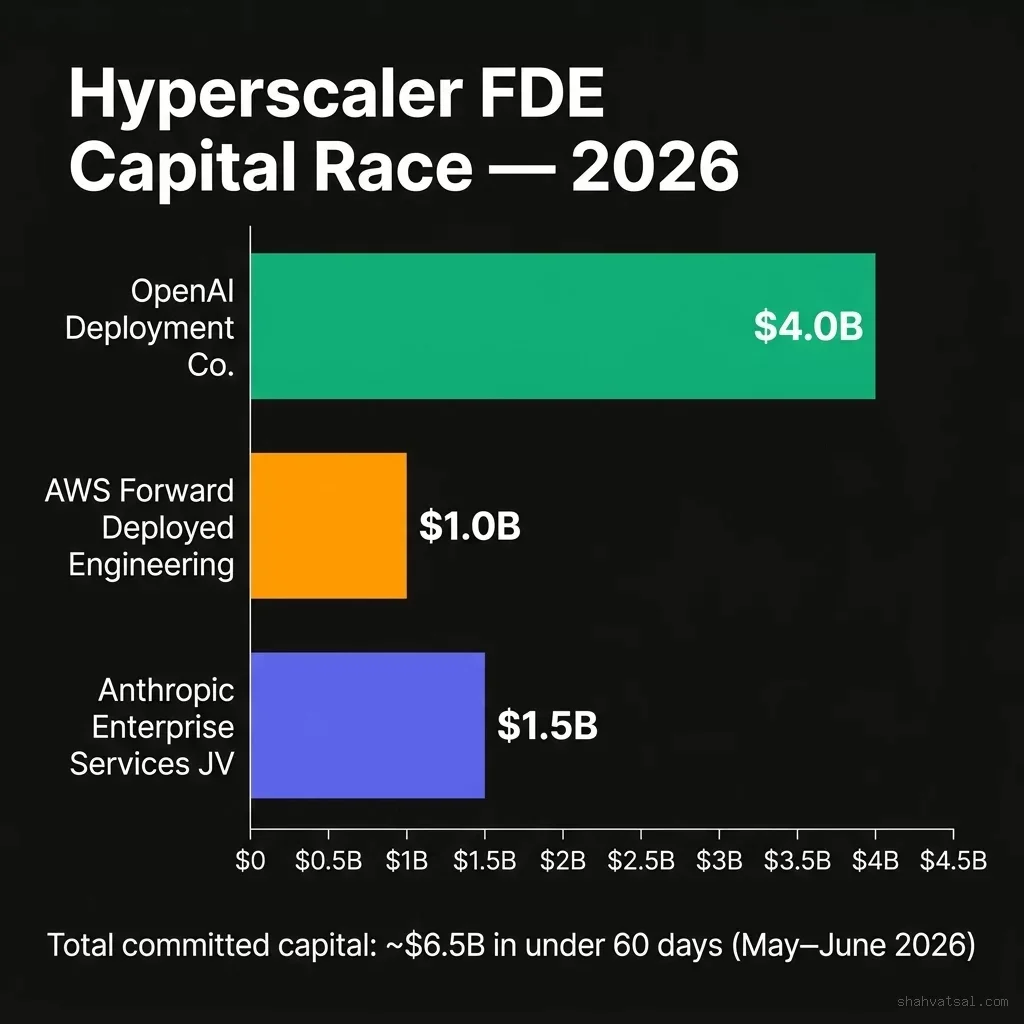
AWS has launched a $1 billion Forward Deployed Engineering organization that puts pods of five to six engineers directly inside enterprise customers — aiming to deliver production AI agent systems in as little as 45 days. Announced June 30, 2026, the program is the cloud giant's most direct entry yet into hands-on implementation services, and arrives two months after OpenAI ($4 billion) and Anthropic ($1.5 billion) formalized their own enterprise deployment arms.
What AWS Has Built
The AWS Forward Deployed Engineering (FDE) organization, announced by Francesska Vasquez, VP of Frontier AI Engineering and Services at AWS, is structured around three distinguishing principles: agentic-first delivery, compressed timelines, and a self-sufficiency exit model.
Unlike traditional consulting that delivers recommendations and treats each engagement as a standalone project, AWS FDE embeds engineers as builders inside customer teams. They work directly with business, engineering, and security counterparts to ship production systems using the customer's own data, governance, and AWS infrastructure.
The investment positions AWS alongside competitors that have each made similar moves within the same 60-day window. By June 30, the combined committed capital across OpenAI, Anthropic, and AWS totals approximately $6.5 billion — a signal that hands-on AI deployment has become the defining competitive arena for 2026.
The 45-45-45 Cycle
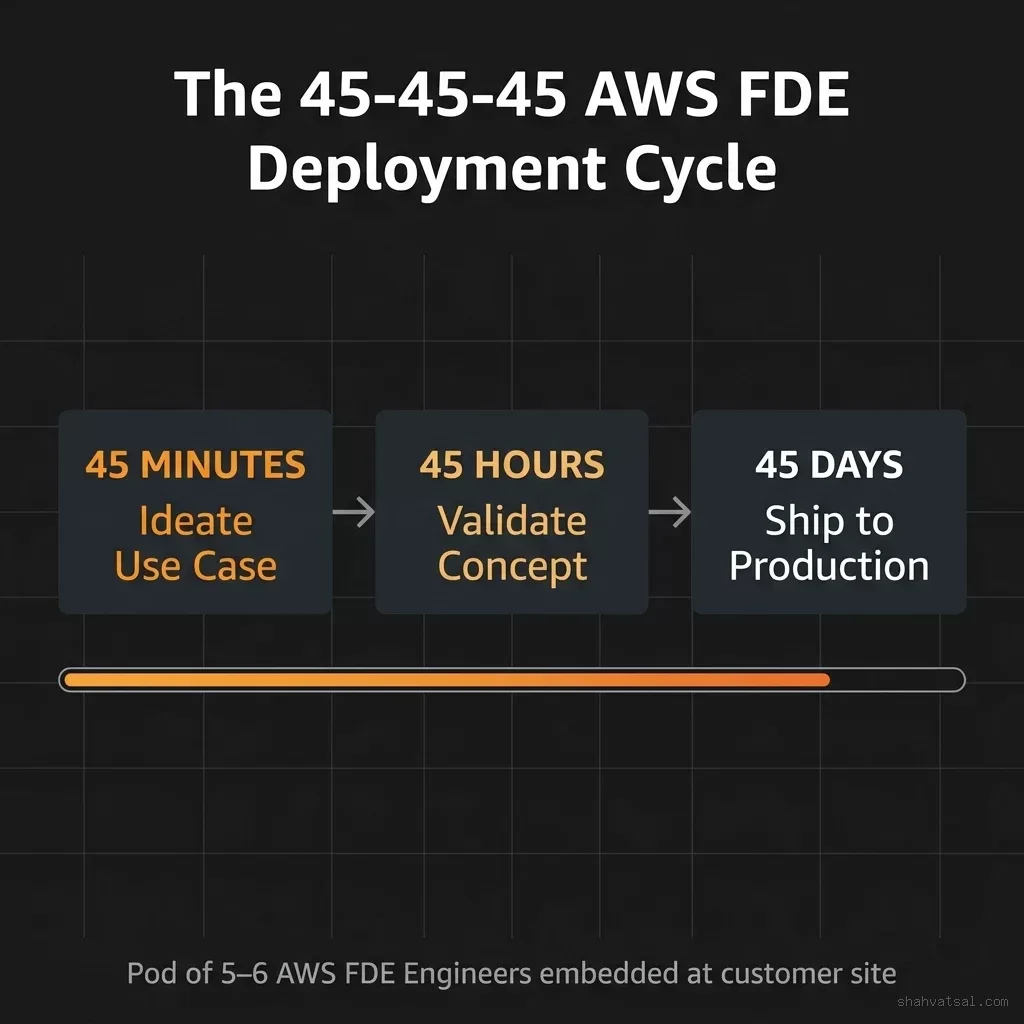
At the operational core of FDE is the 45-45-45 framework:
- 45 minutes to ideate a use case with the customer team
- 45 hours to validate the concept with data and tooling
- 45 days to ship a production-ready AI agent system
Each pod uses AWS's own agentic deployment technology and the AI-Driven Development Lifecycle (AIDL), a methodology that uses AI agents to accelerate every phase of software delivery while keeping human engineers in the oversight seat. The intent is that agents build agentic solutions — a compounding loop that customers can inherit and extend after the engagement ends.
Self-Sufficiency as Exit Criteria
The self-sufficiency model is where FDE departs most clearly from traditional consulting. Vasquez stated that customers leave each engagement with:
- Deployed AI agent systems running in their own AWS account
- Knowledge graphs encoding the customer's business ontology
- Architectural runbooks and documentation
- Trained internal champions capable of operating and extending the systems independently
A semantic layer, deployed into the customer's AWS environment during the engagement, connects to enterprise data sources and builds a governed, versioned knowledge graph. Agents reason over this graph, which means the domain expertise lives in code — not in people who rotate off when the engagement ends. Customer data never leaves the customer's own governance framework; hardware-based isolation and end-to-end encryption are built in from day one.
Early Customers: NFL, NBA, Southwest, Cox, Ricoh
AWS FDE teams are already active at six high-profile organizations:
NFL — FDE engineers partnered with the league to launch NFL Fantasy AI and NFL IQ, two fan-facing products deployed in weeks rather than months. Gary Brantley, the NFL's Chief Information Officer, said the engagement let the league "innovate at the pace and scale needed to meet the high expectations of our fans."
NBA, Southwest Airlines, Cox Automotive, Ricoh, and the Allen Institute — also confirmed as early customers, though AWS did not disclose financial terms or the size of each engagement.
The customer list is notable for its cross-sector range: sports media, automotive retail, airlines, hardware manufacturing, and academic research. Each represents a category where production AI workflows — not just experiments — carry meaningful operational leverage.
Where AWS Stands in the Hyperscaler FDE Race
AWS's entry into FDE is both offensive and defensive:
Offensive: AWS has been building AI solutions with customers since 2017. The AWS Generative AI Innovation Center — predecessor to FDE — has delivered thousands of engagements, including helping BMW reduce service disruptions across 23 million connected vehicles and helping Lyft resolve driver support issues 87% faster. FDE formalizes that capability into a scaled, funded org.
Defensive: Anthropic held approximately 32% of enterprise LLM market share as of Menlo Ventures' 2025 mid-year report, compared to OpenAI's 25% and Google's 20%. Both competitors were moving aggressively to embed their own engineers at customer sites. Without a matching capability, AWS risked its cloud infrastructure becoming a commodity backend while model providers captured the higher-margin implementation layer.
The FDE org is also explicitly designed to lock workloads onto AWS infrastructure. By building customer systems on Amazon Bedrock and AWS-native services, the org creates durable switching costs that protect revenue long after each engagement ends.
Context: The FDE Race Reshapes Enterprise AI
The term "forward deployed engineer" was coined by Palantir more than a decade ago. It describes engineers who live at the customer site, understand the customer's systems more deeply than any remote team could, and build solutions that fit precisely into existing workflows. In 2025, job postings for the role surged over 800% between January and September — a signal that the industry had agreed the implementation gap, not model capability, was the primary bottleneck for enterprise AI adoption.
OpenAI's Deployment Company raised $4 billion from 19 investors led by TPG and acquired Edinburgh-based AI consultancy Tomoro, bringing approximately 150 forward deployed engineers in-house. Anthropic formalized its enterprise services arm through a $1.5 billion joint venture with Blackstone, Hellman & Friedman, and Goldman Sachs. Two days after AWS's FDE announcement, Microsoft responded with the Frontier Company — a separate entity housing over 6,000 engineers backed by $2.5 billion, focused on embedding AI capabilities at large enterprise accounts.
For context on related FDE moves, see the Microsoft Frontier Company analysis and Uber's internal Agentic Pods model.
The competitive dynamic has now produced over $6.5 billion in committed capital across four organizations — all targeting the same 90-day window of 2026. The message from every hyperscaler is consistent: shipping AI into production, not selling API access, is where the margin is.
What This Means for Enterprise Buyers
For organizations evaluating AI implementation partners, the AWS FDE launch changes the calculus in three ways:
Speed. The 45-day production target is aggressive by any standard. Traditional consulting projects of comparable complexity typically span six to eighteen months. If AWS can consistently deliver, it compresses the timeline for enterprises to realize ROI from agentic AI.
Ownership transfer. The self-sufficiency exit model means customers are not permanently dependent on AWS engineers — a meaningful differentiator from consulting models that optimize for billable hours. The knowledge graph and runbook artifacts become permanent internal assets.
Infrastructure lock-in. Solutions built through FDE will run on AWS infrastructure, on Bedrock, with AWS security and governance defaults. Buyers who are already heavily invested in AWS cloud will find alignment straightforward. Buyers on multi-cloud or competitor infrastructure should factor migration costs into any evaluation.
For regulated industries — financial services, healthcare, government — where data governance is non-negotiable, the on-premises data model (customer data stays in the customer's AWS account) is a meaningful risk mitigation.
Sources: About Amazon · TechCrunch · SiliconANGLE · MLQ News
Frequently Asked Questions
What is AWS Forward Deployed Engineering?
AWS Forward Deployed Engineering (FDE) is a $1 billion organization launched by AWS in June 2026. It embeds small pods of five to six expert engineers directly inside enterprise customers to build and deploy production AI agent systems — with a target delivery timeline of 45 days from ideation to live production.
How does the 45-45-45 AWS FDE cycle work?
The 45-45-45 framework is the operational blueprint for FDE engagements: 45 minutes to ideate a use case with the customer team, 45 hours to validate the concept using data and tooling, and 45 days to ship a fully production-ready agentic solution integrated into the customer's systems, data, and governance framework.
Who are the first AWS FDE customers?
Confirmed early customers include the NFL, NBA, Southwest Airlines, Cox Automotive, Ricoh, and the Allen Institute for AI. The NFL partnership resulted in two fan-facing products — NFL Fantasy AI and NFL IQ — launched in production within weeks of engagement.
How does AWS FDE differ from traditional AI consulting?
AWS FDE is structured around shared business outcomes rather than billable hours. Engineers deploy agentic AI tools to accelerate every phase of delivery, and the engagement is explicitly designed to leave customers fully self-sufficient — with knowledge graphs, architectural runbooks, and trained internal champions — when the engagement concludes.
How does AWS FDE compare to OpenAI and Anthropic's enterprise services?
OpenAI's Deployment Company raised $4 billion from 19 investors including TPG and acquired AI consulting firm Tomoro (approximately 150 FDE engineers). Anthropic's enterprise joint venture with Blackstone, Hellman & Friedman, and Goldman Sachs totals $1.5 billion. AWS committed $1 billion. Combined, the three organizations represent approximately $6.5 billion in committed capital in under 60 days (May–June 2026).