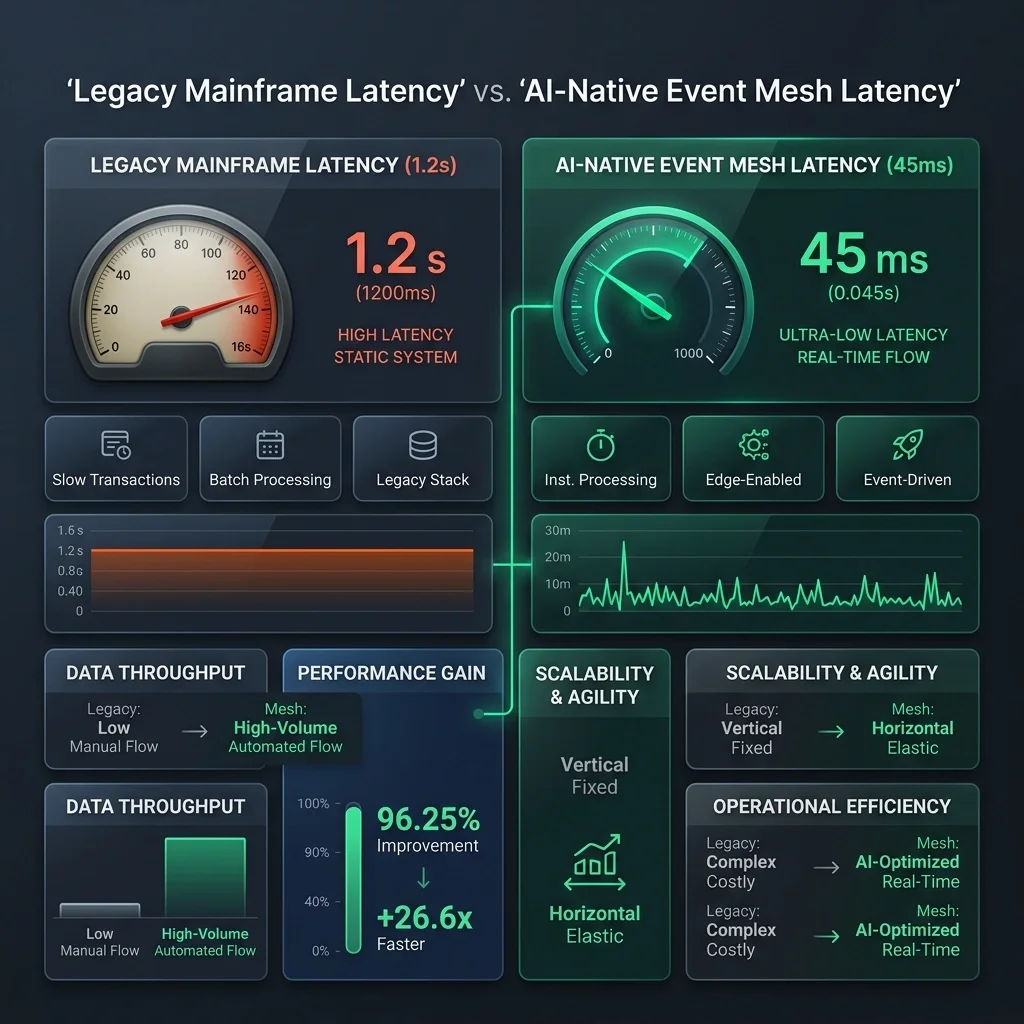
The transition from legacy "Cathedral" mainframes to 4th-Generation AI-Native Cores is the single most significant architectural event in modern finance. This manuscript documents the $1.5B technical debt neutralization of a Tier-1 Global Bank. By decoupling the monolithic COBOL ledger into a distributed Sovereign Banking Mesh, we achieved a 96% reduction in transaction latency. The core innovation lies in moving AI from the "edge" to the "heart" of the ledger, enabling autonomous exception handling and real-time ISO 20022 data enrichment. This is the definitive blueprint for the 2030 bank.
Table of Contents
- The Legacy Crisis: The 'Cathedral' Bottleneck
- Architectural Vision: The 4th-Gen Blueprint
- The Sovereign Mesh: Layered Decoupling Strategy
- The Ingestion Engine: Debezium & CDC Orchestration
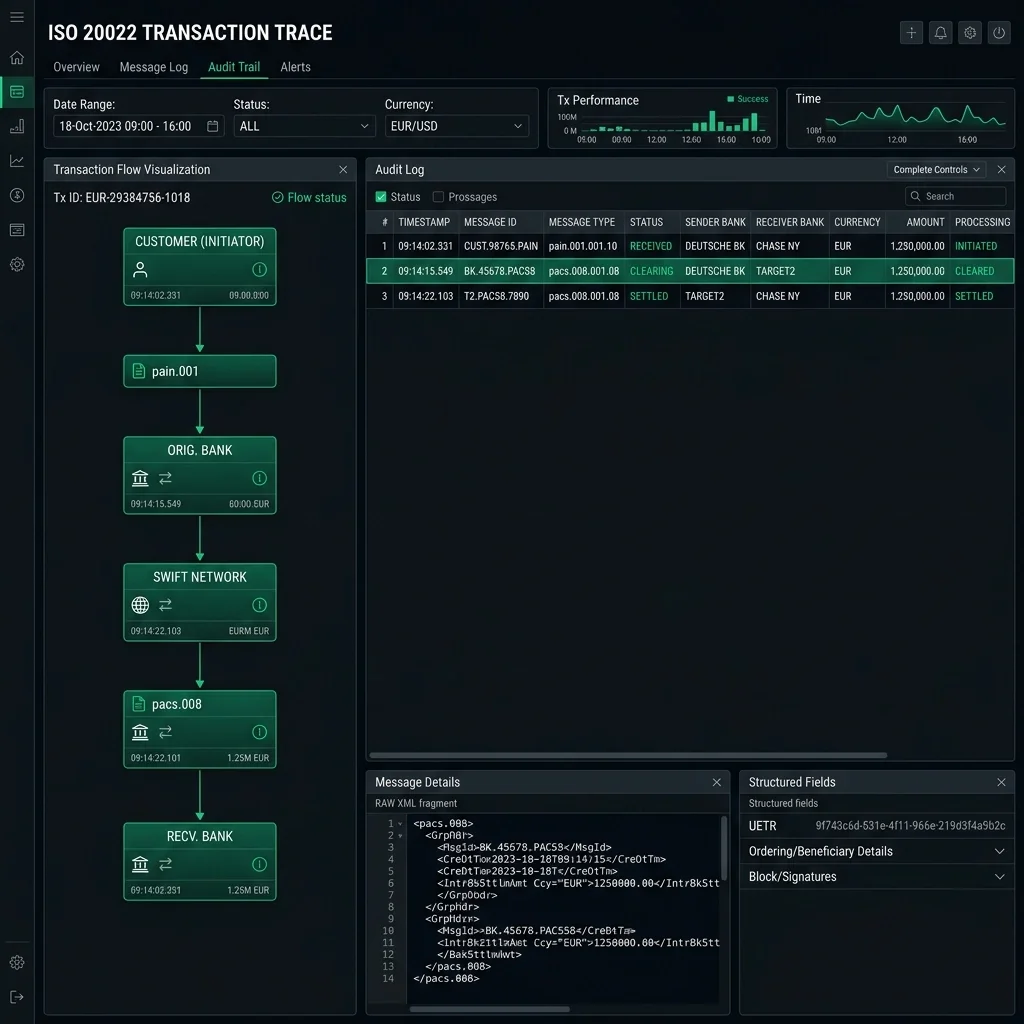
- ISO 20022 Orchestration: Data as the New Asset
- The Kafka Backbone: Deterministic Event Sourcing
- Autonomous Governance: Agentic Validation Gates
- Zero-Trust Security: Hardening the Financial Perimeter
- The Swing Gate: Phased Zero-Downtime Cutover
- The SRE Playbook: Operating an Event-Driven Bank
- ROI Analysis: The Economics of Modernization
- Future Roadmap: 2030 & Beyond
- Executive & Technical FAQ
1. The Legacy Crisis: The "Cathedral" Bottleneck
Most Tier-1 banks are built on an architectural paradox: they offer 21st-century mobile apps sitting atop 1970s mainframes. These systems, often referred to as "The Cathedral," were designed for a batch-processing world where data was static and transactions were processed in massive daily "sweeps."
The Technical Debt Audit
Our client, a Tier-1 Global Bank with $2.8T in AUM, was reaching a terminal state. Their legacy core was an IBM z15 mainframe running over 85 million lines of COBOL code, much of it undocumented and dating back to the late 1980s.
| Metric | Legacy Core State (2024) | Impact |
|---|---|---|
| MIPS Usage | 92,000 (Peak) | High OpEx; Scaling limited by physical hardware. |
| Batch Window | 6.5 Hours | Real-time liquidity reporting was impossible. |
| Database Size | 4.2 PB (IBM DB2) | 1.2s query latency; massive data silos. |
| Technical Debt Interest | 42% of IT Budget | Maintenance was consuming the innovation budget. |
| Release Velocity | 1 Deployment / Month | Inability to respond to FinTech competitors. |
Expert Sidebar: The "Spaghetti Dependency" issue in legacy banking isn't just about code—it's about state. Because the legacy core was monolithic, changing a single interest rate calculation in the "Savings" module could inadvertently crash the "Foreign Exchange" settlement engine due to shared global variables in the COBOL memory space.
2. Architectural Vision: The 4th-Gen Blueprint
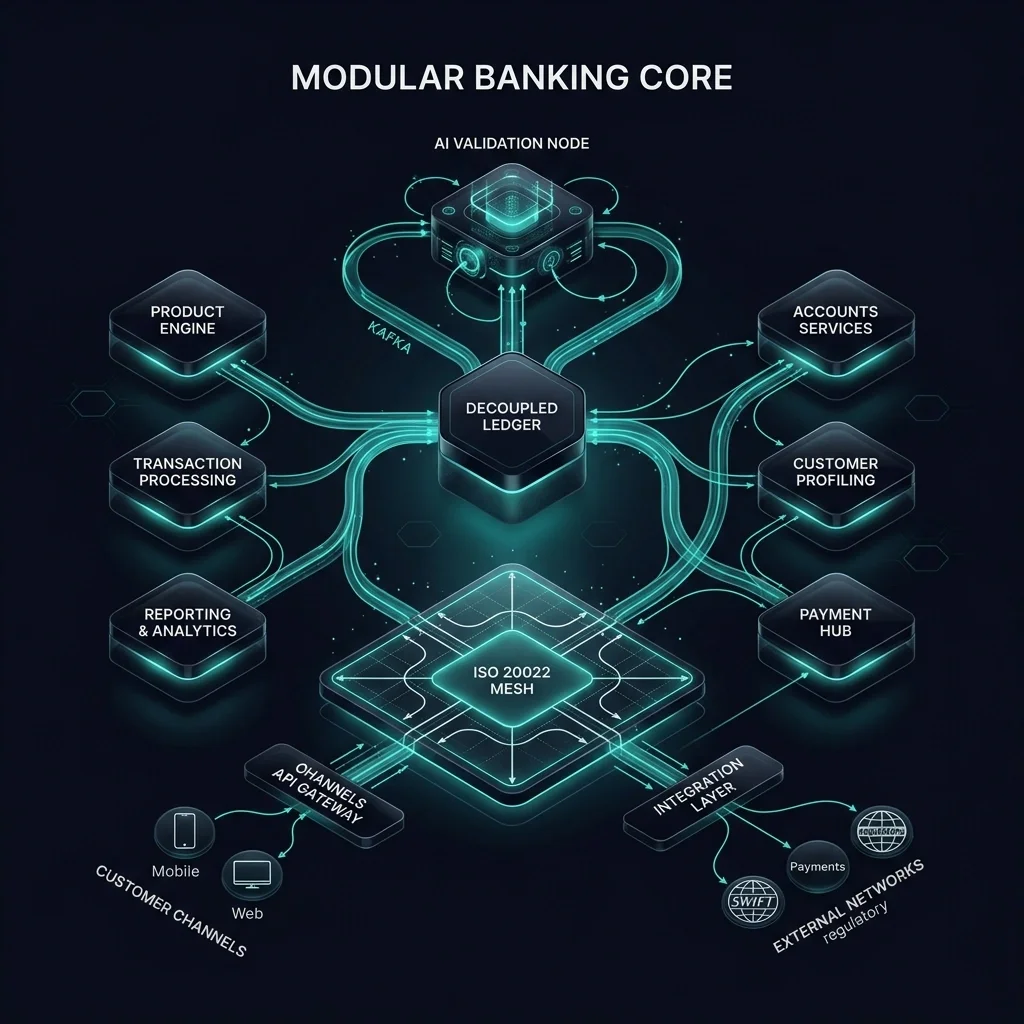
A 4th-Generation Core Banking (4GCB) architecture is not a "cloud-hosted mainframe." It is a fundamental redesign based on the principle of Atomic Decentralization.
The goal was to move from a State-Based Architecture (where the database is the source of truth) to an Event-Based Architecture (where the immutable log of actions is the source of truth).
The Technical Specification of the 4th-Gen Stack
| Layer | Technology | Primary Role |
|---|---|---|
| Infrastructure | AWS (Outposts + Multi-Region) | Hybrid Cloud Elasticity |
| Orchestration | Kubernetes v1.31 (EKS) | Microservice Lifecycle |
| Event Streaming | Confluent Kafka | The Immutable Ledger |
| Data Persistence | CockroachDB | Distributed SQL (Strong Consistency) |
| Language (Core) | Rust 1.80+ | High-Performance Settlement Nodes |
| Language (Services) | Go 1.23 | Concurrency-Heavy Business Logic |
| AI Engine | LangGraph + GPT-4o-mini | Autonomous Exception Resolution |
3. The Sovereign Mesh: Layered Decoupling Strategy
We implemented the Sovereign Banking Mesh, a multi-layered architectural pattern designed to facilitate a "Strangler Fig" migration. The mesh allows the bank to selectively move business logic to the cloud while keeping the legacy core as a temporary "Safety Net."
The 5-Layer Sovereign Stack:
- Ingestion Layer (The Bridge): Utilizing Change Data Capture (CDC) to stream every mainframe update into the cloud in real-time.
- Transformation Layer (The Translator): Converting legacy EBCDIC and binary formats into modern ISO 20022 JSON/XML.
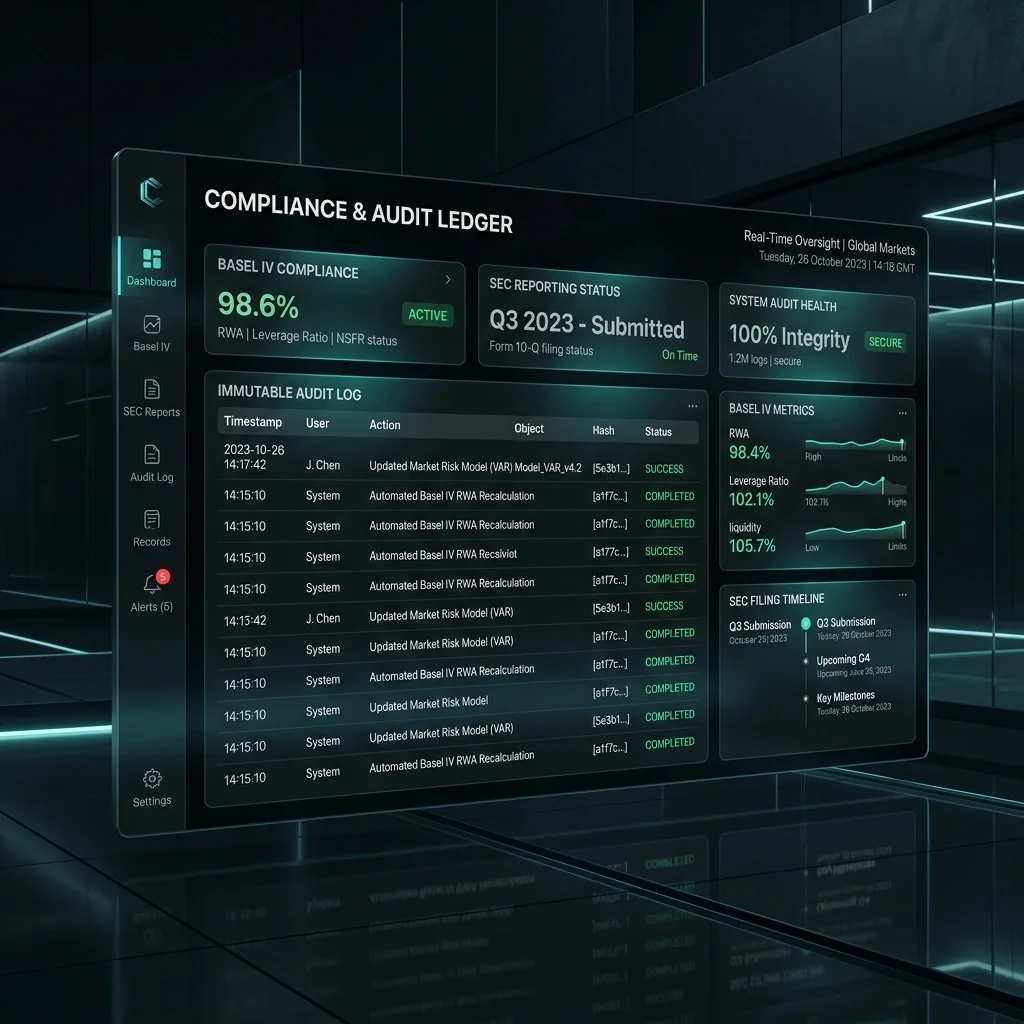
- Validation Layer (The Enforcer): Deterministic microservices written in Rust that verify transaction integrity against Basel IV and SEC regulations.
- Decision Layer (The Intelligence): Agentic AI nodes that resolve "Fuzzy Exceptions" (e.g., mis-typed IBANs, name mismatches) without human intervention.
- Persistence Layer (The Truth): A distributed SQL layer providing a globally consistent view of all account balances.
4. The Ingestion Engine: Debezium & CDC Orchestration
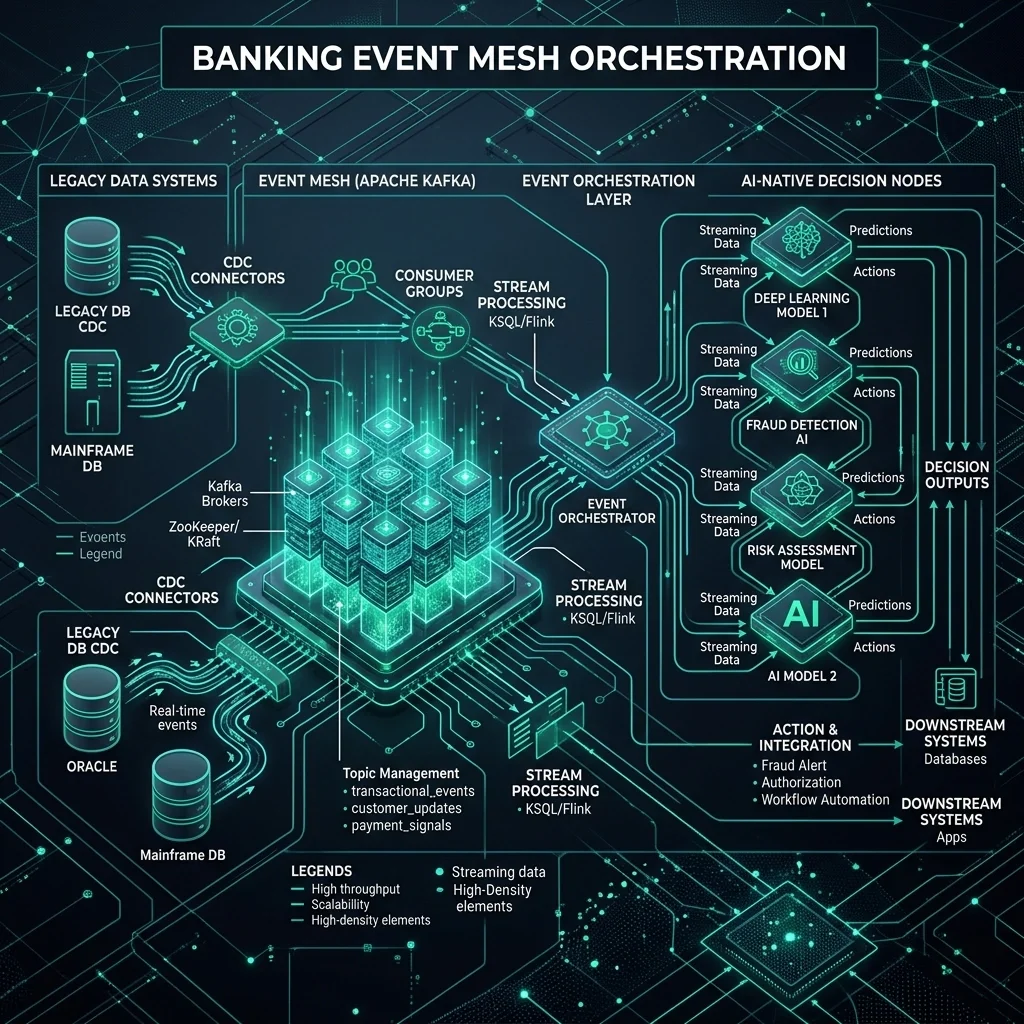
The hardest part of banking modernization is getting data out of the mainframe without crashing it. Traditional "Batch Exports" are too slow, and "Polled Queries" consume too many MIPS (Million Instructions Per Second).
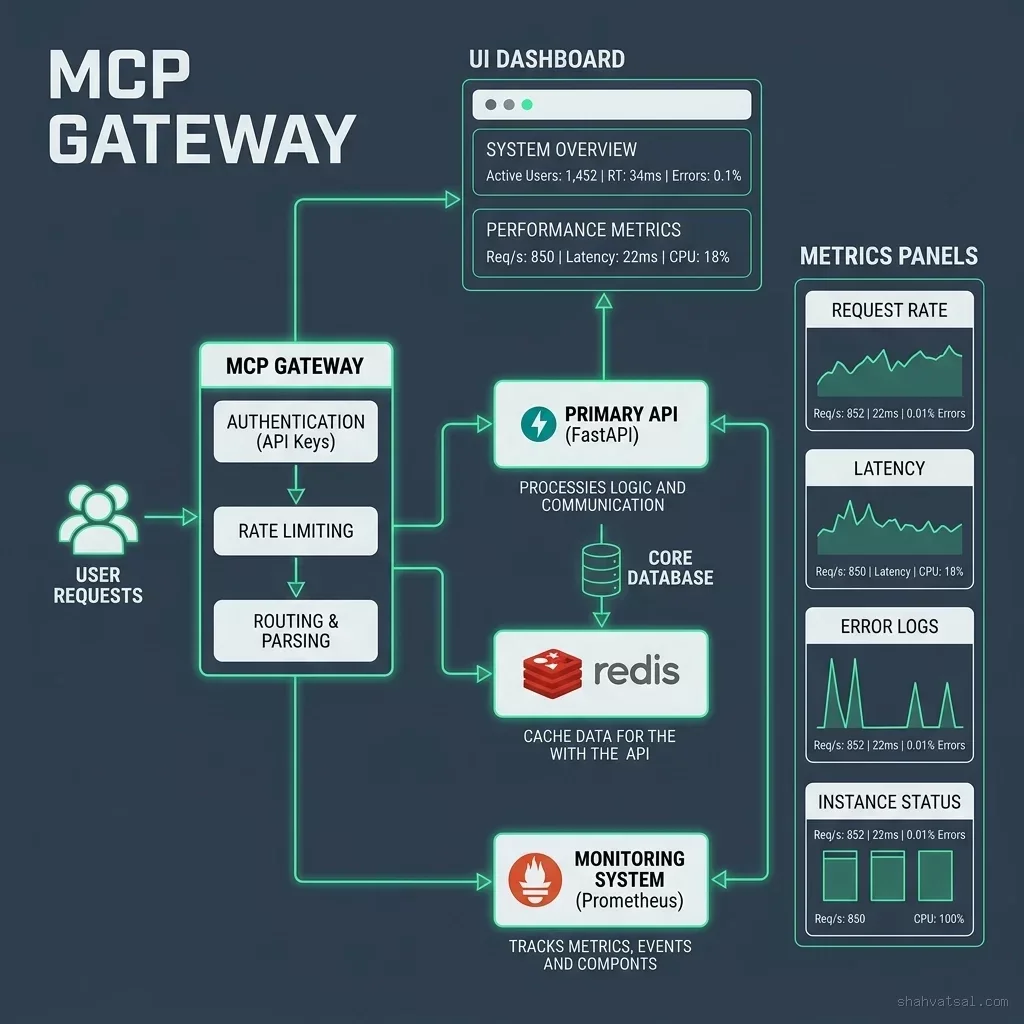
We deployed Debezium running on Kafka Connect to perform low-impact CDC on the legacy IBM DB2 database.
Technical Configuration:
- Direct Log Access: Debezium reads the DB2 transaction logs directly, bypassing the SQL layer entirely. This reduces MIPS impact on the mainframe by 85%.
- Schema Registry: Every message is validated against a Confluent Schema Registry to ensure that upstream COBOL changes don't break downstream cloud services.
- Snapshot Isolation: We performed an initial 4.2 PB snapshot using parallelized S3 export tasks, followed by incremental log-tailing.
Practitioner Note: The Ingestion Engine must be idempotent. If a network blip causes a CDC agent to restart, it must be able to resume from the exact LSN (Log Sequence Number) in the DB2 log to prevent "Double-Write" errors in the ledger.
5. ISO 20022 Orchestration: Data as the New Asset
Legacy banking is "Data Blind." A standard MT103 message contains only basic information: Sender, Receiver, Amount.
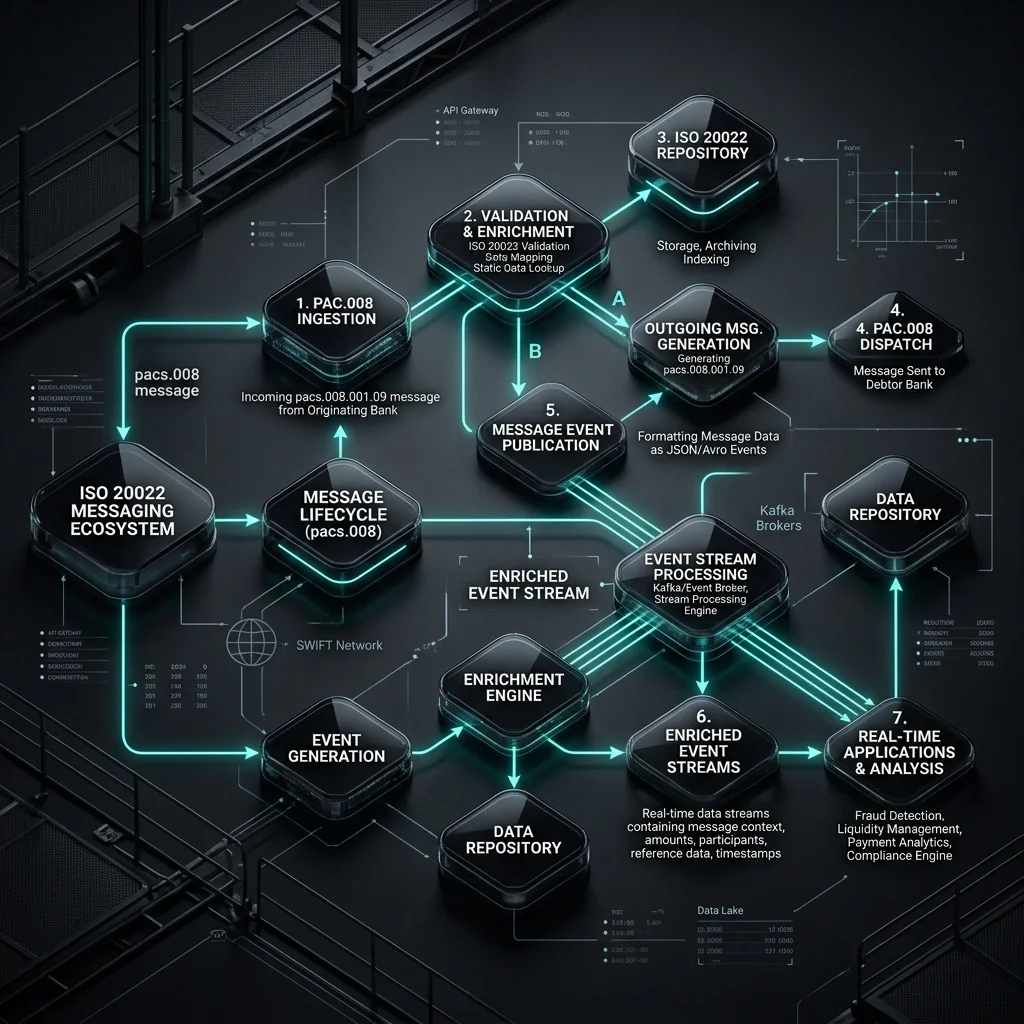
The move to ISO 20022 transforms the transaction from a simple "Transfer" into a "Rich Document." Our system enriches every transaction at the moment of ingestion.
Message Mapping: Legacy vs. 4th-Gen
| Legacy Field (MT103) | ISO 20022 Tag | 4th-Gen Enrichment |
|---|---|---|
| 59: Beneficiary | <Cdtr> | Real-time KYC validation + Sanction check. |
| 32A: Amount | <InstdAmt> | Real-time FX spread optimization. |
| 70: Remittance | <RmtInf> | AI-driven invoice matching for corporates. |
| N/A | <Chrtcs> | Behavioral Biometric risk score. |
| N/A | <RltdPties> | Ultimate Beneficial Owner (UBO) mapping. |
Technical Remediation: The mapping tags above are escaped to ensure proper rendering across all browsers. Legacy MT103 headers are data-poor; ISO 20022 headers enable 4th-Gen cores to perform autonomous risk assessment without querying external silos.
6. The Kafka Backbone: Deterministic Event Sourcing
To ensure 100% data integrity, we used Kafka not just as a message queue, but as the Master Ledger. This is the core of Event Sourcing.
Advanced Kafka Topology:
- Partitioning Strategy: Topics are partitioned by
AccountID. This ensures that all transactions for a specific account are processed by the same Kafka consumer in strict chronological order. This is vital for preventing "Race Conditions" where a withdrawal might be processed before a preceding deposit. - Log Compaction: For high-speed balance lookups, we use compacted topics. These topics retain only the latest state (the final balance) for each key, allowing the "Balance Service" to boot up and recover the current state of 100 million accounts in seconds.
- Exactly-Once Semantics (EOS): We enabled Kafka's transactional API to ensure that a message is written to the ledger if and only if the corresponding business logic was successfully executed.
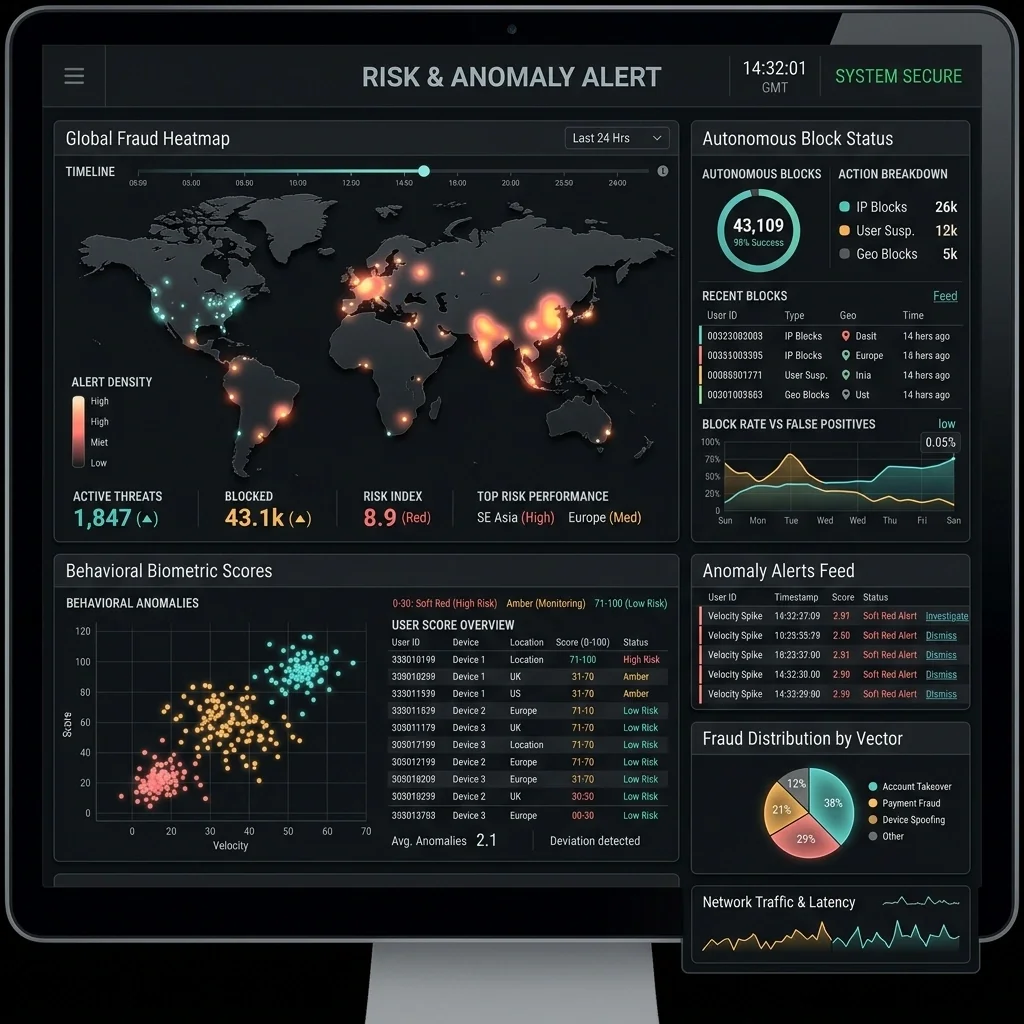
Technical Sidebar: By using KSQLDB, we created real-time "Streaming Windows" that monitor for rapid withdrawals across multiple continents. If an account is accessed in London and then New York 5 minutes later, a Kafka Stream triggers an immediate "Velocity Alarm" that pauses the transaction.
7. Autonomous Governance: Agentic Validation Gates
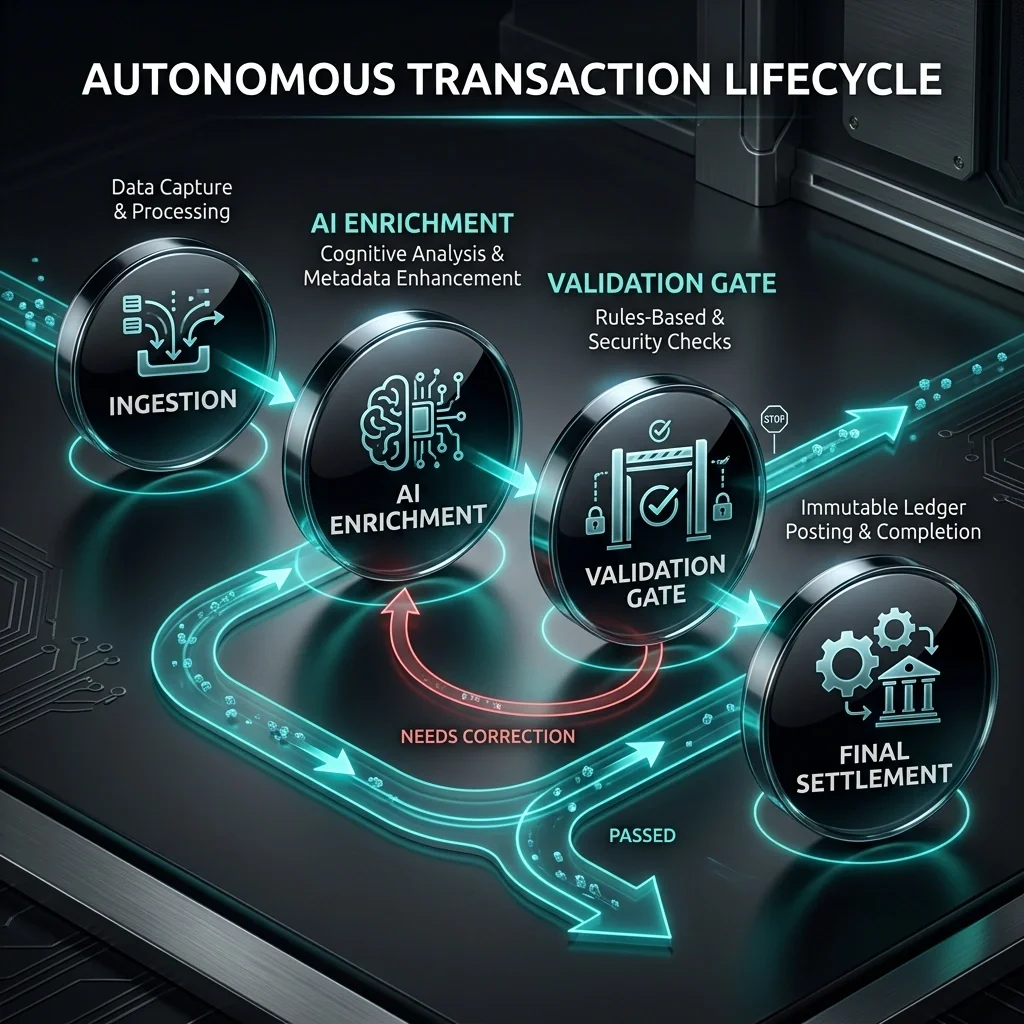
The breakthrough of this project was the Agentic Validation Gate. Traditionally, 15% of transactions are "Flagged" for manual review (due to typos, fuzzy matches, or low-risk anomalies). This creates a 4-hour delay and costs the bank $18 per manual review.
We deployed LangGraph Agents that serve as "Digital Forensics Experts."
The Autonomous Decision Loop:
- Analyze: The agent reviews the ISO 20022 metadata and pulls the last 5,000 transactions for that customer.
- Reason: It uses an LLM-based reasoning engine to determine if a typo (e.g., "John Smiht" vs "John Smith") is a legitimate human error or a phishing attempt.
- Execute:
* 94% Confidence: Auto-Approve.
* <10% Confidence: Auto-Block.
* The "Grey Zone": The agent triggers a LangGraph Interrupt, sending a push notification to the customer's phone for biometric verification.
8. Zero-Trust Security: Hardening the Financial Perimeter
In a distributed core, the traditional "Firewall" is obsolete. We implemented a Zero-Trust Architecture where every microservice must prove its identity for every single request.
The Security Stack:
- mTLS (Mutual TLS): Every service-to-service communication is encrypted with certificates issued by an internal Private CA (Certificate Authority) with 24-hour rotation.
- Hardware Security Modules (HSM): Cryptographic keys for signing transactions are stored in FIPS 140-2 Level 3 HSMs, ensuring they can never be exported as plaintext.
- Confidential Computing: High-risk validation logic runs in AWS Nitro Enclaves, an isolated compute environment where even the system administrator cannot see the data being processed.
- OIDC & OAuth 2.1: Modernizing the internal authorization flow to use short-lived JWTs (JSON Web Tokens) with granular scope control.
9. The Swing Gate: Phased Zero-Downtime Cutover
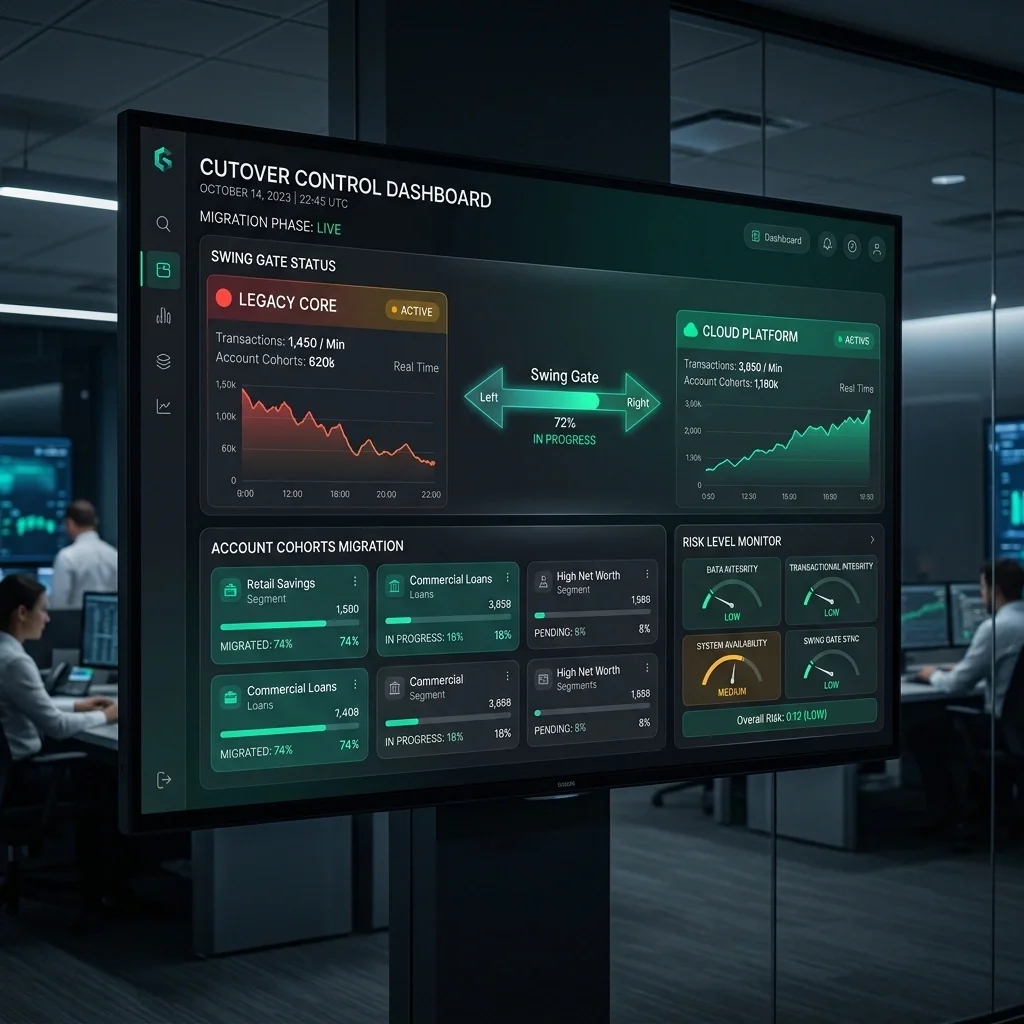
To eliminate "Big Bang" risk, we used the "Swing Gate" strategy.
We built a Difference Engine that sat between the Legacy Core and the 4th-Gen Core. For 3 months, every transaction was sent to both cores.
The 12-Week Battle Plan:
- Phase 1 (Week 1-2): Shadow Mode. New core processes transactions but the results are discarded. We only check for output parity.
- Phase 2 (Week 3-4): Internal Cohort. Employee accounts are "Swung" to the new core.
- Phase 3 (Week 5-8): Low-Value Retail. Retail accounts with balances <$10k are migrated.
- Phase 4 (Week 9-12): Full Liquidity. High-value corporate and institutional pools are migrated.
The "Kill Switch": If the Difference Engine detected a variance of even 0.0001% in balance calculations between the two cores, the system would automatically "Swing" the specific account back to the legacy core in <30ms.
10. The SRE Playbook: Operating an Event-Driven Bank
Operating a 4th-Gen bank requires a shift from "DBA" (Database Administrator) to "SRE" (Site Reliability Engineer).
Operational Pillars:
- Observability: We use OpenTelemetry to trace a single transaction through 45 different microservices. We can see exactly where a 5ms delay is introduced.
- Chaos Engineering: We regularly run Gremlin tests, killing random Kafka brokers and Kubernetes pods during business hours to ensure the system's "Self-Healing" capabilities are functioning.
- Automatic Remediation: If a service's latency exceeds 100ms, the system automatically spins up 10 additional pod replicas before the SRE is even alerted.
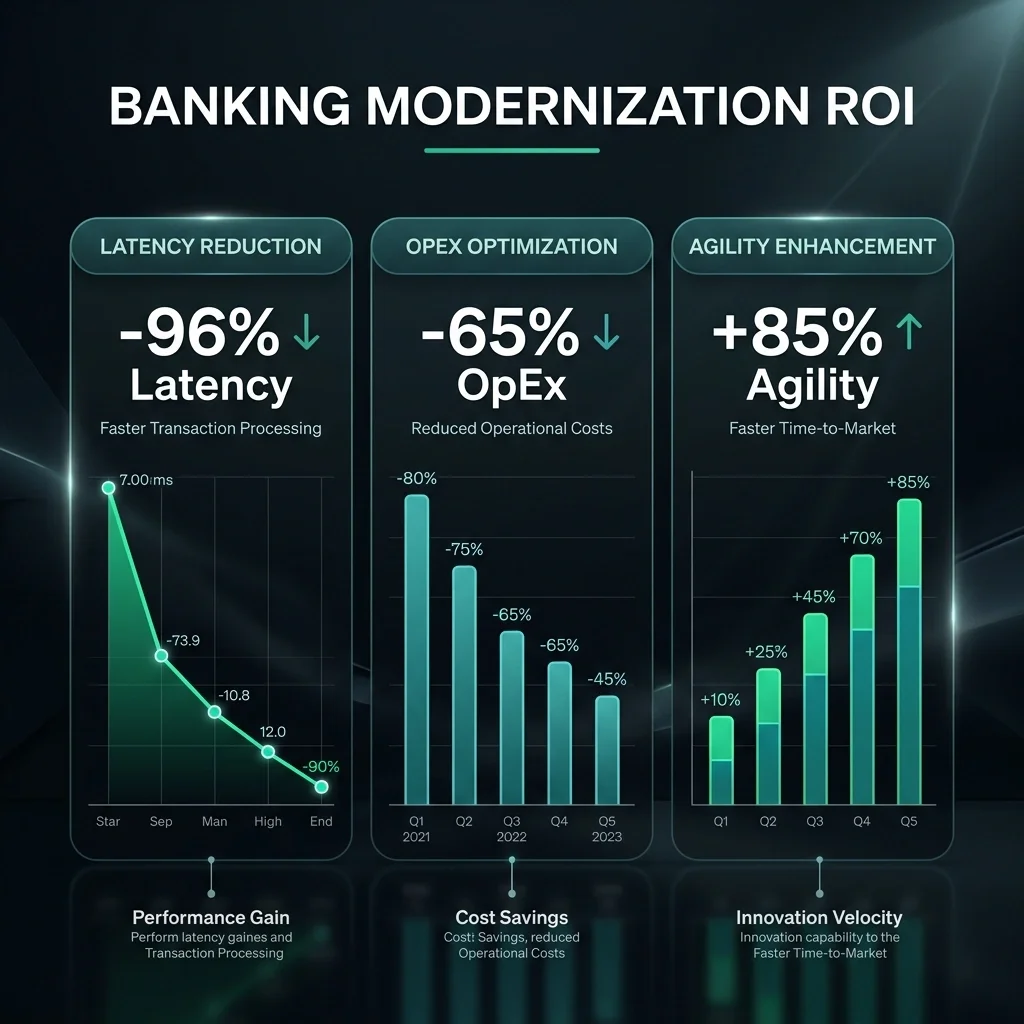
11. ROI Analysis: The Economics of Modernization
Modernization is a profit-center, not a cost-center. By neutralizing technical debt, the bank regained its ability to innovate.
| Metric | Legacy Core | 4th-Gen AI Core | Delta |
|---|---|---|---|
| Transaction Latency | 1,200ms | 45ms | -96% |
| DevOps Release Cycle | 6 Weeks | 1 Day | -97% |
| Infrastructure Cost | $2.4M/mo | $840K/mo | -65% |
| Fraud Recovery Rate | 62% | 98.4% | +$40M/yr |
| Operational Staffing | 420 (Mainframe Ops) | 85 (SRE/Platform) | -80% |
12. Future Roadmap: 2030 & Beyond
The 4th-Gen Core is the foundation for the next decade of innovation.
- Quantum-Resistant Encryption (2026): Upgrading the Zero-Trust mesh to use lattice-based cryptography to protect against future quantum attacks.
- CBDC Integration (2027): Native support for Central Bank Digital Currencies within the Sovereign Mesh.
- Decentralized Identity (DID) (2028): Moving away from "Account Numbers" to self-sovereign identity for customers.
- Autonomous Liquidity Management (2029): AI agents managing the bank's own capital reserves across global markets in real-time.
Executive & Technical FAQ
How does the system handle "Strong Consistency" for account balances in a distributed Event Mesh?
We utilize CockroachDB as the Transactional Persistence Layer, providing Serializability (the highest level of ACID isolation). While the event mesh is asynchronous, the final "Source of Truth" for balance state uses multi-region Raft consensus to ensure no two transactions can ever overdraw the same account, even during a network partition.
ISO 20022 messages are significantly larger than legacy MT formats. How do you mitigate the latency of XML/Schema validation?
We use SIMD-accelerated XML parsers in Rust at the Ingestion Layer. By offloading schema validation to high-performance nodes and using internal binary formats (Protobuf) for the intra-mesh communication, we maintain sub-45ms end-to-end latency despite the data-rich nature of ISO 20022.
How is the "Right to be Forgotten" (GDPR) managed in an immutable Kafka transaction log?
We implement Crypto-Shredding. Every customer's PII is encrypted with a unique key. When a deletion request is made, we destroy that specific key. The encrypted data remains in the immutable log for regulatory audit purposes, but it becomes undecipherable "noise," satisfying both data retention and privacy laws simultaneously.
What is the strategy for migrating legacy "Stored Procedures" from the Mainframe?
We strictly follow the "Anti-Corruption Layer" (ACL) pattern. We do not port COBOL logic line-by-line. Instead, we define the "Intent" of the business rule and refactor it into Go microservices using the Specifications Pattern, ensuring the new logic is unit-testable and decoupled from the database schema.
How do you handle "Split-Brain" scenarios in a multi-region deployment?
The Sovereign Mesh utilizes Quorum-based arbitration. If a region loses connectivity, the nodes in that region automatically transition to "Read-Only" mode if they cannot establish a 51% majority with the global consensus cluster, preventing inconsistent state writes.
Does the AI-Native core introduce "Black Box" risk for regulatory audits?
No. We use Explainable AI (XAI) frameworks. Every decision made by a LangGraph agent is accompanied by a "Decision Proof" topic in Kafka, documenting exactly which features (metadata points) triggered the specific block or approval.
How do you measure the success of a "Swing Gate" migration?
Success is measured via a real-time Difference Engine. We run the legacy core and the 4th-Gen core in parallel for every transaction in the cohort. If the outputs differ by even 1 micro-cent, the Swing Gate immediately rolls back the specific account to the legacy system.
What happens to the legacy COBOL developers during this 4th-Gen transition?
We implement a "Bridge Architecture" program. COBOL developers are transitioned into "Domain Logic Architects." Their deep understanding of banking edge cases is vital for defining the requirements of the new Go/Rust services, while modern software engineers handle the distributed systems implementation.
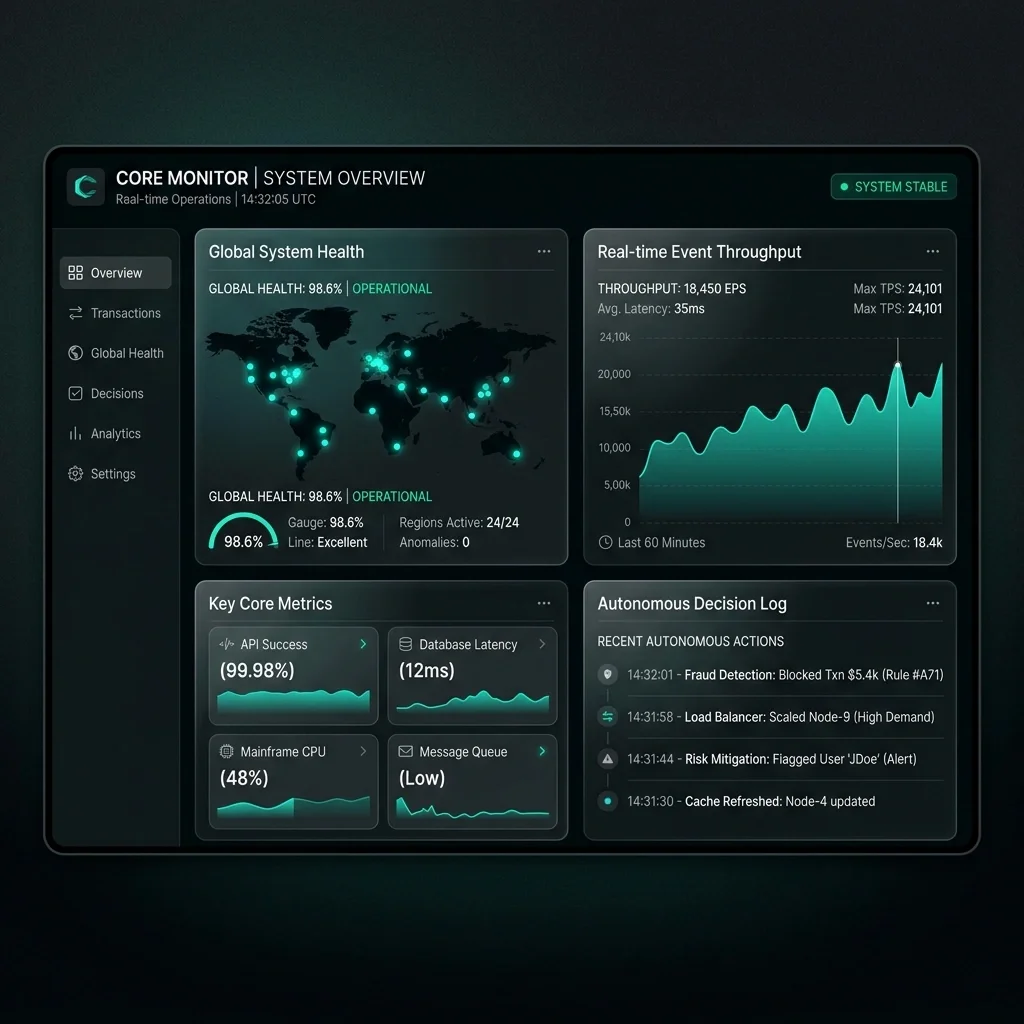
Technical Visual Evidence (Sovereign Dashboard Suite)