AI SUMMARY / EXECUTIVE OVERVIEW
"Vibe Coding" has evolved from a developer meme into a core business strategy. In 2026, founders and product owners are bypass-routing traditional software lifecycle bottlenecks. By focusing entirely on strategic intent and system architecture, non-technical or semi-technical leaders are driving autonomous agent fleets to build, deploy, and scale complex applications. This article details the economics of vibe coding, how leaders maintain absolute quality control, and the transformation of the Product Owner role into a sovereign product architect.
The Business of Vibe Coding: Strategic Intent as the New Currency
By Vatsal Shah | June 10, 2026 | 15 min read
Table of Contents
- Introduction
- What is Vibe Coding in a Business Context?
- Moving from Syntax to Strategic Intent
- The Business Owner as Sovereign Architect
- Quality Control: Auditing What You Didn't Write
- Deep Analysis: Traditional Development vs. Vibe-Driven Orchestration
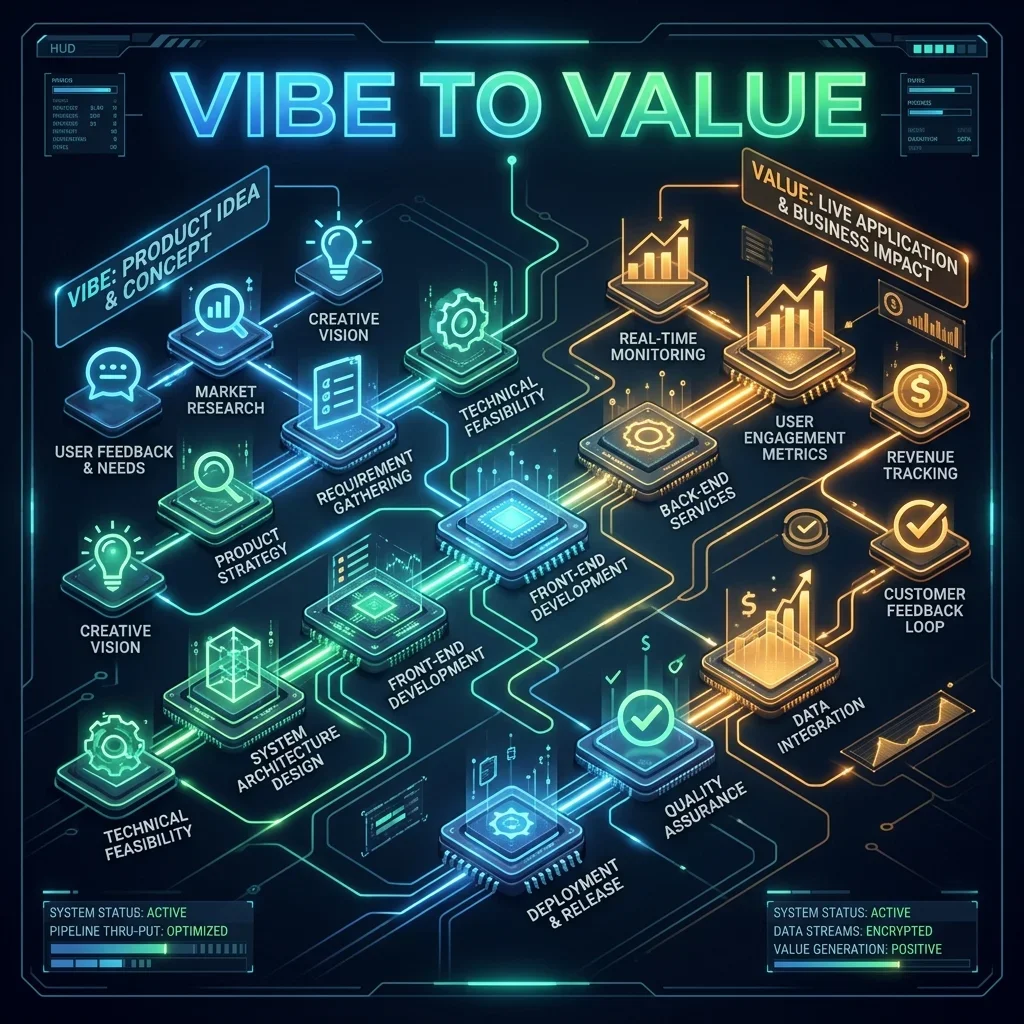
- Procedural Logic: The Vibe-to-Value Pipeline
- Pitfalls & Strategic Anti-Patterns
- Futuristic Horizon: 2027-2030 Roadmap
- Key Takeaways
- FAQ
- About the Author
- Conclusion
Introduction
In 2024, the term "vibe coding" emerged as a colloquial description of developers writing software by copy-pasting AI-generated snippets, relying on their "vibe" to keep things working. Many traditional software engineers dismissed it as a fragile, amateurish trend suitable only for toy projects.
However, by 2026, the joke has ended. The underlying economics have forced a massive shift. In an era where large action models (LAMs) and multi-agent development frameworks compile, deploy, and self-heal codebases with 95% autonomy, vibe coding has become a serious business engine.
Today’s most successful founders and product owners do not treat code as a labor-intensive craft; they treat it as an instant compilation of their strategic intent. The barrier to entry has shattered. A single non-technical founder with deep domain knowledge and clear strategic vision can now lead a fleet of autonomous AI developers to ship SaaS platforms that previously required a team of ten engineers.
In this new ecosystem, strategic intent is the new currency. The traditional software development costs—spent on syntax debugging, boilerplate wiring, and manual sprint alignment—are dropping to near zero. The value lies entirely in the human-exclusive ability to understand the customer, architect the product boundaries, and enforce rigid quality control.
What is Vibe Coding in a Business Context?
Vibe Coding in Business is defined as the practice of building and scaling software products by steering autonomous AI agents using high-level strategic intent, without manually writing or maintaining syntax. It is a transition from code as a labor asset to code as a commodity, shifting the product lifecycle focus from technical execution to market-facing strategy.
Historically, building a software product was a translation problem. The business leader had a vision (the intent). They wrote it in a product requirement document (PRD). This PRD was handed to a product manager, who split it into user stories. These user stories were passed to developers, who translated them into code syntax. Each translation step introduced delays, communication errors, and massive overhead.
Vibe coding collapses these layers. The founder or product owner interfaces directly with agentic development environments. By describing features, data relationships, and business logic, the leader initiates automated creation pipelines. The code compiles instantly. The "vibe" is no longer a guess—it is the direct feedback loop of running software, staging tests, and real-time user validation.
Moving from Syntax to Strategic Intent
When syntax becomes free, the value of the software developer changes, and so does the value of the product owner.
For business leaders, this means learning how to express strategic intent with high fidelity. A low-fidelity prompt ("make me an e-commerce dashboard") yields a generic, useless result. High-fidelity strategic intent requires the leader to act as an architect:
- Systemic Rules: Defining database schemas, user permissions, and compliance boundaries (e.g., "enforce HIPAA regulations on all medical user tables").
- Business Logic: Specifying transaction rules, validation steps, and domain dependencies.
- Outcome Guardrails: Defining what constitutes success—performance metrics, maximum API latencies, and conversion funnels.
When a founder can communicate these parameters clearly, the AI agentic suite builds the application with strict structural integrity. The coding details are managed by the agent, allowing the founder to focus entirely on product strategy, user discovery, and business growth.
The Business Owner as Sovereign Architect
In 2026, we are seeing the rise of the "One-Person Tech Unicorn." These are startups generating millions in annual revenue with just a founder and an array of autonomous agents. The founder is no longer just a "visionary" who relies on an expensive engineering team to build the product; they are a sovereign product architect.
To operate at this level, leaders do not need to master syntax, but they must master systems thinking:
- Domain Mapping: Understanding how data flows through their business. For instance, how a user action on the frontend triggers an invoice in the backend and syncs with the CRM.
- API Integration Logic: Knowing how to leverage existing microservices (Stripe, Twilio, SendGrid) to build value, rather than reinventing the wheel.
- Modular Isolation: Instructing agents to build independent modules so that modifying one feature does not break another.
This shift allows leaders to validate products in days instead of months. If a feature fails to engage users, the founder does not face a massive write-down of engineering hours. They simply direct the agents to purge that module and pivot the codebase toward a new intent.
Quality Control: Auditing What You Didn't Write
The biggest challenge in the vibe coding era is quality control. If you didn't write the code, how do you verify that it is safe, secure, and performant?
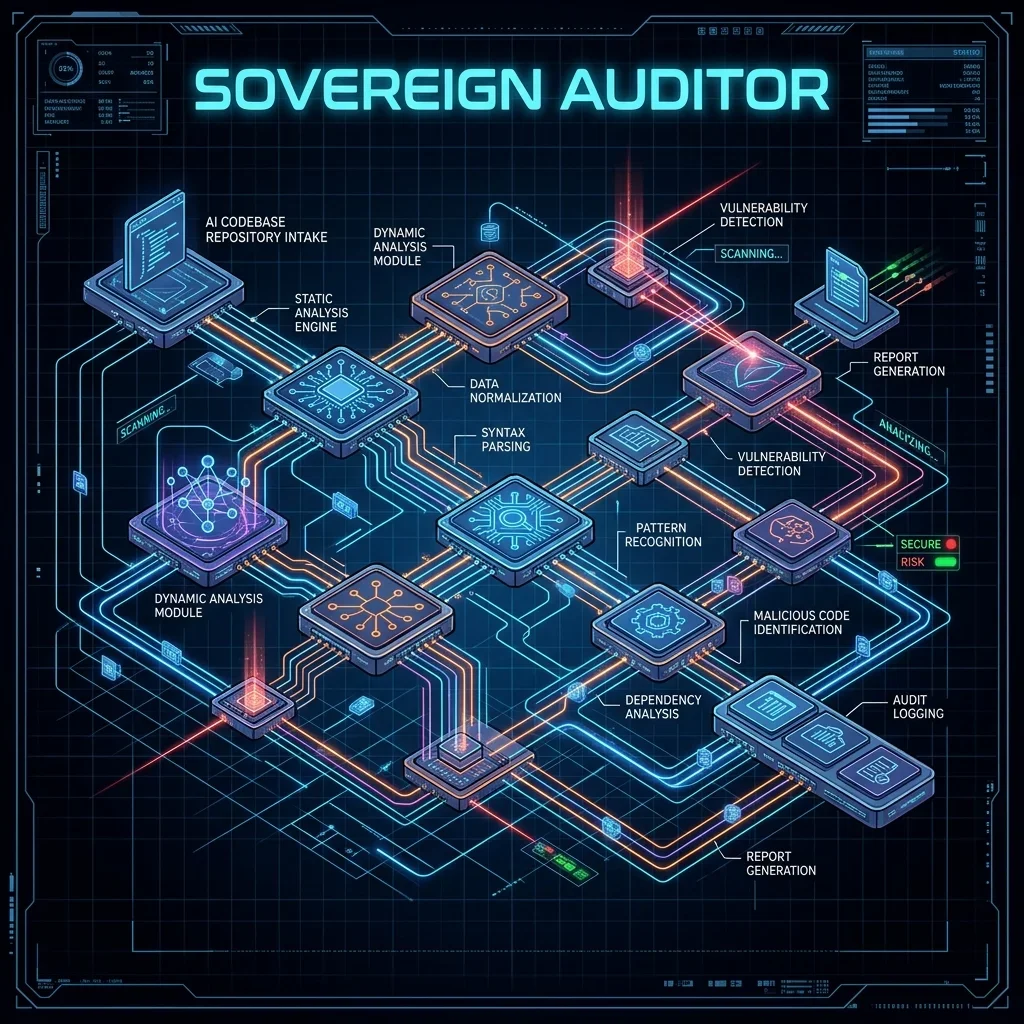
This is where the Sovereign Auditor role becomes vital. A business leader cannot simply trust the AI blindly. They must set up automated verification gates that act as the guardrails of their codebase.
// Conceptual TypeScript representation of an automated compliance gate
interface ComplianceReport {
  isSecure: boolean;
  performancePassed: boolean;
  vulnerabilityCount: number;
}

class SovereignAuditor {
  private scanner = new SecurityScanner();
  private loadTester = new PerformanceTester();

  public async auditRelease(diff: string, codebase: string): Promise<boolean> {
    const security = await this.scanner.runSAST(diff);
    const performance = await this.loadTester.measureLatency(codebase);

    if (security.vulnerabilityCount > 0) {
      console.warn("Audit Failed: Security vulnerabilities detected.");
      return false;
    }

    if (performance.p99LatencyMs > 200) {
      console.warn("Audit Failed: High latency detected in transaction routes.");
      return false;
    }

    return true;
  }
}
By enforcing automated audits, the business owner ensures that coding agents follow strict security practices, prevent memory leaks, and write clean, performant modules. The human acts as the final strategic gatekeeper, verifying that the implementation matches the original business goals.
Deep Analysis: Traditional Development vs. Vibe-Driven Orchestration
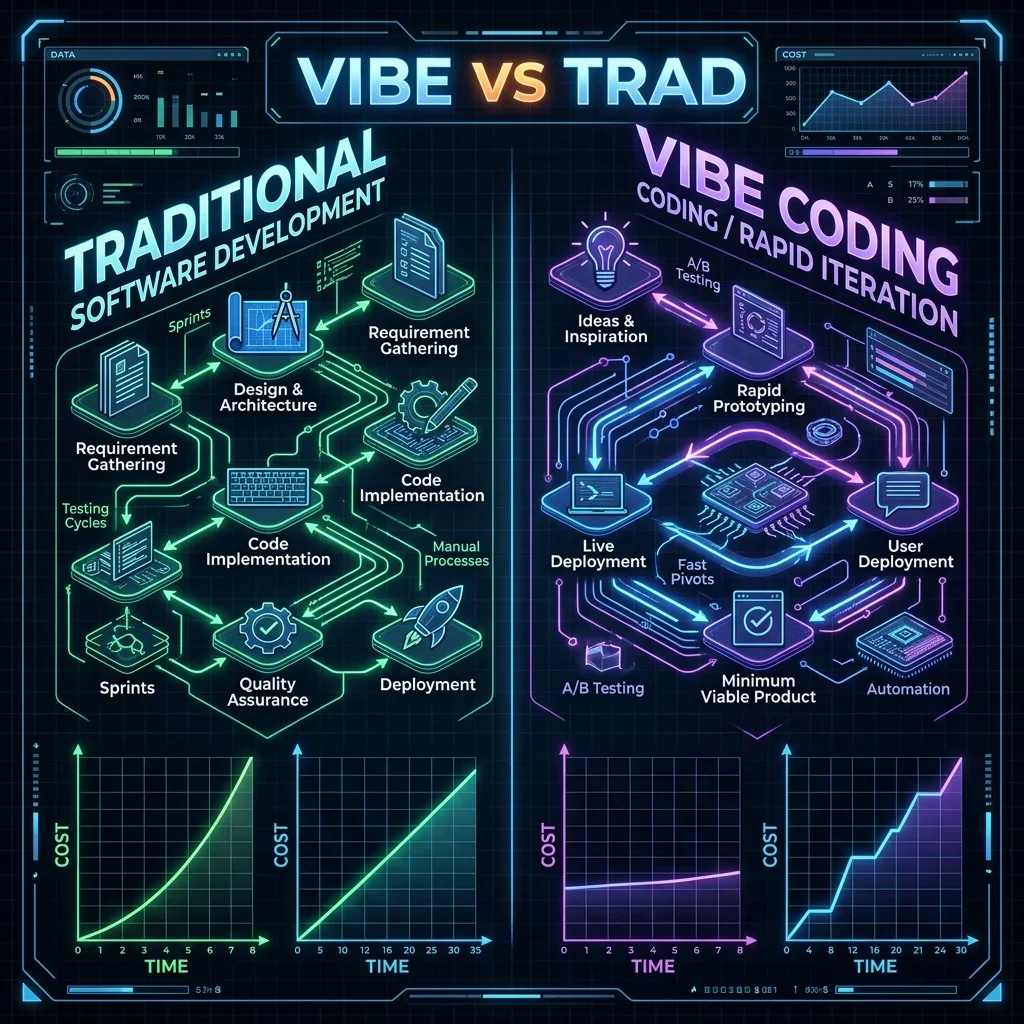
Let's look at the operational differences between the traditional development cycle of the past decade and the modern vibe-driven orchestration model.
| Product Dimension | Traditional Software Delivery | Vibe-Driven Orchestration |
|---|---|---|
| MVP Development Cost | $50,000 - $150,000 (salary/agency hours). | $2,000 - $5,000 (API tokens + orchestration tools). |
| Time-to-Market | 3 to 6 months for initial launch. | 3 to 7 days for functional product. |
| Feature Iteration Loop | Weeks (sprint planning, QA sign-off, staging). | Minutes (real-time specification to production). |
| Resource Efficiency | High capital expenditure on manual labor. | 95% cost reduction; high leverage for domain experts. |
| Maintenance & Debt | High dependency on specific engineer knowledge. | Managed programmatically; automated refactoring is instant. |
Procedural Logic: The Vibe-to-Value Pipeline
To leverage vibe coding successfully as a business tool, leaders must follow a structured pipeline that ensures alignment, safety, and velocity.
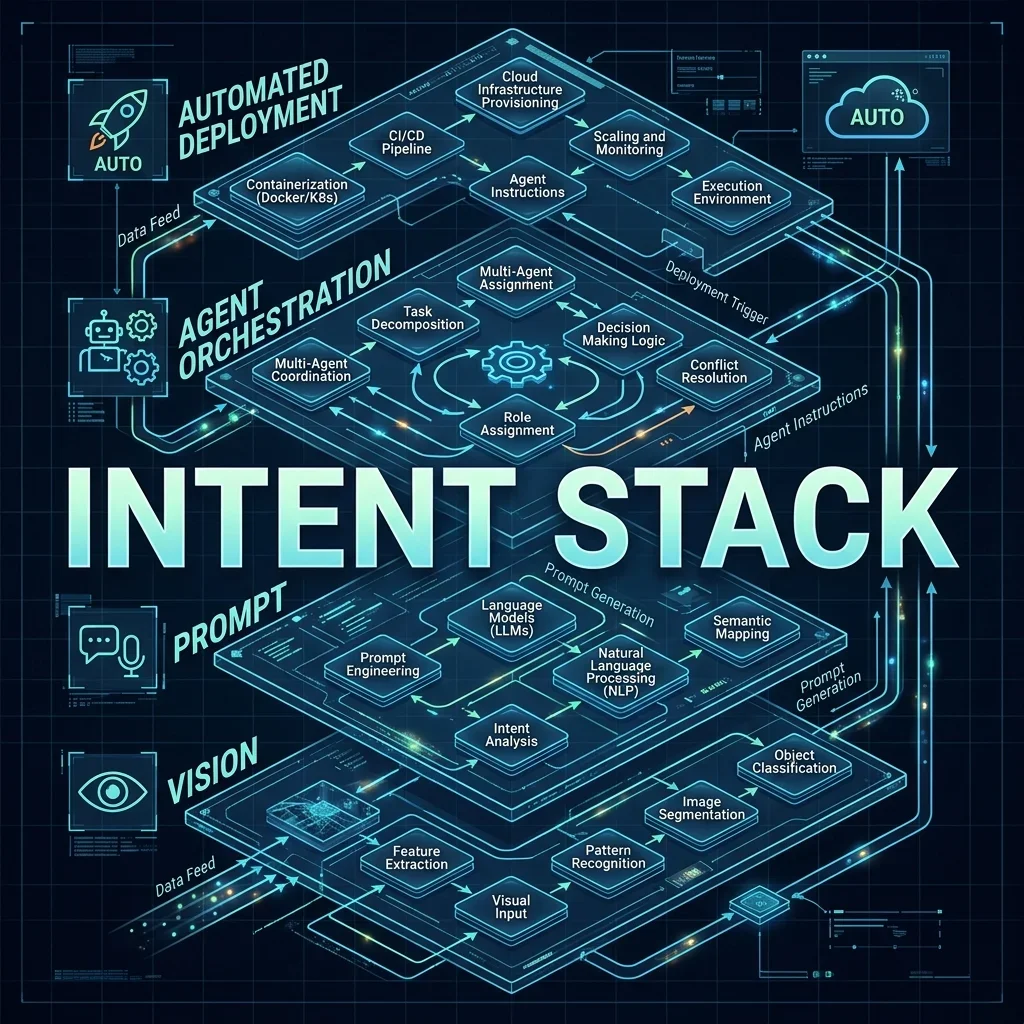
- Vision Specification: The leader defines the product goals and business rules. This is written in a structured, clean document rather than scattered ideas.
- Schema Alignment: The agent proposes the data schemas, database fields, and interface models. The leader reviews this to ensure domain logic is correct.
- Automated Execution: The agent writes the code, resolves package dependency conflicts, and structures the modules.
- Security & Performance Gate: The codebase is analyzed by automated scanners. The leader checks the results and directs the agent to fix any alerts.
- User Loop Validation: The product is deployed to a staging environment. Real users test the system, and their feedback is instantly converted into new feature intents, starting the loop again.
Pitfalls & Strategic Anti-Patterns
Despite its efficiency, vibe coding introduces new organizational risks that product owners must manage.
1. The "Feature Sprawl" Trap
Because building features is easy, founders often request too many tools at once. This leads to a messy product experience for users.
- The Avoidance: Keep your product simple. Focus on solving one core problem exceptionally well before expanding your feature list.
2. Lack of Documentation
AI coding agents are notoriously bad at writing long-term documentation unless explicitly instructed. If your codebase becomes large and lacks clear guides, future auditing becomes very difficult.
- The Avoidance: Instruct your documentation agents to write and maintain a clean
ARCHITECTURE.mdfile after every feature release.
3. Ignoring Vendor Dependency
If your vibe coding relies on a single closed-source AI provider, your business is exposed to pricing shifts or service downtime.
- The Avoidance: Build your agentic infrastructure on open standards like the Model Context Protocol (MCP) so you can switch models or providers without rebuilding your code.
Futuristic Horizon: 2027-2030 Roadmap
As AI models become more context-aware, the barrier between thought and product will disappear completely.
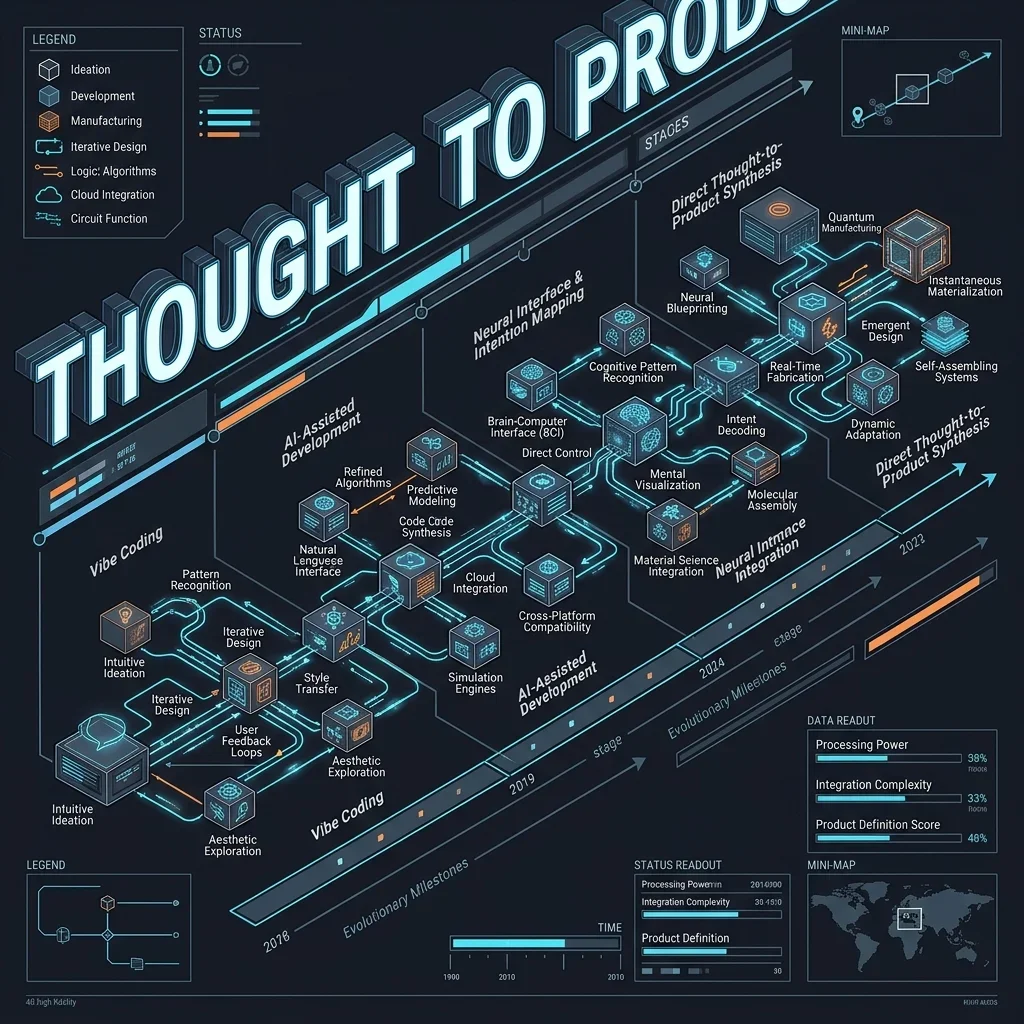
- 2026-2027 (The Vibe Integration Era): Founders design products by managing multi-agent systems, focusing heavily on validation and domain integration.
- 2028-2029 (Zero-Latency Prototyping): AI models generate entire functional apps on the fly during customer discovery meetings, adjusting features in real-time as users describe their problems.
- 2030 (Thought-to-Product Environments): Software becomes dynamic. The application adapts its interface, database schemas, and API connectors in real-time to match user behaviors and needs, requiring zero manual coding.
Key Takeaways
- Strategic Currency: In 2026, strategic intent has replaced syntax knowledge as the primary currency of software development.
- Founder-Architects Rise: Non-technical domain experts can build scale-ready SaaS products using autonomous agents.
- Automation Guardrails: Absolute quality control requires automated security testing and performance checks.
- Simplicity Wins: Avoid the temptation to build bloated software just because execution is cheap.
- Sovereign Portability: Use open standards like MCP to avoid lock-in with closed-source AI vendors.
FAQ
Can a non-technical founder really build a secure software product alone?
Yes. By using automated security scanners and directing specialized auditing agents, a non-technical leader can verify that their application meets modern compliance and security standards without writing code.
What is the difference between Vibe Coding and No-Code tools?
No-Code tools restrict you to preset templates and database structures. Vibe coding creates real, custom, scalable source code (React, Go, Python, Rust) that you own fully and can run on any server.
How much does it cost to run a vibe coding stack?
Running AI agent environments typically costs a few hundred dollars per month in API tokens and development tool subscriptions—fractions of the cost of a traditional developer salary.
Will vibe coding replace traditional software engineers?
It replaces the need for basic boilerplate writing. Traditional developers must pivot to become systems engineers, security auditors, and technical architects, operating at the level of strategic intent rather than line-by-line typing.
How do you handle complex database migrations with vibe coding?
You instruct database-specialist agents to write migration scripts, then run them in a local environment. A human architect audits the data integrity before pushing the migration to production.
About the Author
Vatsal Shah is a veteran technology leader, architect, and software strategist specializing in AI integration, engineering leadership, and digital transformation. With over a decade of experience building scalable enterprise architectures and leading high-performing technical teams, Vatsal writes about modern developer mindsets, autonomous agent design, and the intersection of technology and business strategy at shahvatsal.com.
Conclusion
The democratization of code creation means that business success is no longer limited by engineering capacity. The only limit is your ability to understand the customer, define the problem, and direct AI agents with precise strategic intent. Vibe coding is no longer just a coding trick—it is a competitive business advantage for founders who know how to wield it.
If you are a founder or product leader looking to modernize your development workflows, audit your technical architecture, or build custom agent integrations, feel free to reach out for a consultation.