The $10B Solo Venture: Architecting the Post-Employee Corporation
By Vatsal Shah | June 23, 2026 | 22 min read
Table of Contents
- The First Billion-Dollar Solo Founder: A 2026 Case Study
- What is the Post-Employee Corporation?
- Architecting the Ghost Workforce: Model Context Protocol and Large Action Models
- Procedural Logic: Stateful Graph Orchestration and Routing
- Strategic Leverage: Managing 1,000 Autonomous Processes Asynchronously
- Step-by-Step: Implementing an Autonomous Agent Dispatcher
- The New Equity: Cap Table Dynamics and Value Accrual
- The Autonomous P&L: The 2010 Startup vs The 2026 Sovereign Startup
- Pitfalls & Modern Anti-Patterns in Solo Ventures
- Futuristic Horizon: 2027–2030 Transition Roadmap
- What to Do Monday Morning
- Frequently Asked Questions
- About the Author
- Payroll Substitution: Human headcount is replaced by dynamic networks of Large Action Models (LAMs) running on local and API-driven compute infrastructures.
- MCP Integration: Standardized tool interaction via Model Context Protocol (MCP) allows agents to securely query databases, run tests, and execute deployments.
- Equity Preservation: Sovereign founders retain 100% equity, converting salary expenses to variable compute costs that scale directly with product demand.
- Stateful Graphs: Complex multi-step task execution is stabilized using stateful graph frameworks to prevent infinite loops and context window decay.
- MCP (Model Context Protocol): An open-standard integration layer enabling AI models to interact with files, databases, search systems, and external service toolsets.
- LAM (Large Action Model): An AI agent optimized to execute complex multi-step user interface or API actions rather than merely generating text.
- Stateful Graph: A software architecture that tracks and saves the state of an agent's execution tree across asynchronous execution hops.
- Sovereign Startup: A business entity utilizing zero employees, funded by variable compute budgets, and managed entirely by a single human operator.
- CapEx Capitalization (ASC 350-40): Financial accounting standard for internal-use software development, used to capitalize agent-driven code synthesis.
The First Billion-Dollar Solo Founder: A 2026 Case Study
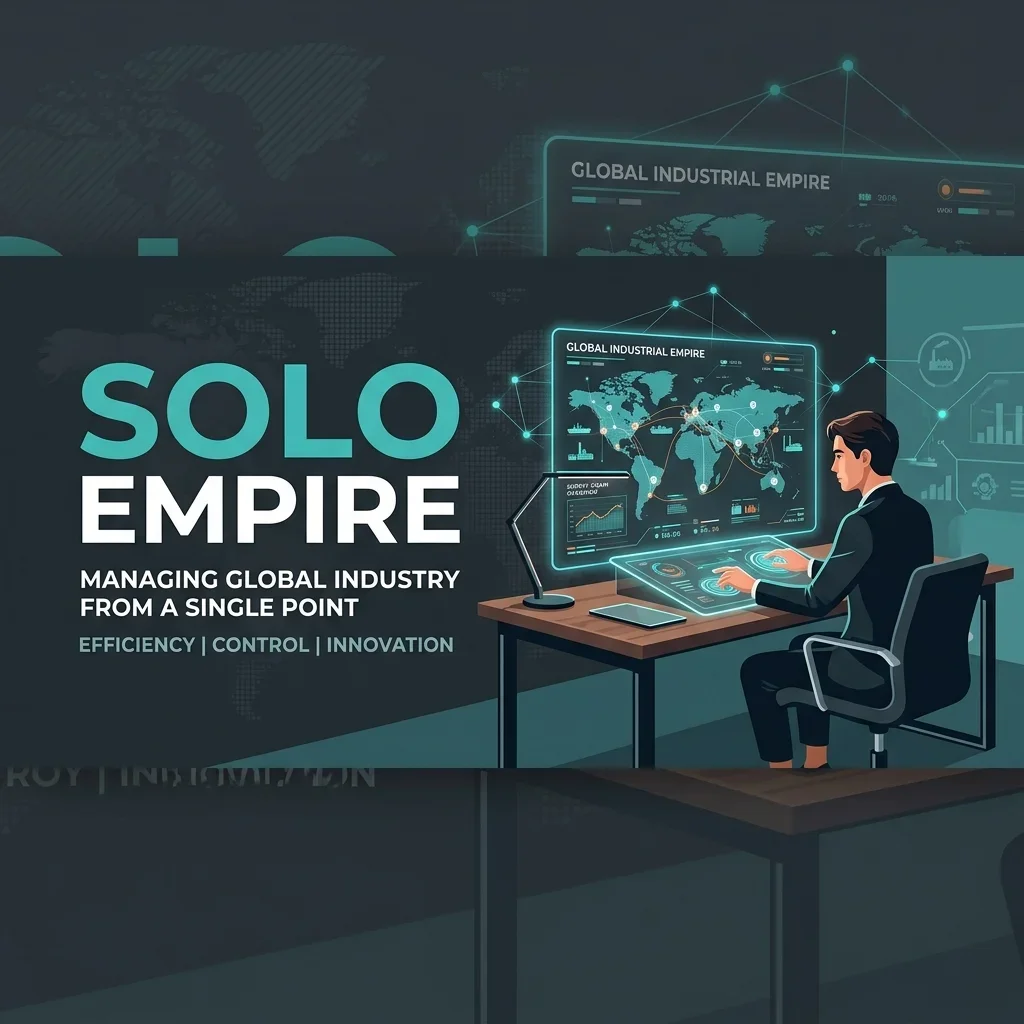
In early 2026, the global technology landscape witnessed a historic milestone: the emergence of the first solo venture to reach a $10 billion private valuation with exactly zero human employees on the payroll. This milestone shattered the traditional venture capital thesis that human scale is a prerequisite for enterprise value.
Historically, companies required hundreds of human managers, coordinators, engineers, and support representatives to scale operationally. Adding more customers meant hiring more hands, creating a linear relationship between organizational complexity and operational overhead.
The $10B solo venture turned this model upside down. By architecting an automated, modular, and self-repairing agentic stack, the founder substituted human labor with dynamic compute resources. Let's analyze the core components that enabled this shift:
- Autonomous Development: Rather than managing a team of human engineers, the founder orchestrated a fleet of specialized coding agents. These agents triaged bugs, wrote unit tests, refactored database schemas, and ran continuous deployment pipelines inside isolated sandboxes.
- Dynamic Operations: Customer support, vendor billing, marketing execution, and regulatory compliance were handled by autonomous Large Action Model (LAM) loops.
- Decoupled Payroll: The company's primary operating expense shifted from fixed monthly salaries to variable, utility-style token costs. If revenue dipped, compute costs decreased in lockstep.
The corporate finance results of this setup are unprecedented. While a traditional mid-sized software enterprise spends 50% to 70% of its operating budget on human salaries, this solo venture achieved operating profit margins exceeding 80%.
What is the Post-Employee Corporation?
A post-employee corporation is defined as a corporate entity that generates massive economic output ($10M+ ARR scaling to $1B+ valuations) while maintaining a headcount of exactly one human: the sovereign founder. The business is not "small" or "lifestyle" in nature; it operates at global enterprise scale, serving millions of users and transacting with Fortune 500 organizations.
The shift to this model is driven by three factors:
- The Action Gap (LLM vs LAM): Large Language Models (LLMs) can write emails and summarize documents, but they cannot execute tasks. Large Action Models (LAMs) close this gap by interacting directly with user interfaces, APIs, and command lines to complete workflows.
- Context Standardization (MCP): In the past, integration was a custom engineering nightmare. Standardizing on Model Context Protocol allows models to instantly connect to databases, servers, and software systems without custom connectors.
- Stateful Execution Graphs: Early agent experiments failed because models got stuck in loops or lost track of their goals. Modern stateful graphs enforce structured recovery paths, allowing agents to execute multi-hour tasks with high reliability.
By combining these technologies, the sovereign founder shifts from a "people manager" to a "system architect." The founder's role is not to perform the labor, but to design, audit, and direct the automated systems that execute the labor.
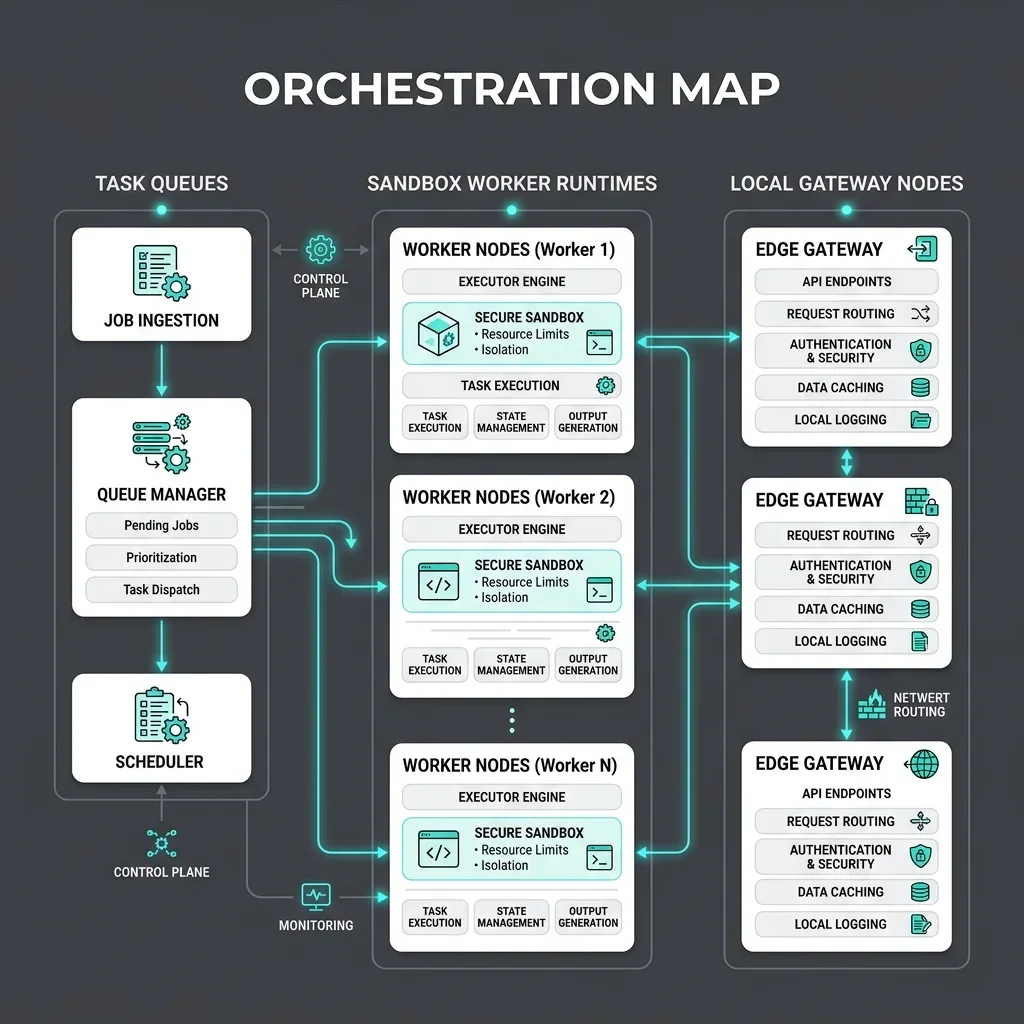
Architecting the Ghost Workforce: Model Context Protocol and Large Action Models
To build a "ghost workforce," you must construct a layered architectural system that bridges the gap between high-level reasoning models and low-level system APIs. A common mistake is connecting an LLM directly to a terminal or database. Without strict boundaries, this leads to security failures and unpredictable system states.
The modern sovereign architecture utilizes a three-tier model:
- Cognitive Tier: High-tier reasoning models that handle task planning, intent resolution, and failure analysis.
- Orchestration Tier: Stateful graph engines that manage task history, branch decisions, and sandbox allocation.
- Execution Tier (MCP Gateway): Secure, local MCP servers that translate model requests into safe API calls, database queries, and filesystem operations.
The following architecture diagram details how a single human operator routes requests through this three-tier system to safely manipulate production environments:
Procedural Logic: Stateful Graph Orchestration and Routing
In an agentic business, tasks are rarely completed in a single step. For example, resolving a database performance issue requires:
- Monitoring log queries to detect high latency.
- Parsing the slow queries using an AST analyzer.
- Generating optimized indexes inside a staging sandbox.
- Running the full test suite to check for side effects.
- Merging and deploying the patch to production.
If any of these steps fail, the agent must not crash. It must save its state, analyze the failure log, formulate a correction plan, and resume execution. This cycle is managed using a stateful execution graph.
The graph defines the boundaries of agent autonomy. Each node in the graph represents a specific operational phase (e.g., "Analyze", "Patch", "Test"). The transitions between nodes are governed by strict verification gates. If an agent fails to pass a gate (e.g., a test fails), the graph routes the task back to the debugging node rather than letting it proceed to deployment.
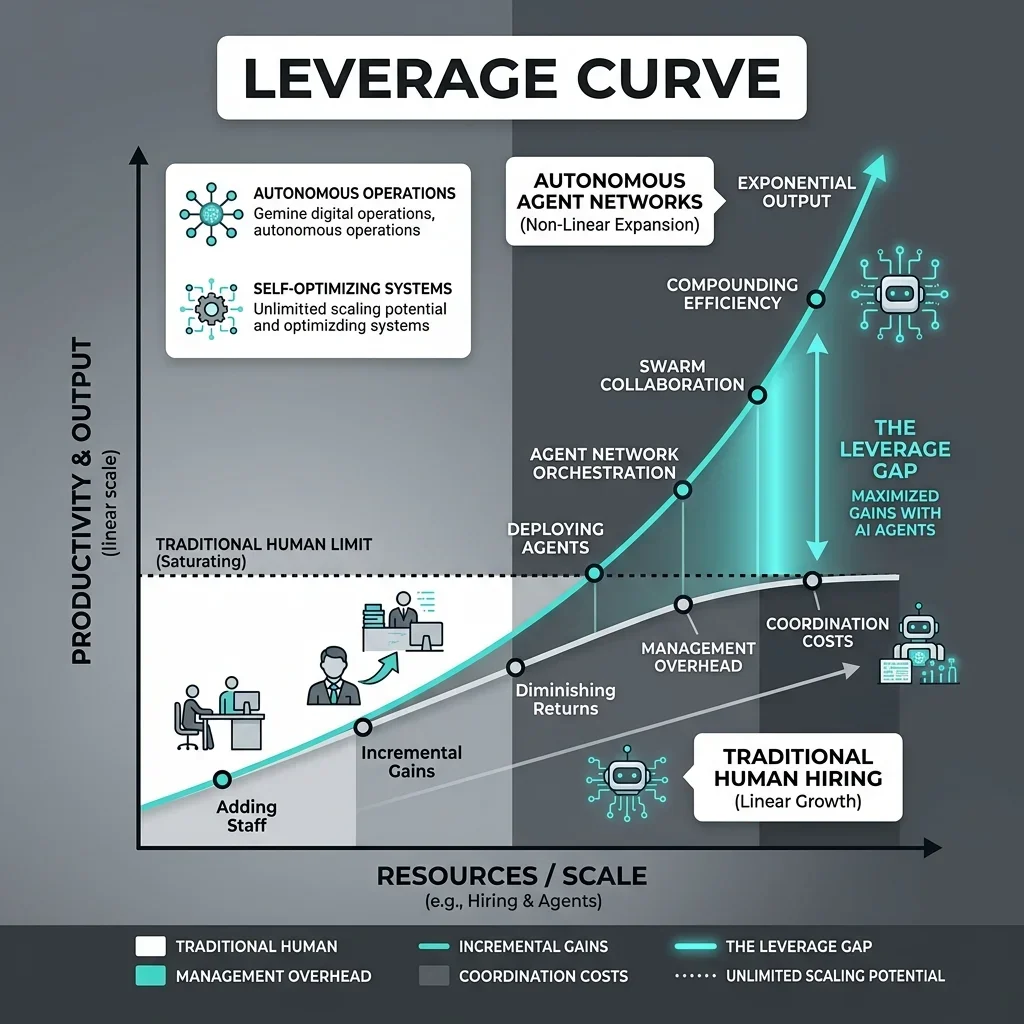
Strategic Leverage: Managing 1,000 Autonomous Processes Asynchronously
The primary constraint of the sovereign founder is cognitive bandwidth. A single human cannot monitor 1,000 concurrent processes. If the founder has to approve every minor decision, the business becomes bottlenecked.
To achieve scale, the founder must implement asynchronous delegation with structured callbacks:
- Low-Risk Autonomy: Agents are granted permission to execute routine tasks (e.g., security patching, database optimization, support triaging) autonomously within strict sandbox limits.
- Escalation Triggers: If a task exceeds a specific risk threshold (e.g., a customer refund request >$500, or a database patch that changes core schemas), the orchestrator pauses execution and sends a webhook alert to the founder's mobile interface.
- State Serialization: The founder can view the entire execution trace, inspect the proposed patch, and approve or reject the action with a single tap. Once approved, the agent resumes execution from the exact point it was paused.
This model allows the founder to act as a flight controller, overriding systems only when anomalies occur, while the day-to-day operations execute automatically in the background.
Step-by-Step: Implementing an Autonomous Agent Dispatcher
Let's look at how to implement a lightweight, production-ready agent dispatcher. This Python system uses asyncio to monitor an operation queue, query tools via an MCP client interface, and manage worker lifecycles asynchronously.
import asyncio
import json
import logging
from typing import Dict, Any, List

logging.basicConfig(level=logging.INFO)
logger = logging.getLogger(class="tok-str">"SovereignDispatcher")

class ToolRegistry:
    class="tok-str">""class="tok-str">"Simulates local MCP server tool registration."class="tok-str">""
    class="tok-kw">def __init__(self):
        self.tools = {}

    class="tok-kw">def register_tool(self, name: str, handler):
        self.tools[name] = handler
        logger.info(fclass="tok-str">"[Registry] Registered tool: {name}")

    async class="tok-kw">def execute_tool(self, name: str, args: Dict[str, Any]) -> Any:
        if name not in self.tools:
            raise ValueError(fclass="tok-str">"Tool {name} not found in registry")
        return await self.tools[name](args)

class AgentDispatcher:
    class="tok-kw">def __init__(self, registry: ToolRegistry, task_queue: asyncio.Queue):
        self.registry = registry
        self.task_queue = task_queue
        self.running = False

    async class="tok-kw">def start(self):
        self.running = True
        logger.info(class="tok-str">"[Dispatcher] Starting autonomous agent execution loop...")
        while self.running:
            task = await self.task_queue.get()
            asyncio.create_task(self.execute_task(task))
            self.task_queue.task_done()

    async class="tok-kw">def execute_task(self, task: Dict[str, Any]):
        task_id = task.get(class="tok-str">"id")
        task_type = task.get(class="tok-str">"type")
        logger.info(fclass="tok-str">"[{task_id}] Allocating agent for task type: {task_type}")

        class="tok-cm"># Stateful loop simulation
        loops = 0
        max_loops = 3
        success = False

        while loops < max_loops and not success:
            loops += 1
            logger.info(fclass="tok-str">"[{task_id}] Loop {loops}: Running context assembly...")
            await asyncio.sleep(1.0) class="tok-cm"># Network lag simulation

            try:
                if task_type == class="tok-str">"DB_TUNING":
                    class="tok-cm"># Tool Negotiation via MCP
                    result = await self.registry.execute_tool(
                        class="tok-str">"analyze_slow_queries",
                        {class="tok-str">"min_duration_ms": 500}
                    )
                    parsed_result = json.loads(result)

                    if parsed_result.get(class="tok-str">"slow_query_count", 0) > 0:
                        logger.info(fclass="tok-str">"[{task_id}] Slow queries detected. Initiating index synthesis...")
                        patch_res = await self.registry.execute_tool(
                            class="tok-str">"apply_database_index",
                            {class="tok-str">"table": class="tok-str">"orders", class="tok-str">"column": class="tok-str">"created_at"}
                        )
                        logger.info(fclass="tok-str">"[{task_id}] Index applied: {patch_res}")
                        success = True
                    else:
                        logger.info(fclass="tok-str">"[{task_id}] Database performance is within normal thresholds.")
                        success = True

                elif task_type == class="tok-str">"DEPLOY_HOTFIX":
                    test_out = await self.registry.execute_tool(class="tok-str">"run_test_suite", {class="tok-str">"suite": class="tok-str">"integration"})
                    parsed_tests = json.loads(test_out)

                    if parsed_tests.get(class="tok-str">"failures", 0) == 0:
                        logger.info(fclass="tok-str">"[{task_id}] Integration tests passed. Deploying patch...")
                        await self.registry.execute_tool(class="tok-str">"deploy_container", {class="tok-str">"image": class="tok-str">"hotfix-v1.2"})
                        success = True
                    else:
                        logger.warning(fclass="tok-str">"[{task_id}] Test suite failed. Escalating to debugging sandbox...")
                        class="tok-cm"># Loop continues to retry debugging steps

            except Exception as e:
                logger.error(fclass="tok-str">"[{task_id}] Error in execution loop {loops}: {e}")
                await asyncio.sleep(2.0)

        if success:
            logger.info(fclass="tok-str">"[{task_id}] Task completed successfully in {loops} loops.")
        else:
            logger.error(fclass="tok-str">"[{task_id}] Task failed after reaching max iteration limit.")

class="tok-cm"># Define dummy tool handlers
async class="tok-kw">def analyze_slow_queries_handler(args):
    return json.dumps({class="tok-str">"slow_query_count": 3, class="tok-str">"queries": [class="tok-str">"SELECT * FROM orders WHERE user_id = X"]})

async class="tok-kw">def apply_database_index_handler(args):
    return json.dumps({class="tok-str">"status": class="tok-str">"success", class="tok-str">"index_name": class="tok-str">"idx_orders_user_id"})

async class="tok-kw">def run_test_suite_handler(args):
    return json.dumps({class="tok-str">"total": 128, class="tok-str">"failures": 0, class="tok-str">"passed": 128})

async class="tok-kw">def deploy_container_handler(args):
    return json.dumps({class="tok-str">"status": class="tok-str">"deployed", class="tok-str">"container_id": class="tok-str">"c_92a188f"})

async class="tok-kw">def main():
    class="tok-cm"># Setup Registry
    registry = ToolRegistry()
    registry.register_tool(class="tok-str">"analyze_slow_queries", analyze_slow_queries_handler)
    registry.register_tool(class="tok-str">"apply_database_index", apply_database_index_handler)
    registry.register_tool(class="tok-str">"run_test_suite", run_test_suite_handler)
    registry.register_tool(class="tok-str">"deploy_container", deploy_container_handler)

    class="tok-cm"># Setup Queue
    queue = asyncio.Queue()
    await queue.put({class="tok-str">"id": class="tok-str">"T-86d1", class="tok-str">"type": class="tok-str">"DB_TUNING"})
    await queue.put({class="tok-str">"id": class="tok-str">"T-86d2", class="tok-str">"type": class="tok-str">"DEPLOY_HOTFIX"})

    class="tok-cm"># Launch Dispatcher
    dispatcher = AgentDispatcher(registry, queue)
    dispatcher_task = asyncio.create_task(dispatcher.start())

    class="tok-cm"># Allow tasks to run then stop
    await queue.join()
    dispatcher.running = False
    await dispatcher_task

if __name__ == class="tok-str">"__main__":
    asyncio.run(main())
The New Equity: Cap Table Dynamics and Value Accrual
In a traditional startup model, scaling requires capital, and capital requires equity dilution. A typical venture-backed cap table looks like a fragmented web of investors, founders, advisors, and employees:
- Institutional Dilution: Every funding round (Seed, Series A, Series B) dilutes the founders by 15% to 25%.
- Option Pool Handoffs: Startups must allocate 10% to 15% of their equity to an Employee Stock Option Pool (ESOP) to attract high-tier engineering talent.
- Founders' Share: At exit, the original founders often own a combined total of less than 15% of the business, significantly reducing their financial return.
The post-employee corporation completely alters these dynamics. Because the sovereign founder does not need to hire a large human engineering team, they do not need to construct a massive ESOP option pool. Because their operating costs are low and variable, they can bootstrap or raise minimal funding, preventing institutional dilution.
This allows the founder to retain 90% to 100% of the equity at scale. When the company achieves a valuation of $1 billion or more, the financial returns accrue almost entirely to the single individual who designed the system, creating a new class of hyper-concentrated wealth.
The Autonomous P&L: The 2010 Startup vs The 2026 Sovereign Startup
To visualize the financial superiority of this model, let's compare the income statements of two companies: LegacySoft Co. (a traditional 2010-era SaaS startup) and SovereignCorp (a 2026-era sovereign startup running on an agentic ghost workforce). Both companies generate $25,000,000 in ARR.
| Income Statement Line Item | LegacySoft Co. (2010 Model) | SovereignCorp (2026 Model) | Operational Variance Analysis |
|---|---|---|---|
| Annual Recurring Revenue (ARR) | $25,000,000 | $25,000,000 | Both serve identical enterprise markets with similar ARR. |
| Cost of Goods Sold (COGS) | $4,000,000 (16% of Rev) | $2,100,000 (8.4% of Rev) | SovereignCorp uses automated agents to continuously optimize hosting and cloud spend. |
| R&D Expenses (Engineering Salaries) | $11,500,000 (80 human FTEs) | $360,000 (2 human architects) | 96.8% reduction. Human engineers shift entirely to high-level system design. |
| API Tokens & Agent Compute | $0 (traditional SaaS tools) | $1,100,000 (agent loops) | Replaces human R&D payroll with highly predictable, elastic compute costs. |
| Sales, Marketing & G&A | $5,200,000 | $800,000 | Marketing execution is automated via programmatic content generation and distribution. |
| Office Space & Admin Overhead | $1,200,000 (HQ leasing) | $50,000 (remote workspace) | Eliminates corporate office leasing, onboarding overhead, and human resources. |
| Operating Profit (EBITDA) | $3,100,000 (12.4% Margin) | $20,590,000 (82.36% Margin) | SovereignCorp generates over $20M in free cash flow annually, scaling capital reserves. |
The P&L comparison highlights the fundamental operational difference: LegacySoft Co. is highly fragile, requiring a $3.1M EBITDA run-rate to support an $11.5M payroll overhead, while SovereignCorp is highly resilient, operating with minimal fixed costs.
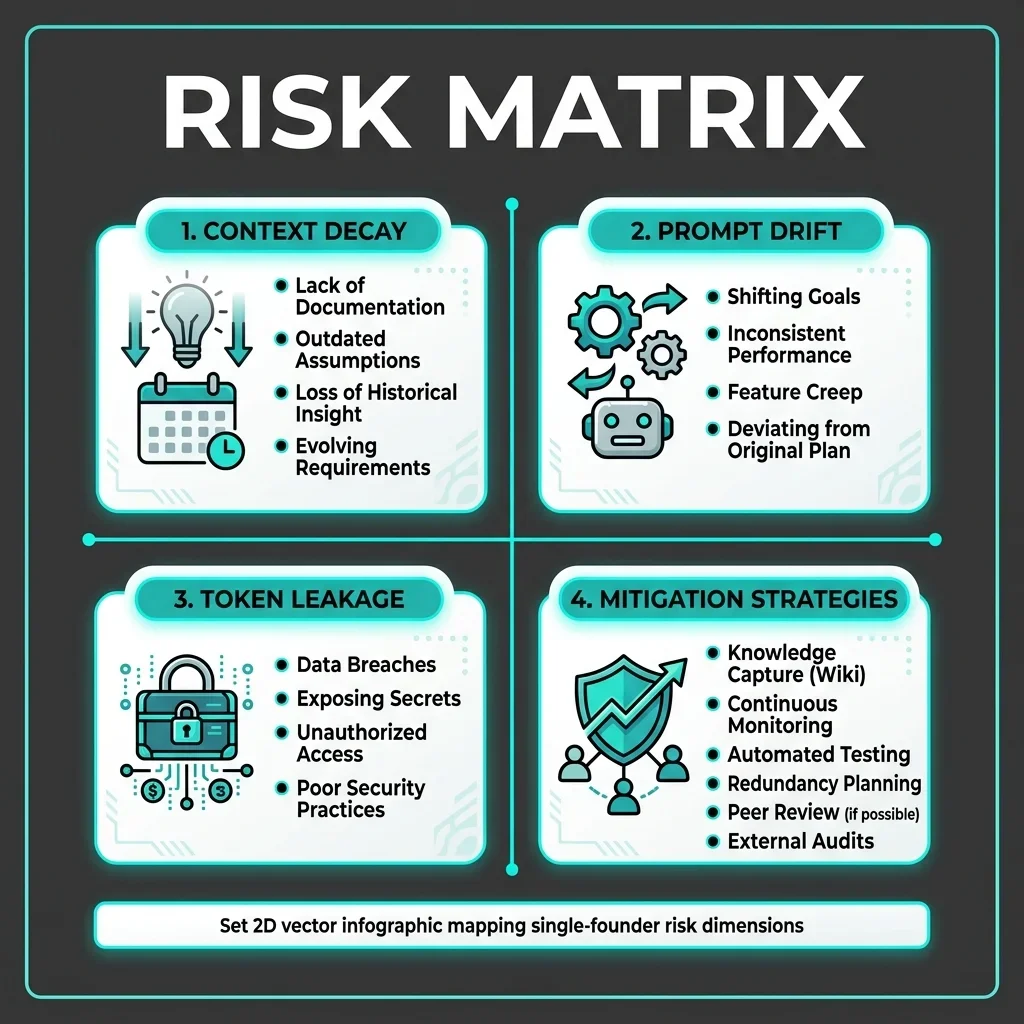
Pitfalls & Modern Anti-Patterns in Solo Ventures
Scaling a business with zero human employees is not without operational hazards. Founders frequently fall into several critical anti-patterns when deploying autonomous agent networks:
- The Recursive Loop Outage: Without strict iteration limits, an agent can get stuck in a debug-fail cycle, consuming thousands of dollars in API token usage in a single night.
- Context Window Overload: Feeding entire repository file contents into input context boxes leads to high billing and low accuracy. Developers must implement semantic indexing so agents only retrieve code sections relevant to their active task.
- Prompt Injection in Actions (DeFi & DB): Giving a Large Action Model database access without strict parameter validation allows malicious user input to execute raw system commands, risking complete system compromise.
- Lack of Isolated Runtimes: Running agent-generated scripts directly on production host environments can lead to dependency conflicts or directory traversals. Agents must always execute inside isolated sandboxes.
To prevent these pitfalls, sovereign founders must implement policy-based guardrails, use local/fine-tuned models for sensitive operations, and enforce human approval gates for critical actions.
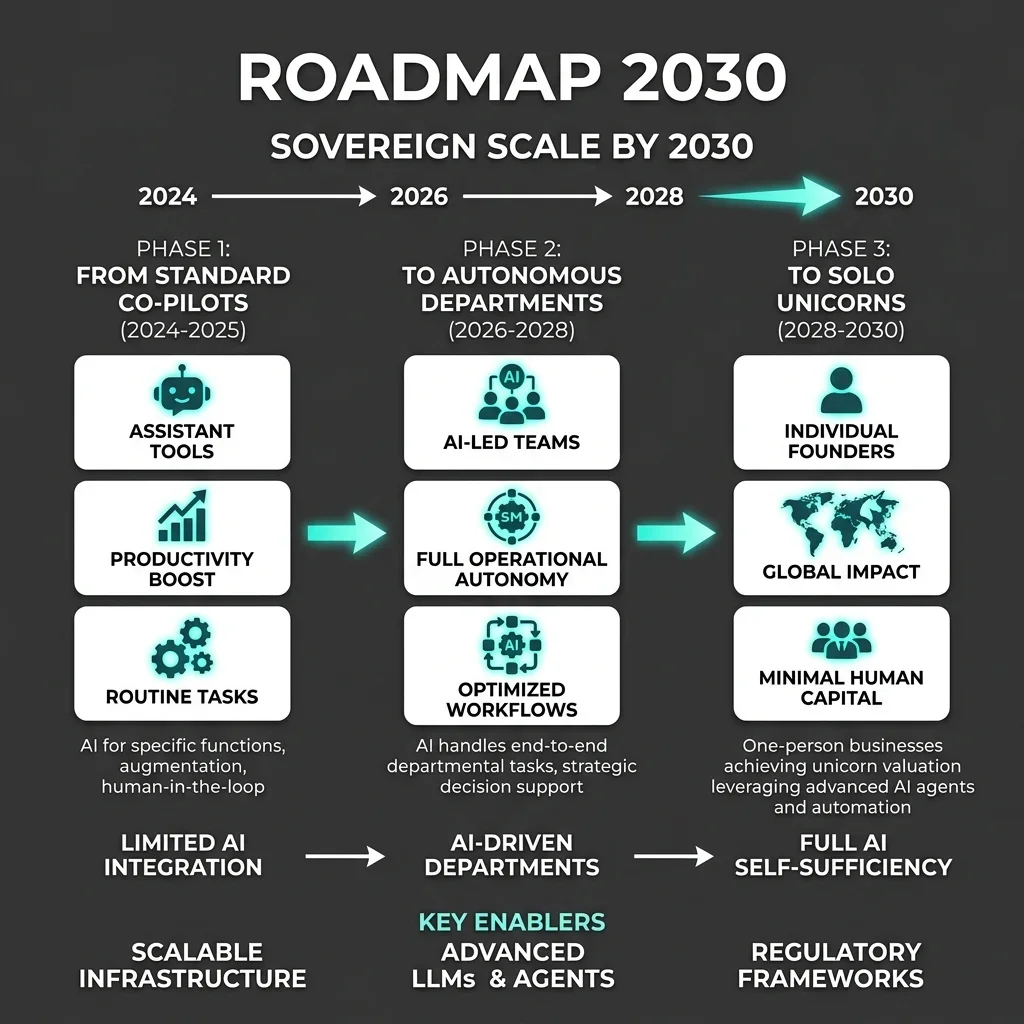
Futuristic Horizon: 2027–2030 Transition Roadmap
The transition to post-employee corporations will evolve over three distinct stages as model capabilities and infrastructure systems mature:
Phase 1: Cognitive Handoffs (2026–2027)
- Focus: Standardizing on Model Context Protocol (MCP) and integrating agentic workflows for code compilation, testing, and continuous deployment.
- Key Milestone: A single developer can manage up to 5 concurrent engineering tasks, doubling overall software shipping velocity.
- Infrastructure: Standardized local MCP servers, Docker containers, and API orchestrators.
Phase 2: Agentic Departments (2027–2029)
- Focus: Deploying autonomous departments that handle entire business functions (e.g., support, sales qualification, finance close) without human intervention.
- Key Milestone: Support ticket queues, invoices, and security patches are triaged and resolved automatically, reducing human operations.
- Infrastructure: Stateful execution graphs, local reasoning engines, and decentralized data lakes.
Phase 3: The Sovereign Unicorn (2029–2030)
- Focus: The emergence of multi-billion dollar enterprises managed by a single human founder leveraging coordinated agent networks.
- Key Milestone: A single sovereign founder launches, grows, and exits a global technology platform serving millions of users with zero human payroll.
- Infrastructure: Autonomous capital routing, cognitive coordination networks, and self-healing systems.
What to Do Monday Morning
To transition your startup or enterprise architecture toward a post-employee operational model, focus on these three action steps:
1. Document Core Operating Workflows
Identify the repetitive processes in your development and business workflows. Before automating with agents, document these steps in clean, structured Markdown checklists to serve as the system instructions.
2. Wrap Systems in Model Context Protocol (MCP)
Before building new custom integrations, wrap your databases, filesystem directories, and internal services in standardized MCP schemas. This ensures they are immediately discoverable by autonomous models.
3. Deploy Sandboxed Runtime Environments
Construct secure, isolated sandboxes (e.g., using Docker containers or gVisor runtimes) where code-generation tools and agents can compile and test scripts without exposing main host environments.
Frequently Asked Questions
How do post-employee corporations handle customer support at scale? +
Customer support tickets are triaged by action agents that connect directly to customer databases. The agent retrieves user history, diagnoses the issue, formulates a response, and triggers API actions (e.g., issuing refunds or resetting passwords) within defined financial limits.
What happens when an autonomous agent makes a mistake? +
When an error occurs, the orchestrator logs the exception trace, isolates the affected database row or code container, reverts to the last known stable state, and flags the issue for the founder's review via mobile notifications.
How are token costs classified on corporate balance sheets? +
Under ASC 350-40, token and infrastructure costs directly spent on synthesizing new software features are capitalized as internal-use software development costs (CapEx), while costs spent on bug triaging and general maintenance are categorized as operating expenses (OpEx).
Can a single founder really manage complex regulatory compliance? +
Yes. By deploying regulatory agent networks that continually monitor updates, scan codebases for compliance drift (e.g., SOC 2 or GDPR data boundaries), and automatically generate audit documentation, compliance processes are simplified and managed autonomously.
Will this model work for non-software enterprises? +
While software and digital products are the easiest to automate, hybrid industries (e.g., e-commerce, real estate management, logistics) are successfully implementing post-employee models by wrapping physical partner operations in standardized software APIs.
About the Author
Vatsal Shah is a technology executive, system architect, and sovereign founder specializing in enterprise AI adoption, digital business transformation, and stateful agentic system integration. Over his career, he has guided global engineering organizations, scaled enterprise software platforms, and designed high-throughput distributed systems that align business operations with emerging technology trends.
Conclusion + CTA
The era of headcount-centric scaling is coming to an end. By substituting human payroll overhead with standardized MCP gateways and stateful agent loops, sovereign founders are building high-efficiency corporate entities that achieve global market dominance with zero employee drag.
Are you looking to design and scale an autonomous system architecture for your enterprise operations? Get in touch today to schedule a technical session.