AI SUMMARY
Python packaging and execution have standardized around the FastAPI + uv + asyncio trinity in 2026. This technical analysis explores the transition from legacy package managers to uv, demonstrates how to construct high-throughput tool servers using asyncio Task Groups, and details production configuration for structured loggers and OpenTelemetry.
Table of Contents
- The Python Paradox: Solving Package Drift and Runtime Latency in 2026
- FastAPI as the Agent Tool Server: OpenAPI, WebSockets, and SSE
- Decoupled Package Architecture: Standardizing on uv Lockfiles
- asyncio at Scale: Task Groups, Backpressure, and Event Loops
- Production Observability: Structured Logging, Health Probes, and OTel Tracing
- Comparative Intelligence: pip/Poetry vs. uv Packaging Stack
- Developer Blueprint: Creating a Secure FastAPI Agent Tool Service
- Failure Modes: Timeout Management, Circuit Breakers, and Retries
- FinOps Management: Slim Docker Containerization with uv
- Roadmap to 2030: WebAssembly (WASM) Python and the Edge Runtime
- Key Takeaways
- Frequently Asked Questions (FAQ)
- About the Author
1. The Python Paradox: Solving Package Drift and Runtime Latency in 2026
For years, Python developers struggled with slow package management and complex environment setups. Tools like pip, virtualenv, and Poetry often created dependency resolution issues and took minutes to build containers in CI/CD pipelines.
In 2026, fastapi uv production stack 2026 indicates that teams have shifted toward unified, Rust-backed tools. By combining uv with FastAPI and asyncio, developers can build backends that resolve dependencies in milliseconds and handle thousands of concurrent requests.
Legacy Stack:
[pip/Poetry] -> [Slow Dependency Lock] -> [Sync Python Runtime] -> [High Latency]

Modern Stack (2026):
[uv package manager] -> [Instant lock] -> [asyncio Task Groups] -> [Low Latency]
Implementing this stack at scale requires understanding how to configure packaging boundaries, manage async tasks, and trace execution paths. Relying on legacy practices can lead to slow deployments and performance bottlenecks in production.
In my experience designing high-throughput backends, package drift and slow container builds are major hurdles. In serverless environments, cold-start latency directly impacts user experience. uv solves this by downloading and caching packages instantly. When paired with FastAPI's routing and asyncio's execution model, it provides a stable foundation for enterprise services.
2. FastAPI as the Agent Tool Server: OpenAPI, WebSockets, and SSE
FastAPI remains a primary framework for building tool servers for autonomous agents due to its built-in OpenAPI schema generation, WebSocket support, and Server-Sent Events (SSE).
- OpenAPI Generation: FastAPI automatically generates schemas that allow AI platforms to discover and call endpoints without manual mapping.
- Server-Sent Events (SSE): Essential for streaming model outputs, enabling real-time UI updates.
- WebSockets: Ideal for persistent bidirectional communication during agent execution loops.
For enterprise tool endpoints, developers should leverage FastAPI's dependency injection system to validate API keys and inject database pools, ensuring clean resource lifecycle management.
3. Decoupled Package Architecture: Standardizing on uv Lockfiles
The uv package manager replaces pip, Poetry, and virtualenv with a single Rust binary.
uv Workspace Management
uv provides native support for monorepos, allowing developers to manage multiple packages within a single workspace while maintaining isolated dependencies.
To configure a production workspace, developers define a pyproject.toml file at the root of their project:
[project]
name = class="tok-str">"sovereign-python-backend"
version = class="tok-str">"1.0.0"
description = class="tok-str">"FastAPI + uv production tool stack"
requires-python = class="tok-str">">=3.12"
dependencies = [
    class="tok-str">"fastapi>=0.110.0",
    class="tok-str">"uvicorn[standard]>=0.28.0",
    class="tok-str">"opentelemetry-api>=1.23.0",
    class="tok-str">"structlog>=24.1.0",
]

[tool.uv]
dev-dependencies = [
    class="tok-str">"ruff>=0.3.0",
    class="tok-str">"mypy>=1.9.0",
    class="tok-str">"pytest>=8.1.0",
]PROTOCAL NOTE
By standardizing on uv.lock, dev teams ensure that every environment—from local setups to production containers—runs the exact same package versions.
4. asyncio at Scale: Task Groups, Backpressure, and Event Loops
Handling concurrent tasks in Python requires understanding asyncio primitives. In Python 3.11+, Task Groups provide a structured way to manage concurrent operations.
Task Groups
Task Groups ensure that if one task fails, all other tasks in the group are automatically cancelled, preventing orphaned background tasks:
async with asyncio.TaskGroup() as tg:
    tg.create_task(fetch_data_from_db())
    tg.create_task(query_external_api())
Backpressure Management
To prevent overwhelming downstream services, developers configure semaphore blocks that limit the number of concurrent executions:
sem = asyncio.Semaphore(10)
async with sem:
    await call_third_party_api()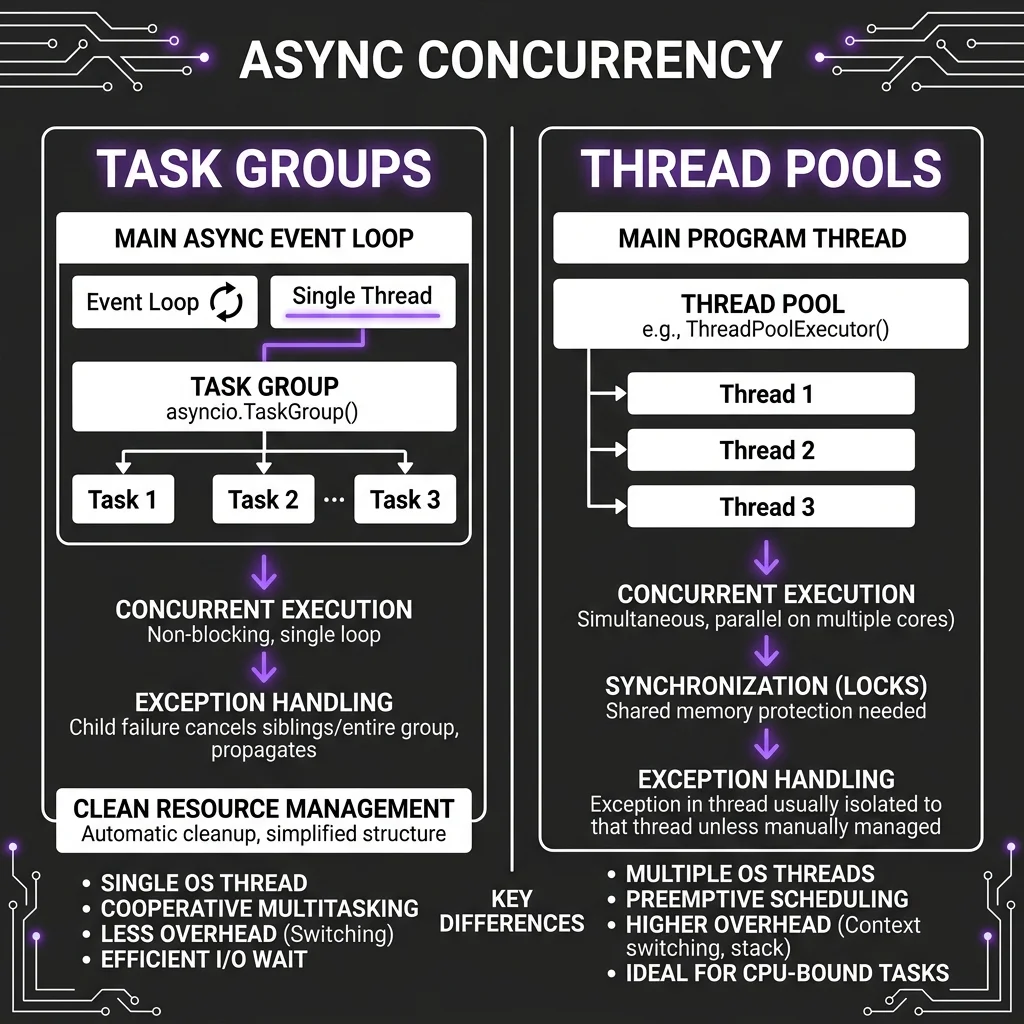
5. Production Observability: Structured Logging, Health Probes, and OTel Tracing
Deploying backends at scale requires deep visibility into runtime metrics, event logs, and API latency.
Observability is enforced through three mechanisms:
- Structured Logging (structlog): Outputting logs in JSON format for easy ingestion by central platforms.
- OpenTelemetry Tracing: Exporting trace spans to capture latency across services.
- Health Probes: Implementing
/healthzand/readyzendpoints for Kubernetes orchestrators.
Below is a configuration snippet showing how to initialize OpenTelemetry tracing inside a FastAPI application:
class="tok-cm"># app/core/telemetry.py
from opentelemetry import trace
from opentelemetry.sdk.trace import TracerProvider
from opentelemetry.sdk.trace.export import BatchSpanProcessor, ConsoleSpanExporter
from opentelemetry.instrumentation.fastapi import FastAPIInstrumentor
from fastapi import FastAPI

class="tok-kw">def setup_telemetry(app: FastAPI):
    provider = TracerProvider()
    processor = BatchSpanProcessor(ConsoleSpanExporter())
    provider.add_span_processor(processor)
    trace.set_tracer_provider(provider)

    FastAPIInstrumentor.instrument_app(app)
Integrating telemetry helps operators debug latency anomalies and tool selection failures in production.
6. Comparative Matrix: pip/Poetry vs. uv Packaging Stack
The table below compares legacy Python package managers with the modern uv stack.
| Dimension | Legacy (pip / Poetry) | Modern (uv Stack) |
|---|---|---|
| Resolution Speed | Seconds to minutes (Python-based resolver) | Milliseconds (Rust-backed multi-threaded resolver) |
| Tooling Footprint | Requires separate pip, virtualenv, and Poetry CLI tools | Single compiled Rust binary (uv) replacing all tools |
| Docker Layer Cache | Complex multi-stage files, slow image build times | Native support for offline installation, fast builds |
7. Developer Blueprint: Creating a Secure FastAPI Agent Tool Service
To integrate with the Python production stack, you must define and deploy a secure FastAPI service. This process involves configuring your endpoint parameters, setting up CORS policies, and mapping request validation rules.
Below is a complete implementation showing how to define a FastAPI application, handle async requests using Task Groups, and return tool outputs securely.
Python Implementation
First, configure the FastAPI application to serve as an agent tool server:
class="tok-cm"># app/main.py
import asyncio
import logging
from fastapi import FastAPI, Depends, HTTPException, status
from fastapi.security import APIKeyHeader
from opentelemetry import trace

logger = logging.getLogger(__name__)
app = FastAPI(title=class="tok-str">"Sovereign Python Tool Server")
api_key_header = APIKeyHeader(name=class="tok-str">"X-Tool-API-Key")

class="tok-kw">def verify_api_key(api_key: str = Depends(api_key_header)):
    if api_key != class="tok-str">"secret-production-auth-token-2026":
        raise HTTPException(
            status_code=status.HTTP_403_FORBIDDEN,
            detail=class="tok-str">"Invalid security token credentials"
        )
    return api_key

@app.post(class="tok-str">"/api/v1/tools/execute")
async class="tok-kw">def execute_tools(payload: dict, token: str = Depends(verify_api_key)):
    class="tok-str">""class="tok-str">"
    Executes multiple backend tools concurrently using asyncio Task Groups.
    "class="tok-str">""
    tracer = trace.get_tracer(__name__)
    with tracer.start_as_current_span(class="tok-str">"execute_tools_group"):
        results = []
        try:
            async with asyncio.TaskGroup() as tg:
                class="tok-cm"># Schedule tasks concurrently
                task1 = tg.create_task(run_database_query(payload.get(class="tok-str">"query")))
                task2 = tg.create_task(run_system_audit(payload.get(class="tok-str">"target")))

            results.append(task1.result())
            results.append(task2.result())
            return {class="tok-str">"success": True, class="tok-str">"data": results}

        except Exception as e:
            logger.error(fclass="tok-str">"Task Group execution failed: {str(e)}")
            raise HTTPException(
                status_code=status.HTTP_500_INTERNAL_SERVER_ERROR,
                detail=fclass="tok-str">"Execution error: {str(e)}"
            )

async class="tok-kw">def run_database_query(q: str) -> dict:
    await asyncio.sleep(0.1) class="tok-cm"># Simulate async I/O
    return {class="tok-str">"query": q, class="tok-str">"status": class="tok-str">"completed"}

async class="tok-kw">def run_system_audit(target: str) -> dict:
    await asyncio.sleep(0.2) class="tok-cm"># Simulate async I/O
    return {class="tok-str">"target": target, class="tok-str">"status": class="tok-str">"passed"}
Go Integration Client
For high-performance services interacting with the FastAPI backend, the following Go client handles request dispatching:
// client/tool_client.go
package client

import (
	"bytes"
	"context"
	"encoding/json"
	"fmt"
	"net/http"
	"time"
)

type ToolClient struct {
	BaseURL string
	APIKey  string
	HTTP    *http.Client
}

func NewToolClient(baseURL, apiKey string) *ToolClient {
	return &ToolClient{
		BaseURL: baseURL,
		APIKey:  apiKey,
		HTTP:    &http.Client{Timeout: 5 * time.Second},
	}
}

func (c *ToolClient) ExecuteTool(ctx context.Context, query string) (map[string]interface{}, error) {
	payload := map[string]string{"query": query, "target": "production-env"}
	body, _ := json.Marshal(payload)

	req, _ := http.NewRequestWithContext(ctx, "POST", c.BaseURL+"/api/v1/tools/execute", bytes.NewBuffer(body))
	req.Header.Set("X-Tool-API-Key", c.APIKey)
	req.Header.Set("Content-Type", "application/json")

	resp, err := c.HTTP.Do(req)
	if err != nil {
		return nil, fmt.Errorf("http request failed: %w", err)
	}
	defer resp.Body.Close()

	var result map[string]interface{}
	json.NewDecoder(resp.Body).Decode(&result)
	return result, nil
}
PHP Integration Client
To call the Python service from a PHP backend, the following class manages token authentication and requests:
<?php
class="tok-cm">// app/Services/PythonToolClient.php
namespace App\Services;
class PythonToolClient
{
private string $baseUrl;
private string $apiKey;
public class="tok-kw">function __construct(string $baseUrl, string $apiKey)
{
$this->baseUrl = rtrim($baseUrl, &class="tok-cm">#039;/class="tok-str">');
$this->apiKey = $apiKey;
}
public class="tok-kw">function executeQuery(string $query): ?array
{
$payload = json_encode([&class="tok-cm">#039;query' => $query, class="tok-str">'target' => class="tok-str">'production-env']);
$opts = [
&class="tok-cm">#039;httpclass="tok-str">' => [
&class="tok-cm">#039;method' => class="tok-str">'POST',
&class="tok-cm">#039;headerclass="tok-str">' => "Content-Type: application/json
" .
"X-Tool-API-Key: {$this->apiKey}
",
&class="tok-cm">#039;content' => $payload,
&class="tok-cm">#039;timeoutclass="tok-str">' => 5
]
];
$context = stream_context_create($opts);
try {
$response = @file_get_contents($this->baseUrl . &class="tok-cm">#039;/api/v1/tools/execute', false, $context);
class="tok-kw">if ($response === false) {
class="tok-kw">return null;
}
class="tok-kw">return json_decode($response, true);
} catch (\Throwable $e) {
class="tok-kw">return null;
}
}
}8. Failure Modes: Timeout Management, Circuit Breakers, and Retries
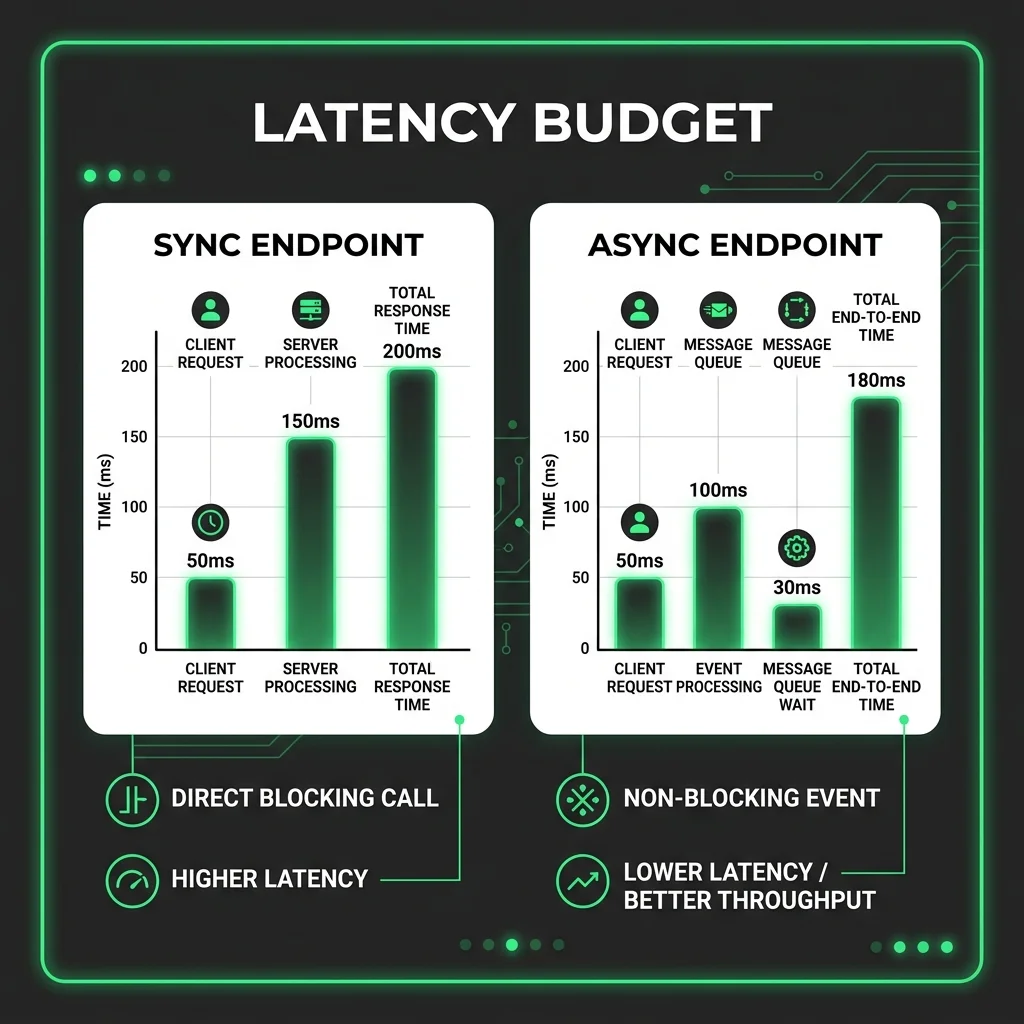
Deploying Python APIs in production requires handling failures. Typical error states include database timeouts, API rate limits, and network disconnects.
To maintain application stability, developers should implement a circuit breaker architecture:
Timeout Enforcement
Every async call must include a timeout limit. If a task exceeds its allocated duration, the runtime raises a timeout exception and triggers a fallback:
try:
    async with asyncio.timeout(3.0):
        await fetch_external_resource()
except TimeoutError:
    logger.warning(class="tok-str">"Resource fetch timed out. Triggering fallback.")
Retry with Jitter
To prevent overloading dependencies during outages, implement an exponential backoff with jitter retry strategy:
async class="tok-kw">def fetch_with_retry(func, retries=3):
    for attempt in range(retries):
        try:
            return await func()
        except Exception:
            if attempt == retries - 1:
                raise
            delay = (2 ** attempt) + random.uniform(0, 1)
            await asyncio.sleep(delay)
9. FinOps Management: Slim Docker Containerization with uv
To minimize storage costs and deploy quickly, developers use multi-stage Docker builds to compile dependencies in a build stage and copy them into a slim runtime image.
Below is a Dockerfile configuration using uv to create a production container:
class="tok-cm"># Build stage
FROM python:3.12-slim-bookworm AS builder
COPY --from=ghcr.io/astral-sh/uv:latest /uv /bin/uv
WORKDIR /app
COPY pyproject.toml uv.lock ./
RUN uv sync --frozen --no-dev --no-install-workspace

class="tok-cm"># Runtime stage
FROM python:3.12-slim-bookworm
WORKDIR /app
COPY --from=builder /app/.venv /app/.venv
COPY app/ ./app
ENV PATH=class="tok-str">"/app/.venv/bin:$PATH"
EXPOSE 8000
CMD [class="tok-str">"uvicorn", class="tok-str">"app.main:app", class="tok-str">"--host", class="tok-str">"0.0.0.0", class="tok-str">"--port", class="tok-str">"8000"]
This multi-stage build creates a container size under 150MB, minimizing storage overhead.
10. Roadmap to 2030: WebAssembly (WASM) Python and the Edge Runtime
The standard stack will continue to evolve as runtime architectures shift toward decentralized models.
Phase 1: Native Rust Tooling (2026–2027)
Modern tools like uv, Ruff, and astral-sh continue to replace traditional Python packaging utilities.
Phase 2: WebAssembly Edge Runtimes (2028–2029)
Python runtimes compile to WASM, enabling servers to run Python functions on edge nodes with low latency.
Phase 3: Decentralized Agent Meshes (2030)
By 2030, Python backends will transition to serverless meshes where micro-agents communicate directly, sharing execution logic.
11. Key Takeaways
- Unified Tooling: uv simplifies environment setup by replacing pip, virtualenv, and Poetry with a single Rust binary.
- Structured Execution: asyncio Task Groups provide clean error handling, preventing orphaned background tasks.
- Production Observability: OpenTelemetry tracing, structlog loggers, and health checks help monitor performance.
- Slim Containers: Multi-stage Docker builds with uv help create deployment packages under 150MB.
- Resilient Infrastructure: Timeouts and retries with jitter help maintain API stability under load.
12. Frequently Asked Questions (FAQ)
How does uv improve dependency resolution speed?
uv uses a dependency resolver written in Rust that processes package indexes and metadata concurrently, completing resolution in milliseconds.
Are asyncio Task Groups compatible with uvloop?
Yes. Task Groups run natively on uvloop, which replaces Python's default event loop with a libuv-backed event loop to improve network I/O throughput.
How do you configure private package registries in uv?
You can configure private registries by setting the UV_EXTRA_INDEX_URL environment variable or defining extra-index-url parameters inside your pyproject.toml file.
Can I run FastAPI without asyncio?
Yes. FastAPI supports synchronous endpoints. However, async endpoints are preferred for tasks involving network I/O or database queries to prevent blocking the event loop.
How does OpenTelemetry tracing help debug async exceptions?
OpenTelemetry automatically injects context metadata into async task spans, allowing developers to trace exceptions across concurrent execution threads in their APM platforms.
13. About the Author
Vatsal Shah is a software architect and digital growth strategist specializing in cloud systems and AI engineering. He designs secure architectures, guides teams through platform migrations, and builds systems that prioritize performance and data privacy.