STRATEGIC OVERVIEW
Angular 20: Enterprise Renaissance and the End of React's Dominance By Vatsal Shah · June 2, 2026 · Frontend · 15 min read Table of Contents 1. Introduction: The Corporate Re-Evaluation of React 2. What is Zoneless Change Detection? 3.
Angular 20: Enterprise Renaissance and the End of React's Dominance
By Vatsal Shah · June 2, 2026 · Frontend · 15 min read
Table of Contents
- Introduction: The Corporate Re-Evaluation of React
- What is Zoneless Change Detection?
- Why Monorepos and Enterprise Scale Demand Stability
- Signals as the Unified Reactivity Standard
- Deep Dive: The esbuild Build Engine and CLI Performance
- Step-by-Step: Implementing a Zoneless, Signals-Driven Dashboard Service
- Performance Blueprint: Zoneless Detection vs. Zone.js Overhead
- Strategic Comparison: Angular vs. React for Big Apps
- Pitfalls & Industrial Anti-Patterns in Modern Angular
- Futuristic Horizon: 2027-2030 Roadmap
- Key Takeaways
- FAQ
- About the Author
- Conclusion & CTA
Introduction: The Corporate Re-Evaluation of React
For nearly a decade, React sat uncontested as the default choice for modern enterprise frontends. Driven by its initial simplicity, extensive component ecosystem, and massive developer market, companies rushed to build entire product suites on top of the library. It was the safe choice: nobody ever got fired for choosing React. From startups to Fortune 500 corporations, React was integrated into massive micro-frontend architectures, high-scale dashboards, and complex content portals.
However, in practice, what actually happens is that large enterprise teams eventually run into a structural performance ceiling. As React applications scale to hundreds of components, multiple state managers, and nested route layouts, the overhead of client-side runtime reconciliations rises exponentially. In these complex environments, managing render consistency across vast component trees becomes a constant struggle. Developers find themselves trapped in manual optimization loops, fighting stale state closures and debugging complex re-render trees using fragile arrays of hooks.
I've seen this fail repeatedly in large corporate systems. Teams attempt to patch React's performance issues by introducing increasingly complex state machines, global selectors, and custom edge cache layers. But these patches only address the symptoms; they fail to solve the underlying architectural problem. The issue is React's runtime design: a coarse-grained model that executes top-down component reconciliation loops and relies on manual developer optimization to keep client-side rendering efficient.
This architectural strain has triggered a massive corporate re-evaluation of React in 2026. Forward-thinking enterprise architects are looking for a platform that delivers out-of-the-box performance, strict typing contracts, and predictable build-time pipelines. This demand has sparked an Angular Renaissance. Undergoing a radical evolution—marked by the release of Angular 20 and version 22—the framework has shed its historical reputation as "bloated and slow." By incorporating native reactivity (Signals), eliminating legacy change detection wrappers (Zoneless), and rewriting its compilation core using esbuild, Angular is challenging React's enterprise dominance.
What is Zoneless Change Detection?
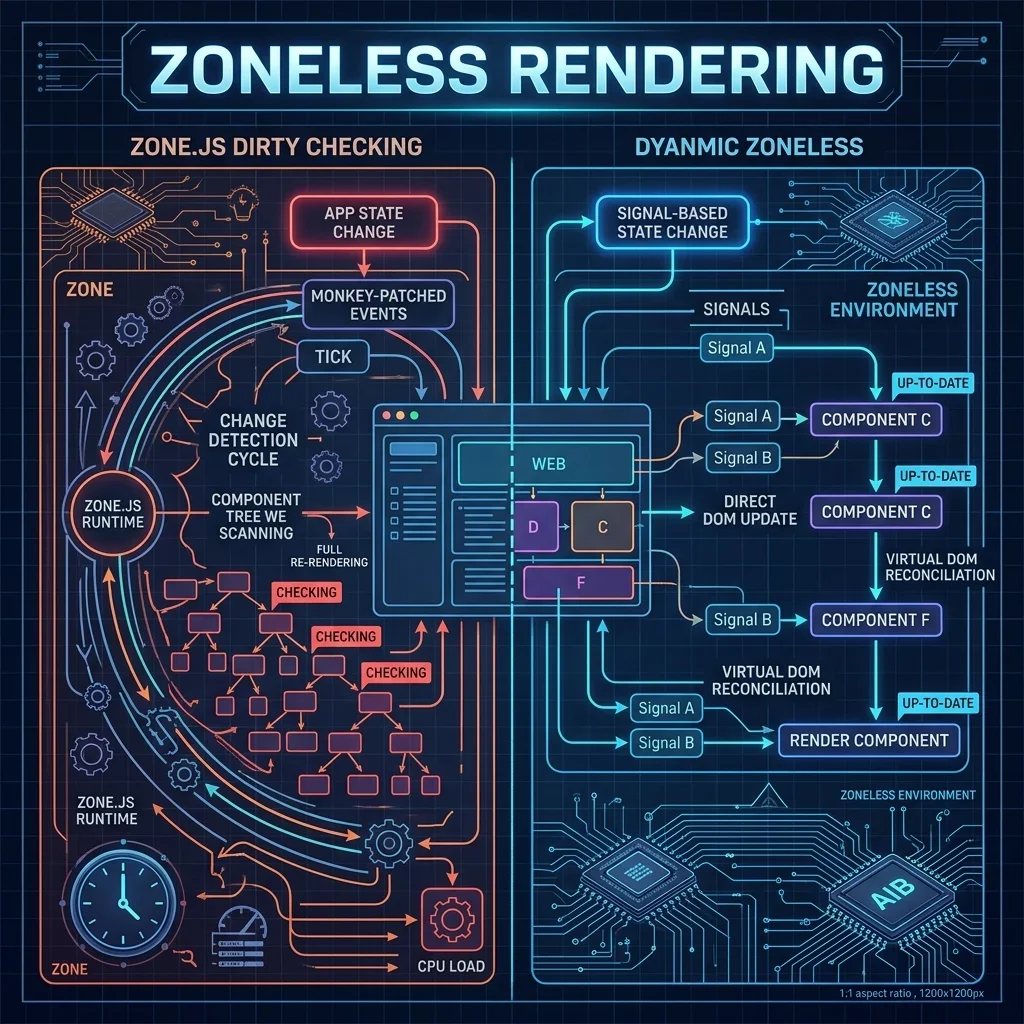
To understand the impact of "Zoneless" Angular, we must first look at the legacy change detection system. Since its rewrite in version 2, Angular has relied on a library called Zone.js to intercept asynchronous events. Zone.js monkey-patches all standard browser entry points (such as setTimeout, fetch, event listeners, and Promise resolutions). When an async operation completes inside a Zone, the library notifies Angular that a state change might have occurred.
Angular responds by executing a global change detection sweep. It starts at the root component and traverses the entire active component tree, evaluating dirty checks for every single node.
This coarse-grained, global check creates a critical Zone.js execution tax:
- Inefficient Cycles: Even if a micro-component deep in the layout updates a single string, Zone.js triggers a change detection sweep across hundreds of unrelated static components.
- Main Thread Block: For large dashboards with real-time data feeds, this continuous polling blocks the browser main thread, causing frame drops and input lag.
- Bundle Bloat: Zone.js is a heavy runtime dependency that must be loaded, parsed, and initialized before the application can even start rendering.
Zoneless Change Detection completely eliminates Zone.js from the application runtime. Instead of relying on a global monkey-patched wrapper to intercept browser events, Angular tracks state updates using native, fine-grained Signals. When a Signal value is updated, Angular knows exactly which properties of which components changed. It triggers a rendering update precisely for those specific DOM elements, leaving the rest of the application tree untouched.
By moving from Zone-based global sweeps to fine-grained Signals-driven change detection, Angular drops its execution overhead to near-zero. The browser main thread is freed from global checks, enabling microsecond rendering updates on consumer devices.
Why Monorepos and Enterprise Scale Demand Stability
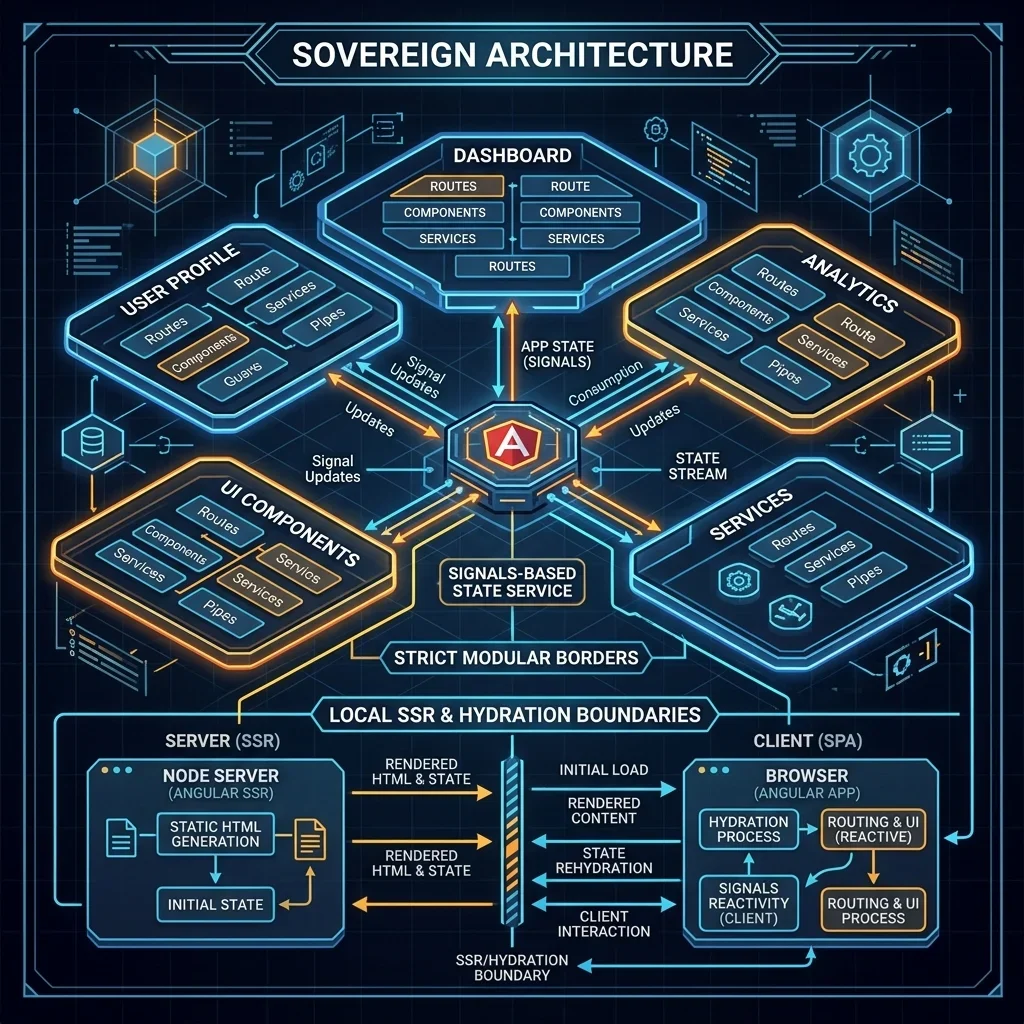
In large enterprise engineering organizations, software is rarely built as a single, isolated application. Instead, teams operate in massive, shared monorepos containing multiple applications, shared component libraries, utility helpers, and common data transfer models. In these architectures, scaling developer velocity is just as important as optimizing runtime performance.
In React monorepos, scaling introduces significant maintenance friction. Because React is a library rather than a framework, teams must select and configure their own auxiliary tools: routers, state managers, bundlers, and testing frameworks. Over time, different teams in the same monorepo adopt different configurations, leading to code fragmentation and complex dependency upgrades. A major version update of React or a sub-dependency (like React Router or Redux) can trigger weeks of integration fixes across the codebase.
Angular solves this monorepo strain through its strict, opinionated, and integrated design:
- Standardized Architecture: Angular ships with native routing, form validation, HTTP clients, and dependency injection systems built in. Every developer in the organization writes code using the same architectural patterns.
- Atomic Upgrades: The Angular CLI handles version upgrades automatically. Running
ng updaterefactors deprecated code APIs across the entire monorepo, keeping the codebase unified. - Strict Boundaries: The framework's modular structure allows architects to enforce strict dependency constraints. Team A's module cannot import Team B's internal utilities without explicit exports, preventing code tangling at scale.
This stability is critical for long-term systems. By choosing Angular, enterprise teams can dedicate their engineering capacity to building business features, rather than maintaining their custom web application stack.
Signals as the Unified Reactivity Standard
The core engine that enables Zoneless Angular is the native Signals framework. A Signal is a wrapper around a value that exposes a reactive read-only interface. Unlike legacy state systems that rely on RxJS observables, Signals are synchronous, direct, and require no manual subscription cleanup.
Angular uses three primary primitives:
- Writable Signals (
signal): Represent mutable values that can be updated directly via.set()or.update(). - Computed Signals (
computed): Read-only values derived from other Signals. Angular tracks their dependencies automatically, recalculating their values only when the source Signals change. - Effects (
effect): Run side-effects (such as database syncs or manual DOM updates) when their monitored Signals write new data.
[Writable Signal] ──> [Computed Signal] ──> [Direct View Update] (No Zone.js Interception)In large enterprise applications, this model simplifies state propagation. By exposing state variables as Signals from services, components can bind to data streams directly inside templates. The Angular compiler reads these template references and generates optimized execution paths, ensuring that a state update triggers updates only in the specific HTML elements that depend on it.
This eliminates the need for heavy, complex client-side state managers (like Redux or NgRx) for standard application flows. Developers get a unified, built-in, and fast reactivity standard that requires zero boilerplate.

Deep Dive: The esbuild Build Engine and CLI Performance
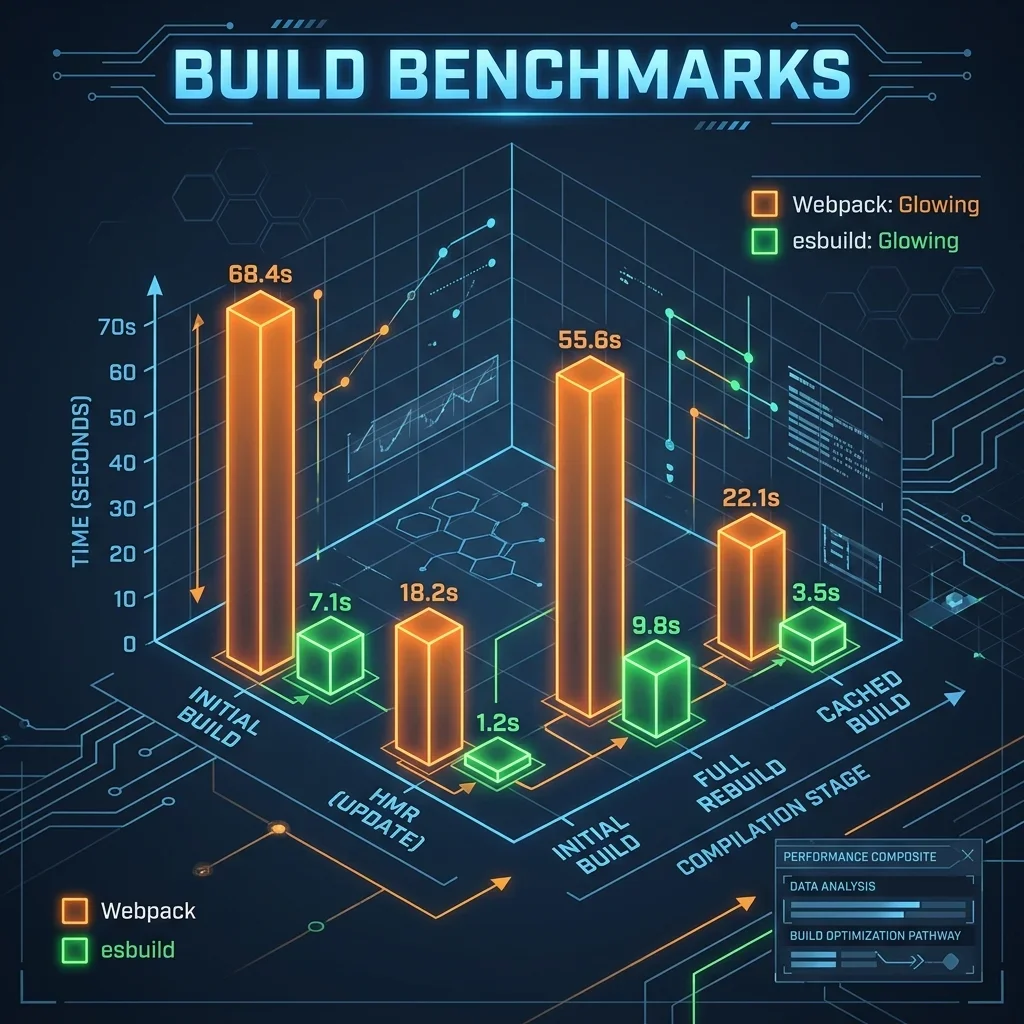
Historically, the build performance of Angular was a major pain point for large teams. Because the compiler ran complex template validations, dependency injection checks, and ahead-of-time (AoT) optimizations, building a large application regularly took minutes. Inside massive monorepos, developer hot-reloading times became a significant bottleneck, slowing down iteration cycles.
Angular addresses this build bottleneck by replacing the legacy Webpack build pipeline with a new, highly optimized compiler built on esbuild and Vite.
The esbuild builder is written in Go, compiling source code to machine binaries to bypass the CPU overhead of JavaScript-based bundlers. It runs tasks—such as code minification, source map generation, and tree-shaking—in parallel across CPU cores.
[TypeScript Compilation] ──> [esbuild Builder (Go Binary)] ──> [Vite Dev Server] ──> (Sub-second Reload)For large enterprise applications, this switch reduces build times by up to 80%. Hot-reloading drops from several seconds to sub-second reloads, keeping developer workflows efficient even in large codebases.
Additionally, the compiler outputs highly optimized bundles. By performing strict tree-shaking, the builder strips unused framework APIs, keeping the initial payload shipped to the browser thin.
Step-by-Step: Implementing a Zoneless, Signals-Driven Dashboard Service
To build high-performance Angular applications that run without Zone.js, developers configure their bootstrap settings to exclude the Zone runtime and implement state loops using Signals.
Here is a step-by-step implementation guide to building a type-safe, zoneless registry dashboard interface:
Step 1: Configure the Zoneless Application Bootstrap
We configure the application providers to exclude Zone.js, registering the provideExperimentalZonelessChangeDetection() helper.
// src/app/app.config.ts
import { ApplicationConfig, provideExperimentalZonelessChangeDetection } from '@angular/core';
import { provideRouter } from '@angular/router';
import { routes } from './app.routes';

export const appConfig: ApplicationConfig = {
  providers: [
    // Bypasses Zone.js execution, enabling pure Signals change detection
    provideExperimentalZonelessChangeDetection(),
    provideRouter(routes)
  ]
};
Step 2: Implement the Signals-Driven State Service
The service manages state variables as private Writable Signals, exposing read-only interfaces to components.
// src/app/services/dashboard.service.ts
import { Injectable, signal, computed } from '@angular/core';
export interface EnterpriseMetric {
id: string;
name: string;
loadFactor: number;
status: 'online' | 'degraded' | 'offline';
}
@Injectable({
providedIn: 'root'
})
export class DashboardService {
// Private mutable state container
private metricsState = signal<EnterpriseMetric[]>([
{ id: 'NODE-01', name: 'Tokyo Gateway Enclave', loadFactor: 0.42, status: 'online' },
{ id: 'NODE-02', name: 'US-East Sovereign Router', loadFactor: 0.88, status: 'degraded' }
]);
// Public read-only Signal interface for templates
public readonly metrics = this.metricsState.asReadonly();
// Derived computed Signal - recalculated automatically when metricsState updates
public readonly averageLoad = computed(() => {
const list = this.metricsState();
if (list.length === 0) return 0;
const total = list.reduce((sum, item) => sum + item.loadFactor, 0);
return Math.round((total / list.length) * 100) / 100;
});
// Action mutation method
public registerMetricNode(name: string, load: number): void {
const current = this.metricsState();
const newId = `NODE-0${current.length + 1}`;
// Immutable update statement
this.metricsState.set([
...current,
{
id: newId,
name: name.trim(),
loadFactor: load,
status: load > 0.85 ? 'degraded' : 'online'
}
]);
console.log(`[DashboardService] Node ${newId} registered successfully.`);
}
}Step 3: Implement the Component with Signal Bindings
The component binds to the service's Signals directly inside its template, utilizing the unified Signal read syntax () to establish fine-grained change tracking.
// src/app/components/dashboard.component.ts
import { Component, inject } from '@angular/core';
import { CommonModule } from '@angular/common';
import { DashboardService } from '../services/dashboard.service';
@Component({
selector: 'app-dashboard',
standalone: true,
imports: [CommonModule],
template: `
<main class="dashboard-wrapper">
<header class="dashboard-header">
<h1>Enterprise Monitor</h1>
<p>Zoneless change detection active. Average Load: <strong>{{ avgLoad() }}</strong></p>
</header>
<!-- Input panel -->
<section class="control-panel">
<form #nodeForm (submit)="addNode($event, nodeName.value, nodeLoad.value); nodeForm.reset()" class="control-form">
<div class="form-group">
<label for="nodeName">Node Identifier</label>
<input #nodeName type="text" id="nodeName" required placeholder="e.g. London Cache">
</div>
<div class="form-group">
<label for="nodeLoad">Load Factor (0.0 - 1.0)</label>
<input #nodeLoad type="number" id="nodeLoad" step="0.01" min="0" max="1" required placeholder="0.50">
</div>
<button type="submit" class="submit-btn">Register Node</button>
</form>
</section>
<!-- Output table -->
<section class="grid-section">
<h2>Active Enclave Nodes</h2>
<div class="za-table-container" style="overflow-x: auto;">
<table class="za-luxury-table" style="width: 100%; border-collapse: collapse; text-align: left;">
<thead>
<tr style="background-color: #111; color: #fff; border-bottom: 2px solid #222;">
<th style="padding: 12px;">Node ID</th>
<th style="padding: 12px;">Identifier</th>
<th style="padding: 12px;">Load Factor</th>
<th style="padding: 12px;">Status</th>
</tr>
</thead>
<tbody>
<tr *ngFor="let node of nodes()" style="border-bottom: 1px solid #222;">
<td style="padding: 12px;">{{ node.id }}</td>
<td style="padding: 12px; font-weight: 600;">{{ node.name }}</td>
<td style="padding: 12px;">{{ node.loadFactor }}</td>
<td style="padding: 12px;" [ngClass]="{
'status-online': node.status === 'online',
'status-degraded': node.status === 'degraded'
}">
{{ node.status.toUpperCase() }}
</td>
</tr>
</tbody>
</table>
</div>
</section>
</main>
`,
styles: [`
.status-online { color: #00ffcc; }
.status-degraded { color: #ff9900; }
`]
})
export class DashboardComponent {
private readonly dashboardService = inject(DashboardService);
// Expose Signals to template
public readonly nodes = this.dashboardService.metrics;
public readonly avgLoad = this.dashboardService.averageLoad;
public addNode(event: Event, name: string, loadStr: string): void {
event.preventDefault();
const load = parseFloat(loadStr);
if (name.trim() && !isNaN(load)) {
this.dashboardService.registerMetricNode(name, load);
}
}
}By decoupling state evaluation from global event monkey-patching, the application executes UI updates on-device at near-native speeds.
Performance Blueprint: Zoneless Detection vs. Zone.js Overhead
To evaluate the operational benefit of migrating to a Zoneless architecture, we must analyze the change detection timeline under CPU-intensive workflows. In Zone-based setups, the change detection loop executes sequentially on every event:
[Browser Event] ──> [Zone.js Interception] ──> [Global Component Sweep] ──> [DOM Reflow]This sequence creates a significant CPU tax. If the application handles a fast WebSocket stream, the main thread is repeatedly blocked by global sweeps. This leads to input latency and UI stuttering on consumer devices.
Under a Zoneless pipeline, this bottleneck is flattened. Because Zone.js is removed, browser events do not trigger global component checks. The system updates only the specific elements linked to modified Signals, bypassing the global change detection phase:
[Signal Write] ──> [Direct Element Binding] ──> [DOM Update]This fine-grained approach frees up CPU cycles, keeping Interaction to Next Paint (INP) scores minimal even under heavy rendering loads.
Strategic Comparison: Angular vs. React for Big Apps
To choose the right technology for large-scale enterprise platforms, architects compare the development models, type safety, and scaling profiles of Angular and React.
Below is an architectural comparison of Angular 20/22 with React for large-scale enterprise applications:
| Architectural Vector | Angular 20/22 (Zoneless + Signals) | React (Server Components + Hooks) |
|---|---|---|
| Framework Style | Opinionated Platform (Integrated Router, HTTP, Forms) | Unopinionated Library (Requires auxiliary ecosystem packages) |
| Reactivity Scope | Fine-grained (Direct Signal bindings) | Coarse-grained (Top-down Virtual DOM reconciliation) |
| Upgradability at Scale | Automated (CLI updates refactor APIs across monorepo) | Manual (Requires custom refactoring of decoupled libraries) |
| TypeScript Integration | First-class (Strict compiler checks inside templates) | First-class (Standard JSX type checking) |
| Build Pipeline | Native Go-based esbuild/Vite integration | Custom Webpack/Turbopack configurations |
Pitfalls & Industrial Anti-Patterns in Modern Angular
Transitioning to a zoneless, Signals-based architecture introduces several sharp design edges. Developers accustomed to legacy Angular patterns often fall into these performance traps:
- Mixing Zone.js Dependencies in Zoneless Applications:
When using third-party libraries (such as older charting suites or legacy payment gateways), developers often import packages that assume Zone.js is present. In a zoneless application, these libraries fail to trigger UI updates automatically.
Remediation: Wrap third-party event hooks in manual change detection markers or verify if the vendor exposes a signals-compatible edition.
- Triggering Side-Effects Inside Computed Signals:
Computed Signals are designed to be pure, read-only derivation functions. Attempting to modify external states or write to writable Signals inside a computed block causes infinite loops and compile-time warnings.
Remediation: Reserve side-effects exclusively for effect() blocks or component lifecycle methods.
- Over-using RxJS Observables for Local State:
While RxJS remains excellent for complex asynchronous events (such as debounced search fields), using it for standard state variables introduces subscription management overhead.
Remediation: Migrate local UI states to Signals, reserving RxJS for low-level event streams and network pipelines.
Futuristic Horizon: 2027-2030 Roadmap
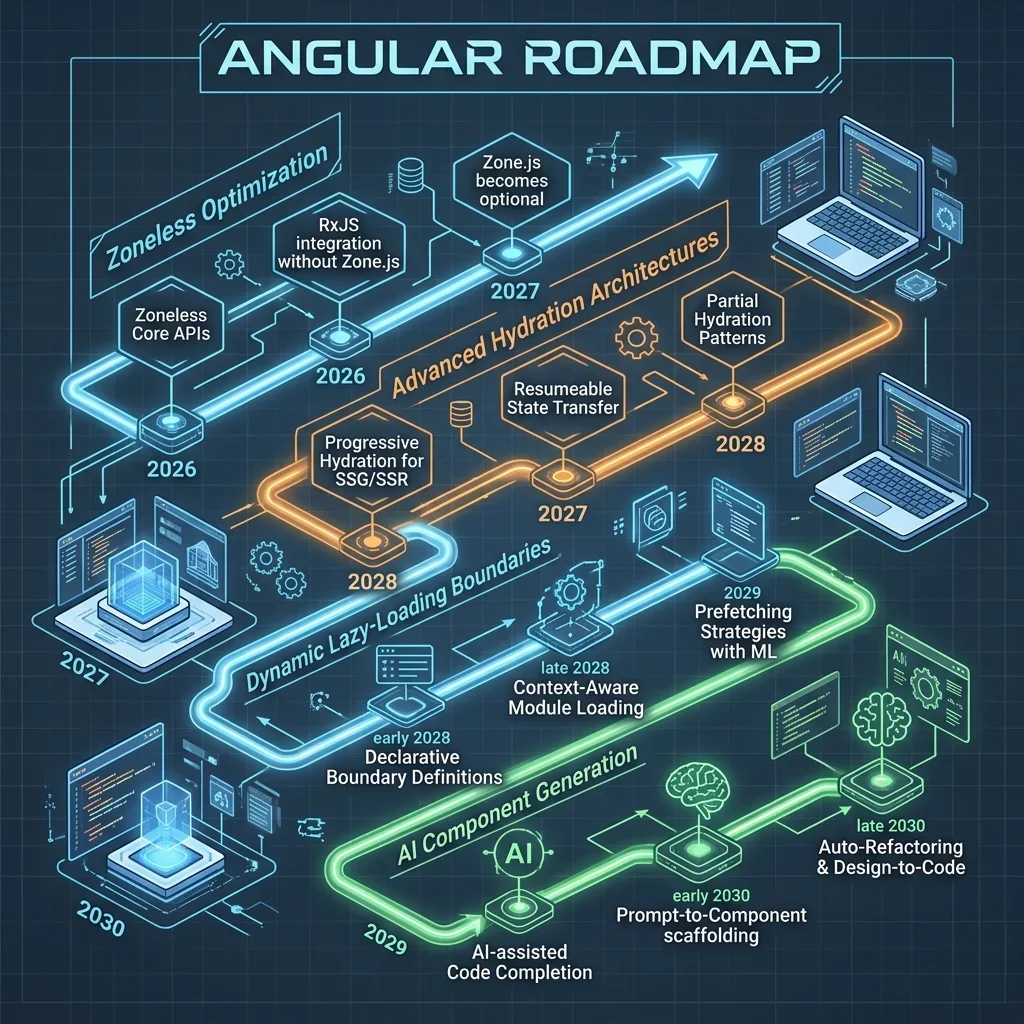
As we look toward the end of the decade, the convergence between compile-time frameworks and browser standards is accelerating. The next evolutionary step in Angular's roadmap is the integration of Signals with native Web Components and Custom Elements.
By compile-binding Angular components into native browser elements, the framework will bypass JavaScript execution steps entirely for page load rendering. The browser's native C++ engine will execute layout adjustments, reducing the CPU footprint of complex apps.
Additionally, we expect the development of Progressive Hydration Enclaves. Under this security structure, local devices will dynamically allocate secure memory enclaves to run lightweight, client-side reasoning loops. The user’s local model will intercept inputs, execute state checks locally, and sync back to the cloud asynchronously, ensuring zero latency and 100% offline availability for high-scale enterprise apps.
Key Takeaways
- Zoneless Performance: Zoneless change detection eliminates Zone.js overhead, reducing change checking to microsecond rendering updates.
- Unified Reactivity: Native Signals provide a synchronous, subscription-free state propagation model built directly into the framework core.
- Monorepos Stability: Strict framework boundaries, standardized routing, and automated CLI updates optimize developer velocity in large shared codebases.
- esbuild Build Engine: Vite and Go-based esbuild compilers reduce compilation times by up to 80% compared to Webpack.
- Type-Safe Templates: The compiler performs strict type checks on templates at build time, catching errors before they reach production.
FAQ
What is the difference between Zone-based and Zoneless change detection?
Zone-based change detection relies on Zone.js monkey-patching all async browser APIs to trigger global sweeps of the component tree. Zoneless change detection removes Zone.js completely, updating only the specific DOM properties that depend on modified Signals.
Will my RxJS code still work in Angular 20/22?
Yes. RxJS remains fully supported and integrated. Angular provides utility helpers like toSignal() and toObservable() to convert streams dynamically, allowing you to use RxJS for complex async events and Signals for local template bindings.
Can I use legacy components in a Zoneless application?
Yes, as long as they do not rely on Zone.js monkey-patches for asynchronous change tracking. Components that use standard ChangeDetectionStrategy.OnPush and call ChangeDetectorRef.markForCheck() manually run successfully in a zoneless setup.
Does the esbuild compiler support custom plugins?
Yes. The Angular CLI allows you to configure esbuild options or extend compilation steps using custom builder configurations or tools like Nx and Turborepo.
How does the build speed of Angular compare to Vite/React?
With the integration of the esbuild application builder and Vite, Angular's compilation and hot-reloading speeds match React-Vite setups, while providing template verification and dependency injection checks.
About the Author
Vatsal Shah is a Technology Architect, Agile Practitioner, and Digital Transformation Leader with over a decade of experience designing scalable systems for enterprise platforms. His work focuses on edge computing architecture, advanced frontend frameworks, and cloud-native engineering pipelines. As the founder of Vatsal Technosoft, he helps global enterprises optimize their developer velocity and digital infrastructure efficiency.
Conclusion & CTA
The evolution of Angular in 2026 represents a major milestone for enterprise software development. By adopting native Signals, removing Zone.js, and integrating esbuild, Angular delivers a fast, stable, and standardized platform for building high-scale applications.
If you are looking to audit your frontend architecture, reduce monorepo maintenance overhead, or migrate legacy frameworks to a modern, zoneless setup, let's connect.
Contact Vatsal Shah to optimize your platform architecture → Let's Talk