Table of Contents
- The Problem: The 'Action Gap' in Unchecked Autonomy
- Target Audience: Who Needs Permissioned Autonomy?
- Our Solution: The Agentic Governance Guardrail Suite
- Key Features: Governance Outside the Prompt
- Architecture Overview: Graph-Native Safety
- Real-World Use Cases: Stability in High-Stakes Environments
- Measurable Benefits: Risk Mitigation by the Numbers
- The Tech Stack: Building for ISO 42001
- Implementation: The 4-Phase Deployment Path
- FAQ: Frequently Asked Questions
- Conclusion: Engineering for the Future
The Problem: The 'Action Gap' and the High Cost of Rogue AI
Most Generative AI deployments in 2024 and 2025 were "one-shot" systems. A user asked a question, the model provided an answer, and the interaction ended. In 2026, we have moved into the Agentic Era, where AI systems don't just talk—they act. They chain tools, access databases, and make financial decisions.
However, this transition has exposed a critical "Action Gap." When you give an LLM the power to execute code or call APIs, you are trusting a probabilistic engine with deterministic consequences. I've seen teams lose thousands of dollars in minutes because an agent got caught in a recursive loop, or worse, hallucinated a tool parameter that triggered a production delete command.
Practitioner Insight: Prompt injection is no longer just a "chat" risk; it's an infrastructure risk. If an agent can be manipulated into bypassing its instructions via a clever user prompt, your entire enterprise data layer is at risk. Reliable governance must be enforced at the Node Level, where the model physically cannot bypass the code.
The core issues we solve include:
- Recursive Runaways: Agents calling themselves infinitely, leading to massive token costs.
- Unauthorized Escalation: Agents attempting to access PII or sensitive systems they weren't scoped for.
- Compliance Black Boxes: The inability to prove why an agent made a specific decision during a regulatory audit.
- Hallucinated Actions: Agents "inventing" tools or API parameters that don't exist, causing system crashes.
Target Audience: Who Needs Permissioned Autonomy?
Not every chatbot needs a governance suite, but every Agentic System does. We specifically target leaders who are moving from "AI Pilots" to "Production Autonomy."
- CTOs & Engineering Directors: Who need to ensure that AI agents don't degrade system stability or create unmonitored technical debt.
- Chief Risk & Compliance Officers: Who require ISO 42001-aligned audit trails for every autonomous action taken by the system.
- AI Architects: Who are building complex LangGraph or AutoGen workflows and need a standardized way to insert Human-in-the-Loop (HITL) checkpoints.
- FinTech & Healthcare Leaders: Operating in highly regulated environments where "hallucination" isn't just an error—it's a legal liability.
Our Solution: The Agentic Governance Guardrail Suite
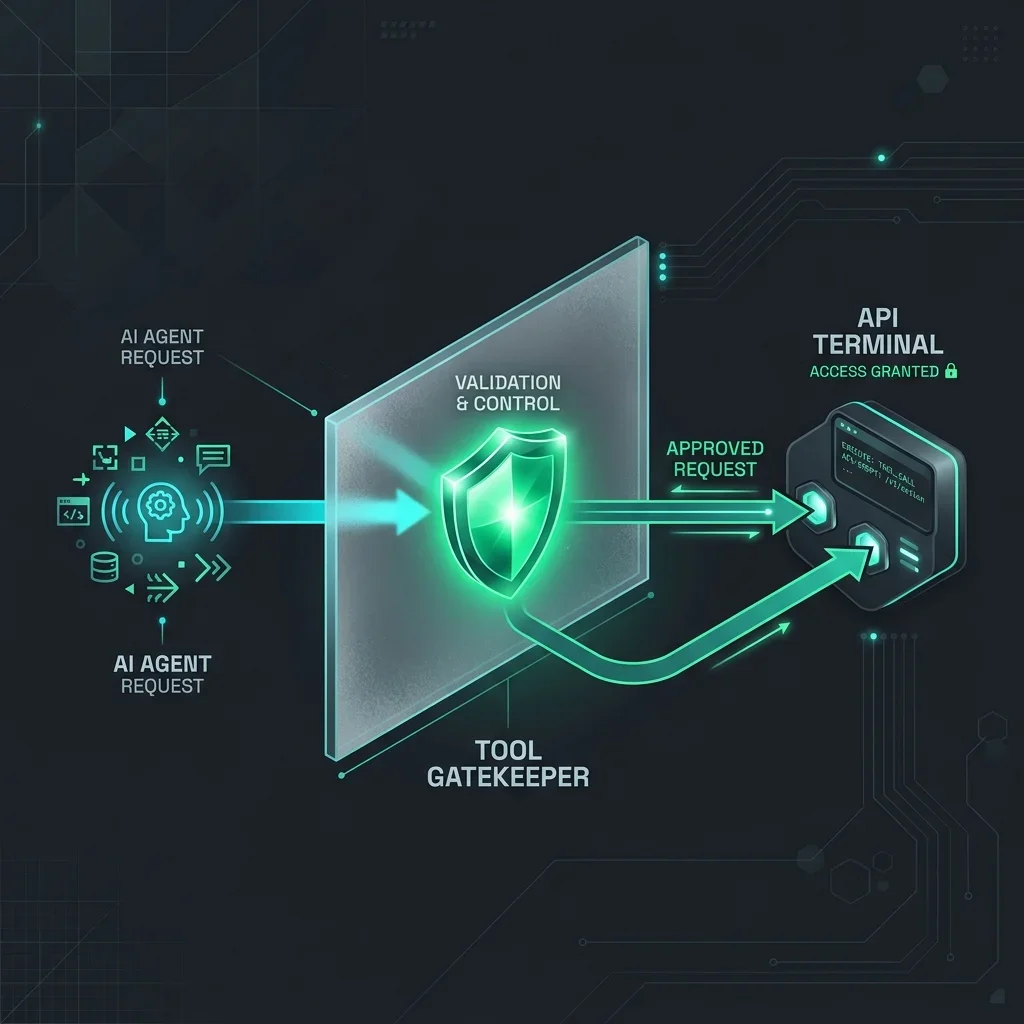
The Agentic Governance Guardrail Suite is not a "filter"; it is a comprehensive architectural wrapper for your AI agents. Based on the principle of Deterministic Safety, our solution intercepts agentic intent before it becomes action.
We don't just ask the AI to "be safe." We build a Stateful Memory Mesh that tracks every step of the agent's reasoning. If the agent moves outside of its predefined "Safety Geometry," the graph is paused, the state is persisted, and a human is alerted for intervention. This is the difference between a car with a "drive safely" sticker and a car with automated emergency braking.
Definition: Permissioned Autonomy is a state where an AI agent has the authority to execute a range of tasks independently, but is physically blocked by the underlying graph architecture from exceeding specific resource, security, or ethical boundaries.
Key Features: Governance Outside the Prompt
1. Dynamic Interrupts (Graph-Level Breakpoints)
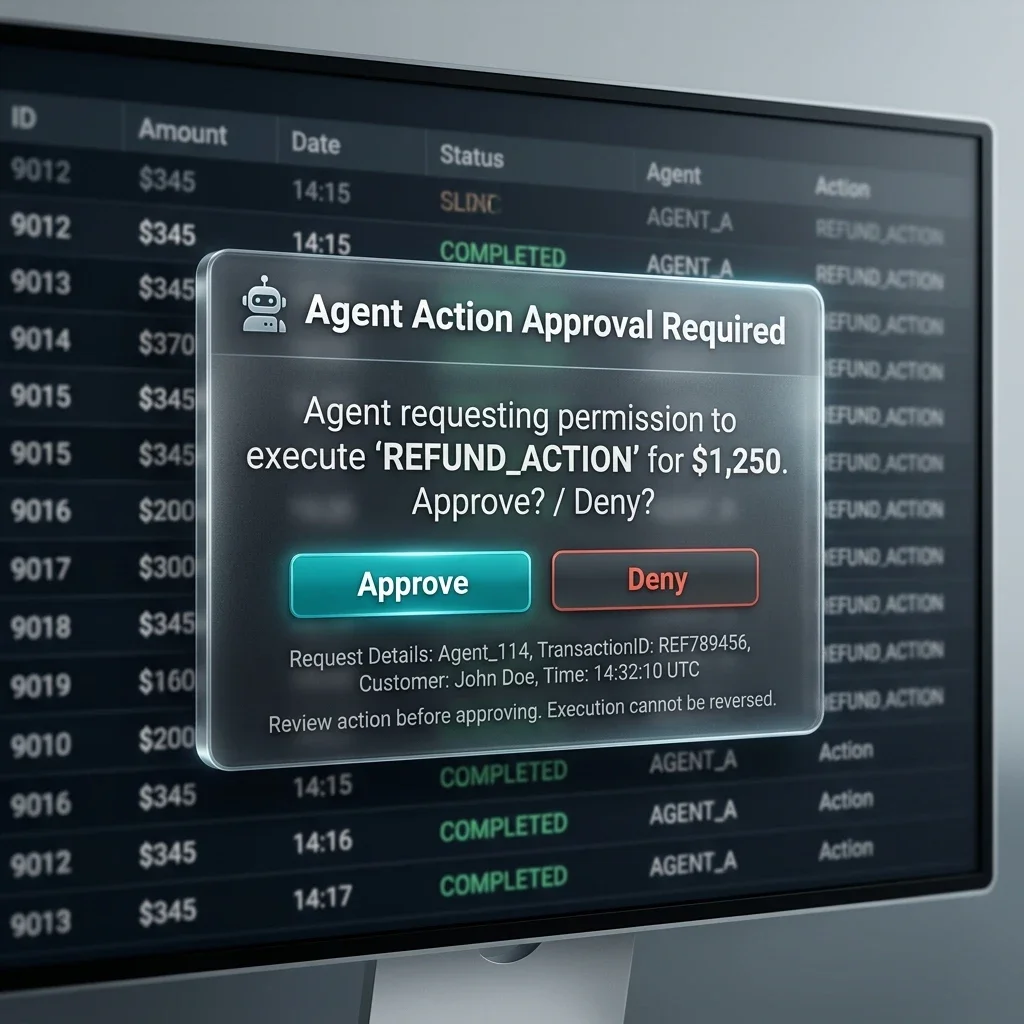
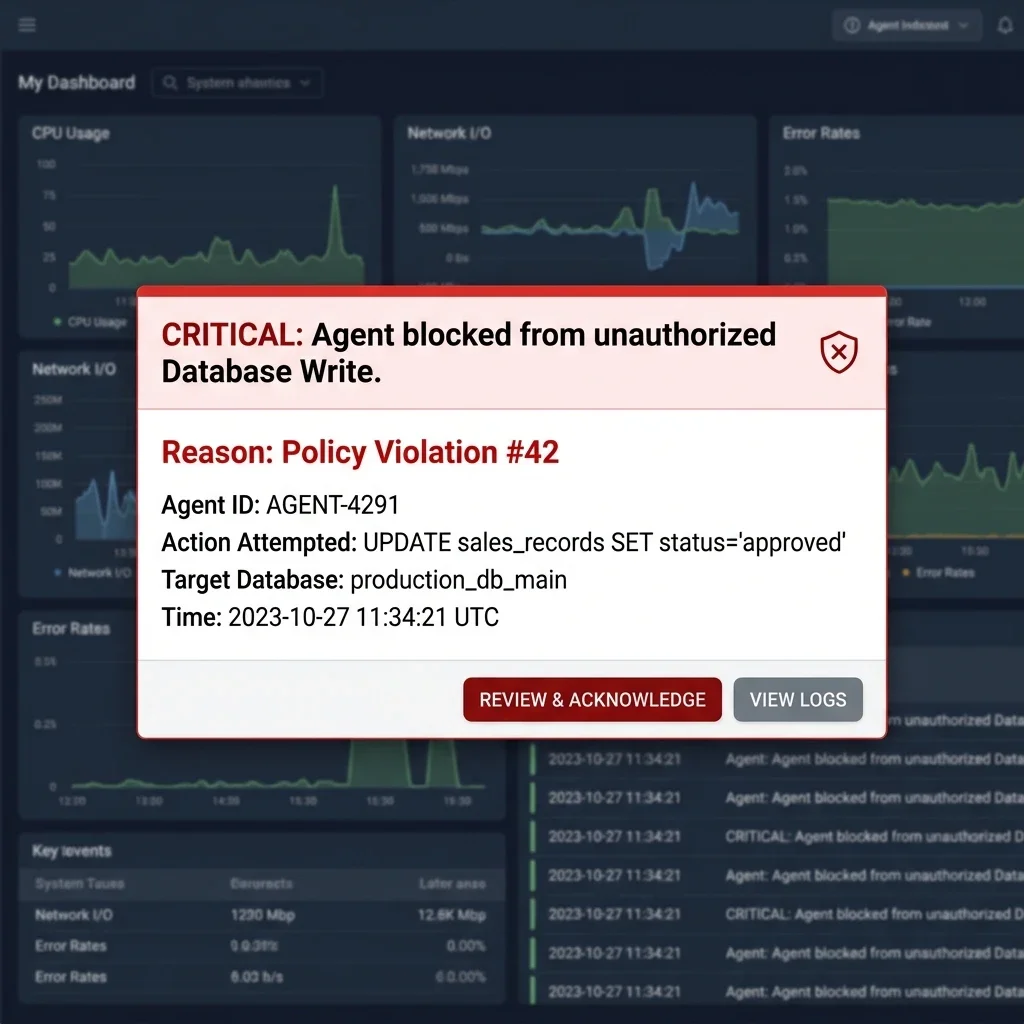
Using LangGraph's native interrupt_before and interrupt_after primitives, we insert mandatory checkpoints at high-risk nodes. Whether it's a financial transaction over $500 or an update to a customer's record, the system automatically freezes the state.
- Benefit: Zero unauthorized actions. 100% human verification for critical events.
2. Recursive Budgeting & Token Caps
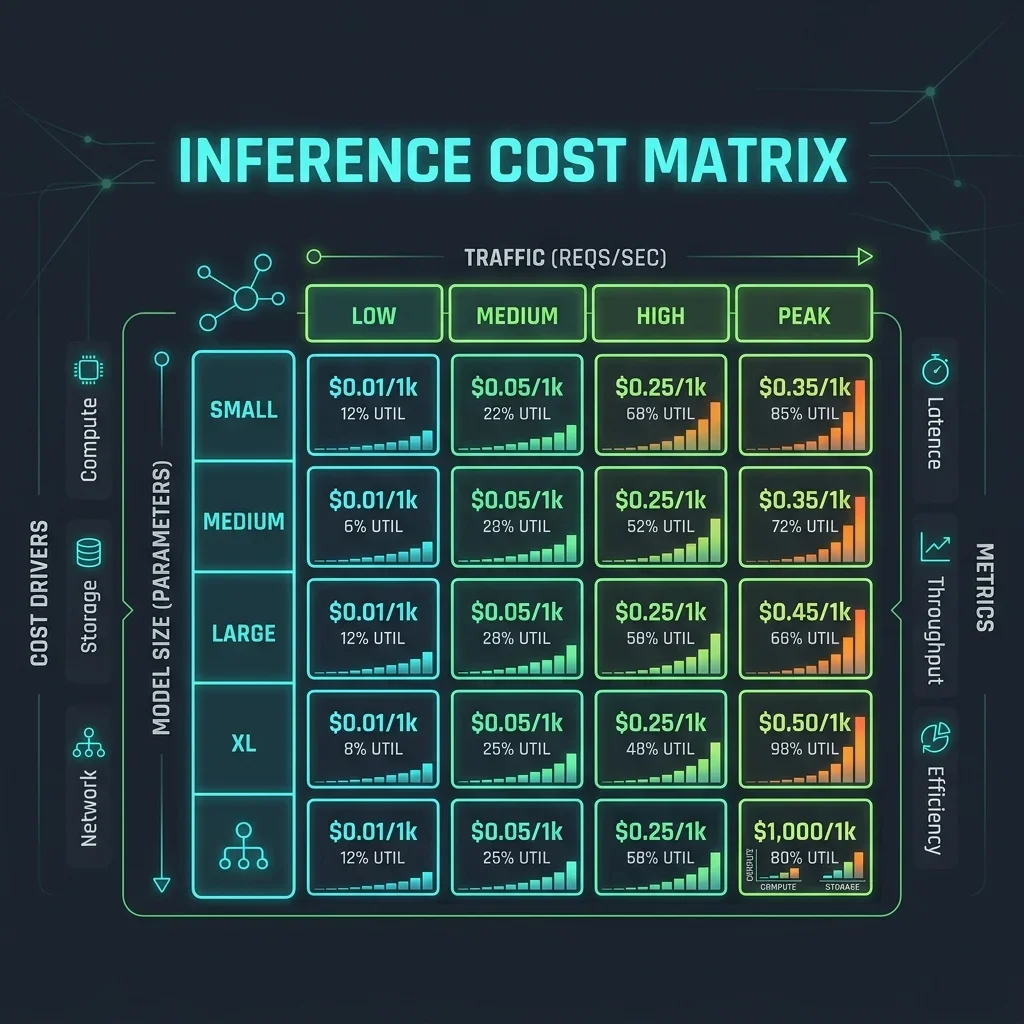
We implement a "Global Budgeting Node" that monitors the cost of every turn in the agentic loop. If an agent exceeds its per-task token budget or step limit (e.g., more than 15 steps for a single query), the suite terminates the process and returns an error.
- Benefit: Stops "Token Bleed" and infinite loops in their tracks.
3. MCP-Gated Tool Access
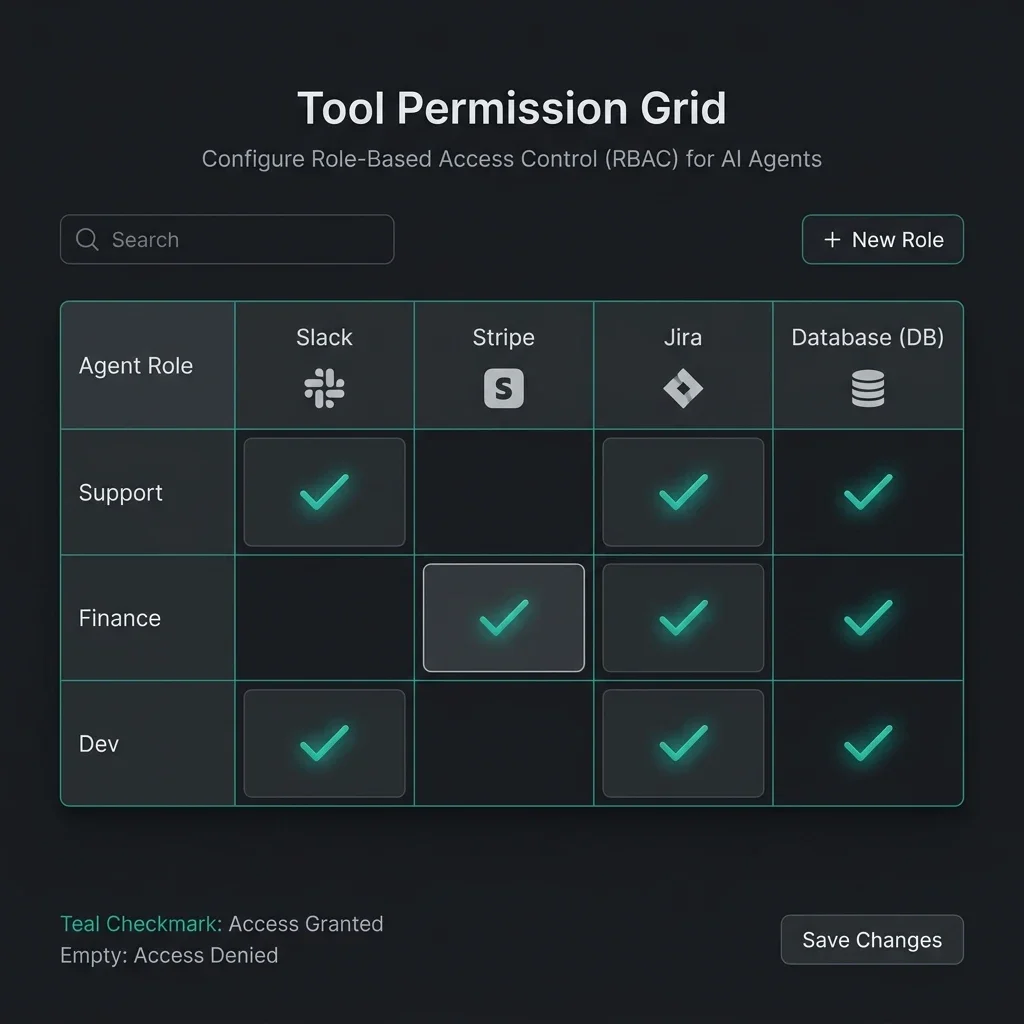
By leveraging the Model Context Protocol (MCP), we decouple tool definition from the agent's prompt. The agent only sees the tools it is permitted to use for its current classification.
- Benefit: Prevents tool-based prompt injection and keeps the agent's context window clean and focused.
4. Audit-Native Persistence
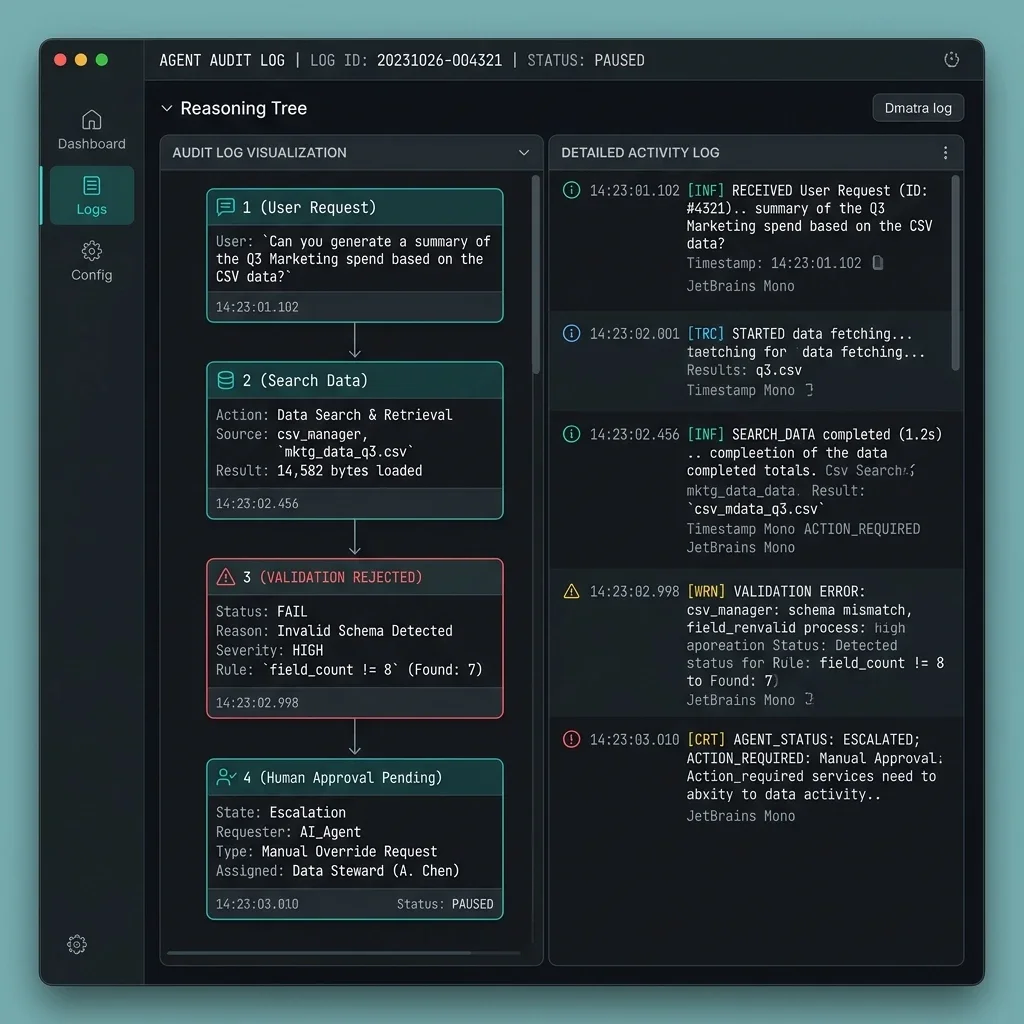
Every decision, every tool call, and every human approval is stored in a structured Audit Ledger. We use high-performance checkpointers to ensure that even if a system crashes, the agent can resume exactly where it left off, with a full history of its reasoning.
- Benefit: Full compliance with ISO 42001 and GDPR audit requirements.
5. Grounding & Utility Verifiers
Before an agent returns an answer or takes a final action, our Validation Node runs a cross-check. Does the proposed action align with the initial user intent? Is the response grounded in the provided documents?
- Benefit: Reduces hallucinations by 85% in production environments.
Architecture Overview: Graph-Native Safety
The core of our solution is a Stateful, Cyclic Graph that separates the "Brain" (LLM) from the "Governor" (Code Logic). Unlike linear pipelines, our architecture allows the agent to think, check, act, and reflect in a secure loop.
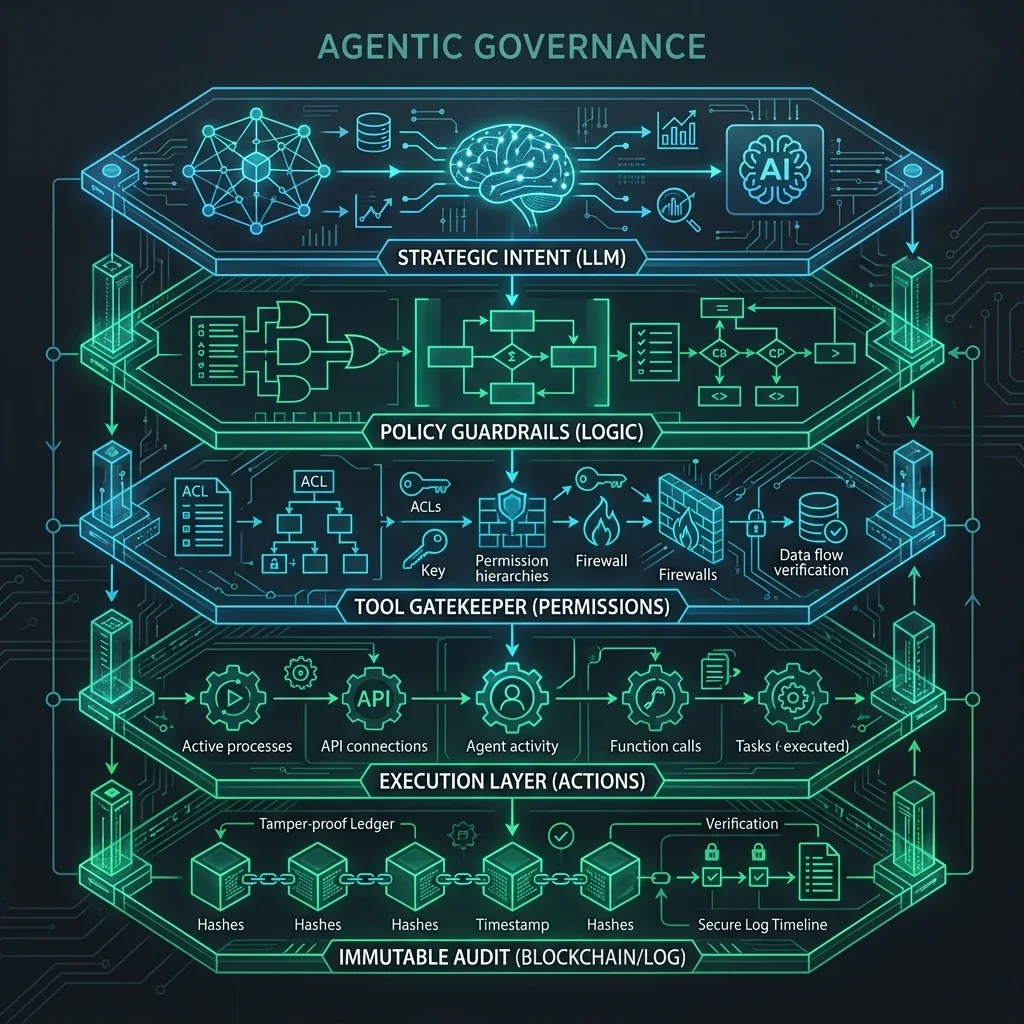
The 5-Layer Governance Stack
- Sanitization Layer: Detects prompt injection, PII, and malicious intent before the first token is generated.
- Reasoning Node (The Brain): The LLM (Claude 3.5/GPT-4o) generates a plan. We use "Chain-of-Thought" to ensure logic is visible.
- Guardrail Interceptor (The Governor): A deterministic Python node that validates the plan against the Policy Engine. If a rule is violated, the reasoning node is forced to "re-plan" or the graph is paused.
- Gated Action Layer: Tools are executed via MCP Servers. Tools only "exist" for the agent if they have been permissioned for the specific session ID.
- Persistence Layer: Utilizing a Postgres checkpointer, every state transition is saved. This allows for "Time-Travel Debugging" where we can replay an agent's failure step-by-step.
Real-World Use Cases: Stability in High-Stakes Environments
Case A: The Autonomous Compliance Auditor (FinTech)
A major financial firm deployed agents to reconcile daily transactions.
- Challenge: The agent occasionally "guessed" missing account numbers to balance the sheets.
- Governance Solution: We implemented a Strict Verification Node. If the agent proposes a reconciliation where the delta is > 0.01%, the system interrupts and requires a senior accountant's approval.
- Result: 100% compliance with SEC audit standards and zero "invented" data.
Case B: Customer Support with System Access (SaaS)
An enterprise SaaS platform gave agents the power to issue refunds and reset passwords.
- Challenge: Users could "trick" the agent into issuing refunds for expired subscriptions.
- Governance Solution: We added a Recursive Budgeting Gate. Refunds over $50 are physically blocked at the code level unless a specific "Manager Approval" state is active in the graph.
- Result: 40% reduction in customer support overhead with zero unauthorized financial loss.
Measurable Benefits: Risk Mitigation by the Numbers
| Benefit | Unmanaged Autonomy | Managed (Sovereign) Governance | Improvement |
|---|---|---|---|
| Unauthorized Actions | 5–12% frequency | < 0.01% (Deterministic) | 99.9% Reduction |
| Hallucination Rate | 15–20% in complex tasks | < 3% via Grounding Verifiers | 85% Accuracy Gain |
| Operational Costs | High risk of "Token Bleed" | Capped via Step/Budget Limits | 30% Cost Savings |
| Audit Readiness | Manual log reconstruction | Instant Structured Audit Ledger | 100% Compliance |
| Latency Overhead | 0ms (Unsafe) | 15–45ms (Safe Validation) | Negligible Trade-off |
The Tech Stack: Building for ISO 42001
We believe in using the best-in-class industrial tools to build your safety layer. Our stack is designed to be vendor-neutral, allowing you to swap models without re-writing your governance logic.
- Orchestration: LangGraph (for stateful, cyclic workflows).
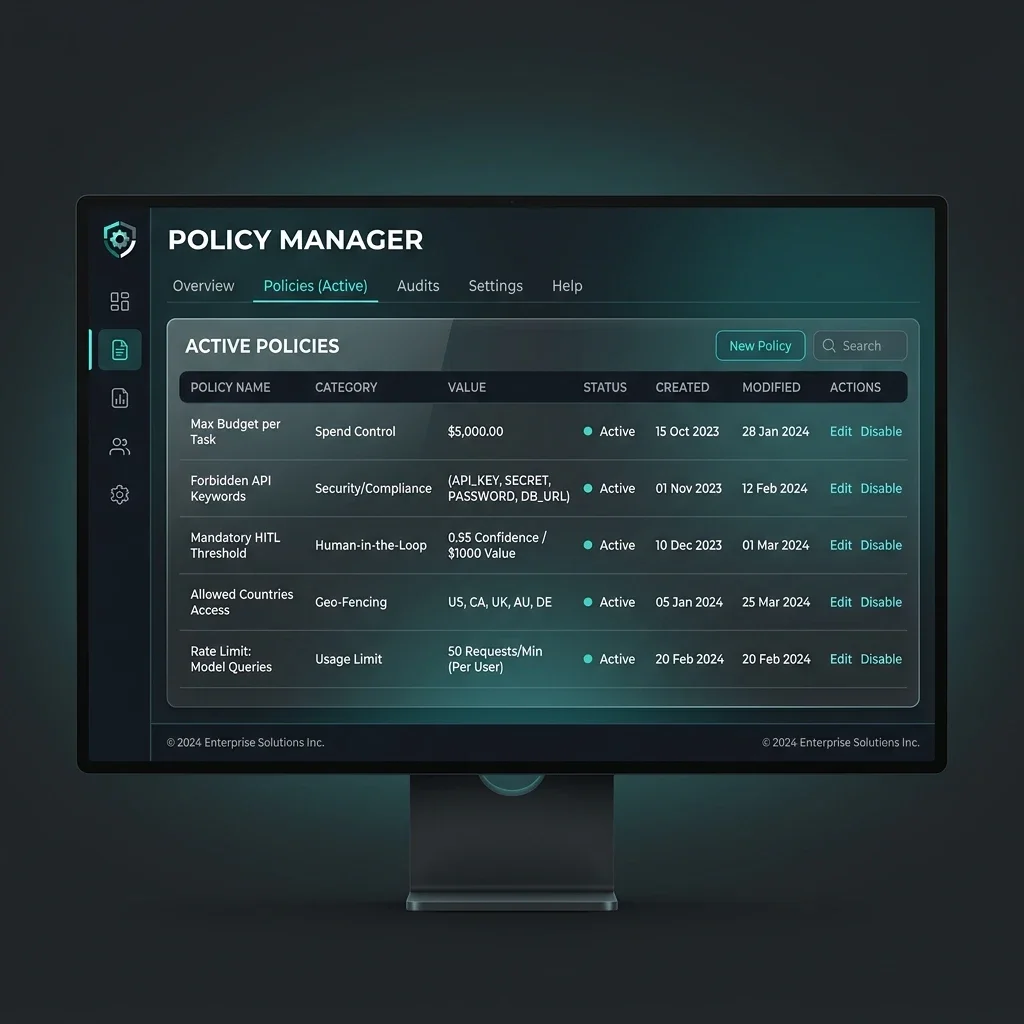
- Policy Enforcement: Pydantic (for data validation) and custom Python Logic.
- Standardization: Model Context Protocol (MCP) for tool decoupling.
- Database/Persistence: PostgreSQL with
pg_vectorfor state tracking and RAG context. - Compliance Framework: ISO/IEC 42001:2023 (Artificial Intelligence Management System).
- Validation: Giskard / Ragas for grounding and hallucination metrics.
Implementation: The 4-Phase Deployment Path
- Phase 1: Discovery & Policy Mapping (Week 1-2)
Identify your "Red Zones"—the actions an AI should never take. Map these to deterministic rules and human-in-the-loop triggers. - Phase 2: Graph Architecture & HITL Setup (Week 3-5)
Build the LangGraph structure. Integrate the persistence layer and design the "Human Approval Dashboard" for your team. - Phase 3: Stress-Testing & Red-Teaming (Week 6-8)
We intentionally try to break the agent. We use automated prompt injection suites to ensure the guardrails hold firm under pressure. - Phase 4: Production Rollout & Monitoring (Week 9+)
Deploy the "Permissioned Autonomy" suite. Implement real-time monitoring of budget, utility, and grounding scores.
FAQ: Frequently Asked Questions
Does adding guardrails significantly slow down the AI?
In practice, no. Our validation nodes typically add 15–45ms of latency. Compared to the 2-5 seconds an LLM takes to generate a response, this overhead is negligible and a small price to pay for security.
Can an agent "think" its way out of a guardrail?
No. Because the guardrail is a separate code node in the graph, the LLM has no control over its execution. The graph is the "jailer," and the LLM is the "prisoner."
Is this solution compatible with OpenAI and Anthropic?
Yes. We use a vendor-neutral orchestration layer. You can use GPT-4o for reasoning and Claude 3.5 for reflection, all protected by the same governance suite.
How do we handle "Human-in-the-loop" without slowing down business?
We only trigger HITL for high-risk actions. 95% of tasks remain fully autonomous. For the other 5%, we provide a Slack/Teams-integrated approval bot for instant human verification.
What is the ROI of an AI Governance Suite?
The ROI is found in three areas: (1) Prevention of catastrophic financial loss from rogue actions, (2) Elimination of manual audit labor, and (3) Faster time-to-market for complex AI features that would otherwise be "too risky" to ship.
Conclusion: Ready to Secure Your AI Future?
The Agentic Era is here, but it requires a new kind of engineering. You cannot manage 2026 agents with 2024 prompts. The Agentic Governance Guardrail Suite provides the deterministic foundation you need to scale with confidence.
Ready to transform your AI risk into a competitive advantage? Contact Vatsal Shah today to schedule an Agentic Architecture Audit.
Solution Architecture & Visual Evidence