STRATEGIC OVERVIEW
Practitioner breakdown of Python's Evolution: Orchestrating Billion-Parameter AI Workflows in 2026 — written for CTOs, VP Engineering, and India GCC leads shipping production AI with measurable ROI.
1. The Separation of Compute and Control
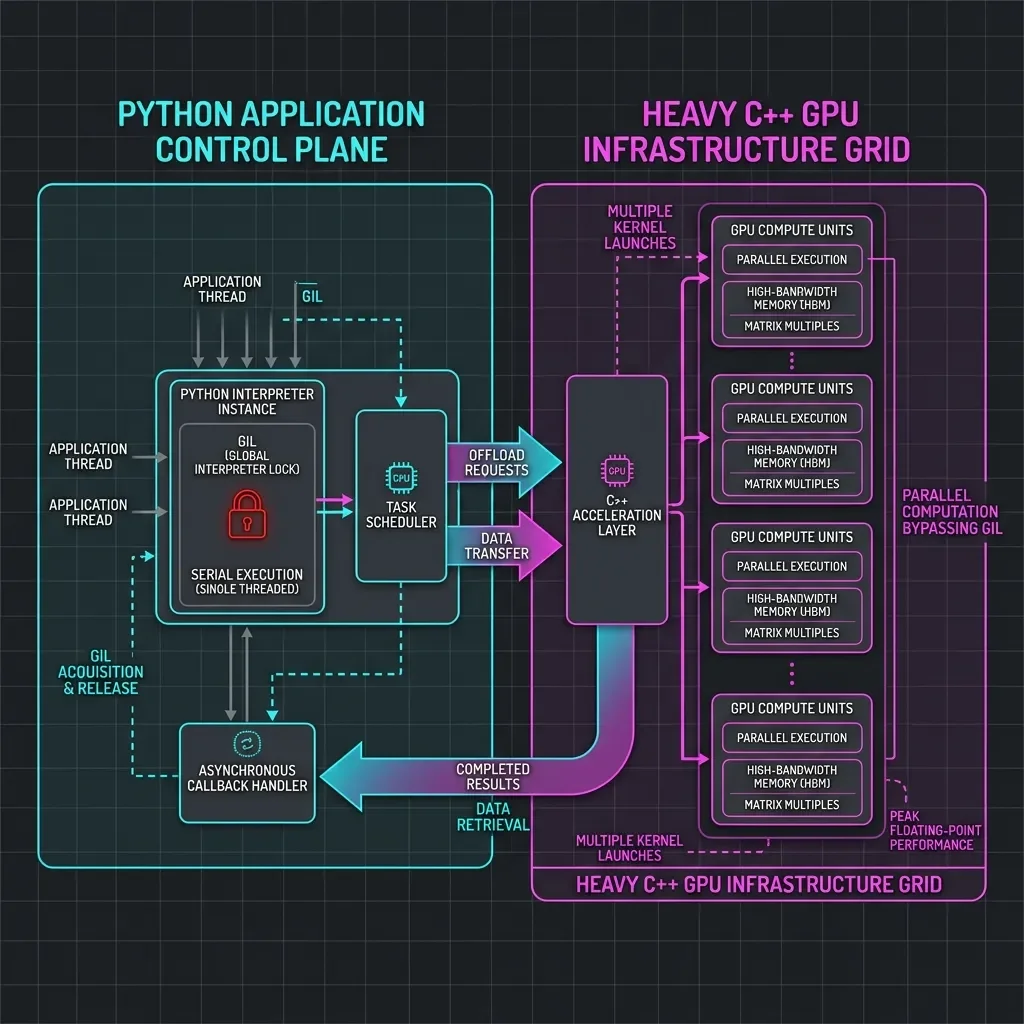
To scale an AI platform beyond a monolithic "chatbot" and into an autonomous mesh that operates across your enterprise datastores, you must architecturally sever Python from the mathematical inference load.
The Compute Plane (vLLM / TensorRT-LLM)
The compute plane handles Matrix Multiplication, KV cache orchestration, and continuous batching. This is physically executed on Nvidia or AMD silicon. The overarching rule in 2026 is simple: Python never touches a tensor during inference.
Engines like vLLM (written heavily in CUDA/C++) consume the raw model weights, manage the PagedAttention memory maps, and expose an ultrafast networking socket.
The Control Plane (Python)
Python sits above this layer. Its sole responsibility is highly asynchronous I/O tracking:
- Receiving client streams.
- Formulating the prompt chains via LangGraph or native syntax.
- Triggering the Model Context Protocol (MCP) tool execution.
- Pausing execution until the GPU inference stream returns the data.
Because Python is merely orchestrating the requests rather than executing the math, its supposed CPU weaknesses disappear entirely.
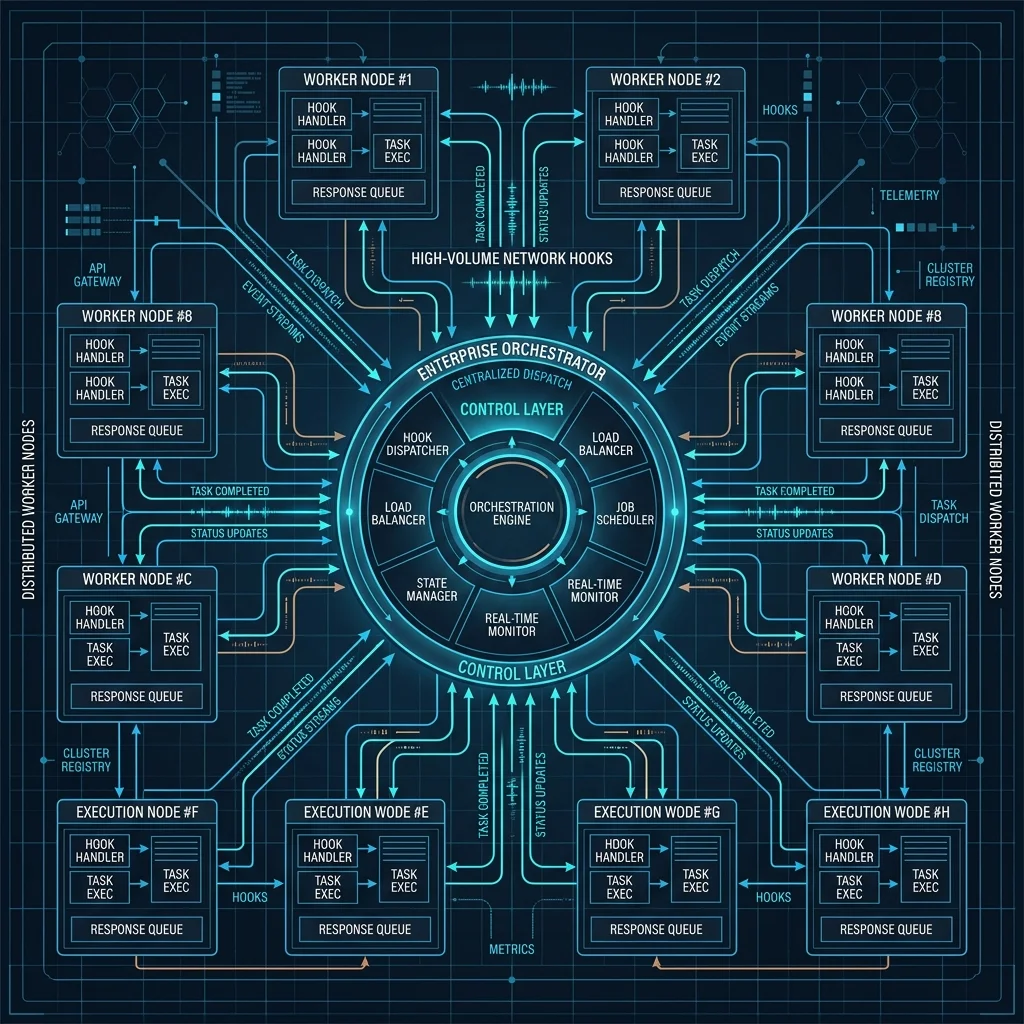
2. Asynchronous vs. Threaded Agentic Wrappers
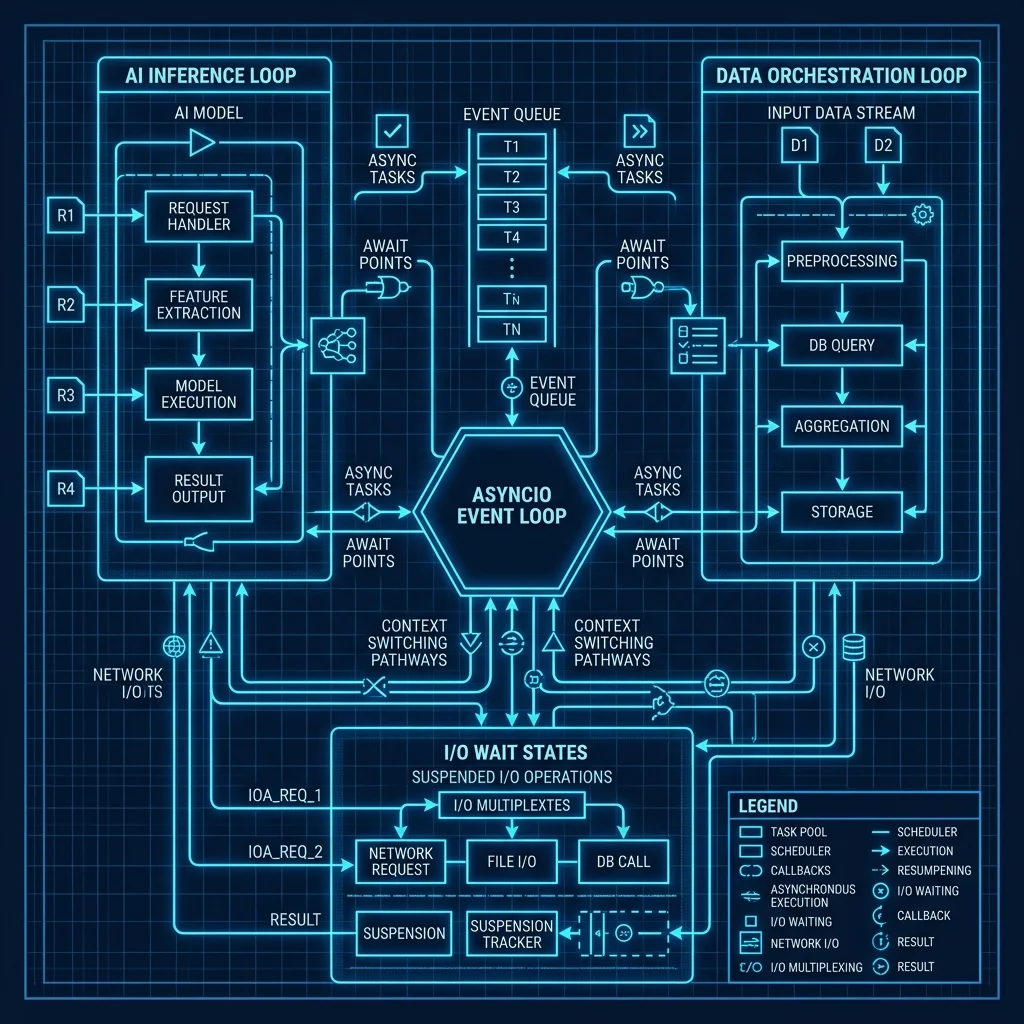
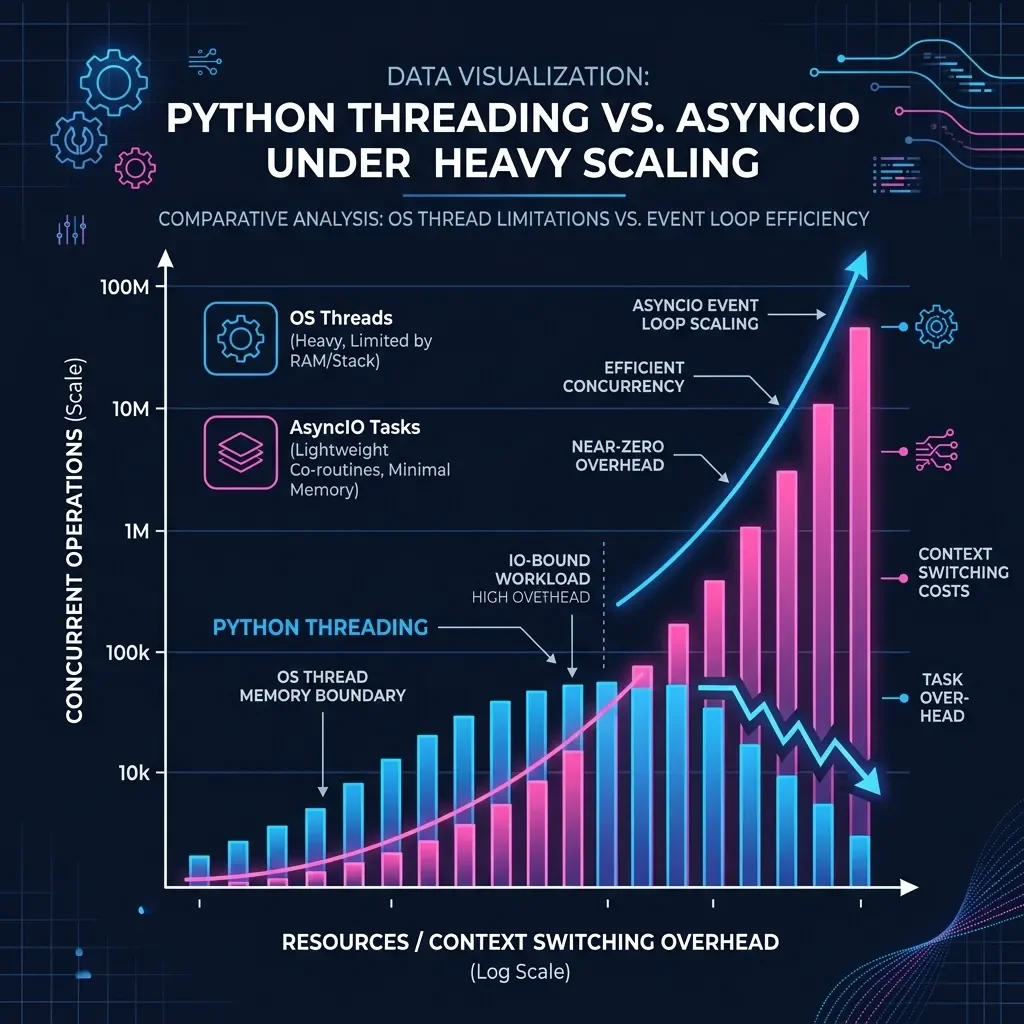
If an LLM wrapper relies strictly on continuous single-process execution, one network delay completely paralyzes the system. The standard legacy approach to concurrency is threading (Preemptive Multitasking). The modern 2026 AI infrastructure approach is asyncio (Cooperative Multitasking).
The Crushing Weight of OS Threads
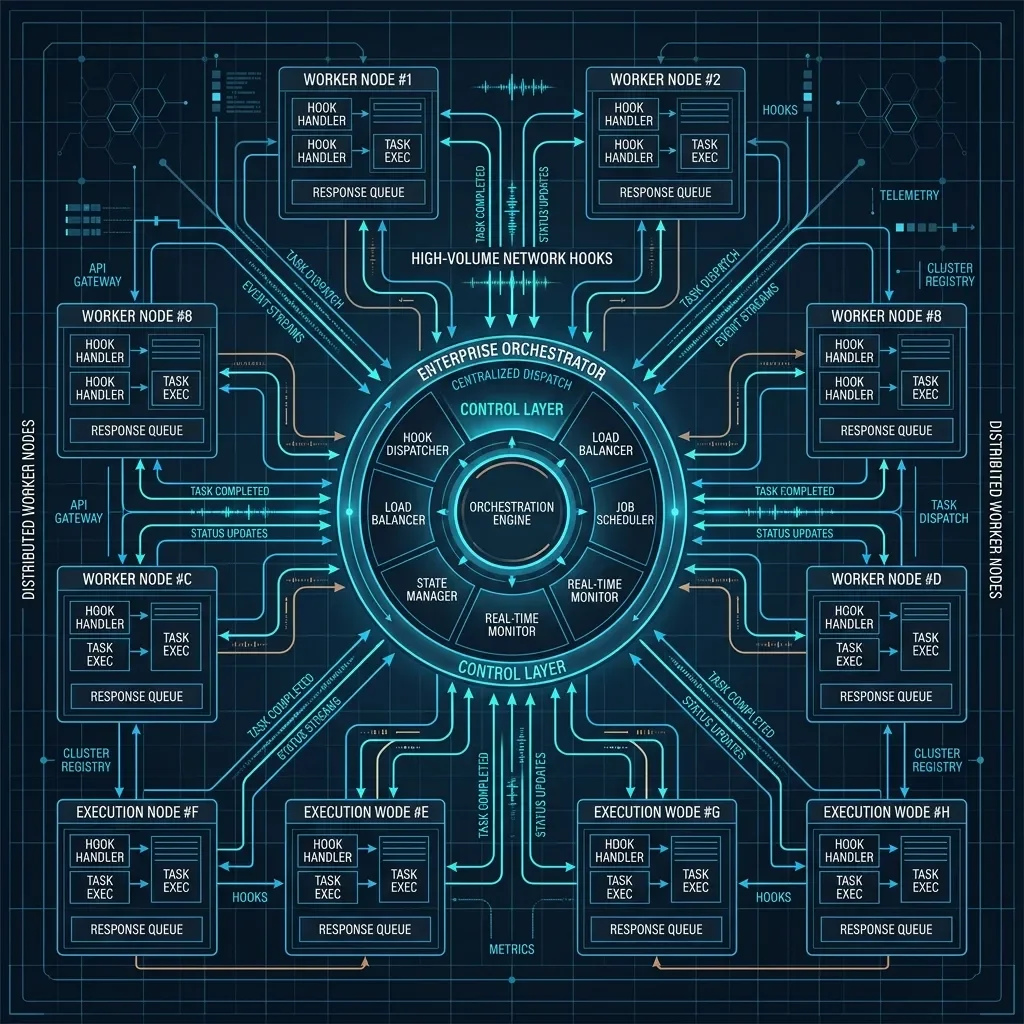
When an enterprise scales Agentic Workflows, it is common to have hundreds of agents simultaneously suspended--"waiting for an API constraint to resolve, or waiting for a massive 4096-token GPU context to formulate.
If you orchestrate this via concurrent.futures.ThreadPoolExecutor, the OS generates a rigid stack for every single tool-hook. At enterprise scale, context switching between thousands of raw threads starves the CPU cache before a single token is even generated.
The Mathematical Superiority of asyncio
asyncio operates on a single-threaded Event Loop. When an AI agent executes await model.generate(), the Python interpreter formally suspends that block, preserving its microscopic state in an event loop object, and instantly picks up another agent's request.
The absolute answer is no.
When Python calls an external C/C++ boundary (like a networking library or compiled data-science framework like PyTorch or vLLM), the engine natively releases the GIL. As the GPU clusters roar to life consuming thousands of watts running the transformer architecture, Python sits entirely unblocked, continuing to route other asynchronous events in the background.
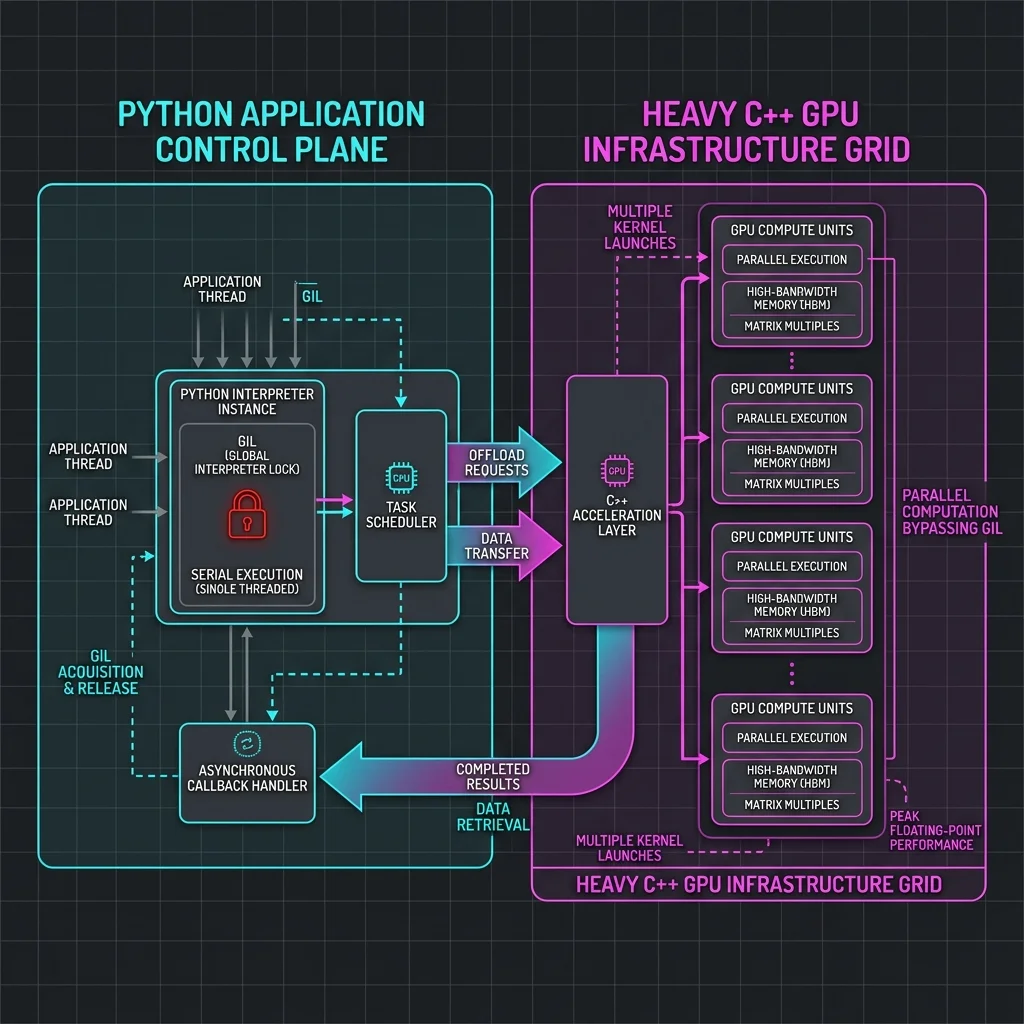
However, there is a specific danger zone: Pre-Processing and Tokenization.
If you attempt to deserialize a 4-Gigabyte JSON log file native in pure Python to feed an agent architecture, you will lock the event loop and paralyze total orchestration. The architectural standard maps heavy data scrubbing explicitly to multiprocessing worker pools or Rust binaries, reserving the primary Python process exclusively for semantic routing.
4. Engineering the Autonomous Mesh (vLLM & MCP)
Integrating Large Action Models with the Model Context Protocol (MCP) requires a structural mindset shift. We must accept that Agents are essentially highly chaotic finite state machines.
To orchestrate this, enterprise platforms utilize Python's unparalleled binding ecosystem:
- Continuous Batching: We wrap our custom fine-tuned open-weight models (Llama 3 / Mistral) in
vLLMto maximize the throughput of prompt evaluations relative to token generation limit. - Streaming Architecture: Python connects into the continuous batch streaming capability via SSE (Server-Sent Events) or WebSockets. This ensures the first "thought" token immediately reaches the downstream tool executor.
- MCP Handshake: The Python orchestrator utilizes native
pydanticstrict typing to negotiate JSON-RPC handshakes with local system resources or remote APIs, feeding the deterministic tool schema back into the LAM's localized context window.
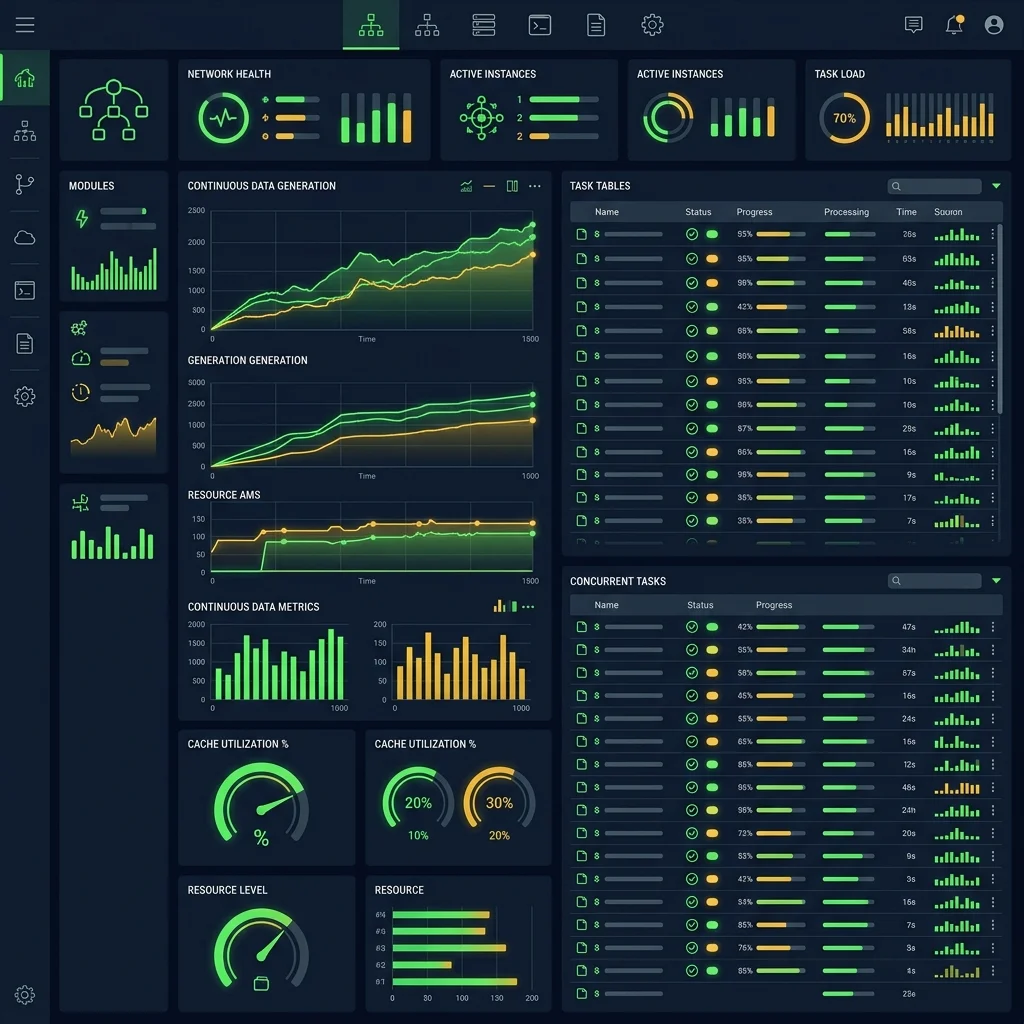
This specific triangle of technologies forms what is known internally as the Sovereign Industrial Stack. It is entirely decoupled, infinitely horizontally scalable, and guarantees total data residency by executing directly on localized edge GPU nodes.
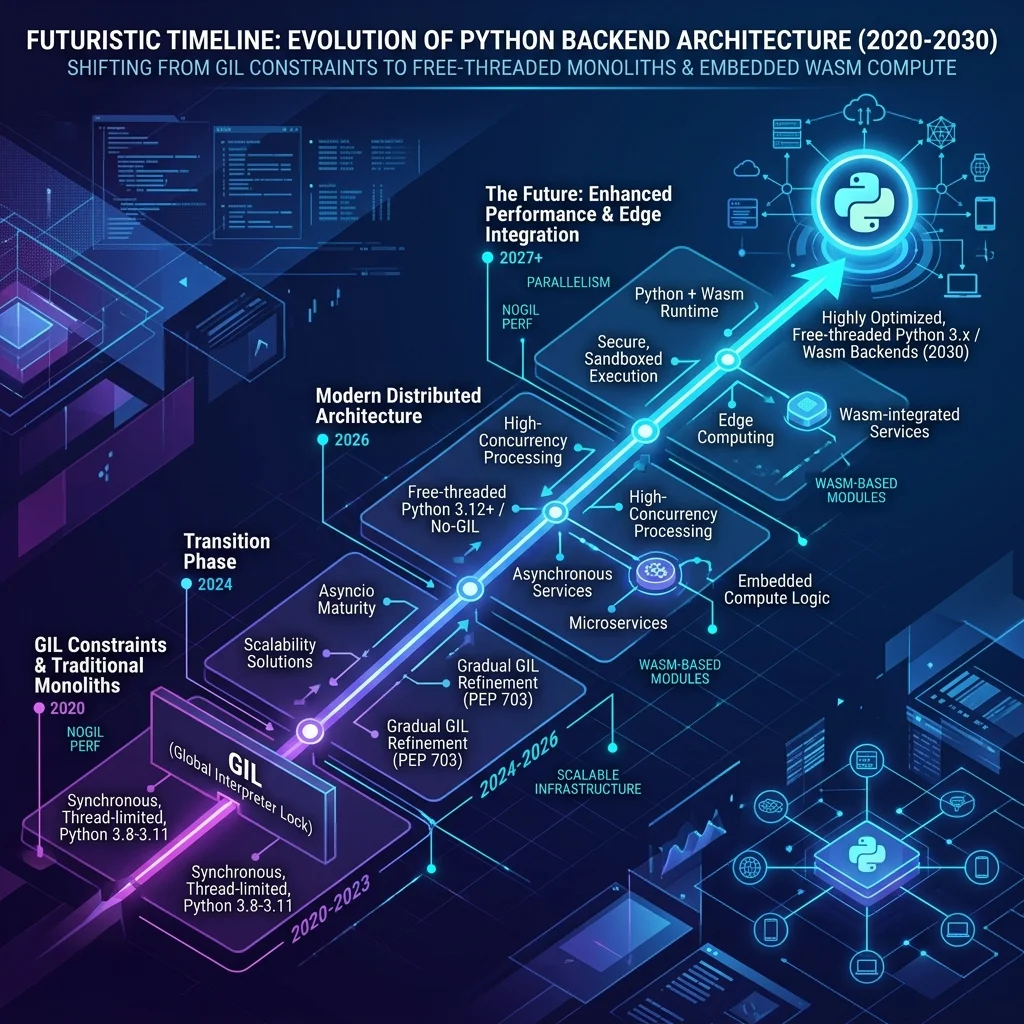
The 2030 Horizon: No-GIL & Memory Domination
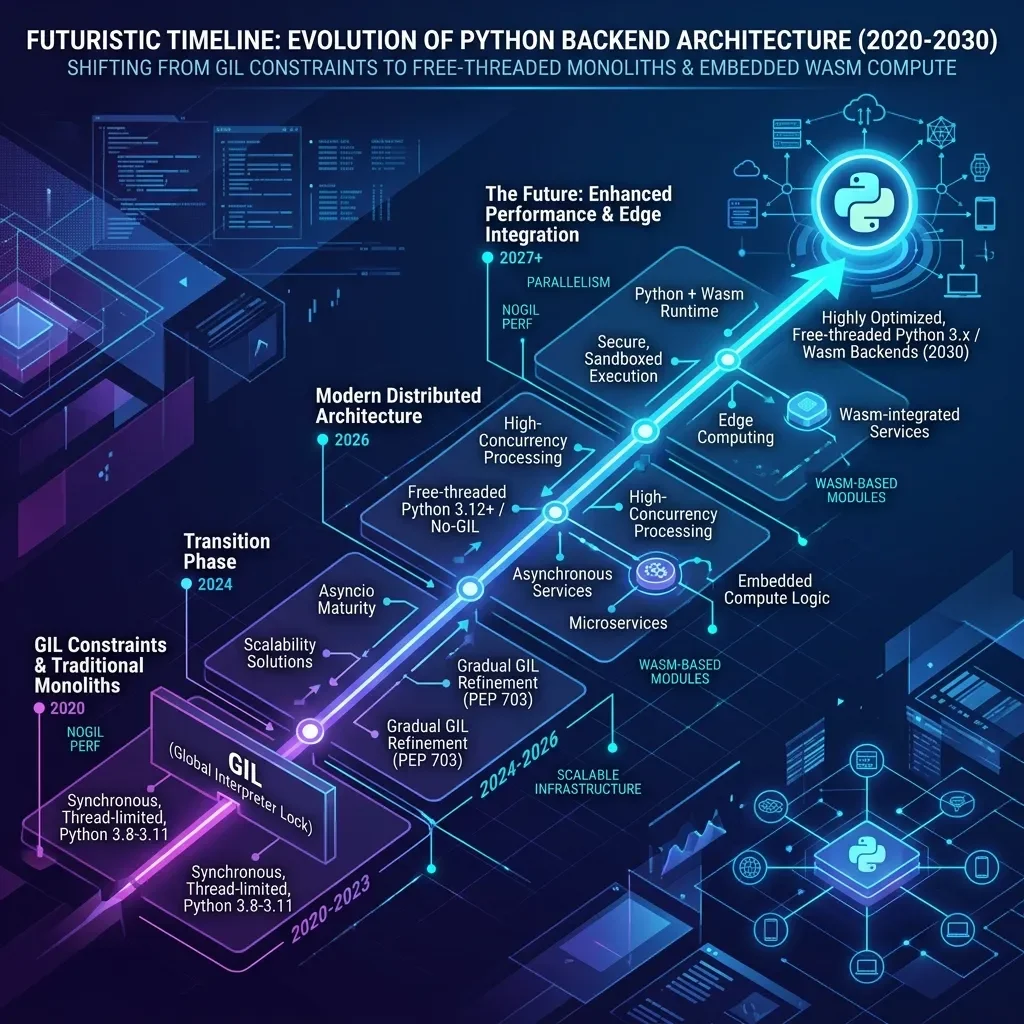
As the Python Steering Council aggressively targets PEP 703 (Making the Global Interpreter Lock Optional in CPython), the horizon will change dramatically.
With a true free-threaded Python structure entering stabilization towards 2028-2030, the strict boundary separating multiprocessing datastores and asyncio networking routing will blur. We will witness shared-memory GPU orchestration scaling seamlessly across monolithic Python endpoints without the serialization nightmare that currently plagues inter-process architecture.
Key Takeaways
- You Do Not Compute In Python: C++, CUDA, Triton, and Rust execute the heavy numerical math. Python orchestrates the network inputs and output routing.
- Asyncio Is Mandatory: For AI systems scaling past a handful of requests, the context-switching latency of synchronous
threadingdestroys performance. - The Action Gap Requires Speed: Because agents perform iterative, looping network requests, minimizing the overhead of your Python microservices via
uvloopacts as the critical barrier towards realistic automation. - The GIL Is Circumstantial: If structured correctly, your LLM infrastructure will easily bypass the GIL whenever inference is running to maximize local utilization.
Why use asyncio for LLMs instead of multithreading?
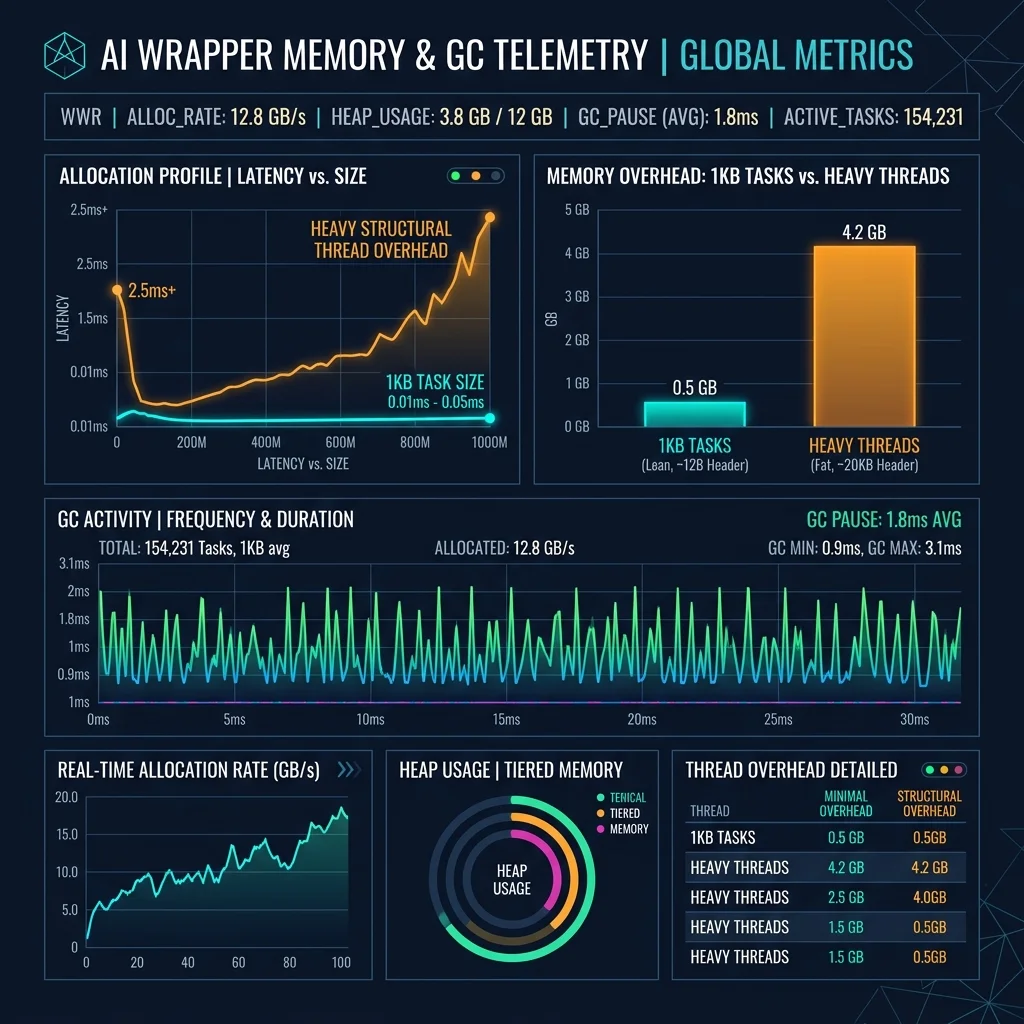
LLM operations are notoriously I/O bound. The system spends massive cycles waiting for the GPU cluster or external APIs to return tokens. asyncio allows the Python engine to handle thousands of waiting requests using minimal memory (~1KB per task), whereas system-level threading demands heavy OS resource footprints for every single suspended request.
Should I use a separate microservice for Tokenization?
Generally, yes. Tokenization is mathematically CPU bound. Doing massive batch tokenization natively inside the same Python event loop that is handling web requests will hard-lock the system. Offloading this to a multiprocessing worker or a Rust native module solves the locking.
Can I run vLLM on a cluster without Python?
Yes. The vLLM project offers a pre-compiled OpenAI-compatible server binary. However, if you require extreme customization of your sampling parameters or deep integration into specific enterprise hardware monitors, retaining the Python binding layer is optimal.
How does the Model Context Protocol (MCP) differ from normal REST API calling?
MCP establishes a standardized communication topology where both the client (the AI) and the server explicitly negotiate tool availability and security context dynamically. It treats tool-use as a formalized "Language of Execution" rather than messy ad-hoc HTTP hooks.
If Python is just a glue language, why not write the orchestrator in Go or Rust?
Ecosystem gravity. Over 99% of the world's most advanced AI research, prompt engineering frameworks, and hardware bindings are written in Python. While Rust/Go are incredible, fighting the prevailing ecosystem limits enterprise agility and developer momentum unacceptably.
About the Author
Vatsal Shah is a world-class AI Solutions Architect and Engineering Leader specializing in Industrial High-Performance Web Architecture. He builds sovereign Agentic Mesh networks utilizing vLLM, LangGraph, and Rust-integrated data architectures. Vatsal consults for enterprise Fortune 500 networks to map optimal GPU infrastructure layouts, ensuring deterministic speed and absolute total data privacy.
Additional Intelligence Assets