STRATEGIC OVERVIEW
PLG 3.0: Agent-Led Growth and the Death of the Freemium Ceiling By Vatsal Shah · July 11, 2026 · Product & Marketing Table of Contents - Introduction - The Evolution: From PLG 1.0 to PLG 3.0 - The Freemium Ceiling: Why Traditional PLG Stalls - Onboarding Reimagined: The.
PLG 3.0: Agent-Led Growth and the Death of the Freemium Ceiling
By Vatsal Shah · July 11, 2026 · Product & Marketing
Table of Contents
- Introduction
- The Evolution: From PLG 1.0 to PLG 3.0
- The Freemium Ceiling: Why Traditional PLG Stalls
- Onboarding Reimagined: The Agent-Led Activation Loop
- The Mechanics of Agentic Integration (MCP Server Implementations)
- Usage-Based Expansion: The Agentic Trigger Engine
- Analyzing the NRR Lever of Agent-Led Growth
- The Hybrid SLG/PLG Architecture
- Key Funnel Metrics in the ALG Era
- Strategic Action Plan for SaaS Leaders
- Conclusion
Introduction
Product-Led Growth (PLG) has defined the SaaS playbook for over a decade. By putting the product at the center of the customer acquisition, activation, and expansion loop, organizations like Slack, Zoom, and Dropbox achieved rapid scale. However, the traditional PLG playbook is hitting a hard boundary. The self-serve model, designed for human users navigating interfaces, faces a major limitation: the user's time and cognitive capacity. This friction point is the "freemium ceiling," where users sign up but fail to reach the key "Aha!" moment due to setup fatigue, lack of integration support, or complex configurations.
In 2026, the rise of agentic AI is shifting the paradigm from human-centric Product-Led Growth to PLG 3.0: Agent-Led Growth (ALG). In this new model, software is not just a tool for humans to click through; it is an environment where AI agents act as users, configurators, and success managers. By automating the onboarding path, continuously demonstrating ROI, and triggering usage-based expansions, ALG closes the gap between signup and enterprise contraction.
STRATEGIC PRACTITIONER INSIGHT
In the ALG paradigm, the metric Time-to-Value (TTV) drops from days to seconds. When an AI agent configures the database connections, maps the APIs, and populates the dashboards for the user immediately after signup, the cold-start problem disappears. We are moving from self-serve setup to zero-friction utility.
SaaS platforms that ignore this shift will find their conversion metrics deteriorating. As buyers increasingly expect AI agents to evaluate, integrate, and manage their software, the traditional human-centered customer journey will become too slow, too manual, and too expensive. Achieving product-market fit in 2026 and beyond requires designing for the autonomous user agent.
The Evolution: From PLG 1.0 to PLG 3.0
The progression of product-centric go-to-market motions reflects the increasing capabilities of the underlying technology stack. Understanding where we are requires tracing this evolution.
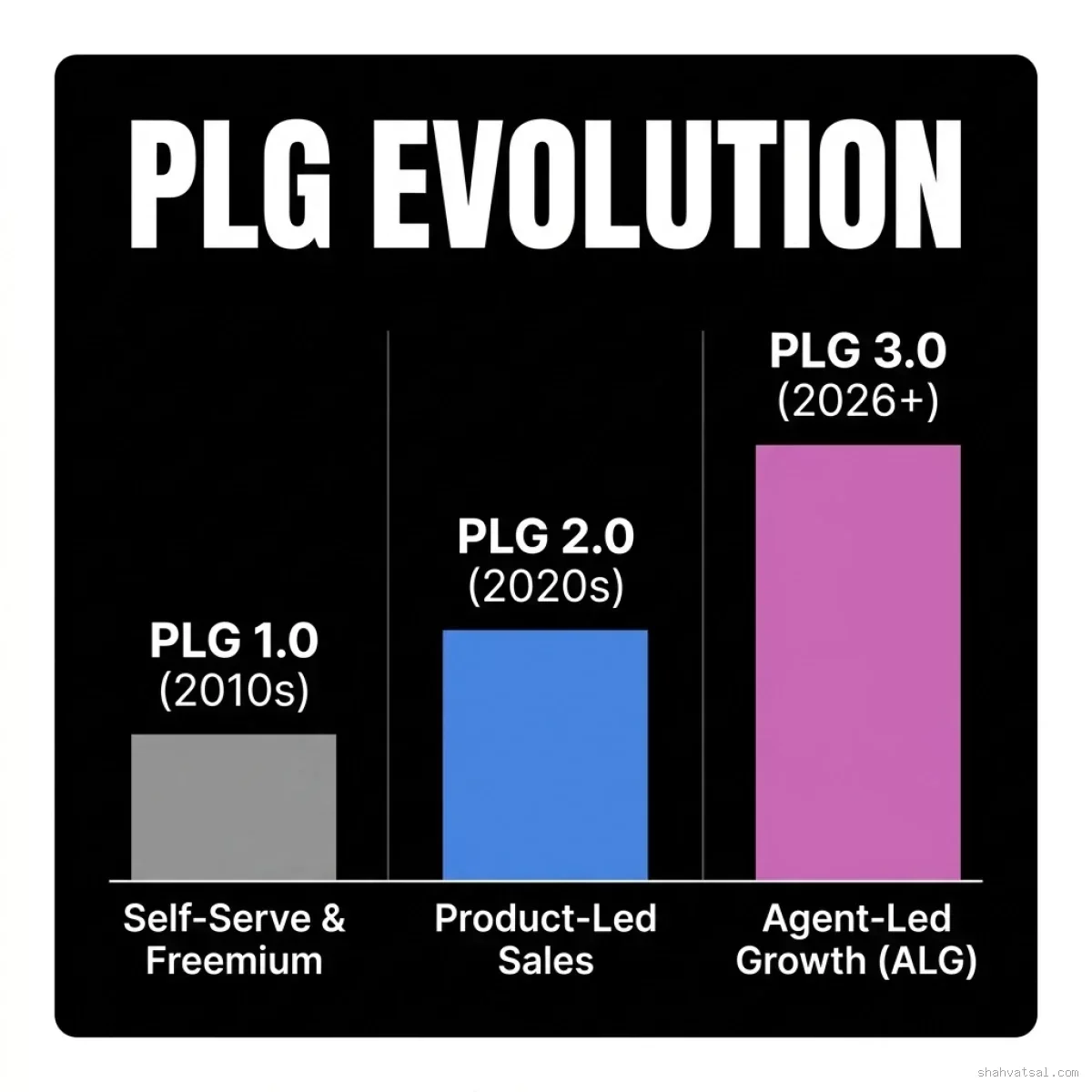
PLG 1.0: The Self-Serve Foundation (2010s)
PLG 1.0 focused on removing the sales gate. The product was freemium or trial-based, allowing individual users to sign up with a credit card. Growth was driven by virality (organic sharing) and simple self-serve onboarding. While highly efficient for simple utilities, PLG 1.0 struggled with complex B2B products that required team-wide configuration or security sign-offs.
Under PLG 1.0, the core growth engine looked like this:
Signup -> Basic Setup Checklist -> Active Daily Usage -> Referral LoopThis loop was highly dependent on clean UI/UX, tooltip tours, and email newsletters urging the user to return to the product. If the user got distracted, the loop broke. The cognitive load rested entirely on the human user, who had to dedicate active attention to setting up the environment.
PLG 2.0: Product-Led Sales (Early 2020s)
As SaaS companies matured, they realized that self-serve users often needed a human touch to transition into large enterprise accounts. PLG 2.0 introduced the Product-Led Sales (PLS) model. By tracking Product Qualified Leads (PQLs) — users who demonstrated high-value activity inside the app — sales teams could reach out at the right moment. The product acted as the lead generator, while human sales reps closed the contract.
The PLG 2.0 model added a layer of complexity:
Signup -> PQL Trigger -> Data Sync -> Sales Rep Outreach -> Enterprise DemoWhile this improved enterprise conversion rates, it introduced human bottlenecking. Sales reps had to parse product data dashboards, draft outreach emails, and coordinate schedules, leading to leakage in the middle of the funnel.
PLG 3.0: Agent-Led Growth (2026+)
PLG 3.0 shifts the operational load from humans to agents. Instead of waiting for a developer to read documentation and configure a workspace, an onboarding agent handles it. Instead of a sales rep analyzing product data to identify an expansion opportunity, a customer success agent runs continuous simulations, quantifies the value delivered, and presents a pre-configured upgrade proposal directly inside the application interface.
By deploying autonomous systems, PLG 3.0 eliminates the human latency in both the activation and sales loops. The software acts as an active, self-optimizing system that maximizes consumption and value delivery dynamically. The software environment acts as a collaborative canvas where agents execute configurations, verify compliance parameters, and alert human operators only when business-critical decisions or security approvals are required.
The Freemium Ceiling: Why Traditional PLG Stalls
The "freemium ceiling" refers to the point where self-serve conversion curves flatten out. This stall typically occurs due to three primary friction points:
- The Setup Gap: Modern B2B software is rarely standalone. It requires connecting to identity providers (SSO), data warehouses, API gateways, and communication channels (Slack/Teams). The average non-technical user, or even a busy developer, often abandons the setup process when faced with complex configuration screens.
- The Delayed 'Aha!' Moment: If a user has to wait for data to sync or invite five team members before the product becomes useful, the time-to-value stretches out. If value is not demonstrated in the first session, retention drops.
- The ROI Attribution Gap: Users frequently forget why they are paying for a subscription. If the product does not actively and continuously demonstrate the money or time it is saving, the user is susceptible to churn during budget consolidation cycles.
By introducing autonomous agentic runtimes, ALG tackles these bottlenecks at the root. Rather than forcing the human user to configure the product, the product configures itself.
Let's look at a typical B2B database configuration. A user wants to connect an analytics engine to their database. In a traditional PLG flow, they are presented with a forms block:
{
  class="tok-str">"host": class="tok-str">"db.example.com",
  class="tok-str">"port": 5432,
  class="tok-str">"database": class="tok-str">"production",
  class="tok-str">"user": class="tok-str">"read_only_user",
  class="tok-str">"ssl_mode": class="tok-str">"require"
}
If the connection fails due to an IP mismatch, SSL certificate issue, or firewall rule, the user is blocked. In an ALG flow, the onboarding agent interacts with the environment, diagnoses the port issue, suggests the exact security configuration required, and validates the connection in the background.
Additionally, traditional systems suffer from the "blank slate" problem. Even after connection, the user must figure out how to build charts, generate reports, or configure workflows. The freemium ceiling represents the drop-off of users who get overwhelmed by this customization process and leave before realizing the value of the software.
Onboarding Reimagined: The Agent-Led Activation Loop
In an ALG model, onboarding is active rather than passive. Instead of presenting the user with a checklist of tasks to complete, the software deploys a specialized onboarding agent.
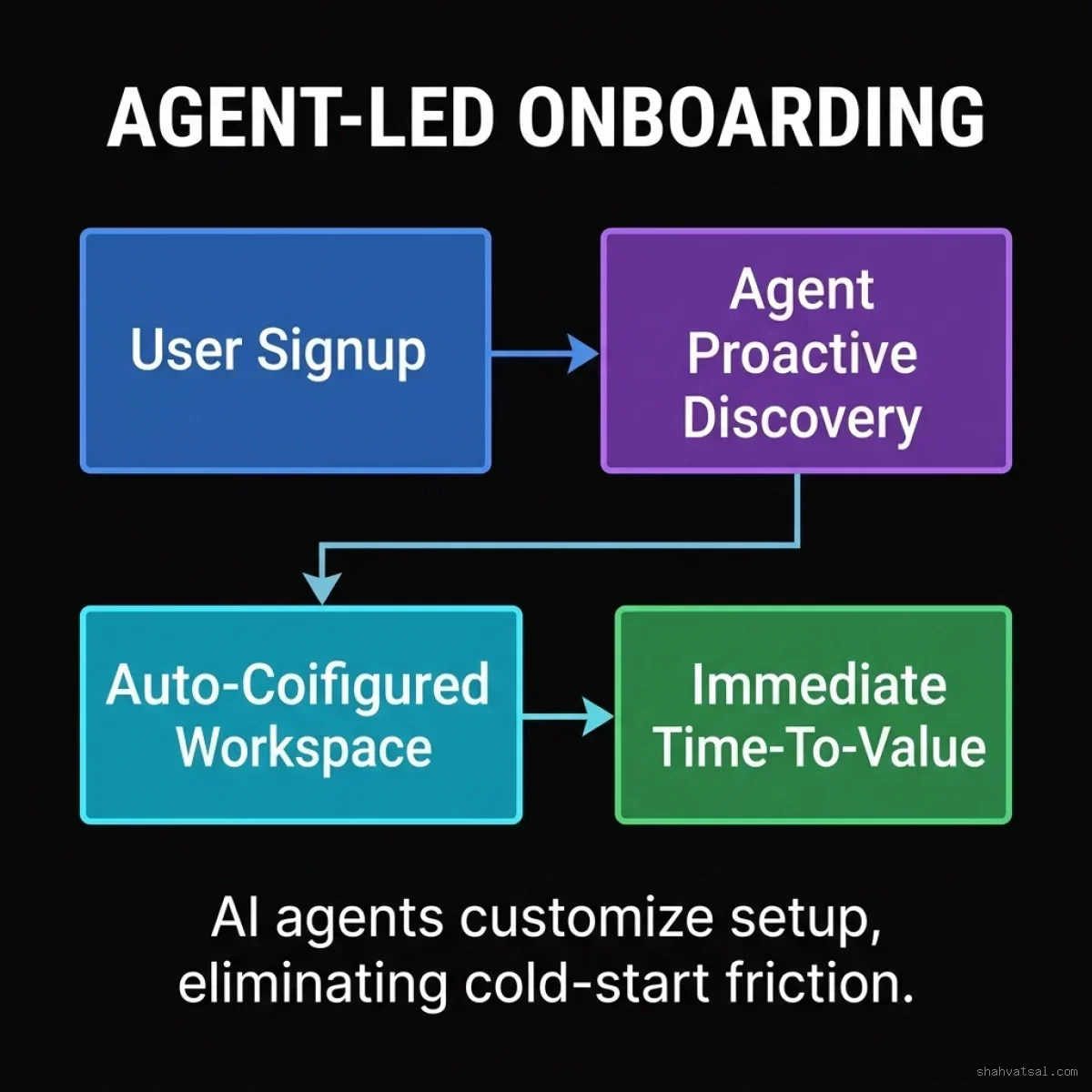
Let's look at a concrete workflow. When a user signs up for an enterprise analytics tool, the onboarding agent:
- Accesses authorized data sources via secure integrations.
- Analyzes the schema and automatically generates the first set of dashboards.
- Identifies anomalous patterns in the client's data and flags them in the first session.
- Generates a personalized report showing exactly what the team can optimize.
The user does not configure tables or drag charts. They log in and immediately see their actual data analyzed. The setup gap is closed autonomously.
To build this loop, the application must expose structured entrypoints for the agent. For example, an application onboarding controller might look like this:
class AgenticOnboardingController extends BaseController
{
    protected $agentService;

    public class="tok-kw">function initiateSetup()
    {
        $userId = $this->request->getPost(&class="tok-cm">#039;user_idclass="tok-str">');
        $workspaceId = $this->request->getPost(&class="tok-cm">#039;workspace_id');

        class="tok-cm">// Spawn the background onboarding agent
        $agent = new OnboardingAgent($workspaceId);
        $agentId = $agent->spawn([
            &class="tok-cm">#039;modeclass="tok-str">' => 'active_discoveryclass="tok-str">',
            &class="tok-cm">#039;permissions' => [class="tok-str">'read_schema', class="tok-str">'generate_templates']
        ]);

        class="tok-cm">// Log telemetry event for setup start
        $this->logOnboardingTelemetry($workspaceId, $agentId, &class="tok-cm">#039;setup_initiatedclass="tok-str">');

        class="tok-kw">return $this->response->setJSON([
            &class="tok-cm">#039;status' => class="tok-str">'initiated',
            &class="tok-cm">#039;agent_idclass="tok-str">' => $agentId,
            &class="tok-cm">#039;message' => class="tok-str">'Agent is analyzing your database schema and configuring your workspace.'
        ]);
    }

    private class="tok-kw">function logOnboardingTelemetry($workspaceId, $agentId, $step)
    {
        $this->db->table(&class="tok-cm">#039;agent_telemetryclass="tok-str">')->insert([
            &class="tok-cm">#039;workspace_id' => $workspaceId,
            &class="tok-cm">#039;agent_idclass="tok-str">' => $agentId,
            &class="tok-cm">#039;step_name' => $step,
            &class="tok-cm">#039;timestampclass="tok-str">' => date('c')
        ]);
    }
}
By shifting setup to a background agent task, the user experiences a frictionless "Aha!" moment. Instead of staring at an empty state dashboard with placeholders, they see real analysis.
PRACTITIONER NOTE
For this loop to succeed, products must expose clear API endpoints and support standard metadata protocols. Implementing a Model Context Protocol (MCP) server at the application level allows the onboarding agent to safely interact with local files and configurations with user permission, accelerating setup.
The Mechanics of Agentic Integration (MCP Server Implementations)
The core enabler of PLG 3.0 is the standardization of context transfer. When an AI agent attempts to onboard a user or configure a database, it must communicate with local and cloud resources securely and structured.
This is where the Model Context Protocol (MCP) becomes critical. By implementing a standardized MCP server interface inside your SaaS product, you allow user agents to query system capabilities, read configurations, and bootstrap workflows dynamically.
Consider the following architectural mapping of an MCP-driven onboarding sequence:
[User Agent (Client)]  -- (Queries MCP Server) -->  [Application MCP Server]
                                                           |
                                                (Lists Available Tools)
                                                           |
                                                           v
                                                [Retrieve DB Schema Tool]
                                                [Configure SSO Tool]
                                                [Verify Webhook Tool]
By presenting tools as standard MCP capabilities, the agent can programmatically choose how to heal a connection or resolve a setup bottleneck. If an API credential is missing, the agent does not output a generic "Authentication Failed" error to the user. Instead, it queries the MCP server's tools list, selects the request_credential_refresh method, and initiates a secure token renewal in the background.
Furthermore, this machine-readable approach allows product teams to build self-diagnosing workspaces. If an integration breaks on a weekend, the agent detects the connection loss, references the MCP API, locates the backup gateway, and re-routes the traffic autonomously, ensuring zero downtime.
Usage-Based Expansion: The Agentic Trigger Engine
Traditional usage-based pricing models rely on hard limits: "You have used 90% of your data quota; please upgrade." This approach creates a negative user experience, acting as a gate rather than a value trigger.
ALG shifts this to value-based expansion:
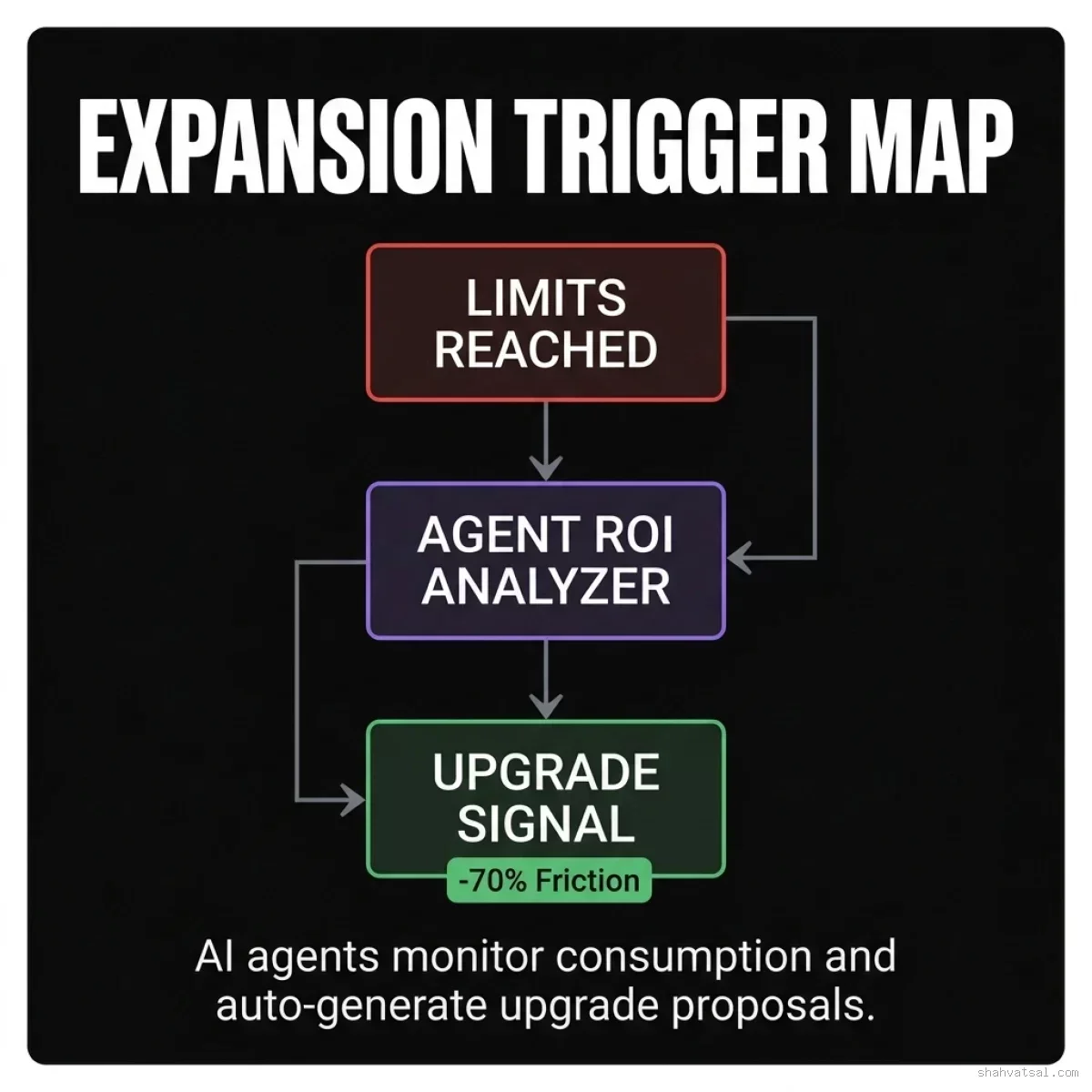
When a user approaches a tier boundary, the customer success agent runs a simulation in the background:
- It calculates the business value delivered by the current tier (e.g., "This tool processed 12,000 tasks, saving 40 engineering hours this month").
- It projects the value of the next tier based on current growth trends ("Upgrading will allow you to automate 5,000 more tasks, saving an estimated $3,500/month").
- It packages these metrics into a customized, one-click upgrade proposal presented to the workspace owner.
Let's look at the underlying schema for the agent's ROI calculation:
{
  class="tok-str">"workspace_id": class="tok-str">"ws_987654",
  class="tok-str">"current_tier": class="tok-str">"Starter",
  class="tok-str">"usage_percent": 88.5,
  class="tok-str">"telemetry": {
    class="tok-str">"tasks_completed": 12450,
    class="tok-str">"manual_labor_hours_saved": 41.5,
    class="tok-str">"system_latency_reduction_ms": 120
  },
  class="tok-str">"expansion_projection": {
    class="tok-str">"target_tier": class="tok-str">"Growth",
    class="tok-str">"projected_additional_hours_saved": 18.0,
    class="tok-str">"cost_difference_usd": 150.0,
    class="tok-str">"net_roi_multiplier": 4.2
  }
}
When the user opens the billing settings or encounters the limit block, the page displays a custom-tailored calculation:
"You saved 41.5 engineering hours this month on the Starter tier. Based on your current transaction velocity, upgrading to the Growth tier will save you an additional 18.0 hours next month — yielding a 4.2x ROI on the upgrade cost."
The expansion conversation shifts from a billing alert to a clear business business case. This transparent alignment of billing increments to real business metrics forms the bedrock of customer trust in PLG 3.0.
Analyzing the NRR Lever of Agent-Led Growth
In B2B SaaS, the ultimate validation of a GTM motion is its impact on Net Revenue Retention (NRR). Traditional self-serve funnels suffer from high leakage at the expansion stage because upgrading requires manual negotiation or friction-heavy payment flows.
By delegating the customer success and expansion prompts to an agentic engine, SaaS companies see measurable improvements across three core NRR components:
1. Proactive Retention
Traditional customer success models are reactive. CS managers reach out after usage has already dropped. In contrast, the customer success agent monitors telemetry in real-time. If it notices a drop in transaction frequency, it automatically analyzes potential bottlenecks, suggests query optimizations to the developers, and proactively adjusts configurations to prevent churn before it manifests.
2. Natural Upselling
Rather than utilizing cold outreach emails, the agent introduces contextual feature access. If a developer attempts to write a complex, multi-model route, the agent presents a suggestion: "I can optimize this pipeline using our Advanced routing module. Would you like to enable a 14-day trial of our Enterprise tier to verify the performance gains?"
3. Automated Contract Negotiation
For mid-market accounts, upgrading to custom contracts requires significant legal and administrative overhead. AI agents can negotiate basic terms, align usage structures, and auto-generate draft agreements based on approved corporate guidelines, routing to legal teams only for final execution.
The Hybrid SLG/PLG Architecture
For enterprise SaaS, growth is rarely purely product-led or purely sales-led. It is a hybrid motion. ALG acts as the bridge between these two motions by generating qualified leads for the enterprise sales pipeline.
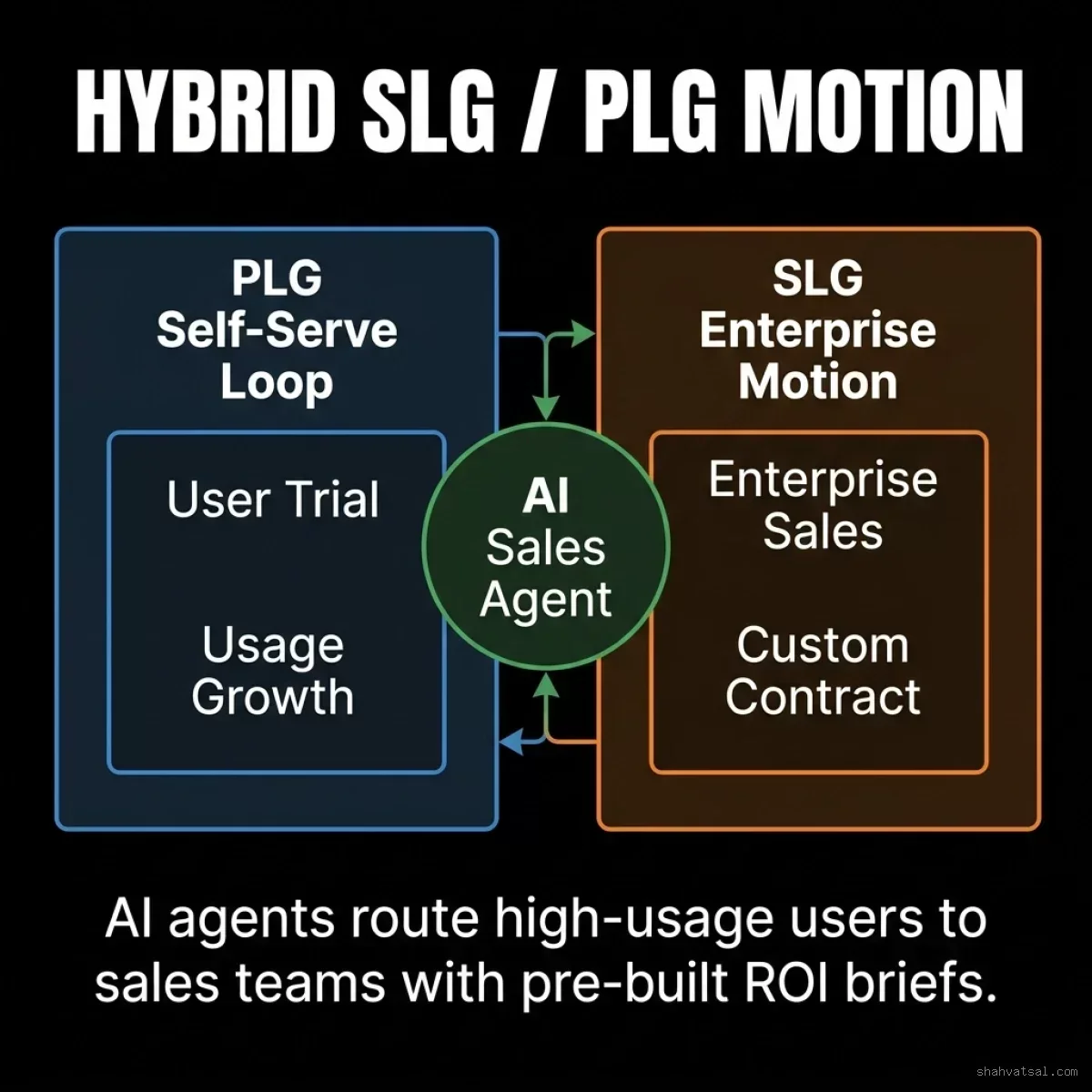
When the agent identifies an account that has crossed key expansion markers (e.g. multi-department signups, high query density, custom security queries), it automatically packages a sales brief. This brief contains:
- Current workspace metrics and growth rates.
- An automatically generated ROI scorecard.
- The identified technical champion within the account.
- The recommended enterprise tier and contract structure.
This handoff ensures that enterprise sales reps are not cold-calling; they are reaching out to active, high-value accounts with a data-backed business case in hand.
For example, the routing logic in the backend monitors daily activities:
class SalesHandoffRouter
{
    protected $db;

    public class="tok-kw">function monitorAccounts()
    {
        $accounts = $this->db->table(&class="tok-cm">#039;workspacesclass="tok-str">')
                             ->where(&class="tok-cm">#039;usage_index', class="tok-str">'>', 90)
                             ->where(&class="tok-cm">#039;sales_contact_statusclass="tok-str">', 'uncontactedclass="tok-str">')
                             ->get();

        foreach ($accounts as $account) {
            $analysis = $this->runAgenticAnalysis($account->id);
            class="tok-kw">if ($analysis[&class="tok-cm">#039;enterprise_potential'] > 0.85) {
                $this->notifySalesTeam($account->id, $analysis);
                $this->db->table(&class="tok-cm">#039;workspacesclass="tok-str">')
                         ->where(&class="tok-cm">#039;id', $account->id)
                         ->update([&class="tok-cm">#039;sales_contact_statusclass="tok-str">' => 'queued_for_outreachclass="tok-str">']);
            }
        }
    }

    private class="tok-kw">function runAgenticAnalysis($workspaceId)
    {
        class="tok-cm">// Query daily active users and query spikes
        $userCount = $this->db->table(&class="tok-cm">#039;users')->where(class="tok-str">'workspace_id', $workspaceId)->count();
        $queryCount = $this->db->table(&class="tok-cm">#039;telemetry_logsclass="tok-str">')->where('workspace_idclass="tok-str">', $workspaceId)->count();

        $potential = ($userCount > 10 && $queryCount > 50000) ? 0.90 : 0.40;

        class="tok-kw">return [
            &class="tok-cm">#039;workspace_id' => $workspaceId,
            &class="tok-cm">#039;enterprise_potentialclass="tok-str">' => $potential,
            &class="tok-cm">#039;metrics' => [
                &class="tok-cm">#039;active_usersclass="tok-str">' => $userCount,
                &class="tok-cm">#039;total_queries' => $queryCount
            ]
        ];
    }

    private class="tok-kw">function notifySalesTeam($workspaceId, $analysis)
    {
        class="tok-cm">// Trigger alert inside sales system or Slack integration
        $slackWebhook = class="tok-str">"https:class="tok-cm">//hooks.slack.com/services/mock/sales-alerts";
        $payload = json_encode([
            &class="tok-cm">#039;textclass="tok-str">' => "🚀 Account {$workspaceId} qualified for SLG Outreach. Potential: " . ($analysis['enterprise_potentialclass="tok-str">'] * 100) . "%"
        ]);

        $ch = curl_init($slackWebhook);
        curl_setopt($ch, CURLOPT_POSTFIELDS, $payload);
        curl_setopt($ch, CURLOPT_HTTPHEADER, array(&class="tok-cm">#039;Content-Type:application/json'));
        curl_setopt($ch, CURLOPT_RETURNTRANSFER, true);
        curl_exec($ch);
        curl_close($ch);
    }
}
This automated handoff loop ensures that sales teams receive rich context on every high-growth account. Instead of guessing how the team uses the tool, they can open their CRM and review the exact feature-usage patterns and integration dependencies compiled by the customer success agent.
Key Funnel Metrics in the ALG Era
The metrics used to measure SaaS growth must evolve to match the agent-led model. The traditional funnel (Acquisition, Activation, Retention, Referral, Revenue) changes when agents manage execution.
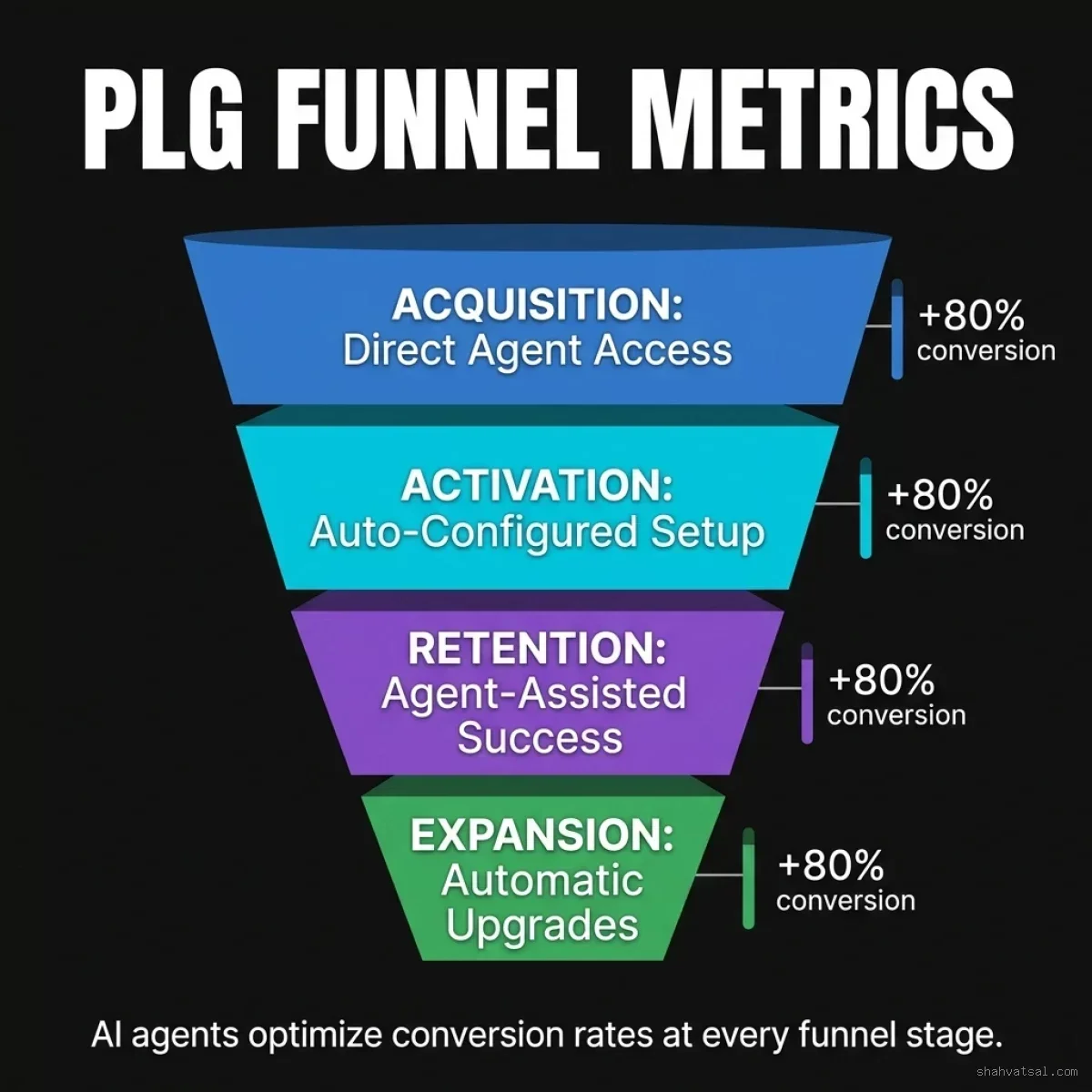
Let's look at the key metrics SaaS product teams should track:
| Metric | Traditional Definition | PLG 3.0 (ALG) Definition | Operational Impact |
|---|---|---|---|
| Time-to-Value (TTV) | Days/weeks for user to complete manual setup. | Seconds for the agent to complete automated configuration. | Reduces signup abandonment by up to 60%. |
| Activation Rate | Percentage of users who complete basic profile setups. | Percentage of workspaces where the agent successfully runs first automated task. | Ensures users see real output in their first session. |
| Expansion Velocity | Months to upgrade user through billing notifications. | Days to trigger upgrade based on agentic ROI simulations. | Accelerates Net Revenue Retention (NRR) growth. |
| Churn Mitigation Rate | Reactive customer success outreach after low usage metrics. | Proactive agent optimization loops to continuously prove value. | Stabilizes retention metrics prior to renewal events. |
Adapting to Agent Users
As AI agents consume more APIs and handle more operations on behalf of businesses, product teams must optimize their funnels for non-human traffic. This requires distinct shifts:
- Rate-Limit Optimization: Standard human-centric rate limits block agentic crawlers that want to map the application interface or configure settings.
- Machine-Readable Errors: If the application errors, returning a standard 400 page with a generic message breaks the agent. Return structured JSON blocks indicating exactly what went wrong and how the agent can heal the connection.
- Agentic Authentication: Simplify OAuth setups for system-to-system access. Use short-lived, automated token exchange mechanisms to allow agents to authenticate and bootstrap setups without forcing the human owner through multi-step consent screens every session.
Strategic Action Plan for SaaS Leaders
Transitioning to an Agent-Led Growth model requires deliberate architectural planning. Here is the operational checklist for product teams looking to build ALG capabilities:
- Expose Agent-Friendly APIs: Your product must be easily readable by AI agents. Implement clean JSON API schemas, standard authentication scopes, and comprehensive developer documentation.
- Build the Onboarding Agent: Develop specialized agent runtimes tasked exclusively with user activation. Provide them with secure execution sandboxes to analyze schemas, populate sample configurations, and verify integrations.
- Implement Value Telemetry: Track metrics that map directly to business ROI (time saved, database queries optimized, tasks automated). The agent must have access to these metrics to build the expansion business cases.
- Wire the Agent-to-Sales Bridge: Connect your product telemetry to sales tools (CRMs, Slack channels). Build automation paths that trigger Slack alerts or create CRM opportunities with complete value reports when accounts hit expansion thresholds.
- Establish Security Guardrails: Since agents execute actions autonomously, you must implement granular role-based access control (RBAC). The agent should be able to configure and read schemas, but billing approvals and data deletions must remain gated behind explicit human sign-offs.
FAQ {#faq}
Conclusion
The traditional, human-centric PLG model is hitting its limits. Setup friction, delayed value realization, and manual expansion loops create a freemium ceiling that stalls scaling.
PLG 3.0: Agent-Led Growth resolves these limitations. By deploying AI agents as active participants in user activation, value delivery, and account expansion, SaaS platforms can build self-optimizing growth engines. The future of software scaling belongs to products that configure themselves, prove their own business value, and trigger their own expansion loops.