Centralized AI Centers of Excellence (CoEs) are killing digital transformation velocity. When 30–40% of enterprise processes go agentic, central build teams become catastrophic bottlenecks. Learn how industry leaders transition to the Federated Agentic Platform Operating Model: shared core foundations (models, MCP tool catalog, Cedar guardrails, eval harnesses) paired with autonomous, domain-owned workflow squads.
Executive Summary: The Structural Failure of the Monolithic AI Center of Excellence
Between 2023 and 2025, global enterprises embraced the AI Center of Excellence (CoE) as the default organizational structure for artificial intelligence adoption. In the era of exploratory prompt engineering, centralized retrieval-augmented generation (RAG) experiments, and early Copilot rollouts, the centralized CoE served a necessary purpose: pooling scarce machine learning engineering talent, securing unified API contracts with model providers, and establishing baseline security perimeters.
However, in 2026, the artificial intelligence landscape underwent a tectonic phase transition from passive conversational assistants to multi-agent autonomous systems. When enterprise workflows shift from humans querying chatbots to autonomous agents executing multi-step business processes—such as 3-way invoice matching in Accounts Payable, candidate pipeline qualification in HR, or real-time incident remediation in SRE—the monolithic AI CoE transforms from an innovation accelerator into a lethal structural bottleneck.
                       ┌──────────────────────────────────────────────┐
                       │       Traditional Monolithic AI CoE          │
                       │    (Centralized Dev, Scoping & Delivery)    │
                       └──────────────────────┬───────────────────────┘
                                              │
                    ┌─────────────────────────┼─────────────────────────┐
                    ▼                         ▼                         ▼
         ┌────────────────────┐    ┌────────────────────┐    ┌────────────────────┐
         │ Finance AP Project │    │ HR Onboarding Bot  │    │ IT SRE Remediation │
         │ Backlog: 9 Months  │    │ Backlog: 14 Months │    │ Backlog: 6 Months  │
         └────────────────────┘    └────────────────────┘    └────────────────────┘
                                [ ENTERPRISE VELOCITY GRINDS TO A HALT ]
When business domains are forced to submit Jira tickets to a central AI CoE to build, tweak, or deploy domain-specific agents:
- Domain Context Is Lost in Translation: A centralized data science team lacks the nuanced contextual knowledge of SAP reconciliation edge cases, compliance mandates in healthcare claims, or nuanced enterprise sales commission schedules.
- Delivery Latency Explodes: Enterprise project backlogs swell to 9–18 months, choking business agility and inciting rogue "Shadow AI" engineering across disgruntled business units.
- Operational Fragility Surges: When production prompts or tool APIs drift, the central CoE lacks the operational domain bandwidth to triage hundreds of concurrent business-critical agent anomalies.
The winners of enterprise digital transformation in 2026 have abandoned the monolithic CoE in favor of the Federated Agentic Platform Operating Model.
Under this paradigm, the enterprise is bifurcated into two mutually empowering tiers:
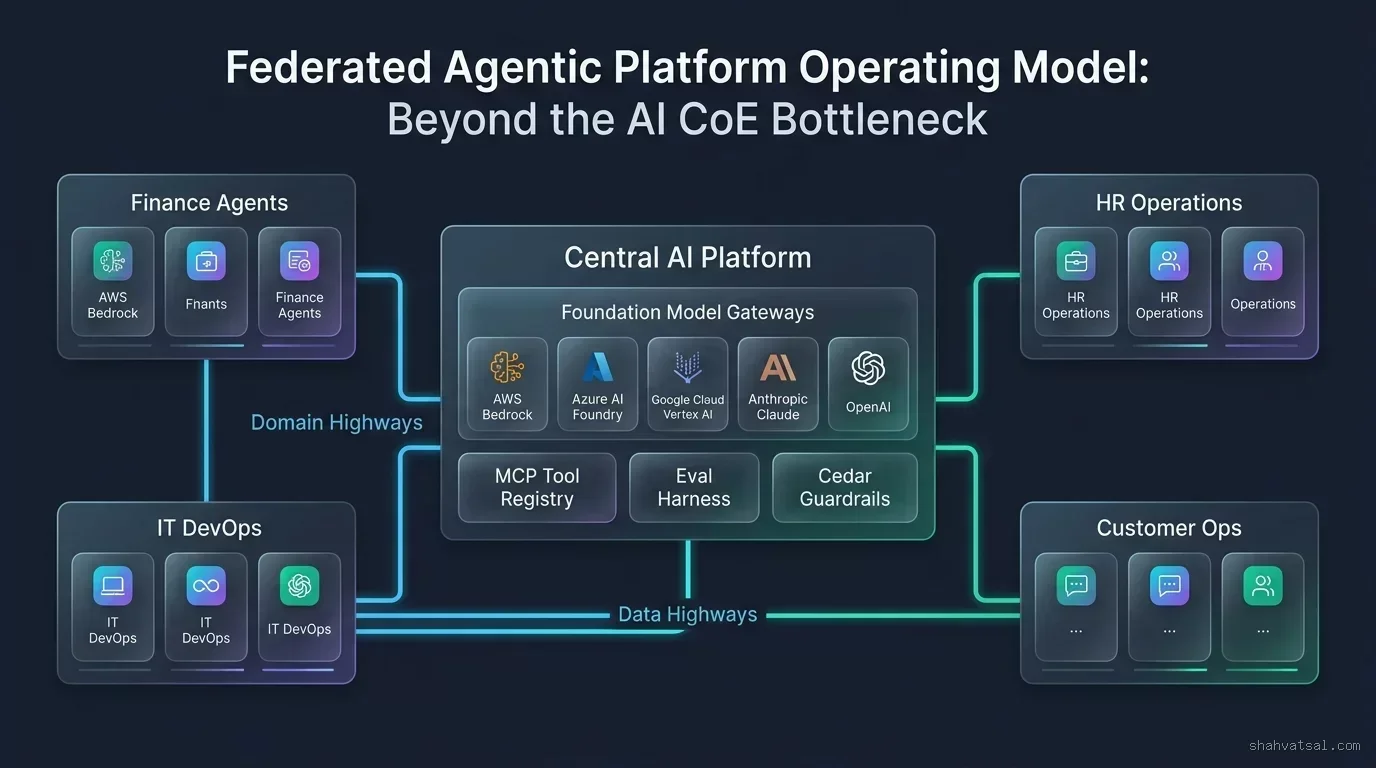
- A Central AI Platform Team that acts as an infrastructure and governance provider—delivering unified foundation model gateways (AWS Bedrock, Azure AI Foundry, Google Cloud Vertex AI), an enterprise Model Context Protocol (MCP) tool registry, automated synthetic evaluation harnesses, Cedar-based deterministic guardrails, and real-time FinOps telemetry.
- Autonomous Domain Business Squads (Finance, HR, Legal, Supply Chain, IT Ops) that own their business process redesign, prompt engineering, agent graph logic, and outcome KPIs.
This guide provides the complete blueprint for executive leaders, Chief Digital Officers (CDOs), Chief Information Officers (CIOs), and Enterprise Architects transitioning to a scalable, federated agentic platform operating model.
The Agentic Tipping Point: Why 30–40% Workflow Density Demands an Operating Model Shift
Enterprises do not fail overnight; they fail through linear scaling mismatches. In the early stages of generative AI adoption, when less than 10% of departmental workflows involve autonomous LLM interactions, centralized build teams can maintain an illusion of control.
However, mathematical modeling of organizational throughput reveals that once 30% to 40% of end-to-end business workflows integrate autonomous multi-step agents, centralized CoE delivery models experience catastrophic queue congestion.
       100% ┼─────────────────────────────────────────────────────────────
            │                                              / Extreme Shadow
            │                                             /  AI Explosion
        80% │                                            /
  Queue     │                                           /
  Wait  60% │                                          / [Tipping Point]
  Time      │                                         /
  Growth    │                                       /─
        40% │                                    /──
            │                                 /──
        20% │                          /──────
            │──────────────────────────
          0% ┼───────┬──────────┬──────────┬──────────┬──────────┬──────────
             0%     10%        20%        30%        40%        50%
                     Enterprise Agentic Workflow Density (%)
The Queuing Theory of Centralized AI Bottlenecks
We can model the request arrival and resolution dynamics of a central AI CoE using Kingman's formula for waiting time in heavy-traffic $G/G/c$ queuing systems:
$$\mathbb{E}[W_q] \approx \left( \frac{\rho^{\sqrt{2(c+1)}-1}}{c(1-\rho)} \right) \left( \frac{c_a^2 + c_s^2}{2} \right) \left( \frac{1}{\mu} \right)$$
Where:
- $\rho = \frac{\lambda}{c \cdot \mu}$ represents the utilization rate of the central AI engineering pool.
- $\lambda$ is the arrival rate of domain agent build requests across all enterprise business units.
- $\mu$ is the mean service rate (completion rate of agent development cycles).
- $c$ is the number of dedicated central AI engineering pods.
- $c_a^2$ and $c_s^2$ represent the coefficients of variation for arrival and service times, respectively.
As business units discover high ROI opportunities across Accounts Payable, IT Service Management, Procurement Contract Drafting, and Customer Success, the arrival rate $\lambda$ surges exponentially:
$$\lambda(t) = \lambda_0 e^{k \cdot \text{Density}(t)}$$
Because agentic workflows require deep domain context and iterative human-in-the-loop validation, the service variance $c_s^2$ is exceptionally high. As departmental agent adoption crosses 35%, system utilization $\rho \to 1.0$, causing expected waiting time $\mathbb{E}[W_q]$ to asymptotically approach infinity.
| Adoption Phase | % Agentic Density | Primary Org Bottleneck | CoE Status | Recommended Operating Model |
|---|---|---|---|---|
| Phase 1: Exploration | 0% – 10% | AI Literacy & Model Access | Centralized CoE (Incubator) | Monolithic Incubator CoE |
| Phase 2: Point Solutions | 10% – 25% | Tool Integration & Security | CoE Prioritization Backlog | Hybrid CoE with Domain Champions |
| Phase 3: Agentic Scale | 30% – 40% | Domain Context & Delivery Velocity | Catastrophic Bottleneck | Federated Agentic Platform |
| Phase 4: Agent-Native | 50%+ | Inter-Agent Governance & Mesh | Fully Obsolete | Distributed Domain Mesh with Platform Fabric |
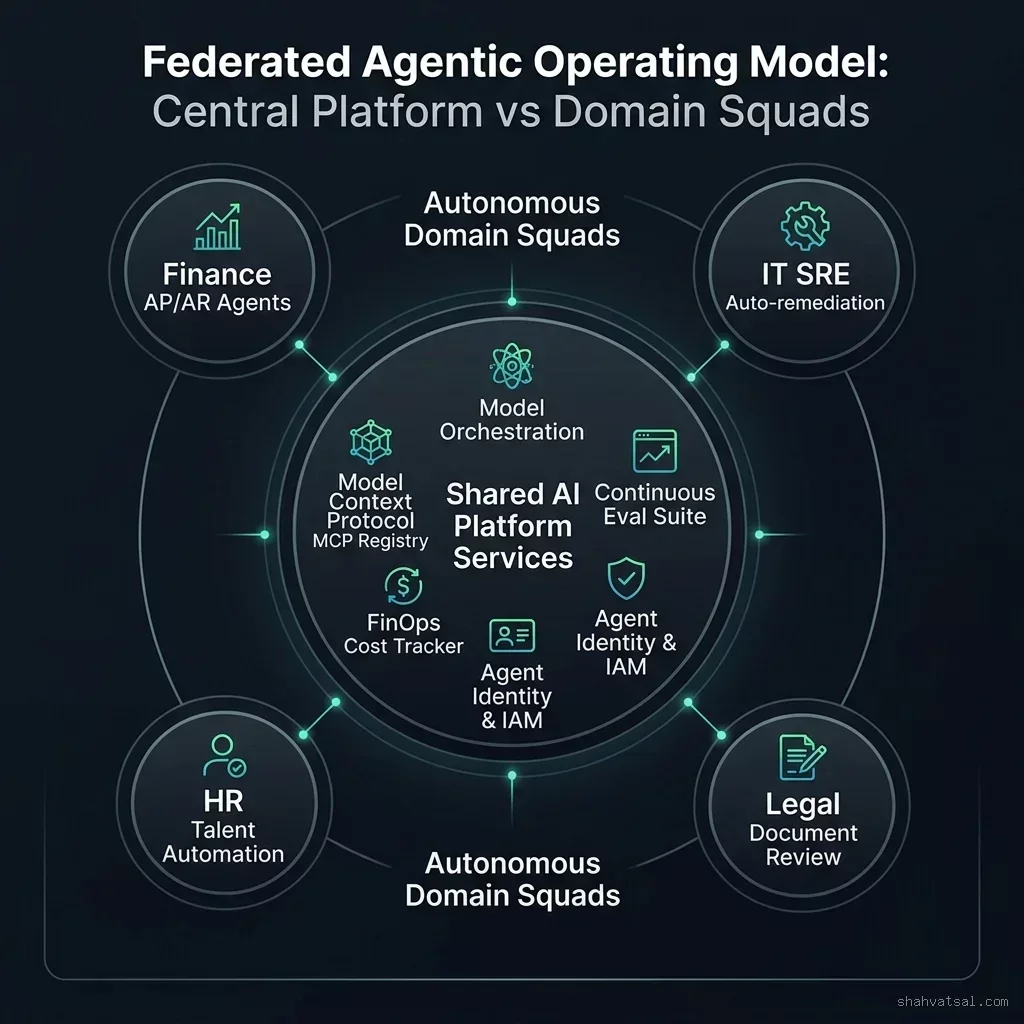
Federated vs. Centralized vs. Decentralized: The Operating Model Matrix
When restructuring enterprise AI capabilities, executive leaders typically evaluate three competing architectural topologies:
- Centralized Monolithic Model: All AI talent, budget, and implementation authority reside in a single corporate AI department.
- Decentralized "Wild West" Model: Each business unit independently procures LLM subscriptions, hires data scientists, builds isolated tool connectors, and establishes disparate security protocols.
- Federated Agentic Platform Model (Hub-and-Spoke): A dedicated Platform Engineering organization provides centralized infrastructure, security guardrails, evaluation suites, and tool registries as reusable primitives, while embedded Domain Engineering Pods build, deploy, and maintain their business workflows.
Comparative Architectural Analysis
┌───────────────────────────┬───────────────────────────┬───────────────────────────┐
│     Centralized CoE       │    Decentralized Anarchy  │  Federated Platform Model │
├───────────────────────────┼───────────────────────────┼───────────────────────────┤
│ • Single point of failure │ • Zero enterprise audit   │ • Scalable self-service   │
│ • 12+ month backlog       │ • Redundant API spending  │ • Unified security & IAM  │
│ • High domain disconnect  │ • Catastrophic data leaks │ • Domain context intact   │
│ • Rigid monolithic stack  │ • Fragile point solutions │ • Standardized FinOps     │
└───────────────────────────┴───────────────────────────┴───────────────────────────┘
The detailed structural trade-offs across core operational dimensions are summarized below:
| Architectural Vector | Centralized CoE | Decentralized Anarchy | Federated Agentic Platform |
|---|---|---|---|
| Time-to-Market for New Agents | Slow (6–12 months) | Fast initial (2–4 weeks), unmaintainable | Rapid & Sustainable (1–3 weeks) |
| Domain Context Fidelity | Low (Central engineers lack business depth) | High (Built by domain staff) | Very High (Built by Domain Pods) |
| Enterprise Security & Compliance | Strict but overly restrictive | Non-existent / Extreme Risk | Automated, Policy-as-Code (Cedar/OPA) |
| LLM & Tooling Redundancy | Zero redundancy (Single stack) | Severe (5x duplicate licenses) | Zero Redundancy (Unified Catalog) |
| FinOps Token Cost Attribution | Blended corporate overhead | Fragmented credit card billing | Exact Real-Time P&L Attribution |
| Graduation & Promotion Gates | Manual bureaucratic committee | None (Live in production) | Automated CI/CD Eval Gateways |
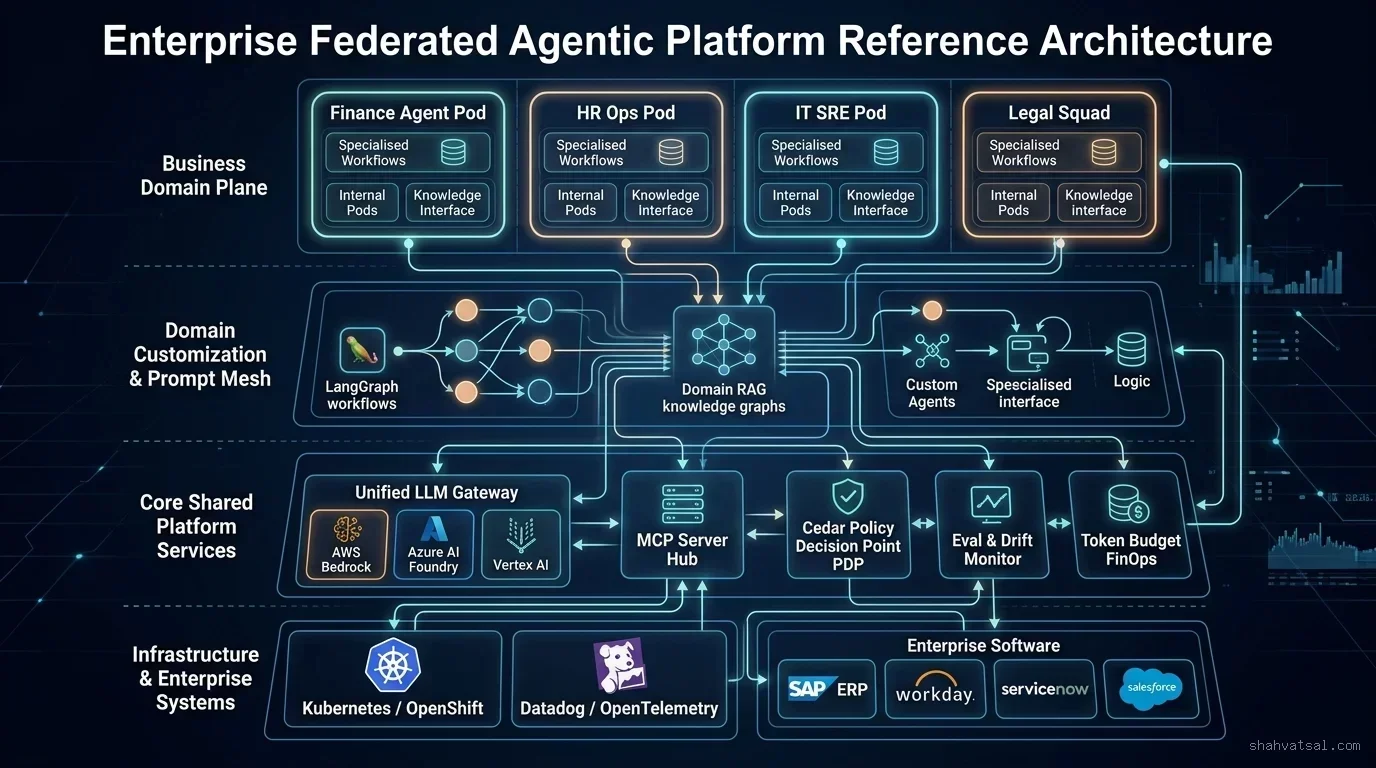
Architectural Blueprint: The 4-Tier Federated Platform Stack
To implement the federated operating model, enterprise IT must deliver a modern, multi-tiered agentic platform stack that decouples core infrastructure from business logic.
Tier 1: Business Domain Plane (Decentralized Execution)
The top layer consists of dedicated domain squads embedding inside core enterprise functions:
- Finance Pod: Accounts Payable 3-way invoice matching agents, cash flow forecasting orchestrators, SOX compliance audit agents.
- HR Operations Pod: Employee onboarding lifecycle orchestrators, resume screening and candidate engagement agents, benefits query triage.
- IT & SRE Pod: Automated telemetry triage agents, root-cause analysis bots, self-healing infrastructure remediation workflows.
- Customer Operations Pod: Multi-turn conversational support agents, proactive dispute resolution orchestrators.
Tier 2: Domain Customization & Prompt Mesh
Business units retain full autonomy over agent graphs and domain data integration:
- Orchestration Frameworks: Domain pods leverage enterprise-approved frameworks (LangGraph, CrewAI, AutoGen, LlamaIndex) packaged as standardized internal templates.
- Domain RAG & Knowledge Graphs: Localized vector indexes and graph databases containing proprietary business knowledge (e.g., internal SAP dictionaries, corporate HR policy handbooks, Jira history).
Tier 3: Core Shared Platform Services (Centralized Foundation)
Managed centrally by the AI Platform Engineering team, this tier exposes enterprise capabilities via high-performance APIs and SDKs:
- Unified Multi-Cloud Model Gateway: Dynamic routing layer spanning AWS Bedrock, Azure AI Foundry, Google Cloud Vertex AI, Anthropic Claude, and OpenAI endpoints with automatic failover, load balancing, and semantic caching.
- Model Context Protocol (MCP) Server Hub: A governed internal registry of standardized tool connectors exposing internal APIs (SAP ERP, Workday, ServiceNow, Salesforce, Snowflake) via standardized MCP contracts.
- Deterministic Guardrails & Cedar Policy Engine: Real-time Policy Decision Points (PDP) enforcing role-based tool invocation permissions, PII redaction, and semantic output filters before execution.
- Automated Synthetic Evaluation Harness: Continuous testing suites that run hundreds of synthetic golden dataset permutations against candidate agent graphs to evaluate accuracy, tool-calling precision, and hallucination drift.
- FinOps & Token Budget Controller: Real-time token telemetry tracking usage per domain cost center, executing automated throttle policies when quotas are exceeded.
Tier 4: Enterprise Infrastructure & System of Record
- Compute Runtime: Hardened Kubernetes / Red Hat OpenShift clusters running isolated containerized agent pods with fine-grained egress networking controls.
- Distributed Observability: OpenTelemetry instrumentation streaming full agent execution traces, token consumption, latency metrics, and tool execution logs to Datadog and internal Splunk SIEM clusters.
- Core Enterprise Systems: Bidirectional secure connectors to SAP S/4HANA, Workday, ServiceNow, Salesforce, and Microsoft 365.
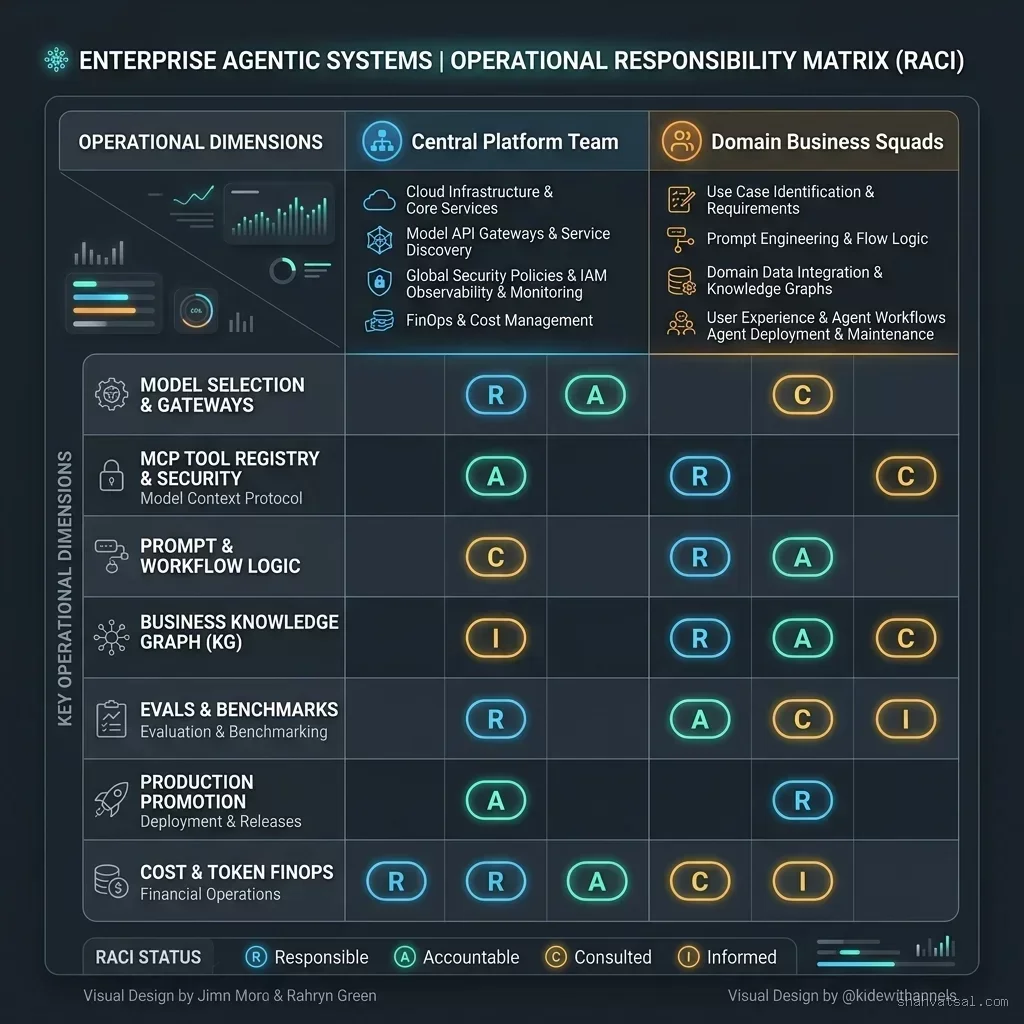
The Enterprise RACI: Central Platform vs. Domain Autonomous Squads
A successful federated operating model requires an unambiguous, legally binding RACI (Responsible, Accountable, Consulted, Informed) contract between the Central AI Platform team and the decentralized Domain Squads. Ambiguity in ownership leads to either bureaucratic deadlocks or ungoverned security vulnerabilities.
┌──────────────────────────────────────────────────────────────────────────────────┐
│              ENTERPRISE FEDERATED AGENTIC RACI CONTRACT                          │
├───────────────────────────────────────┬───────────────────┬──────────────────────┤
│ Operational Dimension                 │ Central Platform  │ Domain Business Pod  │
├───────────────────────────────────────┼───────────────────┼──────────────────────┤
│ 1. Multi-Cloud Model Procurement & GW │  ACCOUNTABLE (A)  │    CONSULTED (C)     │
│ 2. MCP Tool Registry & Core Security  │  ACCOUNTABLE (A)  │   RESPONSIBLE (R)    │
│ 3. Prompt Engineering & Agent Graphs  │   CONSULTED (C)   │   ACCOUNTABLE (A)    │
│ 4. Domain Knowledge Base & RAG        │    INFORMED (I)   │   ACCOUNTABLE (A)    │
│ 5. Synthetic Evals & Benchmarking     │   RESPONSIBLE (R) │   ACCOUNTABLE (A)    │
│ 6. Production Promotion Authority     │  ACCOUNTABLE (A)  │   RESPONSIBLE (R)    │
│ 7. Token FinOps & Cost Attribution    │  ACCOUNTABLE (A)  │   RESPONSIBLE (R)    │
└───────────────────────────────────────┴───────────────────┴──────────────────────┘
Detailed Ownership Breakdown
1. Foundation Model Selection & Gateway Architecture
- Central Platform Team (Accountable): Evaluates, negotiates, and provisions enterprise model contracts (OpenAI GPT-5.6, Anthropic Claude 3.7/Fable 5, Google Gemini 2.5). Maintains the multi-model latency/cost routing gateway and semantic caching layer.
- Domain Pod (Consulted): Submits domain-specific accuracy and latency requirements (e.g., Finance requires high-precision reasoning; Customer Support requires sub-400ms TTFT).
2. MCP Tool Registry & Security Hardening
- Central Platform Team (Accountable): Governs the enterprise MCP server catalog. Enforces mTLS authentication, secret rotation, rate limiting, and Cedar authorization checks for all tool endpoints.
- Domain Pod (Responsible): Develops custom business tool specifications (e.g., an SAP PO approval tool) complying with platform MCP interface schemas.
3. Agent Graph Logic & Prompt Engineering
- Domain Pod (Accountable): Designs the state machine, system prompts, error-recovery loops, and human-in-the-loop escalation criteria using approved enterprise orchestration frameworks.
- Central Platform Team (Consulted): Provides reusable workflow design patterns, agent architectural reviews, and performance optimization guidance.
4. Synthetic Evals & Benchmark Suites
- Domain Pod (Accountable): Curates and maintains the "Golden Dataset" of realistic business inputs, expected tool calls, and baseline outputs for their domain.
- Central Platform Team (Responsible): Delivers the automated CI/CD eval infrastructure that executes regression suites, measures drift, and scores candidate releases against enterprise guardrails.
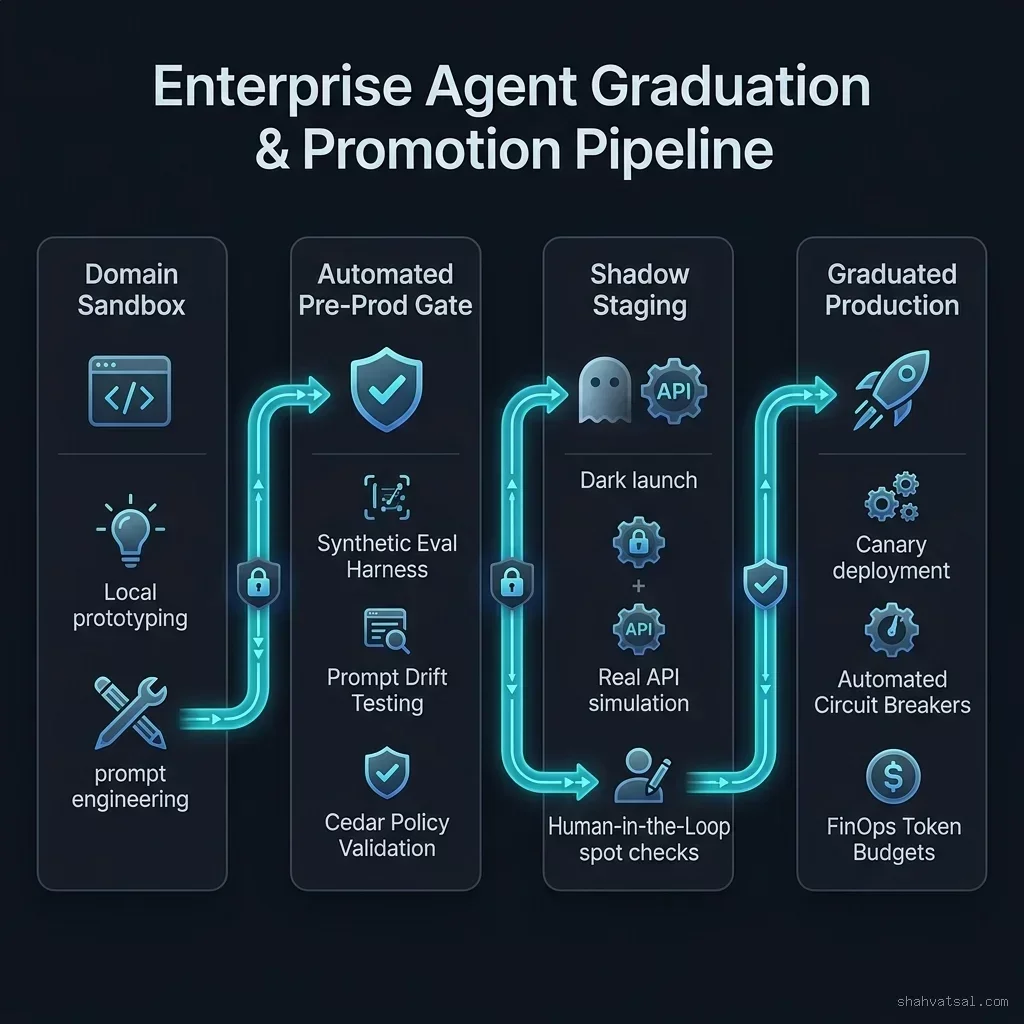
Autonomous Agent Graduation & Promotion Pipeline
In a federated model, domain squads must move fast without breaking enterprise security or compliance. Rather than relying on a slow, manual "Architecture Review Board" meeting every two weeks, the platform enforces Automated Graduation Authority via CI/CD release pipelines.
 [STAGE 1: Local Sandbox]
        │  • Rapid prototyping with synthetic mock tools
        │  • Developer prompt optimization & unit testing
        ▼
 [STAGE 2: Automated Pre-Prod Gate]
        │  • Synthetic Eval Harness (500+ golden test vectors)
        │  • Tool Calling Precision Threshold >= 99.2%
        │  • Cedar Policy & Guardrail Static Analysis
        │  • PII & Data Exfiltration Penetration Testing
        ▼
 [STAGE 3: Shadow Staging]
        │  • Dark launch in production stream (zero write-actions)
        │  • Asynchronous comparison against human operator outputs
        │  • Human-in-the-loop spot audit & drift score validation
        ▼
 [STAGE 4: Graduated Production]
        │  • Canary rollout (5% -> 25% -> 100% traffic)
        │  • Real-time circuit breakers (Auto-rollback on error spike)
        │  • FinOps token budget quotas active with auto-throttling
The 4 Graduation Gates
Gate 1: Synthetic Evaluation & Regression Suite
Every candidate agent release must achieve minimum performance thresholds on domain golden datasets:
- Task Success Rate: $\ge 96.0\%$
- Tool Selection Precision: $\ge 99.2\%$ (Zero unauthorized tool calls)
- Hallucination Drift Index: $\le 1.5\%$ across 500 stochastic permutations
Gate 2: Policy-as-Code (Cedar) Verification
The platform CI/CD pipeline compiles all agent tool invocations against enterprise Cedar security policies to ensure that:
- Agents cannot escalate privileges beyond their assigned IAM identity.
- High-risk operations (e.g., issuing bank transfers $>\$10,000$ or modifying Active Directory root groups) mandate cryptographic human-in-the-loop signatures.
Gate 3: Shadow Mode (Dark Launch)
Before receiving live write permissions, agents run in "Shadow Mode" alongside human workers for 7–14 days. The agent receives real-time production context, generates decisions, and records logs without executing external API writes. Discrepancies between agent recommendations and human actions are flagged for automated scoring.
Gate 4: Canary Rollout with Automated Circuit Breakers
Production deployment utilizes progressive traffic shaping. If runtime observability detects an anomaly (e.g., token consumption spiking $>3\times$ baseline, latency exceeding 4,000ms, or repeated tool-retry loops), the platform gateway automatically trips the circuit breaker and reverts traffic to fallback models or human operators.
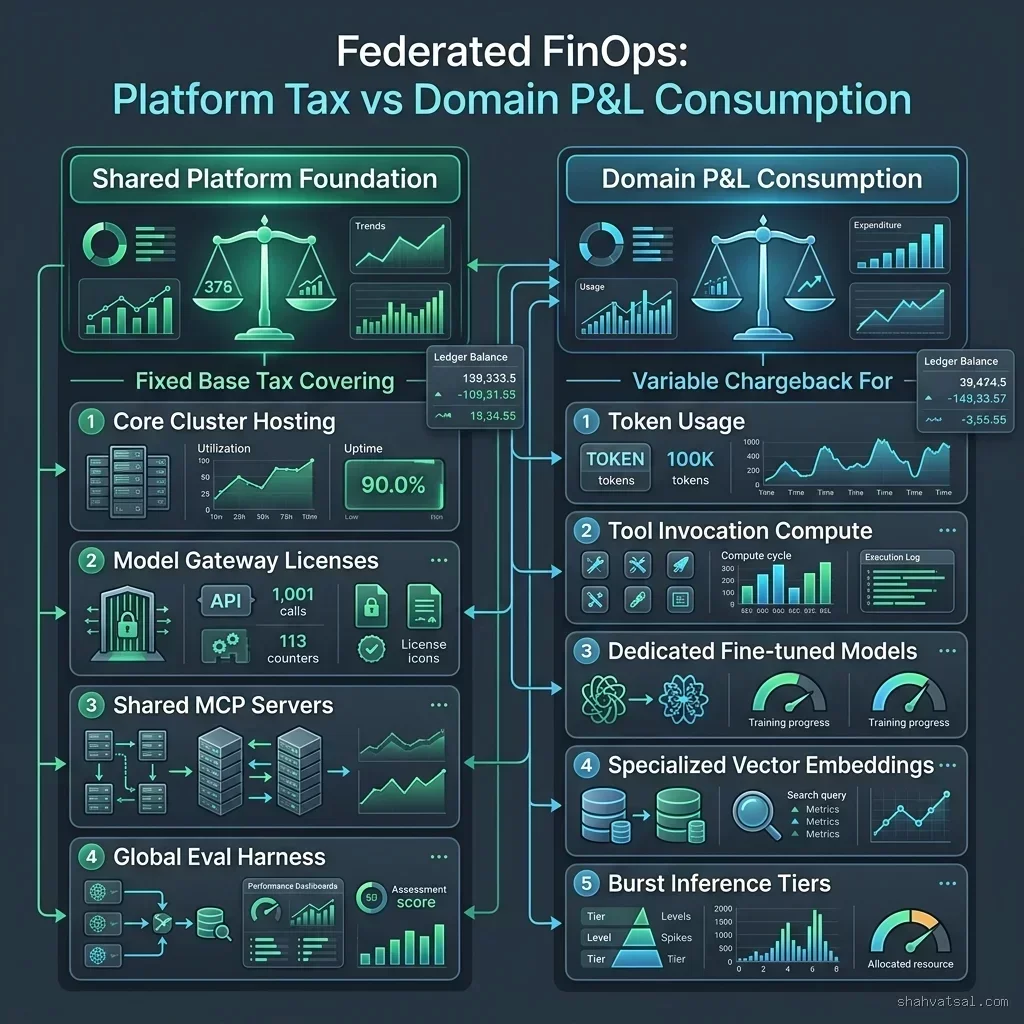
Federated FinOps: Shared Platform Tax vs. Domain P&L Consumption
A primary reason centralized AI initiatives stall is funding friction: does the central IT budget absorb millions of dollars in inferencing tokens, or do business units pay?
The Federated Operating Model resolves this with a Dual-Pillar FinOps Allocation Framework:
                       ┌──────────────────────────────────────────────┐
                       │           Enterprise FinOps Model            │
                       └──────────────────────┬───────────────────────┘
                                              │
                    ┌─────────────────────────┴─────────────────────────┐
                    ▼                                                   ▼
       ┌───────────────────────────┐                       ┌───────────────────────────┐
       │   Shared Platform Tax     │                       │   Domain P&L Consumption  │
       │   (Fixed IT Overhead)     │                       │    (Variable Chargeback)  │
       ├───────────────────────────┤                       ├───────────────────────────┤
       │ • Base Kubernetes hosting │                       │ • LLM Input/Output tokens │
       │ • Model Gateway licenses  │                       │ • Tool execution compute  │
       │ • Shared MCP server fleet │                       │ • Fine-tuned model host   │
       │ • Central Eval & SIEM ops │                       │ • Specialized vector DBs  │
       └───────────────────────────┘                       └───────────────────────────┘
Cost Allocation Formulas
- Total Enterprise Agentic Cost:
$$\mathcal{C}{\text{Total}} = \mathcal{C}{\text{Platform Fixed}} + \sum_{i=1}^{N} \mathcal{C}_{\text{Domain}_i}$$
- Domain-Specific Variable Chargeback:
$$\mathcal{C}{\text{Domain}_i} = \sum{m \in \mathcal{M}} \left( T_{\text{in}}^{(m)} \cdot P_{\text{in}}^{(m)} + T_{\text{out}}^{(m)} \cdot P_{\text{out}}^{(m)} \right) + \sum_{k \in \mathcal{K}} \left( E_k \cdot C_k \right) + \mathcal{S}_{\text{Dedicated}}$$
Where:
- $T_{\text{in}}^{(m)}, T_{\text{out}}^{(m)}$ are prompt and completion tokens consumed on model $m$.
- $P_{\text{in}}^{(m)}, P_{\text{out}}^{(m)}$ are unit prices per 1M tokens for model $m$.
- $E_k$ is the number of tool invocations against service $k$ with compute cost $C_k$.
- $\mathcal{S}_{\text{Dedicated}}$ represents dedicated vector storage or fine-tuned inference endpoints.
Real-Time Budget Enforcement
The central platform gateway injects domain cost-center headers (x-tenant-id, x-domain-pod) into every downstream request. When a domain consumes 80% of its monthly token allocation, automated notifications alert the domain lead. At 100%, the gateway automatically demotes non-critical workflows from ultra-heavyweight reasoning tiers (e.g., GPT-5.6 Sol) to cost-optimized tiers (e.g., GPT-5.6 Luna / Claude 3.5 Haiku) unless emergency budget overrides are granted.
Multi-Domain Case Studies: Finance, HR, and IT Operations on a Unified Mesh
To understand how the federated platform operates in practice, consider a Fortune 500 industrial manufacturing enterprise with 45,000 employees that successfully migrated from a monolithic CoE to a federated operating model in 2026.
                               ┌──────────────────────────┐
                               │ Central Platform Gateway │
                               │  (Auth, FinOps, Routing) │
                               └────────────┬─────────────┘
                                            │
               ┌────────────────────────────┼────────────────────────────┐
               ▼                            ▼                            ▼
      ┌─────────────────┐          ┌─────────────────┐          ┌─────────────────┐
      │  Finance Agent  │          │  HR Talent Bot  │          │   IT SRE Bot    │
      │   (LangGraph)   │          │    (CrewAI)     │          │   (AutoGen)     │
      └────────┬────────┘          └────────┬────────┘          └────────┬────────┘
               │                            │                            │
               ▼                            ▼                            ▼
     [SAP S/4HANA via MCP]        [Workday HCM via MCP]       [ServiceNow via MCP]
1. Finance Domain: Accounts Payable Autonomous Matching
- Business Challenge: Processing 120,000 global supplier invoices monthly required a team of 40 manual accounts payable clerks to resolve 3-way purchase order discrepancies.
- Federated Implementation: The Finance Pod built a multi-agent LangGraph workflow using internal tax calculation libraries and domain SAP schemas.
- Platform Services Leveraged:
- Standardized SAP ERP MCP Server for read/write access.
- Cedar Policy Engine enforcing strict authority limits (Agents can approve PO discrepancies up to \$5,000; larger amounts trigger Slack human-in-the-loop approvals).
- GPT-5.6 Terra inference for structured invoice extraction.
- Business Outcome: Invoice processing cycle time reduced from 9 days to 14 minutes; 82% straight-through processing rate; \$4.2M annual operational savings.
2. HR Operations: Enterprise Talent Engagement & Onboarding
- Business Challenge: High new-hire attrition caused by fragmented IT provisioning, compliance training scheduling, and benefits enrollment delays.
- Federated Implementation: HR engineers built an autonomous onboarding agent utilizing CrewAI that orchestrates cross-functional tasks across Slack, Workday, and Jira.
- Platform Services Leveraged:
- Workday HCM and Microsoft Graph MCP connectors.
- Platform PII redaction filters ensuring candidate medical and compensation data never leaks into inference logs.
- Automated eval harness scoring candidate response empathy and policy accuracy.
- Business Outcome: Onboarding completion velocity improved by 74%; HR service desk ticket volume dropped by 61%.
3. IT & SRE Operations: Autonomous Incident Remediation
- Business Challenge: Mean Time to Resolution (MTTR) for Tier-2 infrastructure incidents averaged 48 minutes, driving severe downtime costs during peak trading hours.
- Federated Implementation: The Cloud Infrastructure squad deployed an autonomous SRE agent capable of querying Datadog logs, correlating alerts, and generating auto-remediation pull requests.
- Platform Services Leveraged:
- Kubernetes cluster telemetry APIs and Datadog MCP server.
- Synthetic eval gates preventing agents from executing unverified shell commands.
- Business Outcome: Tier-2 incident MTTR plummeted to 3.8 minutes; 45% of recurring disk and memory pressure incidents resolved with zero human intervention.
4-Phase Enterprise Transition Roadmap & Change Management Playbook
Migrating an enterprise from a centralized CoE bottleneck to a thriving federated operating model requires a disciplined 12-month transformation roadmap.
 ┌──────────────────────────────────────────────────────────────────────────────────┐
 │ Phase 0 (Month 1-2): Foundation & Core Platform Build                           │
 │ • Form Central Platform Engineering Squad; deploy LLM Gateway & MCP Registry.   │
 ├──────────────────────────────────────────────────────────────────────────────────┤
 │ Phase 1 (Month 3-5): Lighthouse Domain Pilots                                    │
 │ • Embed engineers in 2 high-ROI domains (Finance + IT Ops); ship initial agents. │
 ├──────────────────────────────────────────────────────────────────────────────────┤
 │ Phase 2 (Month 6-8): Automated CI/CD Graduation & Self-Service Rollout           │
 │ • Deprecate manual review boards; activate automated eval & Cedar policy gates.  │
 ├──────────────────────────────────────────────────────────────────────────────────┤
 │ Phase 3 (Month 9-12): Full Enterprise Scale & Cross-Domain Mesh                  │
 │ • Onboard all business domains; enable agent-to-agent inter-domain collaboration.│
 └──────────────────────────────────────────────────────────────────────────────────┘
Transition Milestone Checklist
- [ ] **Phase 0: Central Platform Inception (Months 1–2)**
  - [ ] Stand up dedicated Central AI Platform Team (Platform Architect, 4 Cloud/DevOps Engineers, 2 Security Leads).
  - [ ] Deploy multi-cloud LLM gateway with latency-based fallback and semantic caching.
  - [ ] Implement central MCP registry with authentication and role-based access control.
  - [ ] Publish developer documentation, SDKs, and standardized repository templates.

- [ ] **Phase 1: Lighthouse Domain Pilots (Months 3–5)**
  - [ ] Select 2 high-impact domains with tech-savvy leadership (e.g., Accounts Payable, SRE).
  - [ ] Pair central platform advocates with domain subject matter experts.
  - [ ] Build and dark-launch initial agentic workflows in production shadow mode.
  - [ ] Validate FinOps token attribution tracking against real domain P&L cost centers.

- [ ] **Phase 2: Self-Service & Automated Governance (Months 6–8)**
  - [ ] Deploy automated synthetic evaluation harness into enterprise GitLab/GitHub CI/CD.
  - [ ] Mandate Cedar Policy-as-Code for all production tool integrations.
  - [ ] Transition central CoE staff into Platform Enablement Consultants and Domain Squad Leads.
  - [ ] Launch internal Agent Developer Certification and self-paced training curriculum.

- [ ] **Phase 3: Autonomous Mesh & Scale (Months 9–12)**
  - [ ] Expand federated model across HR, Legal, Supply Chain, and Marketing.
  - [ ] Establish Agent-to-Agent (A2A) inter-domain protocols for complex multi-department handoffs.
  - [ ] Conduct quarterly FinOps reviews and optimize reserved compute / provisioned throughput commitments.
Production-Grade Implementation Artifacts
To accelerate implementation, enterprise platform teams can deploy the following production-ready architectural templates.
1. Enterprise Model Gateway with Token FinOps & Dynamic Routing (Python / FastAPI)
class="tok-str">""class="tok-str">"
Enterprise Federated AI Platform - Multi-Model Gateway & FinOps Router
Enforces domain authentication, Cedar authorization, semantic routing, and token metering.
"class="tok-str">""

from fastapi import FastAPI, HTTPException, Header, Depends, Request
from pydantic import BaseModel, Field
import time
import httpx
import structlog
from typing import Dict, Any, Optional

logger = structlog.get_logger()
app = FastAPI(title=class="tok-str">"Enterprise Federated AI Gateway", version=class="tok-str">"2.0.0")

class="tok-cm"># In-memory Token FinOps Quota Store (Production: Redis / DynamoDB)
DOMAIN_TOKEN_BUDGETS = {
    class="tok-str">"finance-pod-01": {class="tok-str">"monthly_limit": 50_000_000, class="tok-str">"consumed": 12_450_000},
    class="tok-str">"hr-ops-pod-02": {class="tok-str">"monthly_limit": 20_000_000, class="tok-str">"consumed": 18_900_000},
    class="tok-str">"it-sre-pod-03": {class="tok-str">"monthly_limit": 80_000_000, class="tok-str">"consumed": 34_120_000},
}

class AgentChatRequest(BaseModel):
    agent_id: str = Field(..., description=class="tok-str">"Unique ID of calling agent")
    domain_id: str = Field(..., description=class="tok-str">"Domain cost center identifier")
    messages: list[Dict[str, str]]
    temperature: float = 0.2
    max_tokens: int = 4096
    preferred_tier: str = class="tok-str">"balanced"  class="tok-cm"># class="tok-str">'reasoning', class="tok-str">'balanced', class="tok-str">'fast'

class="tok-kw">def verify_domain_budget(domain_id: str, requested_tokens: int = 4000):
    if domain_id not in DOMAIN_TOKEN_BUDGETS:
        raise HTTPException(status_code=403, detail=fclass="tok-str">"Unregistered domain: {domain_id}")

    budget = DOMAIN_TOKEN_BUDGETS[domain_id]
    if budget[class="tok-str">"consumed"] + requested_tokens > budget[class="tok-str">"monthly_limit"]:
        logger.warn(class="tok-str">"token_quota_exceeded", domain=domain_id, consumed=budget[class="tok-str">"consumed"])
        raise HTTPException(
            status_code=429,
            detail=class="tok-str">"Monthly token quota exceeded. Downgrade model tier or request budget expansion."
        )
    return True

@app.post(class="tok-str">"/v1/chat/completions")
async class="tok-kw">def route_agent_request(
    request: AgentChatRequest,
    authorization: str = Header(...),
    authorized: bool = Depends(verify_domain_budget)
):
    start_time = time.perf_counter()

    class="tok-cm"># 1. Dynamic Model Tier Routing Logic
    if request.preferred_tier == class="tok-str">"reasoning":
        selected_endpoint = class="tok-str">"https:class="tok-cm">//bedrock-runtime.us-east-1.amazonaws.com/model/anthropic.claude-v3-7-sonnet"
        model_name = class="tok-str">"claude-3-7-sonnet-enterprise"
        cost_per_1m_out = 15.00
    elif request.preferred_tier == class="tok-str">"fast":
        selected_endpoint = class="tok-str">"https:class="tok-cm">//openai-azure-prod.openai.azure.com/models/gpt-5-6-luna"
        model_name = class="tok-str">"gpt-5-6-luna"
        cost_per_1m_out = 1.25
    else:
        selected_endpoint = class="tok-str">"https:class="tok-cm">//vertex-ai-gateway.gcp.internal/models/gemini-2-5-flash"
        model_name = class="tok-str">"gemini-2-5-flash"
        cost_per_1m_out = 3.00

    class="tok-cm"># 2. Simulated Model Forwarding (Production: Async Client with Circuit Breakers)
    logger.info(class="tok-str">"routing_agent_invocation",
                agent=request.agent_id,
                domain=request.domain_id,
                model=model_name)

    class="tok-cm"># Simulate inference latency & response
    latency = time.perf_counter() - start_time
    simulated_tokens_in = 850
    simulated_tokens_out = 420

    class="tok-cm"># 3. FinOps Ledger Update
    DOMAIN_TOKEN_BUDGETS[request.domain_id][class="tok-str">"consumed"] += (simulated_tokens_in + simulated_tokens_out)

    return {
        class="tok-str">"id": fclass="tok-str">"gen-{int(time.time())}",
        class="tok-str">"agent_id": request.agent_id,
        class="tok-str">"domain_id": request.domain_id,
        class="tok-str">"model": model_name,
        class="tok-str">"latency_ms": round(latency * 1000, 2),
        class="tok-str">"usage": {
            class="tok-str">"prompt_tokens": simulated_tokens_in,
            class="tok-str">"completion_tokens": simulated_tokens_out,
            class="tok-str">"total_tokens": simulated_tokens_in + simulated_tokens_out,
            class="tok-str">"estimated_cost_usd": round((simulated_tokens_out / 1_000_000) * cost_per_1m_out, 6)
        },
        class="tok-str">"choices": [
            {
                class="tok-str">"message": {
                    class="tok-str">"role": class="tok-str">"assistant",
                    class="tok-str">"content": class="tok-str">"Action validated against central Cedar policy. Proceeding with execution."
                }
            }
        ]
    }
2. Deterministic Agent Authorization Guardrail (Cedar Policy Definition)
class="tok-cm">// Enterprise Cedar Security Policy for Federated Agentic Platform
class="tok-cm">// Governs Finance Domain Agent permissions against SAP Accounts Payable Tools

class="tok-cm">// 1. Permit Finance Agents to read PO and Invoice metadata without human approval
permit (
    principal in Role::class="tok-str">"FinanceAgent",
    action in [Action::class="tok-str">"ReadInvoice", Action::class="tok-str">"QueryPurchaseOrder", Action::class="tok-str">"CheckVendorStatus"],
    resource in ResourceType::class="tok-str">"SAP_FinancialRecords"
);

class="tok-cm">// 2. Permit automated PO discrepancy reconciliation ONLY under $5,000 threshold
permit (
    principal in Role::class="tok-str">"FinanceAgent",
    action == Action::class="tok-str">"ApproveDiscrepancy",
    resource in ResourceType::class="tok-str">"SAP_Invoice"
)
when {
    resource.discrepancy_amount_usd <= 5000 &&
    principal.graduation_status == class="tok-str">"ProductionApproved" &&
    context.mfa_authenticated == true
};

class="tok-cm">// 3. Forbid all direct write actions to production bank transfer rails
forbid (
    principal in Role::class="tok-str">"FinanceAgent",
    action == Action::class="tok-str">"ExecuteWireTransfer",
    resource in ResourceType::class="tok-str">"BankingRail"
);
3. Automated CI/CD Agent Graduation Gate (GitHub Actions Workflow)
name: Autonomous Agent Graduation & Promotion Gate
on:
pull_request:
branches: [main]
paths:
- &class="tok-cm">#039;agents/**class="tok-str">'
- &class="tok-cm">#039;prompts/**'
- &class="tok-cm">#039;tools/**class="tok-str">'
jobs:
agent-eval-and-compliance:
runs-on: ubuntu-latest
steps:
- name: Checkout Repository
uses: actions/checkout@v4
- name: Setup Python Environment
uses: actions/setup-python@v5
with:
python-version: &class="tok-cm">#039;3.11'
cache: &class="tok-cm">#039;pipclass="tok-str">'
- name: Install Platform Dependencies
run: |
pip install -r requirements-eval.txt
pip install cedar-policy-validator pytest-asyncio
- name: Execute Static Cedar Policy Security Scan
run: |
echo "Verifying Agent Tool Invocations against Enterprise Cedar Policies..."
python -m security.scan_cedar_compliance --rules ./policies/enterprise.cedar --agents ./agents/
- name: Run Synthetic Golden Dataset Eval Suite (500 Permutations)
env:
PLATFORM_EVAL_GATEWAY_KEY: ${{ secrets.PLATFORM_EVAL_GATEWAY_KEY }}
run: |
echo "Executing automated evaluation benchmark..."
python -m evals.run_benchmark \
--dataset ./evals/golden_dataset_finance_v2.jsonl \
--min-success-rate 0.96 \
--min-tool-precision 0.992 \
--output-report ./eval_results.json
- name: Evaluate Graduation Criteria
run: |
python -c "
import json, sys
with open(&class="tok-cm">#039;./eval_results.json') as f:
data = json.load(f)
class="tok-kw">if data[&class="tok-cm">#039;task_success_rateclass="tok-str">'] < 0.96 or data['tool_precisionclass="tok-str">'] < 0.992:
print(f&class="tok-cm">#039;FAILED: Criteria not met. Success: {data[\"task_success_rate\"]}, Precision: {data[\"tool_precision\"]}')
sys.exit(1)
print(&class="tok-cm">#039;PASS: All graduation criteria satisfied.')
class="tok-str">"
- name: Register Agent in Platform Production Catalog
class="tok-kw">if: success()
run: |
echo "Agent qualified for Canary Production rollout. Registering artifact..."Frequently Asked Questions (FAQ)
What is the difference between an AI CoE and a Federated AI Platform Team?
A traditional AI CoE attempts to build, deliver, and maintain custom AI solutions for every business unit centrally, inevitably becoming a capacity and context bottleneck. A Federated AI Platform Team does not build individual business agents; instead, it provides enterprise-grade infrastructure, model gateways, tool catalogs, evaluation pipelines, security guardrails, and FinOps telemetry that enable decentralized domain teams to build and maintain their own agents safely.
How does an enterprise prevent "Shadow AI" in a federated model?
Federation prevents Shadow AI by providing domain teams with a friction-free, high-velocity internal platform that is superior to external public APIs. By offering instant access to provisioned frontier models, pre-authenticated enterprise MCP connectors (SAP, Salesforce, Workday), and pre-built CI/CD evaluation pipelines, domain developers choose the governed internal platform because it enables them to deploy production agents in days rather than months.
What is the ideal staffing ratio for Platform vs. Domain Squads?
Top-performing enterprises maintain a 1:5 to 1:8 ratio between Central Platform Engineers and Domain Agent Developers. A core platform team of 8–12 senior engineers (spanning cloud infrastructure, security, compiler/MCP tooling, and FinOps) can effectively support 50–100 domain developers across 8–12 distinct business units.
How do we handle regulatory compliance (GDPR, HIPAA, SOX) in a federated architecture?
Compliance is enforced as Code at the Platform Tier. The central model gateway executes automated PII/PHI redaction filters, the Cedar policy engine deterministically prevents unauthorized data modifications, and OpenTelemetry streams immutable cryptographic audit logs of every prompt, tool call, and completion to enterprise SIEM storage.
When should an enterprise begin transitioning away from its central CoE?
Transition planning should begin immediately when 15% to 20% of departmental workflows explore generative AI, and full execution must complete before reaching the 30%–40% agentic workflow density tipping point, beyond which centralized queue delays severely impair business operations.
Conclusion & Next Steps
The era of monolithic AI Centers of Excellence has reached its structural limit. As enterprise automation evolves from simple chat interfaces to autonomous, multi-agent business operations, organizations that cling to centralized development will find their digital transformation initiatives paralyzed by project backlogs, domain disconnects, and shadow AI fragmentation.
The Federated Agentic Platform Operating Model represents the proven enterprise architecture for 2026 and beyond. By establishing a world-class central platform foundation and empowering domain squads to own their workflows, enterprise leaders unleash unstoppable transformation velocity backed by deterministic governance, enterprise security, and granular FinOps control.
Recommended Implementation Actions:
- Audit Current AI Backlog: Measure your central CoE request arrival rate ($\lambda$) and calculate average delivery lead time.
- Charter the AI Platform Team: Form a dedicated platform engineering squad tasked with delivering multi-model gateways and an enterprise MCP catalog.
- Establish the RACI Contract: Formalize ownership boundaries between platform infrastructure and domain workflow logic.
- Deploy Automated Eval CI/CD: Replace manual architectural review committees with deterministic synthetic test harnesses and Cedar policy gates.